The Unstoppable Force: Why Educating Women Transforms Everything.

The statistics are stark, yet inspiring: when we invest in a girl’s education, we don’t just change her life—we transform entire communities, economies, and futures. Despite centuries of progress, the fight for women’s education and advancement remains one of the most critical battles of our time, with ripple effects that extend far beyond classroom walls.

The Foundation That Changes Everything.

Education serves as the great equaliser, but for women, it becomes something even more powerful—a tool of liberation. When girls receive quality education, the benefits cascade through generations like stones thrown into still water, creating waves of change that touch every corner of society.

The Immediate Impact: Lives Transformed

The data speaks volumes about education’s transformative power:

Health Revolution: Educated women make informed healthcare decisions, leading to lower maternal mortality rates and healthier families.

Economic Powerhouse: Each additional year of schooling increases a woman’s earnings by 10-20%, injecting vital funds into local economies.

Population Stability: Educated women have fewer children and invest more in each child’s future, creating a cycle of opportunity.

Leadership Pipeline: Education builds confidence and critical thinking skills, preparing women to lead in their communities and beyond

Breaking the Chains of Child Marriage

In many parts of the world, education becomes a shield against harmful traditional practices. When families see their daughters gaining knowledge, skills, and confidence, the girl’s perceived value shifts dramatically. Education delays marriage, reduces teenage pregnancy, and opens doors to possibilities that seemed impossible just one generation ago.

The Persistent Barriers: What Still Stands in Our Way.

Despite overwhelming evidence of education’s benefits, obstacles remain stubbornly entrenched across the globe.

In Developing Nations: The Triple Threat

1. Poverty’s Cruel Mathematics

Families facing survival often view girls as economic burdens rather than investments. The immediate need for income outweighs long-term benefits, forcing girls into work or early marriage.

2. Violence and Safety Concerns

The journey to school becomes dangerous for girls in areas where gender-based violence is common. Parents, seeking to protect their daughters, often keep them home.

3. Cultural Resistance

Deep-rooted beliefs about women’s roles continue to limit educational opportunities. Traditional societies may view educated women as threats to established hierarchies.

In Developed Nations: The Paradox of Progress

Here lies one of the most frustrating ironies of our time: countries with the highest female enrolment rates still struggle with gender equity in leadership positions.

The Pipeline Problem

– Women earn 60% of university degrees in the US and Europe.

– Yet they hold only 20% of senior executive positions.

– The gap between education and leadership roles reveals systemic barriers that persist despite formal equality.

The Confidence Gap

Even in nations where legal barriers have fallen, cultural expectations and unconscious biases continue to limit women’s advancement, creating what researchers call the “confidence penalty.”

The Ripple Effect: How Educated Women Transform Society.

When women succeed, everyone wins. This isn’t just feel-good rhetoric—it’s economic reality backed by decades of research.

Economic Multipliers

Community Investment

Women reinvest 90% of their earnings back into their families and communities, compared to 35% for men.

This means every educated woman becomes an economic catalyst, multiplying prosperity throughout her network.

Innovation Drivers

Companies with diverse leadership teams are 21% more likely to experience above-average profitability. Women bring different perspectives, experiences, and problem-solving approaches that drive innovation and growth.

Social Transformation.

Breaking Generational Cycles

Educated mothers are more likely to educate their own children, creating positive feedback loops that elevate entire communities over time.

Political Participation

Education correlates strongly with civic engagement. Educated women vote more frequently, run for office more often, and advocate more effectively for social change.

The Path Forward: From Potential to Reality

The solution isn’t just about getting more girls into classrooms—it’s about creating comprehensive support systems that carry them from education to empowerment.

1. Address Root Causes

Economic Support: Conditional cash transfer programs that pay families to keep girls in school.

Safety Measures: Safe transportation, secure school environments, and community protection programs.

Cultural Engagement: Working with community leaders and families to shift perspectives on women’s roles

2. Bridge the Leadership Gap

Mentorship Programs: Connecting educated women with role models and sponsors.

Policy Reform: Implementing family-friendly workplace policies and addressing systemic biases.

Entrepreneurship Support: Providing access to capital and business training for women-led ventures.

3. Sustain Long-term Change

Institutional Reform: Ensuring educational institutions are equipped to support and advance women.

Community Building: Creating networks that support women throughout their careers.

Measurement and Accountability: Tracking progress and holding institutions accountable for gender equity.

The Moral Imperative: Why This Matters Now In an interconnected world facing complex challenges—from climate change to economic inequality to global health crises—we cannot afford to waste half of our human talent. The problems we face require all minds, all perspectives, and all the innovation we can muster.

Educating women isn’t just about fairness or equality—it’s about survival and prosperity in an increasingly competitive world. Countries that fail to fully utilise their female talent will find themselves at a significant disadvantage in the global economy.

The Call to Action

Every stakeholder has a role to play:

Governments must invest in education infrastructure and remove legal barriers.

Communities need to challenge harmful traditional practices and support girls’ aspirations.

Employers should create pathways for women’s advancement and address workplace biases.

Individuals can mentor, advocate, and vote for policies that support women’s education and empowerment.

Conclusion: The Future We Can Build

The evidence is overwhelming: educating women creates a better world for everyone. Yet millions of girls still lack access to quality education, and millions more face barriers in translating their education into meaningful opportunities.

This isn’t just a women’s issue—it’s a human issue. It’s an economic issue. It’s a survival issue for our species and our planet.

The question isn’t whether we can afford to invest in women’s education and advancement. The question is whether we can afford not to. The cost of inaction—in lost potential, stunted economies, and persistent

inequality—far exceeds the investment required to create change.

The path forward is clear. The tools are available. What we need now is the collective will to turn this knowledge into action, ensuring that every girl has the chance to fulfil her potential and contribute to our shared future.

The time for half-measures and good intentions has passed. The future demands nothing less than our complete commitment to unleashing the full power of educated, empowered women. Our world depends on it.

United Nations has designated the theme on International Women’s Day this year as “Rights. Justice. Action. For ALL Women and Girls.

HAPPY WOMEN’S DAY.

Posted in Social Relevance | Tagged , , , , , | Leave a comment

The Grass Isn’t Always Greener: 27 Years of Entrepreneurial Truth

The Grass Isn’t Always Greener: 27 Years of Entrepreneurial Truth.

A candid reflection on the realities of building a business, the myths that mislead aspiring entrepreneurs, and what it truly takes to survive—and occasionally thrive—in the entrepreneurial wilderness.

When I started my entrepreneurial journey 27 years ago, I thought I understood what lay ahead. I was wrong. Like most first-time founders, I believed the grass would be greener on the entrepreneurial side of the fence. Today, with salt-and-pepper hair as my witness, I can tell you that the grass isn’t uniformly green—it’s patchy at best, with occasional verdant spots interspersed among the brown patches of struggle.

The Myth of Instant Green.

Over the years, I’ve watched many former employees take the entrepreneurial plunge. Some jumped with grand visions, others with detailed roadmaps that looked flawless on paper: secure funding, build valuation, execute an IPO or acquisition, then walk away with “tons and tons of money.

The reality? I rarely hear success stories from these departures.

This silence speaks volumes. The entrepreneurial graveyard is littered with dreams built on the myth of the get-rich-quick scheme. We live in an era where a select few have struck gold, creating a narrative that entrepreneurship is a lottery ticket rather than a marathon. This misconception fuels the current startup stampede—and explains why 90% of startups fail.

The harsh truth: those few who “hit pay dirt are statistical outliers, not the norm.

The Long Gestation of Success.

Real entrepreneurship isn’t a sprint to riches—it’s an endurance test that would make an Olympian proud.

Just as athletes don’t accidentally stumble onto podiums, successful entrepreneurs don’t stumble into success. There are no shortcuts.

What It Actually Takes

1. A Burning Desire That Survives Reality.

You need more than enthusiasm; you need an obsession that can withstand years of setbacks. This isn’t passion—it’s something deeper, more primal. It’s the difference between wanting something and needing it to define your existence.

2. The “Why” Factor.

Before you quit your job or pitch investors, answer this: Why does your venture need to exist? Not why you want it to exist, but why the world needs it. If you can’t articulate this clearly, you’re building on sand.

3. Start Small, Think Big.

Remember Birbal finding warmth from a candle burning miles away? Your vision might be distant and dim, but it must be visible enough to guide you through dark periods. Start with minimal viable steps while keeping that distant light in sight.

4. Embrace the Mistake Factory.

Mistakes aren’t just inevitable—they’re your primary education. Each failure should strengthen your resolve, not weaken it. The entrepreneurs who survive aren’t those who make fewer mistakes; they’re those who learn faster from them.

The Price of the Entrepreneurial Path

Here’s what most people don’t tell you about entrepreneurship: it demands sacrifice that employed life never does.

What You’ll Likely Sacrifice:

Financial security (for years, possibly decades).

Work-life balance (your business becomes your life).

Predictable income (feast or famine becomes normal).

Professional safety nets (no HR department, no guaranteed paycheck)

Social time (while friends advance in corporate careers, you’ll be grinding).

What You Might Gain:

Autonomy over your decisions and destiny.

The possibility of significant financial returns (emphasis on possibility).

Deep satisfaction from building something meaningful.

Resilience that serves you in every life area.

Stories that make for interesting dinner conversations.

The Relentless Test. Twenty-seven years in, I can confirm that the test never stops being severe and relentless. Market conditions change, competitors emerge, team members leave, funding dries up, customers disappoint, and sometimes everything goes wrong simultaneously.

The question isn’t whether you’ll face adversity—it’s whether you’ll maintain that “fire in the belly” when adversity becomes your daily companion.

Surviving the Long Haul

Perseverance Over Perfection: Your first idea probably won’t work. Neither will your second or third.

Success often comes from persistence through iterations, not brilliance on attempt one.

Work Ethic as Oxygen: If you’re looking for better work-life balance, stay employed. Entrepreneurship demands a work ethic that borders on obsessive. This isn’t sustainable for everyone, and that’s okay.

Never Give Up (But Know When to Pivot): There’s a fine line between persistence and stubbornness.

The situation will change eventually, but sometimes you need to change your approach to the situation.

The Uncomfortable Truth About Green Grass.

After 27 years, my grass has some green patches—moments of success, financial wins, personal satisfaction from building something lasting. But it’s not the uniform, lush green that entrepreneurship mythology promises.

And you know what? That’s perfectly fine.

The real victory isn’t achieving some fantasy of endless green grass. It’s building something meaningful while accepting that entrepreneurship is inherently messy, uncertain, and often unrewarding in traditional metrics.

For Aspiring Entrepreneurs.

Before you leap, ask yourself:

– Are you prepared for a decades-long journey with no guarantees?

– Can you find fulfilment in the process, not just the outcome?

– Do you have the financial runway and personal support for extended uncertainty?

– Is your “why” strong enough to sustain you through years of difficulty?

If your answers give you pause, consider staying employed while building something on the side. There’s no shame in choosing stability—and there’s wisdom in understanding your own tolerance for risk and uncertainty.

Final Thoughts

Entrepreneurship isn’t for everyone, despite what startup culture suggests. It’s not a fast track to wealth, freedom, or happiness. It’s a difficult path that demands everything you have and offers no guarantees in return.

But for those with the right combination of vision, persistence, and perhaps a touch of madness, it can be profoundly rewarding—just not in the ways you initially expect.

The grass may not be uniformly greener, but those patches of green you do cultivate? They’re genuinely yours. And after 27 years of tending to them, that means something.

Sometimes the most honest thing you can tell someone about entrepreneurship is this: if you can imagine being happy doing anything else, do that instead. But if you can’t shake the vision of building something meaningful, then welcome to the long, difficult, occasionally rewarding journey of entrepreneurship.

Posted in personal Milestones | Tagged , , , , , , , , | Leave a comment

🚀 Your Enterprise is Your Baby: Lessons from an Entrepreneurial Journey.

They say entrepreneurship is not for the faint-hearted, and after years of riding the rollercoaster of business ownership, I can tell you—they’re absolutely right. But what they don’t tell you is that it’s also one of the most rewarding journeys you’ll ever embark on, filled with lessons that shape not just your business, but your character.

🏢 Be Proud of Your Baby

Your enterprise is your baby. Be proud of it. Never be dazzled by what’s around you.

I’ll never forget when a very senior person made a remark about the location of my office. For a moment, I felt that familiar pang of self-doubt creeping in. But then reality hit me—this is MY office, and I am proud of it. I built this from the ground up. I am the employer here.

Here’s what I’ve learned: if employees don’t want to compromise and have their own locational preferences, that’s their restricted mindset, and I cannot help it. After all, whoever heard of a well walking up to a thirsty person? The value lies not in the glamorous address or the fancy furnishings—it lies in what you can provide: genuine value addition.

To young entrepreneurs reading this: don’t let anyone make you feel small about where you started or where you currently are. Every successful business empire started somewhere, often in the most humble of places. Your garage, your spare bedroom, that small rented space—embrace it.

Own it. Be proud of it.

🤝 Integrity: The Foundation of Everything

Over the years, I have built goodwill by practicing integrity, and this has definitely resulted in very positive customer retention. Let me be crystal clear about something: your customers should not stop believing in your venture. Never take them for granted. You exist only because of them, and it can never be the other way around.

I’ve discovered something remarkable—if your reputation and integrity exceed expectations, customers will be willing to associate with you regardless of cost. It won’t matter if you’re more expensive than your competitors. They’ll choose you because they trust you.

Think about it: in a world where consumers are bombarded with options, what makes them stick with one business over another? It’s not always the lowest price or the fanciest marketing. It’s the confidence that you’ll deliver on your promises, every single time.

Here are the integrity principles that have guided my journey:

  • Always under-promise and over-deliver.
  • Be transparent about limitations and challenges.
  • Admit mistakes quickly and fix them faster.
  • Treat every customer interaction as an opportunity to build trust.

🎢 The Rollercoaster: Risk vs. Gamble

When you embarked on your entrepreneurial journey, was it a ‘risk’ or a ‘gamble’? I’ve spent many sleepless nights pondering this question, especially during the tough times.

Just like success is never guaranteed, failure does not mean the end. Nothing is final. Let me share something personal: at one point, I scaled heights that I had only dreamed of. The business was thriving, revenues were soaring, and I felt invincible. Then, in the very next year, my business plummeted. It was devastating.

The slide seemed unstoppable. Customers were leaving, revenue was drying up, and doubt crept in like a persistent shadow. But here’s the thing about entrepreneurship—it has its flips and flops. The key is never to be discouraged.

I could have given up. Many people expected me to. Some even suggested I should. But something inside me refused to surrender. I held on to one simple belief: if you do not give up, there is nothing that can stop you from succeeding.

And you know what? The slide could be stopped only recently, and I have again regained that upward momentum. This isn’t just business theory—this is a true life story, happening right now.

💪 Lessons for Young Entrepreneurs

If you’re just starting out or struggling through a difficult phase, here’s what I want you to remember:

  1. Your current circumstances are not your final destination. That small office, limited budget, or lack of fancy resources? They’re temporary. What matters is your vision and determination.
  2. Build relationships, not just transactions. Every customer interaction is an investment in your future. Treat them with respect, deliver value, and watch how loyalty transforms your business.
  3. Embrace the uncertainty. Entrepreneurship isn’t about eliminating risk—it’s about managing it intelligently while staying true to your values.
  4. Define success on your own terms. Don’t let others dictate what your business should look like or where it should be located. Your vision, your rules.
  5. Persistence beats perfection. You don’t need to have all the answers from day one. You just need to keep moving forward, learning, and adapting.

🌟 The Journey Continues

As I write this, I’m reminded that entrepreneurship is not a destination—it’s a journey. There will be days when you feel like you’re on top of the world, and others when you question every decision you’ve made. Both are part of the process.

What I’ve learned is that success isn’t measured just in revenue or market share. It’s measured in the relationships you build, the integrity you maintain, and the resilience you develop. It’s about creating something meaningful, something you can be genuinely proud of.

Your enterprise is your baby. Nurture it with passion, protect it with integrity, and never let anyone make you feel ashamed of where you are in your journey. Every giant oak tree was once just an acorn that held its ground.

To every young entrepreneur reading this: trust the process, believe in yourself, and remember—if you don’t give up, there’s nothing that can stop you from succeeding. This isn’t just motivation; it’s a promise backed by experience.

Keep building, keep believing, and keep moving forward. Your success story is being written every single day.

What’s your entrepreneurial story? Share your journey in the comments below—I’d love to hear about the challenges you’ve overcome and the lessons you’ve learned along the way.

Posted in personal Milestones | Tagged , , , , , , , , , , , , | Leave a comment

The Arrow and the Karta: Why Every Decision Shapes Your Destiny.

The Arrow and the Karta: Why Every Decision Shapes Your Destiny.

The Weight of Choice.

Three years ago, I stood at the crossroads of my career, staring at two job offers on my desk. One was safe—a predictable role at an established company with steady pay. The other was risky—a startup position with equity instead of security. The data was inconclusive, the future uncertain, and the outcomes completely unpredictable. Yet I had to choose.

In that moment, I realised what ancient wisdom has always known: **we are all called to be the Karta**—the decision-maker who acts despite uncertainty, who shoulders the burden of choice when others hesitate.

The Subjective Nature of Every Call

Everyone looks to the Karta for a decision despite data being unreliable, the future being uncertain, and outcomes that are unpredictable. Not everyone can do it. He who is able to make decisions independently is the Karta. He who allows others to do so is Yajaman.

I’ve learned this truth through countless sleepless nights, weighing options that had no clear “right” answer.

When I decided to leave my corporate job to become a content creator, my spreadsheets showed financial risk. My family questioned the timing. My friends offered conflicting advice. The data was incomplete, biased by my own desires and fears.

Yet someone had to decide. Someone had to pull the trigger.

That someone was me—not because I had perfect information, but because I was willing to accept the responsibility of choice. The Karta doesn’t decide because they know more; they decide because they understand that indecision is also a decision, and that paralysis serves no one.

Context Changes Everything

All decisions are contextual. Laws by their very nature are arbitrary and depend on the context. What one community considers fair, another may not. What is considered fair by one generation is not considered fair by the next.

I remember a decision that haunted me for months. During a family crisis, I chose to prioritise my work commitments over being physically present with my loved ones. At the time, providing financial stability seemed like the responsible choice. My generation values professional reliability; my parents’ generation values physical presence during hardship.

Both perspectives were valid. Both came from love. Neither was universally “right.”

This taught me that no decision exists in a vacuum. The same choice that makes you a hero in one context makes you a villain in another. The strategy that works during prosperity fails during crisis. The rules that govern peacetime crumble in moments of emergency.

The weight of being Karta isn’t just making decisions—it’s accepting that your choices will be judged by standards that shift like sand.

The Arrow That Cannot Return

An arrow that has been released from the bow is a metaphor for a decision that cannot be undone.

Every morning, I publish content that reaches thousands of readers. Once I hit “publish,” that arrow flies beyond my control. I cannot recall harsh words, unsound advice, or poorly-timed opinions. Each piece of content creates ripples I cannot predict or contain.

This is the essence of karma—not some cosmic reward system, but the simple truth that every action creates consequences that extend far beyond our intention or control.

When I chose to write vulnerably about my failures, I expected judgment. Instead, I received messages from strangers saying my words helped them through dark times. When I shared what I thought was encouraging career advice, I later learned it contributed to someone making a decision that didn’t work out for them.

The arrow lands where it lands. Our job as Karta is not to control every outcome, but to aim with intention and accept responsibility for the flight.

The Burden Only Some Can Bear

Not everyone can handle the burden of uncertainty. We can never know everything and we can never be sure. All information is incomplete, and all readings distorted by personal prejudice. And yet we have to take decisions all the time and hope the results favour us.

The difference between Karta and Yajaman isn’t intelligence or wisdom—it’s tolerance for ambiguity.I’ve watched brilliant people freeze when faced with incomplete data. I’ve seen less capable individuals thrive simply because they could act despite uncertainty. The Karta learns to make peace with imperfect information, knowing that waiting for complete clarity means never moving at all.

This burden is real. Some nights, I lie awake replaying decisions, wondering about the paths not taken. The weight of choice is heavy because every decision forecloses other possibilities. When you choose one direction, you accept responsibility not just for where you go, but for where you don’t go.

Living with the Ecosystem of Consequences

The Indian concept of karma teaches us that no action exists in isolation. Every decision impacts the ecosystem around us. It’s not simply “as you sow, so shall you reap”—it’s more complex than that.

My decision to become a content creator didn’t just affect me. It changed my family’s financial stability, shifted the dynamics of my relationships, and created opportunities for others in my network. Some consequences were immediate and obvious; others won’t reveal themselves for years.

This interconnectedness means that being Karta requires humility. You’re not just choosing for yourself—you’re choosing for an entire web of relationships and circumstances you can barely comprehend, let alone control.

The Courage to Choose

In a world that demands decisions but offers no guarantees, the Karta learns to find peace in the process rather than the outcome. We aim the arrow with care, understanding our limitations, accepting our responsibility, and releasing it with courage.

The burden of choice is the price of agency. The weight of consequences is the cost of influence. Not everyone can bear this load—and that’s okay. The world needs both those who decide and those who support, both Kartas and Yajamans.

But for those called to choose, remember: your willingness to act despite uncertainty is not recklessness—it’s leadership. Your acceptance of consequence is not burden—it’s power.

The arrow flies whether we aim it or not. The only question is whether we’ll take responsibility for its direction.

What decisions are you avoiding because the data isn’t perfect? What arrows are you afraid to release?

Share your thoughts below—sometimes the burden of choice feels lighter when shared.

Posted in Uncategorized | Leave a comment

Finding Your True North: When Life’s Journey Finally Becomes Your Own.

Finding Your True North: When Life’s Journey Finally Becomes Your Own.

Have you ever been stopped in your tracks by a seemingly simple question? The kind that appears innocent on the surface but sends you tumbling down a rabbit hole of self-reflection? That’s exactly what happened to me recently when a friend casually asked: 

What are you passionate about? 

Are you following what your heart and mind desire?”

On the surface, it seemed like an easy question to answer. After all, I’ve built and run a fairly successful small business for 27 years. As a first-generation entrepreneur, I could confidently say that passion drove me to achieve something meaningful. But when I looked deeper—really looked—I wasn’t quite sure anymore.

The Passenger Syndrome: When Life Drives You.

For years, I wondered: Have I been in control of my life, or has life been driving me along its own predetermined path while I sat as a mere passenger?

Looking back, my early years were anything but deliberate:

• School: I finished in a stream that wasn’t my forte at all. Barely made through.

• College: Switched to a subject that was, once again, everything but a choice.

• Military: Joined the Armed Forces without much deliberation, deciding within the first year that I’d only stay for the stipulated five years.

Each step felt like following the Darwinian theory of survival—adapting, persisting, but not necessarily thriving in alignment with my true self.

The First Real Choice: Entrepreneurship as Awakening.

The turning point came when I decided to become an entrepreneur. For the first time in my life, this felt like a deliberated choice—not just going through the motions or following societal expectations.

Despite the usual “rollicking” of Army life, this decision set me going in a direction that felt authentically mine. Yes, there were troughs and crests, the inevitable tempests of establishing something new. But through it all, I found myself enjoying what I was doing for the first time in my life.

That’s when I realised something profound: the need to be creative and keep creating new vistas and avenues is what I’m truly passionate about.

Life Lessons Learned Along the Way.

1. Passion Isn’t Always Obvious from the Start.

Sometimes passion isn’t a lightning bolt of clarity. It’s something you discover through experience, through trying different paths, even through the things you initially resist. My journey through various streams and careers wasn’t wasted time—it was research for finding my true calling.

2. Being a “Passenger” Isn’t Always Wrong.

There’s wisdom in allowing life to guide you sometimes, especially in your early years. Those experiences I thought were just “going through the motions” actually equipped me with skills, resilience, and perspectives that later proved invaluable in entrepreneurship.

3. Calculated Risks Are Worth Taking.

I’ve never gambled in the conventional sense, but I realize I’ve been “gambling with life” all this while— taking chances, betting on myself, choosing uncertainty over security. This kind of calculated risk-taking has been the gateway to my most fulfilling experiences.

4. Transformation Is Ongoing.

The usual transformational changes keep happening. What excites me today might evolve tomorrow, and that’s not inconsistency—it’s growth. The key is staying open to these changes rather than rigidly sticking to outdated versions of ourselves.

5. Creation Is Its Own Reward.

The passion I’ve discovered isn’t just about business success—it’s about the act of creation itself. Building new vistas, exploring fresh avenues, bringing ideas to life. This creative drive transcends any single venture or achievement.

Questions for Your Own Reflection.

As I’ve learned, sometimes the most valuable questions are the ones that initially make us uncomfortable:

1. When did you last make a truly deliberated choice? Not just going with the flow, but actively choosing your direction?

2. What activities make you lose track of time? These might point toward your genuine passions.

3. If you could start over, what would you do differently? More importantly, what would you keep the same?

4. What kind of “gambling” are you avoiding? Sometimes the biggest risk is not taking any risks at all.

5. How has being a “passenger” in some areas of your life actually served you? 

Not all unplanned journeys are wasted journeys.

The Journey Continues.

Today, I’m more comfortable with the idea that life is part deliberate choice and part surrender to circumstances beyond our control. The key is recognising when to take the wheel and when to trust the process.

My 27-year entrepreneurial journey taught me that passion isn’t just about following your heart—it’s about creating a life where your heart and mind can thrive together. It’s about embracing both the planned destinations and the unexpected detours.

The most important realisation? You’re never too late to start making deliberated choices. Whether you’re 25 or 55, whether you’re just starting out or pivoting after decades in one direction, you always have the power to become the driver of your own life.

Sometimes the best journeys begin not with knowing exactly where you’re going, but with the courage to finally take the wheel.

What deliberated choice will you make today

Posted in personal Milestones | Tagged , , , , , , , , | Leave a comment

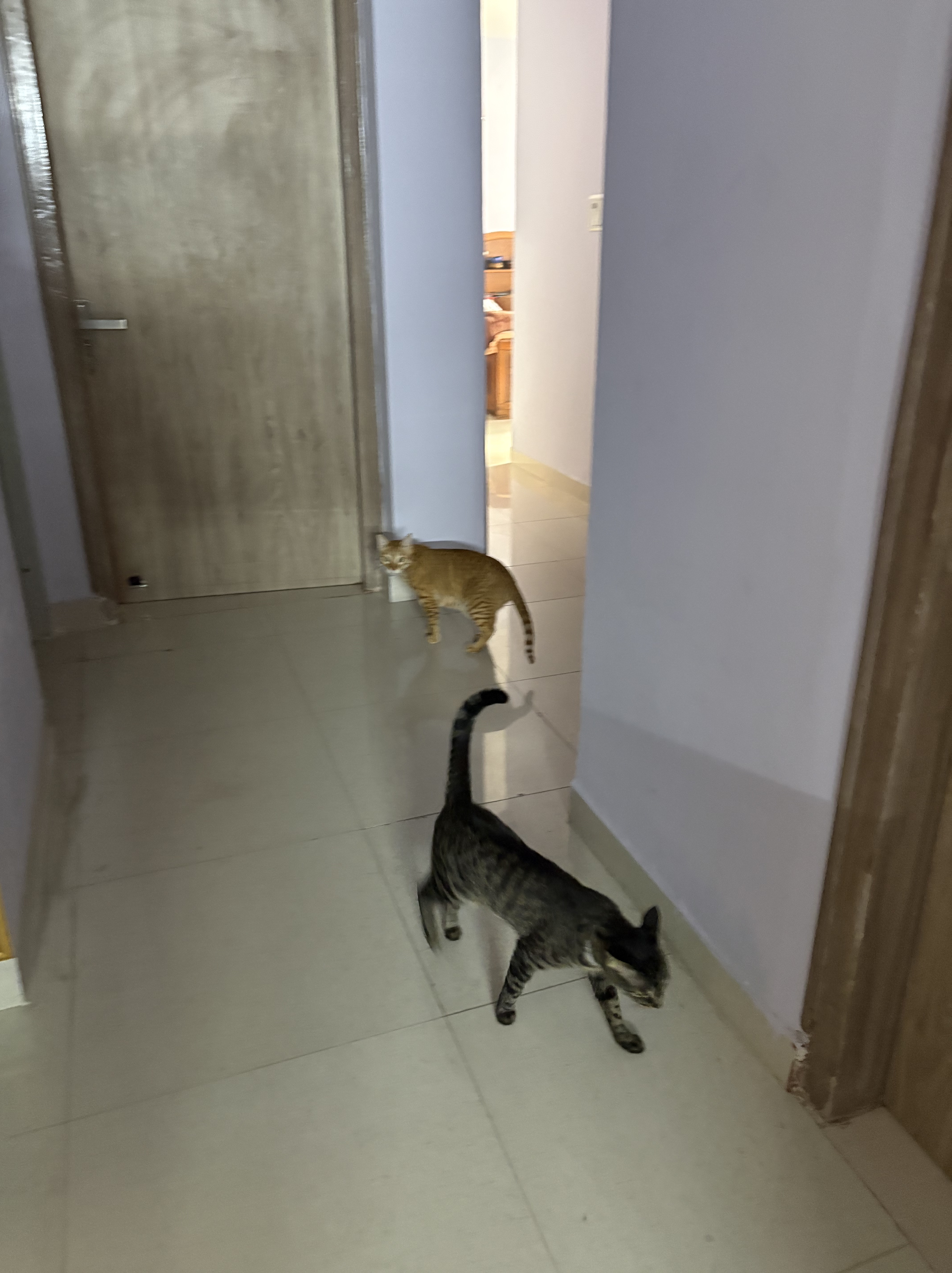
The Chronicles of Luna & Kiwi.

A Tale of Two Attention-Seeking Furballs.

Looking at these two adorable furballs, it’s clear that life with Luna and Kiwi is never boring. Here is the story of their daily adventures seeking.

Meet Luna, the golden tabby with the red collar who believes she’s the undisputed queen of the household. Her amber eyes hold the wisdom of someone who has knocked exactly 47 items off counters and regrets nothing.

Chapter 1: The Great Hallway Parade 🚶‍♂️

Then there’s Kiwi, the sleek tabby-and-white tuxedo cat who thinks subtlety is overrated. If Luna is the queen, Kiwi has appointed himself as the royal drama king.

Every morning at precisely 4:50 AM, the Great Hallway Parade begins. Luna leads the procession with the dignity of a military general, her collar jingling like a bell of authority. Kiwi follows behind, but not in submission—oh no—he’s plotting.

Chapter 2: The Strategic Positioning Committee 🎯

These two have turned attention-seeking into an art form. They’ve established what I like to call “Strategic Positioning Points” throughout the house:

  • Position Alpha: Right in front of any door you need to pass through
  • Position Beta: Directly in the path between you and your coffee
  • Position Gamma: The exact spot where you planned to step next

In the photos, you can see them executing “Formation Doorway”—a classic maneuver where they position themselves to create maximum adorable inconvenience. Luna takes point (because hierarchy), while Kiwi covers the rear flanks (because someone needs to look pathetic enough to earn sympathy treats).

Chapter 3: The Loneliness Conspiracy 💔

Here’s the thing about Luna and Kiwi—they’ve convinced themselves they’re tragic, neglected souls despite being photographed more than most celebrities.

Look at Luna’s posture! She’s practically auditioning for a cat food commercial with the theme “Feed the Forgotten Feline.” Meanwhile, Luna simply parks herself wherever you need to be and radiates an aura of “You cannot ignore royalty.”

Chapter 4: The Food Bowl Summit 🍽️

The final photo captures a rare moment of diplomacy—the Food Bowl Summit. Here we see both cats in the same frame without anyone’s tail being attacked, which is basically the feline equivalent of a peace treaty.

  1. The Approach: Both cats pretend they’re not desperately hoping for treats
  2. The Positioning: Strategic placement to maximize guilt-inducing adorability
  3. The Wait: Patient suffering while maintaining eye contact

The Truth About Their “Loneliness” 💕

The beautiful irony: these two aren’t actually lonely at all. They’re attention connoisseurs. They’ve trained their human to be the perfect audience for their daily performances. They’re not seeking attention because they lack it; they’re seeking it because they’re addicted to it.

They are masterful manipulators who’ve turned being adorable into a full-time career. And honestly? They’re absolutely crushing it.

Every day, they wake up and ask themselves: “How can we be even more irresistible today?” And every day, they succeed.

🎭 The End…their journey is to be continued.

Posted in Uncategorized | Leave a comment

Holi: The Festival of Colors—A Journey Through History, Tradition, and Lost Essence.

Every spring, as winter retreats and new life blooms across India, something magical happens. Streets transform into vibrant canvases. Strangers become friends. Enemies embrace. The air fills with laughter, music, and the sweet aroma of traditional sweets. This is Holi—the festival of colors, love, and renewal.

But have you ever wondered where this spectacular celebration originated? Or why, despite its enduring popularity, many feel that Holi has lost something essential along the way?

Let’s journey back in time, explore the rich traditions that once defined this festival, and understand what we may be losing in our modern pursuit of celebration.

The Ancient Roots: Where It All Began

Holi isn’t just a festival—it’s a narrative that’s been passed down for thousands of years, embedded in mythology, philosophy, and the seasonal rhythms of Indian civilisation.

The Legend of Holika and Prahlad

The most celebrated legend behind Holi traces back to ancient Hindu scriptures, particularly the Bhagavata Purana. Picture this: A powerful demon king named Hiranya kashyap rules the cosmos, so arrogant that he believes himself invincible. His son, Prahlad, is different—devoted entirely to Lord Vishnu despite his father’s tyranny.

Enraged by his son’s unwavering faith, Hiranya kashyap devises cruel punishments. Yet Prahlad survives every torment through his devotion. In desperation, the demon king enlists his sister, Holika—a demoness immune to fire—to carry Prahlad into blazing flames. But here’s where divine justice intervenes: Prahlad emerges unburned while Holika perishes in the fire.

This triumph of good over evil, righteousness over tyranny, faith over fear—is the beating heart of Holi. The festival commemorates not just a mythological victory, but a universal truth: that devotion and goodness ultimately triumph over malice.

The Spring Connection: Celebrating Renewal

Beyond mythology, Holi is deeply rooted in the agricultural calendar. Celebrated at the end of the winter harvest (around March), it marks the arrival of spring—nature’s ultimate symbol of renewal, fertility, and hope. The winter crops are gathered, ensuring food security for another year. The earth stirs awake, flowers bloom, and life bursts forth in new colors.

Ancient communities understood something profound: celebration should synchronise with nature’s cycles. Holi wasn’t arbitrary—it emerged from the land itself, reflecting humanity’s gratitude for abundance and its optimism for the future.

The Sacred Traditions: What Made Holi Truly Special

Understanding Holi’s original traditions is key to grasping what makes this festival spiritually significant. These weren’t just customs—they were embodiments of profound values.

1. Holika Dahan: The Night Before

On the evening before Holi, families gather around bonfires (Holika fires) in communal spaces. This wasn’t a recreational activity—it was deeply ceremonial. People brought wood symbolising negativity, old sorrows, and past grievances. As the fire blazed, these were symbolically burned away.

The bonfire also had practical significance. Winter grains were roasted as offerings (called Holika Prasad) to thanking the divine for the harvest. Families shared these roasted grains—a moment of collective gratitude and bonding. The warmth of the fire, the smell of roasting grains, the gathering of the community—all created a sacred space where old enmities were forgotten.

2. Playing with Colors: A Symbol, Not Just Fun

When dawn broke on Holi morning, the color-play began—but with a purpose far deeper than entertainment. In traditional Holi celebrations, natural colors derived from flowers, plants, and minerals were used. Turmeric produced golden yellow, henna gave warm orange, indigo flowers offered shades of blue, and charcoal provided black.

These colors weren’t random. Each carried symbolic meaning:

  • Red symbolised love, courage, and fertility.
  • Yellow represented purity, wisdom, and prosperity.
  • Green signified new beginnings and hope.
  • Blue embodied divinity and transcendence.

When someone applied color to another, they weren’t just playing—they were bestowing blessings. Enemies would seek each other out, apply colors, and embrace, symbolically wiping away grudges. Masters would play with servants, erasing temporary hierarchies.

Children would color their elders, parents would color their children. The colors were an equalizing force.

3. Forgiveness and Reconciliation

Perhaps the most sacred aspect of Holi was its emphasis on forgiveness. Before the festival began, people would visit neighbours, colleagues, and even estranged relatives with sincere apologies. “Holi milo”—”let’s celebrate Holi together”—became an invitation to reconciliation.

This wasn’t superficial. It was in the belief that festivals are moments of spiritual reset. To celebrate properly, one had to clear the slate—to genuinely forgive and be forgiven. Only then could the joy of the festival be authentic.

4. Sharing Sweets and Blessings

Holi sweets—gujhiya, kheer, ladoos—weren’t just treats. Sharing sweets was a ritual of goodwill and affection. When you offered sweets to someone, you were offering them sweetness in your heart. The phrase “Holi Mubarak” (Holi greetings) was often accompanied by these offerings, creating bonds of community and care.

The Modern Festival: What Has Changed?

Fast forward to today. Holi is still celebrated with enthusiasm, but something fundamental feels different. Let’s examine what’s shifted and what we may have lost.

1. The Shift from Natural to Chemical Colors

The most visible change is in the colors themselves. Traditional natural colors have been replaced by synthetic, chemical-based colored powders. While convenient and vibrant, these often contain toxic compounds—heavy metals, lead, and harmful chemicals that cause skin allergies, respiratory issues, and eye problems.

There’s a subtle irony here: A festival meant to celebrate nature and renewal now often harms it. Synthetic colors pollute water sources, affect aquatic life, and leave environmental scars. More importantly, the shift reflects our modern tendency to prioritise convenience and aesthetics over significance and sustainability.

2. From Reconciliation to Obligation

Holi was once a festival where reconciliation happened naturally—driven by genuine desire and spiritual conviction. Today, the emphasis has shifted. People exchange Holi greetings out of social obligation rather than heartfelt intention. A Holi greeting becomes a WhatsApp message sent to dozens of contacts. An apology becomes a perfunctory gesture rather than a sincere repair.

The fundamental ethos—that this festival is a moment to genuinely reset relationships—has diluted. Holi has become less about inner transformation and more about external celebration.

3. Commercialisation and Consumerism

Walk into any city market before Holi, and you’ll see aggressive consumerism in full swing. Luxury brands release special Holi editions. Restaurants advertise “exclusive Holi menus.” Shopping malls offer “Holi sale” discounts. Sweets that once carried personal meaning are now mass-produced, often by brands more interested in profit margins than tradition.

This commercialisation creates a new hierarchy based on what you can afford. The essence of Holi—where a servant and master were equals for a day—gets replaced by Instagram-worthy celebrations accessible primarily to the wealthy.

4. Water Wastage and Environmental Neglect

The color-play tradition, while joyful, now often involves water balloons, water guns, and unlimited water-throwing. In regions facing severe water scarcity, Holi has become increasingly problematic. What was once a celebration of harvest abundance now often represents careless wastage. The traditional approach used minimal water—just enough to apply colors. Modern Holi often turns into water wars, particularly in urban areas where water stress is acute.

5. Erosion of Community Spirit

Historically, Holi was deeply communal. Neighbours gathered around bonfires. The bonfire was a central meeting point where the entire community assembled. Today, many celebrate within their homes or among a select group of friends. The communal bonfire—a symbol of collective identity—has been replaced by apartment balconies and private parties. The festival that once broke down social hierarchies now often reinforces them—celebrated differently based on economic class, geographic location, and lifestyle choices.

The Deeper Loss: What Holi Meant Beyond the Celebration

Beyond the visible changes lies a more profound erosion. The fundamental philosophy underlying Holi—what made it truly sacred—seems to be fading.

Happy Holi. And this time, let’s make it count.

The Loss of Spiritual Intentionality

Holi was rooted in a spiritual understanding: that humans are cyclical beings who need regular moments of renewal, forgiveness, and reset. The festival provided a structured, socially-sanctioned space to do the deep inner work of reconciliation.

Modern Holi has become primarily about fun, colors, and photos. The spiritual architecture—the intentionality behind each ritual—has been replaced by a checklist of what you “should” do during Holi. It’s become a performance rather than a practice.

The Forgotten Principle of Equality

One of Holi’s most revolutionary aspects was its implicit rejection of hierarchy. On Holi, society’s built-in power structures temporarily dissolved. This wasn’t merely symbolic—it was philosophically significant. It suggested that beneath all social roles and divisions, humans are fundamentally equal.

Today, Holi celebrates often reinforce divisions. Those with resources celebrate lavishly; others celebrate modestly. The festival has become a mirror of economic inequality rather than a momentary escape from it.

The Disconnect from Nature

A festival born from humanity’s intimate relationship with agricultural cycles and natural rhythms has become divorced from its ecological roots. We’ve forgotten that Holi was originally humanity saying “thank you” to the earth, celebrating abundance responsibly.

Now, when we pollute water sources, waste resources, and use chemical colors to celebrate, we’re essentially performing a ritual in complete contradiction to its original meaning.

Can We Reclaim the True Spirit of Holi?

This might sound pessimistic, but there’s genuine hope. Across India and the diaspora, a growing movement is emerging—people who recognise what’s been lost and are intentionally working to reclaim authentic Holi.

Steps Toward Authentic Celebration

  1. Use Natural Colors: Return to traditional colors made from flowers, herbs, and natural pigments. Yes, they’re less vibrant and more expensive. But they’re safer and carry symbolic meaning.
  2. Prioritize Reconciliation: Before colors and sweets, have genuine conversations with people you’ve been at odds with. Let forgiveness precede celebration.
  3. Reduce Water Consumption: Skip water guns. Enjoy the colors without making it a water-wasting spectacle. In water-stressed regions, celebrate without water entirely.
  4. Revive Community Bonfires: If possible, gather in communal spaces for Holika Dahan. Let it be a moment of shared reflection, not just a performance.
  5. Expand Your Circle: On Holi, deliberately include people from different backgrounds, economic classes, and communities. Recreate the festival’s original promise of equality.
  6. Reflect Internally: Alongside external celebration, spend time reflecting. What negativity are you burning in your metaphorical Holika fire? What relationships need healing?

The Festival We Lost, The Festival We Can Find Again

Holi’s deterioration isn’t inevitable. It’s a consequence of choices—choices to prioritise convenience over meaning, consumption over community, performance over practice. But choices can be reversed.

Every Holi presents an opportunity to remember. To remember that this festival carries profound wisdom. That forgiveness and reconciliation are acts of courage. That equality isn’t just an ideal but a lived experience. That humans are part of nature, not separate from it.

Perhaps the most beautiful aspect of Holi is its cyclical nature. Every spring, it returns. And every spring, we have a fresh chance to celebrate it authentically. The colors are waiting. The bonfire is ready. Our neighbours are waiting for genuine connection.

The earth is waiting for our gratitude.

This Holi, let’s not just play with colors. Let’s play with meaning. Let’s paint our celebrations with intention, our greetings with sincerity, and our actions with consciousness.

Because the greatest gift this ancient festival offers isn’t a splash of colour on our clothes—it’s the possibility of renewal in our hearts.

Happy Holi. And this time, let’s make it count.

Posted in Social Relevance | Tagged , , , | Leave a comment

Soaring to Success: Leadership Principles from the Majestic Eagle.

I have personally always been in awe of Eagles. These majestic creatures of the sky stand as the chief amongst all winged beings, commanding respect and admiration across cultures and centuries. Even though a lot has been written in the past by other more accomplished writers, I could not resist writing about this favourite topic. Even though it may sound repetitive and also borrowed heavily from my more accomplished predecessors.

Several authors and poets have explored eagle symbolism—particularly themes of leadership, strength, vision, courage, and overcoming adversity—in literature, poetry, and non-fiction.

Alfred Lord Tennyson (“The Eagle”): Portrays the eagle as a symbol of bravery, survival, and victory, watching from mountain heights before striking like a thunderbolt.

Robert Francis (“Eagle Plain”): Uses the American eagle to represent discipline, honesty, and hard work, unaware of its own virtues.

Dejan Stojanovic (“The Creator”): Compares the eagle’s eyesight to human thought, symbolizing power, persistence, and success.

Gift Gugu Mona (“The Essence of Faith”): Draws from Isaiah, likening faith to mounting wings like an eagle for strength and perseverance.

Jack E. Davis (The Bald Eagle: The Improbable Journey of America’s Bird): Examines the bald eagle’s history as a national symbol of strength and environmental resilience, covering its cultural reverence and near-extinctions.

EAGLES have, since ancient times been as a sacred symbol of LEADERSHIP, STRENGTH, and VISION. Throughout history, it has also been revered as an emblem of HOPE, STRENGTH, and SALVATION. From the ancient empires of Babylon and Egypt to the mighty Roman Empire and the modern United States of America, the Eagle has graced countless banners, becoming a legendary symbol of POWER, STRENGTH, and LEADERSHIP.

There exist seven primary leadership principles that we can and should learn from these magnificent beings—principles that can help us reach the epitome of success in our personal and professional endeavours.

The Seven Eagle Leadership Principles

1. Eagles Fly High and Fly Alone

The first leadership principle we can learn from eagles is their unique attitude towards life. Eagles soar to great heights and often journey alone, unperturbed by solitude. Similarly, true leaders are distinguished from the masses by their individual focus and aspirations. They understand that the path to excellence often requires traveling alone, making difficult decisions, and reaching peaks that others dare not attempt.

Great leaders embrace the loneliness that comes with responsibility, knowing that their vision may not always be understood or supported by everyone around them.

2. Eagles Have Great Vision – Both Penetrative and Accurate

An eagle’s vision is both penetrative and remarkably accurate. From tremendous heights, they can spot their prey through all environmental clutter with precision that is simply astounding. As leaders, we must cultivate a similar visionary capability—maintaining a clear, long-term goal that we can focus on without becoming distracted by the noise around us. If you can maintain unwavering focus on your objectives, regardless of obstacles and distractions, success becomes inevitable.

3. Eagles Do Not Eat Dead Things – They Feed Only on Fresh Prey

Perhaps one of the most important lessons leaders can learn from eagles is their refusal to rely on stale sustenance. Eagles hunt fresh prey, never settling for what is old or decaying. Similarly, effective leaders must never become overly dependent on past accomplishments or outdated strengths.

Continuous growth demands that we discover new skills, strive toward unknown frontiers, and courageously conquer fresh challenges. Living on past glory is the enemy of future success.

4. Eagles Love the Storm

By far the most crucial similarity between eagles and true leaders is their remarkable comfort during stormy weather. While other birds seek shelter during storms, eagles actually thrive in these conditions, using the powerful winds to soar even higher with minimal energy expenditure.

True achievers are not afraid of challenges—they view turbulent times as opportunities for growth and advancement. They understand that storms, while difficult, often provide the strongest winds for reaching new heights.

5. Female Eagles Test Male Eagles for Commitment

This principle speaks directly to the human resource skills essential for effective leadership. Female eagles engage in elaborate courtship rituals that test the commitment, skill, and reliability of potential mates before choosing a partner.

Similarly, leaders must carefully evaluate the commitment of people in their professional sphere. The ability to select the right individuals for the right positions—people who share your vision and demonstrate unwavering commitment—is crucial for organisational success.

6. Eagles Prepare for Training

True leaders, like eagles, are forever ready to leave their comfort zones because they understand that growth cannot occur in familiar territory. Eagles continually hone their hunting skills, adapt to new environments, and refine their techniques throughout their lives.

Exceptional leaders maintain a similar mindset—always prepared for training, forever ready to learn something new, and willing to challenge themselves in ways that expand their capabilities and effectiveness.

7. When Eagles Grow Old, They Undergo Renewal

Perhaps the most profound lesson comes from the eagle’s renewal process. When eagles reach approximately 40 years of age, they face a critical decision: undergo a painful but necessary transformation or perish. They retreat to a high place and begin the arduous process of removing old feathers, breaking off worn talons, and even breaking their beaks—all to grow new, stronger replacements.

Leaders must occasionally undergo similar renewal processes, shedding outdated habits, obsolete methods, and limiting beliefs. Those who recognise this need and courageously embrace transformation emerge as true leaders, equipped for continued success in an ever-changing world.

Conclusion: Embracing the Eagle Spirit

Eagle people are the visionaries and seekers who are not afraid to push the limits of self-discovery and growth. The eagle person is the true leader—ready to embark on any challenge and forever prepared to fly high above the ordinary.

By embodying these seven principles—flying high and alone when necessary, maintaining clear vision, seeking fresh opportunities, embracing challenges, testing commitment, preparing for continuous learning, and undergoing periodic renewal—we can transform ourselves into the kind of leaders who inspire others and achieve extraordinary results.

The eagle soars not because the journey is easy, but because it has developed the strength, vision, and courage necessary to rise above every storm. As leaders, we must cultivate these same qualities if we hope to reach our own magnificent heights.

Posted in Personal Reflections | Tagged , , , , | Leave a comment

The Eternal Paradox: Understanding War Through History and Human Nature.

War, humanity’s oldest and most persistent companion, has shaped civilisations, redrawn maps, and claimed countless lives across millennia. Despite technological advancement, diplomatic institutions, and growing global interconnectedness, we remain trapped in cycles of conflict that seem as inevitable as they are devastating. To understand why peace remains elusive, we must examine the historical patterns that have driven nations to war and explore the complex interplay between political ambition and popular sentiment.

The Historical Roots of Human Conflict.

Ancient Foundations of Warfare.

The history of war is nearly as old as recorded civilisation itself. Archaeological evidence suggests organised warfare emerged around 10,000 years ago, coinciding with the agricultural revolution and the establishment of permanent settlements. Early conflicts typically arose from:

1. Resource competition – Access to fertile land, fresh water, and trade routes.

2. Territorial expansion – The drive to secure defensible boundaries and strategic positions.

3. Religious and cultural differences – Conflicts over belief systems and ways of life.

4. Economic advantage – Control of wealth-generating resources and trade networks.

The ancient empires of Mesopotamia, Egypt, Greece, and Rome all built their power through systematic  conquest, establishing patterns that would persist for millennia. These early wars were often justified through religious mandate, cultural superiority, or the supposed divine right of rulers.

Medieval to Modern Evolution.

The medieval period introduced new dimensions to warfare:

Feudal obligations created military hierarchies that made war a social institution.

Religious crusades demonstrated how ideology could mobilize entire populations.

Technological advances in weaponry continuously shifted the balance of power.

Economic systems became increasingly dependent on conquest and tribute.

The Peace of Westphalia (1648) established the modern nation-state system, but paradoxically created new sources of conflict as clearly defined borders and sovereignty claims led to more frequent territorial disputes.

The Modern Drivers of Conflict.

Economic Imperatives

Modern warfare often stems from economic motivations disguised as ideological or security concerns:

Resource Wars: From 19th-century colonialism to contemporary conflicts in oil-rich regions, access to natural resources remains a primary driver of international conflict.

Market Competition: Trade wars, economic sanctions, and competition for global markets create tensions that can escalate to military action.

Military-Industrial Complex: The economic interests of defense contractors and arms manufacturers can create institutional pressures for continued conflict.

Ideological and Identity Conflicts.

The 20th and 21st centuries have seen wars increasingly framed around competing worldviews:

Nationalism – The belief that ethnic or cultural groups deserve their own sovereign states.

Political systems – Democracy vs. authoritarianism, capitalism vs. socialism.

Religious fundamentalism – Conflicts between different faith traditions or secular vs. religious governance.

Civilizational clash – Broader cultural conflicts between different ways of organizing society.

Technological and Strategic Considerations.

Modern warfare is shaped by technological capabilities and strategic thinking:

1. Nuclear deterrence has paradoxically both prevented large-scale wars and created new forms of proxy conflict.

2. Cyber warfare has opened new domains for international competition.

3. Space militarization represents the newest frontier of potential conflict.

4. Asymmetric warfare allows smaller powers to challenge larger ones through unconventional means.

Why Peace Remains Elusive: The Structural Problem.

The Security Dilemma

Political scientists identify a fundamental “security dilemma” in international relations: actions taken by one state to increase its security inevitably threaten other states, leading to arms races and heightened tensions. This creates a self-perpetuating cycle where preparation for war makes war more likely.

Psychological and Evolutionary Factors.

Human psychology may predispose us toward conflict:

In-group/Out-group Bias: Humans naturally favor their own groups while viewing outsiders with suspicion, a tendency that leaders can exploit to build support for aggressive policies.

Loss Aversion: People fight harder to prevent losses than to achieve gains, making territorial or status quo challenges particularly inflammatory.

Evolutionary Heritage: Some researchers argue that capacity for organized violence provided evolutionary advantages, leaving us with inherited aggressive tendencies.

Institutional Failures

Despite organizations like the United Nations, international institutions often lack the power to prevent conflict:

Sovereignty principle limits intervention in domestic affairs.

Great power politics allow major nations to block collective action.

Enforcement mechanisms are often weak or inconsistently applied.

Economic interdependence, while reducing some conflicts, can create new vulnerabilities.

Citizens vs. Leadership: Who Really Wants War?

The Democratic Peace Theory

One of the most robust findings in international relations research is that democratic countries rarely fight wars against each other. This suggests that when ordinary citizens have genuine political power, they tend to choose peace over conflict. Several factors explain this pattern:

Economic Costs: Citizens bear the direct costs of war through taxation, economic disruption, and military service.

Human Costs: Families who send their children to war have strong incentives to avoid unnecessary conflicts.

Information Access: Democratic societies typically have freer media that can expose the true costs and questionable justifications for war.

Political Accountability: Leaders in democracies face electoral consequences for unsuccessful or unpopular wars.

When Citizens Support War

However, popular support for war does emerge under certain conditions:

1. Perceived existential threats – When citizens believe their way of life or survival is at stake.

2. Nationalism and pride – Appeals to national honor or historical grievances can mobilize popular support.

3. Economic hardship – During economic crises, external conflicts can serve as scapegoats for domestic problems.

4. Information manipulation – Propaganda and media control can shape public perception of threats and opportunities.

Elite Interests and War

Political and economic elites often have different incentives regarding war:

Political Leaders may benefit from:

Rally-around-the-flag effects that boost approval ratings during crises.

Distraction from domestic problems or scandals.

Legacy building through military achievements.

Power consolidation as war often expands executive authority.

Economic Elites may benefit from:

Defense contracts and military spending.

Resource acquisition through conquest or political influence.

Market disruption that eliminates competitors.

Reconstruction opportunities in post-conflict societies.

Military Leadership may benefit from:

Increased budgets and institutional importance.

Career advancement through combat experience.

Technological development driven by military needs.

Institutional prestige associated with military success

Case Studies: When Peace Efforts Succeeded and Failed.

Successful Peace-Building.

European Union: The transformation of Europe from the world’s most war-torn continent to a zone of unprecedented peace demonstrates that institutional design, economic integration, and shared values can overcome historical enmities.

Canada-United States Border: The world’s longest undefended border shows how shared democratic values, economic interdependence, and cultural similarities can create lasting peace: till it is disturbed.

Failed Peace Efforts

Interwar Period (1919-1939): Despite the League of Nations and extensive peace treaties, underlying tensions and unresolved grievances led to an even more devastating second world war.

Middle East Peace Process: Decades of negotiation have failed to resolve the Israeli-Palestinian conflict, demonstrating how identity, territory, and historical grievances can resist diplomatic solutions. And now the ongoing Israel-Iran conflict which could boomerang.

Yugoslav Wars: The breakup of Yugoslavia showed how ethnic nationalism can overwhelm civic institutions and lead to savage conflicts even in relatively developed societies.

The Path Forward: Building Sustainable Peace

Institutional Reforms

Creating lasting peace requires strengthening international institutions:

1. Reformed UN Security Council with broader representation and limited veto powers.

2. International Criminal Court with universal jurisdiction over war crimes.

3. Global economic governance that reduces inequality between nations.

4. Regional security organizations that can prevent local conflicts from escalating

Economic Integration

The European model suggests that deep economic integration can make war economically irrational:

Free trade agreements that create mutual dependence.

Joint infrastructure projects that require ongoing cooperation.

Shared currencies and financial systems that raise the costs of conflict.

Cross-border investment that gives elites stakes in peaceful relations.

Cultural and Educational Change

Long-term peace requires changing how societies think about conflict:

Education Reform: Teaching critical thinking about nationalism, propaganda, and the true costs ofwar while emphasizing shared human values and interdependence.

Media Responsibility: Promoting journalism that seeks truth over sensation and that humanizes potential enemies rather than demonizing them.

Cultural Exchange: Increasing person-to-person contact across national and ethnic boundaries to break down stereotypes and build empathy.

Democratic Development: Supporting the growth of genuine democratic institutions that give citizens meaningful voice in decisions about war and peace.

Conclusion: The Continuing Challenge

The persistence of war throughout human history suggests that conflict may be an enduring feature of international relations, but it is not inevitable. The significant reduction in interstate wars since World War

II, the emergence of zones of peace like the European Union, and the general trend toward democratic governance offer hope that humanity can transcend its violent past.

The key insight from this historical analysis is that war typically results from a complex interaction between structural conditions (resource scarcity, institutional weakness, power imbalances) and human  choices (political leadership, popular sentiment, cultural values). While ordinary citizens generally prefer peace, they can be mobilized for war under certain conditions, particularly when they perceive existential threats or when information is manipulated by self-interested elites.

Building sustainable peace requires addressing both the structural and human elements of conflict. This means creating international institutions strong enough to manage disputes peacefully, economic

systems that provide prosperity without exploitation, and cultural values that emphasize shared humanity over tribal divisions.

The question is not whether humans are capable of peace—clearly, we are, as demonstrated by the many peaceful relationships that exist at personal, community, and even international levels. The question is whether we can create the conditions that make peace more attractive than war for both ordinary citizens and the elites who often make decisions about conflict.

As we face new challenges like climate change, technological disruption, and growing inequality, the need for effective peace-building becomes even more urgent. The choice between war and peace remains, as always, fundamentally human—and therefore within our power to influence.

Posted in Personal Reflections | Tagged , , , | Leave a comment

The Cautionary Vision of Aldous Huxley’s Brave New World.

“But I don’t want comfort. I want God, I want poetry, I want real danger, I want freedom, I want goodness. I want sin.” — John the Savage.

Aldous Huxley’s Brave New World (1932) stands as one of literature’s most prescient warnings about the perils of technological control and manufactured happiness. Written during the rise of mass production and behaviorist psychology, Huxley’s dystopian masterpiece explores a fundamental question that remains urgently relevant today: Can a society built on pleasure, efficiency, and stability ever truly fulfil human nature?

The novel’s answer is a resounding no — and its exploration of why reveals profound truths about freedom, suffering, and what it means to be authentically human.

The World State: Perfection Without Soul.

Huxley’s World State represents the ultimate technocratic society, where every aspect of human existence has been optimised for stability and happiness. The citizens of AF 632 (After Ford, referencing Henry Ford’s assembly line revolution) live in a world that has seemingly solved humanity’s greatest problems:

Biological Engineering eliminates genetic inequality through controlled reproduction in “Hatcheries and Conditioning Centres.” Children are no longer born but manufactured, with their intelligence and physical capabilities predetermined by their assigned caste.

Pavlovian Conditioning shapes behavior from infancy, ensuring each person finds satisfaction in their predetermined role. Delta and Epsilon children are conditioned to hate books and nature, while Alphas are trained for leadership — creating a society where oppression feels natural.

Soma Distribution provides chemical happiness on demand. This miracle drug offers all the benefits of alcohol, narcotics, and antidepressants without hangovers, addiction, or side effects. Why suffer when relief is just a pill away?

Sexual Liberation replaces love and family bonds with casual encounters, preventing the deep emotional attachments that might challenge state authority. The mantra “everyone belongs to everyone else” ensures no citizen develops loyalty to anyone but the state.On the surface, this world has achieved what every society claims to want: no war, no poverty, no suffering, no unfulfilled desires. Yet Huxley reveals this paradise as profoundly hollow.

The Savage’s Mirror: What We Lose in Paradise.

John the Savage serves as the novel’s moral center and our window into what the World State has sacrificed for its stability. Raised on Shakespeare and traditional human values on the Reservation, John embodies everything the World State has eliminated: passion, moral struggle, spiritual yearning, and the capacity for both profound joy and devastating sorrow.

The Conflict Between Comfort and Truth.

When John encounters World State civilisation, his horror isn’t directed at obvious evils but at the absence of meaning itself. He’s repulsed not by cruelty but by the casual indifference to beauty, truth, and human dignity. In his famous exchange with World Controller Mustapha Mond, John articulates the novel’s central theme:

– John demands the right to be unhappy, to struggle, to face real danger.

– Mond responds that such desires are antisocial and unnecessary in a world that can provide easy satisfaction.

This conversation reveals Huxley’s crucial insight: a society that eliminates suffering also eliminates the conditions necessary for human growth, creativity, and genuine fulfillment.**

Love vs. Conditioning.

John’s relationship with Lenina crystallizes this conflict. His passionate, romantic love — shaped by Shakespeare’s sonnets — collides with her conditioned casual sexuality. Neither can understand the other:

– John seeks transcendent connection, viewing sexuality as sacred when combined with love.

– Lenina finds his intensity confusing and unnecessary, having been conditioned to view emotional attachment as unhealthy.

Their tragic inability to connect represents the broader gulf between authentic human nature and engineered satisfaction.

Huxley’s Prophetic Warnings.

Writing in 1932, Huxley anticipated developments that wouldn’t fully emerge for decades. His warnings prove remarkably prescient:### The Tyranny of Pleasure Unlike Orwell’s 1984, where citizens are controlled through fear and pain, Brave New World presents a more seductive form of control. The World State doesn’t need to threaten its citizens — it simply makes them too comfortable to rebel.

Modern parallels include:

– Social media platforms designed to provide endless, easy gratification.

– Consumer culture that promises happiness through material acquisition.

– Pharmaceutical solutions for emotional and spiritual problems.

– Entertainment that distracts from deeper questions about meaning and purpose.

The Standardisation of Humanity.

The World State’s caste system represents an extreme version of social engineering, but Huxley’s real concern is the broader tendency to treat humans as interchangeable units rather than unique individuals.

Contemporary echoes appear in:

– Educational systems focused on standardised testing rather than individual growth.

– Economic policies that prioritize efficiency over human flourishing.

– Technology that reduces complex human needs to data points and algorithms.

The Elimination of Difficult Beauty.

Perhaps most tragically, the World State has eliminated art, religion, and philosophy — anything that might disturb its citizens’ contentment. Beauty exists only in sanitised, consumable forms.

Today’s version might include:

– Art reduced to viral content optimised for engagement.

– Spiritual practices repackaged as wellness trends.

– Literature and philosophy marginalized in favor of immediately practical information.

The Price of Paradise.

John’s suicide represents the novel’s darkest conclusion: that authentic humanity cannot survive in a world designed to eliminate suffering. His death poses uncomfortable questions:

Is struggle necessary for human fulfillment? The World State’s citizens appear happy, but their satisfaction seems shallow compared to John’s capacity for both ecstasy and agony.

Can technology solve human problems without destroying human nature?

Every technological solution in the World State comes with the hidden cost of diminishing some essential aspect of humanity.What happens when comfort becomes more important than truth? The citizens live in a carefully constructed illusion, protected from reality’s sharp edges but also cut off from its genuine beauty.

Lessons for Our Time.

Huxley’s vision feels increasingly relevant as we grapple with similar questions about technology, pleasure, and control. His novel suggests several crucial principles:

Preserve Space for Difficulty.

A truly human society must allow room for struggle, failure, and growth. Easy solutions to complex problems often eliminate opportunities for character development and genuine achievement.

Value Individual Uniqueness.

Efficiency and equality are worthy goals, but not at the cost of individual personality, creativity, and moral agency. Systems that treat people as interchangeable units ultimately dehumanise everyone.

Choose Meaningful Over Comfortable.

The novel argues that meaning matters more than happiness — that a difficult life pursuing truth and beauty surpasses an easy life of shallow pleasure.

Question Technological Solutions.

Every technological advance should be evaluated not just for its benefits but for its hidden costs to human flourishing. What aspects of humanity might we lose in exchange for convenience or comfort?

Conclusion: The Enduring Challenge.

Brave New World doesn’t offer easy answers, but it poses essential questions that each generation must answer anew. In our age of social media, artificial intelligence, and biotechnology, Huxley’s warnings feel prophetic rather than fantastical.

The novel’s lasting power lies not in its specific predictions but in its fundamental insight: the greatest threats to human dignity often come disguised as benefits. A society that promises to solve all problems, eliminate all suffering, and provide all pleasures may inadvertently eliminate the struggles that make us most human.

John the Savage’s tragic fate reminds us that the choice between comfort and authenticity, between easy happiness and meaningful existence, remains as relevant today as it was in 1932. The question isn’t whether we’ll face this choice — it’s whether we’ll have the courage to choose wisely when we do.

As Huxley himself might say, the price of true humanity may be the willingness to embrace both the beauty and the terror of being genuinely alive.

When we introspect, it is quite evident that all these magnificent and exemplary authors had such prophetic vision and extraordinary power of imagination.

Posted in Social Relevance | Tagged , , , , , , , , , | Leave a comment