If you’re under 25, a smartphone is basically an extra limb. It’s your TV, your bank, and your social life. But you’ll never quite get to understand what a phone meant in 2007.
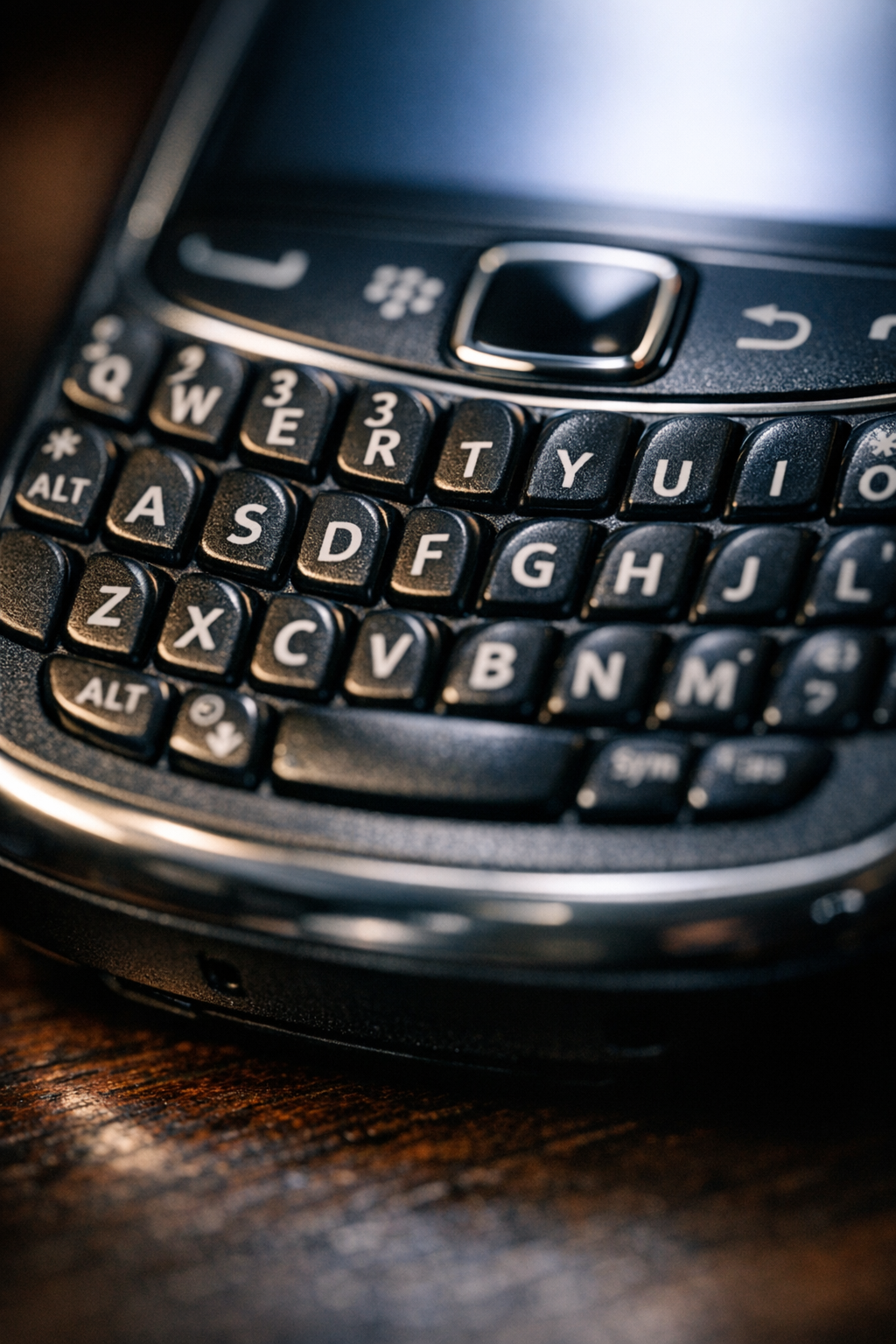
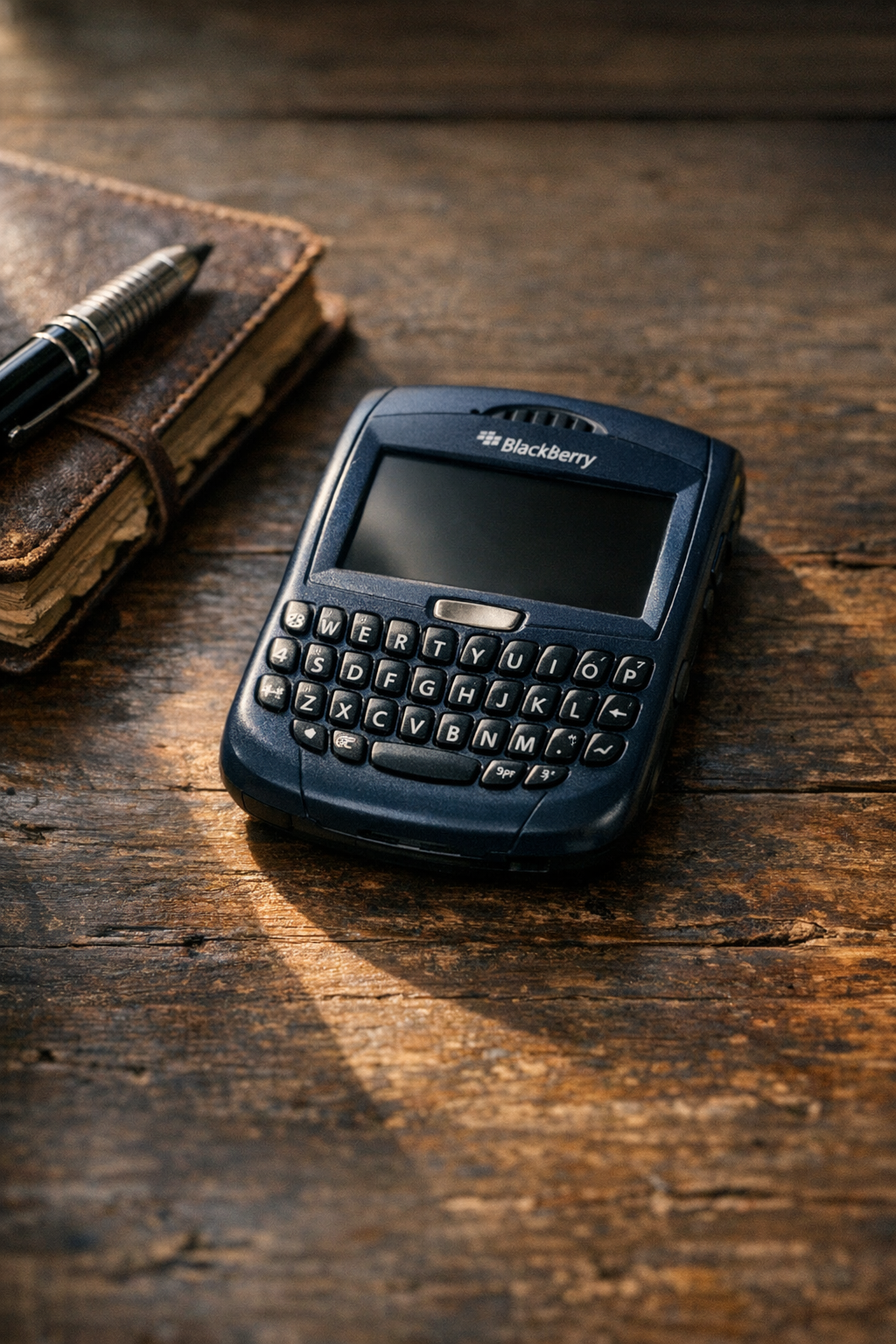
Back then, owning a BlackBerry wasn’t about having a “device.” It was about having arrived. It was the ultimate “I’m busy, I’m important, and I’m connected” flag. We’re kicking off this nostalgia series with the king of the boardroom: the CrackBerry.
I am beginning a new series KALEIDOSCOPE dedicated to the lost relics of nostalgia, and there is only one place to start: the magnificent, unrivalled “BlackBerry.” This is the story of Research In Motion (RIM) and the tiny device that defined corporate status, hooked a generation, and established the blueprint for modern communication, only to be left behind.
The “Click” That Built Empires.
Modern screens are glass—cold, flat, and personality-free. The BlackBerry was tactile. It had soul.
Those tiny, slanted QWERTY keys weren’t just for typing; they were for working. There was a specific, mechanical “click” that provided a hit of dopamine every time you fired off a response. You didn’t just tap a screen; you engaged with a machine. You could type a three-paragraph email while walking through an Airport without looking down once. It was ergonomic perfection that modern touchscreens still haven’t touched.
The Red Blinking Light
If you knew, you knew. That little red LED in the corner was the heartbeat of the corporate world.
Before the chaos of WhatsApp etc, we had the “Hallmark” of communication: the BlackBerry Internet Service (BIS). It was seamless. Emails didn’t just “arrive”; they were pushed to you instantly, encrypted and reliable. When that red light blinked, it meant someone needed you. It meant you were in the loop. It was a status symbol that demanded attention, yet offered a strange sense of security.
Why We Cannot Go Back.
To a generation raised on “swipe to unlock,” the BlackBerry would look like a calculator from a bygone era. It’s hard to translate that feeling of holding a device that didn’t want to entertain you—it wanted to help you conquer the day.
The Relic.
It was a tool for creators and leaders, not just consumers. As the world moved toward video and endless scrolling, the BlackBerry became a beautiful relic. We traded that satisfying physical click for a vibration motor, and that rock-solid reliability for “touches & swipes.”
The BlackBerry is gone, but for those of us who lived through the era of the blinking red light, it remains the unsurpassable peak of practical tech.
The favorite line every Doctor utters after He/She has finished writing the prescription is, “Control your Stress”. I have always wondered as to how easy it is for the Doctor to comments and how difficult it is for the patient to adhere to.
You know the feeling. The shoulders that never fully drop. The sleep that never quite restores. The sense that something is running in the background you cannot switch off. This is not just life. That is your body under siege. Your body has been invaded by the “stealth killer”. Diabetes may be known as the silent killer, but one of the chief causes of Diabetes is also STRESS.
Let’s Stop Calling it “Just Stress”.
We have normalized something that should alarm us. ‘I’m stressed’ has become the answer to every question — why you are tired, why you snapped at someone, why you cannot concentrate, why your back aches, why your digestion is off, why you have not slept properly in weeks. We say it with a shrug, the way you might mention the weather. But stress is not weather. It is not background noise. It is one of the most potent biological events your body can undergo — and when it becomes chronic, it is one of the most destructive.
The World Health Organization has called stress the epidemic of the twenty-first century. Not high blood pressure. Not obesity. Stress — because stress is the upstream cause of most of what we are actually treating downstream. And yet, in most conversations about health, it still gets a footnote rather than a headline.
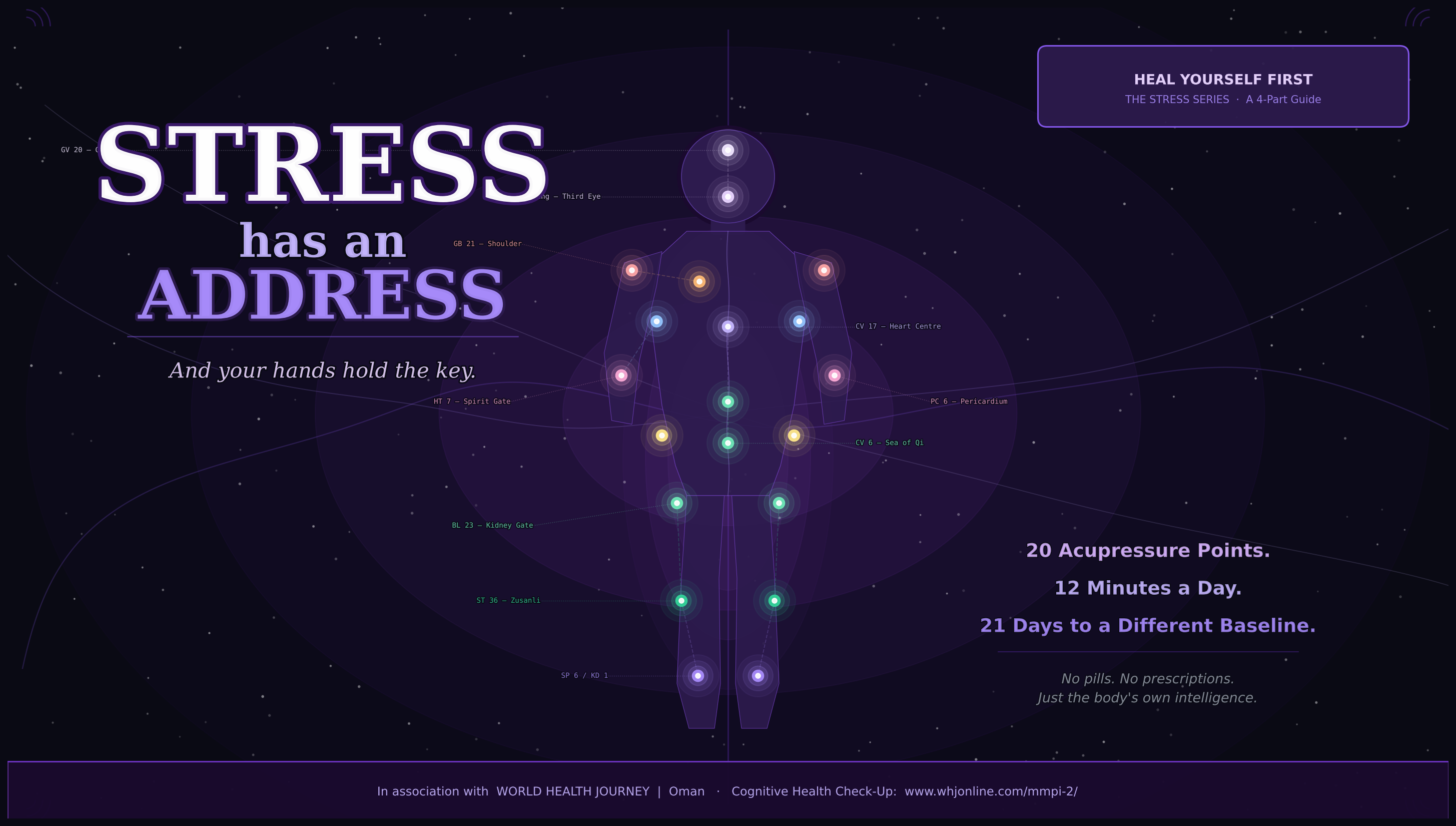
This four-part series is that headline. We are going to look at what stress actually does to your body — not in vague terms, but system by system, organ by organ. And then we are going to give you the tools to actively intervene in that process using acupressure — one of the oldest and most underused physiological levers available to us.
First things First – See the full Picture.
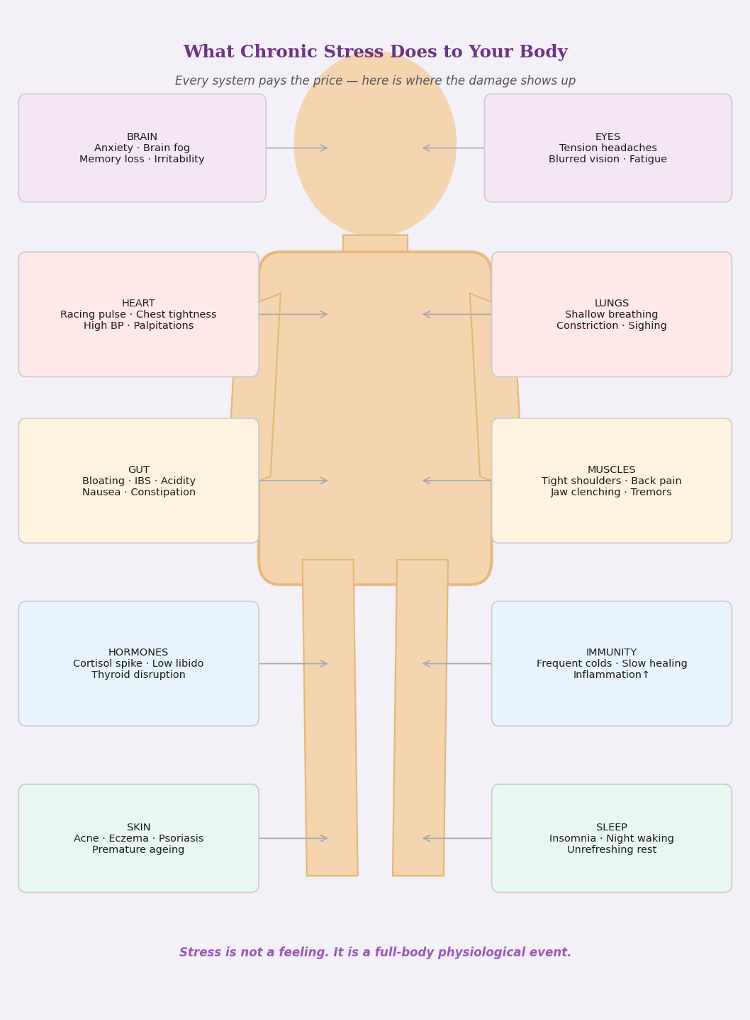
Before we talk about solutions, spend a moment with this. Most people understand stress as a feeling. What the diagram below shows is that stress is, in fact, a full-body physiological event that touches every single system you have.
Figure 1: What Chronic Stress Does to Your Body – a system-by-system breakdown.
Look at the map carefully. The brain, the heart, the lungs, the gut, the immune system, the hormones, the skin — there is not a single system that chronic stress leaves untouched. This is why the person with persistent stress-related headaches also has gut issues. Why the person who cannot sleep also gets frequent colds. Why the person with chronic back tension also feels emotionally depleted. It is all the same storm.
The Cortisol Problem Nobody Warned You AboutWhen you experience stress — whether it is a deadline, an argument, financial pressure, or even a disturbing news cycle — your adrenal glands release cortisol. This is your body’s emergency fuel: it sharpens your focus, floods your muscles with glucose, and temporarily suppresses everything your body considers non-essential (digestion, immunity, reproduction, deep repair).That emergency response was designed to last minutes. A predator appears; you run; cortisol spikes and drops. In modern life, the predator never leaves. Cortisol stays elevated. And a body running on chronic cortisol is a body that is steadily, quietly consuming itself — degrading muscle, inflaming tissue, disrupting hormones, and eroding the very brain structures responsible for keeping you calm.This is not metaphor. This is measurable, documented physiology. And it is entirely addressable.
The Vagus Nerve: Your Body’s Built-In Antidote to Stress.
Here is the good news that often gets buried under the alarm: your body has its own anti-stress system, and it is extraordinarily powerful. It is called the parasympathetic nervous system, and its primary vehicle is the vagus nerve — a long, wandering nerve that runs from the base of your brainstem all the way down to your gut, touching your heart, your lungs, your liver, and your digestive tract along the way.
When the vagus nerve is active, you are in what physiologists call ‘rest and digest’ mode. Your heart rate drops. Your blood pressure normalises. Your gut motility resumes. Your immune system rebuilds. Cortisol decreases. Inflammation reduces. Your brain’s prefrontal cortex — the seat of rational thought and emotional regulation — comes back online.
The question is: how do you activate the vagus nerve when your nervous system is locked in stress mode? There are several well-documented approaches — slow diaphragmatic breathing, cold water on the face, humming, and yes, acupressure at specific points that directly stimulate vagal tone. That last one is what this series is about.
The Acupressure Approach: Calming the Storm from the Top.
We begin today with the points that address the neurological and muscular manifestations of stress — the racing mind, the tight shoulders, the clenched jaw, the tension headache that arrives like clockwork. These are the points you can reach most easily, and they work fastest.
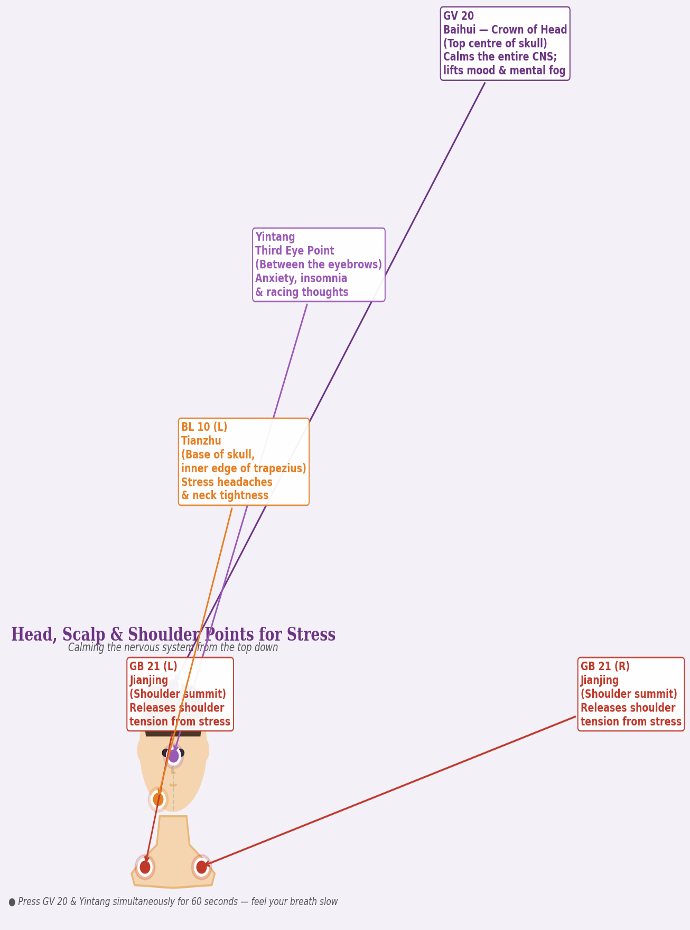
Figure 2: Head, Scalp & Shoulder Points – the first line of acupressure defence against stress.
GV 20 — Baihui: The Crown That Calms Everything
At the very top of the skull, in the centre — if you draw a line from the tip of one ear straight up over the head, and another from the bridge of your nose straight up over the crown, they meet at GV 20. This is the Governing Vessel’s highest point, and in Chinese medicine it is considered the meeting place of all yang energy in the body. Stimulating it draws energy upward, clears the mind, and has a documented calming effect on the central nervous system.
Research has shown that acupressure at GV 20 significantly reduces self-reported anxiety scores, lowers heart rate in stressed subjects, and influences the prefrontal cortex — the part of your brain that stress most aggressively disables. In short: when you cannot think clearly because you are overwhelmed, this is the point to press first.
How to apply: Place three fingers flat at the crown of the head. Apply gentle downward pressure — not a hard push, but sustained and intentional weight. Close your eyes. Take five slow breaths. Hold the pressure for sixty seconds. You may feel a sense of warmth or mild pulsing. That is normal. Repeat morning and evening.
Yintang — The Third Eye Point: Your Emergency Calm Button
Between the eyebrows, in the slight depression at the bridge of the nose. You already know this point — you press it instinctively when you have a headache, or when you are trying to concentrate. In acupressure, Yintang is one of the most potent points for quieting the mind. It has a direct sedating effect on the nervous system and is used clinically for anxiety, insomnia, and the kind of relentless mental churning that stress produces.
A particularly powerful combination: press GV 20 and Yintang simultaneously. One hand at the crown, one index finger at the third eye. Close your eyes. Breathe. Ninety seconds. This two-point pairing is one of the fastest-acting self-help acupressure protocols for acute anxiety.
How to apply: Single index finger, pressing gently but firmly inward and slightly upward. Circular micro-movements. Eyes closed. Breathe into the belly. This point can be held for up to two minutes. It is safe to use as many times a day as needed — before a difficult conversation, during a moment of panic, before sleep.
GB 21 — Jianjing: Releasing the Shoulders You Have Been Holding for Months
At the highest point of each shoulder — the midpoint between the base of the neck and the edge of the shoulder. If you have ever had someone press there when you are tense and felt an almost overwhelming release, you have found GB 21. This point is the body’s primary storage location for unexpressed stress. Tight GB 21 points are a clinical indicator of chronic stress load. The tighter they are, the longer the stress has been there.
In traditional texts, this point is described as ‘the shoulder well’ — a place where stress collects and stagnates. Releasing it is not just locally relieving. It sends a signal through the gallbladder meridian that travels down the side of the body, reducing tension in the neck, mid-back, and hip.
How to apply: Use the opposite hand’s thumb and first two fingers to grip the shoulder muscle firmly. Squeeze and hold — it will be uncomfortable if you carry a lot of tension there. Hold ten seconds, release, repeat five times. Then make slow circles with the fingers at the point. Do both shoulders.
Note: avoid deep GB 21 pressure during pregnancy.
BL 10 — Tianzhu: Where Stress Lives at the Base of Your Skull
At the base of the skull, about one finger-width out from the midline on each side, in the thick muscles just below the bony ridge. This point — Heavenly Pillar — is the body’s junction between the head and the rest of the nervous system. Chronic stress creates extraordinary tension here: it compresses blood vessels feeding the brain, contributes to tension headaches, and maintains a low-level fight-or-flight signal that is very hard to break without directly addressing this point.
How to apply: Interlace your fingers behind your head. Use both thumbs to press upward and inward into the muscles on each side of the spine at the skull’s base. Tilt your head back slightly onto the pressure. Hold thirty seconds. Release. Repeat three times. The relief — especially if you spend hours at a desk — is often immediate.
The Wrist Points — What to Do When Stress Hits Without Warning
The beauty of the next set of points is their accessibility. You are at a meeting that is turning adversarial. You are sitting in traffic. You are lying awake at 2 am with thoughts that will not stop. These points are there, in your own wrists and hands, always. No one needs to know you are using them.
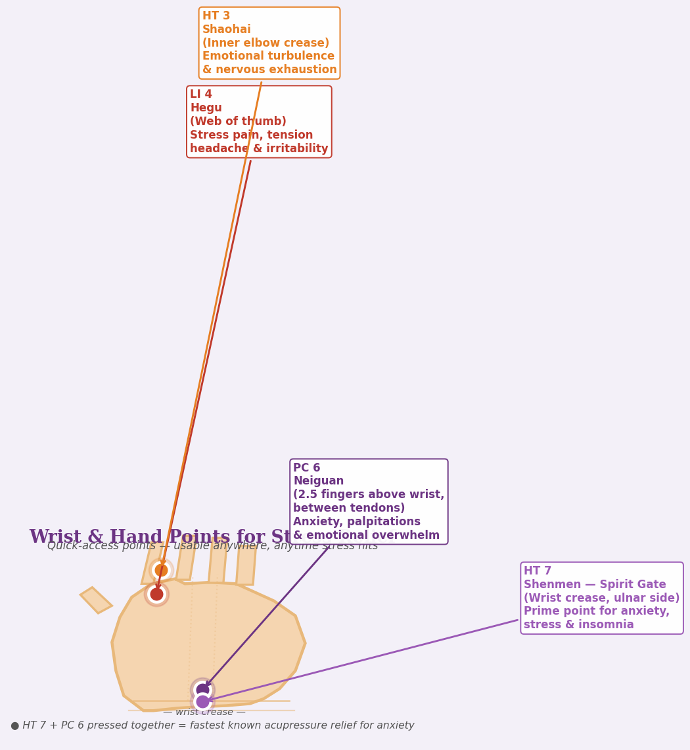
Figure 3: Wrist and Hand Points – fast access stress relief that works anywhere anytime.
HT 7 — Shenmen: The Spirit Gate
At the wrist crease, on the little-finger side, in the small hollow just inside the tendon. Shenmen means ‘Spirit Gate’ in Chinese — and the name is not poetic exaggeration. This is the primary point of the Heart meridian for emotional disturbance. Anxiety, panic, emotional pain, the physical sensation of a racing heart during stress — all of these respond to HT 7. In clinical acupuncture practice, it is one of the most-used points for anxiety and insomnia, alongside its neighbour PC 6.
How to apply: Use the thumb of the opposite hand to apply firm pressure at the wrist crease hollow. The sensation should be slightly achy, like pressing on a bruise. Hold six seconds, release two seconds. Repeat ten times. Then switch wrists. For acute anxiety or panic, maintain continuous pressure for three minutes while breathing slowly through the nose.
PC 6 — Neiguan: Calming the Heart-Mind Axis
Two and a half finger-widths above the wrist crease, between the two central tendons of the inner forearm. We met this point in our gut health post, where it excels at nausea and reflux. But its primary classical function is emotional: it governs the Pericardium meridian, which in Chinese medicine is the heart’s protector. Stress that manifests as chest tightness, palpitations, emotional overwhelm, and the inability to ‘close down’ thoughts at the end of the day — PC 6 addresses all of these.
The research on PC 6 for anxiety is extensive enough that wristbands pressing this point are now sold in mainstream pharmacies for travel sickness and morning sickness. But the full range of its effect on the nervous system goes far beyond nausea.
Combination technique: Press HT 7 and PC 6 on the same wrist simultaneously — one thumb on each. Hold for ninety seconds. This paired application is faster-acting than either point alone for acute emotional stress.
The Grounding Points — When Stress Has You Spinning
There is a concept in mind-body practice called ‘grounding’ — the idea of reconnecting with the body when stress has pulled you entirely into your head. In acupressure, this is not metaphor. The foot points below literally bring energy downward from an overactive head and nervous system, reducing the physiological arousal that keeps stress cycling.
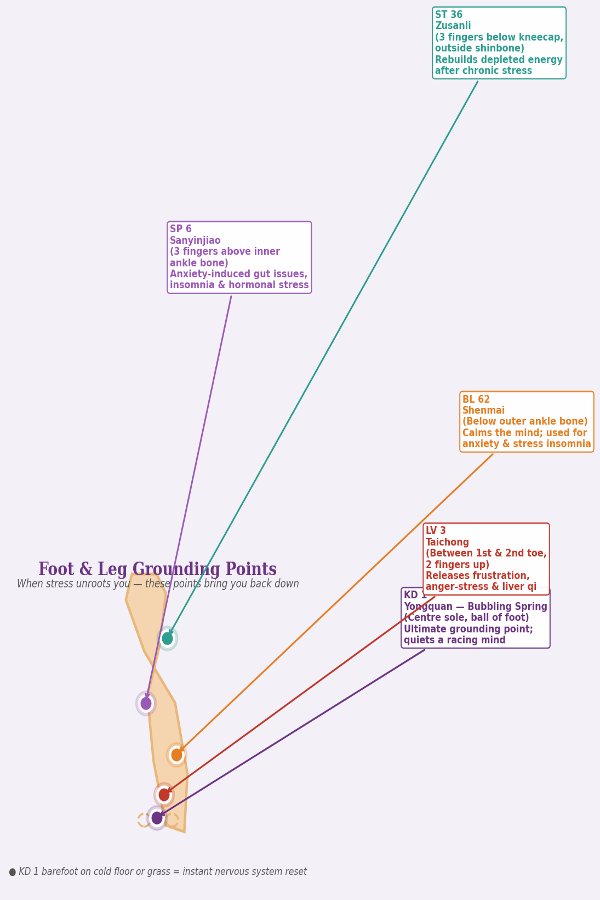
Figure 4: Foot & Leg Grounding Points – When your mind won’t stop, press your feet.
KD 1 — Yongquan: The Bubbling Spring (Your Most Powerful Grounding Point)
At the centre of the sole of the foot, in the depression just below the ball. We first encountered KD 1 in our eye health discussion, but its relationship with stress is perhaps its most important function. Kidney 1 is the body’s only acupressure point on the sole of the foot, and it is the most inferior point on the entire meridian system — as far down as you can go. In Chinese medicine, it grounds the spirit, anchors the mind, and pulls hyperactive energy down from the head.
There is a beautiful old practice in Chinese wellness tradition: walking barefoot on morning dew-wet grass. Not because the grass is special, but because the cold, textured ground stimulates KD 1 with every step. You do not need morning dew. A firm thumb, two minutes, daily.
How to apply: Sit comfortably. Cross one leg. Use the thumb to press firmly into the centre of the sole. Hold and make small circles. The pressure should feel intense — this point is often quite sensitive in stressed or anxious individuals. Sixty seconds each foot. You may feel a wave of calm almost immediately.
LV 3 — Taichong: For the Stress That Comes With Anger and Frustration.
Between the first and second toes, two finger-widths up from the webbing. This is the source point of the Liver meridian — and in Chinese medicine, the liver governs the smooth flow of qi throughout the body. When stress comes with frustration, irritability, a sense of things being stuck, rage that has nowhere to go — the liver meridian is involved. LV 3 is its release valve.
Combine LV 3 with LI 4 in the hand (the web between thumb and index finger) for what practitioners call the ‘Four Gates’ — two points pressed simultaneously on both hands and feet that create a powerful circuit for releasing stagnant energy and reducing systemic tension. Many people who try the Four Gates for the first time feel an emotional release within minutes.
How to apply: Thumb pressed firmly into the point between the first and second metatarsals. It will be tender — often notably so in people carrying a lot of suppressed frustration.
Hold, breathe, rotate slowly. Ninety seconds per foot.
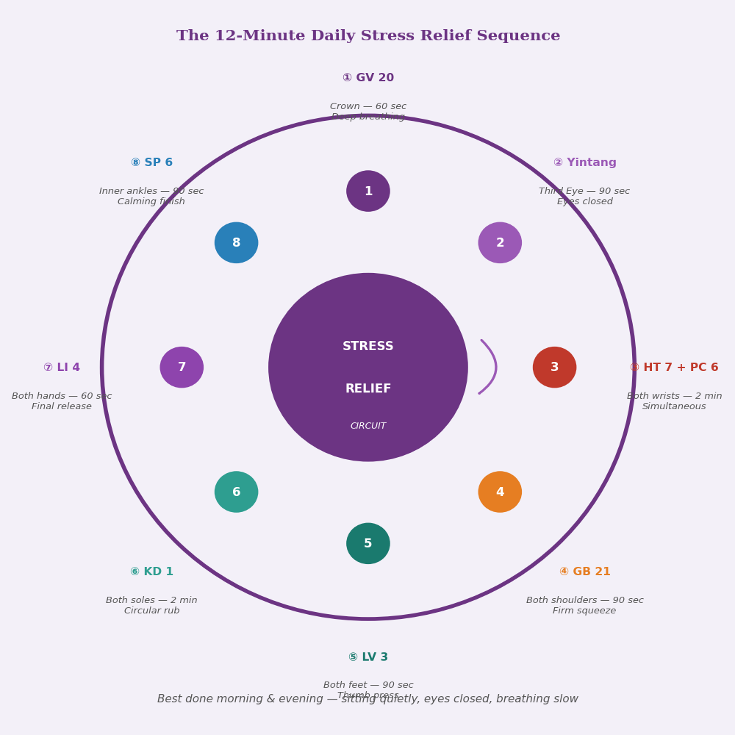
Putting It Together: Your Daily 12-Minute Stress Relief Sequence
Each of the points above works individually. But done in sequence — moving from the head down through the wrists and finally to the feet — they create a cumulative calming effect that systematically addresses every layer of the stress response. Morning and evening is ideal. Even once a day, consistently, will produce measurable change within ten days.
Figure 5: The 12-minute Daily Stress Relief Sequence – Follow in order, twice daily.
The 12-Minute Stress Relief Circuit① GV 20 — Crown of head (60 seconds, gentle sustained pressure, deep breathing)② Yintang — Third eye (90 seconds, eyes closed, full focus on slowing breath)③ HT 7 + PC 6 — Both wrists together (2 minutes, press both simultaneously)④ GB 21 — Both shoulders (90 seconds, firm grip and release, not just touch)⑤ LV 3 — Both feet (90 seconds, thumb press between first and second toes)⑥ KD 1 — Both soles (2 minutes, firm circular rub with thumb)⑦ LI 4 — Both hands (60 seconds, web of thumb, firm rotational pressure)⑧ SP 6 — Inner ankles (90 seconds each, calm closing point)Total: approximately 12 minutes. Do this before checking your phone in the morning.Repeat in the evening before sleep. You will sleep differently within a week.
Beyond the Points: Three Lifestyle Pivots for This Week.
The 4-7-8 Breath (Use It Before the Points, Every Time).
Breathe in through the nose for 4 counts. Hold for 7. Breathe out through the mouth for 8. The extended exhale activates the vagus nerve directly— it is the fastest non-pharmaceutical intervention known to reduce acute anxiety. Do this three times before beginning any acupressure session. It primes the nervous system for the points that follow.
Name the Stress — Write It Down
Unprocessed stress is physically heavier than named stress. There is neuroscience behind this: the act of labeling an emotion in writing activates the prefrontal cortex and quiets the amygdala — the brain’s alarm center. A five-minute journal entry before bed asking ‘What stressed me today, and what is actually within my control?’ is not therapy. It is basic neural hygiene. Do it for seven days and notice how different mornings feel.
One Meal, Eaten Without a Screen.
We talked about this in the gut health post, but it deserves repeating from a stress angle: eating in a sympathetic (stressed) state raises cortisol, reduces serotonin, impairs nutrient absorption, and — crucially — teaches your nervous system that there is no safe moment to rest. One meal a day, eaten slowly, with attention, without your phone, sends the opposite signal. It is a physiological practice, not a mindfulness exercise.
What to Expect After One Week
You will not eliminate stress in a week. But you will notice the edge is softer. Sleep will begin to shift — not dramatically, but the difference between lying awake for forty minutes and lying awake for twenty is enough to change your next day. The shoulder tension will begin to map — you will notice when it arrives and have a tool to use. The racing mind at 2am will have something to engage with rather than just spiral.
These are not minor improvements. These are the first cracks in a pattern that stress relies on to perpetuate itself. Keep the practice going for three weeks — which is what Posts 2, 3, and 4 of this series will walk you through — and the changes become structural. Not just symptom relief. A genuinely different baseline.
Stress is not the price of ambition. It is the cost of not knowing your own body well enough. Let’s change that.
About the Author
Your Guide on This JourneyI have been an avid acupressure and alternative treatment methodologies enthusiast and have spent years researching. Stress, in my experience, responds faster and more deeply to body-based intervention than almost any other health condition — because it lives in the body, not just in the mind.This series is a starting point. If you want a personalised acupressure protocol tailored to your specific stress patterns, sleep profile, and health history, I offer one-on-one consultations in collaboration with trained and qualified Acupressure specialists that go beyond what any blog post can provide.
Coming in Post 2: ‘Your Nervous System Is Stuck on Alarm — How to Switch It Off Without a Single Pill’
In Association with World Health Journey | Oman | http://www.whjonline.comIs stress affecting your mental health in ways you haven’t fully recognised yet?Consider taking a Cognitive Health Check-Up — a clinically validated assessment that maps your stress profile, emotional health, and psychological resilience with precision.Take the assessment here: www.whjonline.com/mmpi-2/or Drop a Mail to shaji@whjonline.comBecause knowing where you stand is always the first step to getting better.
The Gut Doesn’t Lie – And it’s Been Trying to Talk to you for Years.
Ever wonder why we get “butterflies in the Stomach” when we’re nervous?
Our gut is our second brain. Most of us reach for an antacid the moment we feel a bloat, but that’s just putting a band-aid on a biological protest. Instead of suppressed symptoms, let’s talk about flow.
You don’t need a prescription to start healing your digestion. You need your hands, ten minutes, and the willingness to listen.
For a great part of my life, I have battled with this problem of my gut not behaving. Like an errant child, it has troubled me for years, till I found the remedies and took the matter in my own hands. Though this happened after I had consumed countless “pills” & trying other alternative treatments like Ayurveda. Now for the first time in decades, I am at peace because I have devoted 10 minutes every morning massaging the root cause areas on my body.
If you have ever sat across from a doctor with a complaint about bloating, constipation, acidity, or that persistent heaviness after a meal, chances are you walked out with an antacid, a laxative, or at best a referral to a gastroenterologist. What you almost certainly did not walk out with is the knowledge that your own hands hold some of the most effective tools for digestive relief known to medicine — tools that have been refined over three thousand years, validated by modern neuroscience, and available to you free of charge, right now.
The gut is extraordinary. It has its own nervous system — the enteric nervous system — with roughly 500 million neurons embedded in its lining. Scientists call it the ‘second brain,’ and they mean that literally, not poetically. This second brain communicates constantly with your head brain via the vagus nerve, and it responds powerfully to what you eat, how you breathe, how much you sleep — and yes, to touch and pressure applied at specific points on the body.
That last part is where acupressure comes in. And once you understand how it works, you will wonder why nobody ever taught you this alongside how to brush your teeth.
Before You Read Further
This post covers acupressure techniques for everyday gut wellness — bloating, acidity, sluggish digestion, constipation, and general gut fatigue. If you are experiencing severe abdominal pain, blood in stool, unexplained weight loss, or any symptoms that concern you, please see a doctor first. These practices work beautifully alongside medical care — not in place of it when something serious is happening, because you failed to listen to it’s woeful cries of distress.
Why Your Gut Is So Much More Than a Digestive Tube
Here is something that might shift your entire view of health: approximately 70 percent of your immune system lives in your gut. Your gut lining produces serotonin — the very same molecule that anti-depressants target — in quantities that dwarf what your brain makes. When your gut is inflamed, sluggish, or dysbiotic (that means the bacteria colony inside it is out of balance), you do not just feel bloated. You feel tired, anxious, foggy-headed, and often inexplicably low.
The reverse is also true. A well-functioning gut — one with good motility, a diverse microbiome, and a healthy mucosal lining — shows up in your energy levels, your skin, your mood, and your ability to fight infections. The gut is not a side conversation in your health. It is the main event.
And the single most underused, most overlooked tool for maintaining it? Daily, deliberate pressure on a small set of points that your body has been waiting or you to discover.
Section 1: The Abdominal Points — Working Directly at the Source
These are the points on the belly itself. Many people are hesitant to massage their own abdomen — it feels intrusive somehow. But the abdominal wall is packed with lymph nodes, fascia, and pressure receptors that, when stimulated correctly, directly influence intestinal motility, reduce visceral tension, and improve blood flow to the digestive organs. Think of it as manually waking your gut up.
CV 12 — Zhongwan: The Master Switch for Digestion
Located exactly four finger-widths above your navel, CV 12 is arguably the most important single point for upper digestive function. In Traditional Chinese Medicine, it governs the Stomach and is used to treat everything from acid reflux and bloating to nausea and lack of appetite. Modern research has shown that stimulation of this point activates gastric acid regulation and promotes gastric emptying — which is exactly what you need when food feels like it is sitting in your stomach like a stone.
How to apply: Place three fingers of your right hand flat over this point (just above navel centre). Apply gentle but firm downward pressure — not poking, but sustained weight. Hold for a slow count of ten. Release. Repeat six to eight times. Then make small clockwise circles with the same three fingers for ninety seconds. You may feel mild gurgling. That is not a bad sign — that is your gut waking up. TRY IT NOW.
ST 25 — Tianshu: The Two Points That Balance Everything
These two points sit two finger-widths to the left and right of the navel, and they are bilateral — meaning you work both sides. ST 25 is the ‘Heavenly Pivot,’ and the name gives a clue to its function: it balances the intestines between too much and too little. Constipated? Stimulating ST 25 promotes peristalsis. Dealing with loose stools or IBS-D? The same point, applied more gently, helps regulate and calm the gut. This bidirectional action is one of the things that makes acupressure genuinely different from a pharmaceutical intervention.
How to apply: Place one thumb on the left ST 25 and one on the right simultaneously. Apply steady circular pressure — clockwise for constipation, counter-clockwise if dealing with urgency or loose stools. Two minutes. Breathe deeply throughout. Do not rush this one. TRY IT NOW.
CV 6 — Qihai: The Sea of Energy Beneath Your Navel
One and a half finger-widths below the navel. This point — literally called the ‘Sea of Qi’ — governs the body’s core energy and, importantly for us, intestinal motility. When digestion is sluggish, this point feels dull and sometimes slightly tender when pressed. Regular stimulation of CV 6 improves lower gut function, reduces the bloating that sits heavily in the lower abdomen, and over time strengthens what Chinese medicine calls ‘digestive fire’— the body’s fundamental capacity to process food.
How to apply: Two fingers flat, pressing slowly inward. Hold at a depth that feels like mild pressure — not pain. Hold for six counts. Release. Repeat eight times. Then keep your fingers there and breathe into the abdomen for sixty seconds, feeling the belly rise against your hand.TRY IT NOW.
Section 2: The Leg Points — Why Your Knee Area Controls Your Stomach.
During our growing up years, we have often heard this statement, “your brains are in your knees” especially as a slander remark for tall people. Little did I realise then as to how true this statement is.
This surprises everyone the first time they hear it. The idea that pressing a point below the knee could affect the stomach, intestines, or liver seems counterintuitive until you understand the meridian system. In Chinese medicine — and increasingly in the acupuncture research literature — the Stomach meridian runs from the face all the way down to the second toe, passing through the knee and lower leg. Stimulating points along this channel creates measurable physiological changes in gastric function.
ST 36 — Zusanli: The Single Most Studied Acupressure Point on the Planet
This point deserves its own paragraph, because it has earned it. Zusanli — ‘Three Mile Leg’ — sits three finger-widths below the kneecap, just outside the shinbone. It has been the subject of hundreds of clinical trials and is used across traditional systems in China, Japan, Korea, and increasingly in integrative medicine settings worldwide. Its effects on digestion are well-documented: it increases gastric motility, regulates gut microbiome diversity, reduces post-operative nausea, improves nutrient absorption, and stimulates the vagus nerve.
But here is the thing that really captures people: in Chinese medical tradition, this point is considered one of the longevity points. Farmers in ancient China would press this point every morning before a long day of work. The phrase associated with it translates roughly as: ‘Press Zusanli daily and live a hundred years.’ Whether or not you plan on a century, the point delivers.
How to apply: Sit with one leg bent. Place your thumb on ST 36 and press firmly downward and slightly inward toward the bone. You will likely feel a distinct ache or a sensation that radiates down the leg. That is the point. Hold for six counts, release, repeat eight times. Then switch legs. Two minutes per leg. Do this every single morning.
SP 6 — Sanyinjiao: Three Meridians, One Powerful Point
Four finger-widths above the inner ankle bone, on the back edge of the shinbone. This is the meeting point of three major meridians — Spleen, Liver, and Kidney — and its effects ripple through all three organ systems simultaneously. For the gut, SP 6 is invaluable: it aids in the transformation and transportation of food, reduces abdominal distension, calms IBS, and helps with the emotional component of gut dysfunction (the anxiety-gut connection that so many people experience but nobody talks about enough).
Note: SP 6 is contraindicated in pregnancy as it can stimulate uterine contractions. Pregnant women should skip this point.
Section 3: Hand and Wrist Points — Fast Relief at Your Fingertips.
The hands are perhaps the most convenient acupressure tools you have, because you always have access to them — at a desk, in a car, in a meeting, on a flight when your stomach is rebelling against airline food at thirty thousand feet. The points here are particularly useful for acute symptoms: sudden nausea, heartburn, food regret.
PC 6 — Neiguan: The Nausea Point That Actually Works
Two and a half finger-widths above the wrist crease, between the two prominent tendons on the inner wrist. If you have ever worn acupressure wristbands for travel sickness, this is the point they press. PC 6 is so well-validated for nausea that it is included in multiple clinical guidelines for chemotherapy-induced nausea and post-operative nausea alongside conventional anti-emetics.
But its effects go further than nausea. Regular stimulation of this point calms the cardiac plexus, reduces the nervous system’s contribution to gut symptoms, and eases the kind of reflux that gets worse when you are stressed. The gut-brain axis runs directly through this point.
How to apply: Use the thumb of the opposite hand. Press firmly inward between the tendons. Hold for six counts. For acute nausea, stimulate rhythmically — press, hold, release, repeat — for three continuous minutes. You should feel relief within five minutes of consistent application.
LI 4 — Hegu: The Universal Pain and Motility Point
In the fleshy web between the thumb and index finger. This is one of the first points every acupressure student learns, and with good reason — it is a master point for pain anywhere in the body, and for the large intestine specifically. LI 4 stimulates intestinal contractions, helps with constipation, and relieves the cramping pain associated with IBS and spastic colon.
How to apply: Pinch the web firmly between thumb and index finger of the opposite hand. Apply deep, rotating pressure for ninety seconds. It should feel intense — this point is rarely dull in people with gut issues. Switch hands. Do this twice a day on difficult gut days.
Your Daily 12-Minute Gut Circuit — The Full Sequence
Below is the recommended daily sequence. Done in order, these six points create a cumulative effect that is greater than any one of them individually. The sequence moves energy from the stomach downward through the intestines and out — which is the natural direction of healthy digestion. Working clockwise at each point reinforces this direction.
The 12-Minute Daily Morning Gut Routine
① CV 12 — Stomach centre (2 minutes, clockwise circles)
② ST 25 — Either side of navel (1 minute each side, clockwise)
Best done on an empty stomach, first thing in the morning. Lie down for the abdominal points. Sit comfortably for the leg and hand points. Breathe slowly throughout — never hold your breath while pressing.
How I do it…
Every morning I would put on some soothing music which keeps playing in the background while I continue these routine. I devote over 45 minutes daily, apart from other regular morning routine like waking up, brushing teeth, consuming warm water with a dash of lemon, walking or jogging etc. Time we all have, it is just how we learn to use it. Out of 24 Hours, everyday I would suggest give 90 minutes at the most to your own body. You love your body and the body will love you back.
There is more to it, but then this article has taken the length of our intestines. So in case I get better response, I might bring in a second part where I can talk about how to make lifestyle changes to boost your gut health. I started by asking a question, “Your Stomach is Talking, Are You Listening”. My advise – please do, it is your Stomach.
Want a personalised Gut-care plan?
I can design a tailored acupressure and lifestyle program based on your health history, current symptoms, and goals. Reach out to book a consultation — I’m happy to help.
Tomorrow’s trailer…
Day 5 and for a few more days beyond that I will focus on STRESS (the stealth enemy or root cause of most of our health issues) : simple acupressure points and belly routines to manage STRESS. See you then!
The gentle giant – The Liver. Possibly the largest and one very hardworking Organ of the Body. It is like a giant processor – which will process anything and everything we keep throwing down the throat quite literally. However, there are limits to which anyone can suffer – and so does the Liver. I call it the traffic police with barricades.
That is why a great percentage of all who get an ultrasound of the Liver comes back with a minimum Stage 1 fatty Liver.
Learn to love your Liver. Don’t treat it like it is adopted. However Gentle Acupressure & Habits will Support Your Liver.
Hello there — welcome to Day 3 of our self-care series Health in Your Hands. Today we will give some loving attention to one of our body’s most hardworking organs: the liver. When our liver is happy, energy, digestion, and even mood get a boost. Little, regular self-care for the liver can pay big dividends.
Why the liver matters?
– The liver detoxifies, stores nutrients, helps regulate blood sugar, and supports digestion.
– Modern life—alcohol, smoking, processed foods, stress, irregular sleep—can overwork the liver.
– Acupressure can stimulate points that support liver circulation, drainage, and balance without needing any equipment.
The 7-Minute Liver Support Routine.
– Time: max 7 minutes (do once daily; morning is ideal)
1. Sit comfortably or lie down. Take three slow, deep breaths. Make your touch warm—rub your hands together for a few seconds.
2. Liver 3 (Taichong) — the cornerstone (2 minutes)
– Location: On the top of the foot, in the depression between the big toe and second toe, about 1–2 finger-widths back from the web.
– Action: Using your thumb, apply steady, comfortable pressure to the point. Hold for 30 seconds, then massage in small clockwise circles for 1–2 minutes. Repeat on the other foot.
– Why: Taichong (LV-3) is a primary liver point in acupressure and acupuncture; it helps soothe liver qi, reduce tension, and improve circulation.
3. Spleen 6 (Sanyinjiao) — support and balance (1.5 minutes)
– Location: On the inside of the lower leg, about four finger-widths above the inner ankle bone, just behind the tibia.
– Action: Press gently with your thumb or knuckle for 30 seconds, then use small circular motions for another 30–60 seconds per leg.
– Why: Spleen 6 harmonises the digestive and reproductive systems and supports liver function indirectly by improving fluid metabolism and qi flow.
4. Gallbladder 34 (Yanglingquan) — unblock and move (1 minute)
– Location: On the outside of the lower leg, in the depression just below and in front of the head of the fibula (the outer bone).
– Action: Firm pressure and a few circles for 30 seconds per leg.
– Why: GB-34 supports bile flow and helps “unclog” stagnant liver energy—excellent when you feel irritable or sluggish.
– Action: Place both palms on your right upper abdomen (below the ribcage). Make gentle clockwise
circular strokes for 30–60 seconds, imagining lymph and blood gently moving toward the liver for processing.
– Why: Encourages gentle liver circulation and supports digestion.
Breathing + visualisation (30 seconds)
– Finish with slow deep breaths. Visualise a warm, golden light bathing your liver, helping it filter and renew.
Quick signs that it’s working
– A sense of warmth or looseness in the abdomen.
– Reduced bloating or heaviness after meals.
– Feeling calmer and less irritable.
Lifestyle & diet nudges for liver resilience is equally important. Choose what you eat, how you eat.
Disclaimers & when to seek advice.
These are just precautions. These techniques are gentle and safe for most people, but if you have diagnosed liver disease, are pregnant, on blood thinners, or have serious health conditions, check with your healthcare provider before starting these new routines. If, you are already ailing with any form of Liver disease please continue the regular treatment plan as suggested by your Doctor or Health Care professional. If you feel sharp pain, dizziness, or any alarming symptoms during a session, stop and consult a professional.
But indulge in the suggested 7 minute routine daily so that it gives a boost to the pills that you are consuming daily. You can also refer to your Doctor for advise.
Want a personalised liver-care plan?
I can design a tailored acupressure and lifestyle program based on your health history, current symptoms, and goals. Reach out to book a consultation — I’m happy to help.
Tomorrow’s trailer…
Day 4 will focus on digestion: simple acupressure points and belly routines to ease bloating and improve nutrient absorption. See you then!
Sharp Eyes Start at Your Feet: Acupressure for Better Eyesight.
Remember yesterday I said we’d explore a surprising connection? 👀 Today’s topic is one of my personal favourites because the results are often noticeable within just a few weeks of consistent practice.
Our eyes are working harder than ever. Between all types of screens, artificial lighting, and constant digital stimulation, it’s no wonder so many of us are reaching for glasses or eye drops. But before you resign yourself to thicker prescriptions, consider this: your feet and hands hold the keys to clearer vision.
In acupressure, the eyes are intimately connected to the liver and kidney meridians. These meridians run through specific points on the feet and thumbs, which—when stimulated—can improve eye circulation, reduce strain, and enhance your natural vision.
Your Feet & Thumbs Matter for Vision.
Think of your feet as a miniature map of your entire body. The eyes correspond to specific zones on your soles and the web between your big toe and second toe. Your thumbs, too, contain powerful reflex points. By massaging these areas, you’re essentially sending a ‘refresh’ signal directly to your optical system.
Benefits of this daily practice:
Improved blood flow to the eyes and surrounding tissues.
Reduced eye strain and fatigue from screen time.
Enhanced nutrient and oxygen delivery to the retina.
Natural relief from dry eyes and irritation.
Support for the liver and kidney organs (which govern vision in traditional medicine).
Day 2: The Eye-Brightening Foot & Thumb Massage (10 Minutes)
Part A: Foot Massage (5 minutes)
1. Sit comfortably with one foot resting on your opposite knee (or use a footrest).
2. Locate the eye reflex point. On the sole of your foot, find the area just below your second and third toes. This is your eye zone. It should feel slightly tender when you press it—that’s normal and a sign you’re in the right spot.
3. Apply firm pressure. Using your thumb or index finger, press this point steadily for 30 seconds. Breathe deeply and imagine sending healing energy to your eyes.
4. Work the entire zone. Gently massage the area with circular motions, covering the space below all your toes on the sole. Spend 2–3 minutes per foot.
5. Don’t forget the inner edge. Massage along the inner edge of your sole (near the arch), as this corresponds to the kidney meridian, which also supports eye health.
Part B: Thumb Massage (5 minutes)
1. Hold your hand palm-up. Look at the web of skin between your thumb and index finger.
2. Pinch and massage. Using the thumb and index finger of your opposite hand, gently pinch and massage this webbed area. This point is called LI-4 (Large Intestine-4) and supports overall vitality, including eye health.
3. Now massage the thumb itself. Pay special attention to the inner side of your thumb (the side facing your palm). Use small circular motions, working from the base to the tip. Do both thumbs for about 2 minutes each.
4. Press the tip. Gently press the pad of your thumb for 10–15 seconds with your index finger. Release and repeat 3–4 times on each hand.
A Quick Note on Expectations
You won’t suddenly wake up with 20/20 vision tomorrow. But consistent practice over 2–4 weeks often brings noticeable improvements: sharper focus, less eye fatigue, and reduced strain. Many people report clearer vision by the end of this 30-day journey. I have done myself.
A Little Extra: Eye Care + Nutrition
Today, pair your massage with these natural vision boosters:
Eat : Carrots, spinach, blueberries, and sweet potatoes are packed with lutein and beta-carotene—natural eye vitamins. Aim to eat at least one orange or dark leafy green per day.
The 20-20-20 rule: Every 20 minutes of screen time, look at something 20 feet away for 20 seconds. This simple habit reduces digital eye strain dramatically.
Let’s Keep Going
If you’re feeling the benefits already or want to dive deeper into how acupressure can transform your specific vision concerns, I’m here for a one-on-one consultation. Together, we can identify any underlying imbalances and create a targeted plan just for you.
What’s Coming Tomorrow?
Tomorrow, we shift our focus upward (literally!) to explore powerful eye exercises that complement your acupressure work. These movements strengthen the eye muscles and boost circulation even further. Trust me—your eyes will thank you.
We keep saying that we need to make money work and not let it remain idle. I would go a little further and say keep using your HANDS, don’t let them be idle for better health. Keep seeing clearly. 👁️✨
For a long time now I have been personally enamoured by the alternative healing methods. So I thought of sharing what I have learnt (self-practised) for quite a long period. At some point in the distant past, I used to consume a lot of pills for every kind of ailment. Diabetes, Blood Pressure, Gastroenteritis etc. When I got fed up, I started doing research on the alternatives. These are my experiments which have helped me. I am not advocating it, just sharing. It is entirely your choice. But it works. And worst case scenario no harm will be done.
How many times have you reached for a painkiller at the first sign of a headache, or immediately booked a doctor’s appointment for a minor ache?
Unlike in the good old days, in our fast-paced world today, we’ve been conditioned to seek quick fixes—often in the form of pills and professional interventions—while overlooking the incredible healing power we hold in our own hands.
Yes. If we just devoted 30 minutes every day for our body we can keep our bodies tuned.
I have tried all these and have experienced a great benefit. My tryst with Accupressure and alternative healing methodologies started a few years back. I have always abhorred the “pills” and was always looking at ways to have some alternative remedies. I switched from Allopathy to Ayurveda. But then I discovered the healing touch of our hands, which when used diligently on a daily basis massaging certain parts of our body can do wonders. Best case scenario – there can never be any side-effects. Does not suit – forget it, no harm done.
Welcome to the start of something transformative. Over the next few days, I’ll guide you through simple, daily acupressure techniques and lifestyle tweaks that can help you reconnect with your body, boost your well-being, and potentially reduce your reliance on external remedies. Like I already mentioned, this isn’t about rejecting modern medicine—it’s about empowering yourself with preventive, natural self-care that costs nothing but a few minutes of your time.
I’m not a certified acupressure practitioner, but an avid enthusiast, and through this series, I want to share the wisdom that our bodies are equipped with their own pharmacy. You just need to know where the ‘buttons’ are, and I want to disclose those buttons.
Let’s Start with the Heart?
The heart isn’t just a physical organ; in many holistic traditions, it’s considered the seat of vitality and emotional balance. Stress, sedentary habits, and poor circulation silently strains this vital everlasting pump. Today’s technique is a gentle way to show your heart some love—literally.
Day 1: The 5-Minute Calf Massage for Heart Health
You might be surprised: what do calf muscles have to do with the heart? The Calf Muscle is also known as the second Heart. In acupressure, the calf region houses key points (like Sanyinjiao SP-6) that influence blood circulation and heart function. Massaging this area helps:
Improve venous blood return from the legs, reducing the heart’s workload.
Stimulate meridians connected to the cardiovascular system.
Release tension that can contribute to high blood pressure.
Promote overall relaxation, which is directly beneficial for heart health.
How to Do It (Step-by-Step)
1. Find a comfortable seat. Sit on a chair or the edge of your bed, with both feet flat on the floor.
2. Place your hands on the back of one calf, between the knee and the ankle.
3. Apply gentle pressure. Using your thumbs or the heels of your palms, press firmly but comfortably into the muscle. You should feel a pleasant sensation, not pain.
4. Use circular motions. Move your thumbs in small circles, working your way from the top of the calf down to the ankle and back up. Spend about 2–3 minutes on each leg.
5. Breathe deeply. As you massage, take slow, deep breaths. Imagine sending oxygen-rich blood to your heart with each inhale.
That’s it! Do this once or twice today—perhaps in the morning and before bed.
A Little Extra: Lifestyle & Diet Nudges
While acupressure is powerful, combining it with conscious habits amplifies the benefits. Today, try one of these:
Hydrate with a twist: Start your day with a glass of warm water with a squeeze of lemon. It aids digestion and alkalises the body.
Take a 5-minute walk after meals. This simple habit improves circulation and helps regulate blood sugar.
Invitation to Go Deeper
If this resonates with you and you’d like a personalised acupressure plan or have specific health concerns, I offer one-on-one consultations. Together, we can map out the points that will best support your unique constitution. Feel free to reach out for a detailed analysis—I’m here to help you on your journey to sustainable wellness.
What’s Next?
Coming Soon, I’ll discuss a surprising connection: how massaging your feet and big toes can sharpen your eyesight. Yes, you read that right! Get ready to give your eyes some love from the ground up.
Until then, be kind to your heart—and your calves. 💖
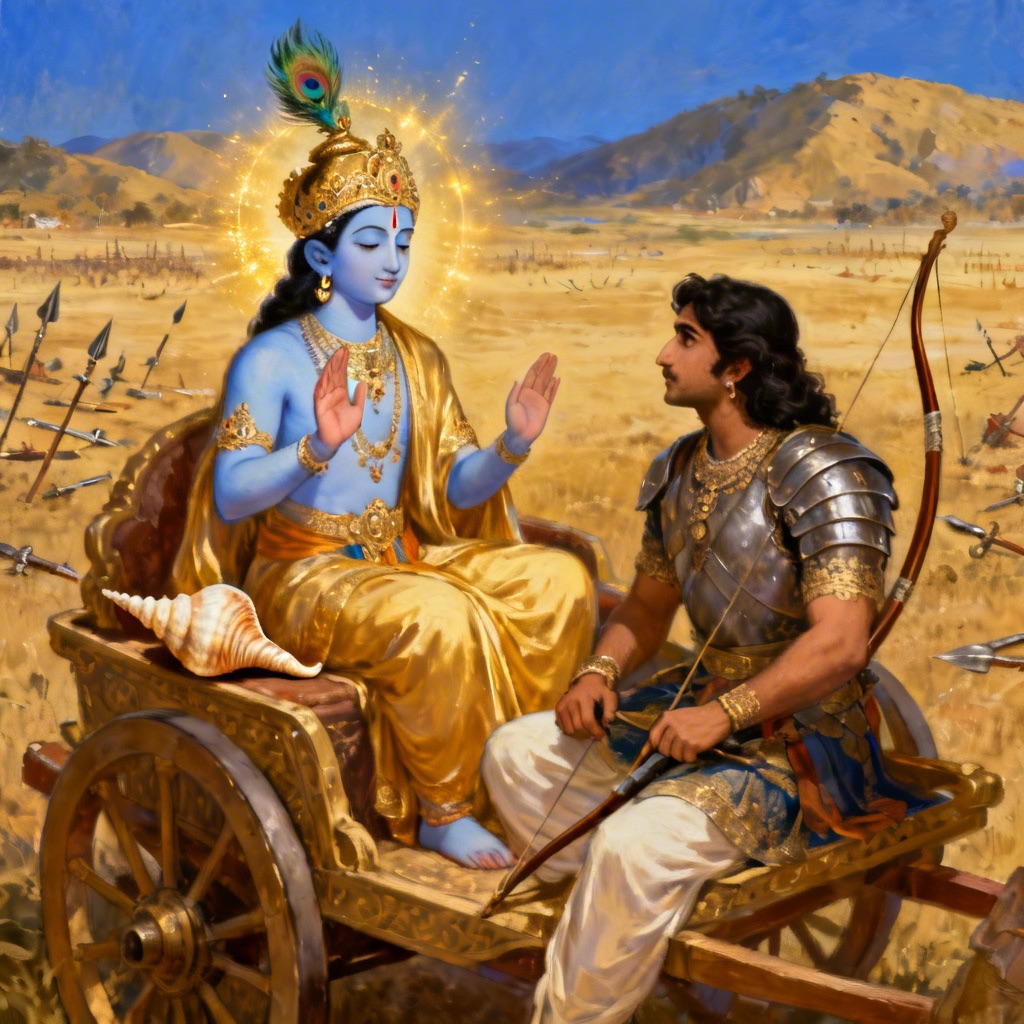
What a 5,000-Year-Old Battlefield Conversation can teach us About Leadership.
I used to think the Bhagavad Gita was just another religious text. Then I discovered it’s actually the most practical leadership guide ever written. Since then I have held on to this sacred book in different forms. The Printed Version, the Kindle eBook, Cards for daily reference.
When Everything’s on the Line, when you know that moment when you’re staring at a decision that could make or break everything? I’m talking about those tough situations which everyone faces in their lives, you don’t necessarily have to be a Leader, nevertheless running through scenarios, knowing that whatever you choose tomorrow will ripple through your team, your company, maybe even your entire career.
That’s where Arjuna was standing—literally on a battlefield, facing his cousins in what would be the bloodiest war in ancient history. And he completely froze. What happened next changed how I think about leadership forever.
Here’s what I got wrong about the Gita for years: I thought it was some mystical conversation between holy men sitting under trees, talking about detaching from the world.
No. This is two warriors having a very real conversation about duty, fear, and making impossible choices when lives hang in the balance. Arjuna isn’t asking for spiritual enlightenment—he’s asking for practical advice on how to lead when the stakes are crushing.
Sound familiar?
In today’s context it would look like this:
– Quarterly numbers. The Agony or Ecstacy.
– A product launch that could save or sink the company.
– Choosing between short-term profits and long-term values.
– Managing a team through a recession, merger, layoffs, or industry disruption. The pressure is different, but the paralysis feels exactly the same.
The Counter intuitive Secret That Changes Everything
Krishna’s advice to Arjuna seems backwards at first: “Do your absolute best work, then let go of the results.”
Wait, what? Isn’t caring about results what separates leaders from… well, everyone else?
But here’s what I’ve learned after trying this approach for years:
When you stop being desperately attached to specific outcomes, you actually get better outcomes. Try it. It holds true.
Why This Actually Works is, just think about it—when was the last time you made a great decision while panicking about the consequences?
When you’re white-knuckling the steering wheel, worried about where you’ll end up, you can’t actually steer very well.
But when you know you’ve done everything possible and you trust the process? That’s when the magic happens. You think clearer. You take smarter risks. You inspire confidence instead of spreading anxiety.
I saw this firsthand during my company’s worst times. Not once, but many times. Instead of running around like my hair was on fire, I focused on what we could control: our response time, our communication with clients, our team’s morale. We came out stronger. And honestly? I slept better. In fact I have never lost sleep over anything ever. Whatever may have been the situation I have managed to keep my wit’s cool.
Life Happens TO You, and you cannot stop that from happening, But You can definitely choose Your Response – on how to deal with it.
The Gita has this concept that basically divides everything into two buckets: stuff that happens to you (prarabdha) and how you respond to it (purushartha).
This sounds obvious until you realise how much energy we waste trying to control the first bucket. You Cannot.
Here’s What I Mean:
Sometime back one of our biggest and longest standing Client decided not to renew. One year of revenue, gone. That’s prarabdha—it happened, period.
But everything else? That’s on me:
– How I broke the news to the team- Whether I spiralled into worst-case scenarios or started planning our next move.
– Whether I used this as a learning opportunity or just complained about “disloyal clients”!!
You could spend days obsessing over what we could have done differently. Or you sit and analyse, make an last ditch effort to save if possible, and if even after giving it your best shot, then instead of ruminating look at alternative solutions. How to make up the lost revenue in the shortest span so that the effect is cushioned in the shortest span of time.
The Balance That Actually Matters
There’s this verse (Chapter 4, Verse 22, if you’re keeping track) that basically says balanced people don’t get thrown off by wins or losses. They just keep moving forward.
This isn’t about being emotionless—it’s about being consistent.
What This Looks Like in Practice
Good news: Celebrate for five minutes, then ask “What’s next?”
Bad news: Feel it for five minutes, then ask “What can we learn and Do next?”
Uncertainty: Work with what you know, then adapt as you learn more.
My Son figured this out before I did. He told me, “You used to be a roller coaster—amazing when things went well, impossible when they didn’t. Now we actually know what to expect from you.” He just told me to look at my old Photographs when I was younger.
That hit harder than any performance review.
The Best Analogy I’ve Ever Heard About Ambition.
The Gita compares desires to paan—that sweet digestive you have after a good meal. It’s nice, but you don’t need it to feel satisfied.
This completely reframed how I think about professional goals.
Instead of: “I need this promotion/deal/metric to prove I’m successful”
I started thinking: “I’m already pretty fortunate. This would be a nice bonus.”
Why This Isn’t Just Feel-Good Philosophy
When you’re not operating from desperation:
– You negotiate better (you’re not afraid to walk away).
– You make clearer decisions (you’re not clouded by need).
Actually Trying This Stuff (Not Just Nodding Along).
Look, reading about this is one thing. Actually doing it when your boss is breathing down your neck and wants answers is completely different.
Practice it in your daily life. Concentrate on doing great work without bothering on specific outcome. See what happens. How it balances your stress level.
When problems come up, spend your energy on your response, not on not on complaining about the problem.
Try to maintain same tone in meetings whether you’re delivering good news or bad news. It will have an impact on your Team. The energy percolates down.
None of this is groundbreaking. But doing it consistently? That’s where the real change happens.
Why a Battlefield Guide Still Works.
The reason the Gita works for modern leadership isn’t because it’s ancient wisdom (though it is). It’s because it was written for someone who had to make life-or-death decisions under impossible pressure.
The details are different, but the core challenge is the same: How do you lead effectively when the outcome matters desperately but you can’t guarantee success?
Answer: You control what you can control, you do your best work, and you trust the process. It’s not magic. But it works.
What’s your version of standing on that battlefield? The moment when everything you’ve worked for hangs on a decision you have to make? Remember: it’s not about predicting the future perfectly—it’s about showing up fully to the present.
P.S. – If this resonated with you, I’d love to hear about your own battlefield moments. Because honestly, We’re all just figuring this out as we go, and sometimes it helps to know we’re not alone out there.
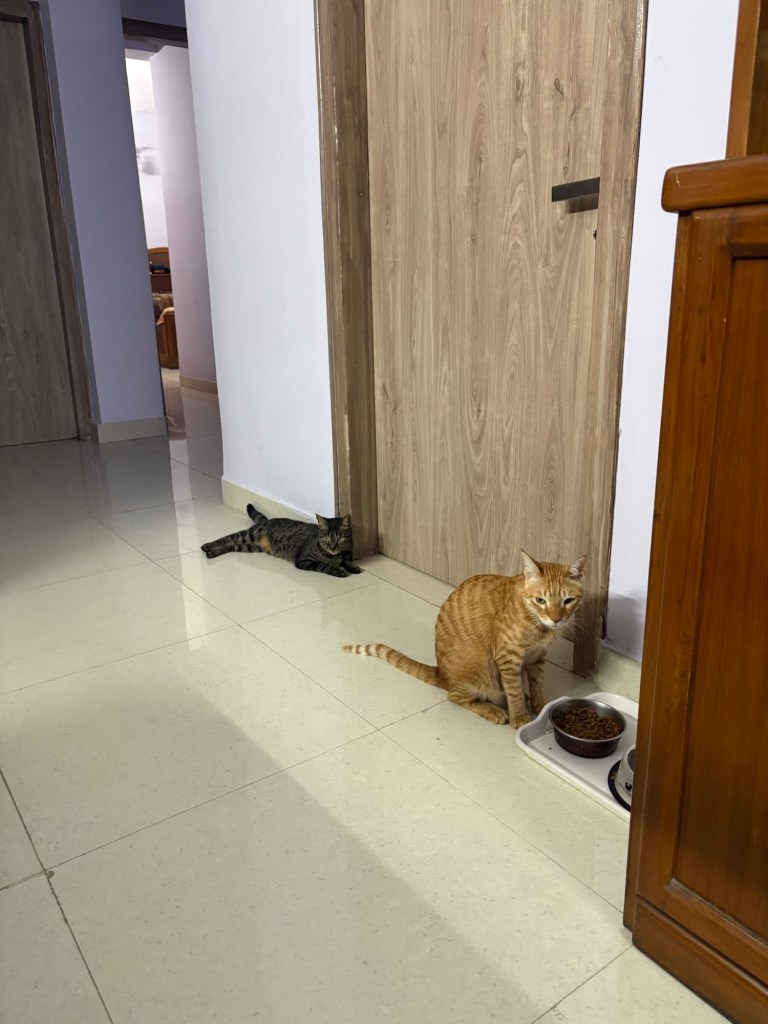
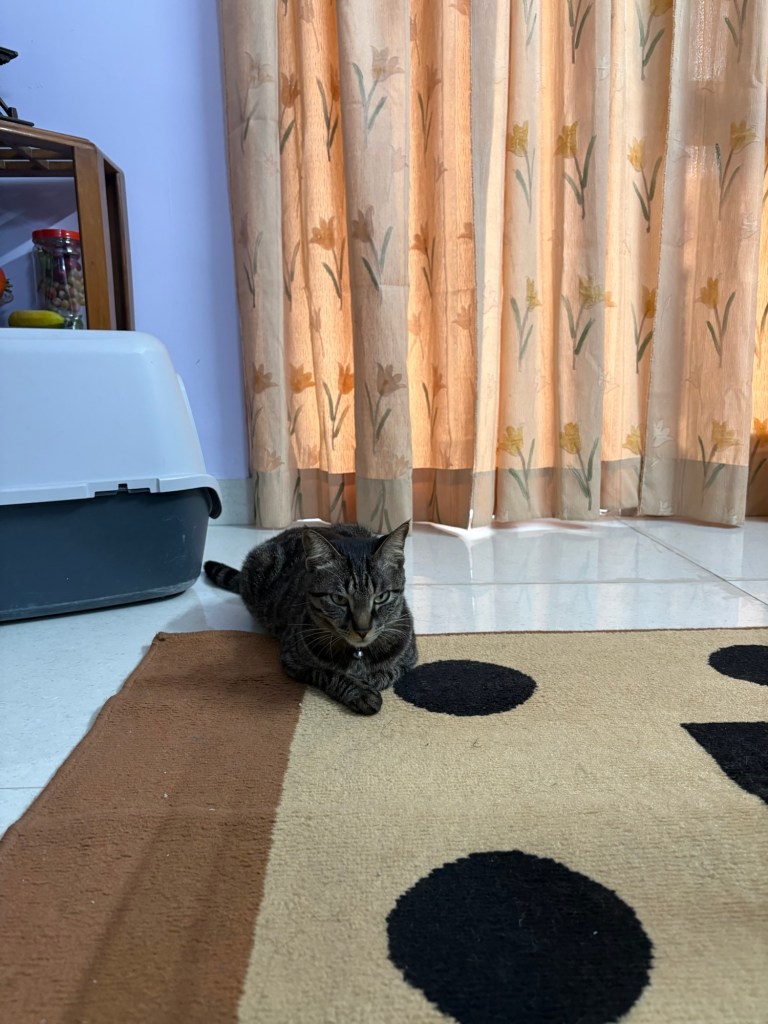
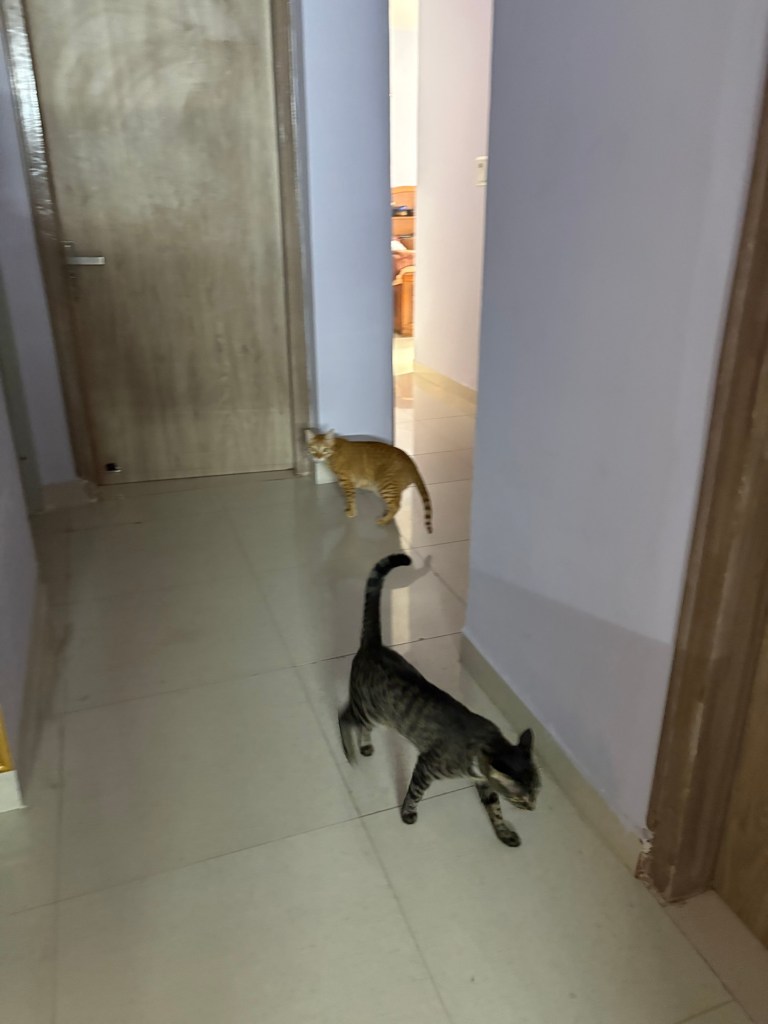
After the overwhelming success of their first adventure, our dynamic duo returns with even more hilarious hijinks! 😸
Chapter 1: The Throne Wars Begin 👑
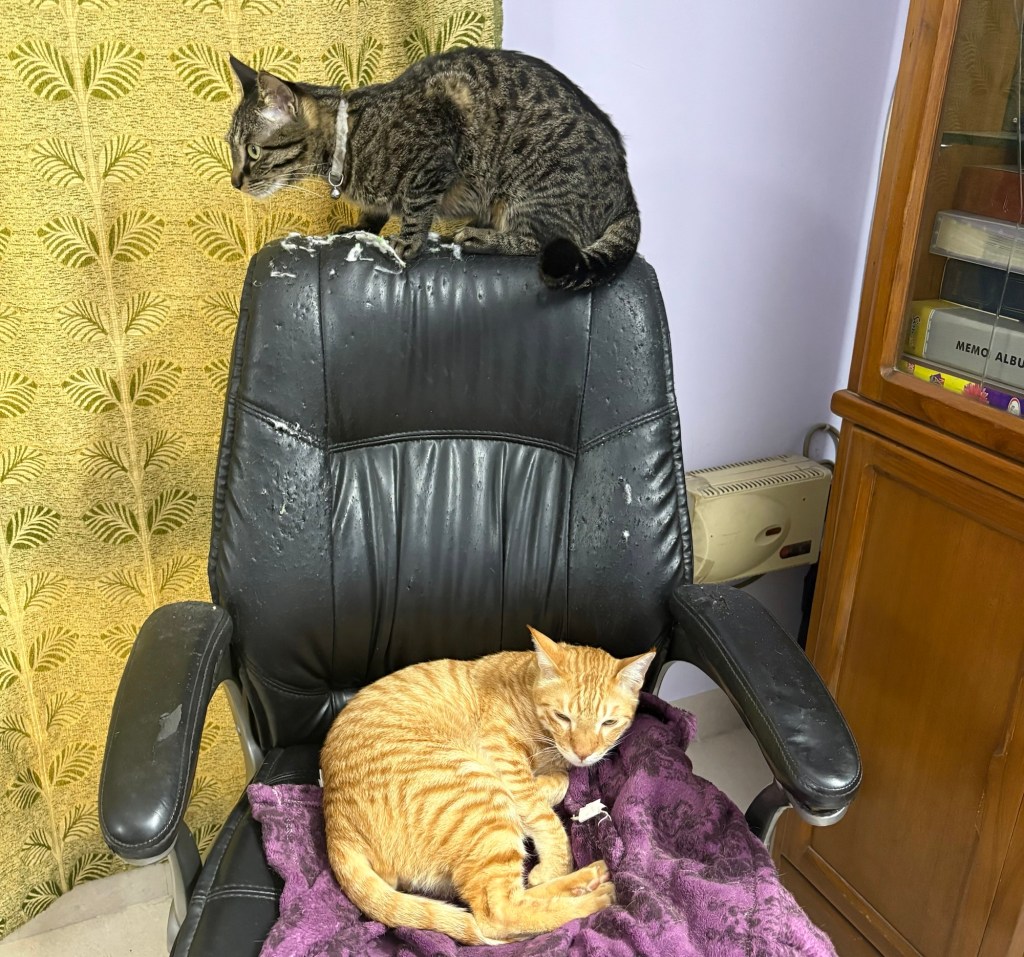
It was a Tuesday morning when Luna, our sleek black mastermind, discovered what she believed to be the ultimate power move in feline politics: chair domination. 😼
“Kiwi!” Luna announced from her perch atop the office chair, her green eyes gleaming with mischief. “I have made a groundbreaking discovery!”
Kiwi, currently engaged in the very important business of napping on his purple blanket below, opened one amber eye sceptically. “Let me guess… you’ve figured out how to open the treat cabinet?” 🍪
“Better!” Luna declared, dramatically gesturing with her paw. “I have discovered that whoever controls the chair… controls the ENTIRE household!”
Kiwi’s other eye popped open. This was either genius or completely ridiculous — and with Luna, it was usually both. 🤔
Chapter 2: Operation Chair-man of the Board 📋
Within hours, Luna had developed what she called “The Chair Strategy” — a comprehensive plan to claim every seat in the house. Her logic was flawless (in her mind): if humans always sat in chairs to do important things, then chairs must be the source of all power! 💺
“Phase One,” Luna explained to Kiwi while demonstrating her ‘intimidating chair pose’ (which looked suspiciously like a regular cat loaf), “we establish dominance over the office chair. This is clearly the command centre.”
Kiwi watched as Luna attempted to look regal while simultaneously trying not to slide off the leather seat. “Luna, you do realize you’re basically just… sitting there, right?” 😂
“EXACTLY!” Luna exclaimed, nearly losing her balance. “Strategic sitting! It’s all about the attitude, Kiwi. Watch and learn!”
● What followed was Luna’s attempt at ‘power poses’ on the chair, which included:
● The ‘CEO Loaf’ (looking important while doing absolutely nothing) 💼
● The ‘Boardroom Stretch’ (dramatically extending one paw) ✋
● The ‘Executive Nap’ (sleeping with one eye open to maintain authority) 😴
Chapter 3: Kiwi’s Counter-Strategy 🎯
Meanwhile, Kiwi had developed his own approach to the chair situation. While Luna was busy being ‘important’ up top, she had discovered the true secret: the chair’s secret compartment — also known as the space underneath where his purple blanket created the perfect cozy cave! 🏠
“You know, Luna,” Kiwi called up from his blanket fortress, “while you’re up there trying to rule the world, I’m down here actually comfortable. Plus, I have the advantage of being able to attack your tail anytime I want!” 🎯
This had not occurred to Luna. She peered down suspiciously. “Kiwi… you wouldn’t dare…”
“Wouldn’t I?” Kiwi’s eyes twinkled with mischief as he wiggled his bottom, preparing to pounce. 😈
Chapter 4: The Great Chair Chase 🏃♀️
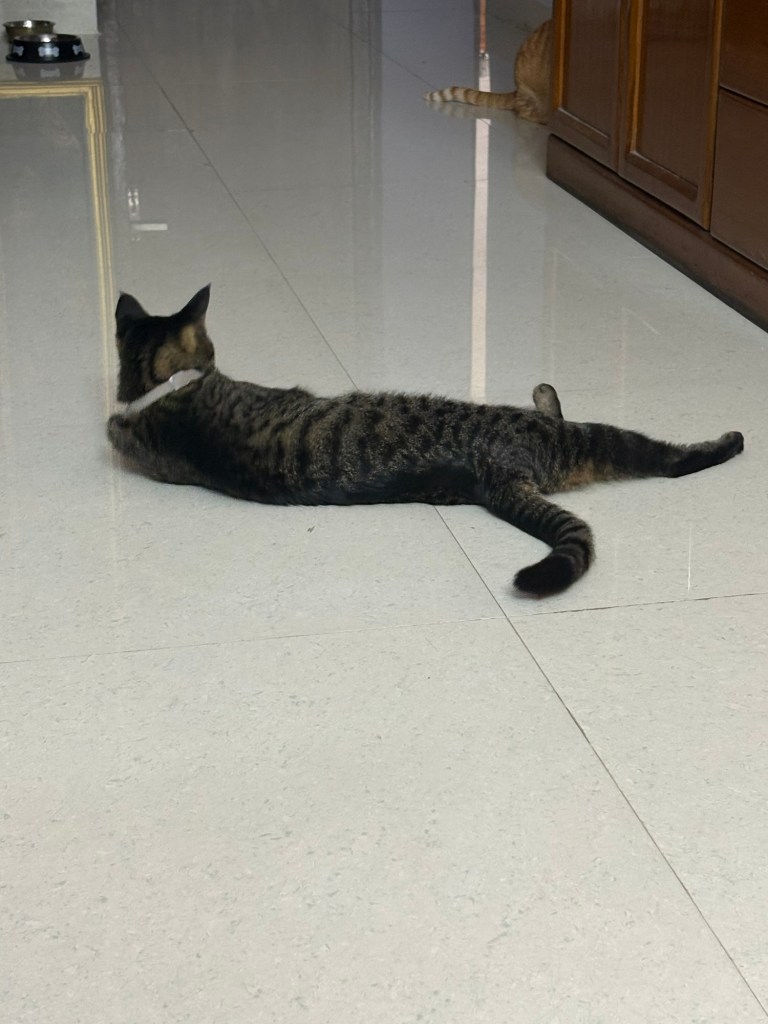
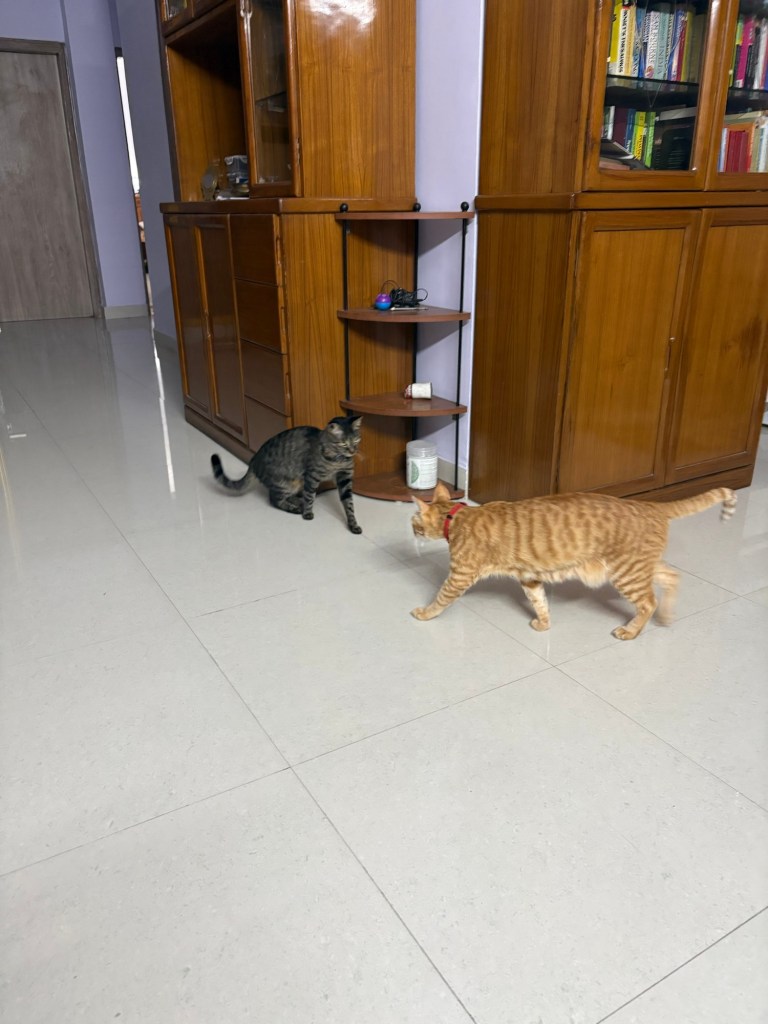
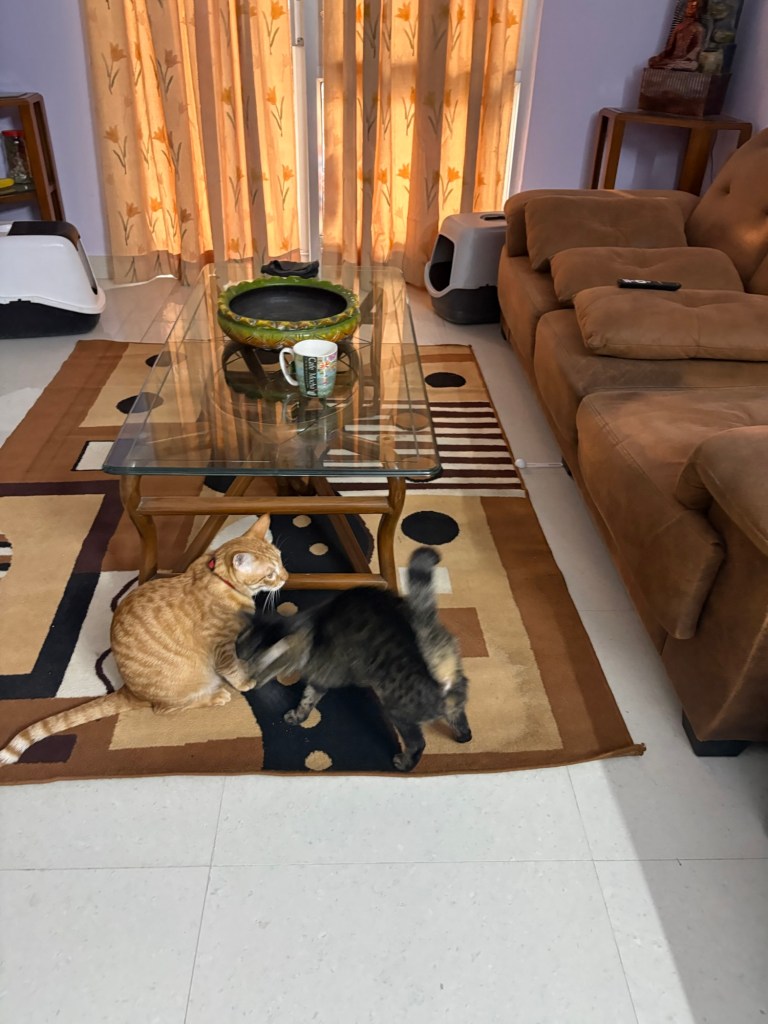
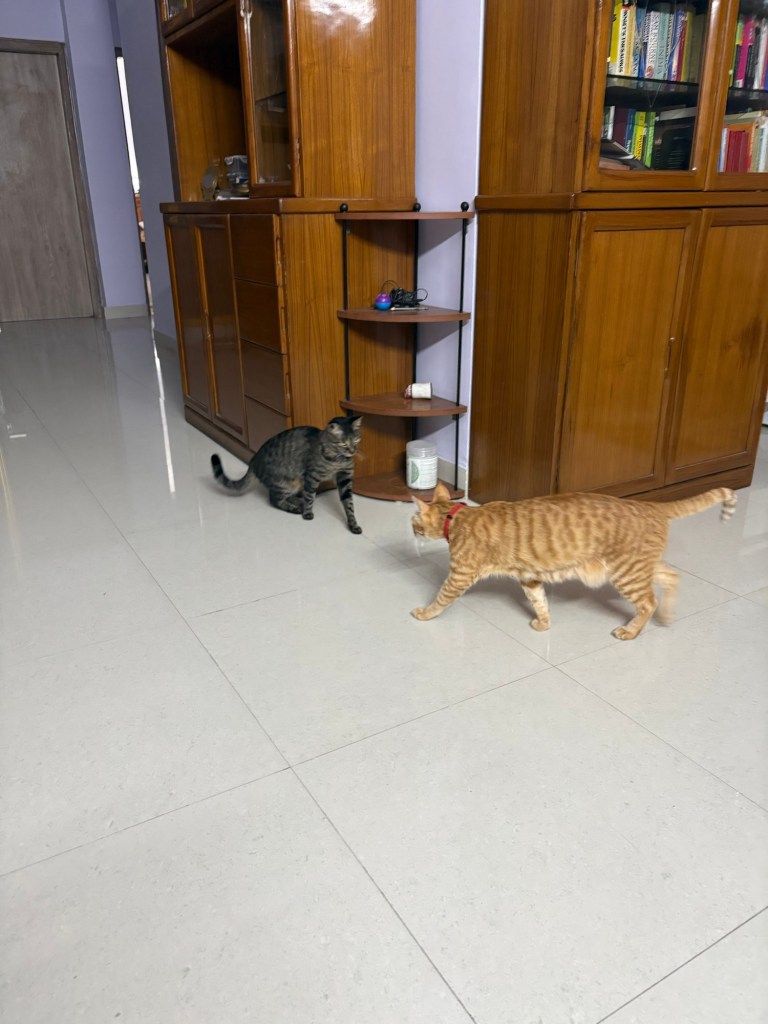
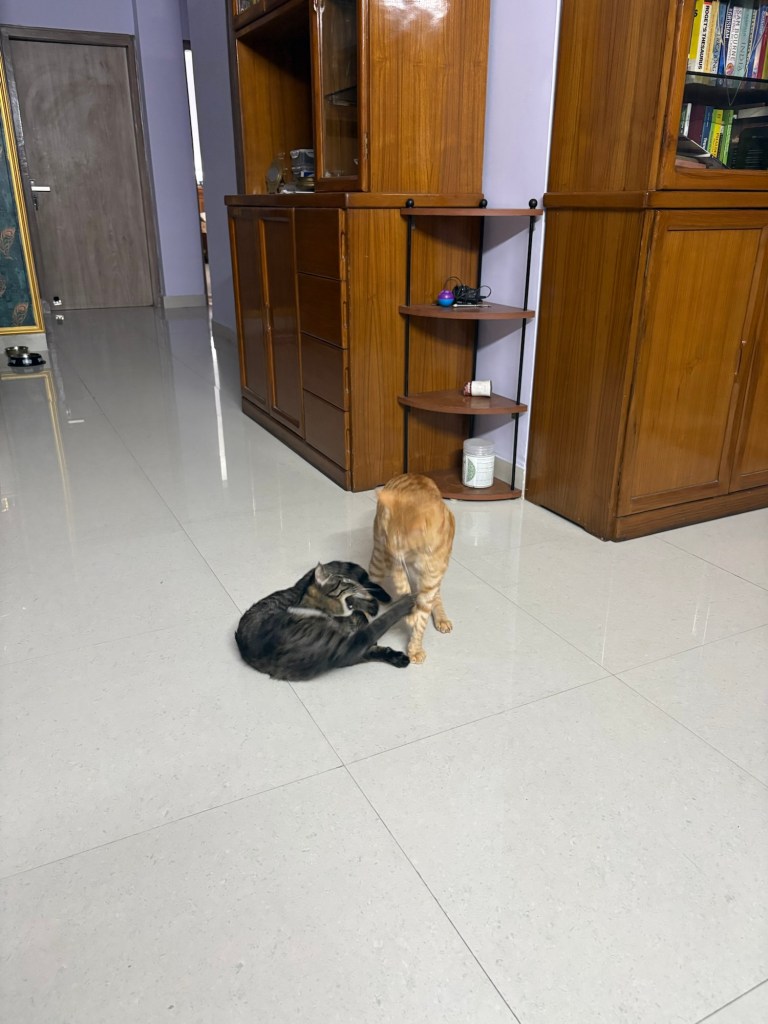
What happened next could only be described as ‘controlled chaos.’ Kiwi launched himself at Luna’s dangling tail, Luna leaped from the chair with a dramatic yowl, and both cats proceeded to engage in what their humans would later describe as ‘the Great Living Room Chase of Tuesday Afternoon.’ 🌪️
● The chase route included:
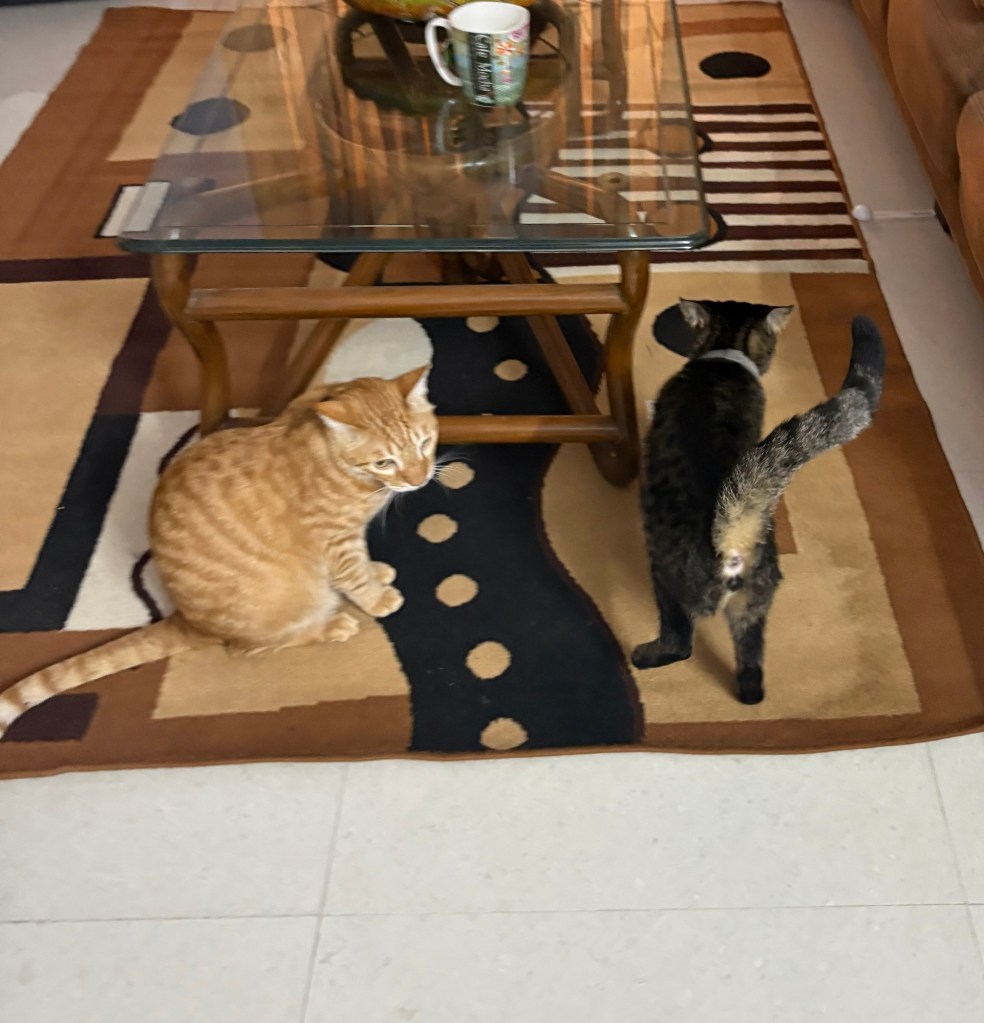
● Three laps around the coffee table (nearly knocking over the plant) 🌿
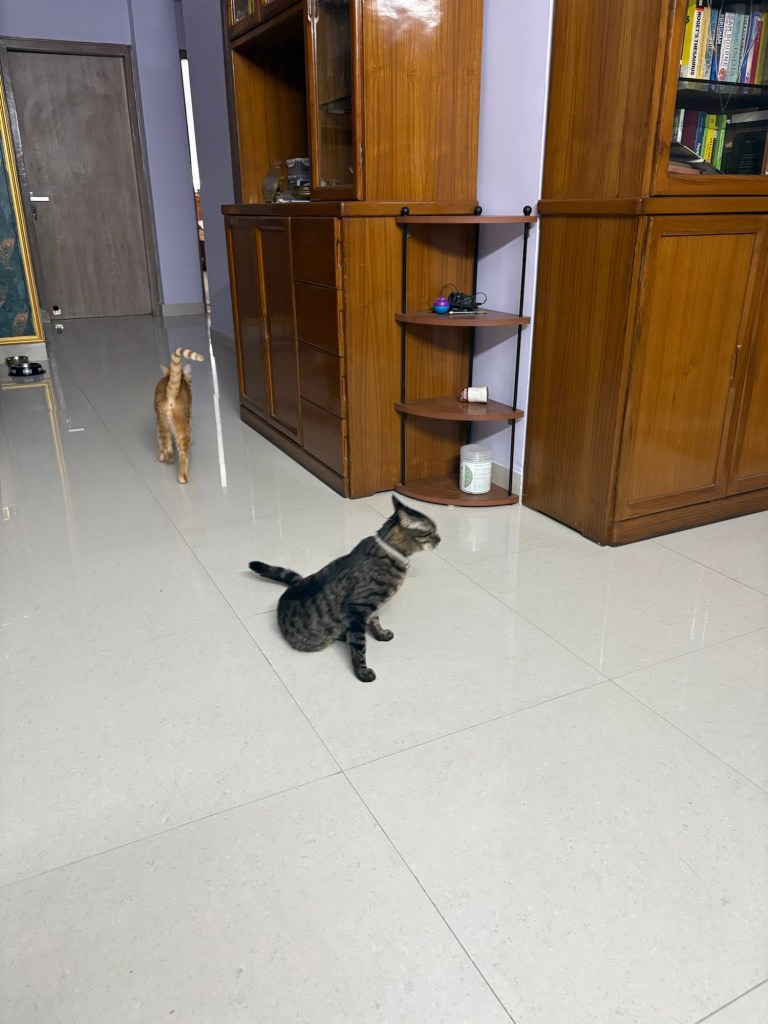
● A dramatic leap over the food bowls (with Kiwi pausing mid-chase for a quick snack) 🍽️
● An epic standoff in the hallway that lasted exactly 3.7 seconds ⏱️
● A strategic retreat to opposite ends of the living room carpet 📍
Chapter 5: The Peace Treaty 🕊️
After their epic chase, both cats found themselves panting on the geometric rug, staring at each other across the vast expanse of… three feet. 📏
“You know,” Luna panted, “maybe this chair thing is bigger than both of us.”
“Agreed,” Kiwi replied, already eyeing a sunny spot by the window. “Plus, I just remembered that the best seat in the house is actually that warm patch of sunlight that moves around the living room.” ☀️
Luna’s eyes lit up. “Ooh! The mysterious moving warm spot! I’ve been trying to figure out how to catch that for weeks!”
And so, their great chair conspiracy evolved into something far more important: a joint investigation into the phenomenon of ‘traveling sunshine.’ Because really, what’s the point of ruling from a chair when you could be basking in a sunbeam? 🌞
Chapter 6: The Plot Thickens… 🕵️♀️
As our story comes to a close, Luna and Kiwi have formed an unlikely alliance. Luna, with her strategic mind, and Kiwi, with his laid-back wisdom, make the perfect team for investigating the house’s greatest mysteries. 🔍
● Their current theories about the moving sunbeam include:
● It’s controlled by the same force that moves the red dot (highly suspicious) 🔴
● The humans are secretly operating a giant outdoor flashlight (plausible) 🔦
● It’s magic (Luna’s favorite theory) ✨
● It’s just physics (Kiwi’s boring but probably correct theory) 🔬
Epilogue: The Continuing Adventures 📖
As the sun sets on another day in the household, Luna can be found conducting ‘important research’ from her new favorite spot (the top of the bookshelf, because elevation equals authority, obviously), while Kiwi has mastered the art of the ‘strategic blanket burrow.’ 📚
Their humans remain blissfully unaware that they’re living with two furry masterminds who spend their days developing complex theories about household management and the fundamental forces of nature. 🤓
But Luna and Kiwi know the truth: every day is an adventure when you have a best friend to share your ridiculous ideas with — even if those ideas involve treating furniture like thrones and sunbeams like treasure. 💎
Stay tuned for the next episode, where our dynamic duo attempts to solve the mystery of the ‘Midnight Food Bowl Bandit’ (spoiler alert: it’s probably also them). 🌙
The End… for now! 😸
— -
💭 What did you think of Luna and Kiwi’s latest adventure? Share your favorite moment in the comments below! And if your pets have their own quirky theories about how the world works, we’d love to hear about them! 🐾
Finding Your Inner Circle: The Art of Building Your S10
A journey toward authentic leadership and meaningful connections.
The Power of the Few.
In our hyper-connected world, we often forget a fundamental truth: you don’t need everyone to believe in your vision—you just need the right ones.
Throughout history, the most impactful leaders understood this principle. They cultivated a select group of trusted advisors, confidants, and supporters who became the backbone of their success. I call this your S10**—your Strategic 10. These are the people who will stand by you, challenge you, and help you reach the culmination of your real objectives.
The Ancient Wisdom of Oral Tradition
There’s something profound about the spoken word that written text can never fully capture. Consider how the Vedas were passed down through generations—not through scrolls or tablets, but from mouth to ear, creating an unbroken chain of wisdom and understanding.
When we speak our truths, when we share our visions verbally, something magical happens:
– Our passion becomes palpable.
– Our conviction carries weight.
– Our humanity shines through.
This is why great rulers maintained councils—not just for their knowledge, but for their ability to communicate, inspire, and deliver results through authentic connection.
The S10 Project: A Labor of Love
Like preparing the perfect biryani over a slow flame, identifying your S10 requires patience, intention, and careful attention to detail. This isn’t a process you can rush—it’s a continuous quality endeavor that deserves the same dedication you’d give to any masterpiece.
The Selection Principles:
No Elimination Without Cause Every person in your consideration deserves fair evaluation. Names don’t get crossed off lightly.
Holistic Assessment One conversation, one interaction, one moment doesn’t define someone’s potential value to your circle.
Continuous Evolution Like quality itself, this is an ongoing process. Your S10 may shift as you grow and your mission evolves.
Time-Tested Validation Just as the finest biryanis need time to develop their full flavor, the best relationships reveal their true worth over time.
The Multimedia Advantage
While I write these words now, I recognise that written content only captures part of the story. The tremor in a voice when someone shares their deepest conviction, the sparkle in eyes when passion ignites, the pause that speaks volumes—these elements transform mere information into transformation.
This is why the greatest teachers, from ancient gurus to modern thought leaders, understand that multi-sensory communication creates deeper impact:
– Visual elements engage imagination.
– Audio conveys emotion and nuance.
– Written words provide structure and reference.
– Personal interaction builds trust and connection.
Building Your Own Council
As you work toward becoming a thought leader who makes a real difference, ask yourself:
Who are the people that…
– Challenge your thinking without crushing your spirit?
– Celebrate your wins authentically?
– Offer honest feedback when you need course correction?
– Stand by you when others doubt?
– Amplify your message because they truly believe in it?These are your potential S10 members. They’re not necessarily the loudest voices or the most obvious choices—they’re the ones whose values align with yours and whose presence makes you a better version of yourself.
The Marathon Mindset
Remember, this isn’t a sprint to a finish line—it’s a 25-year journey of continuous growth, refinement, and impact. Your S10 today might look different from your S10 in five years, and that’s not just okay—it’s expected and healthy.
The goal isn’t perfection; it’s authentic progress toward meaningful impact.
Closing Wisdom: The Rules for a Happy Life
As we navigate this journey of building our circles and our influence, let’s anchor ourselves in timeless wisdom:
1. Don’t HATE – Life is too short to waste time hating. That energy could be channeled into building something beautiful instead.
2. Don’t COMPARE – Don’t try to be someone else. The world already has them—what it needs is the best version of YOU.
3. Don’t WORRY trust yourself.
The day you stop worrying will be the FIRST day of your NEW LIFE.
Trust the process, trust your S10.
What started as a pet project has become a profound reminder: we’re not meant to journey alone. We’re meant to find our people, nurture those relationships, and together, create the change we wish to see in the world.
In the fast-paced world of entrepreneurship, it’s easy to get caught up in the rush to grow, to scale, to succeed. But what separates thriving businesses from those that collapse under their own weight? The answer lies in two fundamental leadership principles that have proven their worth time and again: building a solid foundation and understanding that scalability is a science, not a gamble.
The most important phase is the first phase which is primarily the development stage. It is during this time that every decision feels urgent. You’re bootstrapping, hustling, and trying to make every rupee count. In these crucial early days, it’s tempting to look for quick fixes—cheap systems that promise rapid results with minimal effort. But this is precisely where mistakes are made. Penny wise and pound foolish.
A visionary leader understands that investing in a robust, reliable foundation is not an expense—it’s an investment in the future. It is difficult but doable. Remember Business is like a rocket that you want to send into orbit. As in any Rocket, there is the initial propulsion which takes the Rocket out of the Earth’s gravitational pull, which in terms of a Business is the first 2-3 years, and then the propulsion stage where the Rocket moves into orbit, which is the 10-12 Year phase. Both these phases are absolutely important.
Why Foundation Matters
Consider the foundation of building or any infrastructure. Architects don’t cut corners on the base to save money on the upper floors. They know that without a fortress-like foundation, the entire structure will eventually crumble, no matter how beautiful the facade. Your business foundation works the same way. And we know the consequences of this neglect when newly constructed flyovers or buildings collapse. The same happens for your business as well.
When you resist the temptation for quick fixes and instead pour your resources—time, energy, capital, and talent—into building something robust and reliable, you create an ideal platform for sustainable growth Systems that can handle increased demand without breaking. A culture of excellence that attracts top talent Operational efficiency that scales naturally. The credibility and trust needed to pursue expansion plans.
When leaders opt for sloppy, makeshift solutions to save time or money upfront, they inevitably pay a much steeper price later. Technical debt accumulates. The team becomes frustrated with unreliable systems. Customers experience inconsistencies. And when you finally try to scale, everything comes crashing down because the foundation was never adequate to support growth.
The companies that dominate their industries—the Amazons, the Apples, the organisations that survive economic downturns and industry disruptions—are those that invested heavily in their foundations. They didn’t cut corners. They built fortresses.
Once your foundation is solid, the next critical phase is scaling. But here’s what many leaders get wrong: they treat scalability like a lottery ticket, hoping that growth will happen if they just push harder or spend more money. The truth is far more elegant—scalability is a science. Scalability isn’t about explosive growth; it’s about linear strategic growth achieved methodically over time. When you scale a business properly, you’re not just increasing revenue—you’re doing more with proportionally less effort. You’re creating leverage.
For a business to truly be scalable, it must focus on two core principles:
Increasing efficiency: Doing more with fewer resources, time, and effort.
Adding value: Ensuring that each increment of growth delivers proportional or greater value to customers and stakeholders.
Before you make the critical decision to scale, a thorough evaluation is essential. Ask yourself these questions:
Are my systems and processes optimised for growth? Do I have the right team in place to support expansion?
Is my market large enough to justify the investment?
What are the financial implications of scaling?
How will this growth affect my brand and customer experience?
Strategic scaling requires intentional planning. You must establish a clear growth trajectory that answers these critical questions:
What speed? How fast do you want to grow—and more importantly, how fast can you grow without sacrificing quality?What route? Which markets, channels, or customer segments will drive your growth? What resources? What investments in capital, talent, and technology do you need?When to pause? Recognising when to slow down to maintain quality or reassess your strategy.
When to finish? Knowing your end goal—whether it’s a specific market share, revenue target, or operational maturity.
These two lessons aren’t separate paths—they’re interconnected. Your solid foundation enables you to scale confidently. And your understanding of scalability as a science ensures that your foundation will continue to support your growth without buckling under pressure.
As a leader, your responsibility is to resist the siren song of shortcuts and quick wins. Build something that lasts. Be intentional about your growth. Treat scaling like the serious, scientific endeavour it truly is.
The businesses that thrive aren’t the ones that grew fastest—they’re the ones that grew smartest. And that smartness starts with a leader who understands these two timeless principles.
Build your fortress. Scale with science. Lead with vision.








 Capt. Shaji Kumar