We live in a world that has almost normalized stress.
Being busy is worn like a badge of honour. Sleepless nights are celebrated as dedication. Anxiety is dismissed as part of ambition. Burnout is called success.
But let me ask you one simple question.
If stress is the problem, why do so many people eliminate one source of stress only to find another waiting for them?
Someone changes jobs.
The work stress disappears.
Financial stress arrives.
They earn more.
Relationship stress begins.
They improve relationships.
Health anxiety takes over.
It is an endless cycle.
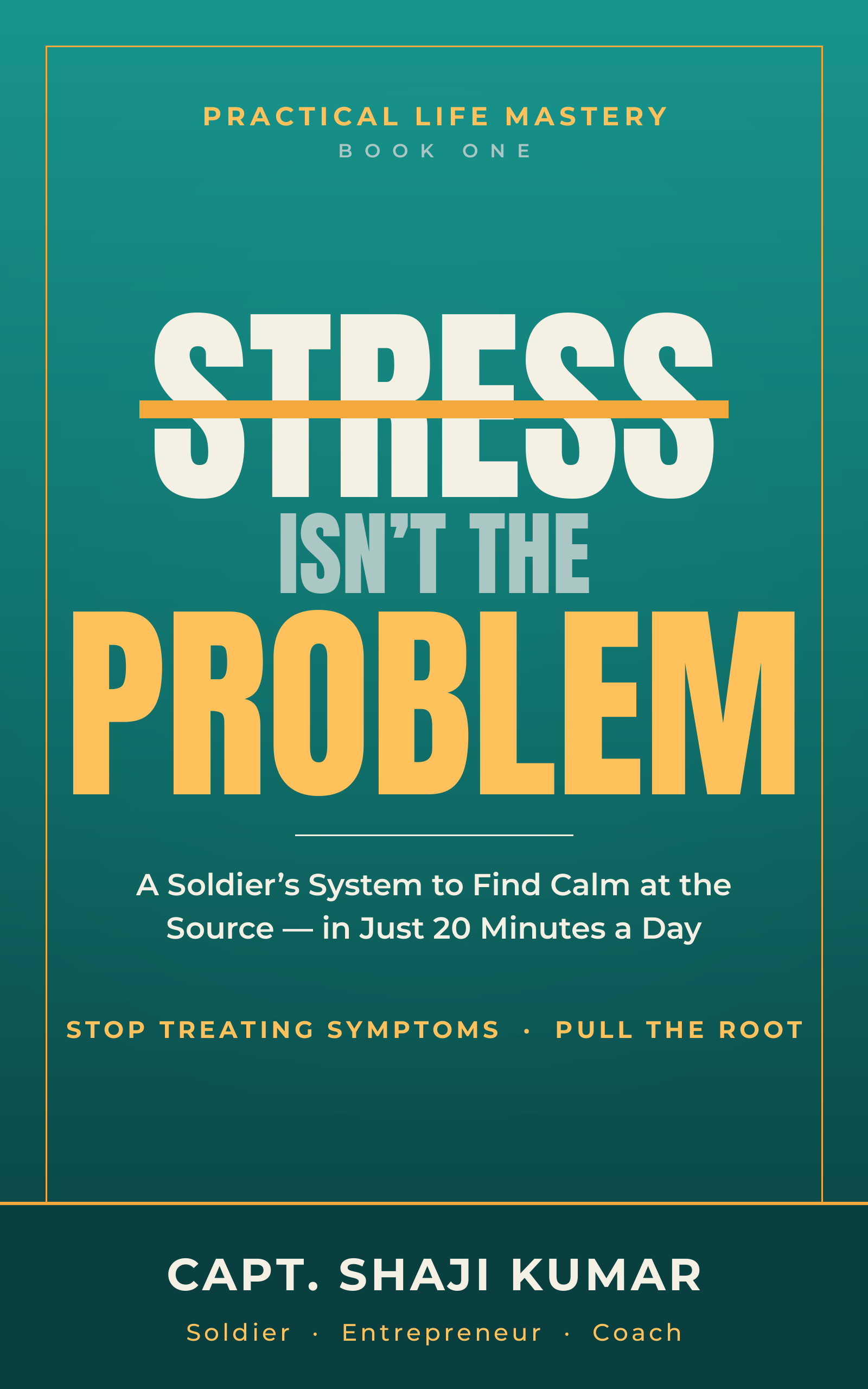
That is precisely why I wrote “Stress Isn’t The Problem.”
Because after spending decades in the Indian Army, building businesses, leading teams, facing personal setbacks and rebuilding life more than once, I realised something profound.
Stress is rarely the real problem.
It is only the symptom.
We Keep Treating Symptoms
Modern life offers countless solutions.
Meditation apps.
Music.
Vacations.
Weekend breaks.
Motivational videos.
Breathing exercises.
Most of them work.
For a while.
But then stress quietly returns wearing a different mask.
Why?
Because we keep removing leaves while the roots remain untouched.
Imagine a tree whose leaves keep turning yellow.
You can polish the leaves.
Trim them.
Spray them.
Replace them.
But unless you fix the roots, nothing changes.
Stress works exactly like that.
My Journey Changed the Way I Understood Stress
The lessons in this book did not come from a laboratory.
They came from life.
From military service.
From entrepreneurship.
From leadership.
From financial uncertainty.
From success.
From failure.
From rebuilding after losing almost everything.
There were moments when I realised something remarkable.
The people who stayed calm under immense pressure were not necessarily stronger.
They simply understood where stress was actually coming from.
That became the foundation of this book.
Stress Has Many Faces
Most people believe stress is just one thing.
It isn’t.
Stress appears in many forms.
Financial stress.
Career stress.
Family stress.
Health stress.
Relationship stress.
Identity stress.
Purpose stress.
Treating all of them with one generic solution is like prescribing the same medicine for every illness.
It simply doesn’t work.
One of the central ideas in my book is identifying the seven branches of stress so that you stop fighting the wrong battle.
Stop Asking, “How Do I Reduce Stress?”
Start asking,
“What is creating this stress?”
That single shift changes everything.
Instead of becoming reactive, you become aware.
Instead of suppressing emotions, you begin understanding them.
Instead of surviving every day, you begin designing a better life.
Clarity Is the Real Antidote
Throughout my coaching programmes under Clarity Under Pressure™, I have observed one common pattern.
People rarely lack intelligence.
They rarely lack capability.
They lack clarity.
Unclear priorities.
Unclear goals.
Unclear expectations.
Unclear boundaries.
And uncertainty is one of the greatest generators of stress.
When clarity increases, stress naturally begins to decrease.
That is why this book is not another motivational book.
It is a practical system.
A Soldier’s Framework
Military training teaches something invaluable.
When pressure increases, you don’t panic.
You return to your system.
That philosophy shaped this book.
Inside, you’ll discover:
Why chasing symptoms keeps you exhausted.
The seven branches of stress and how to identify which one is affecting you.
A practical 20-minute daily practice that helps reset your mind.
A simple seven-day reset.
A Pocket Protocol you can use whenever life feels overwhelming.
Nothing complicated.
Nothing theoretical.
Just practical methods that can be applied immediately.
Who Should Read This Book?
This book is for you if:
You constantly feel mentally exhausted.
Your mind refuses to switch off.
Work follows you home.
Small problems feel overwhelming.
You’re successful on the outside but restless within.
You want practical solutions instead of motivational speeches.
Whether you’re a professional, entrepreneur, student, leader, parent or someone simply trying to regain control of life, this book was written with you in mind.
Stress Doesn’t Need Another Escape Route
It needs understanding.
When you understand its source, you stop fearing it.
When you stop fearing it, you begin leading your life instead of reacting to it.
That is the transformation I hope every reader experiences.
A Personal Invitation
If this article resonated with you, I invite you to read my latest book:
Money flows faster than ever, yet peace of mind feels rarer than gold.
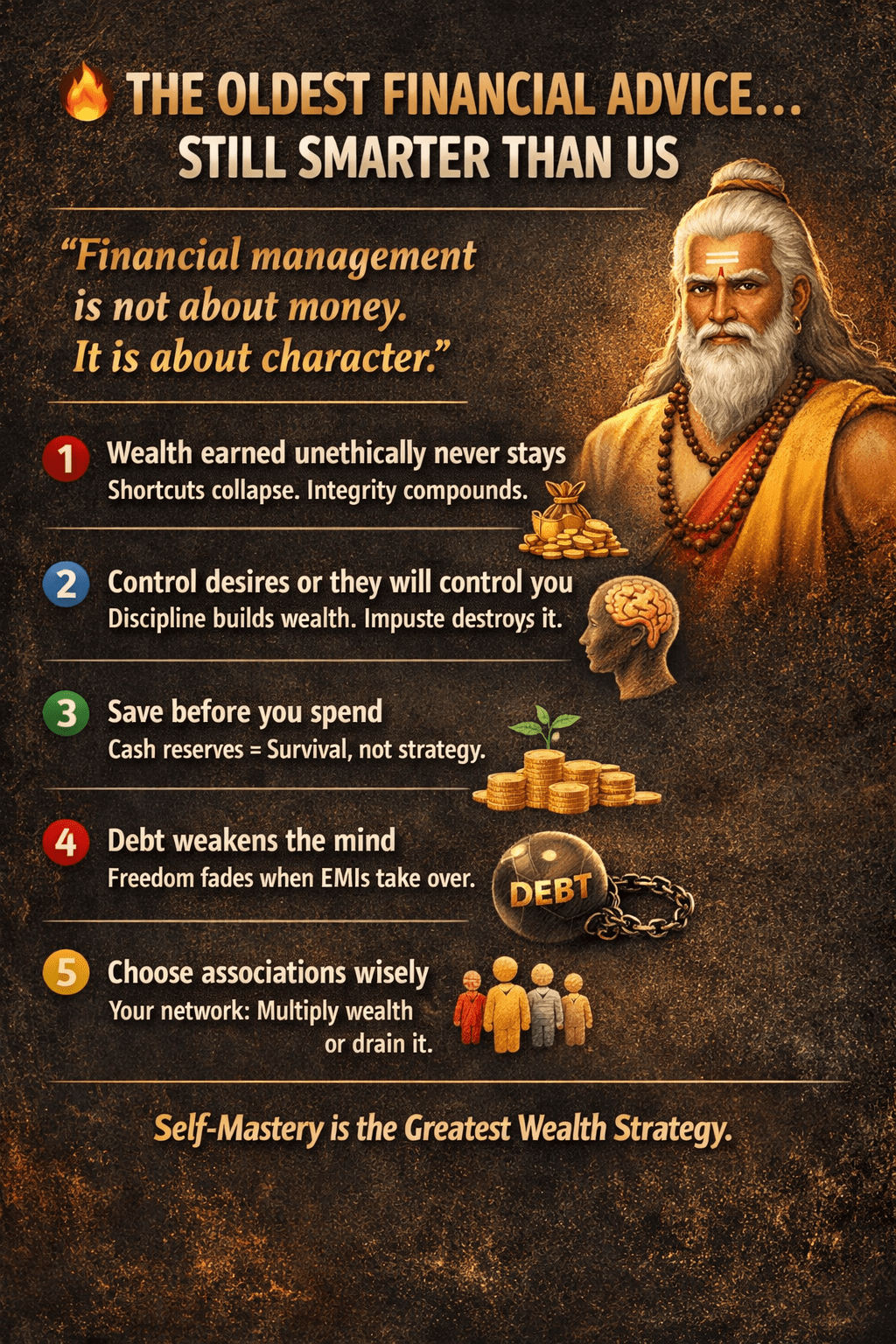
Every generation believes it invented financial wisdom — until it meets Vidur Niti.
Three thousand years ago, Vidur, the royal advisor in the Mahabharata, spoke truths that still cut through the noise of modern finance. His words weren’t about numbers or markets. They were about character — the foundation of every sustainable fortune.
Wealth Earned Unethically Never Stays.
Vidur warned that wealth gained through deceit destroys the one who holds it.
It’s not karma — it’s mathematics.
Unethical gains create instability, distrust, and eventual collapse.
In today’s world, this translates to:
Shortcuts collapse. Integrity compounds.
The most valuable currency is credibility.
Control Desires or They Will Control You
Vidur didn’t blame poverty on lack of income. He blamed it on lack of restraint.
Desire, when unchecked, becomes debt.
We call it lifestyle inflation, impulse buying, or social comparison — but it’s the same disease.
Discipline builds wealth. Impulse destroys it.
The richest people aren’t those who earn the most — they’re those who can say no.
Save Before You Spend
Vidur insisted that a wise person always keeps reserves for difficult times.
In modern language: build your emergency fund before your dream fund.
Savings are not a financial strategy.
They are a survival strategy.
Debt Weakens the Mind
Vidur saw debt as a spiritual and psychological burden.
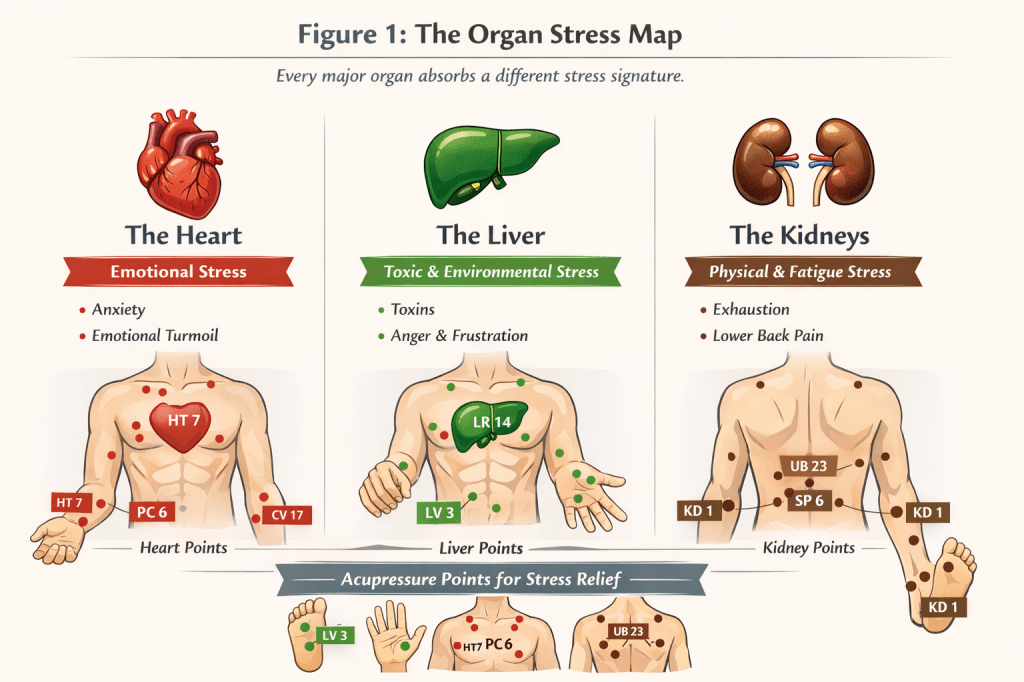
Your body has been keeping a very detailed record of everything you have been through. It is written in your organs. Time to read it — and respond.
There is a reason this phrase has become famous in the world of trauma and stress research. The body does not experience stress as an abstract event that happens to the mind. It experiences it as a physical event that happens to tissue, glands, organs, and cells. And over time, the tissue remembers.
In traditional Chinese Medicine, this understanding is thousands of years old — and expressed with elegant precision. Each major organ is associated not just with a physiological function but with an emotional domain. The heart with joy and its absence. The liver with smooth flow and, when disrupted, with anger and frustration. The kidneys with the capacity to face life without fear. The lungs with the ability to take in and let go — breath by breath. When stress persists, these emotional-organ relationships become sites of accumulation. The organ that carries the load eventually shows it.
Today’s post maps exactly where your specific stress pattern might be living — and gives you a targeted acupressure protocol for each organ system. You will likely recognise your own pattern before you finish reading.
The Heart — When Stress Becomes a Feeling You Cannot Name
The Chinese medical classics describe the Heart as the emperor of all organs — the one that must remain calm and clear for all the others to function. When stress is relentless and the Heart is disturbed, the first sign is rarely physical. It is the inability to feel settled. The sense that something is wrong even when nothing specific is wrong. The racing thoughts at night. The disproportionate emotional response to small things. These are signs that the Heart’s Shen — its governing spirit and consciousness — is disturbed.
Physically, the heart under stress shows up as palpitations, elevated resting heart rate, blood pressure that is persistently high even when you are trying to rest, and a strange kind of chest tightness that comes and goes without a clear cause. Long-term, the cardiovascular consequences of unresolved stress are among the most serious and well-documented in medicine.
Heart Protocol
CV 17 (sternum centre): 2 minutes, sustained and gentle, with slow breath
BL 15 (back, level with heart): Tennis ball or partner press, 90 seconds, eyes closed
HT 7 (wrist crease, Spirit Gate): 2 minutes, press steadily while breathing out slowly
PC 6 (inner wrist, 2.5 fingers up): 90 seconds each wrist — the Heart’s protector point
Lifestyle addition: One tablespoon of raw honey in warm water each morning has been used across traditional medicine systems to support the heart and calm the spirit. Add a small pinch of cardamom — a heart-supportive spice with documented vasodilatory properties.
The Liver — Where Frustration Goes to Live
Of all the organ-stress relationships in Chinese medicine, the Liver-stress connection is perhaps the most immediately recognisable to a modern audience. When the Liver qi is constrained — when the smooth flow of energy through the body is blocked — the emotional signature is unmistakable: irritability that arrives before you have even had time to think, a short fuse that surprises even you, the feeling of things being stuck or obstructed, tension in the sides of the body and the ribcage.
Sound familiar? For most people living with chronic stress, the liver meridian is involved. And the physical consequences of long-term liver qi stagnation are not trivial: disrupted hormone metabolism, impaired detoxification, elevated inflammatory markers, digestive disturbance (the liver and the digestive system are intimately linked), and increasingly, research connecting liver health to mood disorders in ways that blur the traditional line between ‘physical’ and ‘mental’ health.
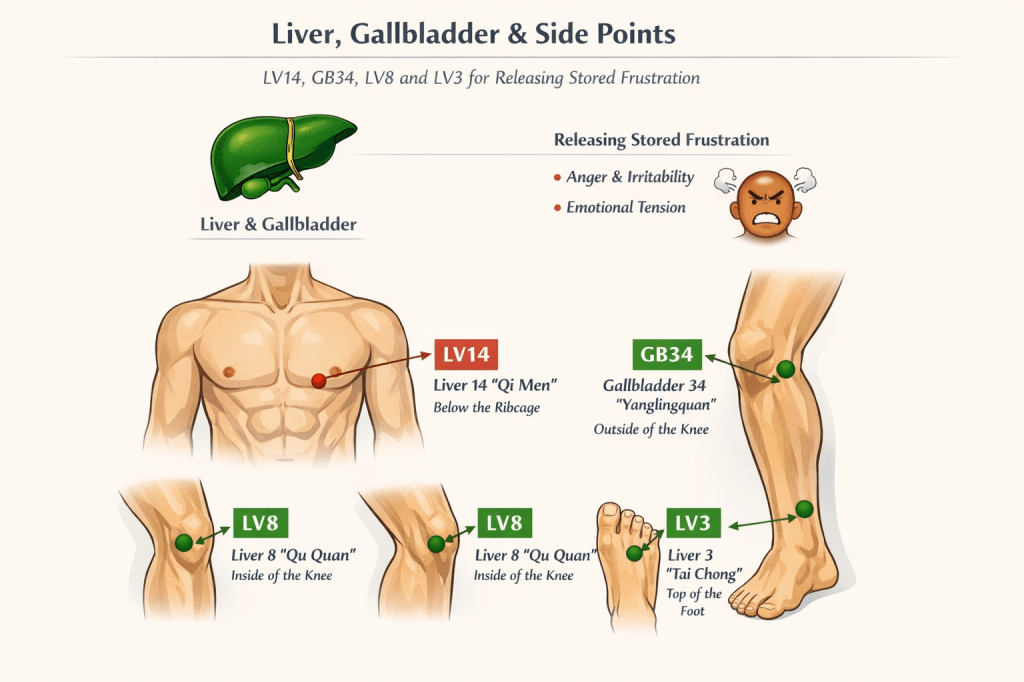
Liver Protocol
LV 3 (between first and second toes): The liver’s primary release valve — 90 seconds each foot, firm press, breathe through the tenderness
LV 14 (below breast, 6th intercostal): 90 seconds each side — the liver’s alarm point on the chest, often exquisitely tender
GB 34 (below outer knee): Influential point of the sinews — releases muscle tension from stress and frustration
LV 8 (inner knee crease): Nourishes liver blood — important for those with fatigue and emotional volatility from long-term stress
Lifestyle addition: The liver performs most of its detoxification work between 1am and 3am — which is exactly when stressed individuals with liver qi stagnation tend to wake. Going to bed by 11pm, drinking warm lemon water on waking, and avoiding alcohol entirely during stressful periods are the three most impactful liver lifestyle choices.
The Kidneys — When Fear Has Been the Background Note for Too Long
In Chinese medicine, the Kidney is the organ of fear and of fundamental vitality. When fear — not acute fright, but the low-grade existential anxiety of modern life, the worry about the future that never fully resolves — becomes chronic, it depletes the Kidney system. What this looks like physiologically is adrenal exhaustion: the state of being tired but unable to rest, depleted but unable to switch off, anxious without a specific cause.
The kidneys govern the bones, the lower back, the knees, the ears, and the hair. Chronic stress-induced kidney depletion shows up as persistent lower back ache, knee weakness, tinnitus, premature greying, and the specific kind of exhaustion that sleep does not fully resolve. If this description feels accurate to you, the kidney protocol below is where to begin.
Kidney Protocol
BL 23 (lower back, L2 level): The Kidney’s back-shu point — tennis ball method, 2 minutes, daily
KD 1 (sole of foot, centre): The grounding point — 2 minutes each foot, morning barefoot is ideal
KD 3 (inner ankle, behind bone): The Kidney’s source point— just behind and below the inner ankle bone; press firmly for 90 seconds each side
GV 4 (Ming Men, between L2-L3): Warm palm or heating pad, 2 minutes — rebuilds the Yang fire the kidneys need
Lifestyle addition: Black sesame seeds, kidney beans, walnuts, and bone broth are the four most kidney-nourishing foods in both Chinese dietary therapy and modern nutritional science. A tablespoon of black sesame daily — ground and added to porridge or smoothies — is one of the simplest kidney-supportive habits there is. Reduce salt intake: chronically high sodium places direct strain on the kidney’s filtration function.
The Lungs — Carrying Grief and the Inability to Let Go
The lungs govern not just breathing but, in Chinese medicine, the rhythm of taking in and letting go that applies as much to experiences, relationships, and emotions as it does to air. Grief — unprocessed loss of any kind, including the smaller but cumulative losses of a stressful life: opportunities, time, health, ease — is the emotion that damages the lung system most acutely.
People with lung-dominant stress often present with persistent respiratory symptoms (frequent colds, recurrent chest infections, chronic cough, asthma that worsens under emotional stress), a shallow, high breathing pattern that never quite settles, and a tendency to sigh frequently — which is the lung’s attempt to self-correct the breathing rhythm. They may also experience skin problems, because in Chinese medicine the lungs govern the skin and the body’s exterior.
Lung Protocol
LU 1 (upper chest, below clavicle): Lung’s alarm point — press firmly for 90 seconds, expect tenderness if grief is present
LU 7 (inner wrist, above thumb side): 1.5 finger-widths above the wrist crease on the thumb side — Lung’s command point; 90 seconds each
CV 17 (sternum centre): Opens the chest, deepens breath — 2 minutes with conscious expansion breathing.
Breathing practice: Grief-dominant stress responds particularly well to extended exhale breathing. Breathe in for 4 counts. Breathe out for 8. The longer exhale directly stimulates the vagus nerve and physiologically represents ‘letting go.’ Five minutes of this breathing daily, specifically paired with LU 1 pressure, is a practice of profound emotional as well as physical effect.
The Thyroid — Where Stress Disrupts the Hormonal Axis
The thyroid gland sits at the front of the throat, and its relationship with stress is direct and increasingly well-documented. Chronic cortisol elevation suppresses thyroid hormone conversion — specifically the conversion of the inactive form (T4) to the active form (T3). This is why many people with chronic stress develop subclinical hypothyroid symptoms: persistent fatigue, weight gain that does not respond to diet, hair thinning, cold intolerance, cognitive slowing, and depression — even when a standard TSH blood test returns as ‘normal.’
The throat is also — in both the physiological and energetic sense — the site of self-expression. The stress of suppressing what you need to say, of swallowing words and feelings, of living in environments where authentic expression feels unsafe, concentrates here. The sensation of a lump in the throat during emotional stress is not metaphor. It is the physical manifestation of unexpressed content held at the throat level.
Figure 3: Throat, Neck & Thyroid Points — CV22, ST9, TW17 for hormonal balance and jaw tension
Thyroid & Throat Protocol
CV 22 (hollow at base of throat): One finger, very gentle pressure — never hard on the throat. Circular motion, 60 seconds. Releases the thyroid zone and the throat’s holding pattern.ST 9 (side of neck, beside Adam’s apple): CAUTION: Apply one side at a time only. Light touch — this point is near the carotid artery. 30 seconds each side, alternating. Regulates blood pressure and supports thyroid circulation.
TW 17 (behind earlobe): In the bony depression behind each ear — press firmly but gently for 60 seconds each side. Releases jaw clenching, TMJ tension, and the neck tightening that stress produces.
Lifestyle addition: Iodine-rich foods support thyroid function directly: seaweed (nori, kelp), eggs, and iodised salt in moderation. Selenium, found in Brazil nuts (two daily is sufficient), is essential for thyroid hormone conversion. Avoid raw cruciferous vegetables in large quantities if thyroid function is already compromised — lightly cook them instead.
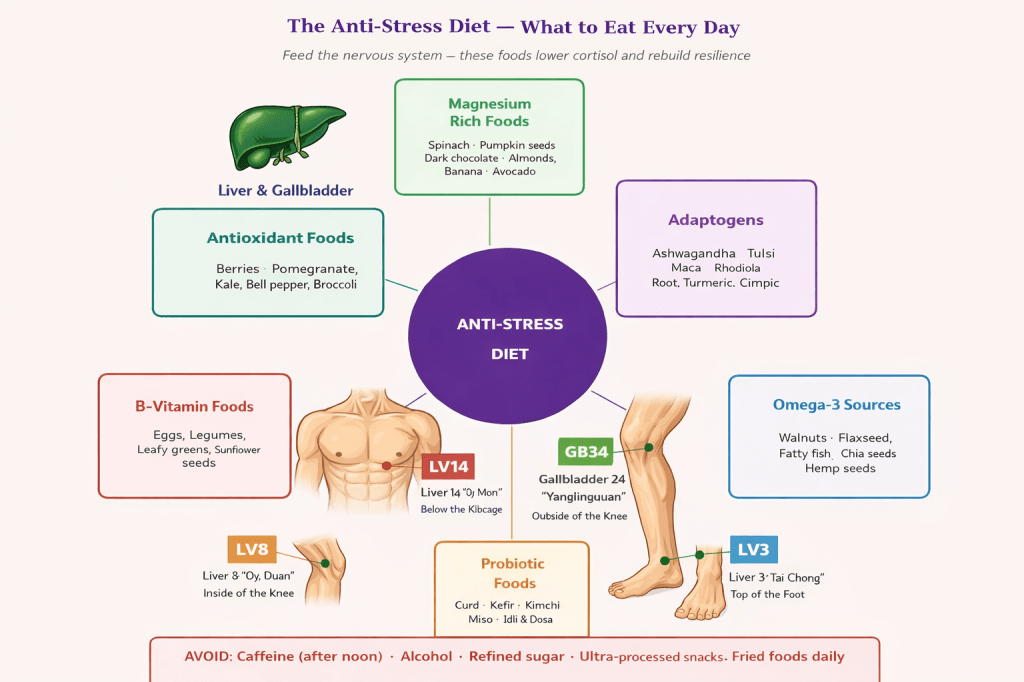
The Anti-Stress Diet — Feeding Your Nervous System
Food is information. Every meal you eat sends a signal to the nervous system, the immune system, and the hormonal axis either in the direction of resilience or in the direction of greater vulnerability to stress. The diagram below maps the most important food categories for stress recovery — not a complicated diet, but a daily orientation toward the foods that actively support the systems stress most damages.
The 5 Daily Non-Negotiables for a Stressed Body
1. MAGNESIUM — Most stressed people are magnesium-deficient. Stress depletes it; deficiency worsens stress. A handful of pumpkin seeds or a tablespoon of ground flaxseed daily covers a significant portion of requirements.
2. PROBIOTICS — The gut-brain axis is a two-way street. Stressed guts produce stressed minds, and vice versa. One serving of fermented food daily (curd, kefir, kanji, kimchi) maintains the microbiome that produces 90% of your serotonin.
3. OMEGA-3 — Directly reduces neuroinflammation, which chronic stress generates. Walnuts, flaxseed, and fatty fish are the most accessible sources. These fats literally lubricate the nervous system.
4. B VITAMINS — The entire B-complex is stress-depleted and stress-essential simultaneously. Eggs, legumes, and leafy greens cover the full spectrum. Avoid single-B supplements — they work as a team.
5. ASHWAGANDHA — An adaptogenic herb with the most robust clinical evidence base for cortisol reduction. 300-600mg of root extract daily. Not a cure — an adaptation tool. Pair with the acupressure practice for compounded effect.
The Sleep-Cortisol Loop — Breaking the Cycle
Here is the vicious cycle that most stressed people are caught in: poor sleep raises cortisol; elevated cortisol disrupts the next night’s sleep; the resulting exhaustion lowers stress tolerance; everything feels more stressful; cortisol stays high. Around and around.
Breaking this cycle requires targeting both ends simultaneously. The acupressure practices in this series address the cortisol side. The sleep hygiene practices below address the sleep side. Together, they give the loop somewhere to break.
Consistent sleep and wake times — even on weekends. The circadian rhythm is the single most powerful regulator of cortisol, and it requires consistency to function.
No caffeine after 1pm. Caffeine has a half-life of five to seven hours. A 3pm coffee is still partly in your system at midnight.
The evening acupressure sequence (SP 6, KD 1, Yintang, HT 7) done lying in bed — this is detailed in full in Post 4 [To be published soon.
Magnesium glycinate 200-400mg before sleep: the most evidence-supported supplement for sleep quality and cortisol reduction, with an excellent safety profile.
No alcohol within three hours of sleep. Alcohol initially sedates but severely fragments sleep architecture in the second half of the night — producing the early-morning waking that stressed people so commonly report.
Your organs do not hold stress against you. They are simply waiting for the signal that it is safe to let go. These practices are that signal.
Work With Me
Understanding which organ system is carrying the primary load of your stress — and tailoring the acupressure practice accordingly — makes the practice significantly more efficient. The same hour invested, but directed precisely.
In a consultation, we identify your specific stress-organ pattern through a combination of symptom mapping, lifestyle history, and the classical diagnostic approaches that Chinese medicine uses to locate where in the body the stress has taken deepest root.
Then we build your protocol — points, sequence, timing, dietary adjustments, and lifestyle shifts calibrated to your specific picture.
Reach out: skcjos@gmail.com
Coming in Post 4: ‘The 21-Day Stress Reset — A Daily Practice That Actually Holds’
In Association with World Health Journey | Oman
Chronic stress does not just strain your body — it leaves lasting psychological patterns that shape every decision, relationship, and response you have. These patterns are measurable.
The Cognitive Health Check-Up from World Health Journey maps your psychological stress architecture — identifying the emotional patterns, cognitive distortions, and resilience gaps that chronic stress has created, before they become something harder to address.
Three weeks before his death, Carl Jung wrote something that sent shockwaves through the world of psychology: “God is not a belief. It is a psychological fact.“
This wasn’t a sudden leap of faith or a religious conversion. It was the clinical observation of a man who had spent decades documenting the transformation of the human psyche as it approaches the finish line.
Having studied hundreds of patients, Jung identified a pattern so consistent it transcended culture, creed, and personal conviction. What he found suggests that we have been looking at our lives entirely backward.
The Four Stages of the Ego’s Dissolution Jung documented a specific, four-stage preparation process that the psyche undergoes. It is not a process of “fading away,” but one of intense emergence.
The Ego’s Retreat: The persona we’ve spent a lifetime building—the job titles, the social standing, the “version” of ourselves we defend—begins to lose its grip.
The Dissolution: The boundaries of the individual “I” start to soften.
The Emergence of the Self: As the ego shrinks, the Self—the totality of the psyche—begins to take center stage.
The Union: A realization that the internal psychological reality is more “solid” than the external world. Through this lens of depth psychology, Jung reached a startling conclusion: We are not bodies that happen to have souls; we are souls who happen to have bodies.
5 Signs the “Self” is Calling You You don’t have to be at the end of your life to experience this shift. In fact, Jung’s final message was about waking up while you are still alive. Here are five signs that your “Self” is calling you toward this individuation:
A Growing Distaste for the “Performative”: You find it increasingly exhausting to maintain a version of yourself that feels “unreal”.
Vivid, Archetypal Dreams: Your subconscious begins using powerful, universal symbols to grab your attention.
The Weight of Material Success: A realization that external achievements no longer provide the “soul-filling” sustenance they once did.
A Pull Toward Solitude: Not out of depression, but out of a need to finally meet what has been waiting beneath the surface your entire life.
Synchronicity: You begin to notice “meaningful coincidences” that suggest a deeper relationship between your consciousness and the physical world. The Final Message: It’s Not About Death Jung’s discovery changed everything because it shifted the focus from the end of life to the depth of life. His final weeks weren’t spent mourning the loss of the body, but celebrating the discovery of the eternal Self. If you are ready to stop defending a ghost and start living as the soul you are, the journey doesn’t start at the end. It starts today.
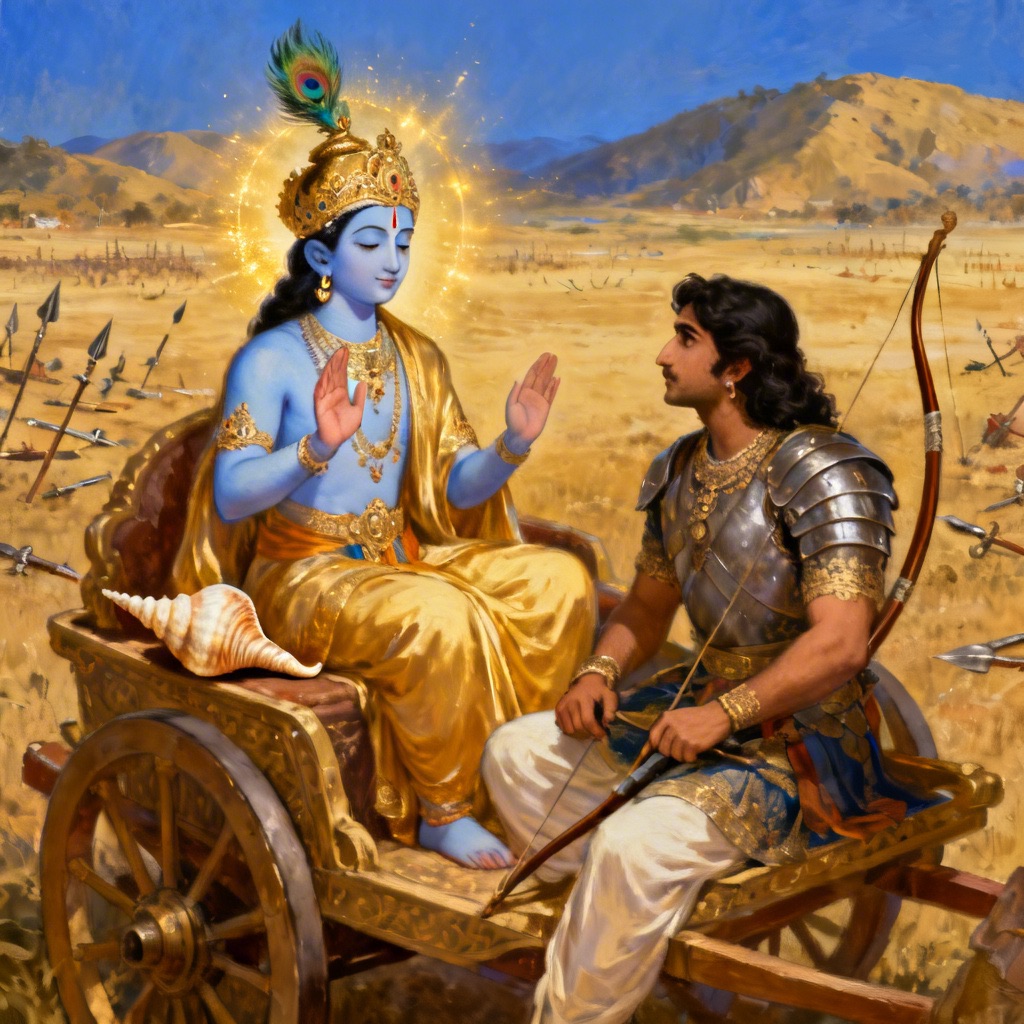
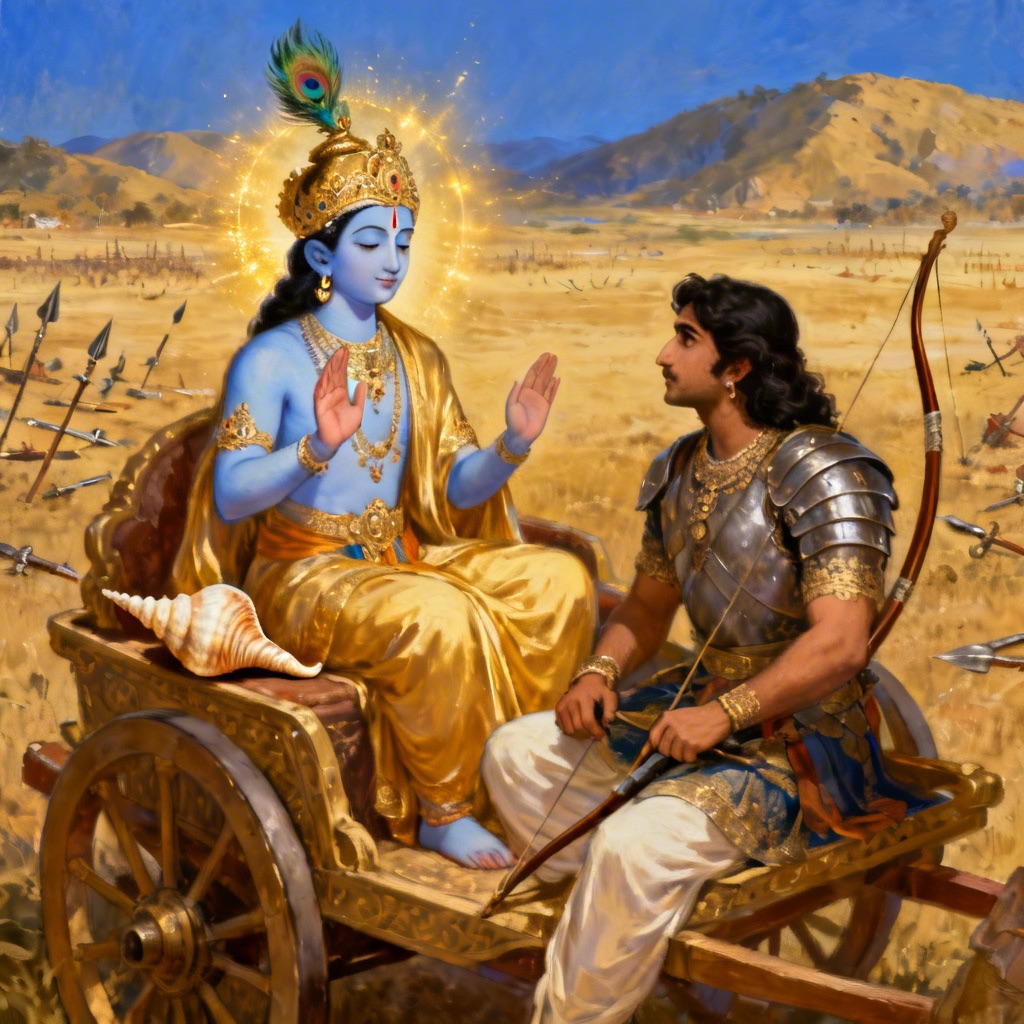
What a 5,000-Year-Old Battlefield Conversation can teach us About Leadership.
I used to think the Bhagavad Gita was just another religious text. Then I discovered it’s actually the most practical leadership guide ever written. Since then I have held on to this sacred book in different forms. The Printed Version, the Kindle eBook, Cards for daily reference.
When Everything’s on the Line, when you know that moment when you’re staring at a decision that could make or break everything? I’m talking about those tough situations which everyone faces in their lives, you don’t necessarily have to be a Leader, nevertheless running through scenarios, knowing that whatever you choose tomorrow will ripple through your team, your company, maybe even your entire career.
That’s where Arjuna was standing—literally on a battlefield, facing his cousins in what would be the bloodiest war in ancient history. And he completely froze. What happened next changed how I think about leadership forever.
Here’s what I got wrong about the Gita for years: I thought it was some mystical conversation between holy men sitting under trees, talking about detaching from the world.
No. This is two warriors having a very real conversation about duty, fear, and making impossible choices when lives hang in the balance. Arjuna isn’t asking for spiritual enlightenment—he’s asking for practical advice on how to lead when the stakes are crushing.
Sound familiar?
In today’s context it would look like this:
– Quarterly numbers. The Agony or Ecstacy.
– A product launch that could save or sink the company.
– Choosing between short-term profits and long-term values.
– Managing a team through a recession, merger, layoffs, or industry disruption. The pressure is different, but the paralysis feels exactly the same.
The Counter intuitive Secret That Changes Everything
Krishna’s advice to Arjuna seems backwards at first: “Do your absolute best work, then let go of the results.”
Wait, what? Isn’t caring about results what separates leaders from… well, everyone else?
But here’s what I’ve learned after trying this approach for years:
When you stop being desperately attached to specific outcomes, you actually get better outcomes. Try it. It holds true.
Why This Actually Works is, just think about it—when was the last time you made a great decision while panicking about the consequences?
When you’re white-knuckling the steering wheel, worried about where you’ll end up, you can’t actually steer very well.
But when you know you’ve done everything possible and you trust the process? That’s when the magic happens. You think clearer. You take smarter risks. You inspire confidence instead of spreading anxiety.
I saw this firsthand during my company’s worst times. Not once, but many times. Instead of running around like my hair was on fire, I focused on what we could control: our response time, our communication with clients, our team’s morale. We came out stronger. And honestly? I slept better. In fact I have never lost sleep over anything ever. Whatever may have been the situation I have managed to keep my wit’s cool.
Life Happens TO You, and you cannot stop that from happening, But You can definitely choose Your Response – on how to deal with it.
The Gita has this concept that basically divides everything into two buckets: stuff that happens to you (prarabdha) and how you respond to it (purushartha).
This sounds obvious until you realise how much energy we waste trying to control the first bucket. You Cannot.
Here’s What I Mean:
Sometime back one of our biggest and longest standing Client decided not to renew. One year of revenue, gone. That’s prarabdha—it happened, period.
But everything else? That’s on me:
– How I broke the news to the team- Whether I spiralled into worst-case scenarios or started planning our next move.
– Whether I used this as a learning opportunity or just complained about “disloyal clients”!!
You could spend days obsessing over what we could have done differently. Or you sit and analyse, make an last ditch effort to save if possible, and if even after giving it your best shot, then instead of ruminating look at alternative solutions. How to make up the lost revenue in the shortest span so that the effect is cushioned in the shortest span of time.
The Balance That Actually Matters
There’s this verse (Chapter 4, Verse 22, if you’re keeping track) that basically says balanced people don’t get thrown off by wins or losses. They just keep moving forward.
This isn’t about being emotionless—it’s about being consistent.
What This Looks Like in Practice
Good news: Celebrate for five minutes, then ask “What’s next?”
Bad news: Feel it for five minutes, then ask “What can we learn and Do next?”
Uncertainty: Work with what you know, then adapt as you learn more.
My Son figured this out before I did. He told me, “You used to be a roller coaster—amazing when things went well, impossible when they didn’t. Now we actually know what to expect from you.” He just told me to look at my old Photographs when I was younger.
That hit harder than any performance review.
The Best Analogy I’ve Ever Heard About Ambition.
The Gita compares desires to paan—that sweet digestive you have after a good meal. It’s nice, but you don’t need it to feel satisfied.
This completely reframed how I think about professional goals.
Instead of: “I need this promotion/deal/metric to prove I’m successful”
I started thinking: “I’m already pretty fortunate. This would be a nice bonus.”
Why This Isn’t Just Feel-Good Philosophy
When you’re not operating from desperation:
– You negotiate better (you’re not afraid to walk away).
– You make clearer decisions (you’re not clouded by need).
Actually Trying This Stuff (Not Just Nodding Along).
Look, reading about this is one thing. Actually doing it when your boss is breathing down your neck and wants answers is completely different.
Practice it in your daily life. Concentrate on doing great work without bothering on specific outcome. See what happens. How it balances your stress level.
When problems come up, spend your energy on your response, not on not on complaining about the problem.
Try to maintain same tone in meetings whether you’re delivering good news or bad news. It will have an impact on your Team. The energy percolates down.
None of this is groundbreaking. But doing it consistently? That’s where the real change happens.
Why a Battlefield Guide Still Works.
The reason the Gita works for modern leadership isn’t because it’s ancient wisdom (though it is). It’s because it was written for someone who had to make life-or-death decisions under impossible pressure.
The details are different, but the core challenge is the same: How do you lead effectively when the outcome matters desperately but you can’t guarantee success?
Answer: You control what you can control, you do your best work, and you trust the process. It’s not magic. But it works.
What’s your version of standing on that battlefield? The moment when everything you’ve worked for hangs on a decision you have to make? Remember: it’s not about predicting the future perfectly—it’s about showing up fully to the present.
P.S. – If this resonated with you, I’d love to hear about your own battlefield moments. Because honestly, We’re all just figuring this out as we go, and sometimes it helps to know we’re not alone out there.
The Grass Isn’t Always Greener: 27 Years of Entrepreneurial Truth.
A candid reflection on the realities of building a business, the myths that mislead aspiring entrepreneurs, and what it truly takes to survive—and occasionally thrive—in the entrepreneurial wilderness.
When I started my entrepreneurial journey 27 years ago, I thought I understood what lay ahead. I was wrong. Like most first-time founders, I believed the grass would be greener on the entrepreneurial side of the fence. Today, with salt-and-pepper hair as my witness, I can tell you that the grass isn’t uniformly green—it’s patchy at best, with occasional verdant spots interspersed among the brown patches of struggle.
The Myth of Instant Green.
Over the years, I’ve watched many former employees take the entrepreneurial plunge. Some jumped with grand visions, others with detailed roadmaps that looked flawless on paper: secure funding, build valuation, execute an IPO or acquisition, then walk away with “tons and tons of money.
The reality? I rarely hear success stories from these departures.
This silence speaks volumes. The entrepreneurial graveyard is littered with dreams built on the myth of the get-rich-quick scheme. We live in an era where a select few have struck gold, creating a narrative that entrepreneurship is a lottery ticket rather than a marathon. This misconception fuels the current startup stampede—and explains why 90% of startups fail.
The harsh truth: those few who “hit pay dirt are statistical outliers, not the norm.
The Long Gestation of Success.
Real entrepreneurship isn’t a sprint to riches—it’s an endurance test that would make an Olympian proud.
Just as athletes don’t accidentally stumble onto podiums, successful entrepreneurs don’t stumble into success. There are no shortcuts.
What It Actually Takes
1. A Burning Desire That Survives Reality.
You need more than enthusiasm; you need an obsession that can withstand years of setbacks. This isn’t passion—it’s something deeper, more primal. It’s the difference between wanting something and needing it to define your existence.
2. The “Why” Factor.
Before you quit your job or pitch investors, answer this: Why does your venture need to exist? Not why you want it to exist, but why the world needs it. If you can’t articulate this clearly, you’re building on sand.
3. Start Small, Think Big.
Remember Birbal finding warmth from a candle burning miles away? Your vision might be distant and dim, but it must be visible enough to guide you through dark periods. Start with minimal viable steps while keeping that distant light in sight.
4. Embrace the Mistake Factory.
Mistakes aren’t just inevitable—they’re your primary education. Each failure should strengthen your resolve, not weaken it. The entrepreneurs who survive aren’t those who make fewer mistakes; they’re those who learn faster from them.
The Price of the Entrepreneurial Path
Here’s what most people don’t tell you about entrepreneurship: it demands sacrifice that employed life never does.
What You’ll Likely Sacrifice:
– Financial security (for years, possibly decades).
– Work-life balance (your business becomes your life).
– Predictable income (feast or famine becomes normal).
– Professional safety nets (no HR department, no guaranteed paycheck)
– Social time (while friends advance in corporate careers, you’ll be grinding).
What You Might Gain:
– Autonomy over your decisions and destiny.
– The possibility of significant financial returns (emphasis on possibility).
– Deep satisfaction from building something meaningful.
– Resilience that serves you in every life area.
– Stories that make for interesting dinner conversations.
The Relentless Test. Twenty-seven years in, I can confirm that the test never stops being severe and relentless. Market conditions change, competitors emerge, team members leave, funding dries up, customers disappoint, and sometimes everything goes wrong simultaneously.
The question isn’t whether you’ll face adversity—it’s whether you’ll maintain that “fire in the belly” when adversity becomes your daily companion.
Surviving the Long Haul
Perseverance Over Perfection: Your first idea probably won’t work. Neither will your second or third.
Success often comes from persistence through iterations, not brilliance on attempt one.
Work Ethic as Oxygen: If you’re looking for better work-life balance, stay employed. Entrepreneurship demands a work ethic that borders on obsessive. This isn’t sustainable for everyone, and that’s okay.
Never Give Up (But Know When to Pivot): There’s a fine line between persistence and stubbornness.
The situation will change eventually, but sometimes you need to change your approach to the situation.
The Uncomfortable Truth About Green Grass.
After 27 years, my grass has some green patches—moments of success, financial wins, personal satisfaction from building something lasting. But it’s not the uniform, lush green that entrepreneurship mythology promises.
And you know what? That’s perfectly fine.
The real victory isn’t achieving some fantasy of endless green grass. It’s building something meaningful while accepting that entrepreneurship is inherently messy, uncertain, and often unrewarding in traditional metrics.
For Aspiring Entrepreneurs.
Before you leap, ask yourself:
– Are you prepared for a decades-long journey with no guarantees?
– Can you find fulfilment in the process, not just the outcome?
– Do you have the financial runway and personal support for extended uncertainty?
– Is your “why” strong enough to sustain you through years of difficulty?
If your answers give you pause, consider staying employed while building something on the side. There’s no shame in choosing stability—and there’s wisdom in understanding your own tolerance for risk and uncertainty.
Final Thoughts
Entrepreneurship isn’t for everyone, despite what startup culture suggests. It’s not a fast track to wealth, freedom, or happiness. It’s a difficult path that demands everything you have and offers no guarantees in return.
But for those with the right combination of vision, persistence, and perhaps a touch of madness, it can be profoundly rewarding—just not in the ways you initially expect.
The grass may not be uniformly greener, but those patches of green you do cultivate? They’re genuinely yours. And after 27 years of tending to them, that means something.
Sometimes the most honest thing you can tell someone about entrepreneurship is this: if you can imagine being happy doing anything else, do that instead. But if you can’t shake the vision of building something meaningful, then welcome to the long, difficult, occasionally rewarding journey of entrepreneurship.
They say entrepreneurship is not for the faint-hearted, and after years of riding the rollercoaster of business ownership, I can tell you—they’re absolutely right. But what they don’t tell you is that it’s also one of the most rewarding journeys you’ll ever embark on, filled with lessons that shape not just your business, but your character.
🏢 Be Proud of Your Baby
Your enterprise is your baby. Be proud of it. Never be dazzled by what’s around you.
I’ll never forget when a very senior person made a remark about the location of my office. For a moment, I felt that familiar pang of self-doubt creeping in. But then reality hit me—this is MY office, and I am proud of it. I built this from the ground up. I am the employer here.
Here’s what I’ve learned: if employees don’t want to compromise and have their own locational preferences, that’s their restricted mindset, and I cannot help it. After all, whoever heard of a well walking up to a thirsty person? The value lies not in the glamorous address or the fancy furnishings—it lies in what you can provide: genuine value addition.
To young entrepreneurs reading this: don’t let anyone make you feel small about where you started or where you currently are. Every successful business empire started somewhere, often in the most humble of places. Your garage, your spare bedroom, that small rented space—embrace it.
Own it. Be proud of it.
🤝 Integrity: The Foundation of Everything
Over the years, I have built goodwill by practicing integrity, and this has definitely resulted in very positive customer retention. Let me be crystal clear about something: your customers should not stop believing in your venture. Never take them for granted. You exist only because of them, and it can never be the other way around.
I’ve discovered something remarkable—if your reputation and integrity exceed expectations, customers will be willing to associate with you regardless of cost. It won’t matter if you’re more expensive than your competitors. They’ll choose you because they trust you.
Think about it: in a world where consumers are bombarded with options, what makes them stick with one business over another? It’s not always the lowest price or the fanciest marketing. It’s the confidence that you’ll deliver on your promises, every single time.
Here are the integrity principles that have guided my journey:
Always under-promise and over-deliver.
Be transparent about limitations and challenges.
Admit mistakes quickly and fix them faster.
Treat every customer interaction as an opportunity to build trust.
🎢 The Rollercoaster: Risk vs. Gamble
When you embarked on your entrepreneurial journey, was it a ‘risk’ or a ‘gamble’? I’ve spent many sleepless nights pondering this question, especially during the tough times.
Just like success is never guaranteed, failure does not mean the end. Nothing is final. Let me share something personal: at one point, I scaled heights that I had only dreamed of. The business was thriving, revenues were soaring, and I felt invincible. Then, in the very next year, my business plummeted. It was devastating.
The slide seemed unstoppable. Customers were leaving, revenue was drying up, and doubt crept in like a persistent shadow. But here’s the thing about entrepreneurship—it has its flips and flops. The key is never to be discouraged.
I could have given up. Many people expected me to. Some even suggested I should. But something inside me refused to surrender. I held on to one simple belief: if you do not give up, there is nothing that can stop you from succeeding.
And you know what? The slide could be stopped only recently, and I have again regained that upward momentum. This isn’t just business theory—this is a true life story, happening right now.
💪 Lessons for Young Entrepreneurs
If you’re just starting out or struggling through a difficult phase, here’s what I want you to remember:
Your current circumstances are not your final destination. That small office, limited budget, or lack of fancy resources? They’re temporary. What matters is your vision and determination.
Build relationships, not just transactions. Every customer interaction is an investment in your future. Treat them with respect, deliver value, and watch how loyalty transforms your business.
Embrace the uncertainty. Entrepreneurship isn’t about eliminating risk—it’s about managing it intelligently while staying true to your values.
Define success on your own terms. Don’t let others dictate what your business should look like or where it should be located. Your vision, your rules.
Persistence beats perfection. You don’t need to have all the answers from day one. You just need to keep moving forward, learning, and adapting.
🌟 The Journey Continues
As I write this, I’m reminded that entrepreneurship is not a destination—it’s a journey. There will be days when you feel like you’re on top of the world, and others when you question every decision you’ve made. Both are part of the process.
What I’ve learned is that success isn’t measured just in revenue or market share. It’s measured in the relationships you build, the integrity you maintain, and the resilience you develop. It’s about creating something meaningful, something you can be genuinely proud of.
Your enterprise is your baby. Nurture it with passion, protect it with integrity, and never let anyone make you feel ashamed of where you are in your journey. Every giant oak tree was once just an acorn that held its ground.
To every young entrepreneur reading this: trust the process, believe in yourself, and remember—if you don’t give up, there’s nothing that can stop you from succeeding. This isn’t just motivation; it’s a promise backed by experience.
Keep building, keep believing, and keep moving forward. Your success story is being written every single day.
What’s your entrepreneurial story? Share your journey in the comments below—I’d love to hear about the challenges you’ve overcome and the lessons you’ve learned along the way.
Finding Your True North: When Life’s Journey Finally Becomes Your Own.
Have you ever been stopped in your tracks by a seemingly simple question? The kind that appears innocent on the surface but sends you tumbling down a rabbit hole of self-reflection? That’s exactly what happened to me recently when a friend casually asked:
What are you passionate about?
Are you following what your heart and mind desire?”
On the surface, it seemed like an easy question to answer. After all, I’ve built and run a fairly successful small business for 27 years. As a first-generation entrepreneur, I could confidently say that passion drove me to achieve something meaningful. But when I looked deeper—really looked—I wasn’t quite sure anymore.
The Passenger Syndrome: When Life Drives You.
For years, I wondered: Have I been in control of my life, or has life been driving me along its own predetermined path while I sat as a mere passenger?
Looking back, my early years were anything but deliberate:
• School: I finished in a stream that wasn’t my forte at all. Barely made through.
• College: Switched to a subject that was, once again, everything but a choice.
• Military: Joined the Armed Forces without much deliberation, deciding within the first year that I’d only stay for the stipulated five years.
Each step felt like following the Darwinian theory of survival—adapting, persisting, but not necessarily thriving in alignment with my true self.
The First Real Choice: Entrepreneurship as Awakening.
The turning point came when I decided to become an entrepreneur. For the first time in my life, this felt like a deliberated choice—not just going through the motions or following societal expectations.
Despite the usual “rollicking” of Army life, this decision set me going in a direction that felt authentically mine. Yes, there were troughs and crests, the inevitable tempests of establishing something new. But through it all, I found myself enjoying what I was doing for the first time in my life.
That’s when I realised something profound: the need to be creative and keep creating new vistas and avenues is what I’m truly passionate about.
Life Lessons Learned Along the Way.
1. Passion Isn’t Always Obvious from the Start.
Sometimes passion isn’t a lightning bolt of clarity. It’s something you discover through experience, through trying different paths, even through the things you initially resist. My journey through various streams and careers wasn’t wasted time—it was research for finding my true calling.
2. Being a “Passenger” Isn’t Always Wrong.
There’s wisdom in allowing life to guide you sometimes, especially in your early years. Those experiences I thought were just “going through the motions” actually equipped me with skills, resilience, and perspectives that later proved invaluable in entrepreneurship.
3. Calculated Risks Are Worth Taking.
I’ve never gambled in the conventional sense, but I realize I’ve been “gambling with life” all this while— taking chances, betting on myself, choosing uncertainty over security. This kind of calculated risk-taking has been the gateway to my most fulfilling experiences.
4. Transformation Is Ongoing.
The usual transformational changes keep happening. What excites me today might evolve tomorrow, and that’s not inconsistency—it’s growth. The key is staying open to these changes rather than rigidly sticking to outdated versions of ourselves.
5. Creation Is Its Own Reward.
The passion I’ve discovered isn’t just about business success—it’s about the act of creation itself. Building new vistas, exploring fresh avenues, bringing ideas to life. This creative drive transcends any single venture or achievement.
Questions for Your Own Reflection.
As I’ve learned, sometimes the most valuable questions are the ones that initially make us uncomfortable:
1. When did you last make a truly deliberated choice? Not just going with the flow, but actively choosing your direction?
2. What activities make you lose track of time? These might point toward your genuine passions.
3. If you could start over, what would you do differently? More importantly, what would you keep the same?
4. What kind of “gambling” are you avoiding? Sometimes the biggest risk is not taking any risks at all.
5. How has being a “passenger” in some areas of your life actually served you?
Not all unplanned journeys are wasted journeys.
The Journey Continues.
Today, I’m more comfortable with the idea that life is part deliberate choice and part surrender to circumstances beyond our control. The key is recognising when to take the wheel and when to trust the process.
My 27-year entrepreneurial journey taught me that passion isn’t just about following your heart—it’s about creating a life where your heart and mind can thrive together. It’s about embracing both the planned destinations and the unexpected detours.
The most important realisation? You’re never too late to start making deliberated choices. Whether you’re 25 or 55, whether you’re just starting out or pivoting after decades in one direction, you always have the power to become the driver of your own life.
Sometimes the best journeys begin not with knowing exactly where you’re going, but with the courage to finally take the wheel.
“But I don’t want comfort. I want God, I want poetry, I want real danger, I want freedom, I want goodness. I want sin.” — John the Savage.
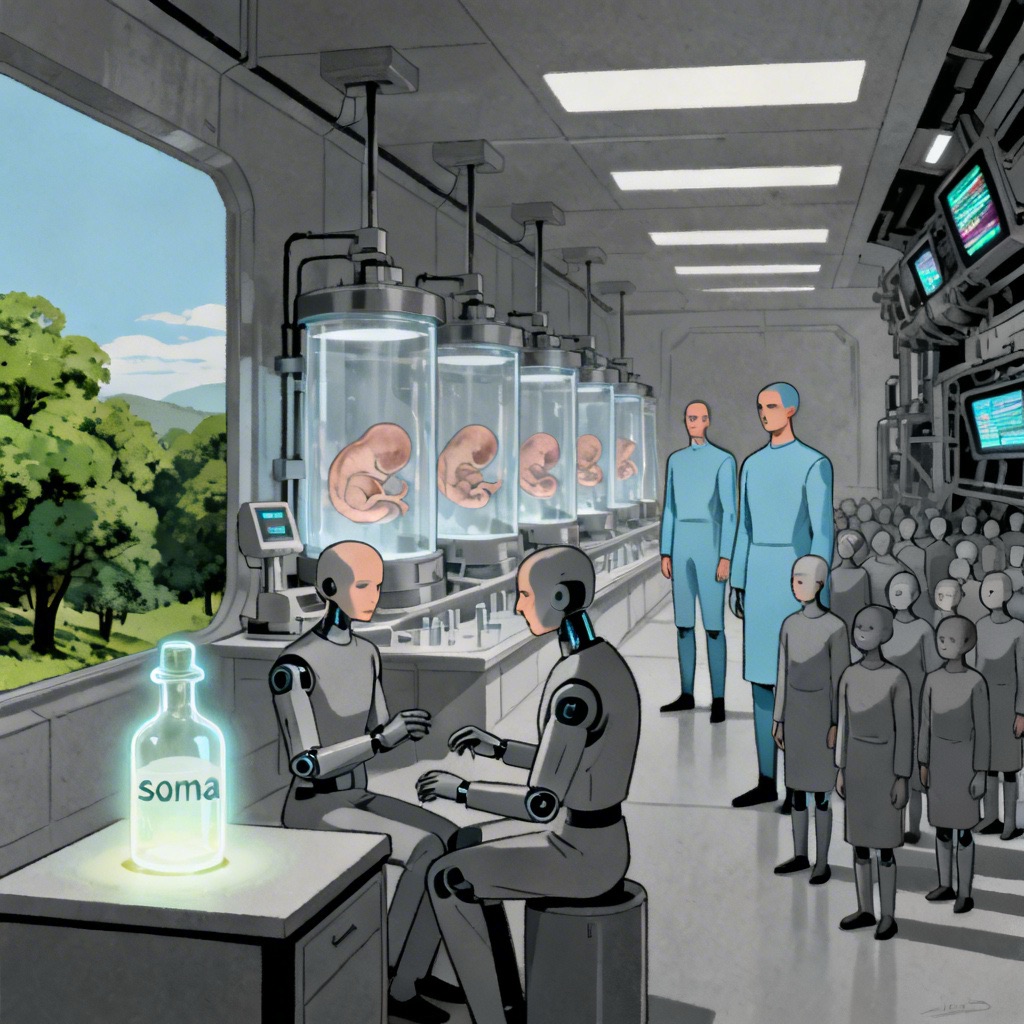
Aldous Huxley’s Brave New World (1932) stands as one of literature’s most prescient warnings about the perils of technological control and manufactured happiness. Written during the rise of mass production and behaviorist psychology, Huxley’s dystopian masterpiece explores a fundamental question that remains urgently relevant today: Can a society built on pleasure, efficiency, and stability ever truly fulfil human nature?
The novel’s answer is a resounding no — and its exploration of why reveals profound truths about freedom, suffering, and what it means to be authentically human.
The World State: Perfection Without Soul.
Huxley’s World State represents the ultimate technocratic society, where every aspect of human existence has been optimised for stability and happiness. The citizens of AF 632 (After Ford, referencing Henry Ford’s assembly line revolution) live in a world that has seemingly solved humanity’s greatest problems:
Biological Engineering eliminates genetic inequality through controlled reproduction in “Hatcheries and Conditioning Centres.” Children are no longer born but manufactured, with their intelligence and physical capabilities predetermined by their assigned caste.
Pavlovian Conditioning shapes behavior from infancy, ensuring each person finds satisfaction in their predetermined role. Delta and Epsilon children are conditioned to hate books and nature, while Alphas are trained for leadership — creating a society where oppression feels natural.
Soma Distribution provides chemical happiness on demand. This miracle drug offers all the benefits of alcohol, narcotics, and antidepressants without hangovers, addiction, or side effects. Why suffer when relief is just a pill away?
Sexual Liberation replaces love and family bonds with casual encounters, preventing the deep emotional attachments that might challenge state authority. The mantra “everyone belongs to everyone else” ensures no citizen develops loyalty to anyone but the state.On the surface, this world has achieved what every society claims to want: no war, no poverty, no suffering, no unfulfilled desires. Yet Huxley reveals this paradise as profoundly hollow.
The Savage’s Mirror: What We Lose in Paradise.
John the Savage serves as the novel’s moral center and our window into what the World State has sacrificed for its stability. Raised on Shakespeare and traditional human values on the Reservation, John embodies everything the World State has eliminated: passion, moral struggle, spiritual yearning, and the capacity for both profound joy and devastating sorrow.
The Conflict Between Comfort and Truth.
When John encounters World State civilisation, his horror isn’t directed at obvious evils but at the absence of meaning itself. He’s repulsed not by cruelty but by the casual indifference to beauty, truth, and human dignity. In his famous exchange with World Controller Mustapha Mond, John articulates the novel’s central theme:
– John demands the right to be unhappy, to struggle, to face real danger.
– Mond responds that such desires are antisocial and unnecessary in a world that can provide easy satisfaction.
This conversation reveals Huxley’s crucial insight: a society that eliminates suffering also eliminates the conditions necessary for human growth, creativity, and genuine fulfillment.**
Love vs. Conditioning.
John’s relationship with Lenina crystallizes this conflict. His passionate, romantic love — shaped by Shakespeare’s sonnets — collides with her conditioned casual sexuality. Neither can understand the other:
– John seeks transcendent connection, viewing sexuality as sacred when combined with love.
– Lenina finds his intensity confusing and unnecessary, having been conditioned to view emotional attachment as unhealthy.
Their tragic inability to connect represents the broader gulf between authentic human nature and engineered satisfaction.
Huxley’s Prophetic Warnings.
Writing in 1932, Huxley anticipated developments that wouldn’t fully emerge for decades. His warnings prove remarkably prescient:### The Tyranny of Pleasure Unlike Orwell’s 1984, where citizens are controlled through fear and pain, Brave New World presents a more seductive form of control. The World State doesn’t need to threaten its citizens — it simply makes them too comfortable to rebel.
Modern parallels include:
– Social media platforms designed to provide endless, easy gratification.
– Consumer culture that promises happiness through material acquisition.
– Pharmaceutical solutions for emotional and spiritual problems.
– Entertainment that distracts from deeper questions about meaning and purpose.
The Standardisation of Humanity.
The World State’s caste system represents an extreme version of social engineering, but Huxley’s real concern is the broader tendency to treat humans as interchangeable units rather than unique individuals.
Contemporary echoes appear in:
– Educational systems focused on standardised testing rather than individual growth.
– Economic policies that prioritize efficiency over human flourishing.
– Technology that reduces complex human needs to data points and algorithms.
The Elimination of Difficult Beauty.
Perhaps most tragically, the World State has eliminated art, religion, and philosophy — anything that might disturb its citizens’ contentment. Beauty exists only in sanitised, consumable forms.
Today’s version might include:
– Art reduced to viral content optimised for engagement.
– Spiritual practices repackaged as wellness trends.
– Literature and philosophy marginalized in favor of immediately practical information.
The Price of Paradise.
John’s suicide represents the novel’s darkest conclusion: that authentic humanity cannot survive in a world designed to eliminate suffering. His death poses uncomfortable questions:
Is struggle necessary for human fulfillment? The World State’s citizens appear happy, but their satisfaction seems shallow compared to John’s capacity for both ecstasy and agony.
Can technology solve human problems without destroying human nature?
Every technological solution in the World State comes with the hidden cost of diminishing some essential aspect of humanity.What happens when comfort becomes more important than truth? The citizens live in a carefully constructed illusion, protected from reality’s sharp edges but also cut off from its genuine beauty.
Lessons for Our Time.
Huxley’s vision feels increasingly relevant as we grapple with similar questions about technology, pleasure, and control. His novel suggests several crucial principles:
Preserve Space for Difficulty.
A truly human society must allow room for struggle, failure, and growth. Easy solutions to complex problems often eliminate opportunities for character development and genuine achievement.
Value Individual Uniqueness.
Efficiency and equality are worthy goals, but not at the cost of individual personality, creativity, and moral agency. Systems that treat people as interchangeable units ultimately dehumanise everyone.
Choose Meaningful Over Comfortable.
The novel argues that meaning matters more than happiness — that a difficult life pursuing truth and beauty surpasses an easy life of shallow pleasure.
Question Technological Solutions.
Every technological advance should be evaluated not just for its benefits but for its hidden costs to human flourishing. What aspects of humanity might we lose in exchange for convenience or comfort?
Conclusion: The Enduring Challenge.
Brave New World doesn’t offer easy answers, but it poses essential questions that each generation must answer anew. In our age of social media, artificial intelligence, and biotechnology, Huxley’s warnings feel prophetic rather than fantastical.
The novel’s lasting power lies not in its specific predictions but in its fundamental insight: the greatest threats to human dignity often come disguised as benefits. A society that promises to solve all problems, eliminate all suffering, and provide all pleasures may inadvertently eliminate the struggles that make us most human.
John the Savage’s tragic fate reminds us that the choice between comfort and authenticity, between easy happiness and meaningful existence, remains as relevant today as it was in 1932. The question isn’t whether we’ll face this choice — it’s whether we’ll have the courage to choose wisely when we do.
As Huxley himself might say, the price of true humanity may be the willingness to embrace both the beauty and the terror of being genuinely alive.
When we introspect, it is quite evident that all these magnificent and exemplary authors had such prophetic vision and extraordinary power of imagination.
Paulo Coelho’s masterpiece “The Alchemist” isn’t just a tale about a shepherd boy’s journey to find treasure—it’s a profound meditation on life’s most essential truths. While the story follows Santiago’s physical journey from Spain to the Egyptian pyramids, the real treasure lies in the spiritual and philosophical insights woven throughout this enchanting narrative.
Beyond Toxic Positivity: Authentic Optimism.
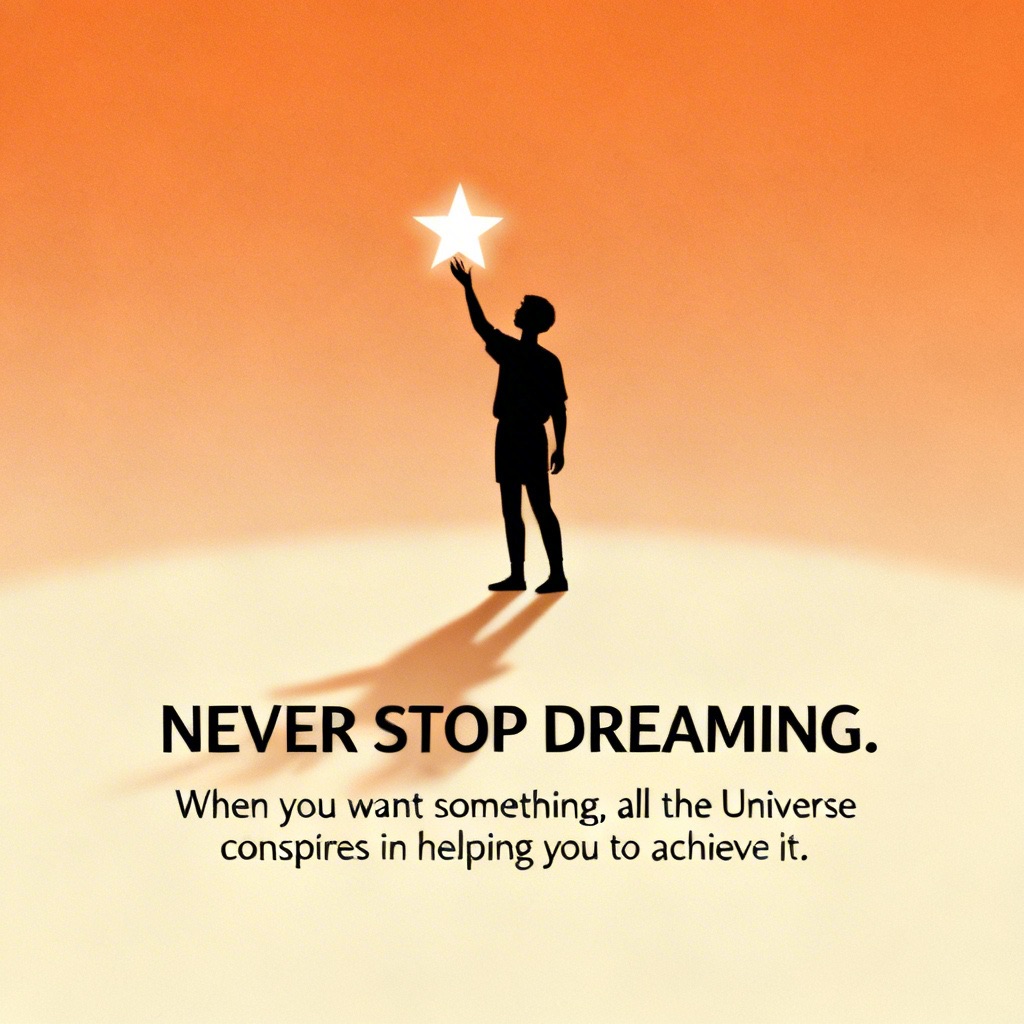
One of the most misunderstood aspects of “The Alchemist” is its famous quote: “When you want something, all the universe conspires in helping you to achieve it.” On the surface, this might sound like toxic positivity—the dangerous belief that positive thinking alone guarantees success.
However, Coelho’s execution reveals something far more nuanced. Santiago doesn’t simply wish his way to success. Instead, he:
• Takes calculated risks after careful consideration.
• Embraces uncertainty and learns from setbacks.
• Balances dreams with practical action.
• Accepts help when it arrives but remains prepared to act.
• Acknowledges negative emotions as part of the journey.
This authentic approach to pursuing dreams makes the novel’s wisdom genuinely applicable to real life.
The Personal Legend: Your Unique Purpose.
What Is a Personal Legend?
Coelho introduces the concept of a “Personal Legend”—essentially your life’s true calling or purpose. It’s described as:
“God’s blessing, the path that God chose for you here on Earth. Whenever we do something that fills us with enthusiasm, we are following our legend.”
The Four Universal ObstaclesUnfortunately, most people never pursue their Personal Legend due to four predictable obstacles:
1. Childhood Conditioning
From early age, we’re told our dreams are “impossible.” Years of accumulated prejudice, fear, and guilt bury our true calling so deep it becomes invisible—though it never truly disappears.
2. Fear of Hurting Others
We worry about abandoning responsibilities or disappointing loved ones. However, genuine love supports our authentic journey—those who truly care want us to be happy and fulfilled.
3. Fear of Failure
Pursuing our dreams means we can’t fall back on the excuse “I didn’t really want it anyway.” This vulnerability makes potential failure more painful, but also makes success more meaningful.
4. Fear of Success
Once we overcome defeats and near our goal, we may fear we’re unworthy of our dreams or that achieving them will change us in unwanted ways.
Universal Truths from Santiago’s Journey
The World’s Greatest Lie.
“At a certain point in our lives, we lose control of what’s happening to us, and our lives become controlled by fate.”
Truth: We always retain the power to choose our response to circumstances. While we can’t control everything that happens, we can control our decisions and actions.
The Language of the Universe.
The novel reveals that enthusiasm, love, and intuition form a universal language that transcends cultural and linguistic barriers. When we align with our authentic purpose, we tap into this deeper communication.
The Principle of Favourability.
When we first attempt something aligned with our Personal Legend, we often experience beginner’s luck.
—a taste of success that whets our appetite for more. This isn’t coincidence but the universe’s way of encouraging us forward.
Present-Moment Awareness.
“I’m interested only in the present. If you can concentrate always on the present, you’ll be a happy man.”
True fulfilment comes from full engagement with the current moment, not dwelling in past regrets or future anxieties.
Practical Wisdom for Modern Life.
Listen to Your Heart
Your heart knows your true desires and can guide you toward your Personal Legend. However, learning its language requires practice and trust.
Embrace the Journey
“The secret of life is to fall seven times and get up eight times.“
Defeats aren’t obstacles—they’re necessary parts of growth that prepare us for success. Each setback teaches valuable lessons and builds resilience.
Recognize Daily Miracles
“When each day is the same as the next, it’s because people fail to recognize the good things that happen in their lives every day that the sun rises.”
Cultivating gratitude and awareness transforms ordinary moments into extraordinary ones.
The Paradox of Seeking
Sometimes what we seek externally already exists within us. Santiago’s treasure hunt ultimately leads him back to where he started, but with newfound wisdom and self-awareness.
The Alchemy of Transformation
The true “alchemy” in Coelho’s novel isn’t turning metal into gold—it’s the transformation of an ordinary person into someone who fully realizes their potential. This transformation requires:
Courage to leave comfort zones.
Faith in the journey despite uncertainty.
Persistence through inevitable challenges.
Wisdom to recognise opportunities and omens.
Love for oneself and the process.
Why “The Alchemist” Endures.
Despite its simple prose and fantastical elements, “The Alchemist” continues to resonate with millions because it addresses universal human experiences:• The tension between security and adventure.
• The challenge of maintaining faith during difficulties
• The importance of following authentic desires
• The role of mentors and guides in personal growth
• The realisation that the journey often matters more than the destination
Your Personal Takeaway
“The Alchemist” ultimately asks each reader a fundamental question:
What is your Personal Legend, and what’s preventing you from pursuing it?
The novel suggests that everyone has a unique purpose that, when pursued with authenticity and persistence, creates a life of meaning and fulfilment. The treasure Santiago seeks—and the treasure we all seek—isn’t material wealth but the deep satisfaction of becoming who we’re meant to be.
Whether you’re contemplating a career change, pursuing a creative passion, or simply seeking more meaning in daily life, Santiago’s journey offers both inspiration and practical wisdom. The universe may indeed conspire to help those who pursue their authentic path—but only when that pursuit is backed by genuine commitment, courageous action, and the willingness to grow through whatever challenges arise.
What treasure are you seeking, and what’s your next step toward finding it?
“It’s the simple things in life that are the most extraordinary.”