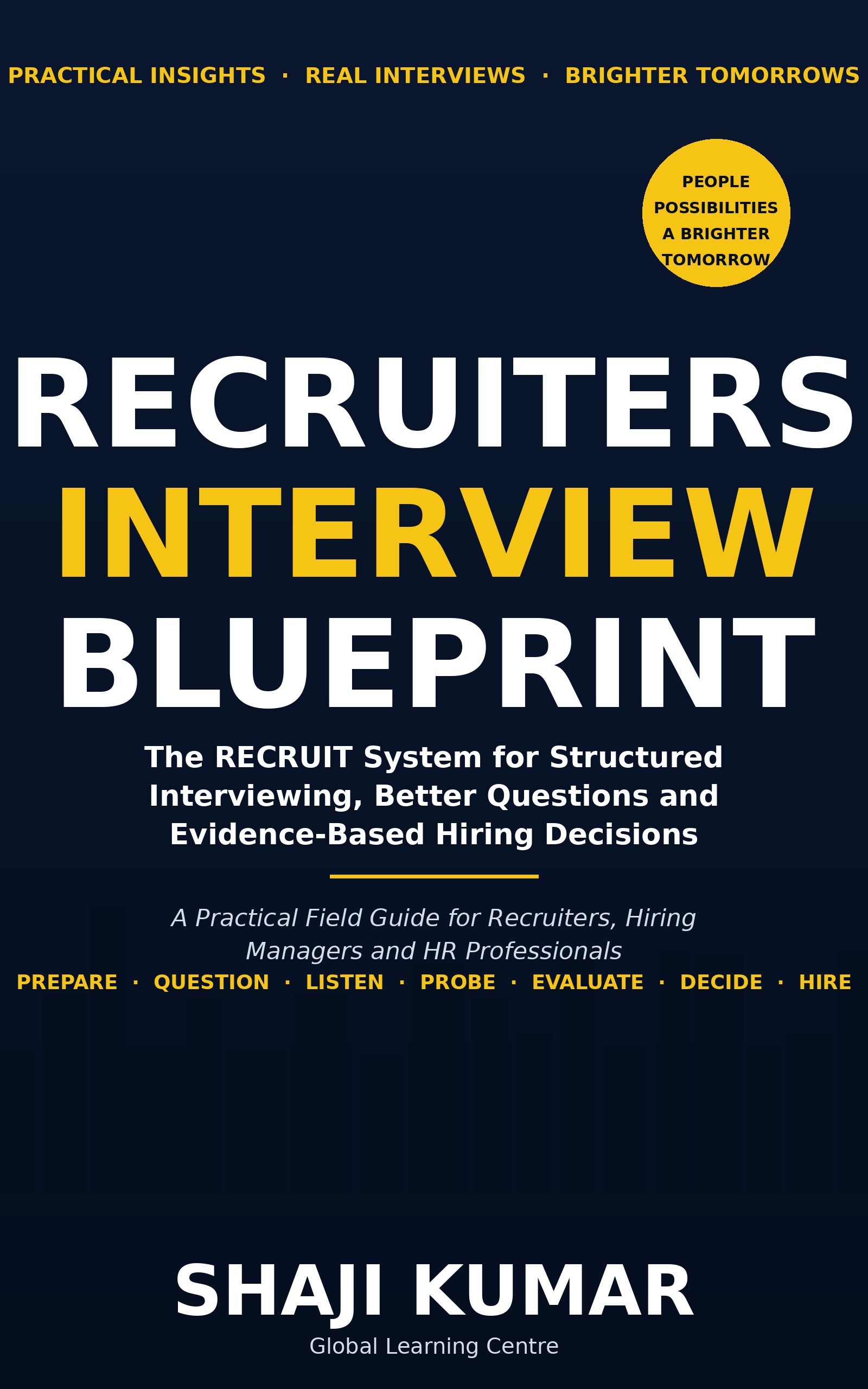
I’m glad to share that my new book, Recruiters Interview Blueprint: The RECRUIT System for Structured Interviewing, Better Questions and Evidence-Based Hiring Decisions, is now live and available everywhere books are sold.
Most interviews fail quietly. The recruiter likes the candidate, the hiring manager has a good feeling, and six months later the hire isn’t working out and no one can say exactly why the process missed it.
Drawing on nearly four decades spent on both sides of the interview table, in the Indian Army and then in corporate HR and staffing, I wrote this as a practical field guide built around the RECRUIT system: Role Clarity, Expectation Alignment, Competency Mapping, Real Evidence, Uncover Depth, Independent Scoring, and Take the Decision. It gives recruiters, hiring managers and HR professionals a repeatable way to define the role properly, ask questions that produce real evidence, probe without interrogating, and reach a hiring decision the whole panel can stand behind.
Inside, you will find a complete question bank organized by competency, worked scorecards and debrief templates, a chapter on the Transfer Test for senior hires moving between very different environments, and a dedicated chapter on interviewing in the age of AI-assisted candidates. Twenty ready-to-use tools turn every framework in the book into paperwork you can put in front of a hiring manager tomorrow.
Published under Global Learning Centre, with a foreword by Cecil Prem T, Founder and Partner of Advik Talent Search and HR Solutions LLP.
What early readers are saying
I read the Recruiters Interview Blueprint in detail and with a lot of interest. My sincere compliments for this document. It is outstanding. I was very happy to relate it with our own Officers Interview process at SSB. I found the similarity really fascinating. Structure, the structure of the document is very logical and it is evident it is built on years of your personal experience. Your RECRUIT system is very logically built and if used correctly by recruiters, can surely ensure apt selection of the candidate for the role required. Defining the Role rightly is the starting point. I especially liked your Chapter 6 with its question bank. Chapter 8 is bang on. We need a structured Interview system, not a gut-based question-and-answer session. In SSB, of course, we have a very structured Interview format. A structured scorecard, as you suggested, is a must and should ideally be filled immediately after each interview. Overall, I found the document very structured and logical. Our SSB Interview system is also aligned similarly, with the nuances we need. A great job, I must say. All the best. May this document assist thousands of recruiters in future.
The Transfer Test asks an important senior-hiring question: not simply whether a candidate succeeded before, but whether the mechanism behind that success is likely to transfer to the environment being hired for.
— Cecil Prem T, Founder and Partner, Advik Talent Search and HR Solutions LLP (from the Foreword)
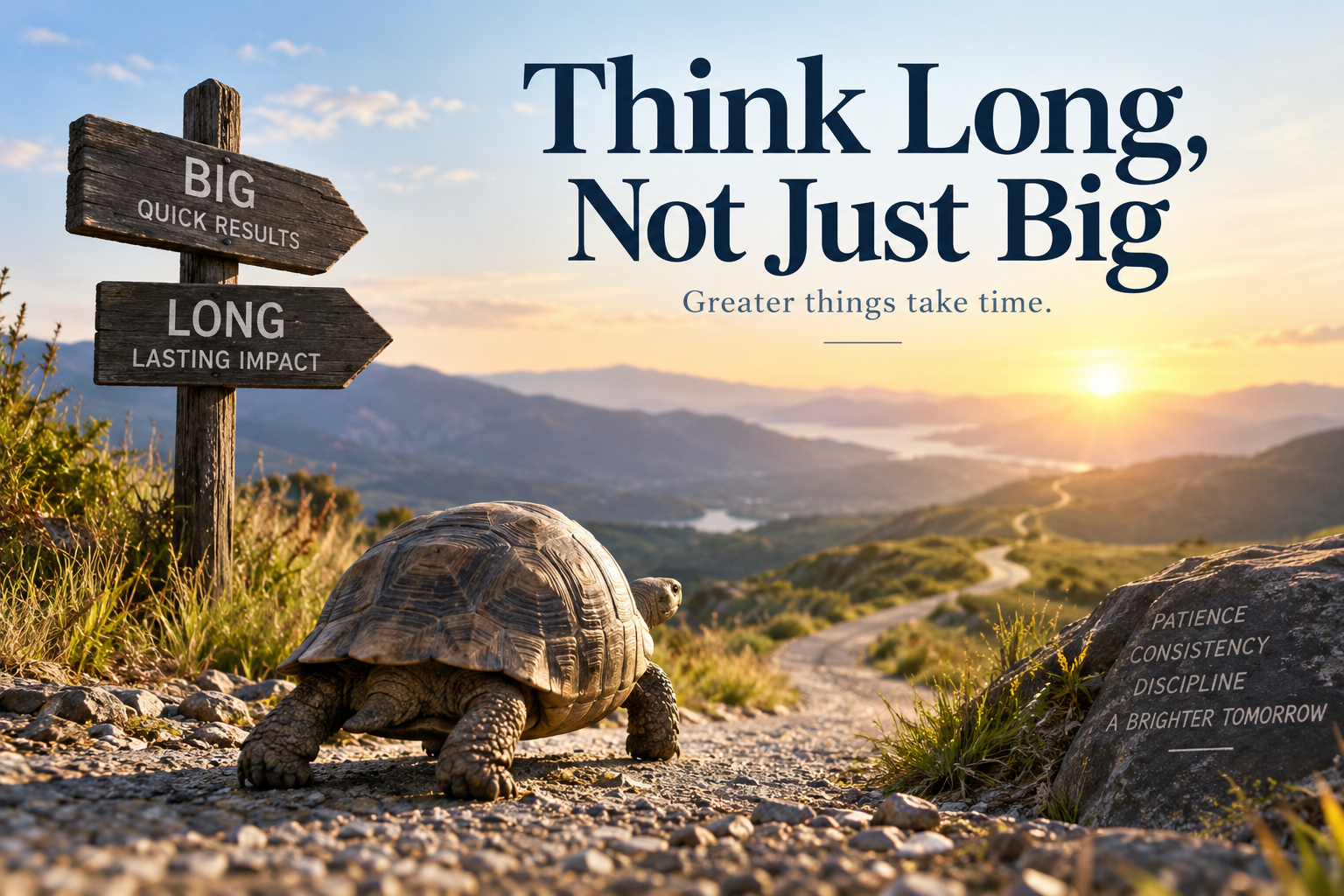
We are constantly told to think big. Dream big. Set audacious goals. Aim for the extraordinary. There is certainly nothing wrong with that. Ambition has driven much of human progress. But over the years, I have begun to wonder whether there is another dimension to success that we do not talk about nearly enough. Perhaps the real advantage is not only in thinking big. Perhaps it is in thinking long.
We live in an age of extraordinary impatience. We want the business to grow quickly, the book to sell immediately, the promotion to come now and the recognition to arrive before we have had enough time to build the capability, credibility and experience that usually produce it. Social media has only intensified this impatience. We constantly encounter stories of overnight success. Someone built a company in two years. Someone became a millionaire before thirty. Someone wrote a book that became a bestseller. Someone transformed their life in six months. What we rarely see is the ten years of preparation, failure, experimentation, learning and persistence behind the headline. We see the harvest. We rarely see the planting.
That is why I find the idea of thinking long so compelling. Most meaningful achievements do not happen overnight. Signposts may appear along the way. There may be small victories, breakthroughs, recognition and moments when we suddenly realise that something is working. But significant results generally require time. Results follow action, certainly, but significant results often require years, sometimes decades, of sustained action. Mastery takes time. Building a respected business takes time. Building a reputation takes time. Developing wisdom takes time. Becoming the person capable of handling the success we desire takes time as well.
The problem is that we often confuse action with immediate results. We start something and expect immediate evidence that it will work. When that evidence does not appear, we begin to question the idea, the opportunity and sometimes even ourselves. We move to something else. Then the same cycle begins again. Eventually, we may conclude that nothing works. But perhaps the problem was not that the idea was wrong. Perhaps we simply did not stay with it long enough.
There is another perspective that I find particularly powerful. Consider the productive span of life broadly, from around twenty to eighty. That gives us sixty years. Six periods of ten years. Six potential decades in which we could dedicate ourselves to learning, building, experimenting and becoming exceptionally good at something. Of course, life does not operate in neat ten-year blocks. Careers overlap, responsibilities change, circumstances intervene and priorities evolve. Yet the arithmetic makes one thing clear. We have considerably more time than we often behave as though we have.
Earlier generations did not necessarily have the same longevity, access to information, technology, educational resources or opportunities to reinvent themselves that we have today. We now live longer and can continue learning and contributing much later in life. A person can start a business at fifty-five, write a book at sixty, learn a new discipline at sixty-five or begin an entirely new chapter at seventy. Yet we often behave as though our opportunities disappear once we cross some arbitrary age boundary.
Why?
Who decided that everything important must happen by thirty? Who decided that a career must be settled by forty? Who decided that sixty is the end of productive life? These may be common social expectations, but they are not laws of nature.
There is something else worth examining. We tend to celebrate people who achieve extraordinary things very quickly. The entrepreneur who builds a billion-dollar company. The person who becomes a global leader. The author who sells millions of books. The athlete who wins everything. Their stories are fascinating because they are exceptional. Biographies exist precisely because these lives are unusual. But most people are not going to become billionaires, win prestigious awards, or change the world in a way that makes history books. Nor do most people necessarily want to.
That does not make their aspirations less meaningful.
Success does not have to be spectacular to be significant. A person may want to build a good business, become an exceptional professional, raise a family well, mentor young people, write something meaningful, create employment, contribute to society or simply become a better version of themselves. These achievements may never make the front page of a newspaper. They can still have enormous significance.
The important message, therefore, is not that everyone can become extraordinary by conventional measures. It is that we should not give up on ourselves simply because we have reached middle age or beyond.
There are still possibilities.
There are still opportunities.
There is still time.
In fact, I would argue that one of the great advantages of living longer is precisely that we get additional chances. The ageing of society is often discussed as though it is some kind of calamity. I see another possibility. The extra decades we now have can provide second, third, fourth and even fifth chances to learn, build, contribute and perhaps achieve something we could not achieve earlier.
You may have failed at something at thirty. You can try again at forty. You may have chosen the wrong career at thirty-five. You can change direction at fifty. You may have built a business that did not work. You can build another. You may have spent decades working for someone else. You can create something of your own. You may have postponed writing that book. You can write it now. Just because something didn’t happen earlier doesn’t mean it cannot happen later.
Sometimes life simply takes longer than we expected.
That brings me to the familiar story of the hare and the tortoise. Most of us encountered it as children. The hare was fast and confident. The tortoise was slow and seemingly insignificant. Yet the tortoise eventually reached the destination. We were probably taught that the lesson was about consistency and not underestimating the competition. But there is another lesson in that story that seems increasingly relevant today.
The tortoise understood time.
It did not need to be spectacular every day. It didn’t need to show dramatic progress every hour. It simply had to keep moving in the right direction.
That is becoming increasingly difficult in our world because we are surrounded by speed. Fast food. Fast communication. Fast delivery. Fast information. Fast careers. Fast money. Fast fame. Technology has made many things faster and artificial intelligence is accelerating that process even further. Speed is undoubtedly useful. But speed is not the same as progress. And progress is not the same as transformation.
Some things simply cannot be rushed.
A tree does not become a tree overnight. A child does not become an adult overnight. A reputation does not develop overnight. Wisdom certainly does not. Why should our most meaningful achievements be any different?
This is where I have begun to examine my own journey more honestly. I have always been fascinated by big ideas, big goals and big possibilities. Looking back, however, I sometimes wonder whether I spent too much time thinking about how big the outcome could be and not enough time thinking about how long I was prepared to stay with the journey.
I should have thought long instead of only thinking big.
That is something I rue.
The size of the goal is rarely the only issue. The more important question may be the timeframe we give ourselves to achieve it. If you want to write one book, perhaps you can do it in a year. If you want to become a respected author, you may need a decade. If you want to launch a business, perhaps you can do it in a few months. If you want to build an institution that outlives you, you may need decades. If you want to acquire a skill, you can learn its fundamentals relatively quickly. If you want mastery, prepare to stay.
That distinction matters.
Thinking big gives us direction. Thinking long gives us endurance. Thinking big can inspire us. Thinking long can sustain us. Thinking big can make us dream. Thinking long can give the dream a realistic chance of becoming reality.
Perhaps this is why some of life’s most important achievements are not the result of extraordinary bursts of effort. They are the result of ordinary effort sustained for an extraordinary length of time.
We underestimate the power of compounding in almost everything except money. We understand that investments grow when allowed to compound over decades, yet we often fail to apply the same principle to knowledge, relationships, reputation, skills, businesses and personal growth. Ten years of learning is not simply ten times one year of learning. Ten years of experience can fundamentally change the quality of our judgement. Ten years of building relationships can create a network that would be impossible to build quickly. Ten years of consistent work can create credibility that no amount of short-term publicity can manufacture.
The difficulty is that compounding is almost invisible in the beginning.
For a long time, it can appear as though nothing much is happening.
That is precisely when most people quit.
The desire for instant results, while completely understandable, can make us less open to the paths that lead to lasting achievement. What is quick and requires less work is naturally more attractive. But the things that matter most in life often ask something different from us. They ask us to stay when the excitement has disappeared. They ask us to continue when nobody is watching. They ask us to work without immediate applause.
That is not glamorous.
It is simply how many worthwhile things are built.
So perhaps we need to rethink what we mean when we tell people to “think big”. Think big, certainly. But attach that ambition to a long horizon. Instead of asking, “How quickly can I achieve this?”, perhaps we should sometimes ask, “What could I build if I stayed committed to this for ten years?”
That is a very different question.
It changes the way we look at failure because failure becomes information rather than a final verdict. It changes the way we measure progress because small improvements begin to matter. It changes how we respond to setbacks because a setback in year two doesn’t look quite so catastrophic when the horizon is ten years. Most importantly, it changes our relationship with age.
We stop seeing age as a countdown and begin seeing it as accumulated capital.
Experience becomes an asset. Mistakes become lessons. Relationships become resources. Perspective becomes an advantage. And the years that once seemed to have passed us by can become the foundation for what comes next.
Perhaps that is the real message we should take from the tortoise.
It was not that the tortoise was faster.
It was that the tortoise stayed in the race.
And maybe that is what many of us need to remember.
You do not have to achieve everything this year. You do not have to prove everything today. You do not have to become successful according to somebody else’s timetable. You do not even have to know exactly where the journey will end.
You simply need to keep moving towards something that matters.
Because sometimes the greatest advantage you have is not speed.
It is time.
As I look back at my own journey, I now believe that one of the most important questions we can ask ourselves is not, “How big is my goal?”
It is, “How long am I prepared to stay with it?”
Thinking big can lift our eyes.
Thinking long can keep our feet on the ground.
And perhaps the combination of the two creates lasting achievement.
But if I had to choose the lesson that I wish I had understood earlier in my own life, it would be this:
Do not just think big. Think long.
Because the power of thinking long may be what finally allows us to go further than we ever imagined.
What rings true for you?
Is it the power of thinking big, or the power of thinking long?
The Journey is yours. The Learning doesn’t have to be.
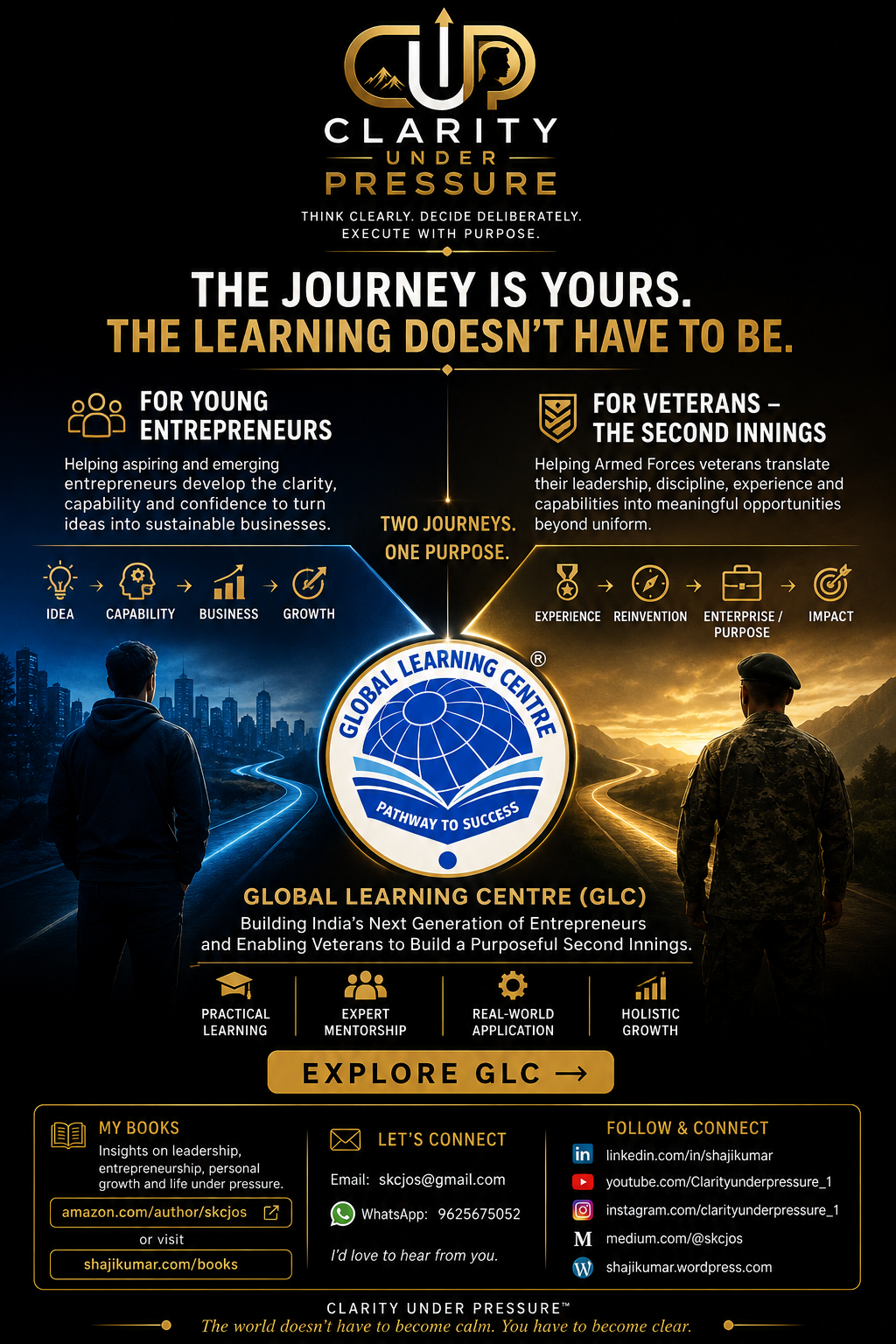
Global Learning Centre (GLC) is being built around two journeys:
FOR YOUNG ENTREPRENEURS
Helping aspiring and emerging entrepreneurs develop the clarity, capability and confidence to turn ideas into sustainable businesses.
FOR VETERANS — THE SECOND INNINGS
Helping Armed Forces veterans translate their leadership, discipline, experience and capabilities into meaningful opportunities beyond uniform.
There is a version of the success story we have all been sold, and most of it is a lie.
Not the part about hard work. The part about speed. Open any feed and you will find it: the twenty-five-year-old who built a unicorn in eighteen months, the founder who “made it” before thirty, the overnight sensation who apparently arrived from nowhere. It makes for a good headline. It makes for a terrible blueprint, because it simply is not how success actually works for almost anyone, including the very people the headlines are about.
I want to make a different case in this post, and in the ones that will follow it. It is a case built on three things I have come to believe are true, not because I read them somewhere, but because I have lived long enough to watch them play out, in my own life and in the lives of hundreds of people I have coached and worked alongside.
First, results follow action, and significant results take time. Usually decades.
The gap between doing the work and seeing the payoff is almost always longer than we expect, and almost always longer than anyone advertises. What gets called an overnight success is, nearly every time, the visible tip of ten or fifteen years most people never saw. There may be signposts along the way if you know where to look, small proofs that you are on the right track. But the idea that meaningful achievement arrives quickly is, for practical purposes, a myth. Plan your life as though the real results are decades out, because they usually are.
Second, most people get more than one chance to succeed, if they are willing to commit the time.
This is the encouraging part, and it is also the part people resist. Most people are capable. Genuine capability is far more common than we like to admit. What is rare is not ability but appetite: the willingness to devote real years, not weeks, to getting good at one thing. Ten years of dedicated focus will take almost anyone from beginner to genuinely excellent at nearly anything worth doing. Few people have sufficient passion for any single pursuit to commit ten years to mastering it. That is not a comment on talent. It is a comment on staying power, and staying power can be built the same way anything else is built: deliberately, and over time.
Third, there is more time available to you than you think, and enough of it to do a few things exceptionally well.
Here is a way of looking at it I find useful. Assume your productive life runs from twenty to eighty. That is sixty years, or six separate ten-year periods. Six full decades, each one long enough on its own to take you from novice to master in a field, if you commit to it. That is roughly three times the productive runway most people could count on a century or two ago, when a working life ending at forty-five or fifty was the norm rather than the exception. We have been handed extra decades that no earlier generation had, and most of us are still living as though we only have the first two.
There is a reframe I keep coming back to on this point. The press tends to write about an ageing society as though it were some kind of calamity, a problem to be managed. I think that gets it backwards. The extra decades we now have are one of the genuinely great developments of our time, because they hand all of us second, third, fourth, even fifth chances at something close to greatness, chances earlier generations simply did not get. Somebody needed to say that plainly, so I am saying it.
I am also deliberately not going to load this post with examples of the truly exceptional: the people who built giant companies, made a billion dollars, won a major prize, or changed the world in some sweeping, documented way. Those stories exist, and they get written up precisely because they are rare. Most of us are not going to reach those heights, and if I am honest, most of us do not actually want to run that particular race. None of that diminishes the real message here, which is this: you should not give up on yourself, or on what you set out to build, simply because you are no longer young. Plenty of people have not given up, and they are doing extraordinary things at forty-five, at fifty-five, at seventy, with none of it making headlines and all of it mattering enormously to them and the people around them.
I want to speak directly to one group of people reading this, because their situation makes the whole argument concrete rather than theoretical.
If you are an officer approaching the end of your service, or you have already hung up the uniform and are wondering what comes next, you are standing at exactly the point this post is about. You gave the first part of your working life to discipline, to a mission larger than yourself, to a code most civilian careers never ask anyone to live by. And then, somewhere in your forties or early fifties, that chapter ends, often earlier than you would have chosen, and you are left looking at what feels like the back half of a life with no obvious script for it.
I would ask you to look at the arithmetic again. If your working life runs to eighty, and your uniformed service ended at fifty, you are not closing a book. You are between campaigns, with two, three, even four more ten-year periods still ahead of you, each one long enough to build something you would be genuinely proud of. That is the whole idea behind Hoplite: the citizen-soldier who serves, returns, and takes up the next fight in civilian life, with the same discipline that got him through the first one. Nothing about your training was wasted. It was preparation for a second campaign you have not fought yet.
This will be the first post in an ongoing series exploring exactly that: how officers rebuild after service, what actually transfers from a military career into corporate life, entrepreneurship, or consulting, and what tends to get in the way. I will not be pretending there is a formula that works for everyone. There is not. But there is a process, and there is a great deal that decades of watching people make this exact transition has taught me about what works and what does not.
If you are an officer thinking about this transition, or you know one who is, I would genuinely like to talk. Not a sales pitch, just a conversation about where you are and what your options actually look like. Reach me directly on WhatsApp at 9625675052, or by email at skcjos@gmail.com.
What would you attempt if you stopped measuring yourself against how young you are?
The Journey is yours. The Learning doesn’t have to be.
Global Learning Centre (GLC) is being built around two journeys:
FOR YOUNG ENTREPRENEURS
Helping aspiring and emerging entrepreneurs develop the clarity, capability and confidence to turn ideas into sustainable businesses.
FOR VETERANS — THE SECOND INNINGS
Helping Armed Forces veterans translate their leadership, discipline, experience and capabilities into meaningful opportunities beyond uniform.
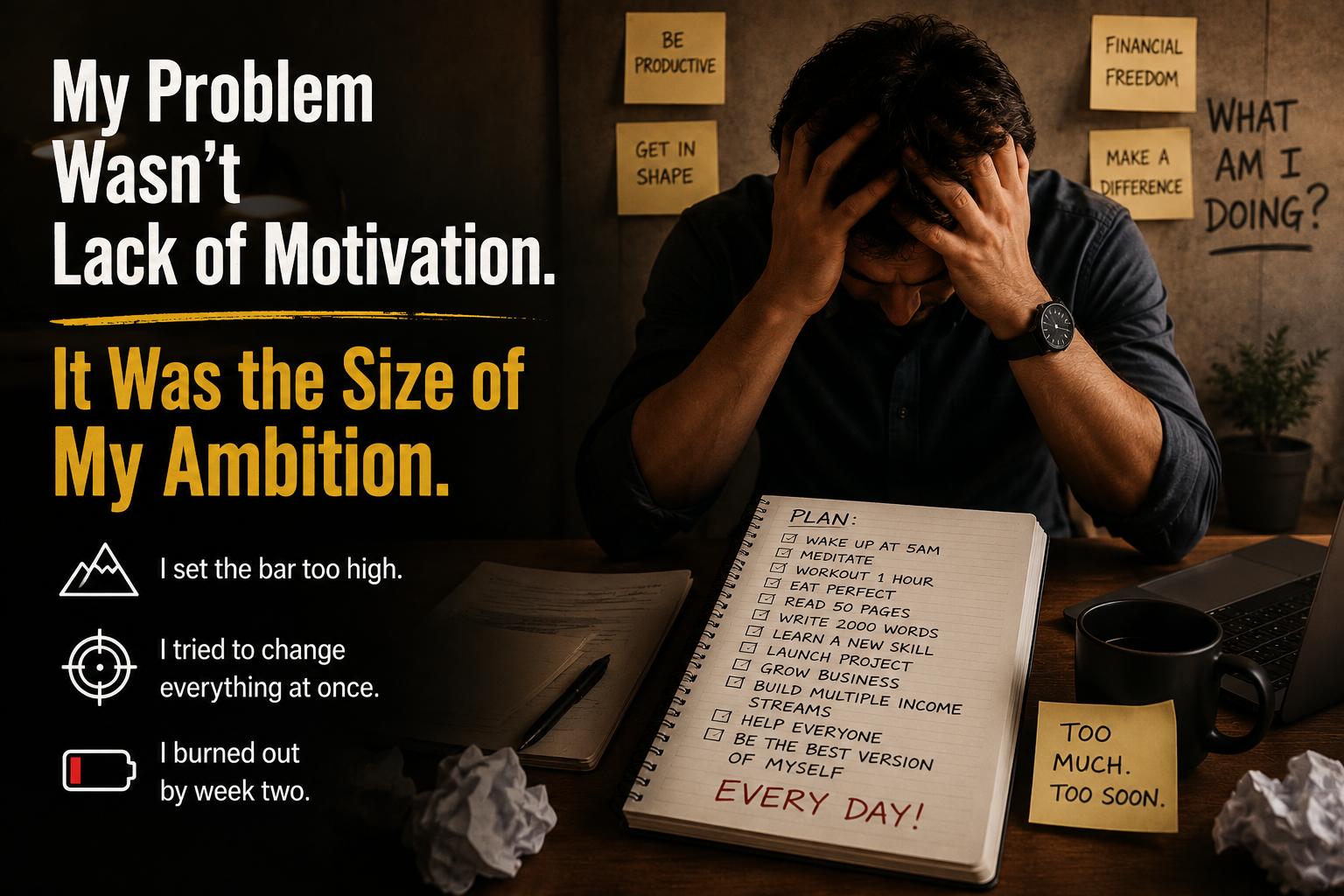
I believed real change required a dramatic declaration, an ambitious plan, and a complete life overhaul.
A new routine. An earlier morning. A stricter diet. More exercise. More reading. More writing. More discipline. More of everything.
Like many people who are obsessed with becoming a better version of themselves, I would occasionally sit down and redesign my entire life.
And, like many people, I would fail. Not immediately. The first few days were always exciting.
I would wake up with renewed determination. I’d write my new schedule neatly. My goals would look ambitious and inspiring. I would feel like a new man.
By the second week, reality would begin to interfere. Work pressures. Travel. Meetings. Unexpected commitments. Fatigue.
One missed morning routine would become two. One deviation from the plan would make me feel that the entire effort had failed.
Soon, I would find myself exactly where I started. Surrounded by the wreckage of another beautifully designed plan. And a familiar feeling of disappointment.
Perhaps you have experienced this too.
We don’t fail because we don’t want change badly enough. Sometimes we fail because we try to change too much, too quickly.
My Problem Wasn’t Lack of Motivation. It Was the Size of My Ambition.
Looking back at my career, I can see this pattern everywhere. Whether it was developing a new capability, improving my health, writing, or building something professionally, I was always attracted to the big picture.
The large goal. The transformation. The finished outcome.
That approach had served me well in many aspects of my professional life. Senior leadership roles require strategic thinking. You are expected to see the future, identify gaps and create large-scale change.
But a problem arises when you apply the same philosophy to your personal life.
You cannot always transform a life through a corporate-style transformation programme. Human beings are not organisations. We don’t respond well to endless PowerPoint plans, aggressive timelines and ambitious implementation charts.
Sometimes the smallest change is more powerful than the grandest strategy. I understood this much later when I came across a simple Japanese philosophy.
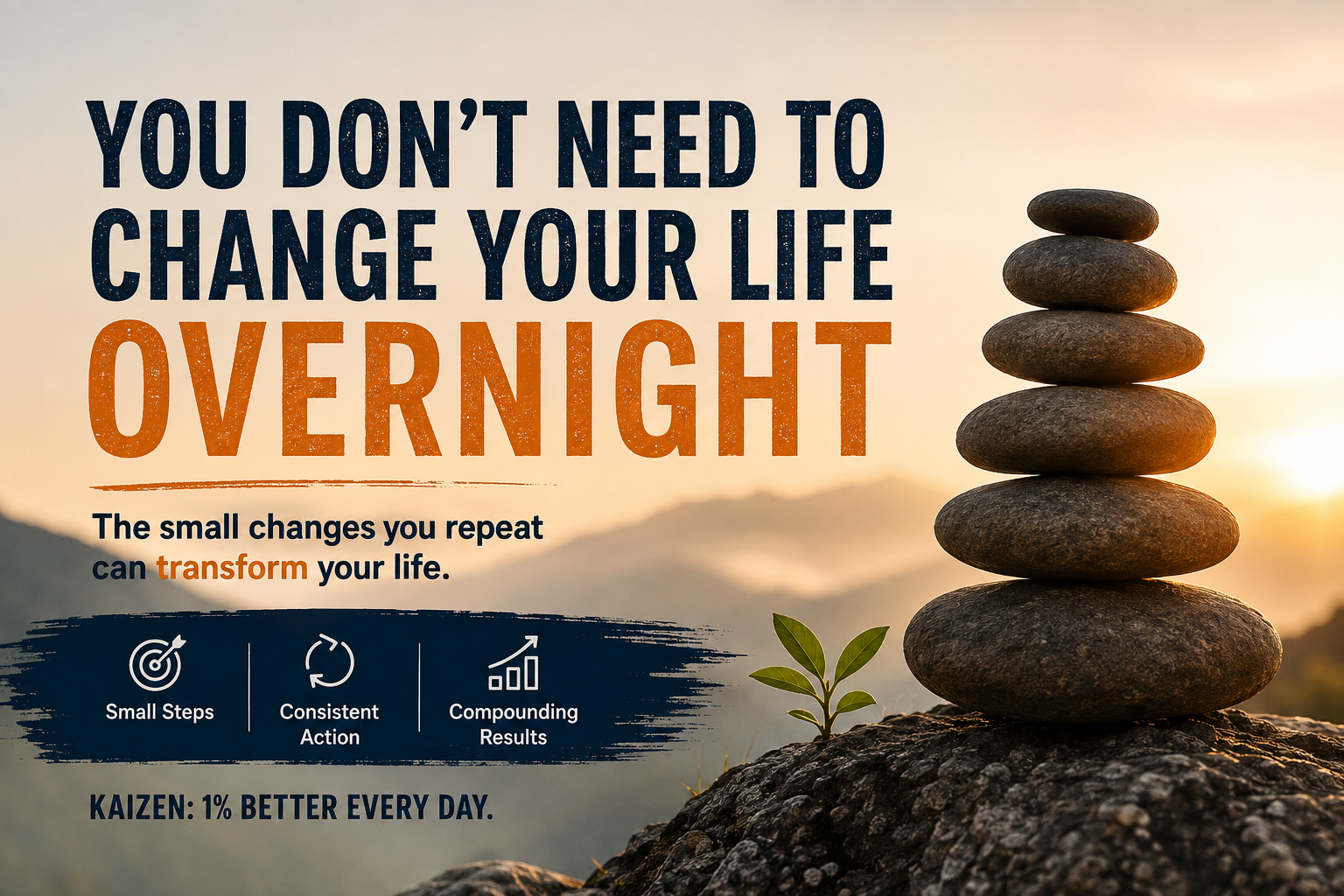
Small improvements. Consistent improvements. Improvements that may appear insignificant today but become extraordinary over time.
Initially, I thought of Kaizen as another productivity concept. Another idea to help people become more efficient. Another fashionable word from the world of management. Then I began reading about where it actually came from. And the philosophy suddenly became far more meaningful.
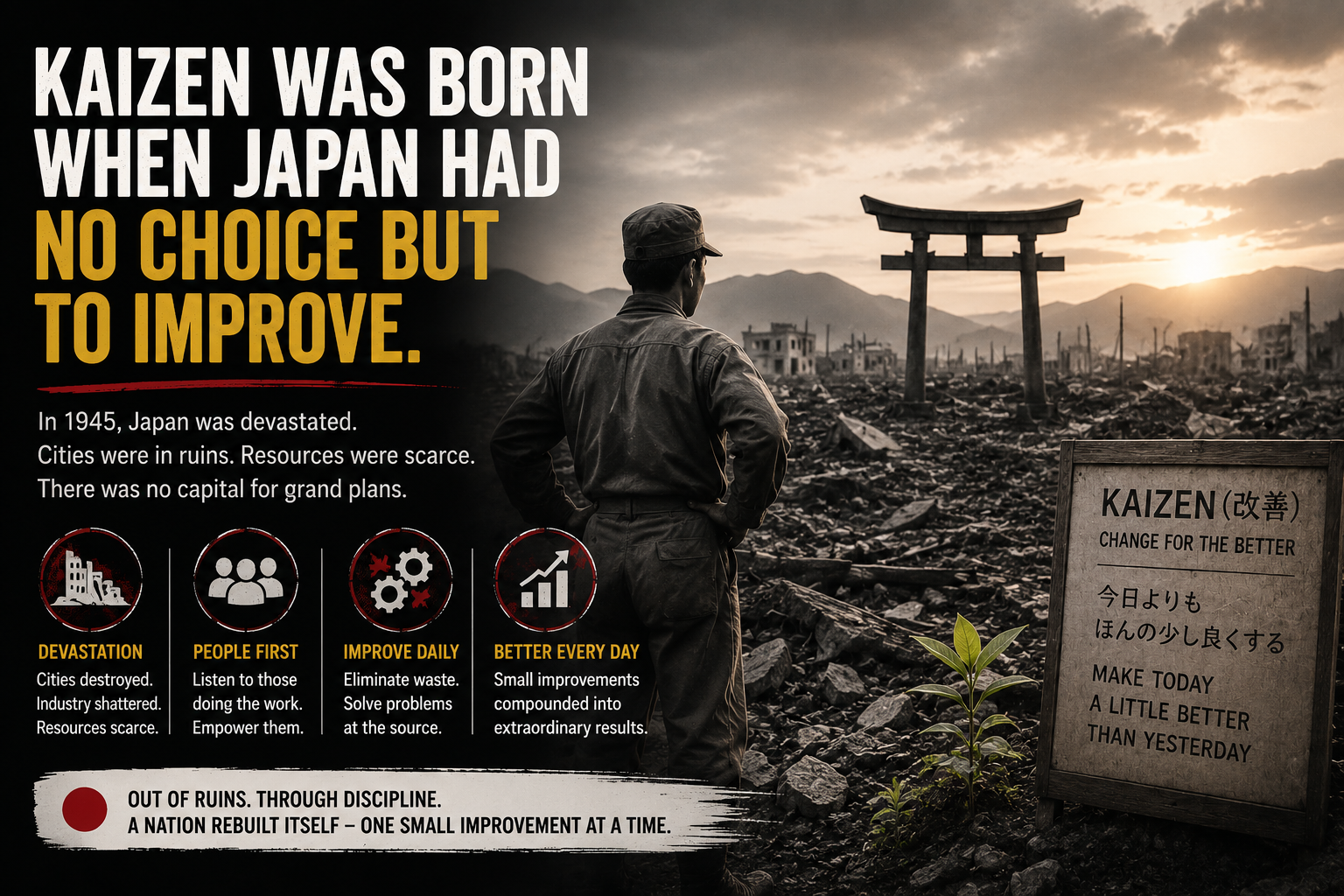
Kaizen Was Born When Japan Had No Choice But to Improve.
In 1945, Japan was devastated.
Its major cities had been destroyed. Infrastructure was damaged. Industries were struggling. The economy was in ruins. There was no luxury of starting everything again from scratch. No endless capital. No massive resources. No opportunity to simply demolish the old system and build a perfect new one overnight.
Japan had to learn how to improve with what it had.
And so, Japanese industry began focusing on something remarkably simple. Make things a little better. Every day. Eliminate one unnecessary step. Reduce one mistake. Improve one process. Solve one problem at its source. Listen to the person actually doing the work.
Quality thinkers such as W. Edwards Deming and Homer Sarasohn reinforced the philosophy, and leaders like Taiichi Ohno later embedded it deeply in companies such as Toyota.
The approach challenged conventional thinking.
Instead of waiting for senior management to design the perfect solution, people closest to the work were encouraged to identify problems. Instead of tolerating errors and fixing them later, organisations began addressing problems at their source. Instead of massive periodic transformations, improvement became a daily habit.
The famous Plan-Do-Check-Act cycle captured this beautifully.
Plan something small. Do it. Check the results. Act on what you learn.
Then repeat.
Again.
And again.
And again.
The result was extraordinary.
By the 1970s and 1980s, the world was watching Japan. The phrase “Made in Japan,” once associated in many Western markets with cheap products, came to mean reliability, precision, and quality. American and European companies began travelling to Japan to understand the Toyota Production System.
Everyone wanted to know the secret.
How had a nation devastated by war become a global industrial powerhouse? The answer was not one miraculous breakthrough. It was thousands of small improvements.
Compounded over time.
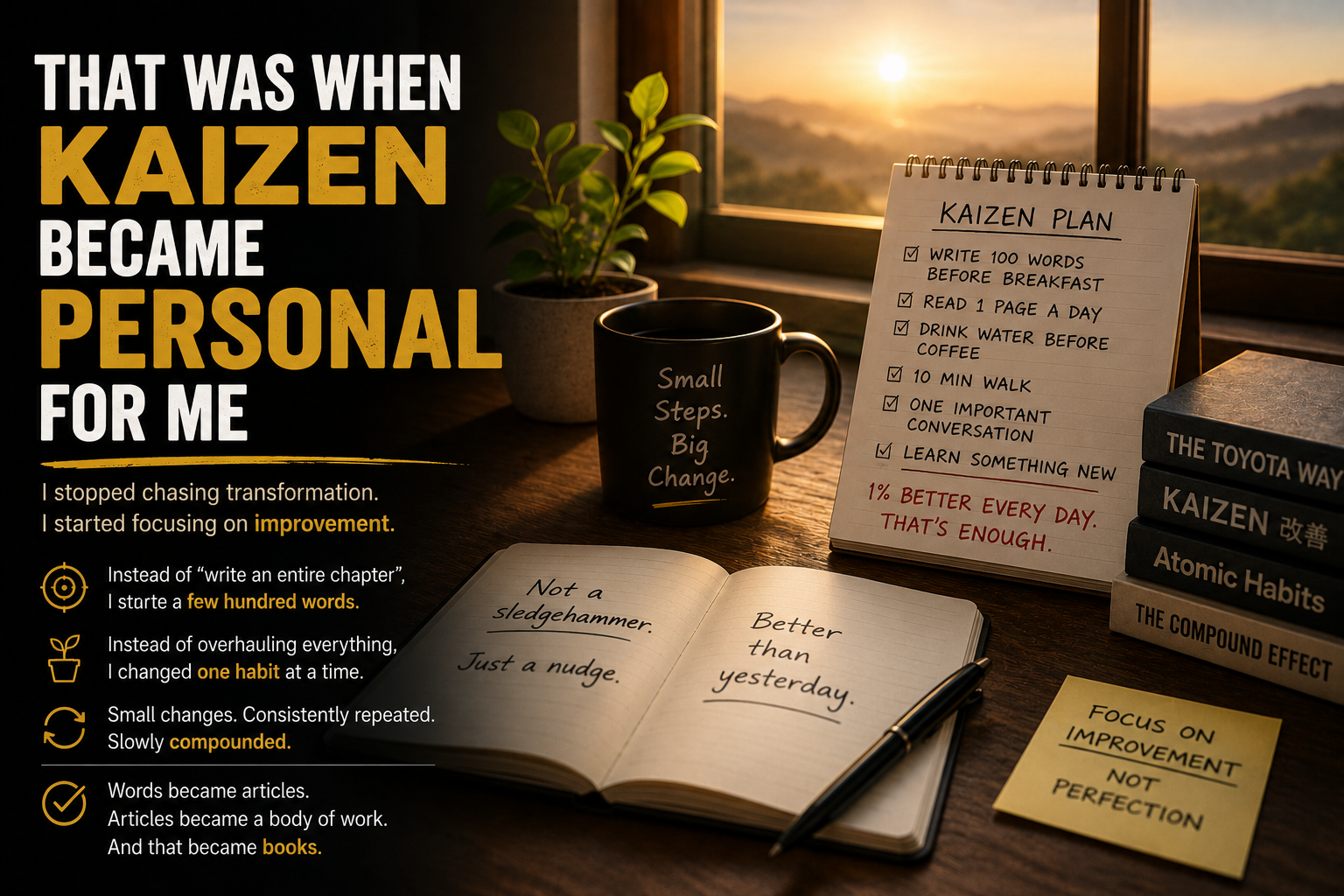
That’s when Kaizen Became Personal for me.
The more I thought about it, the more uncomfortable I became. Because I realised I had been approaching personal change in exactly the opposite way.
I wanted dramatic results. Immediately.
I would decide that I needed to become a more disciplined writer and then set myself an ambitious target. Write more. Write regularly. Finish chapters. Complete the manuscript. Produce something significant.
But staring at a blank page and expecting to produce something brilliant can be intimidating.
So I changed the approach. Instead of thinking about completing a chapter, I focused on writing a few hundred words. Sometimes even less. Just start. One idea. One paragraph. One page.
That was enough.
And something interesting happened. The pressure disappeared. I no longer had to be inspired enough to write an entire chapter. I simply had to write something. Those small writing sessions eventually became articles. Articles became blogs. Blogs became a body of work.
Over time, that body of work contributed to books and ideas I may never have produced if I’d waited for the perfect burst of motivation.
The same principle applied elsewhere.
Instead of completely redesigning my diet, I could change one habit. Instead of declaring that I would become extraordinarily fit, I could focus on moving more consistently.
Instead of trying to read fifty books in a year, I could simply read every day. The objective was no longer to impress myself with the size of my commitment. The objective was to make progress impossible to resist.
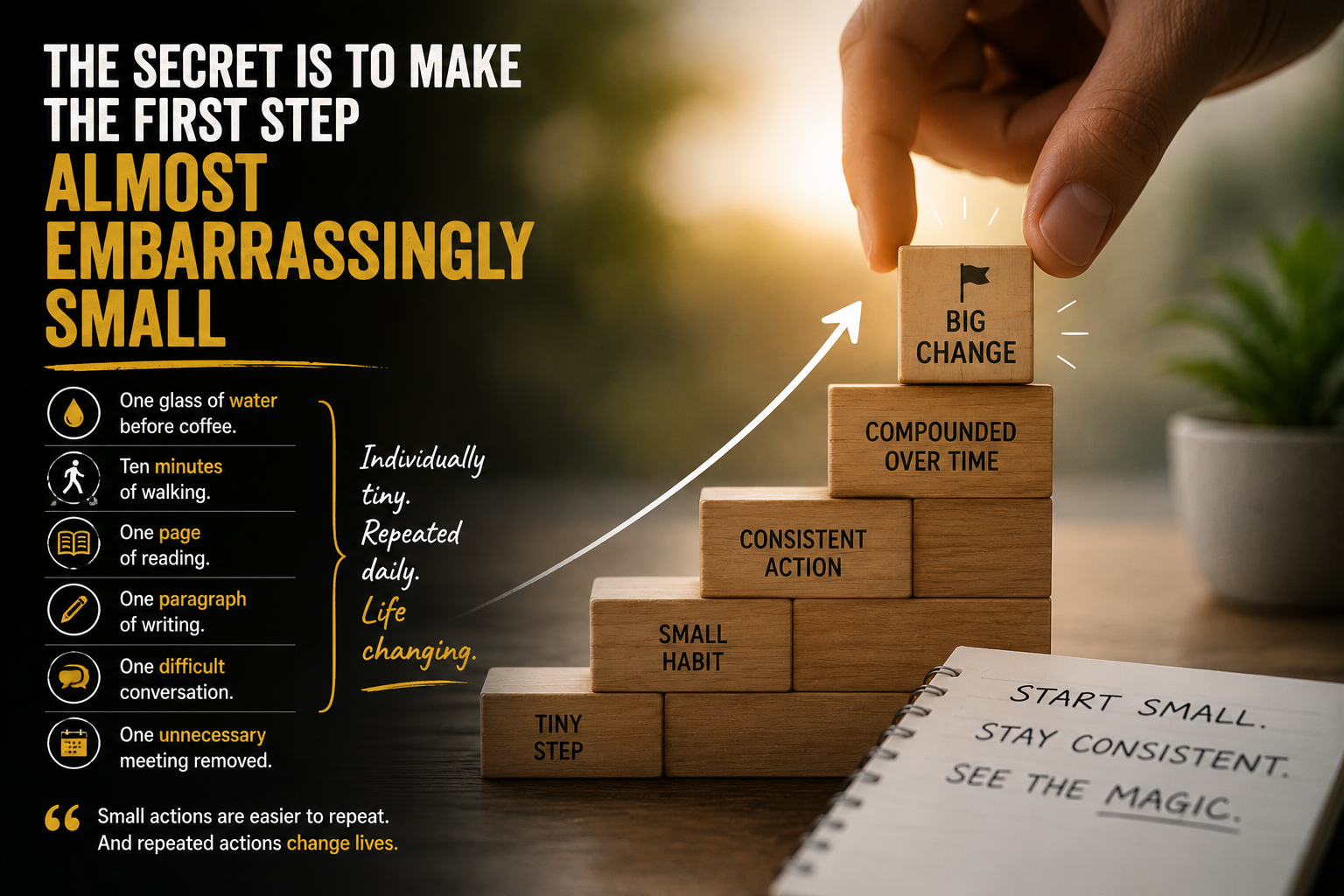
The Secret Is to Make the First Step Almost Embarrassingly Small.
This is where I believe most of us misunderstand change. We think a goal’s difficulty proves how committed we are. So we create difficult routines.
Wake up at 5 a.m.
Exercise for an hour.
Meditate for thirty minutes.
Read fifty pages.
Write two thousand words.
Eat perfectly.
Do it every day.
And when life inevitably interrupts us, we conclude that we lack discipline. But perhaps discipline was never the problem. Perhaps the plan was.
The beauty of a tiny improvement is that it doesn’t frighten you.
One glass of water before your morning coffee.
Ten minutes of walking.
One page of reading.
One paragraph of writing.
One phone call you have been postponing.
One unnecessary meeting removed from your calendar. One difficult conversation you finally initiate. One small improvement to a process at work. Individually, these things look insignificant. Almost laughably insignificant. But Kaizen understands something we often forget.
Small actions are easier to repeat.
And repeated actions become habits. Habits shape behaviour. Behaviour shapes identity. And identity eventually shapes destiny.
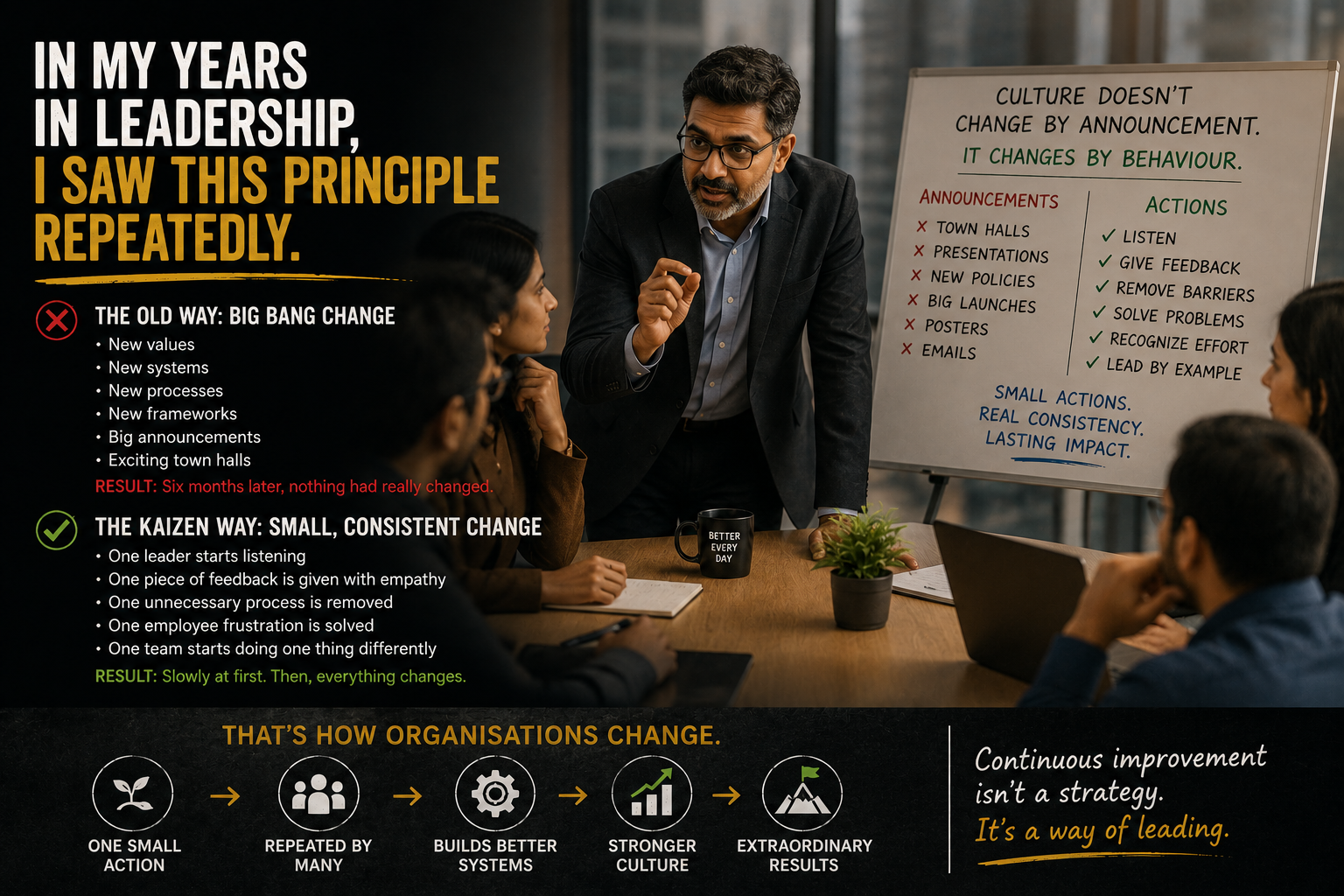
In My Years in Leadership, I Saw This Principle Repeatedly.
During my career in HR and business leadership, I have seen organisations launch magnificent transformation programmes. New vision statements. New values. New competency frameworks. New performance management systems. New leadership models. Everything announced with great enthusiasm. Posters are printed. Town halls are conducted. Presentations are shared.
Then, a few months later, everyone quietly returns to what they were doing before.
Why?
Because culture doesn’t change because someone announces it. Culture changes when behaviour changes. And behaviour changes when people begin doing small things differently. A manager who starts giving genuine feedback. A leader who begins listening before responding. A team that removes one unnecessary approval process. A company that solves one recurring employee frustration. A supervisor who starts recognising good work immediately rather than waiting for the annual awards ceremony.
These may not make headlines.
But they change organisations.
The same is true for people.
We often wait for a life-changing moment. The perfect Monday. The New Year. Our birthday. A new job. A health scare. A personal crisis.
We tell ourselves:
“From tomorrow, everything will change.”
But transformation rarely arrives with a dramatic drumroll. More often, it enters quietly. It begins with something so small that nobody else even notices. You wake up ten minutes earlier. You write one paragraph. You take the stairs. You make one difficult phone call. You stop postponing something. You learn one new skill.
And then you do it again tomorrow.
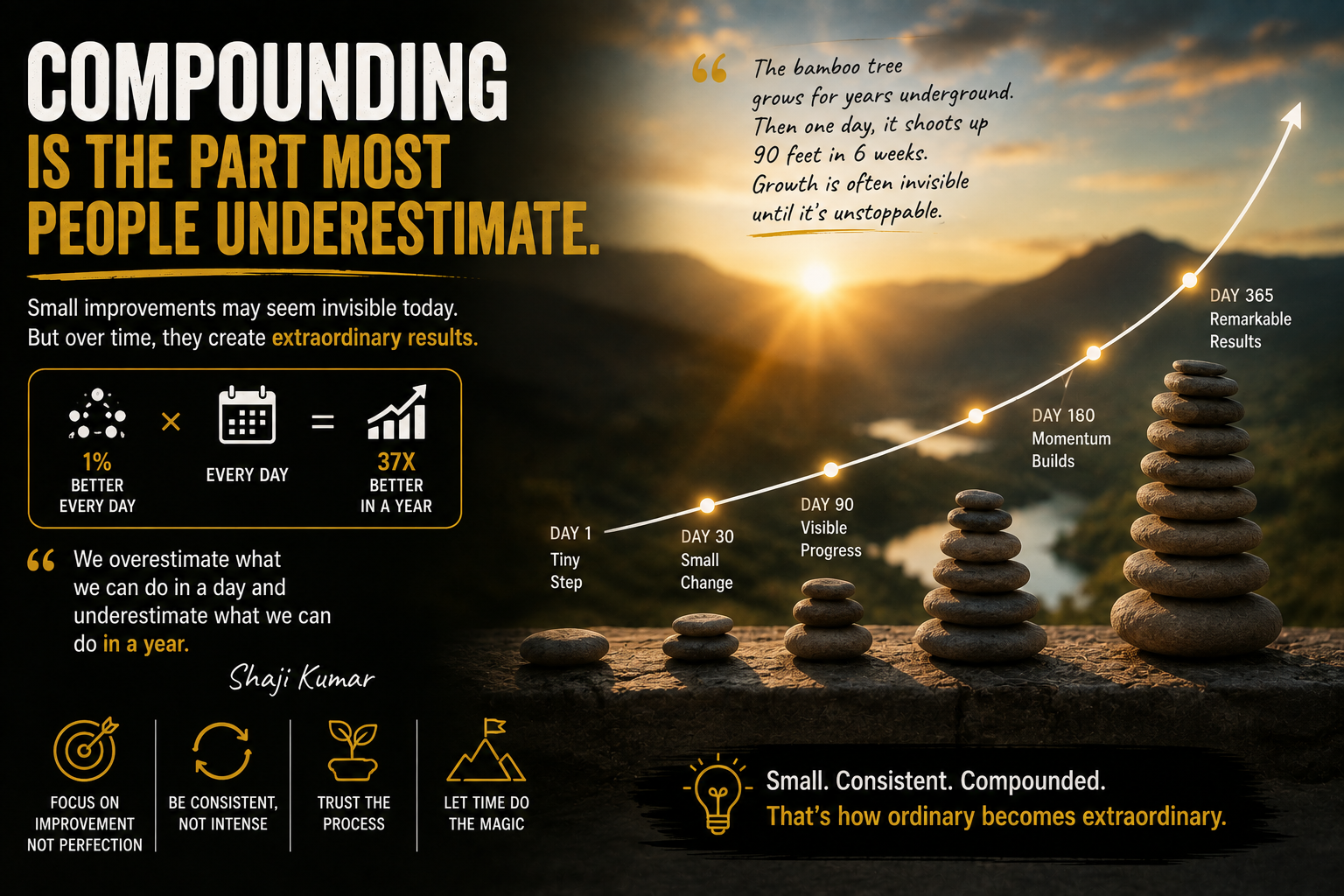
Compounding Is the Part Most People Underestimate.
We are impatient creatures. We want to see results immediately. If we exercise for three days, we look in the mirror. If we write for a week, we wonder why we haven’t finished a book. If we save money for a month, we wonder why we aren’t financially secure.
But Kaizen requires patience.
Because its power is not in today’s improvement. Its power is in accumulated improvement. One per cent better may not look impressive tomorrow. But imagine becoming one per cent better consistently.
Imagine improving one professional skill every month.
Imagine strengthening one relationship through one meaningful conversation every week. Imagine writing 300 words a day. Imagine walking thirty minutes every day. Imagine learning something new every morning. The individual action is small. The accumulated result is not.
This is the mathematics of compounding applied to human behaviour.
And perhaps that is the most important lesson I have learned.
You don’t have to transform your life today.
You only have to improve something today.
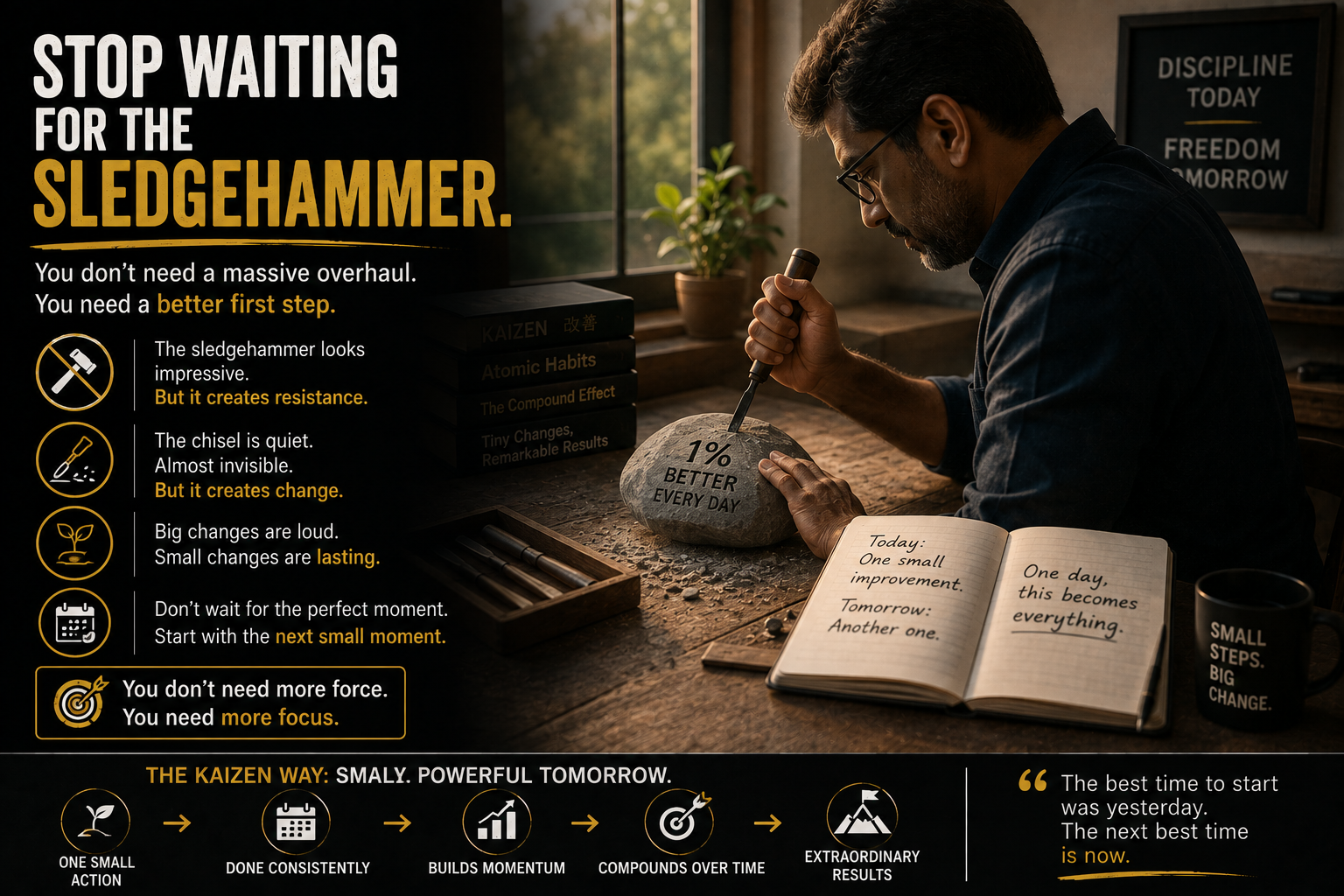
Stop Waiting for the Sledgehammer.
For years, I thought change required a sledgehammer. A dramatic intervention. A complete reinvention. Today, I believe differently.
Sometimes the most powerful transformation begins with something so small that your ego dismisses it.
That first paragraph. That ten-minute walk. That one healthier choice. That single conversation. That one improvement to the way you work.
That one thing you finally stop postponing.
The goal is not to become a different person overnight. The goal is to become slightly better than the person you were yesterday.
Then do it again tomorrow.
And the day after.
Because eventually, those tiny changes stop being tiny. They become your habits. Your habits become your character. And your character quietly builds the life you once thought required a dramatic transformation.
Japan did not rebuild its global reputation through one spectacular leap.
Toyota did not become synonymous with quality because of one brilliant idea.
And most of us will not change our lives because of one motivational speech, one New Year’s resolution or one perfect Monday morning.
We change through repetition. Through patience. Through small corrections. Through the willingness to look at what we do today and ask:
What is one thing I can make slightly better tomorrow?
That is Kaizen.
Not perfection.
Not dramatic reinvention.
Not exhausting yourself in the pursuit of an impossible new version of yourself.
Just continuous improvement.
Quietly.
Consistently.
Patiently.
One small step at a time.
And perhaps that is enough.
Perhaps it has always been enough.
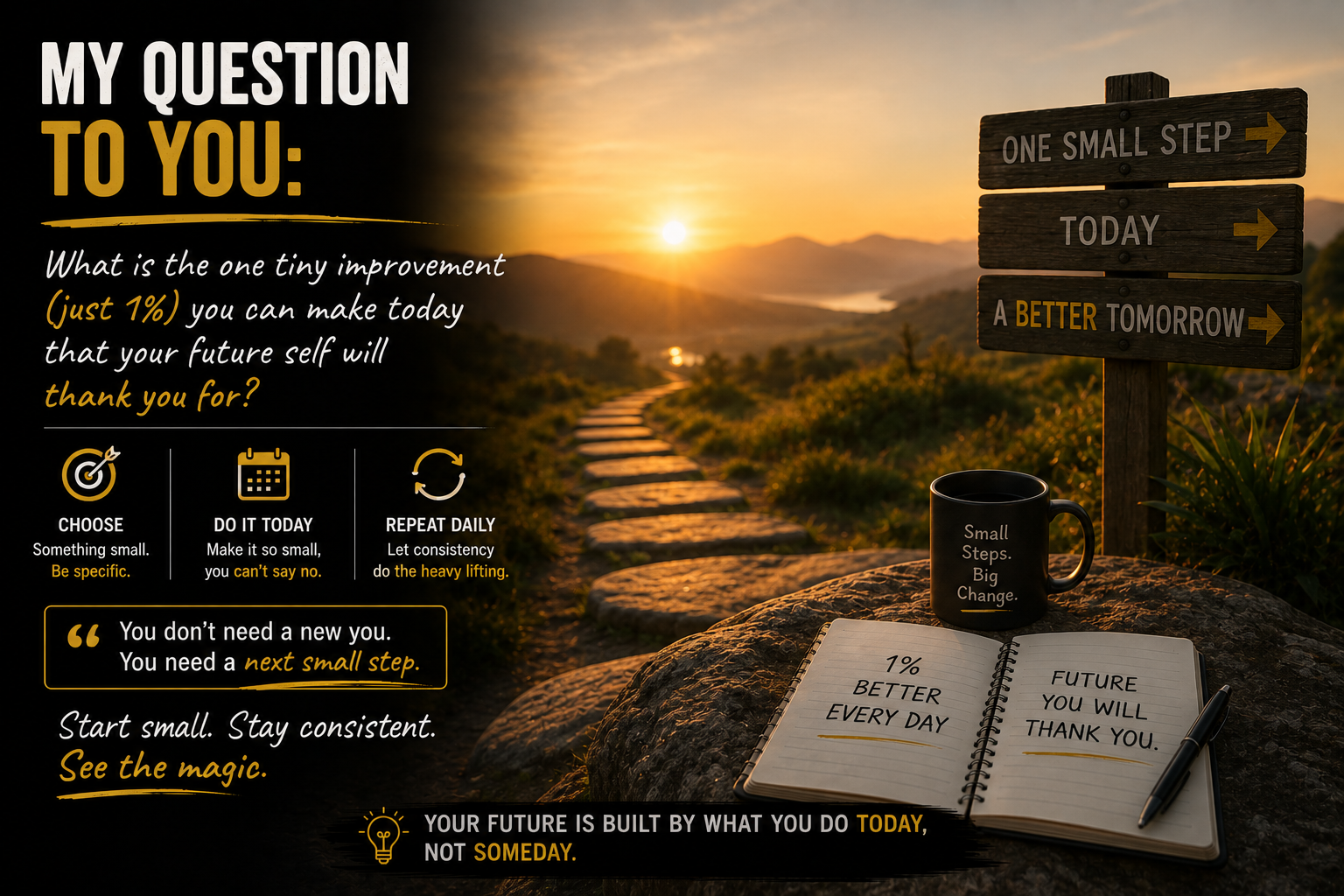
My question to you:
The Journey is yours. The Learning doesn’t have to be.
Global Learning Centre (GLC) is being built around two journeys:
FOR YOUNG ENTREPRENEURS
Helping aspiring and emerging entrepreneurs develop the clarity, capability and confidence to turn ideas into sustainable businesses.
FOR VETERANS — THE SECOND INNINGS
Helping Armed Forces veterans translate their leadership, discipline, experience and capabilities into meaningful opportunities beyond uniform.
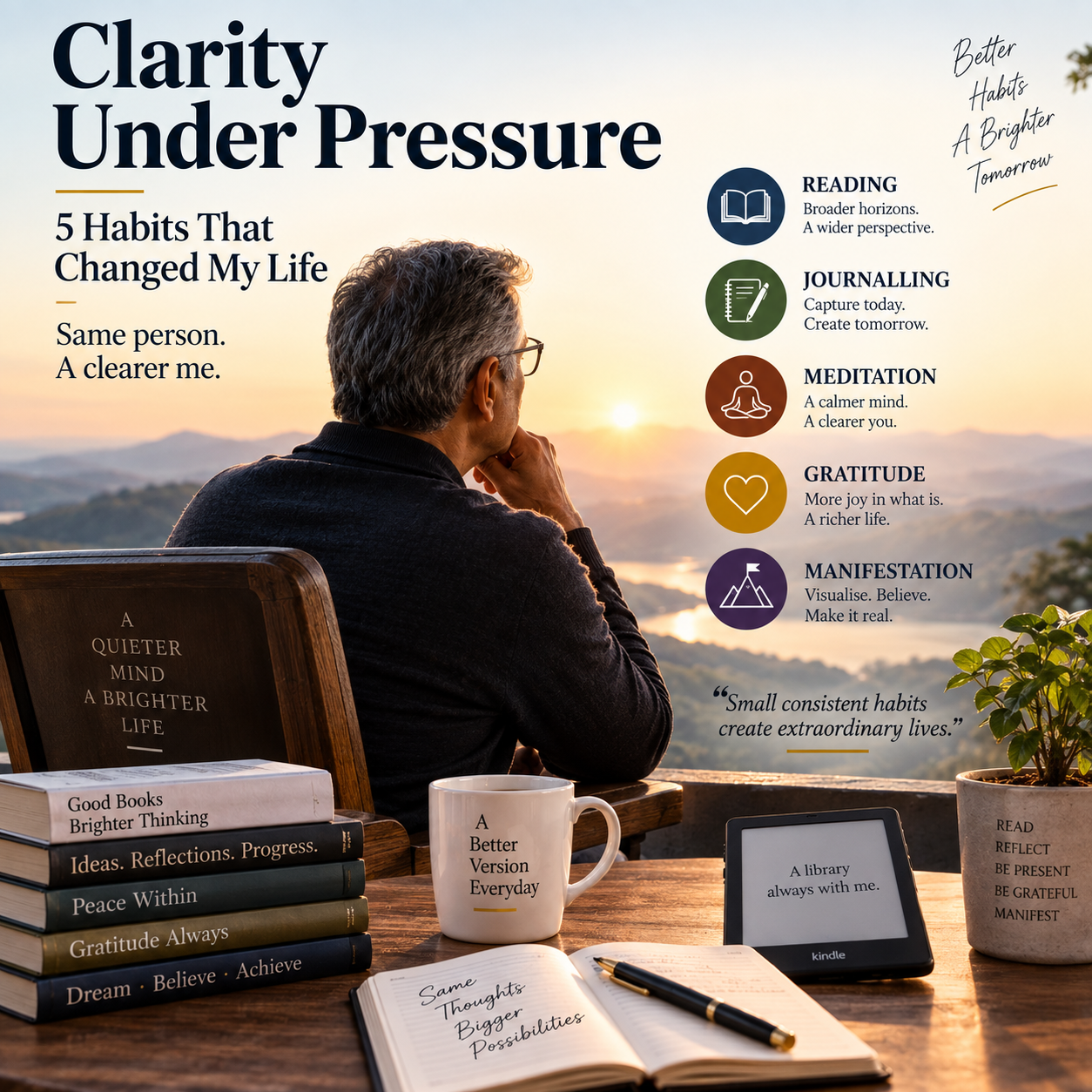
Looking back, I realise that my life changed because of a few habits I practised repeatedly, often without fully understanding how much they were shaping me.
These are not theories I learnt from a motivational seminar.
They are habits I have lived.
1. Reading
I have always had a love affair with books.
I have a large personal collection, and honestly, my books are among my prized possessions. Sometimes I simply look at them and admire them.
Books gave me something formal education alone could not.
Perspective.
Coming from a background where I did not have the advantage of an advanced formal degree, I consciously educated myself by reading.
Books became my teachers.
They broadened my horizons and allowed me to learn from people I would probably never meet.
There was a time when I travelled with four or five books in my bag.
Today, thankfully, my Kindle carries a large part of my library. It has become an inseparable companion on my travels.
Never underestimate what one good book can do to your thinking.
2. Journalling
Thoughts are fleeting.
An idea can arrive while travelling, bathing, eating or in the middle of a conversation. If you don’t capture it, it can disappear forever.
I have kept journals for most of my adult life.
I now have close to 50 of them.
Going back and reading something I wrote twenty or thirty years ago is an experience difficult to describe. It is nostalgia, reflection and sometimes even surprise.
Many ideas I captured in those pages eventually found their way into my life.
My belief is simple:
Our mind is for creating ideas, not storing them.
Write them down.
3. Meditation
I struggled with meditation when I first started.
Like most people, my mind wandered everywhere.
Then I came across Osho’s interpretation of meditation: concentrating your consciousness in one channel.
That changed my approach.
I began by simply being present.
If I was brushing my teeth, I brushed my teeth.
Nothing else.
No planning.
No worrying.
No mental conversation.
Slowly, learning to be fully present in small activities led me towards meditation.
Meditation, for me, is not about asking for something.
It is about expecting nothing.
And somehow, receiving peace.
4. Gratitude
This habit has probably changed my emotional life more than any other.
I consciously remain grateful.
For what I have.
For the people in my life.
Even for waking up to another day.
When I travel from Delhi to my hometown in Adoor, Kerala, I consciously pause to appreciate something as simple as breathing fresh air.
We often postpone happiness until something bigger happens.
A promotion.
More money.
A better house.
A future achievement.
But happiness is also a choice about what we notice today.
There is always something to be grateful for.
5. Manifestation
Aladdin had a Genie.
I believe all of us do too.
We simply need to pick up the lamp.
For me, manifestation is visualisation combined with faith and consistent action.
From humble beginnings, I spent years visualising the life I wanted.
Every morning, I would imagine what I wanted to create and, more importantly, feel grateful as though life had already blessed me with it.
Was it magic?
I don’t know.
But I do know this.
What we repeatedly focus on influences how we think, act and make decisions.
And many things I once visualised are today part of my life.
These five habits did not make life perfect.
They made me clearer.
And when life becomes difficult, clarity is often more valuable than motivation.
Reading expanded my mind.
Journalling captured my thoughts.
Meditation calmed my mind.
Gratitude changed my perspective.
Manifestation gave direction to my dreams.
None of them requires extraordinary talent.
Only consistency.
My question to you:
If you had to name one habit that genuinely changed the direction of your life, what would it be, and when did you realise its impact?
I would genuinely like to know. Perhaps your answer will inspire someone else reading this post.
The Journey is yours. The Learning doesn’t have to be.
Global Learning Centre (GLC) is being built around two journeys:
FOR YOUNG ENTREPRENEURS
Helping aspiring and emerging entrepreneurs develop the clarity, capability and confidence to turn ideas into sustainable businesses.
FOR VETERANS — THE SECOND INNINGS
Helping Armed Forces veterans translate their leadership, discipline, experience and capabilities into meaningful opportunities beyond uniform.
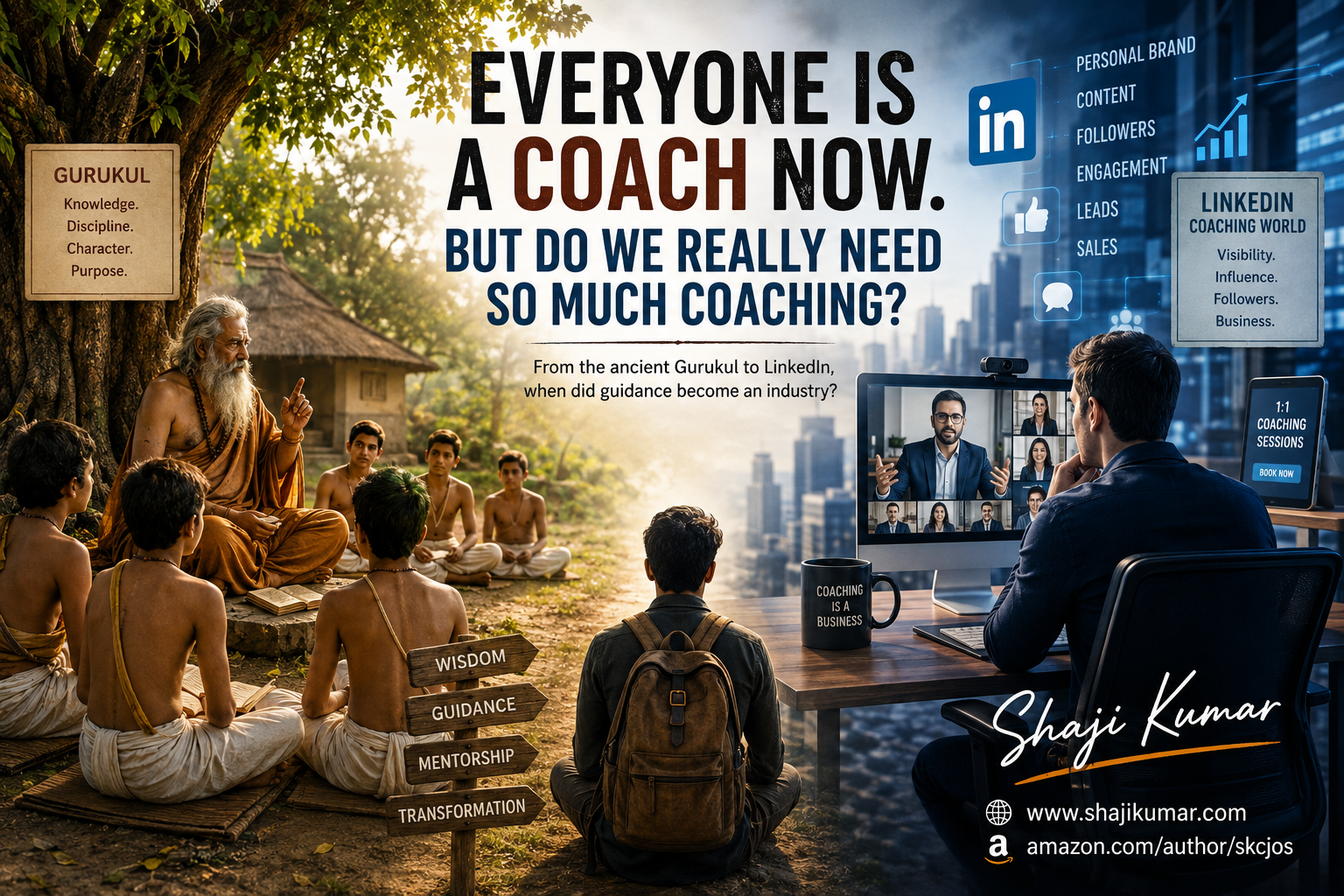
Open LinkedIn on any given morning and you will quickly notice something interesting.
Someone wants to coach you to become a better leader.
Someone else wants to help you discover your purpose.
Another promises to unlock your hidden potential.
There are career coaches, executive coaches, life coaches, leadership coaches, mindset coaches, business coaches, wellness coaches, relationship coaches and performance coaches.
Sometimes I wonder whether we will soon need a coach to help us choose the right coach.
Before anyone misunderstands me, let me make one thing clear.
I am not against coaching.
In fact, having spent over three decades in Human Resources and leadership roles, I have seen first-hand how good coaching can transform people. I have watched capable leaders become more self-aware. I have seen individuals discover strengths they had underestimated. I have seen people change the way they lead because someone asked them the right questions at the right time.
Good coaching can be enormously valuable.
But the extraordinary growth of coaching has made me think.
When did we begin to need so many coaches?
And more importantly, what does our growing dependence on coaching say about the world we live in?
To find an answer, I found myself looking backwards rather than forwards.
Back to an idea that has been part of Indian civilisation for centuries.
The Gurukul.
When Learning Was About More Than Education
The Gurukul system was built around a relationship that went far beyond formal education.
Children and young people would live and learn under the guidance of a Guru. But the Guru was not merely a teacher standing in front of a classroom delivering information.
The relationship was more immersive.
The Guru observed the student.
He understood the student’s strengths and weaknesses.
He corrected behaviour.
He encouraged discipline.
He imparted knowledge.
He questioned thinking.
He developed character.
And, perhaps most importantly, he prepared the individual for life.
Learning was not confined to a timetable.
Life itself was part of the curriculum.
Students learned through observation, participation, responsibility and experience.
The relationship between the Guru and the Shishya was deeply personal. A good Guru did not necessarily treat every student in exactly the same way. Guidance was often shaped by the needs and capabilities of the individual.
When I look at this through a modern lens, I cannot help asking an interesting question.
Was this not, in many ways, coaching?
Perhaps mentoring too.
Perhaps teaching.
Perhaps parenting.
Perhaps something that combined all of these.
The difference was that it was not packaged as a professional service.
Nobody needed a website.
Nobody displayed testimonials.
Nobody built a personal brand around the number of lives they had transformed.
Guidance was simply an accepted and natural part of human development.
Somewhere along the way, we began separating all of these roles.
Teachers teach.
Mentors mentor.
Consultants advise.
Therapists provide psychological support.
Coaches coach.
Influencers inspire.
And increasingly, social media tells us who is qualified to do each of these things.
There is nothing inherently wrong with professionalising expertise. In many cases, professional standards are necessary and valuable.
But I sometimes wonder whether we have fragmented something that was once naturally embedded in human relationships.
Looking Back at My Own Career
When I look back over my own professional journey, I can identify several people who had a profound influence on me.
Some were bosses.
Some were senior leaders.
Some were colleagues.
Some were friends.
A few may have been mentors without either of us ever formally using that word.
They did not necessarily sit across from me and announce that the next sixty minutes would be a coaching session.
There was no structured contract.
No coaching objective written down.
No formal feedback report at the end of the conversation.
But they influenced me.
Some challenged me when I was wrong.
Some trusted me before I had fully earned that trust.
Some gave me opportunities that stretched me.
Some told me things I did not particularly want to hear.
And some simply listened when I needed perspective.
Looking back, I realise that many of the most important lessons of my career came through conversations.
Not training programmes.
Not presentations.
Not competency frameworks.
Conversations.
A senior leader who takes the time to explain why something matters can influence a young professional for years.
A manager who believes in an employee at the right moment can change the direction of a career.
A colleague who tells you an uncomfortable truth can sometimes do more for your development than an expensive course.
None of these people called themselves coaches.
But they were, in their own way, guides.
And that made me wonder whether the growth of the coaching industry is really only about coaching.
Perhaps it is about something deeper.
Perhaps it reflects what we are missing.
The Modern World Has Created a Vacuum
Why are so many people seeking coaches today?
The easy answer is that modern life has become more complicated.
Careers are no longer linear.
Jobs disappear.
Industries change.
Technology evolves faster than many of us can adapt.
The definition of success has become increasingly personal and confusing.
People are constantly told to find their purpose, build their personal brand, discover their passion, achieve financial independence and become the best version of themselves.
That is a lot of pressure.
At the same time, many of the traditional sources of guidance have weakened.
Families are often geographically dispersed.
Communities are less connected.
Workplaces have become increasingly transactional.
Managers are under pressure to deliver targets and manage teams with fewer resources.
Senior leaders often have little time for meaningful developmental conversations.
People may be surrounded by hundreds of digital connections and yet have very few people with whom they can have an honest conversation.
Perhaps this explains part of the coaching boom.
Maybe people are not simply buying coaching.
Maybe they are buying something much more basic.
Attention.
Time.
Listening.
Perspective.
Encouragement.
Accountability.
A safe space to think aloud.
If you look at it that way, the growth of coaching begins to make more sense.
The question then changes.
Instead of asking why there are so many coaches, perhaps we should ask why so many people feel they need one.
The Difference Between Guidance and Dependency
This is where I believe an important distinction needs to be made.
There is a significant difference between helping someone grow and making them dependent on your guidance.
The best teachers eventually want their students to think for themselves.
The best parents want their children to become independent.
The best leaders want their teams to become capable of making decisions without constantly seeking approval.
And I believe the same should be true of coaching.
A good coach should help you see more clearly.
Not see for you.
A good coach should ask better questions.
Not provide every answer.
A good coach should challenge your assumptions.
Not replace your judgement with theirs.
A good coach should build your confidence.
Not make you believe that you cannot progress without another session.
To me, the ultimate measure of successful coaching is not how long a client remains dependent on a coach.
It is how confidently that person eventually walks without one.
This is where the ancient relationship between Guru and Shishya becomes particularly interesting.
The purpose of education was not to create a lifelong follower incapable of independent thought.
The purpose was to prepare the individual for life.
To develop capability.
Character.
Judgement.
And independence.
The student eventually left.
That, in many ways, was the success of the relationship.
Perhaps modern coaching should remember that principle.
Have We Commercialised Human Guidance?
This question may make some people uncomfortable.
Have we turned something fundamentally human into an industry?
There is nothing wrong with professionals being paid for their expertise. Doctors, lawyers, teachers, consultants and coaches invest time in developing knowledge and skills.
Professional coaching, when practised ethically and competently, requires considerable expertise.
But the rapid growth of the industry has also created a crowded marketplace.
Anyone who spends time on social media will have noticed the increasing number of people presenting themselves as coaches.
The barriers to entering the profession can sometimes appear unclear to an outsider.
Credentials vary.
Experience varies.
Methodologies vary.
And the promises can occasionally be extraordinary.
“Transform your life.”
“Unlock your potential.”
“Find your purpose.”
“Become unstoppable.”
“Achieve the life you deserve.”
These are powerful promises.
Perhaps too powerful.
Because real human development is rarely that simple.
People are complicated.
Careers are complicated.
Relationships are complicated.
Life is complicated.
No coach, mentor, leader or guru has all the answers.
And perhaps that is something both coaches and clients need to remember.
Guidance should create greater clarity.
It should not sell certainty where certainty does not exist.
What Organisations Need to Learn
Having spent much of my career in HR, I also believe organisations need to examine their own role in the growing demand for coaching.
Over the years, organisations have invested heavily in leadership development.
They have introduced competency frameworks, assessment centres, executive education programmes and coaching interventions.
Many of these initiatives are valuable.
But I sometimes wonder whether organisations have forgotten one of the most important development tools available to them.
The manager.
A good manager can be one of the most influential people in an employee’s professional life.
A manager sees the individual in action.
They understand the context.
They witness strengths and weaknesses.
They have opportunities to provide feedback in real time.
They can stretch people.
Trust them.
Correct them.
Challenge them.
And help them grow.
Yet many managers are never properly trained to develop people.
They are trained to manage performance.
Meet targets.
Control costs.
Complete appraisals.
Deliver results.
Development becomes an HR initiative rather than a leadership responsibility.
Then, when people need guidance, organisations hire external coaches.
Again, there is nothing wrong with that.
External coaches can bring objectivity and expertise that internal managers cannot.
But perhaps organisations need to ask themselves a difficult question.
Are we investing in coaching because our managers have become too busy to guide their own people?
Could some of the demand for coaching be reduced if organisations created cultures where managers genuinely took responsibility for developing those who worked with them?
Perhaps we need fewer inspirational leadership slogans and more meaningful conversations.
Fewer development frameworks and more managers who actually care about the development of their people.
Fewer formal mentoring programmes and more senior leaders willing to make time for younger professionals.
The answer is not to eliminate coaching.
The answer is to recognise that development cannot be outsourced entirely.
We Have Always Needed Guides
Despite all these questions, I remain convinced of one thing.
Human beings have always needed guides.
We learn from other people.
We observe.
We imitate.
We question.
We receive feedback.
We make mistakes.
And occasionally, someone wiser or more experienced helps us see something we could not see ourselves.
That person may be a Guru.
A teacher.
A parent.
A manager.
A mentor.
A friend.
Or a professional coach.
The labels may have changed.
The fundamental human need has not.
Perhaps that is why coaching has become so important in modern life.
We live in an age overflowing with information but often lacking wisdom.
We have unlimited access to advice but limited access to genuine guidance.
We can follow thousands of experts online while still feeling unsure about our own decisions.
In such a world, a good coach can provide something technology cannot easily replace.
Human attention.
Thoughtful questions.
Perspective.
And the space to think.
That is valuable.
Very valuable.
But there is a line we should be careful not to cross.
Guidance should empower.
Not control.
Coaching should encourage independent thinking.
Not dependency.
A mentor should help you find your path.
Not insist that you follow theirs.
And perhaps the greatest guide is not the person who gives you the most answers.
It is the person who eventually teaches you how to find your own.
So, Have We Turned Guidance Into an Industry?
Perhaps we have.
But I am not sure that is necessarily the problem.
The more interesting question may be why the industry has grown so rapidly.
Maybe modern life has created a shortage of the things human beings have always needed.
Someone to listen.
Someone to challenge.
Someone to encourage.
Someone to tell us the truth.
Someone to help us make sense of our experiences.
In the Gurukul, guidance was embedded in the relationship between the Guru and the student.
In our professional lives, it may come from a manager, mentor or coach.
The format has changed.
The need remains.
My concern is not that coaching exists.
My concern is what happens if we begin believing that every important decision requires external validation.
At some point, the purpose of guidance must be to help us trust ourselves.
The Guru eventually lets the student leave.
The teacher hopes the student will think independently.
The parent hopes the child will stand on their own feet.
The leader hopes the team will eventually perform without constant supervision.
And perhaps the best coach should hope for exactly the same thing.
To become less necessary.
Not more.
That, to me, is the real test of guidance.
It should not create followers.
It should create people capable of walking their own path.
And perhaps that is the lesson we can still learn from an ancient idea like the Gurukul.
What do you think?
Has coaching become an essential part of modern life?
Or have we created an industry around something that was once a natural responsibility of teachers, parents, leaders and communities?
I would genuinely like to hear from coaches, leaders, HR professionals and anyone whose life has been changed by a mentor or coach.
HAPPY TEACHERS DAY
The Journey is yours. The Learning doesn’t have to be.
Global Learning Centre (GLC) is being built around two journeys:
FOR YOUNG ENTREPRENEURS
Helping aspiring and emerging entrepreneurs develop the clarity, capability and confidence to turn ideas into sustainable businesses.
FOR VETERANS — THE SECOND INNINGS
Helping Armed Forces veterans translate their leadership, discipline, experience and capabilities into meaningful opportunities beyond uniform.
We spend an extraordinary amount of time worrying about tomorrow.
What if things don’t work out?
What should I do next?
What happens if I fail?
What if I am not prepared?
And somewhere between worrying about yesterday and planning for tomorrow, we forget the only day we actually have.
TODAY.
My two cats seem to understand this far better than most of us humans do.
One moment they are curious about everything around them. The next moment, they are fast asleep without a care in the World. They don’t seem burdened by yesterday’s mistakes or tomorrow’s possibilities.
They eat when they are hungry.
Sleep when they are tired.
Play when they feel like it.
And enjoy the warmth of the moment they are in.
Perhaps there is a lesson there.
Yes, tomorrow is another day. There will be new challenges, new opportunities and perhaps even new worries.
But tomorrow hasn’t arrived yet.
Today has.
So make that call.
Have that conversation.
Read that book.
Take that walk.
Tell someone you appreciate them.
Laugh a little more.
Rest when you need to.
And don’t postpone living while preparing for life.
PLAN FOR TOMORROW, LEARN FROM YESTERDAY. BUT LIVE TODAY.
Because today, with all its imperfections, ordinary moments and little joys, is the only moment currently guaranteed to us.
My question for you:
What is one thing you have been postponing that you can do-or simply enjoy-TODAY?
Every aspiring author eventually confronts this question.
Should I self-publish my book or wait for a traditional publisher to pick it up?
For decades, only one answer seemed respectable.
You wrote.
You waited.
You submitted.
You collected rejection letters.
You waited some more.
And somewhere at the end of that long tunnel, hopefully, a publisher decided that your manuscript was worthy of becoming a book.
The publisher was the gatekeeper.
And the gatekeeper decided who entered.
Today that gate is still there.
But something remarkable has happened.
There is now another entrance.
And more and more authors are walking through it.
On their own.
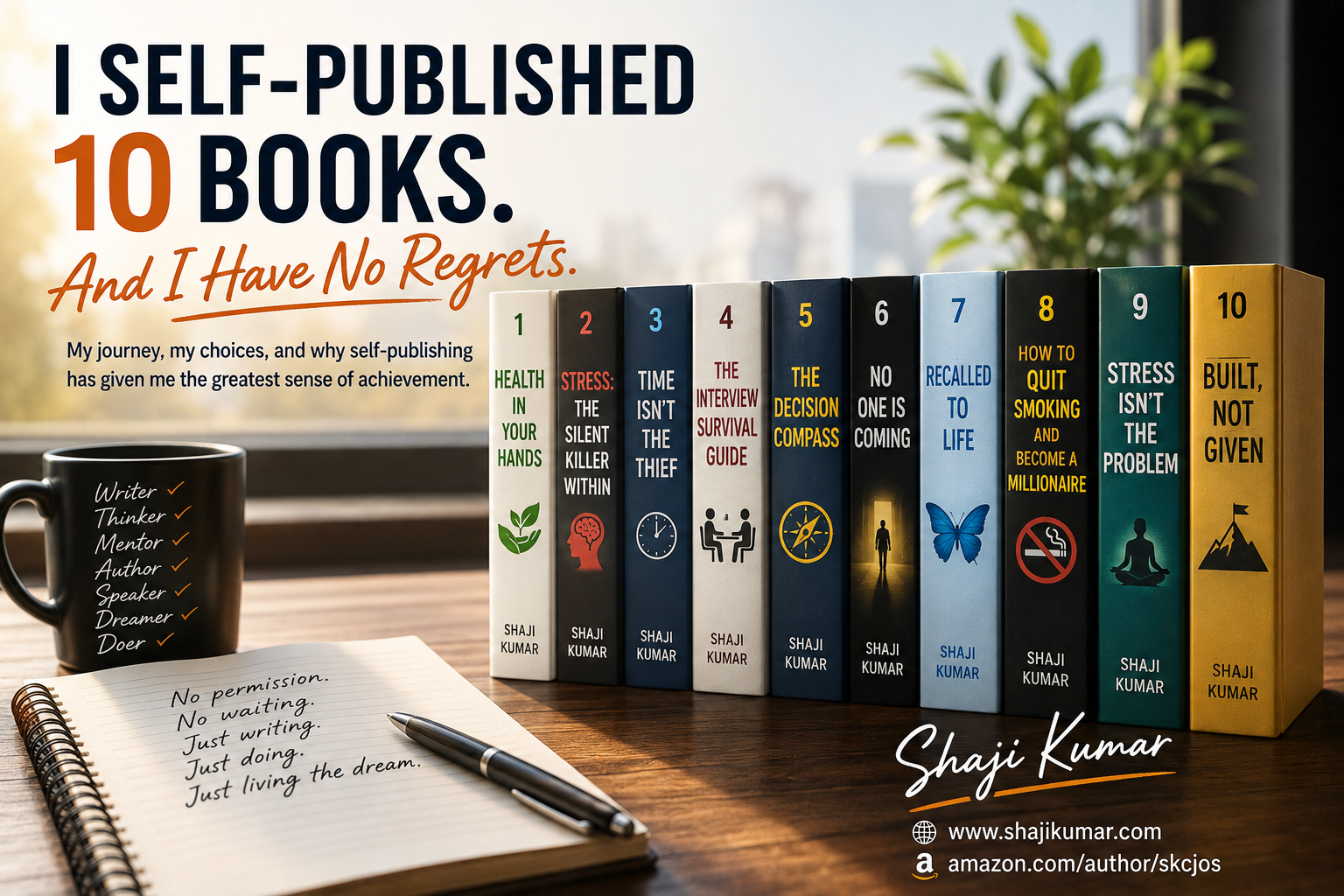
I have Self-Published Ten Books.
Let me make this personal.
I have published 10 Books!
Ten.
When I look at them today, I don’t first think about sales numbers, rankings, royalties or reviews.
I think about something much more personal.
I feel a sense of achievement.
Ten times, I had an idea.
Ten times, I sat down and converted that idea into thousands of words.
Ten times, I fought procrastination, self-doubts, rewrites, corrections and that nagging voice every writer knows:
Is this really worth publishing?
And ten times, I saw something that existed only in my mind become something I could actually hold in my hands.
A book.
With my name on it.
Am I satisfied with my decision to self-publish?
Absolutely.
Would I have felt differently if a large traditional publishing house had published all ten books?
Perhaps.
There is undoubtedly a certain prestige associated with being “published by” a recognised publishing house.
But here is the question I have increasingly begun asking myself:
Prestige for whom?
The Publisher?
The author?
Or the reader?
The Day We Stopped Needing Permission
Traditional publishing was built around scarcity.
Printing a book was expensive.
Distribution was complicated.
Bookstores had limited shelf space.
Marketing required money.
Publishing houses performed an essential role.
They selected manuscripts.
Invested in authors.
Printed books.
Distributed them.
Marketed them.
In other words, they made it possible for an author to reach a reader.
But technology changed that equation.
Today, an author sitting in Delhi, Mumbai, Kochi or a small town in India can write a manuscript, have it professionally edited, design a cover, format and make it available to readers around the World.
Without ever walking into the office of a traditional publisher.
That is revolutionary.
And like every revolution, it has upset the people who benefited from the old system.
The Numbers Are Telling Us Something.
The global publishing world has already begun changing.
In the United States, self-publishing has overtaken traditional publishing in the sheer number of titles produced.
Bowker data reported by Publishers Weekly showed more than 2.6 million self-published titles in 2023 compared with approximately 563,000 traditionally published titles.
But look at what is happening here.
India issued more than half a million ISBN’s in 2024, according to recent ISBN metadata research.
And the self-publishing ecosystem is growing rapidly.
Notion Press alone has claimed to publish between 30,000 to 35,000 books a year.
That is about 100 books a day.
Think about that for a moment.
Every Day.
One hundred new authors somewhere are turning their ideas into books through a single self-publishing platform.
That does not include Amazon KDP.
It does not include Bluerose.
It does not include Pothi.
It does not include the hundreds of hybrid and assisted publishing companies.
And it certainly does not include authors [myself included] who independently manage the entire process themselves.
The genie is out of the bottle.
And it is not going back in.
Traditional publishing is beginning to look like the Morning Newspaper.
I may be controversial when I say this.
But I believe the traditional publishing model is facing the same existential challenge newspapers did.
I belong to a generation that remembers waiting for the morning newspaper.
It was part of life’s ritual.
The newspaper arrived.
You picked it up.
You read the headlines over your morning tea.
You turned the pages.
You discussed the news.
Something almost sacred about that daily ritual.
And then came the Internet.
News became immediate.
Continous.
Personalised.
Accessible.
The newspaper did not disappear overnight.
It is still around.
But its position in our lives changed forever. It went from being the primary source of news to being one of the many sources.
I believe something similar is happening to traditional publishing.
Let me be clear.
Books are not dying.
Publishing is not dying.
Reading is not dying.
But the traditional gatekeeper model is losing its monopoly.
And that is a very different thing.
The Publisher Was Once the Only Route to the Reader.
For centuries, if you wanted to reach readers, you needed a publisher.
Today, you don’t.
That single fact changes everything.
The publisher is no longer the only bridge between the writer and the reader.
Amazon is a bridge.
Social Media is a bridge.
LinkedIn is a bridge.
Substack is a bridge.
Your website is a bridge.
Your professional network is a bridge.
Your readers themselves are a bridge.
Today, an author can build an audience before the book is even published.
In fact, I would argue that this is increasingly the smarter way to do it.
Write.
Share.
Engage.
Build credibility.
Build a community.
Understand your readers.
And when your book arrives, it does not arrive in an empty marketplace.
It arrives among people who already know you.
Let Me Say Something Important About Self-Publishing.
Self-publishing should not mean poorly publishing.
This is where I believe many aspiring authors get it wrong.
Publishing has become easier.
That does not mean writing a good book has become easier.
Nor has creating a professional book.
If anything, the standards should be higher.
When you self-publish, you cannot blame the publisher for a poor cover.
You cannot blame an editor for grammatical errors.
You cannot blame a marketing department for poor sales.
You own the process.
Completely.
And that is precisely what I like about it.
Freedom is wonderful.
But freedom comes with responsibility.
When I self-publish, I am not simply an author.
I am also the publisher.
I have to think about the manuscript.
The editing.
The cover.
The layout.
The title.
The description.
The pricing.
The launch.
The marketing.
The reviews.
The distribution.
Everything.
It is exhausting.
But strangely, it is also deeply satisfying.
Because when the finished book finally arrives, I know exactly how it got there.
If you are an aspiring author and would like some advice completely free of charge, drop me an email at skcjos@gmail.com, and I would be happy to share what I know. Not much, but still a ten-book experience.
The Journey is yours. The Learning doesn’t have to be.
Global Learning Centre (GLC) is being built around two journeys:
FOR YOUNG ENTREPRENEURS
Helping aspiring and emerging entrepreneurs develop the clarity, capability and confidence to turn ideas into sustainable businesses.
FOR VETERANS — THE SECOND INNINGS
Helping Armed Forces veterans translate their leadership, discipline, experience and capabilities into meaningful opportunities beyond uniform.
Maybe “Follow Your Passion” Isn’t Such Good Advice After All
For years, I believed in the advice:
“Follow your passion.”
It sounds wonderful.
Almost poetic.
Find what you love. Do what excites you. Turn your passion into your profession.
What could possibly be wrong with that?
Over the years, though, I have become a little less convinced.
Not because passion is unimportant.
But because I have seen enough people—including myself at different stages of life—to realise that passion and career don’t always arrive together.
Sometimes, you discover your passion after you become good at something.
And sometimes, you begin to enjoy something simply because you have become good at it.
That distinction matters.
I have noticed something interesting
Some people are very passionate about photography but would hate spending eight hours a day as a professional photographer.
Some people love travelling but probably wouldn’t enjoy running a travel company.
And some people never imagined they would enjoy the work they eventually became very good at.
I have met many such people during my professional journey.
What changed their relationship with work wasn’t necessarily the job itself.
It was the experience they had while doing it.
They felt trusted.
They had some control over how they worked.
They became competent.
They were surrounded by people they enjoyed working with.
And gradually, something interesting happened.
They started liking the work.
Perhaps that is why I am increasingly uncomfortable with the simplistic advice to “follow your passion.”
Because a career is not always about finding something you already love.
Sometimes it is about finding something worth becoming good at.
And then discovering that you love the person you become while doing it.
There is another thing I have learnt
Early in our careers, we tend to ask:
“What do I want to do?”
Later, perhaps the better question becomes:
“What kind of work brings out the best in me?”
There is a difference.
The first question is about the job.
The second is about the experience.
Do I have enough autonomy?
Am I learning?
Do I feel competent?
Do I enjoy the people around me?
Do I feel that what I am doing matters?
These things can completely change how we experience work.
And perhaps this explains why two people doing exactly the same job can have completely different levels of satisfaction.
One is miserable.
The other is thriving.
The job hasn’t changed.
Their experience of the job has.
I have also become wary of another piece of advice:
“Do what you love, and you will never work a day in your life.”
Maybe.
But I suspect there is another, less glamorous truth.
Sometimes you work first, become good at something, gain confidence, earn trust, build relationships—and somewhere along the way, you begin to love the work.
Not because it was your childhood dream.
But because it became your work.
That has been one of the more humbling lessons of my professional life.
I no longer think everyone needs to discover their one great passion before choosing a career.
Sometimes, you just need to find something meaningful enough to commit yourself to.
Passion can follow competence.
And sometimes, it follows much later.
Maybe the better career advice is not:
“Follow your passion.”
Maybe it is:
“Find something worth doing. Become good at it. Build relationships. Create some autonomy. And see what happens.”
You may be surprised.
I know I have been.
What has been your experience?
Did you choose your career because you were passionate about it—or did the passion come after you became good at it?
I would genuinely like to hear from people who have travelled both paths.
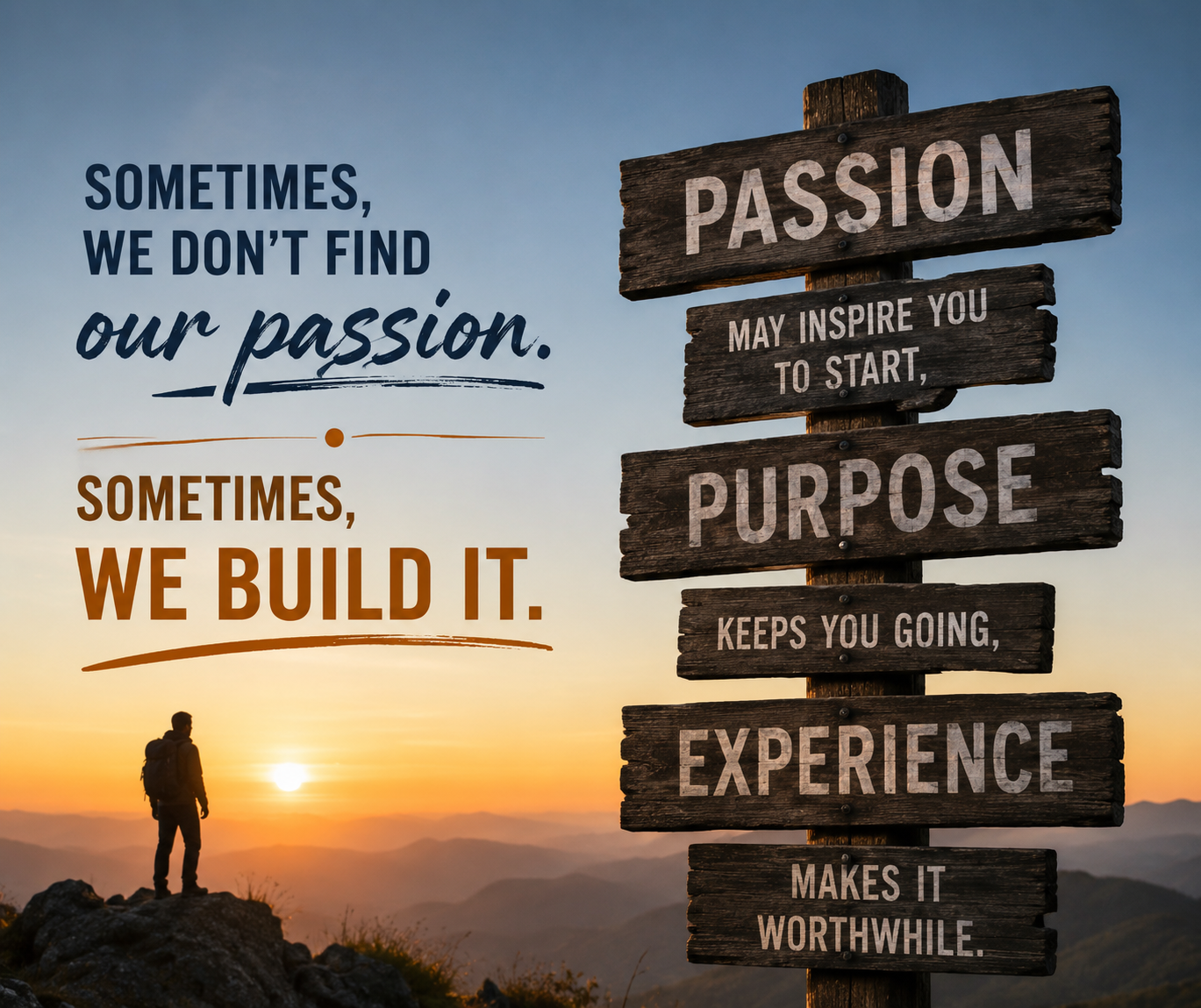
Sometimes we don’t find our passion. Sometimes we build it.
The Journey is yours. The Learning doesn’t have to be.
Global Learning Centre (GLC) is being built around two journeys:
FOR YOUNG ENTREPRENEURS
Helping aspiring and emerging entrepreneurs develop the clarity, capability and confidence to turn ideas into sustainable businesses.
FOR VETERANS — THE SECOND INNINGS
Helping Armed Forces veterans translate their leadership, discipline, experience and capabilities into meaningful opportunities beyond uniform.
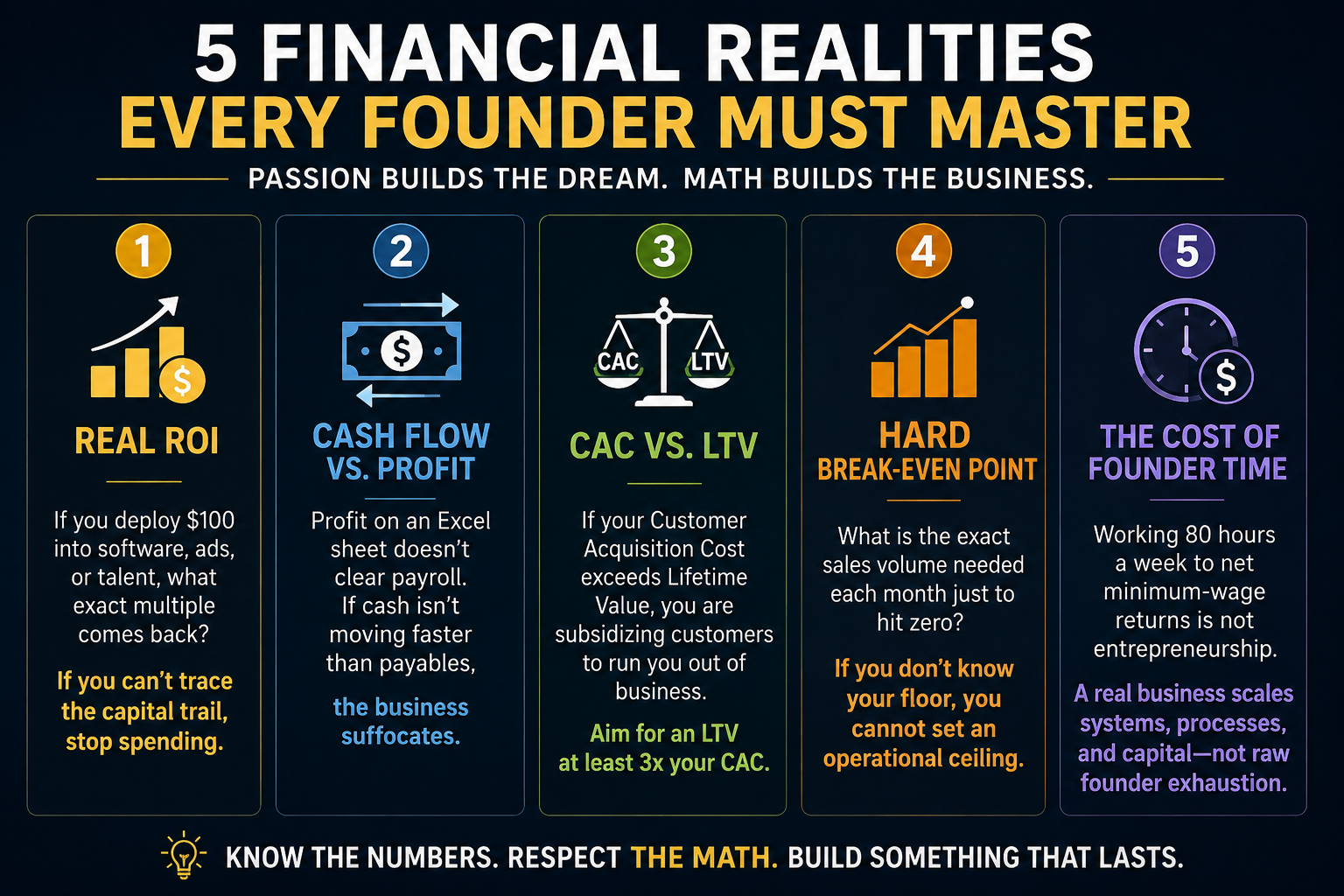
Why founders build their own prisons, and the 5 metrics that set you free.
A romantic myth in modern entrepreneurship is that sheer willpower can conquer any market friction. We celebrate pitch decks, launch parties, and overnight success stories.
What nobody photographs is the quiet, exhausting middle: the founder staring at a spreadsheet at midnight, trying to understand why a company with surging sales has an empty bank account.
Most businesses do not fail from a lack of passion. They bleed out because the founder refused to respect the arithmetic.
In high-stakes environments—whether in field operations or executive commerce—enthusiasm is merely a prerequisite for entry. What determines survival under pressure is systemised discipline. If you cannot answer these five questions with total clarity, you are not operating a business. You are running a gamble.
I. The Illusion of Effort vs. Return on Capital (ROI)
Early in my career, I saw businesses deploy hard-earned capital into “brand visibility” initiatives that couldn’t be tracked, quantified, or tied back to revenue. They treated capital deployment like planting seeds in the dark, hoping something might sprout.
When you spend capital—whether on a CRM system, an ad campaign, or a new hire—you must demand an answer: What is the exact multiple coming back through the door?
If you invest $10,000 in a new initiative, you need to know whether it generates $30,000 in enterprise value or simply burns cash to keep people busy. If you cannot map the pipeline from expense to cash inflow, stop spending.
II. The Difference Between Profit and Oxygen (Cash Flow)
One of the most dangerous traps for early-stage founders is the accrual trap. You send out an invoice for $50,000, celebrate a profitable month on your dashboard, and move forward.
Then payroll comes due on the 1st, and the client hasn’t paid.
Profit is an accounting opinion; cash in hand is reality. If money isn’t cycling through your accounts faster than your liabilities come due, your business will suffocate. Working capital discipline means negotiating payment terms ruthlessly, collecting receivables aggressively, and ensuring your operational runway is never tied up in someone else’s bureaucracy.
III. The Unit Economic Reality Check (CAC vs. LTV)
A business model is fundamentally simple: buy customers for less than they are worth to you over time.
Yet, countless startups burn through seed capital acquiring users at $100 per head, only to realise those users will only ever spend $40. They convince themselves that “scale” will miraculously fix the discrepancy. Scale doesn’t fix broken unit economics; it only accelerates the burn rate.
If your Customer Acquisition Cost (CAC) is higher than your Lifetime Value (LTV), you are paying your customers to put you out of business. If your LTV comfortably outweighs your CAC, you have a predictable engine that can absorb market downturns.
IV. Knowing Your Baseline Floor (Break-Even)
Before you plan for record growth, you must know your survival floor.
How many billable retainers, finished units, or service contracts must you clear every single month just to keep the lights on and the team paid? If you cannot calculate your hard break-even number off the top of your head, you don’t have command of your enterprise.
Knowing your baseline removes operational panic. It tells you exactly where safety ends, and profit begins.
V. The Founder’s Prison (The Cost of Time)
Perhaps the most common trap is the founder who replaces a 40-hour corporate job with an 80-hour business that pays half as much.
They take pride in the grind, handling every administrative task, client email, and operational fire drill. But trading 70 hours a week for marginal profits is not business building—it is self-inflicted servitude.
A viable enterprise must scale systems, processes, and capital. If the entire operation halts the moment you step away for 48 hours, you have not built an asset. You have built a demanding job that you cannot quit.
The Bottom Line
Passion provides the spark, but numbers provide the armour.
Before you sign the next lease, launch the next marketing blitz, or hire your next specialist, pull up your balance sheet. Look at the unit economics with complete honesty. When you respect the math, the business takes care of itself.