Tag: #Gratitude

  • The Unspoken Anchor: Understanding and Cherishing Parental Love.

    The Unspoken Anchor: Understanding and Cherishing Parental Love.

    The Unseen Foundation. In the chaotic symphony of life, we often miss the soft, consistent melody that plays in the background. It’s the silent support, the unwavering belief, the hands that steady us when we stumble. It’s the love that has no conditions, no fine print, and no expectations. This profound, boundless love comes from two people: our parents. The Power of Unconditional Love While the world operates on a system of reciprocity, where love is often tied to actions or worthiness, parental love stands as a stark and beautiful exception. Think back to your earliest memories. The scraped knees comforted, the nightmares banished, the milestones celebrated with genuine joy. This love didn’t depend on your grades, your career choices, or your social standing. It existed purely because you were their child. They were your first cheerleaders, your confidants, and your safest harbour. This type of love, given freely without any underlying motive, is a rare and precious gift.

    When Life Gets in the Way As we grow older, we get absorbed by our own ambitions, challenges, and relationships. We build our own lives, and in the process, we sometimes forget the very foundation that allowed us to build. We become busy. We forget to call. We miss birthdays. We take their presence for granted, assuming they will always be there, just as they have always been. This neglect, however unintentional, can be a silent wound for our parents. They might not complain, but the void left by our absence or lack of expressed affection can be felt deeply.

    The aspersions We Cast by way of misunderstanding their Motives. Sometimes, our parents’ words or actions can be misinterpreted. Their concerns might sound like nagging, their advice might feel like interference, and their questions might seem like intrusions. In our desire for independence, we might push them away, labelling their care as control. However, if we peel back the layers, we’ll often find that their words and actions are rooted in deep-seated love and a desire to protect and guide us. They have seen more of the world, experienced more its challenges, and their wisdom, though perhaps delivered in a way that feels outdated, comes from a place of genuine concern.

    Cultivating a Culture of Gratitude and Respect So, how can we bridge the gap and honor this profound love?

    • Express Your Affection without waiting for a special occasion. Simple gestures can mean the world. A spontaneous phone call, a thoughtful message, a warm hug, or a simple “I love you” can brighten their day.
    • Make Time, Not Excuses: Prioritise quality time with them. Go for a walk, share a meal, or just sit and talk. Be fully present in those moments.
    • Listen with Empathy when they speak. Genuinely listen to understand their perspectives and feelings. Ask about their lives, their dreams, and their worries.
    • Forgive and Move Forward because No parent is perfect. They might have made mistakes. But letting go of past grievances and focusing on the love they have shown can bring peace to your relationship.
    • Show Your Respect with Simple acts of respect, like asking for their advice (even if you don’t always follow it) or listening attentively, can convey that you value their wisdom and experience.

    A Love to Be Cherished Our parents’ love is a beacon that guides us, a safety net that catches us, and a constant in an ever-changing world. It is a love that asks for nothing in return but is fulfilled by seeing us thrive. Let’s not wait for “someday” to express our love and gratitude. Let’s not let the busyness of our life dim the brightness of this connection. Let’s honour the two people who loved us first, and who continue to love us, unconditionally and without aspersions. For in cherishing them, we honour the very essence of love and connection.

  • The Cautionary Vision of Aldous Huxley’s Brave New World.

    The Cautionary Vision of Aldous Huxley’s Brave New World.

    “But I don’t want comfort. I want God, I want poetry, I want real danger, I want freedom, I want goodness. I want sin.” — John the Savage.

    Aldous Huxley’s Brave New World (1932) stands as one of literature’s most prescient warnings about the perils of technological control and manufactured happiness. Written during the rise of mass production and behaviorist psychology, Huxley’s dystopian masterpiece explores a fundamental question that remains urgently relevant today: Can a society built on pleasure, efficiency, and stability ever truly fulfil human nature?

    The novel’s answer is a resounding no — and its exploration of why reveals profound truths about freedom, suffering, and what it means to be authentically human.

    The World State: Perfection Without Soul.

    Huxley’s World State represents the ultimate technocratic society, where every aspect of human existence has been optimised for stability and happiness. The citizens of AF 632 (After Ford, referencing Henry Ford’s assembly line revolution) live in a world that has seemingly solved humanity’s greatest problems:

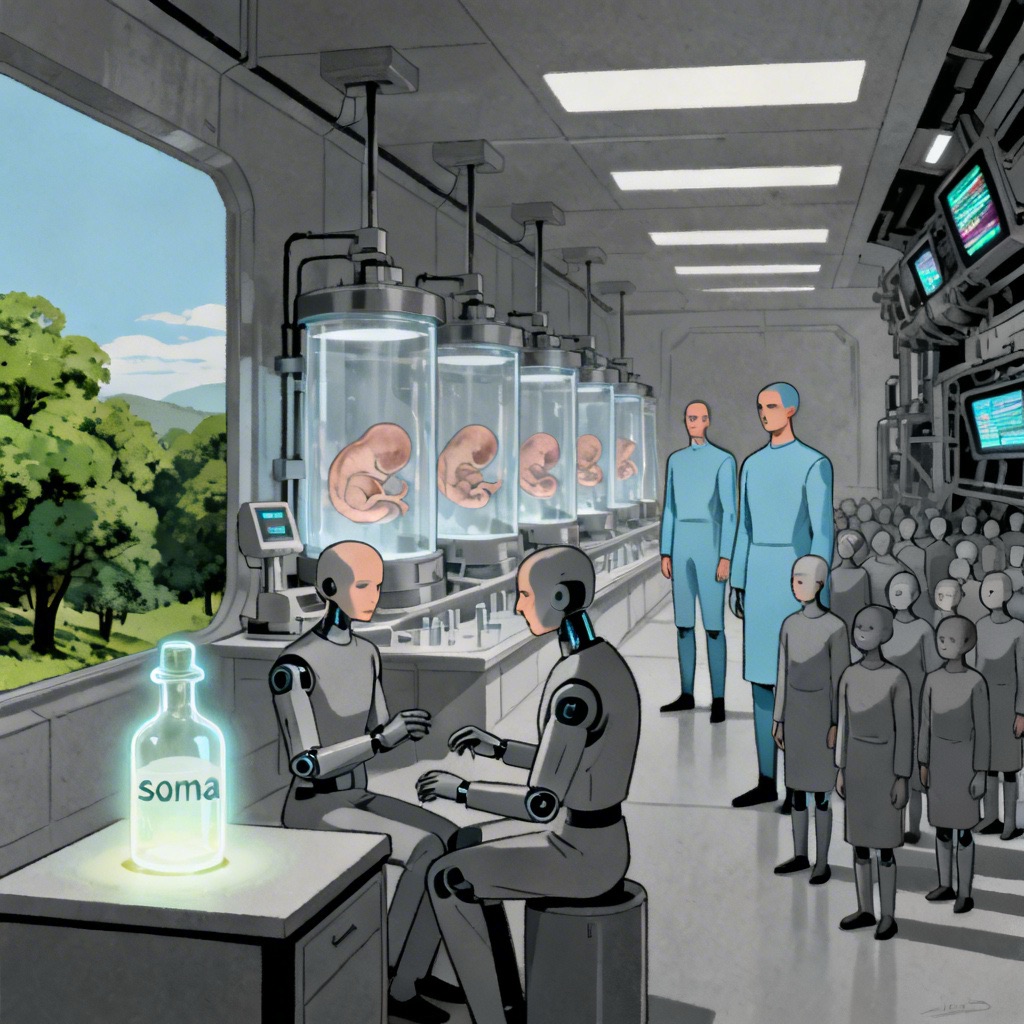
    Biological Engineering eliminates genetic inequality through controlled reproduction in “Hatcheries and Conditioning Centres.” Children are no longer born but manufactured, with their intelligence and physical capabilities predetermined by their assigned caste.

    Pavlovian Conditioning shapes behavior from infancy, ensuring each person finds satisfaction in their predetermined role. Delta and Epsilon children are conditioned to hate books and nature, while Alphas are trained for leadership — creating a society where oppression feels natural.

    Soma Distribution provides chemical happiness on demand. This miracle drug offers all the benefits of alcohol, narcotics, and antidepressants without hangovers, addiction, or side effects. Why suffer when relief is just a pill away?

    Sexual Liberation replaces love and family bonds with casual encounters, preventing the deep emotional attachments that might challenge state authority. The mantra “everyone belongs to everyone else” ensures no citizen develops loyalty to anyone but the state.On the surface, this world has achieved what every society claims to want: no war, no poverty, no suffering, no unfulfilled desires. Yet Huxley reveals this paradise as profoundly hollow.

    The Savage’s Mirror: What We Lose in Paradise.

    John the Savage serves as the novel’s moral center and our window into what the World State has sacrificed for its stability. Raised on Shakespeare and traditional human values on the Reservation, John embodies everything the World State has eliminated: passion, moral struggle, spiritual yearning, and the capacity for both profound joy and devastating sorrow.

    The Conflict Between Comfort and Truth.

    When John encounters World State civilisation, his horror isn’t directed at obvious evils but at the absence of meaning itself. He’s repulsed not by cruelty but by the casual indifference to beauty, truth, and human dignity. In his famous exchange with World Controller Mustapha Mond, John articulates the novel’s central theme:

    – John demands the right to be unhappy, to struggle, to face real danger.

    – Mond responds that such desires are antisocial and unnecessary in a world that can provide easy satisfaction.

    This conversation reveals Huxley’s crucial insight: a society that eliminates suffering also eliminates the conditions necessary for human growth, creativity, and genuine fulfillment.**

    Love vs. Conditioning.

    John’s relationship with Lenina crystallizes this conflict. His passionate, romantic love — shaped by Shakespeare’s sonnets — collides with her conditioned casual sexuality. Neither can understand the other:

    – John seeks transcendent connection, viewing sexuality as sacred when combined with love.

    – Lenina finds his intensity confusing and unnecessary, having been conditioned to view emotional attachment as unhealthy.

    Their tragic inability to connect represents the broader gulf between authentic human nature and engineered satisfaction.

    Huxley’s Prophetic Warnings.

    Writing in 1932, Huxley anticipated developments that wouldn’t fully emerge for decades. His warnings prove remarkably prescient:### The Tyranny of Pleasure Unlike Orwell’s 1984, where citizens are controlled through fear and pain, Brave New World presents a more seductive form of control. The World State doesn’t need to threaten its citizens — it simply makes them too comfortable to rebel.

    Modern parallels include:

    – Social media platforms designed to provide endless, easy gratification.

    – Consumer culture that promises happiness through material acquisition.

    – Pharmaceutical solutions for emotional and spiritual problems.

    – Entertainment that distracts from deeper questions about meaning and purpose.

    The Standardisation of Humanity.

    The World State’s caste system represents an extreme version of social engineering, but Huxley’s real concern is the broader tendency to treat humans as interchangeable units rather than unique individuals.

    Contemporary echoes appear in:

    – Educational systems focused on standardised testing rather than individual growth.

    – Economic policies that prioritize efficiency over human flourishing.

    – Technology that reduces complex human needs to data points and algorithms.

    The Elimination of Difficult Beauty.

    Perhaps most tragically, the World State has eliminated art, religion, and philosophy — anything that might disturb its citizens’ contentment. Beauty exists only in sanitised, consumable forms.

    Today’s version might include:

    – Art reduced to viral content optimised for engagement.

    – Spiritual practices repackaged as wellness trends.

    – Literature and philosophy marginalized in favor of immediately practical information.

    The Price of Paradise.

    John’s suicide represents the novel’s darkest conclusion: that authentic humanity cannot survive in a world designed to eliminate suffering. His death poses uncomfortable questions:

    Is struggle necessary for human fulfillment? The World State’s citizens appear happy, but their satisfaction seems shallow compared to John’s capacity for both ecstasy and agony.

    Can technology solve human problems without destroying human nature?

    Every technological solution in the World State comes with the hidden cost of diminishing some essential aspect of humanity.What happens when comfort becomes more important than truth? The citizens live in a carefully constructed illusion, protected from reality’s sharp edges but also cut off from its genuine beauty.

    Lessons for Our Time.

    Huxley’s vision feels increasingly relevant as we grapple with similar questions about technology, pleasure, and control. His novel suggests several crucial principles:

    Preserve Space for Difficulty.

    A truly human society must allow room for struggle, failure, and growth. Easy solutions to complex problems often eliminate opportunities for character development and genuine achievement.

    Value Individual Uniqueness.

    Efficiency and equality are worthy goals, but not at the cost of individual personality, creativity, and moral agency. Systems that treat people as interchangeable units ultimately dehumanise everyone.

    Choose Meaningful Over Comfortable.

    The novel argues that meaning matters more than happiness — that a difficult life pursuing truth and beauty surpasses an easy life of shallow pleasure.

    Question Technological Solutions.

    Every technological advance should be evaluated not just for its benefits but for its hidden costs to human flourishing. What aspects of humanity might we lose in exchange for convenience or comfort?

    Conclusion: The Enduring Challenge.

    Brave New World doesn’t offer easy answers, but it poses essential questions that each generation must answer anew. In our age of social media, artificial intelligence, and biotechnology, Huxley’s warnings feel prophetic rather than fantastical.

    The novel’s lasting power lies not in its specific predictions but in its fundamental insight: the greatest threats to human dignity often come disguised as benefits. A society that promises to solve all problems, eliminate all suffering, and provide all pleasures may inadvertently eliminate the struggles that make us most human.

    John the Savage’s tragic fate reminds us that the choice between comfort and authenticity, between easy happiness and meaningful existence, remains as relevant today as it was in 1932. The question isn’t whether we’ll face this choice — it’s whether we’ll have the courage to choose wisely when we do.

    As Huxley himself might say, the price of true humanity may be the willingness to embrace both the beauty and the terror of being genuinely alive.

    When we introspect, it is quite evident that all these magnificent and exemplary authors had such prophetic vision and extraordinary power of imagination.

  • The Weight We Carry: How Hidden Resentments Shape our Lives – And How to let them Go.

    The Hidden Burden: We all carry invisible weights—those hardened chunks of anger and hurt that accumulate over months, years, sometimes decades. Resentments aren’t just fleeting emotions; they’re psychological anchors that keep us tethered to painful moments long after they’ve passed.

    What Resentments Really Do to Us!

    1. They steal our present moments.
    2. They build invisible barriers.
    3. They distort our reality.

    The Misunderstood Path: What Letting Go Really Means.

    • Letting go is not weakness—it’s liberation.
    • We can release resentment AND maintain boundaries.
    • We can forgive someone AND never trust them again.
    • We can let go of the past AND protect our future.

    Without self-blame, honestly assess: What was your part? What patterns might you want to change going forward? This isn’t about justifying others’ harmful behavior—it’s about reclaiming your power to make different choices.

    The Choice Is Always Yours.

    Every morning, you wake up with a choice: Will you carry yesterday’s hurts into today’s possibilities? Or will you set down that burden and walk forward with open hands, ready to receive whatever good this day might bring?

    The heaviest thing you carry may not be in your backpack—it may be in your heart. But unlike physical weight, this burden disappears the moment you decide you’re tired of carrying it.

    Your peace is too precious to sacrifice to people who may have already forgotten they ever hurt you.

    Choose yourself. Choose freedom. Choose to finally let go.

    Ready to transform your approach to life? Follow me for more insights on building resilience, embracing change, and finding meaning in the present moment.

    #PersonalDevelopment

  • The Gratitude Revolution: How one simple shift can transform your entire reality.

    The Hidden Crisis of Modern Dissatisfaction.

    We live in an age of unprecedented abundance, yet dissatisfaction has become our default state. Walk into any workplace, scroll through social media, or listen to casual conversations—the pattern is unmistakable: we’ve become experts at focusing on what’s wrong rather than what’s working.

    This isn’t just pessimism; it’s a dangerous form of self-sabotage that’s literally rewiring our brains for unhappiness.

    The Workplace Gratitude Gap: A 27-Year Observation

    In my two decades as a business owner, I’ve witnessed a troubling phenomenon repeat itself countless times. Employees arrive each morning carrying invisible burdens of resentment:

    -“I hate this job”

    -“This place is the worst”

    -“I can’t wait to get out of here”

    -“My boss doesn’t appreciate me”

    Yet here’s the profound irony: these same individuals depend on this “hated” job to feed their families, pay their mortgages, and fund their dreams. They’re literally biting the hand that feeds them—and wondering why they feel spiritually malnourished.

    The Subconscious Sabotage Cycle

    When we consistently broadcast negative thoughts about our source of income, we create what I call the Subconscious Sabotage Cycle:

    1. Negative manifestation → We focus on what we dislike
    2. Energy contamination → This negativity permeates our entire work experience.
    3. Reality reinforcement → Our subconscious mind finds evidence to support our negative beliefs.
    4. Expanded dissatisfaction → The negativity spreads to other life areas.

    Beyond the Workplace: The Geography of Gratitude

    This gratitude deficit doesn’t stop at office doors. It extends like ripples across every aspect of our lives:

    Our Living Environment

    – Complaining about our neighbourhood instead of appreciating shelter and community.

    – Focusing on traffic and noise rather than accessibility and connection

    Our City and Country

    – Highlighting political failures while ignoring infrastructure, opportunities, and freedom.

    – Taking for granted the safety, systems, and social structures that support our daily lives.

    Each complaint is a small act of self-harm, pushing away the very abundance that surrounds us.

    The Neuroscience of Gratitude: Why This Actually Works

    Gratitude isn’t just feel-good philosophy—it’s backed by compelling science:

    • Neuroplasticity: Regular gratitude practice literally rewires your brain for positivity.
    • Stress reduction: Grateful people show lower cortisol levels and better immune function.
    • Enhanced relationships: Gratitude improves empathy and strengthens social bonds.
    • Improved performance: Grateful employees are more productive and creative.

    When you shift from criticism to appreciation, you’re not just changing your thoughts—you’re changing your biology.

    The Practical Gratitude Revolution: 5 Daily Practices.

    1. The Morning Appreciation Ritual**

    Before checking your phone or emails, identify three specific things you’re grateful for about your upcoming day.

    2. The Work Gratitude Pause

    Instead of joining complaint sessions, ask: “What’s one thing that went well today?” Watch how this simple question transforms conversations.

    3. The Livelihood Blessing

    Each payday, take 60 seconds to acknowledge how your income—regardless of the source—enables your life goals.

    4. The Environment Appreciation

    Once weekly, notice something beautiful or functional in your neighbourhood, city, or country that you previously took for granted.

    5. The Evening Reflection

    Before sleep, mentally review your day for moments of support, kindness, or opportunity you received.

    The Transformation Promise

    Here’s what happens when you consistently practice gratitude:

    • Your work becomes more meaningful because you recognise its role in your larger life purpose.
    • Your relationships improve because you attract and appreciate positive people.
    • Opportunities expand because you notice possibilities instead of problems.
    • Your health improves through reduced stress and increased life satisfaction.
    • Your future brightens because you’re manifesting appreciation instead of lack.

    The Choice That Changes Everything.

    Every morning, you face a fundamental choice: Will you focus on what’s missing or appreciate what’s present? Will you manifest scarcity or abundance?

    Your thoughts are not neutral—they’re creative forces shaping your reality. When you choose gratitude, you’re not just changing your perspective; you’re actively redesigning your destiny.

    The source of your livelihood, the place you call home, the country that provides your opportunities—these aren’t obstacles to your happiness. They’re the foundation upon which your dreams are built.

    Start today. Choose gratitude. Watch your world transform.