Clarity Under Pressure™ | A Lesson Every Young Person Should Learn Before Life Teaches It the Hard Way.
A Lesson in Clarity Under Pressure™
There is one question that most of us ask at some point in our lives.
Why me?
Why did this happen to me?
Why did I fail?
Why did I lose?
Why did that opportunity disappear?
Why did someone I trusted walk away?
Why did life become difficult just when I thought things were finally falling into place?
And when the situation becomes particularly painful, we sometimes take the question a little further.
“God, why me?”
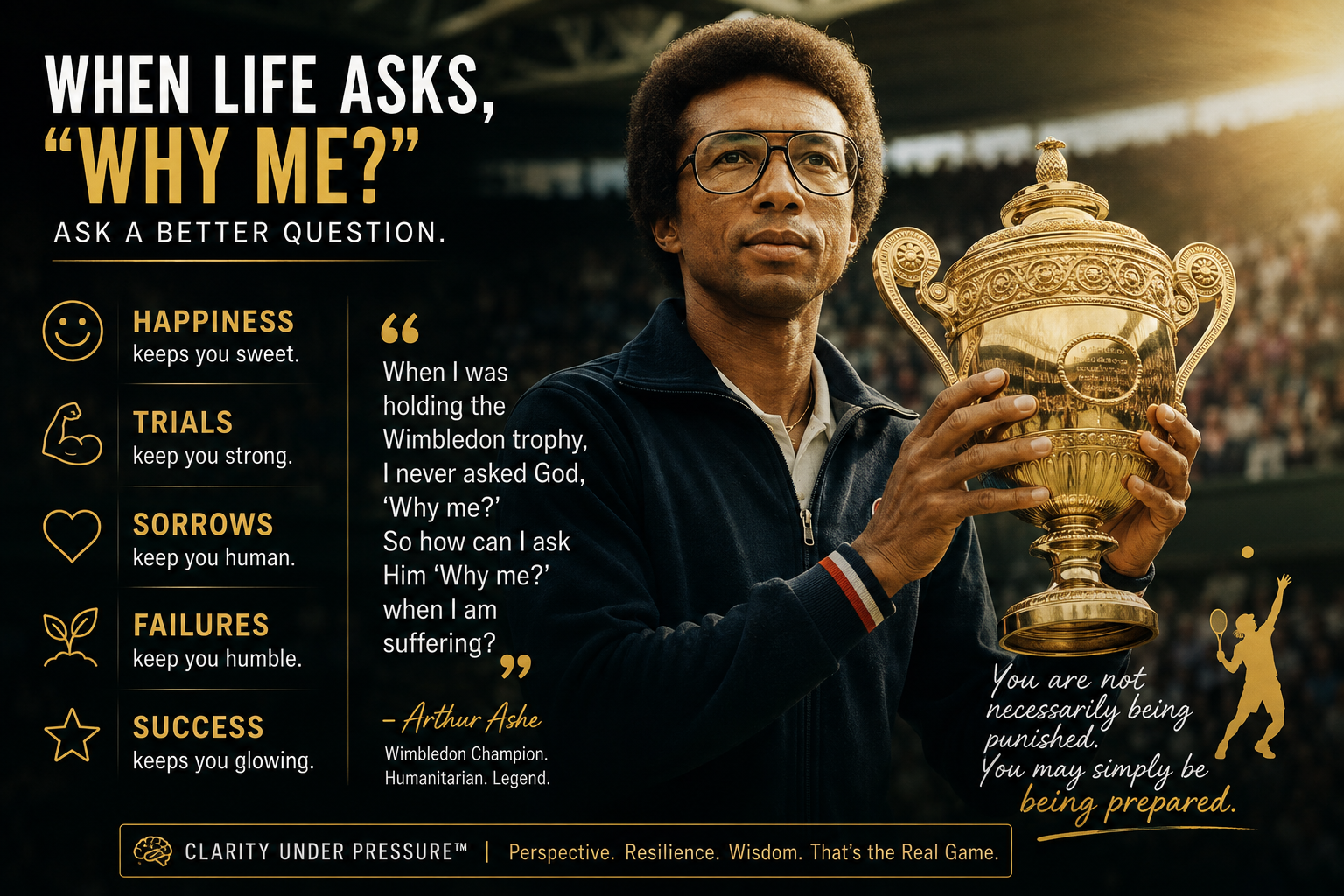
There is a beautiful story associated with the legendary American tennis player Arthur Ashe that has stayed with me for a long time.
Arthur Ashe was a Wimbledon champion, a remarkable sportsman and a deeply dignified human being. Later in life, he contracted HIV, reportedly as a result of a blood transfusion during medical treatment.
People who knew about his faith reportedly asked him a difficult question.
“Arthur, you have always been such a God-fearing and devout man. Why would God allow this to happen to you? Did you ever ask Him, ‘Why me?’”
Arthur’s answer, as the story is commonly told, was remarkably simple.
He reminded them of what it takes to become a Wimbledon champion.
Millions may dream of becoming professional tennis players.
Thousands may eventually play professionally.
A much smaller number reach the Grand Slam tournaments.
Only a handful get to Wimbledon.
Four reach the semifinals.
Two reach the final.
And ultimately, only one person lifts the trophy.
Then came the question that makes this story so powerful.
When he was standing there holding the Wimbledon trophy, did he ever ask God, “Why me?”
No.
So, when life turned painful, how could he now ask, “Why me?”
Whether every detail of the story is historically precise is not really the point.
The lesson is.
We are remarkably comfortable accepting the good things that happen to us.
We rarely question them.
When we receive a promotion, we do not usually look upwards and ask, “Why me?”
When the business succeeds, we do not wonder why we were chosen.
When money comes, when people praise us, when an opportunity opens at exactly the right moment, we simply accept it.
But when things go wrong, the question appears almost immediately.
Why me?
Perhaps we need to look at life differently.
Life does not come to us in separate compartments called happiness, success, failure and sorrow. They are all part of the same journey.
Happiness keeps us sweet.
Trials make us stronger.
Sorrows remind us that we are human.
Failures keep us humble.
Success gives us confidence and makes us glow.
The mistake is to think that only the pleasant parts belong in our lives.
They don’t.
The difficult parts belong there too.
And this is something I believe young people need to understand very early in life.
Do not compare your life with somebody else’s life.
We live in an age where comparison has become almost unavoidable.
You look at someone’s LinkedIn profile and wonder why you are not doing as well.
You look at Instagram and wonder why your life does not look as exciting.
You see someone’s car, house, business, designation, relationship or achievements and quietly ask yourself, “What am I doing wrong?”
But there is a problem with comparison.
You are looking at your entire life and comparing it with a carefully selected portion of someone else’s.
You don’t know their struggles.
You don’t know their disappointments.
You don’t know what they sacrificed to get where they are.
And you certainly don’t know whether the life they are displaying is actually making them happy.
There is an old analogy that captures this beautifully.
A child standing on a farm sees an aeroplane flying overhead and dreams of one day being able to fly.
At the same time, the pilot flying that aeroplane looks down and sees a farmhouse below.
He may be thinking about getting home.
Both are looking at something the other person has.
Both may be unaware of the longing on the other side.
That is life.
We spend so much time wanting what somebody else has that we sometimes fail to appreciate what we already possess.
If wealth alone guaranteed happiness, the richest people would be the happiest people on earth.
If power guaranteed security, powerful people would never need protection.
If fame guaranteed love, celebrities would have perfect marriages.
If possessions guaranteed peace, the biggest houses would have the soundest sleep.
But life does not work that way.
Sometimes the person with very little sleeps peacefully.
Sometimes a child with the simplest toy laughs the loudest.
Sometimes a person living a very ordinary life enjoys a depth of contentment that money cannot purchase.
This is not an argument against ambition.
Far from it.
Dream big.
Work hard.
Build something meaningful.
Become financially independent.
Compete with yourself.
Try to become better every day.
But do not make the mistake of believing that achievement alone will complete you.
There will always be someone richer.
Someone more successful.
Someone younger.
Someone more famous.
Someone who appears to have reached the destination before you.
That is why perspective matters.
And that is where Clarity Under Pressure™ begins.
Clarity under pressure does not mean that you stop feeling pain.
It does not mean pretending that failure does not hurt.
It does not mean becoming indifferent to disappointment.
It means learning to pause when circumstances become difficult.
It means refusing to allow one bad chapter to convince you that the entire book is bad.
It means asking better questions.
Instead of asking:
“Why me?”
Ask:
“What can I learn from this?”
Ask:
“What is within my control?”
Ask:
“What do I need to change?”
Ask:
“What kind of person will I become because of this experience?”
Those are very different questions.
And they put you back in the driver’s seat.
Some failures will teach you more than success ever could.
Some disappointments will take you in a direction you would never have chosen yourself.
Some closed doors may eventually turn out to have protected you from something you could not see at the time.
And some difficult periods may simply be preparing you for responsibilities you are not yet ready to carry.
That is why I believe young people should not be afraid of difficult times.
Respect them.
Learn from them.
Go through them.
But do not allow them to define you.
Your circumstances are not your identity.
Your failure is not your identity.
Your bank balance is not your identity.
Your designation is not your identity.
Your past is not your identity.
What ultimately matters is the person you choose to become.
So, when life is kind to you, be grateful.
When you succeed, remain humble.
When you fail, learn.
When you suffer, remain human.
When you have more than you need, share.
When you have less than you want, remain hopeful.
And when life becomes unbearably difficult, perhaps pause before asking:
“Why me?”
There may be a better question.
“What am I going to do with this?”
That question changes everything.
Because perhaps life is not always punishing you.
Perhaps it is sometimes preparing you.
Live simply.
Be grateful.
Walk humbly.
Love genuinely.
Work honestly.
And when the pressure comes, keep your clarity.
That is the real game.
Clarity Under Pressure™
The Arthur Ashe story is widely circulated in various versions. The precise statistics and wording vary across retellings; the enduring lesson, rather than the numerical accuracy of the anecdote, is what matters here.
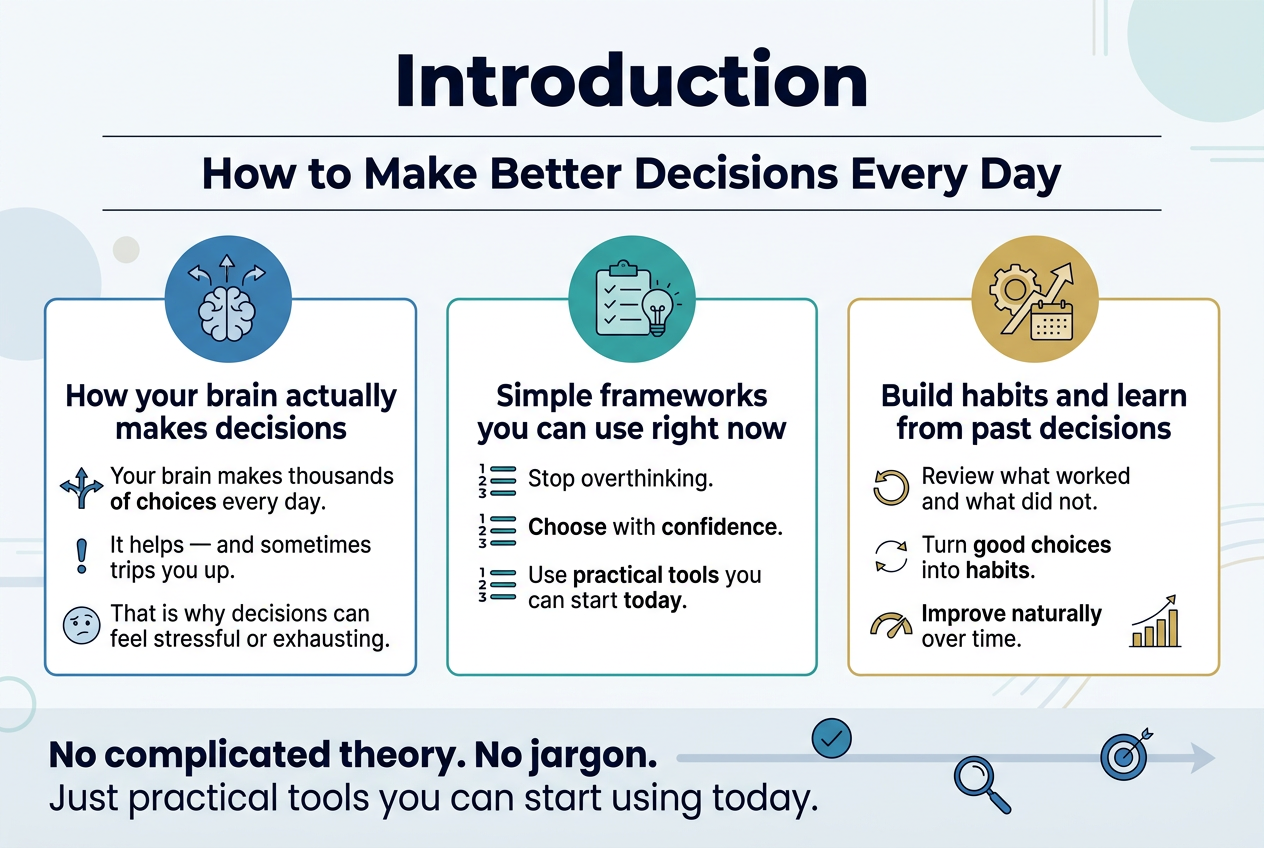
Most people make thousands of decisions every day — what to eat, who to trust, which task to tackle first. Some of those decisions feel easy. Others drain you, stress you out, or leave you second-guessing yourself for days.
If you’ve ever walked away from a choice thinking “I should have known better” — this guide is for you. It’s built for anyone who wants to cut through the mental noise and make smarter, faster decisions without burning out.
Here’s what we’ll cover:
How your brain actually makes decisions — and why it trips you up more than you’d expect
Simple frameworks you can use right now to stop overthinking and choose with confidence
How to build habits and learn from past decisions so you naturally get better over time
No complicated theory. No jargon. Just practical tools you can start using today.
Understand How Your Brain Makes Decisions
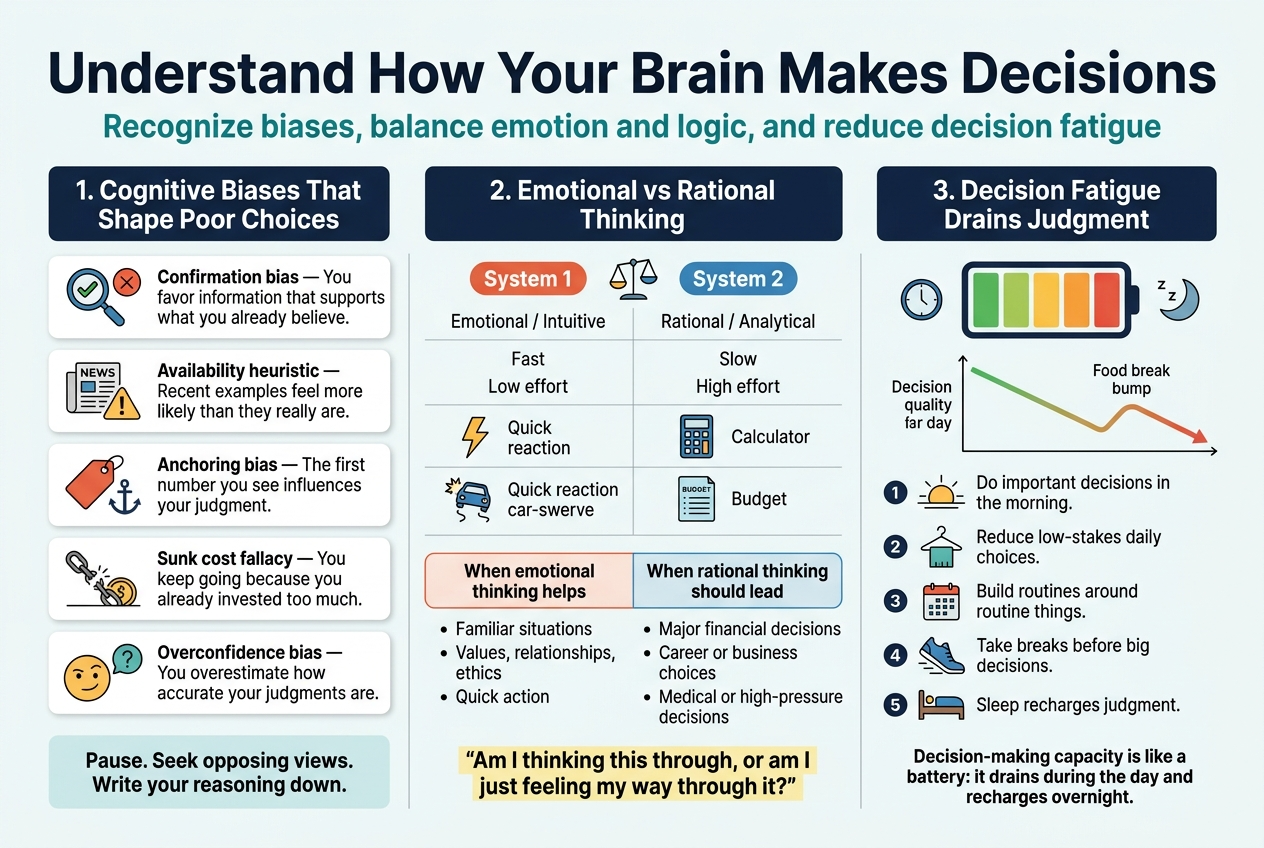
Recognise the Role of Cognitive Biases in Poor Choices
Your brain is not a perfect decision-making machine. It takes shortcuts — and those shortcuts, while often useful, can lead you straight into bad choices without you even realizing it.
These mental shortcuts are called cognitive biases, and every single person has them. They are not signs of weakness or low intelligence. They are simply the brain’s way of managing an overwhelming amount of daily information without burning out.
Here are some of the most common biases that quietly sabotage everyday decisions:
Confirmation bias — You tend to look for information that agrees with what you already believe and ignore evidence that challenges it. This makes you feel right even when you are wrong.
Availability heuristic — You judge how likely something is based on how easily an example comes to mind. If a plane crash was on the news recently, flying suddenly feels much more dangerous than driving, even though the statistics say otherwise.
Anchoring bias — The first piece of information you receive acts as a mental anchor. If a product is marked down from $500 to $300, your brain registers it as a deal — even if $300 is still overpriced.
Sunk cost fallacy — You keep investing time, money, or energy into something simply because you have already put so much into it, even when cutting your losses is clearly the smarter move.
Overconfidence bias — People consistently overestimate how accurate their own judgments are. Studies show that when people say they are “99% sure” about something, they are wrong about 40% of the time.
How to Start Catching Your Own Biases
The first step is simply becoming aware that biases exist and that you are not immune to them. After that:
Pause before big decisions. Rushing almost always amplifies bias.
Seek out opposing viewpoints. Actively look for reasons your preferred option might be wrong.
Ask someone you trust to challenge your thinking. An outside perspective can catch what your brain is filtering out.
Write your reasoning down. When you put your logic on paper, gaps become much easier to spot.
Learn the Difference Between Emotional and Rational Thinking
Most people assume that emotions are the enemy of good decisions. That is not quite right. Emotions carry real, useful information — but only when you know how to read them properly rather than letting them run the show unchecked.
The human brain operates through two main systems of thinking, a concept popularized by psychologist Daniel Kahneman:
System
Type
Speed
Effort
Example
System 1
Emotional / Intuitive
Fast
Low
Swerving to avoid a car accident
System 2
Rational / Analytical
Slow
High
Calculating a monthly budget
Neither system is better than the other. The real skill is knowing which one to lean on depending on the situation.
When Emotional Thinking Actually Helps.
Emotions are not just noise. They carry compressed experience. When a gut feeling tells you something is off about a business deal or a new relationship, that signal is often your brain pattern-matching against past experiences faster than conscious thought can catch up.
Situations where emotional thinking works well:
Familiar situations where you have experience to draw from
Decisions involving personal values, relationships, or ethics
Moments requiring quick action where analysis would take too long
When Rational Thinking Should Take Over
Analytical thinking is your best tool when the stakes are high, the situation is unfamiliar, or the emotional pull is especially strong. Strong emotion in a high-stakes moment is actually a signal to slow down, not speed up.
Situations where rational thinking should lead:
Major financial decisions like buying a house or investing
Career changes or business strategy
Medical decisions with long-term consequences
Any situation where you feel unusually pressured to decide quickly
The Balance Point
The goal is not to eliminate emotion — it is to stop letting emotion make decisions that need careful analysis, and to stop letting overthinking paralyze decisions that your gut already has a good read on. Learning to recognize which mode you are operating in at any given moment is genuinely one of the most powerful decision-making skills you can develop.
A simple way to practice: before any meaningful decision, ask yourself — “Am I thinking this through, or am I just feeling my way through it?” That single question can shift your whole approach.
Discover How Decision Fatigue Drains your Judgment
Here is something most people never connect: the quality of your decisions gets noticeably worse as the day goes on, simply because of how many choices you have already made.
This is called decision fatigue, and it is backed by solid research. A widely cited study on parole board hearings found that judges granted parole about 65% of the time at the start of the day, but that number dropped close to zero by late morning — only to bounce back after a food break. The prisoners’ cases had not changed. The judges’ mental energy had.
Every decision you make — no matter how small — draws from the same mental resource pool. Choosing what to eat for breakfast, what to wear, which emails to answer first, what to say in a meeting — it all adds up. By the time you hit an important decision late in the day, your brain is essentially running on empty.
What Decision Fatigue Looks Like in Real Life
When decision fatigue kicks in, people tend to do one of two things:
Make impulsive choices — grabbing junk food at 4pm, agreeing to things they would normally question, or spending money they did not plan to spend
Avoid deciding altogether — defaulting to “whatever,” sticking with the status quo, or postponing choices that actually need to be made
Neither outcome is great. And the tricky part is that you rarely feel the fatigue — you just start noticing you are less careful, less creative, and less patient.
Practical Ways to Beat Decision Fatigue
Tackle your most important decisions in the morning when your mental energy is at its peak. Do not save hard conversations or big choices for the end of the day.
Reduce the number of low-stakes decisions you make daily. This is exactly why some highly successful people famously wear the same style of outfit every day — they are preserving mental bandwidth for decisions that actually matter.
Build routines around routine things. When your morning, meals, and weekly schedule run on autopilot, you free up serious cognitive space.
Take breaks before big decisions. Even a 10-minute walk or a proper meal can partially restore your judgment — just like the parole board study showed.
Create decision-free zones. Set specific times in your week where certain types of decisions simply do not get made. This sounds rigid, but it is actually freeing.
The Connection Between Rest and Decision Quality
Sleep is probably the single most underrated decision-making tool available to you. A sleep-deprived brain doubles down on emotional System 1 thinking and almost completely loses access to careful rational analysis. If a decision can wait until tomorrow morning after a full night of sleep, it almost always should.
Think of your decision-making capacity as a battery. It starts full, drains throughout the day, and recharges overnight. The smarter you are about managing that charge, the sharper your choices will be when they matter most.
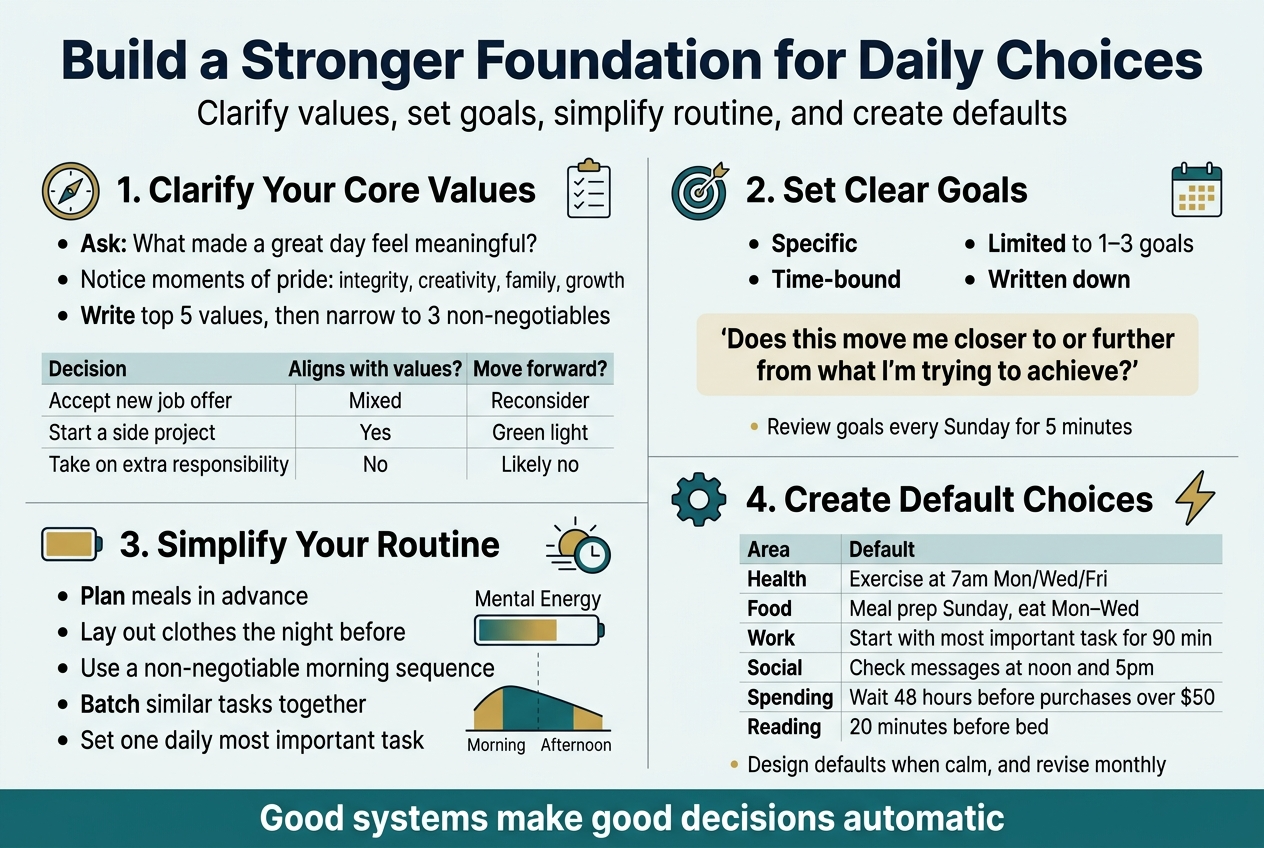
Build a Stronger Foundation for Daily Choices
Clarify Your Core Values to Guide Every Decision
Most people drift through their days making choices without ever asking: what actually matters to me? When your values are fuzzy, every decision feels like a guessing game. When they’re clear, even hard choices become easier because you already know what you’re optimizing for.
Think of your core values as an internal compass. They don’t tell you exactly which road to take, but they always point you in the right direction. Without them, you’re just reacting to whatever feels urgent in the moment.
How to get clear on your values:
Ask yourself: “When I look back on a great day, what made it feel meaningful?” Notice the patterns.
Think about moments you felt genuinely proud of a decision. What were you honoring in that moment — integrity, creativity, family, growth?
Identify decisions that left you feeling hollow even if they looked good on paper. What value did you compromise?
Write down your top 5 values. Then narrow them to 3. These are your non-negotiables.
Once you have them, test every major decision against them. If a choice contradicts your top values, that’s a signal worth paying attention to — even if the opportunity sounds attractive on the surface.
Here’s a simple values-check table you can use:
Decision
Does it align with Value 1?
Does it align with Value 2?
Does it align with Value 3?
Move forward?
Accept new job offer
Yes
No
Yes
Reconsider
Start a side project
Yes
Yes
Yes
Green light
Take on extra responsibility
No
No
Yes
Likely no
Values-based decisions don’t always lead to the easiest path, but they almost always lead to the most satisfying one.
Set Clear Goals That Make Priorities Obvious
One of the sneakiest reasons people struggle with daily decisions is that they have too many competing priorities and no clear hierarchy among them. When everything feels important, nothing really is.
Goals solve this problem. A well-defined goal acts like a filter. When you’re deciding whether to say yes to something, spend time on a project, or shift your focus, a clear goal tells you almost immediately whether that thing belongs in your day.
What makes a goal actually useful for decision-making:
Specificity — “Get healthier” is too vague to guide decisions. “Run three times a week and eat home-cooked meals five nights a week” gives you something concrete to measure choices against.
Time-bound — Attach a deadline. It creates urgency and helps you prioritize now vs. later.
Limited in number — Having 12 top goals is the same as having none. Pick 1–3 goals that genuinely drive your life forward right now.
Written down — Goals that live only in your head are just wishes. Writing them down makes them real and keeps them front of mind.
When you have clear goals, you can run a simple mental check before committing to anything:
> “Does this move me closer to or further from what I’m trying to achieve?”
That one question eliminates a huge amount of decision noise. It takes requests, opportunities, and distractions and quickly sorts them into “worth my time” or “not right now.”
A practical tip: Review your goals every Sunday for five minutes. This keeps them active in your thinking throughout the week so they naturally shape your moment-to-moment choices rather than sitting forgotten in a notebook.
Simplify Your Routine to Protect Mental Energy
Your brain has a limited supply of high-quality decision-making fuel each day. Every choice you make — from what to eat for breakfast to how to respond to an email — draws from that same tank. By the afternoon, many people are running on empty without even realizing it, which is exactly when they make their worst decisions.
This is often called decision fatigue, and it’s very real. The more choices you have to make early in the day about things that don’t really matter, the fewer mental resources you’ll have left for things that do.
Where decision fatigue quietly drains you:
Figuring out what to wear every morning
Deciding what to eat for each meal with no plan
Choosing what to work on when your schedule isn’t structured
Constantly reacting to notifications and emails without a set system
The fix isn’t to care less — it’s to automate the low-stakes stuff so your brain can save energy for the high-stakes stuff.
Simple ways to protect your mental energy through routine:
Plan your meals in advance. Even a loose weekly meal plan removes dozens of small decisions.
Lay out your clothes the night before. This sounds trivial, but it removes a choice at the worst time — when you’re barely awake.
Structure your mornings with a non-negotiable sequence. Wake up, move your body, eat, start focused work. No improvisation required.
Batch similar tasks together. Answer emails at set times instead of all day. Handle administrative tasks in one block rather than scattered throughout.
Set a daily “most important task.” Know before the day starts what one thing must get done. This removes the paralysis of figuring out where to begin.
When your routine handles the predictable parts of your day, your mind stays sharper for the unpredictable ones. You stop bleeding energy on the inconsequential and save it for decisions that actually shape your life.
Create Default Choices to Reduce Daily Overwhelm
A default choice is a pre-made decision that kicks in automatically in a given situation. You’re not choosing in the moment — you’ve already chosen. This is one of the most underrated tools for improving your daily decision-making without needing more willpower or discipline.
Think about it this way: if you have to decide every morning whether to exercise, your tired brain will often talk you out of it. But if your default is “I work out before breakfast on Monday, Wednesday, and Friday, no matter what,” the decision is off the table. You just do it.
Defaults work because they remove the cognitive load of choosing. Instead of weighing options, you follow a pre-agreed-upon rule. The mental effort happens once, upfront, when you’re thinking clearly — not in the moment when you’re tired, hungry, rushed, or distracted.
Where to build defaults into your life:
Area
Instead of deciding each time…
Set this default
Health
“Should I work out today?”
Exercise at 7am on Mon/Wed/Fri
Food
“What should I have for lunch?”
Meal prep Sunday, eat it Mon–Wed
Work
“What should I tackle first?”
Start with your most important task for 90 min
Social
“Should I reply to this now?”
Check messages twice a day at noon and 5pm
Spending
“Can I afford this?”
Wait 48 hours before any unplanned purchase over $50
Reading
“When do I read?”
20 minutes before bed every night
The key to making defaults stick is to design them when you’re calm and clear-headed, not when you’re in the heat of the moment. Sit down on a weekend, look at your week, and pre-decide as much as you can.
You don’t need to lock down every moment of your life. But the more you can automate the recurring, low-stakes decisions, the more mental space you free up for the choices that genuinely deserve your full attention.
One more thing: don’t be afraid to revisit your defaults every month or so. Life changes, and your defaults should change with it. The goal isn’t rigidity — it’s designing your environment and habits so that good decisions become your automatic response rather than a constant battle.
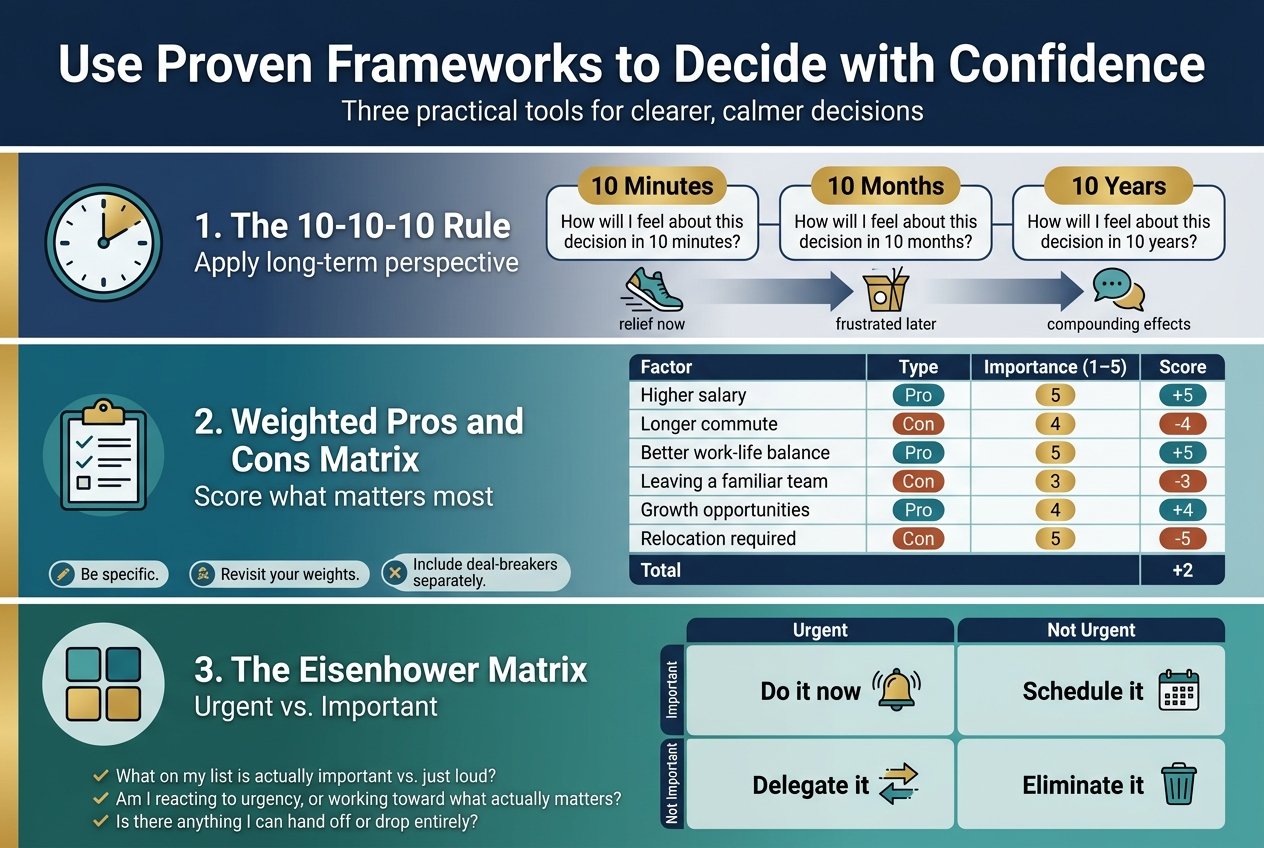
Use Proven Frameworks to Decide with Confidence
Apply the 10-10-10 Rule to Gain Long-Term Perspective
When you’re stuck on a decision and your emotions are running the show, the 10-10-10 Rule is one of the most grounding tools you can reach for. It was popularized by writer Suzy Welch, and the concept is beautifully simple: before you decide anything, ask yourself three questions.
How will I feel about this decision in 10 minutes?
How will I feel about this decision in 10 months?
How will I feel about this decision in 10 years?
That’s it. Three time horizons. But don’t let the simplicity fool you — this shift in perspective can completely change how you see a situation.
Think about a common scenario: you’re tempted to skip the gym again, order takeout for the third night in a row, or snap at a coworker who’s been pushing your buttons. In 10 minutes, skipping the gym feels like relief. In 10 months? You’re frustrated with your progress. In 10 years? You’re dealing with the compounding effects of those small choices made day after day.
The rule works especially well because it forces your brain out of the emotional present and into a more rational future-focused state. When you’re anxious, angry, or excited, your decision-making is hijacked by how you feel right now. Asking “how will I feel in 10 years?” creates psychological distance — and that distance is where clearer thinking lives.
When to Use It
The 10-10-10 Rule shines in situations like:
Career decisions (should I take this job offer?)
Relationship conversations (should I bring this up or let it go?)
Financial choices (should I buy this now or save?)
Health-related decisions (should I skip this workout or push through?)
It won’t resolve every decision on its own, but it cuts through short-term emotional noise fast. If your answers across all three time frames are positive, you’re probably on the right track. If the 10-year answer makes you cringe, it’s worth slowing down.
Use a Simple Pros and Cons Matrix for Complex Decisions
Pros and cons lists get a bad rap for being too basic — but the reason they’ve been around forever is that they work. The real problem isn’t the concept; it’s that most people don’t use them properly. A well-structured pros and cons matrix goes deeper than just jotting down a couple of bullet points on a napkin.
How to Build a Weighted Pros and Cons Matrix
Here’s a smarter way to approach it. Instead of treating all factors equally, assign a weight to each item based on how much it actually matters to you.
Factor
Type
Importance (1–5)
Score
Higher salary
Pro
5
+5
Longer commute
Con
4
-4
Better work-life balance
Pro
5
+5
Leaving a familiar team
Con
3
-3
Growth opportunities
Pro
4
+4
Relocation required
Con
5
-5
Total
+2
When you tally everything up, a positive score leans toward “yes,” and a negative score leans toward “no.” But more importantly, the process of building this matrix forces you to get honest about what actually matters to you — not what you think should matter.
Why This Works Better Than Gut Instinct Alone
Your gut is valuable, but it’s also easily swayed by whichever factor you thought about most recently or whichever emotion is loudest at the moment. Putting things on paper externalizes your thinking. You can look at it, challenge it, and adjust it without your memory playing tricks on you.
A few tips to get the most from this approach:
Be specific. “It pays more” is weaker than “It pays $15,000 more annually, which covers my student loan payments.”
Revisit your weights. After you list everything, look at the numbers you assigned and ask yourself: “Am I being honest, or am I inflating things I want to justify?”
Include deal-breakers separately. Some factors aren’t just important — they’re non-negotiable. Label those clearly and don’t let any score override them.
This method works particularly well for decisions with lots of moving parts — job changes, major purchases, business partnerships, or anything where there’s no single obvious answer.
Leverage the Eisenhower Matrix to Prioritize Effectively
Named after President Dwight D. Eisenhower, this framework is built around a simple but powerful idea: not everything urgent is important, and not everything important is urgent. Mixing those two things up is one of the biggest reasons people feel constantly busy but never truly productive.
The matrix divides your tasks and decisions into four quadrants based on two dimensions — urgency and importance.
The Four Quadrants
Urgent
Not Urgent
Important
Quadrant 1: Do it now
Quadrant 2: Schedule it
Not Important
Quadrant 3: Delegate it
Quadrant 4: Eliminate it
Here’s what each quadrant actually means in real life:
Quadrant 1 — Do it now: These are genuine fires. A medical emergency, a critical work deadline, a client crisis. You handle these immediately. The goal is to spend as little time here as possible by planning ahead.
Quadrant 2 — Schedule it: This is where your most valuable work lives. Long-term planning, relationship building, learning new skills, health maintenance. Most people chronically neglect this quadrant because nothing here is screaming for attention — but ignoring it is what keeps creating Quadrant 1 crises.
Quadrant 3 — Delegate it: These feel urgent but don’t actually move your goals forward. Certain meetings, some emails, requests that pull you away from your priorities. Hand these off when you can.
Quadrant 4 — Eliminate it: Mindless scrolling, busywork that produces nothing, tasks that exist purely out of habit. Cut these without guilt.
How to Apply This Daily
You don’t need to build a formal matrix every morning. Once you understand the quadrants intuitively, you start categorizing incoming decisions and tasks naturally. A good habit is to spend five minutes each morning asking:
What on my list is actually important vs. just loud?
Am I reacting to urgency, or working toward what actually matters?
Is there anything I can hand off or drop entirely?
The Eisenhower Matrix is especially useful for people who feel overwhelmed — not because they have too much to do, but because they’re saying yes to the wrong things. Getting clear on what’s important versus what’s merely urgent reshapes how you spend your time and where your decisions take you.
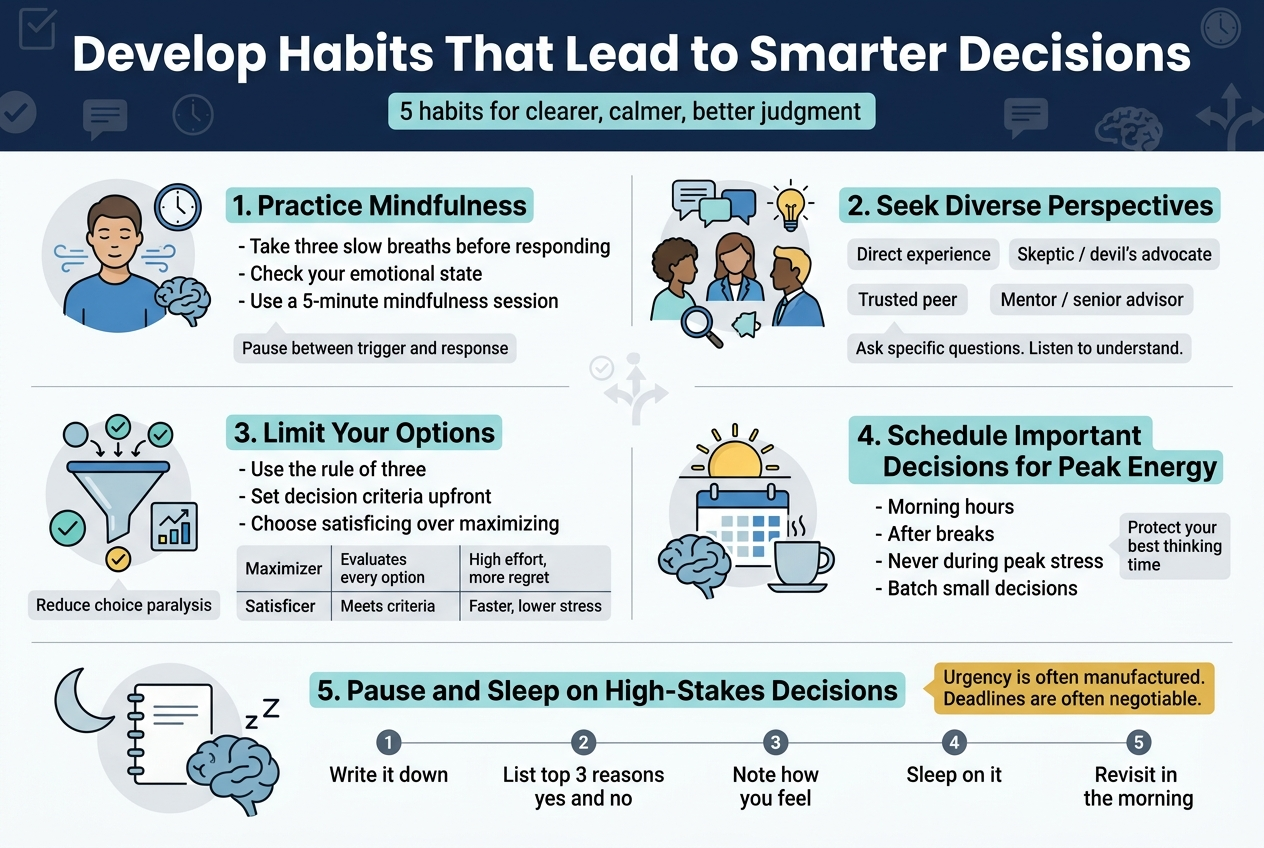
Develop Habits That Lead to Smarter Decisions
Practice Mindfulness to Improve In-the-Moment Awareness
Most bad decisions happen on autopilot. You react before you even realize you’re making a choice. Mindfulness breaks that cycle by creating a tiny but powerful gap between the trigger and your response.
You don’t need to meditate for an hour every morning to get the benefits. Even a few minutes of intentional breathing or a short body scan before a difficult conversation or meeting can shift your mental state dramatically. The goal is to catch yourself when you’re operating from a place of stress, hunger, frustration, or distraction — because all of those states quietly distort your judgment.
Simple ways to build decision-related mindfulness:
Before responding to an urgent email or request, take three slow breaths
Check in with your emotional state before entering a high-stakes conversation: Am I calm? Anxious? Defensive?
Use short journaling prompts like “What am I feeling right now, and how might it be influencing my thinking?”
Try a 5-minute mindfulness app session (Headspace, Calm, or Insight Timer) before tackling a complex problem
Mindfulness also sharpens your awareness of cognitive biases in real time. When you’re more present, you’re more likely to notice when you’re rationalizing a decision rather than genuinely analyzing it.
Seek Diverse Perspectives Before Finalising Major Choices
One of the sneakiest traps in decision-making is assuming your own viewpoint is complete. It rarely is. Your experiences, background, and beliefs shape how you see every situation — and sometimes those filters have blind spots you can’t see on your own.
Deliberately seeking out people who think differently from you isn’t just about being polite or inclusive. It’s a tactical move that leads to sharper, more resilient decisions.
Who to consult and why:
Type of Perspective
Why It Helps
Someone with direct experience in the area
They’ve already made mistakes you haven’t made yet
A skeptic or devil’s advocate
They’ll poke holes in your plan before reality does
Someone outside your industry or field
They bring fresh thinking that insiders often miss
A trusted peer at the same level as you
They understand your constraints without the bias of authority
A mentor or senior advisor
They offer pattern recognition from years of experience
A few practical rules when gathering input:
Don’t just seek validation. It’s tempting to only talk to people you know will agree with you. Resist it.
Ask specific questions. “What do you think?” is too broad. Try “What’s the biggest risk you see in this plan?” or “What would make you change your mind about this?”
Listen to understand, not to respond. If you’re already forming counterarguments while someone’s talking, you’re not really listening.
The more complex and irreversible a decision, the wider your net should be. A choice that affects your career, finances, or relationships deserves multiple rounds of outside input before you commit.
Limit Your Options to Avoid Choice Paralysis
Having too many options feels like freedom, but it often produces the opposite effect — anxiety, indecision, and second-guessing. Psychologist Barry Schwartz called this the “paradox of choice,” and the research is clear: more options frequently lead to worse decisions and lower satisfaction, not better ones.
The fix isn’t to be careless — it’s to be deliberate about constraining your choices before you start evaluating them.
Practical strategies to reduce option overload:
Apply a “rule of three.” Before making a decision, limit yourself to evaluating no more than three solid options. Force yourself to eliminate the rest before you dig in.
Set decision criteria upfront. Decide what matters most before you look at your choices. This keeps you from shifting the goalposts based on whatever option you’re currently excited about.
Use satisficing instead of maximizing. Instead of hunting for the perfect option, identify the minimum standard something needs to meet — and choose the first option that clears that bar.
Create default choices for low-stakes decisions. Pick a go-to lunch spot, a default brand, a standard response to routine requests. Save your decision-making energy for what actually matters.
Decision-Making Style
Behavior
Outcome
Maximizer
Evaluates every available option to find the best
High effort, often more regret, slower decisions
Satisficer
Picks the first option that meets defined criteria
Faster decisions, lower stress, similar outcomes
For everyday decisions, satisficing is almost always the smarter play. For major, high-investment decisions, structured comparison of a small, curated shortlist beats an exhaustive search every time.
Schedule Important Decisions for Peak Mental Performance
Decision-making is a cognitive task, and like any cognitive task, it’s heavily influenced by your mental energy levels. Researchers have documented what’s often called “decision fatigue” — the idea that the quality of your decisions degrades as the day progresses and your mental resources get depleted.
Judges give harsher rulings later in the day. Doctors prescribe more unnecessary antibiotics as their shifts wear on. Executives approve riskier deals in the afternoon. It’s not weakness — it’s biology.
When to schedule your most important decisions:
Morning hours — Cognitive clarity and willpower tend to be at their highest before your brain gets worn down by smaller choices
After breaks — Even a 10-minute walk or a meal can partially restore your decision-making sharpness
Never during peak stress — A deadline crunch, an argument, or a frustrating meeting are terrible launching pads for clear thinking
What to do if a decision can’t wait:
Take a five-minute walk before responding
Eat something if you’re running on empty
Write out the core question you’re trying to answer to get out of reactive mode
Ask for a short delay if the stakes are high — even 30 minutes can help
Protect your peak hours by:
Blocking your best thinking time on your calendar
Doing administrative and routine tasks in the afternoon
Batching small, low-stakes decisions so they don’t nibble away at your focus throughout the day
Even a small adjustment to when you make decisions can dramatically improve the quality of how you make them.
Pause and Sleep on High-Stakes Decisions
Speed is overrated when the decision is irreversible. The culture of “move fast” is great for testing ideas — but terrible advice when you’re deciding whether to leave your job, make a major investment, or end a relationship.
Sleeping on a decision isn’t procrastination. It’s strategy.
During sleep, your brain consolidates information, processes emotions, and reorganizes your thinking in ways that conscious analysis simply can’t replicate. There’s solid research showing that complex decisions often benefit from what scientists call “unconscious thought” — letting your mind work in the background while you step away from the problem.
Signs you should sleep on a decision before committing:
The decision is difficult or impossible to reverse
You’re feeling emotionally activated — angry, excited, anxious, or pressured
You’re being pushed by someone else’s urgency rather than your own
You haven’t yet considered what a bad outcome would actually look like
A simple overnight decision protocol:
Write down the decision clearly — in one sentence if possible
List the top three reasons to go ahead and the top three reasons not to
Note how you feel about the decision in your gut
Sleep on it without discussing it further
In the morning, revisit your notes and notice if your perspective has shifted
One of the most underrated decision-making skills is knowing when not to decide yet. Urgency is often manufactured. Deadlines are often negotiable. And a decision made in a calmer, more rested state is almost always better than one forced in the heat of the moment.
Build the habit of creating space around your most important choices, and you’ll find that you not only make better decisions — you also feel far more confident about the ones you’ve made.
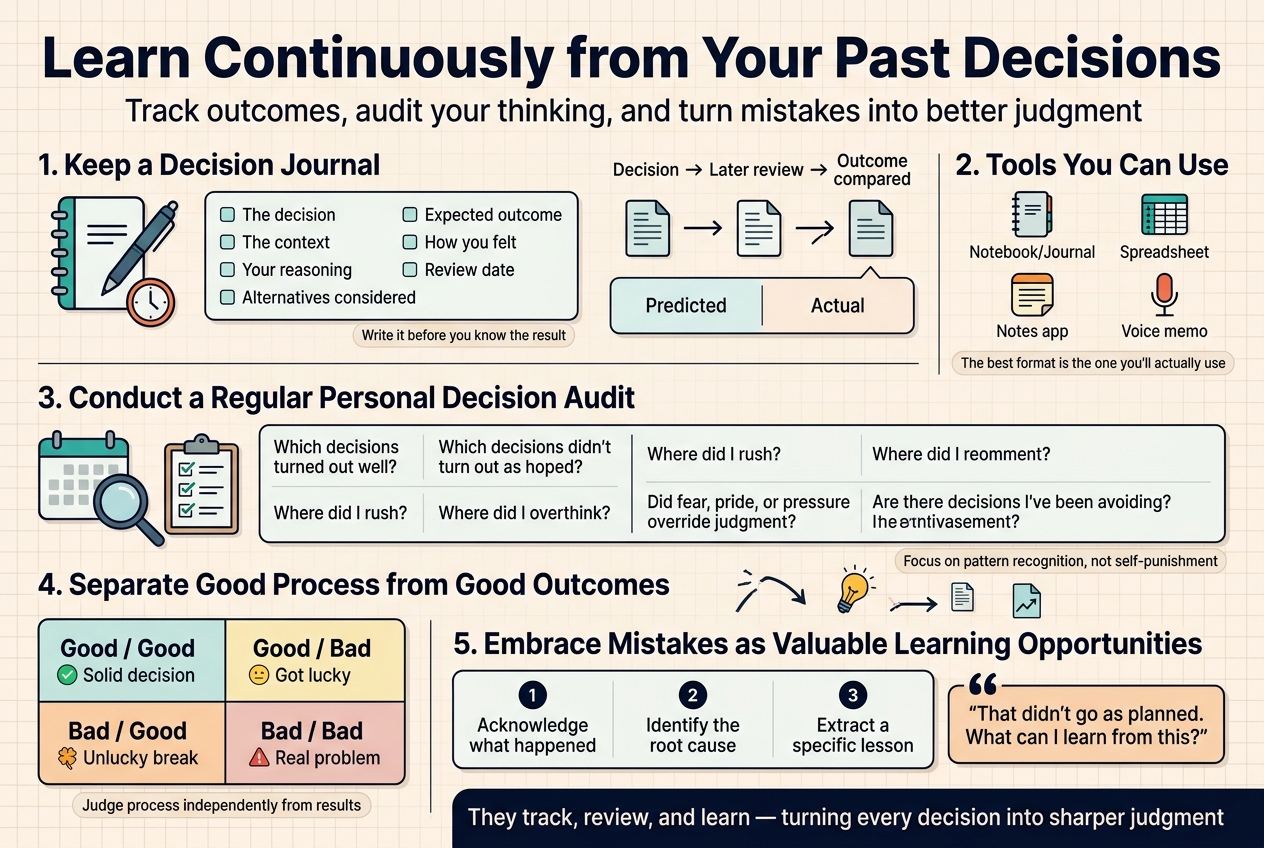
Learn Continuously from Your Past Decisions
Keep a Decision Journal to Track Outcomes and Patterns
Most people make a decision, move on, and never look back — which means they keep repeating the same mistakes without ever connecting the dots. A decision journal breaks that cycle.
The idea is simple: every time you make a significant decision, write it down before you know how it turns out. Record what you decided, why you made that choice, what information you had at the time, and what you expected to happen. Then, weeks or months later, come back and compare what you predicted with what actually occurred.
This practice does something your memory alone can never do — it gives you an honest record of your thinking. Human memory is notoriously revisionist. We naturally rewrite our past reasoning to match current outcomes, convincing ourselves we “knew it all along.” A journal prevents that distortion cold.
What to Include in Each Journal Entry
A strong decision journal entry doesn’t need to be long. Aim for clarity over volume. Here’s a simple structure to follow:
The decision: What exactly did you decide?
The context: What was going on in your life or work at the time?
Your reasoning: Why did this option make the most sense?
Alternatives considered: What other paths did you think about and reject?
Expected outcome: What did you think would happen as a result?
How you felt: Were you confident, anxious, rushed, or pressured?
Review date: When will you come back to evaluate the outcome?
Over time, patterns will start to surface. You might notice that your best decisions tend to come when you’ve slept well, consulted a trusted person, or given yourself at least 48 hours to think. You might also spot recurring blind spots — like consistently overestimating how quickly things will happen, or underestimating costs.
Tools You Can Use
Format
Best For
Pros
Cons
Notebook/Journal
Tactile learners, low distraction
Easy to start, private
Hard to search or review
Spreadsheet
Analytical thinkers
Sortable, pattern tracking
Feels dry for some people
Notes app (Notion, Apple Notes)
People always on their phones
Accessible anywhere
Can get disorganized
Voice memo
Busy people on the go
Quick to capture
Requires transcription for review
There’s no perfect format — the best one is the one you’ll actually stick with. Start simple and adjust as you go.
Conduct a Regular Personal Decision Audit
A decision audit is a scheduled, honest review of the choices you’ve made over a specific period. Think of it as a performance review — but instead of your boss evaluating your work, you’re evaluating your decision-making process.
Pick a regular cadence: monthly works well for most people, though quarterly deep dives can also be powerful for bigger life or career decisions. During each audit, sit down with your decision journal and ask yourself a focused set of questions.
Questions to Ask During Your Audit
Which decisions turned out well? What did I do right in those situations?
Which decisions didn’t turn out as I hoped? Was it bad reasoning or just bad luck?
Where did I rush when I should have slowed down?
Where did I overthink when the answer was actually clear?
Did I let fear, pride, or social pressure override my better judgment?
Are there any decisions I’ve been avoiding that need to be made?
The goal isn’t self-punishment. It’s honest pattern recognition. Beating yourself up over a bad choice accomplishes nothing useful. What does help is clearly seeing how the mistake happened so you can catch that same pattern earlier next time.
Separate Good Process from Good Outcomes
One of the most important skills you can build as a decision-maker is learning to evaluate your process independently from your results. Sometimes great decisions lead to terrible outcomes because of factors entirely outside your control. Sometimes terrible decisions accidentally work out fine.
If you only evaluate based on results, you’ll reinforce bad habits when they happen to pay off and lose confidence in good habits when they don’t. A regular audit helps you stay focused on what you can actually control — the quality of your thinking, the information you gathered, and the way you weighed your options.
Outcome
Process
What It Means
Good
Good
Solid decision — keep doing what you did
Good
Bad
Got lucky — don’t repeat the process
Bad
Good
Unlucky break — don’t abandon the process
Bad
Bad
Real problem — identify and fix the flaw
This framework, popularized by decision strategist Annie Duke, is one of the most clarifying tools available for anyone who wants to get sharper at making choices over time.
Embrace Mistakes as Valuable Learning Opportunities
Here’s the thing about mistakes: everyone makes them, but not everyone learns from them. The difference between someone who keeps growing and someone who keeps spinning their wheels often comes down to one thing — how they relate to being wrong.
A mistake isn’t a verdict on who you are. It’s information. It’s feedback from reality telling you that something in your thinking, your timing, or your approach needs adjusting. When you start seeing errors that way, they lose their sting and gain their value.
Reframe the Way You Think About Being Wrong
Most people experience a mistake and immediately go into one of two modes: self-blame (“I’m so stupid”) or deflection (“It wasn’t really my fault”). Both responses feel natural, and both are completely useless for growth. Self-blame keeps you stuck in shame. Deflection keeps you blind to what you could actually change.
A healthier frame sounds more like: “That didn’t go as planned. What can I learn from this?”
This isn’t toxic positivity. It’s a practical mindset shift that keeps your brain in problem-solving mode rather than threat-response mode. When you’re not busy protecting your ego, you can actually look clearly at what went wrong.
The 3-Step Mistake Review
When something goes sideways, run through this simple process before moving on:
Acknowledge what happened without softening it. Name the mistake clearly. Vague thinking produces vague lessons.
Identify the root cause. Was it bad information? Emotional reasoning? Rushing? Peer pressure? External circumstances? Be honest about the real driver.
Extract a specific lesson. “I’ll do better next time” is not a lesson. “I need to stop making major decisions when I’m stressed and tired” is a lesson.
Write it down. A lesson that lives only in your head tends to evaporate quickly when the next similar situation arrives.
What Separates Great Decision-Makers from Everyone Else
People who consistently make better decisions aren’t necessarily smarter or luckier. They’ve simply built a system for learning that most people skip. They track what they decide, review how it played out, and extract real lessons from both their wins and their failures.
They’re not afraid to say, “I got that wrong.”
They don’t confuse a bad outcome with a bad process — or a good outcome with good thinking.
They actively look for feedback, even when it’s uncomfortable.
They treat each mistake as a data point, not a character flaw.
The compounding effect of this approach is genuinely powerful. Every reviewed decision makes your next decision slightly sharper. Over months and years, that adds up to a dramatically improved ability to navigate uncertainty, read situations clearly, and trust your own judgment — not out of arrogance, but because you’ve actually built it.
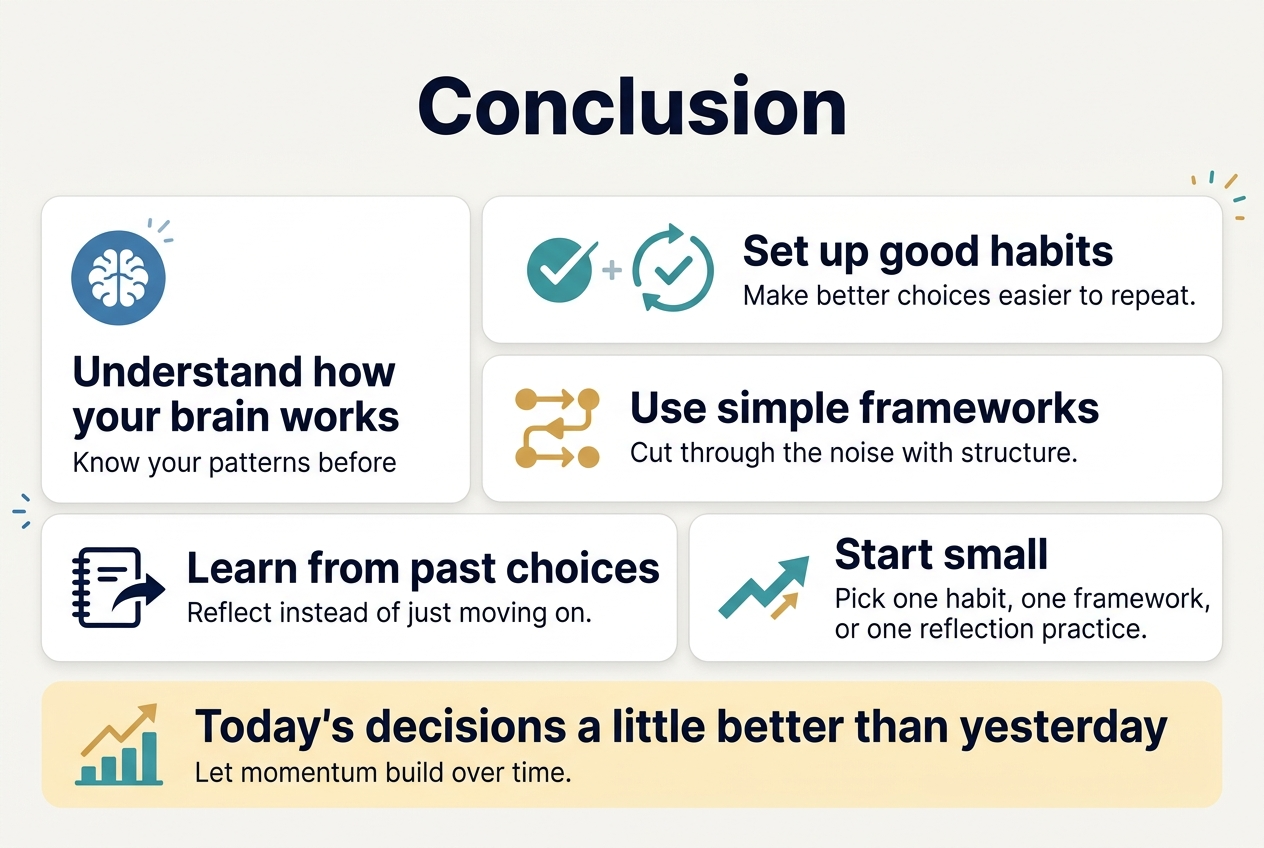
Making better decisions isn’t about being perfect or having all the answers. It’s about understanding how your brain works, setting yourself up with good habits, and using simple frameworks to cut through the noise. When you start learning from your past choices instead of just moving on from them, every decision becomes a chance to get a little sharper.
Start small. Pick one habit, one framework, or one reflection practice and run with it. You don’t need to overhaul everything at once. The goal is just to make today’s decisions a little better than yesterday’s, and let that momentum build over time.
This is the first in a series of posts drawing from Built Not Given by Capt. Shaji Kumar — a memoir on what it actually takes to build something from nothing, told through nearly three decades of entrepreneurship. Get your copy to read the full chapter and the seven that follow.
Where to get it
Built, Not Given is published wide — deliberately, so you can read it however suits you best, on whatever platform you already trust:
IngramSpark: distributed to bookstores and libraries worldwide — ask your local bookstore or library to order it in if you’d rather hold a copy from your own shelf network
Pick whichever is easiest for you. They all lead to the same book.
Beyond the book
Built, Not Given sits alongside my other books and the work I do now coaching founders through their own version of this middle, under the Clarity Under Pressure™ banner. If you want to see the rest — other titles, writing, or how to work with me directly — everything’s at www.shajikumar.com.
If you read it, I’d genuinely like to know what landed. Reply, comment, or leave a review wherever you bought it — for a book this new, that’s the thing that helps it find the next reader who needs it.
We live in a world that has almost normalized stress.
Being busy is worn like a badge of honour. Sleepless nights are celebrated as dedication. Anxiety is dismissed as part of ambition. Burnout is called success.
But let me ask you one simple question.
If stress is the problem, why do so many people eliminate one source of stress only to find another waiting for them?
Someone changes jobs.
The work stress disappears.
Financial stress arrives.
They earn more.
Relationship stress begins.
They improve relationships.
Health anxiety takes over.
It is an endless cycle.
That is precisely why I wrote “Stress Isn’t The Problem.”
Because after spending decades in the Indian Army, building businesses, leading teams, facing personal setbacks and rebuilding life more than once, I realised something profound.
Stress is rarely the real problem.
It is only the symptom.
We Keep Treating Symptoms
Modern life offers countless solutions.
Meditation apps.
Music.
Vacations.
Weekend breaks.
Motivational videos.
Breathing exercises.
Most of them work.
For a while.
But then stress quietly returns wearing a different mask.
Why?
Because we keep removing leaves while the roots remain untouched.
Imagine a tree whose leaves keep turning yellow.
You can polish the leaves.
Trim them.
Spray them.
Replace them.
But unless you fix the roots, nothing changes.
Stress works exactly like that.
My Journey Changed the Way I Understood Stress
The lessons in this book did not come from a laboratory.
They came from life.
From military service.
From entrepreneurship.
From leadership.
From financial uncertainty.
From success.
From failure.
From rebuilding after losing almost everything.
There were moments when I realised something remarkable.
The people who stayed calm under immense pressure were not necessarily stronger.
They simply understood where stress was actually coming from.
That became the foundation of this book.
Stress Has Many Faces
Most people believe stress is just one thing.
It isn’t.
Stress appears in many forms.
Financial stress.
Career stress.
Family stress.
Health stress.
Relationship stress.
Identity stress.
Purpose stress.
Treating all of them with one generic solution is like prescribing the same medicine for every illness.
It simply doesn’t work.
One of the central ideas in my book is identifying the seven branches of stress so that you stop fighting the wrong battle.
Stop Asking, “How Do I Reduce Stress?”
Start asking,
“What is creating this stress?”
That single shift changes everything.
Instead of becoming reactive, you become aware.
Instead of suppressing emotions, you begin understanding them.
Instead of surviving every day, you begin designing a better life.
Clarity Is the Real Antidote
Throughout my coaching programmes under Clarity Under Pressure™, I have observed one common pattern.
People rarely lack intelligence.
They rarely lack capability.
They lack clarity.
Unclear priorities.
Unclear goals.
Unclear expectations.
Unclear boundaries.
And uncertainty is one of the greatest generators of stress.
When clarity increases, stress naturally begins to decrease.
That is why this book is not another motivational book.
It is a practical system.
A Soldier’s Framework
Military training teaches something invaluable.
When pressure increases, you don’t panic.
You return to your system.
That philosophy shaped this book.
Inside, you’ll discover:
Why chasing symptoms keeps you exhausted.
The seven branches of stress and how to identify which one is affecting you.
A practical 20-minute daily practice that helps reset your mind.
A simple seven-day reset.
A Pocket Protocol you can use whenever life feels overwhelming.
Nothing complicated.
Nothing theoretical.
Just practical methods that can be applied immediately.
Who Should Read This Book?
This book is for you if:
You constantly feel mentally exhausted.
Your mind refuses to switch off.
Work follows you home.
Small problems feel overwhelming.
You’re successful on the outside but restless within.
You want practical solutions instead of motivational speeches.
Whether you’re a professional, entrepreneur, student, leader, parent or someone simply trying to regain control of life, this book was written with you in mind.
Stress Doesn’t Need Another Escape Route
It needs understanding.
When you understand its source, you stop fearing it.
When you stop fearing it, you begin leading your life instead of reacting to it.
That is the transformation I hope every reader experiences.
A Personal Invitation
If this article resonated with you, I invite you to read my latest book:
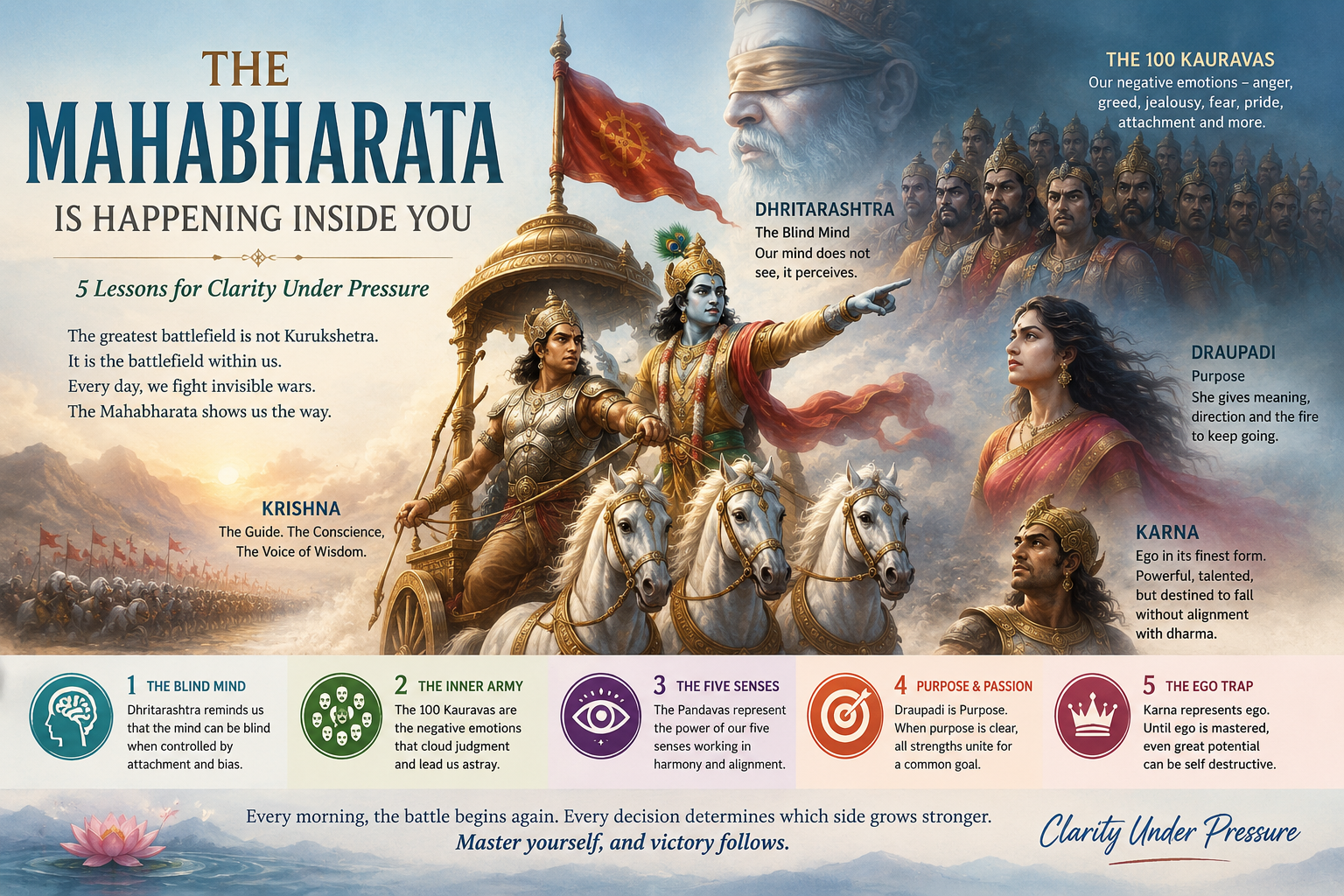
The Mahabharata is often described as the greatest epic ever written. Most people read it as a story of kingdoms, dynasties, politics, war, loyalty and betrayal. I see something more.
I see the Mahabharata as the story of every human mind.
Its greatest battlefield is not Kurukshetra. It is the battlefield within us.
Every single day, we fight invisible wars. Between discipline and temptation. Courage and fear. Ego and humility. Purpose and distraction. Clarity and confusion.
The Mahabharata is not merely ancient history. It is an operating manual for human behaviour.
When viewed through this lens, the characters become symbols of the forces that influence our decisions under pressure.
Here are five lessons that continue to shape my understanding of leadership and life.
1. Dhritarashtra: The Blind Mind.
King Dhritarashtra was born blind.
Symbolically, I see him representing the human mind.
Our mind does not directly experience reality. It depends entirely on information supplied through the senses. Every sight, sound, smell, taste and touch is interpreted before it becomes our understanding of the world.
The problem is not blindness.
The problem is allowing emotion to distort perception.
Dhritarashtra repeatedly chose attachment over justice. His inability to rise above personal bias led to disastrous decisions.
The same thing happens to us.
When fear clouds judgment…When greed overrides ethics…When attachment becomes stronger than truth…
our decisions begin to resemble those of the blind king.
Clarity Under Pressure begins by recognising that perception is not always reality.
Before making important decisions, ask yourself:
“Am I seeing the situation as it is, or as my emotions want me to see it?”
That single question can prevent countless mistakes.
2. The Hundred Kauravas: Your Inner Army of Negative Emotions.
Why one hundred brothers?
Perhaps because negative emotions never arrive alone.
Anger invites revenge.
Fear creates hesitation.
Jealousy breeds resentment.
Greed demands more.
Arrogance rejects advice.
One negative thought rarely remains isolated. It recruits many others.
Whether or not one accepts this symbolic reading, it offers a useful reflection on human behaviour: destructive emotions often reinforce one another.
Every leader experiences this.
Every entrepreneur experiences this.
Every family experiences this.
When pressure increases, the army inside us grows louder.
The challenge is not eliminating emotion.
The challenge is refusing to let emotion command the mind.
The battle is never outside first.
It always begins within.
3. The Five Pandavas: Aligning Your Five Senses
Every human being is gifted with five senses.
Seeing.
Hearing.
Touch.
Taste.
Smell.
These senses constantly collect information about the world around us.
But information alone never creates success.
Alignment does.
Imagine a leader who sees opportunities but refuses to listen.
Or someone who hears advice but ignores evidence.
Or a professional who observes everything but acts without conviction.
Success demands that all our faculties work together.
The Pandavas remind us that strength does not come from individual excellence.
It comes from unity.
Clarity Under Pressure is achieved when what you see, hear, believe and act upon all point in the same direction.
4. Draupadi: Purpose Gives Direction.
One of the most profound symbolic interpretations I have encountered is seeing Draupadi as purpose.
Purpose gives direction to strength.
Without purpose, ability is scattered.
With purpose, ordinary people become extraordinary.
After her humiliation, Draupadi took a solemn vow. That moment transformed personal pain into collective resolve. Every Pandava found renewed determination through a shared cause.
That is exactly what purpose does.
Purpose aligns effort.
Purpose sustains resilience.
Purpose helps people endure hardships that talent alone cannot overcome.
Many organisations have intelligent people.
Many families have capable individuals.
Many professionals possess exceptional skills.
Yet they struggle because everyone is pulling in different directions.
Purpose creates alignment.
When purpose is clear, difficult decisions become easier.
Distractions lose their power.
Momentum replaces confusion.
5. Karna: The Silent Cost of Ego.
Among all the characters in the Mahabharata, Karna remains one of the most fascinating.
Brilliant.
Generous.
Fearless.
Loyal.
Yet tragically conflicted.
Many symbolic interpretations see Karna as representing the human ego. While this is not a traditional reading of the epic, it captures an important truth about life.
Ego rarely announces itself.
It disguises itself as self-respect.
As pride.
As the need to prove a point.
As the refusal to apologise.
As the inability to change.
As the belief that being right matters more than doing what is right.
Think about how many businesses have failed because leaders refused to listen.
How many partnerships collapsed because neither side would compromise.
How many families remain divided because someone chose pride over reconciliation.
Success rarely disappears because of a lack of intelligence.
It disappears because ego quietly takes control.
The greatest victories in life are often achieved not by defeating others, but by mastering ourselves.
And Then There Is Krishna.
Every battlefield needs guidance.
Krishna does not fight the war.
He becomes the charioteer.
The guide.
The voice of wisdom.
The conscience that helps Arjuna see clearly when emotions threaten to overwhelm him.
Every one of us needs a Krishna.
Sometimes it is a mentor.
Sometimes it is a coach.
Sometimes it is a trusted friend.
Sometimes it is our own inner conscience.
Clarity is rarely achieved in isolation.
Wise guidance helps us see what emotion often hides.
The Real Kurukshetra
The Mahabharata is not only about an ancient war.
It is about the war each of us fights every day.
The blind mind.
The army of negative emotions.
The disciplined senses.
A purpose worth living for.
The constant battle against ego.
And the quiet voice of wisdom that helps us choose the right path.
Every morning, the battle begins again.
Every decision determines which side grows stronger.
The question is not whether the Mahabharata still exists.
The question is this:
Who is winning the battle within you?
Because long before we lead organisations, build businesses or transform societies, we must first learn to master ourselves.
That, perhaps, is the timeless lesson of the Mahabharata.
And that is the essence of Clarity Under Pressure.
Money flows faster than ever, yet peace of mind feels rarer than gold.
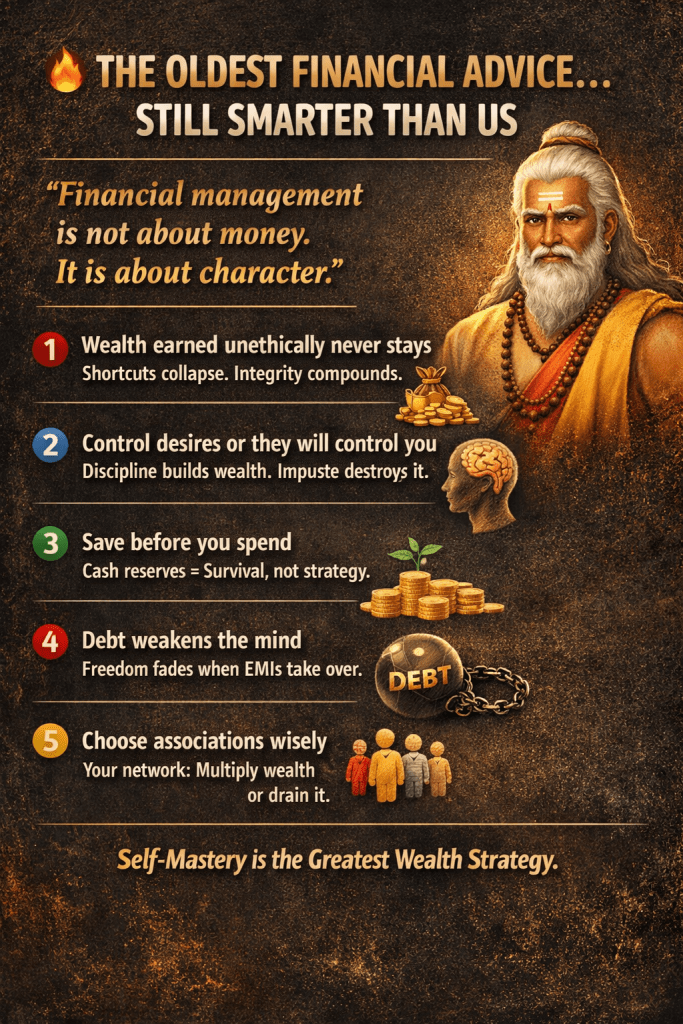
Every generation believes it invented financial wisdom — until it meets Vidur Niti.
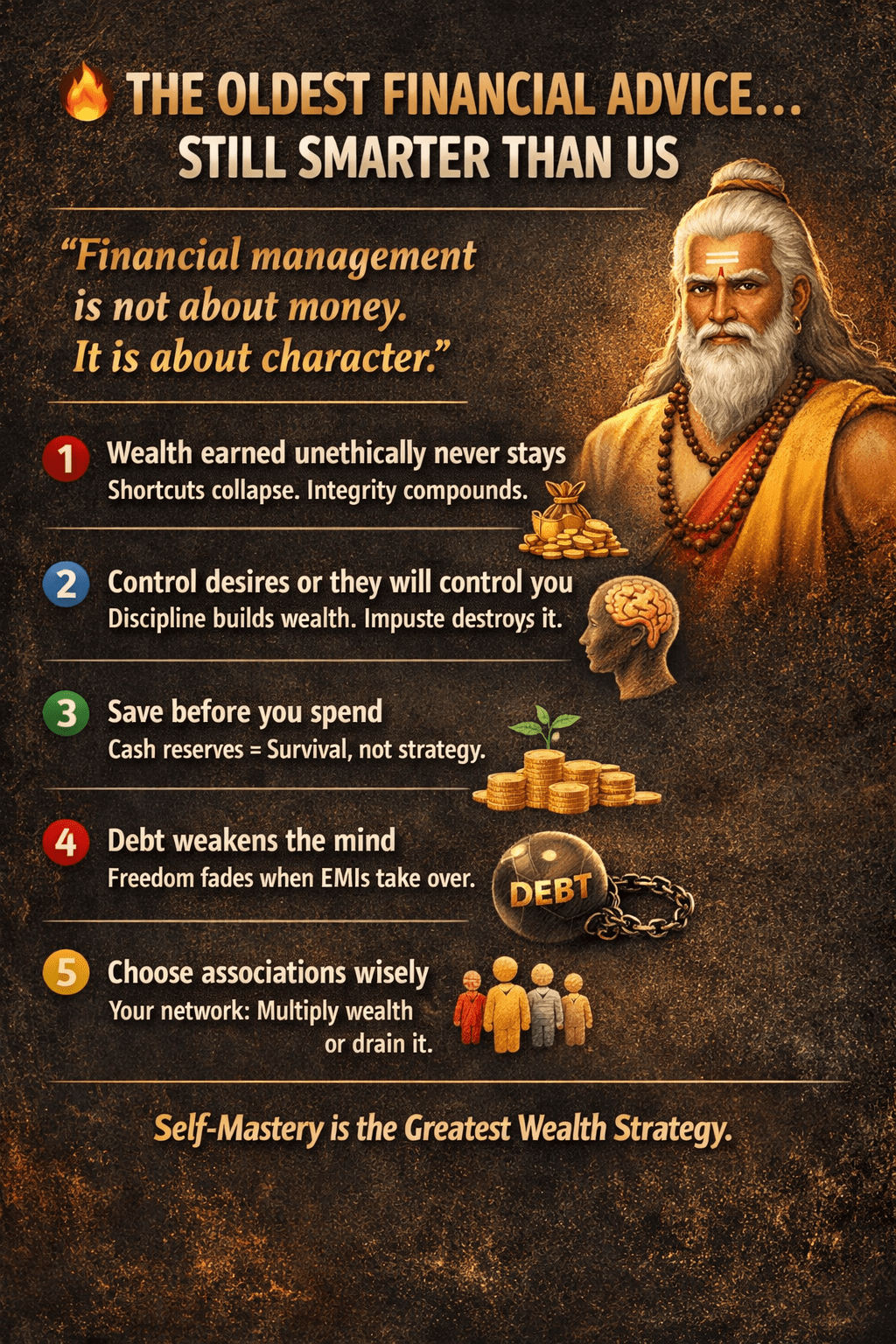
Three thousand years ago, Vidur, the royal advisor in the Mahabharata, spoke truths that still cut through the noise of modern finance. His words weren’t about numbers or markets. They were about character — the foundation of every sustainable fortune.
Wealth Earned Unethically Never Stays.
Vidur warned that wealth gained through deceit destroys the one who holds it.
It’s not karma — it’s mathematics.
Unethical gains create instability, distrust, and eventual collapse.
In today’s world, this translates to:
Shortcuts collapse. Integrity compounds.
The most valuable currency is credibility.
Control Desires or They Will Control You
Vidur didn’t blame poverty on lack of income. He blamed it on lack of restraint.
Desire, when unchecked, becomes debt.
We call it lifestyle inflation, impulse buying, or social comparison — but it’s the same disease.
Discipline builds wealth. Impulse destroys it.
The richest people aren’t those who earn the most — they’re those who can say no.
Save Before You Spend
Vidur insisted that a wise person always keeps reserves for difficult times.
In modern language: build your emergency fund before your dream fund.
Savings are not a financial strategy.
They are a survival strategy.
Debt Weakens the Mind
Vidur saw debt as a spiritual and psychological burden.
Three weeks before his death, Carl Jung wrote something that sent shockwaves through the world of psychology: “God is not a belief. It is a psychological fact.“
This wasn’t a sudden leap of faith or a religious conversion. It was the clinical observation of a man who had spent decades documenting the transformation of the human psyche as it approaches the finish line.
Having studied hundreds of patients, Jung identified a pattern so consistent it transcended culture, creed, and personal conviction. What he found suggests that we have been looking at our lives entirely backward.
The Four Stages of the Ego’s Dissolution Jung documented a specific, four-stage preparation process that the psyche undergoes. It is not a process of “fading away,” but one of intense emergence.
The Ego’s Retreat: The persona we’ve spent a lifetime building—the job titles, the social standing, the “version” of ourselves we defend—begins to lose its grip.
The Dissolution: The boundaries of the individual “I” start to soften.
The Emergence of the Self: As the ego shrinks, the Self—the totality of the psyche—begins to take center stage.
The Union: A realization that the internal psychological reality is more “solid” than the external world. Through this lens of depth psychology, Jung reached a startling conclusion: We are not bodies that happen to have souls; we are souls who happen to have bodies.
5 Signs the “Self” is Calling You You don’t have to be at the end of your life to experience this shift. In fact, Jung’s final message was about waking up while you are still alive. Here are five signs that your “Self” is calling you toward this individuation:
A Growing Distaste for the “Performative”: You find it increasingly exhausting to maintain a version of yourself that feels “unreal”.
Vivid, Archetypal Dreams: Your subconscious begins using powerful, universal symbols to grab your attention.
The Weight of Material Success: A realization that external achievements no longer provide the “soul-filling” sustenance they once did.
A Pull Toward Solitude: Not out of depression, but out of a need to finally meet what has been waiting beneath the surface your entire life.
Synchronicity: You begin to notice “meaningful coincidences” that suggest a deeper relationship between your consciousness and the physical world. The Final Message: It’s Not About Death Jung’s discovery changed everything because it shifted the focus from the end of life to the depth of life. His final weeks weren’t spent mourning the loss of the body, but celebrating the discovery of the eternal Self. If you are ready to stop defending a ghost and start living as the soul you are, the journey doesn’t start at the end. It starts today.
The Unseen Foundation. In the chaotic symphony of life, we often miss the soft, consistent melody that plays in the background. It’s the silent support, the unwavering belief, the hands that steady us when we stumble. It’s the love that has no conditions, no fine print, and no expectations. This profound, boundless love comes from two people: our parents. The Power of Unconditional Love While the world operates on a system of reciprocity, where love is often tied to actions or worthiness, parental love stands as a stark and beautiful exception. Think back to your earliest memories. The scraped knees comforted, the nightmares banished, the milestones celebrated with genuine joy. This love didn’t depend on your grades, your career choices, or your social standing. It existed purely because you were their child. They were your first cheerleaders, your confidants, and your safest harbour. This type of love, given freely without any underlying motive, is a rare and precious gift.
When Life Gets in the Way As we grow older, we get absorbed by our own ambitions, challenges, and relationships. We build our own lives, and in the process, we sometimes forget the very foundation that allowed us to build. We become busy. We forget to call. We miss birthdays. We take their presence for granted, assuming they will always be there, just as they have always been. This neglect, however unintentional, can be a silent wound for our parents. They might not complain, but the void left by our absence or lack of expressed affection can be felt deeply.
The aspersions We Cast by way of misunderstanding their Motives. Sometimes, our parents’ words or actions can be misinterpreted. Their concerns might sound like nagging, their advice might feel like interference, and their questions might seem like intrusions. In our desire for independence, we might push them away, labelling their care as control. However, if we peel back the layers, we’ll often find that their words and actions are rooted in deep-seated love and a desire to protect and guide us. They have seen more of the world, experienced more its challenges, and their wisdom, though perhaps delivered in a way that feels outdated, comes from a place of genuine concern.
Cultivating a Culture of Gratitude and Respect So, how can we bridge the gap and honor this profound love?
Express Your Affection without waiting for a special occasion. Simple gestures can mean the world. A spontaneous phone call, a thoughtful message, a warm hug, or a simple “I love you” can brighten their day.
Make Time, Not Excuses: Prioritise quality time with them. Go for a walk, share a meal, or just sit and talk. Be fully present in those moments.
Listen with Empathy when they speak. Genuinely listen to understand their perspectives and feelings. Ask about their lives, their dreams, and their worries.
Forgive and Move Forward because No parent is perfect. They might have made mistakes. But letting go of past grievances and focusing on the love they have shown can bring peace to your relationship.
Show Your Respect with Simple acts of respect, like asking for their advice (even if you don’t always follow it) or listening attentively, can convey that you value their wisdom and experience.
A Love to Be Cherished Our parents’ love is a beacon that guides us, a safety net that catches us, and a constant in an ever-changing world. It is a love that asks for nothing in return but is fulfilled by seeing us thrive. Let’s not wait for “someday” to express our love and gratitude. Let’s not let the busyness of our life dim the brightness of this connection. Let’s honour the two people who loved us first, and who continue to love us, unconditionally and without aspersions. For in cherishing them, we honour the very essence of love and connection.
What a 5,000-Year-Old Battlefield Conversation can teach us About Leadership.
I used to think the Bhagavad Gita was just another religious text. Then I discovered it’s actually the most practical leadership guide ever written. Since then I have held on to this sacred book in different forms. The Printed Version, the Kindle eBook, Cards for daily reference.
When Everything’s on the Line, when you know that moment when you’re staring at a decision that could make or break everything? I’m talking about those tough situations which everyone faces in their lives, you don’t necessarily have to be a Leader, nevertheless running through scenarios, knowing that whatever you choose tomorrow will ripple through your team, your company, maybe even your entire career.
That’s where Arjuna was standing—literally on a battlefield, facing his cousins in what would be the bloodiest war in ancient history. And he completely froze. What happened next changed how I think about leadership forever.
Here’s what I got wrong about the Gita for years: I thought it was some mystical conversation between holy men sitting under trees, talking about detaching from the world.
No. This is two warriors having a very real conversation about duty, fear, and making impossible choices when lives hang in the balance. Arjuna isn’t asking for spiritual enlightenment—he’s asking for practical advice on how to lead when the stakes are crushing.
Sound familiar?
In today’s context it would look like this:
– Quarterly numbers. The Agony or Ecstacy.
– A product launch that could save or sink the company.
– Choosing between short-term profits and long-term values.
– Managing a team through a recession, merger, layoffs, or industry disruption. The pressure is different, but the paralysis feels exactly the same.
The Counter intuitive Secret That Changes Everything
Krishna’s advice to Arjuna seems backwards at first: “Do your absolute best work, then let go of the results.”
Wait, what? Isn’t caring about results what separates leaders from… well, everyone else?
But here’s what I’ve learned after trying this approach for years:
When you stop being desperately attached to specific outcomes, you actually get better outcomes. Try it. It holds true.
Why This Actually Works is, just think about it—when was the last time you made a great decision while panicking about the consequences?
When you’re white-knuckling the steering wheel, worried about where you’ll end up, you can’t actually steer very well.
But when you know you’ve done everything possible and you trust the process? That’s when the magic happens. You think clearer. You take smarter risks. You inspire confidence instead of spreading anxiety.
I saw this firsthand during my company’s worst times. Not once, but many times. Instead of running around like my hair was on fire, I focused on what we could control: our response time, our communication with clients, our team’s morale. We came out stronger. And honestly? I slept better. In fact I have never lost sleep over anything ever. Whatever may have been the situation I have managed to keep my wit’s cool.
Life Happens TO You, and you cannot stop that from happening, But You can definitely choose Your Response – on how to deal with it.
The Gita has this concept that basically divides everything into two buckets: stuff that happens to you (prarabdha) and how you respond to it (purushartha).
This sounds obvious until you realise how much energy we waste trying to control the first bucket. You Cannot.
Here’s What I Mean:
Sometime back one of our biggest and longest standing Client decided not to renew. One year of revenue, gone. That’s prarabdha—it happened, period.
But everything else? That’s on me:
– How I broke the news to the team- Whether I spiralled into worst-case scenarios or started planning our next move.
– Whether I used this as a learning opportunity or just complained about “disloyal clients”!!
You could spend days obsessing over what we could have done differently. Or you sit and analyse, make an last ditch effort to save if possible, and if even after giving it your best shot, then instead of ruminating look at alternative solutions. How to make up the lost revenue in the shortest span so that the effect is cushioned in the shortest span of time.
The Balance That Actually Matters
There’s this verse (Chapter 4, Verse 22, if you’re keeping track) that basically says balanced people don’t get thrown off by wins or losses. They just keep moving forward.
This isn’t about being emotionless—it’s about being consistent.
What This Looks Like in Practice
Good news: Celebrate for five minutes, then ask “What’s next?”
Bad news: Feel it for five minutes, then ask “What can we learn and Do next?”
Uncertainty: Work with what you know, then adapt as you learn more.
My Son figured this out before I did. He told me, “You used to be a roller coaster—amazing when things went well, impossible when they didn’t. Now we actually know what to expect from you.” He just told me to look at my old Photographs when I was younger.
That hit harder than any performance review.
The Best Analogy I’ve Ever Heard About Ambition.
The Gita compares desires to paan—that sweet digestive you have after a good meal. It’s nice, but you don’t need it to feel satisfied.
This completely reframed how I think about professional goals.
Instead of: “I need this promotion/deal/metric to prove I’m successful”
I started thinking: “I’m already pretty fortunate. This would be a nice bonus.”
Why This Isn’t Just Feel-Good Philosophy
When you’re not operating from desperation:
– You negotiate better (you’re not afraid to walk away).
– You make clearer decisions (you’re not clouded by need).
Actually Trying This Stuff (Not Just Nodding Along).
Look, reading about this is one thing. Actually doing it when your boss is breathing down your neck and wants answers is completely different.
Practice it in your daily life. Concentrate on doing great work without bothering on specific outcome. See what happens. How it balances your stress level.
When problems come up, spend your energy on your response, not on not on complaining about the problem.
Try to maintain same tone in meetings whether you’re delivering good news or bad news. It will have an impact on your Team. The energy percolates down.
None of this is groundbreaking. But doing it consistently? That’s where the real change happens.
Why a Battlefield Guide Still Works.
The reason the Gita works for modern leadership isn’t because it’s ancient wisdom (though it is). It’s because it was written for someone who had to make life-or-death decisions under impossible pressure.
The details are different, but the core challenge is the same: How do you lead effectively when the outcome matters desperately but you can’t guarantee success?
Answer: You control what you can control, you do your best work, and you trust the process. It’s not magic. But it works.
What’s your version of standing on that battlefield? The moment when everything you’ve worked for hangs on a decision you have to make? Remember: it’s not about predicting the future perfectly—it’s about showing up fully to the present.
P.S. – If this resonated with you, I’d love to hear about your own battlefield moments. Because honestly, We’re all just figuring this out as we go, and sometimes it helps to know we’re not alone out there.
Finding Your Inner Circle: The Art of Building Your S10
A journey toward authentic leadership and meaningful connections.
The Power of the Few.
In our hyper-connected world, we often forget a fundamental truth: you don’t need everyone to believe in your vision—you just need the right ones.
Throughout history, the most impactful leaders understood this principle. They cultivated a select group of trusted advisors, confidants, and supporters who became the backbone of their success. I call this your S10**—your Strategic 10. These are the people who will stand by you, challenge you, and help you reach the culmination of your real objectives.
The Ancient Wisdom of Oral Tradition
There’s something profound about the spoken word that written text can never fully capture. Consider how the Vedas were passed down through generations—not through scrolls or tablets, but from mouth to ear, creating an unbroken chain of wisdom and understanding.
When we speak our truths, when we share our visions verbally, something magical happens:
– Our passion becomes palpable.
– Our conviction carries weight.
– Our humanity shines through.
This is why great rulers maintained councils—not just for their knowledge, but for their ability to communicate, inspire, and deliver results through authentic connection.
The S10 Project: A Labor of Love
Like preparing the perfect biryani over a slow flame, identifying your S10 requires patience, intention, and careful attention to detail. This isn’t a process you can rush—it’s a continuous quality endeavor that deserves the same dedication you’d give to any masterpiece.
The Selection Principles:
No Elimination Without Cause Every person in your consideration deserves fair evaluation. Names don’t get crossed off lightly.
Holistic Assessment One conversation, one interaction, one moment doesn’t define someone’s potential value to your circle.
Continuous Evolution Like quality itself, this is an ongoing process. Your S10 may shift as you grow and your mission evolves.
Time-Tested Validation Just as the finest biryanis need time to develop their full flavor, the best relationships reveal their true worth over time.
The Multimedia Advantage
While I write these words now, I recognise that written content only captures part of the story. The tremor in a voice when someone shares their deepest conviction, the sparkle in eyes when passion ignites, the pause that speaks volumes—these elements transform mere information into transformation.
This is why the greatest teachers, from ancient gurus to modern thought leaders, understand that multi-sensory communication creates deeper impact:
– Visual elements engage imagination.
– Audio conveys emotion and nuance.
– Written words provide structure and reference.
– Personal interaction builds trust and connection.
Building Your Own Council
As you work toward becoming a thought leader who makes a real difference, ask yourself:
Who are the people that…
– Challenge your thinking without crushing your spirit?
– Celebrate your wins authentically?
– Offer honest feedback when you need course correction?
– Stand by you when others doubt?
– Amplify your message because they truly believe in it?These are your potential S10 members. They’re not necessarily the loudest voices or the most obvious choices—they’re the ones whose values align with yours and whose presence makes you a better version of yourself.
The Marathon Mindset
Remember, this isn’t a sprint to a finish line—it’s a 25-year journey of continuous growth, refinement, and impact. Your S10 today might look different from your S10 in five years, and that’s not just okay—it’s expected and healthy.
The goal isn’t perfection; it’s authentic progress toward meaningful impact.
Closing Wisdom: The Rules for a Happy Life
As we navigate this journey of building our circles and our influence, let’s anchor ourselves in timeless wisdom:
1. Don’t HATE – Life is too short to waste time hating. That energy could be channeled into building something beautiful instead.
2. Don’t COMPARE – Don’t try to be someone else. The world already has them—what it needs is the best version of YOU.
3. Don’t WORRY trust yourself.
The day you stop worrying will be the FIRST day of your NEW LIFE.
Trust the process, trust your S10.
What started as a pet project has become a profound reminder: we’re not meant to journey alone. We’re meant to find our people, nurture those relationships, and together, create the change we wish to see in the world.
The statistics are stark, yet inspiring: when we invest in a girl’s education, we don’t just change her life—we transform entire communities, economies, and futures. Despite centuries of progress, the fight for women’s education and advancement remains one of the most critical battles of our time, with ripple effects that extend far beyond classroom walls.
The Foundation That Changes Everything.
Education serves as the great equaliser, but for women, it becomes something even more powerful—a tool of liberation. When girls receive quality education, the benefits cascade through generations like stones thrown into still water, creating waves of change that touch every corner of society.
The Immediate Impact: Lives Transformed
The data speaks volumes about education’s transformative power:
• Health Revolution: Educated women make informed healthcare decisions, leading to lower maternal mortality rates and healthier families.
• Economic Powerhouse: Each additional year of schooling increases a woman’s earnings by 10-20%, injecting vital funds into local economies.
• Population Stability: Educated women have fewer children and invest more in each child’s future, creating a cycle of opportunity.
• Leadership Pipeline: Education builds confidence and critical thinking skills, preparing women to lead in their communities and beyond
Breaking the Chains of Child Marriage
In many parts of the world, education becomes a shield against harmful traditional practices. When families see their daughters gaining knowledge, skills, and confidence, the girl’s perceived value shifts dramatically. Education delays marriage, reduces teenage pregnancy, and opens doors to possibilities that seemed impossible just one generation ago.
The Persistent Barriers: What Still Stands in Our Way.
Despite overwhelming evidence of education’s benefits, obstacles remain stubbornly entrenched across the globe.
In Developing Nations: The Triple Threat
1. Poverty’s Cruel Mathematics
Families facing survival often view girls as economic burdens rather than investments. The immediate need for income outweighs long-term benefits, forcing girls into work or early marriage.
2. Violence and Safety Concerns
The journey to school becomes dangerous for girls in areas where gender-based violence is common. Parents, seeking to protect their daughters, often keep them home.
3. Cultural Resistance
Deep-rooted beliefs about women’s roles continue to limit educational opportunities. Traditional societies may view educated women as threats to established hierarchies.
In Developed Nations: The Paradox of Progress
Here lies one of the most frustrating ironies of our time: countries with the highest female enrolment rates still struggle with gender equity in leadership positions.
The Pipeline Problem
– Women earn 60% of university degrees in the US and Europe.
– Yet they hold only 20% of senior executive positions.
– The gap between education and leadership roles reveals systemic barriers that persist despite formal equality.
The Confidence Gap
Even in nations where legal barriers have fallen, cultural expectations and unconscious biases continue to limit women’s advancement, creating what researchers call the “confidence penalty.”
The Ripple Effect: How Educated Women Transform Society.
When women succeed, everyone wins. This isn’t just feel-good rhetoric—it’s economic reality backed by decades of research.
Economic Multipliers
Community Investment
Women reinvest 90% of their earnings back into their families and communities, compared to 35% for men.
This means every educated woman becomes an economic catalyst, multiplying prosperity throughout her network.
Innovation Drivers
Companies with diverse leadership teams are 21% more likely to experience above-average profitability. Women bring different perspectives, experiences, and problem-solving approaches that drive innovation and growth.
Social Transformation.
Breaking Generational Cycles
Educated mothers are more likely to educate their own children, creating positive feedback loops that elevate entire communities over time.
Political Participation
Education correlates strongly with civic engagement. Educated women vote more frequently, run for office more often, and advocate more effectively for social change.
The Path Forward: From Potential to Reality
The solution isn’t just about getting more girls into classrooms—it’s about creating comprehensive support systems that carry them from education to empowerment.
1. Address Root Causes
Economic Support: Conditional cash transfer programs that pay families to keep girls in school.
Safety Measures: Safe transportation, secure school environments, and community protection programs.
Cultural Engagement: Working with community leaders and families to shift perspectives on women’s roles
2. Bridge the Leadership Gap
Mentorship Programs: Connecting educated women with role models and sponsors.
Policy Reform: Implementing family-friendly workplace policies and addressing systemic biases.
Entrepreneurship Support: Providing access to capital and business training for women-led ventures.
3. Sustain Long-term Change
Institutional Reform: Ensuring educational institutions are equipped to support and advance women.
Community Building: Creating networks that support women throughout their careers.
Measurement and Accountability: Tracking progress and holding institutions accountable for gender equity.
The Moral Imperative: Why This Matters Now In an interconnected world facing complex challenges—from climate change to economic inequality to global health crises—we cannot afford to waste half of our human talent. The problems we face require all minds, all perspectives, and all the innovation we can muster.
Educating women isn’t just about fairness or equality—it’s about survival and prosperity in an increasingly competitive world. Countries that fail to fully utilise their female talent will find themselves at a significant disadvantage in the global economy.
The Call to Action
Every stakeholder has a role to play:
Governments must invest in education infrastructure and remove legal barriers.
Communities need to challenge harmful traditional practices and support girls’ aspirations.
Employers should create pathways for women’s advancement and address workplace biases.
Individuals can mentor, advocate, and vote for policies that support women’s education and empowerment.
Conclusion: The Future We Can Build
The evidence is overwhelming: educating women creates a better world for everyone. Yet millions of girls still lack access to quality education, and millions more face barriers in translating their education into meaningful opportunities.
This isn’t just a women’s issue—it’s a human issue. It’s an economic issue. It’s a survival issue for our species and our planet.
The question isn’t whether we can afford to invest in women’s education and advancement. The question is whether we can afford not to. The cost of inaction—in lost potential, stunted economies, and persistent
inequality—far exceeds the investment required to create change.
The path forward is clear. The tools are available. What we need now is the collective will to turn this knowledge into action, ensuring that every girl has the chance to fulfil her potential and contribute to our shared future.
The time for half-measures and good intentions has passed. The future demands nothing less than our complete commitment to unleashing the full power of educated, empowered women. Our world depends on it.
United Nations has designated the theme on International Women’s Day this year as “Rights. Justice. Action. For ALL Women and Girls.