Category: Social Relevance

  • Why Stress Management Doesn’t Work

    Why Stress Management Doesn’t Work

    Why Stress Management Doesn’t Work.

    And the day I realised I had been fighting the wrong enemy.

    For nearly twenty-eight years, I believed stress was the problem. So I did what most of us are taught to do. I managed it.

    I slept more. I exercised every day. I rebuilt my diet from a hundred YouTube videos. I worked fewer hours — which, for a man building a business, was no small thing. I took breaks. I tried every sensible solution I could find.

    And every one of them worked. For a while.

    Then the stress came back. If it wasn’t work, it was money. If it wasn’t money, it was a relationship. If it wasn’t a relationship, it was my health. It felt like a game I was never meant to win.

    Then one day a simple thought stopped me cold.

    Stress wasn’t the problem. Whatever was feeding it was.

    The Whack-a-Mole Game We All Play

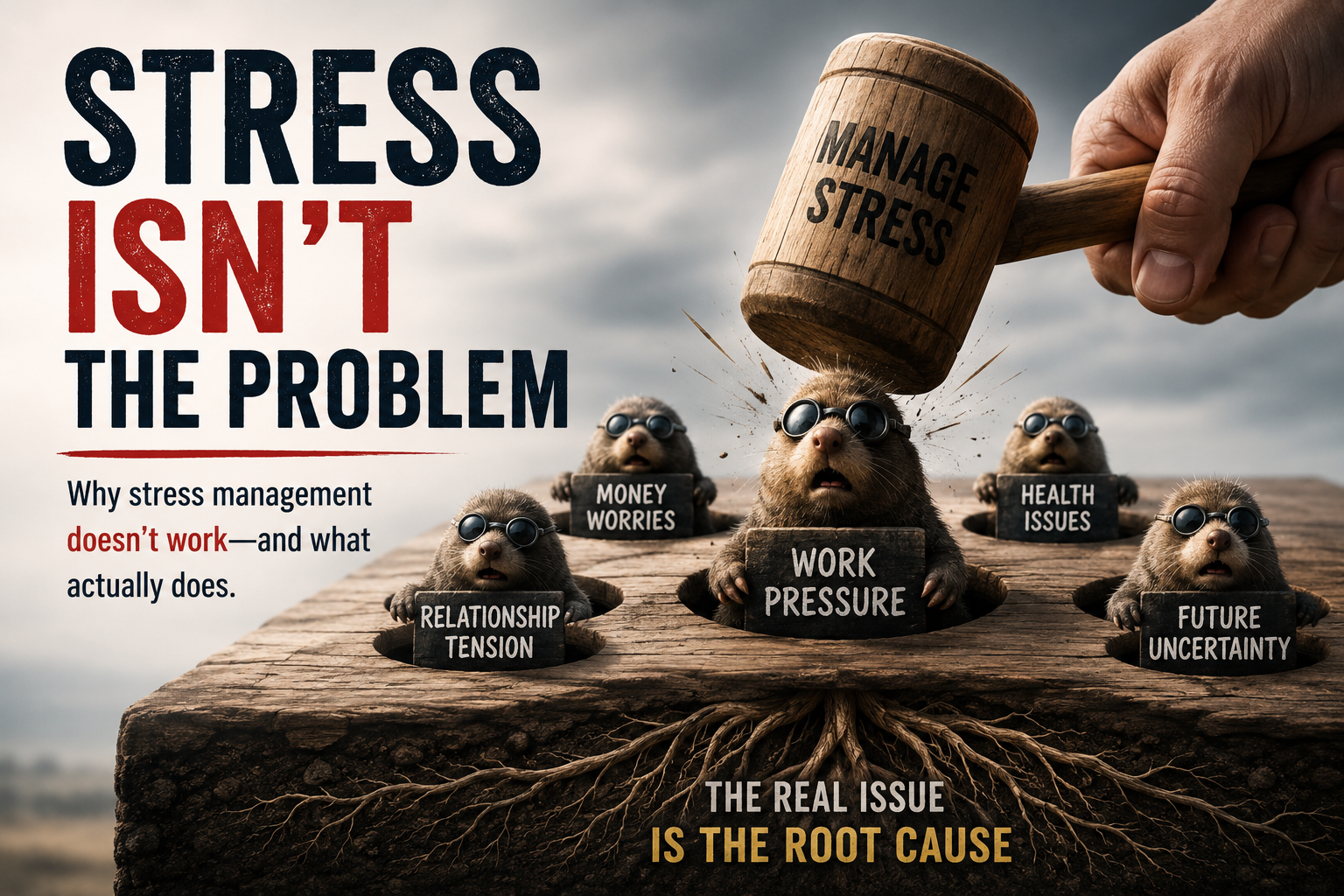
    Most of us treat stress the way we would treat a leaking roof. Find the problem. Patch it. Move on. But stress almost never behaves like a roof.

    You finally fix your sleep, and anxiety shows up. You settle the anxiety, and work pressure climbs. You handle the work, and money worries arrive. You sort out the money, and a relationship begins to strain. Stress simply changes its disguise.

    Picture that carnival game where little moles pop up from a grid of holes. You hammer one down, another springs up. You hammer that one, and a third appears. You can become very, very good at hitting moles and still never win the game.

    Most of us are playing exactly that game with our lives.

    Why Stress Keeps Coming Back

    Every hard experience leaves a mark. And most of the time, we never finish feeling it. We suppress it. We ignore it. We distract ourselves. We promise to deal with it later.

    Later rarely arrives.

    So those unfinished experiences do not disappear. They go quiet. They wait, just beneath the surface. Then one ordinary day, something small happens. A comment. An email. A deadline. A memory.

    And the reaction that comes out of us is far bigger than the moment deserves. Why? Because we are not only reacting to what is in front of us. We are reacting to years of backlog.

    The event is small. The reservoir behind it is not.

    The Mistake Modern Life Encourages

    Modern life has one piece of advice about stress: get better at managing it. More apps. More planners. More productivity systems. More hacks.

    Almost no one talks about emptying the reservoir itself.

    So we become experts at coping, and never actually become calmer. We survive. We function. We perform. And underneath it all, we stay tired.

    What Changed Everything for Me

    The turn came when I stopped asking one question and started asking another. I stopped asking, “How do I get rid of this stress?” I started asking, “Why does it keep coming back?”

    That second question changed everything. It showed me that stress was not my enemy. It was my messenger. It was simply telling me that something deeper was asking for attention.

    When I began tending the root instead of swatting the branches, things changed. Not overnight. Not by magic. But steadily. The reactions grew smaller. The mind grew quieter. The body let go of a tension it had been holding for years.

    Life did not get easier. I got calmer. That is a different thing entirely.

    A Seven-Day Experiment

    You do not have to take my word for any of this. Test it.

    For the next seven days, whenever you feel stress rising, pause and ask yourself one question:

    “Is my reaction bigger than the event in front of me?”

    If the honest answer is yes, then what you are feeling is probably older than today. That single piece of awareness changes your relationship with stress. You stop fighting it. You start understanding it. And understanding is almost always the first step toward freedom.

    The Real Goal

    For years I was certain that stress was ruining my life. I see it differently now.

    Stress was not ruining my life. Whatever I refused to face was.

    The moment we stop chasing symptoms and start looking for the source, stress becomes easier to understand, easier to carry, and — in time — easier to overcome.

    Maybe the goal was never to get better at handling stress. Maybe the goal is to stop feeding the thing that creates it.

    Capt. Shaji Kumar is a former soldier, entrepreneur, and coach. He writes on discipline, stress, personal growth, and practical life mastery. His latest book, Stress Isn’t the Problem, explores the real roots of stress — and a simple, soldier’s system for finding calm at the source.

  • The Prophets Among Us

    The Prophets Among Us

    I WONDER | Issue No. 02 The Prophets Among Us

    “I Told You So.” — The Three Most Dangerous Words in Human History.

    Somewhere, right now, a person is achieving something. And somewhere very close by, another person is clearing their throat, straightening their collar, and preparing to deliver the four syllables that will completely steal the show. “I told You So”.

    There is a moment, in every success story, that nobody talks about. Not the sleepless nights. Not the rejection letters thick enough to wallpaper a room. Not the phase where the person in question seriously considered abandoning everything and opening a small tea stall by the highway.

    No. The moment nobody talks about is the one that comes immediately after success. The two-second window between the good news breaking and the arrival of The Prophets.

    You will recognise them. They travel in groups. They have been waiting. Oh, how they have been waiting.

    “I told you so.”

    Three words. Delivered with the quiet satisfaction of a man who has just won a bet he placed fifteen years ago and never told anyone about.

    Let us trace the life cycle of an achiever, shall we? For science.

    Phase One: The Struggle. Our hero is trying. Really trying. Applying for jobs, facing rejections, doubting themselves at 2 AM, eating instant noodles with the quiet dignity of someone who has chosen ambition over a balanced diet. During this entire phase — and this is crucial — The Prophets are largely absent. They are busy. They have opinions to form. Predictions to quietly log in the filing cabinet of their memory, to be retrieved later, at the perfect dramatic moment.

    Phase Two: The Breakthrough. It happens. The job offer arrives. The business takes off. The exam is cracked. Our hero, bleary-eyed and slightly disbelieving, picks up the phone to share the news.

    Phase Three: The Prophecy Reclamation. Within forty-eight hours — sometimes forty-eight minutes — The Prophets assemble. And the sentence begins.

    “You know, I always said this one had it in them.”

    “I told your father, years ago — mark my words, I said.”

    “I never doubted for even one second. Not one.”

    Now here is the truly magnificent part. The prophecy, as delivered, bears absolutely no relationship to what was actually said during Phase One.

    During Phase One, the same Prophet may have said, with considerable authority: “This field has no future. Why not try something stable? Have you considered government service?”

    But memory, as it turns out, is a remarkably flexible instrument. By Phase Three, that conversation has been quietly edited, rearranged, and rereleased — much like a director’s cut of a film, except the director is rewriting history in real time and no one is allowed to check the original footage.

    The achiever, meanwhile, stands there. Holding their hard-won success. Wondering if they imagined the last three years. Wondering if perhaps the Prophet was, in some metaphysical sense, correct all along. Wondering if they should say something. Deciding, wisely, not to.

    And then — oh, then — comes the extended remix.

    Because “I told you so” is never just four syllables. It is a gateway. A portal to an extended monologue in which the Prophet traces, in extraordinary detail, every single moment they supposedly believed in you — including moments you have no memory of and strong reason to doubt ever occurred.

    “Remember that Sunday lunch in 2019? I looked across the table and I thought — that one. That one is going places.”

    You were eating rice. You had just spilled dal on your shirt. You were not, by any observable measure, going places.

    But here you are, nodding. Because what else do you do?

    The supporting cast, of course, is equally spectacular.

    There is The Competitive Prophet — who told you so, yes, but also told seventeen other people so, and is now doing complex mental arithmetic to figure out which prediction to lead with.

    There is The Reluctant Prophet — who definitely had doubts, enormous doubts, but has decided that publicly owning a prophecy is better than admitting they once suggested you take up accounting.

    And then there is The Retroactive Prophet — the purest form — who, if pressed, cannot actually recall saying anything at all, but has by now told the story of their belief in you so many times that they have genuinely begun to remember it. The brain is a wonderful thing.

    Meanwhile, the actual achiever. The person who set the alarm at 5 AM. Who rewrote the application seventeen times. Who cried once in a parking lot and told nobody. Who kept going on the days when keeping going felt frankly unreasonable.

    That person is standing quietly in the corner, eating cake, occasionally nodding, and thinking: I wonder. I really do wonder.

    But they smile. Because they know. And that, in the end, is entirely enough.

    The next time someone tells you “I told you so” — smile warmly, nod graciously, and know, deep in your bones, that the only person who truly told you so was the one who stared back at you in the mirror every morning and said: keep going.

    That person deserves all the credit. And the cake.

    Capt. Shaji Kumar | I Wonder, Issue 02

    To every achiever who did it quietly, stubbornly, and entirely on their own — this one’s for you.

    All the best Vava. This one is for you.

    #IWonder #IToldYouSo #FamilyHumour #TheProphetsAmongUs #SuccessStories #HumourAndHeart #EverydayObservations #Achievers #KeepGoing #SatireLife #RelatableContent #FunnyButTrue #HumanNature #CelebrationVibes #Resilience #MondayMotivation #WorkplaceHumour #LifeLessons #SmileMore #BlogSeries

  • The Unnamed Accused

    The Unnamed Accused

    We know her name. We know her age. We know which street she lived on, which school she attended, what she was wearing. We have dissected her life, her family’s grief, her trauma — frame by frame — across every television channel and every social media feed.

    We do not know his face.

    That is where I want you to pause. Right there. In that gap — that enormous, telling, deeply shameful gap — lives everything that is wrong with how we as a society respond to rape.

    The victim becomes the story. The perpetrator becomes a footnote. A case number. An “accused” hidden behind the thick procedural curtain of a legal system that was designed, we are told, to protect the innocent — but which, in practice, has become a sanctuary for the guilty.

    Let us talk about what the numbers actually say. Not because numbers capture the truth of this crime — they cannot — but because they reveal the scale of our collective failure with a clarity that no amount of editorial outrage has managed to produce.

    The Data — because the numbers demand to be heard:

    • India, NCRB 2024: 29,536 cases of rape reported. That is 80 reported cases every single day. And the word “reported” is doing enormous heavy lifting in that sentence — independent research suggests that over 99% of rapes in India go unreported, buried under the twin weight of social stigma and fear of retaliation.
    • Of children: In 2024, 784 registered rape victims were under 18 years of age. Under the POCSO Act in 2021 alone, 52,836 cases of sexual offenses against minor girls were filed. Children. In their own homes, their own schools, their own neighborhoods.
    • Conviction rate: India’s conviction rate in rape cases hovers between 27% and 32%. In Delhi — the city that shook the nation with the Nirbhaya case in 2012 — the acquittal rate in rape cases stands at a staggering 83%. In Karnataka, in 2023, of cases disposed of by courts, 92% ended in acquittals.
    • Court pendency: As of recent data, 95% of all crimes against women cases are pending trial. Justice delayed is not merely justice denied — in rape cases, it is a second assault on the survivor, drawn out across years.
    • The accused meanwhile? He returns home. He continues his life. In many cases, he is known to the victim — a neighbour, a relative, a person in a position of trust. He is not paraded. He is not named in most media coverage. He is protected, procedurally and socially, in ways the victim never was and never will be.

    This is not an accident of the system. It is a feature of it.

    Turn on any news channel after a high-profile rape case. Watch carefully. The camera will linger on the family of the victim — their devastation weaponized for viewership. The reporter will stand outside the hospital, outside the home, outside the court — and every question, every frame, every graphic will orbit the survivor. Her identity. Her background. Her movements on the night in question.

    The rapist’s family will not be followed. His neighborhood will not be mapped. His history of behaviour will not be investigated and broadcast in prime time. He will not have to live the rest of his life as a figure of public shame — because the media has decided, consciously or not, that the victim is the more compelling story. Sensation sells. Suffering sells. A family broken sells. A predator exposed and humiliated? That is apparently less interesting.

    This must change. And the change must be structural, not sentimental.

    What the world has done — and what we refuse to consider:

    Several countries have decided, through law and through will, that a rapist forfeits his standing as a protected citizen.

    • Bangladesh passed the Women and Children Repression Prevention (Amendment) Bill in 2020, introducing the death penalty for rape following mass public outrage over high-profile cases.
    • Pakistan introduced the death penalty for gang rape and child sexual abuse in 2020. Chemical castration is an additional sentencing option.
    • Saudi Arabia mandates death by public beheading for convicted rapists under Sharia law. Egypt, Iran, the UAE and China have similar provisions for aggravated rape, particularly involving minors.
    • North Korea sentences rapists to death by firing squad.

    One does not have to admire the legal systems of these countries in their entirety to acknowledge the singular clarity of their message: this act places you outside the protection of civil society.

    India, meanwhile, has the Nirbhaya Fund — announced in 2013, still largely unspent a decade later. It has fast-track courts — chronically understaffed and overwhelmed. It has the POCSO Act — routinely delayed in its application. It has laws. It has frameworks. It has committees. What it does not have is the will to make the punishment so swift, so certain, and so visible that it functions as a genuine deterrent rather than a bureaucratic inconvenience.

    The argument against capital punishment is not without intellectual weight. There are serious, principled objections — the risk of wrongful conviction, the question of whether the state should hold the power of death, the evidence on deterrence. These arguments deserve a hearing in Parliament and in academic institutions. They are not arguments that should be used to endlessly delay action while children are being assaulted and survivors are being re-traumatized in courtrooms for years on end.

    There is a middle ground that India has not seriously explored: mandatory, time-bound trials — completed within ninety days for rape cases. Automatic public identification of convicted rapists — their names, their photographs, their backgrounds published as a matter of public record. Constitutional amendment to classify rape, particularly of minors, as a crime against the state — not merely against the individual — triggering a fundamentally different order of response from the justice system.

    The rapist should be the story. His face should be known. His family should have to reckon with what he has done. The community that sheltered him, that looked away, that whispered about the girl rather than condemning the man, should be made uncomfortable in the full light of public scrutiny.

    Because here is the truth that our system refuses to confront: the victim did not choose this. He did. Every protection, every procedural courtesy, every anonymous news report that shields his identity is a choice — a choice we make, again and again, to protect the wrong person.

    A child who was violated does not get to remain anonymous in her own memory. The very least a just society can do is ensure that the man who violated her cannot remain anonymous in ours.

    We pour our outrage into candlelight vigils and hashtags that trend for forty-eight hours, then we move on — so I ask you plainly: how many more names do we need to remember before we decide that the one name we should never be allowed to forget is his?

    #Reflections #EndRape #JusticeForSurvivors #RapeIsACrime #NameTheRapist #ChildSafety #POCSO #Nirbhaya #WomensRights #GenderBasedViolence #LegalReform #DeathPenaltyForRape #NCRBData #India #SpeakUp #BreakTheSilence #WritingCommunity #LinkedInThoughtLeaders #Medium #Substack

  • Reflections : The Price of a Bride

    Somewhere in India, as you read this sentence, a woman is being reminded that she did not come with enough.

    Let that sit for a moment. Not as a statistic. Not as a headline you scroll past. As a fact about a living, breathing human being — perhaps a daughter, a sister, a friend — whose worth is being measured in rupees, in gold, in the square footage of a refrigerator her parents could or could not afford to send along with her to her new home.

    We are, by every measure, a civilisation that has put men on the moon, mapped the human genome and built artificial intelligence that can write poetry. And yet, in the same civilisation, in the year 2024, sixteen women died every single day in India alone because the cheque their families wrote was not large enough for the family they married into.

    The Data — because numbers have faces:

    • India, NCRB 2024: 5,737 dowry deaths recorded — over 15 women every single day. Uttar Pradesh alone accounted for 2,038 deaths, over one third of the national total. Bihar followed with 1,078.
    • Dowry-related suicides rose 6.7% between 2023 and 2024 — from 1,587 to 1,693 cases.
    • Cruelty by husband or relatives: over 1.2 lakh cases filed in 2024 alone. These are only the ones reported.
    • Pakistan: approximately 2,000 dowry deaths per year — the highest rate per 100,000 women in South Asia, and widely believed to be severely underreported.
    • The Dowry Prohibition Act has been on India’s statute books since 1961. Sixty-four years. The law exists. The dying continues.

    These numbers are not abstract. Each one was a wedding. Each one was a woman who dressed in finery, touched the feet of elders, took the vows according to customs of the religion/faith pertaining thereof, or signed a register, and believed — as every young person has the right to believe on that day — that she was entering a life, not an invoice.

    What is most chilling is not the violence itself, terrible as it is. It is the architecture around it. The neighbors who heard something and said nothing. The in-laws who watched it build and looked away. The police who filed it as a kitchen accident. The extended family that whispered about the girl’s shortcomings rather than the husband’s cruelty. The society that mourned briefly, then moved on to the next wedding season.

    Dowry death is not a crime committed by monsters in dark alleys. It is a crime committed in decorated drawing rooms, in kitchens smelling of turmeric, in the presence of family photographs and gods on the wall. That is precisely what makes it so insidious — and so difficult to confront. Because confronting it means looking at people we know. People we love, perhaps. People we have eaten with.

    Across the border in Pakistan, in the alleys of Dhaka, in the hills of Nepal — the geography changes, the language shifts, the religion differs — but the transaction remains the same. A young woman’s life, quietly balanced against the contents of a trunk she was expected to bring with her.

    The laws are written. The penalties are clear. What is missing is something no legislature can mandate — the collective moral outrage of ordinary people who refuse, finally, to treat this as someone else’s problem.

    We light candles for disasters we cannot control and fall silent about the ones we can — so tell me honestly, the next time you sit at a wedding and hear someone whisper about what the bride’s family did or did not bring, will you smile politely and reach for your glass, or will you finally say something?

  • The Unstoppable Force: Why Educating Women Transforms Everything.

    The Unstoppable Force: Why Educating Women Transforms Everything.

    The statistics are stark, yet inspiring: when we invest in a girl’s education, we don’t just change her life—we transform entire communities, economies, and futures. Despite centuries of progress, the fight for women’s education and advancement remains one of the most critical battles of our time, with ripple effects that extend far beyond classroom walls.

    The Foundation That Changes Everything.

    Education serves as the great equaliser, but for women, it becomes something even more powerful—a tool of liberation. When girls receive quality education, the benefits cascade through generations like stones thrown into still water, creating waves of change that touch every corner of society.

    The Immediate Impact: Lives Transformed

    The data speaks volumes about education’s transformative power:

    Health Revolution: Educated women make informed healthcare decisions, leading to lower maternal mortality rates and healthier families.

    Economic Powerhouse: Each additional year of schooling increases a woman’s earnings by 10-20%, injecting vital funds into local economies.

    Population Stability: Educated women have fewer children and invest more in each child’s future, creating a cycle of opportunity.

    Leadership Pipeline: Education builds confidence and critical thinking skills, preparing women to lead in their communities and beyond

    Breaking the Chains of Child Marriage

    In many parts of the world, education becomes a shield against harmful traditional practices. When families see their daughters gaining knowledge, skills, and confidence, the girl’s perceived value shifts dramatically. Education delays marriage, reduces teenage pregnancy, and opens doors to possibilities that seemed impossible just one generation ago.

    The Persistent Barriers: What Still Stands in Our Way.

    Despite overwhelming evidence of education’s benefits, obstacles remain stubbornly entrenched across the globe.

    In Developing Nations: The Triple Threat

    1. Poverty’s Cruel Mathematics

    Families facing survival often view girls as economic burdens rather than investments. The immediate need for income outweighs long-term benefits, forcing girls into work or early marriage.

    2. Violence and Safety Concerns

    The journey to school becomes dangerous for girls in areas where gender-based violence is common. Parents, seeking to protect their daughters, often keep them home.

    3. Cultural Resistance

    Deep-rooted beliefs about women’s roles continue to limit educational opportunities. Traditional societies may view educated women as threats to established hierarchies.

    In Developed Nations: The Paradox of Progress

    Here lies one of the most frustrating ironies of our time: countries with the highest female enrolment rates still struggle with gender equity in leadership positions.

    The Pipeline Problem

    – Women earn 60% of university degrees in the US and Europe.

    – Yet they hold only 20% of senior executive positions.

    – The gap between education and leadership roles reveals systemic barriers that persist despite formal equality.

    The Confidence Gap

    Even in nations where legal barriers have fallen, cultural expectations and unconscious biases continue to limit women’s advancement, creating what researchers call the “confidence penalty.”

    The Ripple Effect: How Educated Women Transform Society.

    When women succeed, everyone wins. This isn’t just feel-good rhetoric—it’s economic reality backed by decades of research.

    Economic Multipliers

    Community Investment

    Women reinvest 90% of their earnings back into their families and communities, compared to 35% for men.

    This means every educated woman becomes an economic catalyst, multiplying prosperity throughout her network.

    Innovation Drivers

    Companies with diverse leadership teams are 21% more likely to experience above-average profitability. Women bring different perspectives, experiences, and problem-solving approaches that drive innovation and growth.

    Social Transformation.

    Breaking Generational Cycles

    Educated mothers are more likely to educate their own children, creating positive feedback loops that elevate entire communities over time.

    Political Participation

    Education correlates strongly with civic engagement. Educated women vote more frequently, run for office more often, and advocate more effectively for social change.

    The Path Forward: From Potential to Reality

    The solution isn’t just about getting more girls into classrooms—it’s about creating comprehensive support systems that carry them from education to empowerment.

    1. Address Root Causes

    Economic Support: Conditional cash transfer programs that pay families to keep girls in school.

    Safety Measures: Safe transportation, secure school environments, and community protection programs.

    Cultural Engagement: Working with community leaders and families to shift perspectives on women’s roles

    2. Bridge the Leadership Gap

    Mentorship Programs: Connecting educated women with role models and sponsors.

    Policy Reform: Implementing family-friendly workplace policies and addressing systemic biases.

    Entrepreneurship Support: Providing access to capital and business training for women-led ventures.

    3. Sustain Long-term Change

    Institutional Reform: Ensuring educational institutions are equipped to support and advance women.

    Community Building: Creating networks that support women throughout their careers.

    Measurement and Accountability: Tracking progress and holding institutions accountable for gender equity.

    The Moral Imperative: Why This Matters Now In an interconnected world facing complex challenges—from climate change to economic inequality to global health crises—we cannot afford to waste half of our human talent. The problems we face require all minds, all perspectives, and all the innovation we can muster.

    Educating women isn’t just about fairness or equality—it’s about survival and prosperity in an increasingly competitive world. Countries that fail to fully utilise their female talent will find themselves at a significant disadvantage in the global economy.

    The Call to Action

    Every stakeholder has a role to play:

    Governments must invest in education infrastructure and remove legal barriers.

    Communities need to challenge harmful traditional practices and support girls’ aspirations.

    Employers should create pathways for women’s advancement and address workplace biases.

    Individuals can mentor, advocate, and vote for policies that support women’s education and empowerment.

    Conclusion: The Future We Can Build

    The evidence is overwhelming: educating women creates a better world for everyone. Yet millions of girls still lack access to quality education, and millions more face barriers in translating their education into meaningful opportunities.

    This isn’t just a women’s issue—it’s a human issue. It’s an economic issue. It’s a survival issue for our species and our planet.

    The question isn’t whether we can afford to invest in women’s education and advancement. The question is whether we can afford not to. The cost of inaction—in lost potential, stunted economies, and persistent

    inequality—far exceeds the investment required to create change.

    The path forward is clear. The tools are available. What we need now is the collective will to turn this knowledge into action, ensuring that every girl has the chance to fulfil her potential and contribute to our shared future.

    The time for half-measures and good intentions has passed. The future demands nothing less than our complete commitment to unleashing the full power of educated, empowered women. Our world depends on it.

    United Nations has designated the theme on International Women’s Day this year as “Rights. Justice. Action. For ALL Women and Girls.

    HAPPY WOMEN’S DAY.

  • Holi: The Festival of Colors—A Journey Through History, Tradition, and Lost Essence.

    Holi: The Festival of Colors—A Journey Through History, Tradition, and Lost Essence.

    Every spring, as winter retreats and new life blooms across India, something magical happens. Streets transform into vibrant canvases. Strangers become friends. Enemies embrace. The air fills with laughter, music, and the sweet aroma of traditional sweets. This is Holi—the festival of colors, love, and renewal.

    But have you ever wondered where this spectacular celebration originated? Or why, despite its enduring popularity, many feel that Holi has lost something essential along the way?

    Let’s journey back in time, explore the rich traditions that once defined this festival, and understand what we may be losing in our modern pursuit of celebration.

    The Ancient Roots: Where It All Began

    Holi isn’t just a festival—it’s a narrative that’s been passed down for thousands of years, embedded in mythology, philosophy, and the seasonal rhythms of Indian civilisation.

    The Legend of Holika and Prahlad

    The most celebrated legend behind Holi traces back to ancient Hindu scriptures, particularly the Bhagavata Purana. Picture this: A powerful demon king named Hiranya kashyap rules the cosmos, so arrogant that he believes himself invincible. His son, Prahlad, is different—devoted entirely to Lord Vishnu despite his father’s tyranny.

    Enraged by his son’s unwavering faith, Hiranya kashyap devises cruel punishments. Yet Prahlad survives every torment through his devotion. In desperation, the demon king enlists his sister, Holika—a demoness immune to fire—to carry Prahlad into blazing flames. But here’s where divine justice intervenes: Prahlad emerges unburned while Holika perishes in the fire.

    This triumph of good over evil, righteousness over tyranny, faith over fear—is the beating heart of Holi. The festival commemorates not just a mythological victory, but a universal truth: that devotion and goodness ultimately triumph over malice.

    The Spring Connection: Celebrating Renewal

    Beyond mythology, Holi is deeply rooted in the agricultural calendar. Celebrated at the end of the winter harvest (around March), it marks the arrival of spring—nature’s ultimate symbol of renewal, fertility, and hope. The winter crops are gathered, ensuring food security for another year. The earth stirs awake, flowers bloom, and life bursts forth in new colors.

    Ancient communities understood something profound: celebration should synchronise with nature’s cycles. Holi wasn’t arbitrary—it emerged from the land itself, reflecting humanity’s gratitude for abundance and its optimism for the future.

    The Sacred Traditions: What Made Holi Truly Special

    Understanding Holi’s original traditions is key to grasping what makes this festival spiritually significant. These weren’t just customs—they were embodiments of profound values.

    1. Holika Dahan: The Night Before

    On the evening before Holi, families gather around bonfires (Holika fires) in communal spaces. This wasn’t a recreational activity—it was deeply ceremonial. People brought wood symbolising negativity, old sorrows, and past grievances. As the fire blazed, these were symbolically burned away.

    The bonfire also had practical significance. Winter grains were roasted as offerings (called Holika Prasad) to thanking the divine for the harvest. Families shared these roasted grains—a moment of collective gratitude and bonding. The warmth of the fire, the smell of roasting grains, the gathering of the community—all created a sacred space where old enmities were forgotten.

    2. Playing with Colors: A Symbol, Not Just Fun

    When dawn broke on Holi morning, the color-play began—but with a purpose far deeper than entertainment. In traditional Holi celebrations, natural colors derived from flowers, plants, and minerals were used. Turmeric produced golden yellow, henna gave warm orange, indigo flowers offered shades of blue, and charcoal provided black.

    These colors weren’t random. Each carried symbolic meaning:

    • Red symbolised love, courage, and fertility.
    • Yellow represented purity, wisdom, and prosperity.
    • Green signified new beginnings and hope.
    • Blue embodied divinity and transcendence.

    When someone applied color to another, they weren’t just playing—they were bestowing blessings. Enemies would seek each other out, apply colors, and embrace, symbolically wiping away grudges. Masters would play with servants, erasing temporary hierarchies.

    Children would color their elders, parents would color their children. The colors were an equalizing force.

    3. Forgiveness and Reconciliation

    Perhaps the most sacred aspect of Holi was its emphasis on forgiveness. Before the festival began, people would visit neighbours, colleagues, and even estranged relatives with sincere apologies. “Holi milo”—”let’s celebrate Holi together”—became an invitation to reconciliation.

    This wasn’t superficial. It was in the belief that festivals are moments of spiritual reset. To celebrate properly, one had to clear the slate—to genuinely forgive and be forgiven. Only then could the joy of the festival be authentic.

    4. Sharing Sweets and Blessings

    Holi sweets—gujhiya, kheer, ladoos—weren’t just treats. Sharing sweets was a ritual of goodwill and affection. When you offered sweets to someone, you were offering them sweetness in your heart. The phrase “Holi Mubarak” (Holi greetings) was often accompanied by these offerings, creating bonds of community and care.

    The Modern Festival: What Has Changed?

    Fast forward to today. Holi is still celebrated with enthusiasm, but something fundamental feels different. Let’s examine what’s shifted and what we may have lost.

    1. The Shift from Natural to Chemical Colors

    The most visible change is in the colors themselves. Traditional natural colors have been replaced by synthetic, chemical-based colored powders. While convenient and vibrant, these often contain toxic compounds—heavy metals, lead, and harmful chemicals that cause skin allergies, respiratory issues, and eye problems.

    There’s a subtle irony here: A festival meant to celebrate nature and renewal now often harms it. Synthetic colors pollute water sources, affect aquatic life, and leave environmental scars. More importantly, the shift reflects our modern tendency to prioritise convenience and aesthetics over significance and sustainability.

    2. From Reconciliation to Obligation

    Holi was once a festival where reconciliation happened naturally—driven by genuine desire and spiritual conviction. Today, the emphasis has shifted. People exchange Holi greetings out of social obligation rather than heartfelt intention. A Holi greeting becomes a WhatsApp message sent to dozens of contacts. An apology becomes a perfunctory gesture rather than a sincere repair.

    The fundamental ethos—that this festival is a moment to genuinely reset relationships—has diluted. Holi has become less about inner transformation and more about external celebration.

    3. Commercialisation and Consumerism

    Walk into any city market before Holi, and you’ll see aggressive consumerism in full swing. Luxury brands release special Holi editions. Restaurants advertise “exclusive Holi menus.” Shopping malls offer “Holi sale” discounts. Sweets that once carried personal meaning are now mass-produced, often by brands more interested in profit margins than tradition.

    This commercialisation creates a new hierarchy based on what you can afford. The essence of Holi—where a servant and master were equals for a day—gets replaced by Instagram-worthy celebrations accessible primarily to the wealthy.

    4. Water Wastage and Environmental Neglect

    The color-play tradition, while joyful, now often involves water balloons, water guns, and unlimited water-throwing. In regions facing severe water scarcity, Holi has become increasingly problematic. What was once a celebration of harvest abundance now often represents careless wastage. The traditional approach used minimal water—just enough to apply colors. Modern Holi often turns into water wars, particularly in urban areas where water stress is acute.

    5. Erosion of Community Spirit

    Historically, Holi was deeply communal. Neighbours gathered around bonfires. The bonfire was a central meeting point where the entire community assembled. Today, many celebrate within their homes or among a select group of friends. The communal bonfire—a symbol of collective identity—has been replaced by apartment balconies and private parties. The festival that once broke down social hierarchies now often reinforces them—celebrated differently based on economic class, geographic location, and lifestyle choices.

    The Deeper Loss: What Holi Meant Beyond the Celebration

    Beyond the visible changes lies a more profound erosion. The fundamental philosophy underlying Holi—what made it truly sacred—seems to be fading.

    Happy Holi. And this time, let’s make it count.

    The Loss of Spiritual Intentionality

    Holi was rooted in a spiritual understanding: that humans are cyclical beings who need regular moments of renewal, forgiveness, and reset. The festival provided a structured, socially-sanctioned space to do the deep inner work of reconciliation.

    Modern Holi has become primarily about fun, colors, and photos. The spiritual architecture—the intentionality behind each ritual—has been replaced by a checklist of what you “should” do during Holi. It’s become a performance rather than a practice.

    The Forgotten Principle of Equality

    One of Holi’s most revolutionary aspects was its implicit rejection of hierarchy. On Holi, society’s built-in power structures temporarily dissolved. This wasn’t merely symbolic—it was philosophically significant. It suggested that beneath all social roles and divisions, humans are fundamentally equal.

    Today, Holi celebrates often reinforce divisions. Those with resources celebrate lavishly; others celebrate modestly. The festival has become a mirror of economic inequality rather than a momentary escape from it.

    The Disconnect from Nature

    A festival born from humanity’s intimate relationship with agricultural cycles and natural rhythms has become divorced from its ecological roots. We’ve forgotten that Holi was originally humanity saying “thank you” to the earth, celebrating abundance responsibly.

    Now, when we pollute water sources, waste resources, and use chemical colors to celebrate, we’re essentially performing a ritual in complete contradiction to its original meaning.

    Can We Reclaim the True Spirit of Holi?

    This might sound pessimistic, but there’s genuine hope. Across India and the diaspora, a growing movement is emerging—people who recognise what’s been lost and are intentionally working to reclaim authentic Holi.

    Steps Toward Authentic Celebration

    1. Use Natural Colors: Return to traditional colors made from flowers, herbs, and natural pigments. Yes, they’re less vibrant and more expensive. But they’re safer and carry symbolic meaning.
    2. Prioritize Reconciliation: Before colors and sweets, have genuine conversations with people you’ve been at odds with. Let forgiveness precede celebration.
    3. Reduce Water Consumption: Skip water guns. Enjoy the colors without making it a water-wasting spectacle. In water-stressed regions, celebrate without water entirely.
    4. Revive Community Bonfires: If possible, gather in communal spaces for Holika Dahan. Let it be a moment of shared reflection, not just a performance.
    5. Expand Your Circle: On Holi, deliberately include people from different backgrounds, economic classes, and communities. Recreate the festival’s original promise of equality.
    6. Reflect Internally: Alongside external celebration, spend time reflecting. What negativity are you burning in your metaphorical Holika fire? What relationships need healing?

    The Festival We Lost, The Festival We Can Find Again

    Holi’s deterioration isn’t inevitable. It’s a consequence of choices—choices to prioritise convenience over meaning, consumption over community, performance over practice. But choices can be reversed.

    Every Holi presents an opportunity to remember. To remember that this festival carries profound wisdom. That forgiveness and reconciliation are acts of courage. That equality isn’t just an ideal but a lived experience. That humans are part of nature, not separate from it.

    Perhaps the most beautiful aspect of Holi is its cyclical nature. Every spring, it returns. And every spring, we have a fresh chance to celebrate it authentically. The colors are waiting. The bonfire is ready. Our neighbours are waiting for genuine connection.

    The earth is waiting for our gratitude.

    This Holi, let’s not just play with colors. Let’s play with meaning. Let’s paint our celebrations with intention, our greetings with sincerity, and our actions with consciousness.

    Because the greatest gift this ancient festival offers isn’t a splash of colour on our clothes—it’s the possibility of renewal in our hearts.

    Happy Holi. And this time, let’s make it count.

  • The Cautionary Vision of Aldous Huxley’s Brave New World.

    The Cautionary Vision of Aldous Huxley’s Brave New World.

    “But I don’t want comfort. I want God, I want poetry, I want real danger, I want freedom, I want goodness. I want sin.” — John the Savage.

    Aldous Huxley’s Brave New World (1932) stands as one of literature’s most prescient warnings about the perils of technological control and manufactured happiness. Written during the rise of mass production and behaviorist psychology, Huxley’s dystopian masterpiece explores a fundamental question that remains urgently relevant today: Can a society built on pleasure, efficiency, and stability ever truly fulfil human nature?

    The novel’s answer is a resounding no — and its exploration of why reveals profound truths about freedom, suffering, and what it means to be authentically human.

    The World State: Perfection Without Soul.

    Huxley’s World State represents the ultimate technocratic society, where every aspect of human existence has been optimised for stability and happiness. The citizens of AF 632 (After Ford, referencing Henry Ford’s assembly line revolution) live in a world that has seemingly solved humanity’s greatest problems:

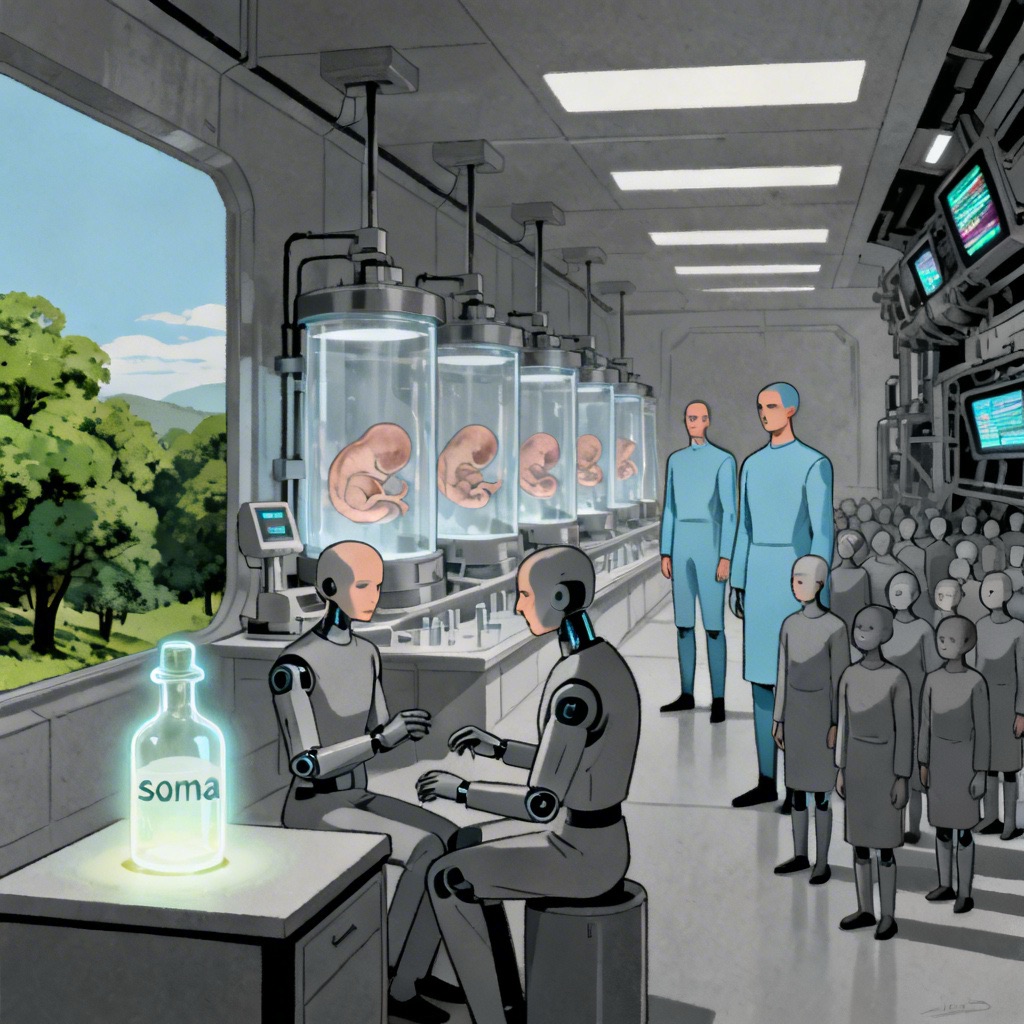
    Biological Engineering eliminates genetic inequality through controlled reproduction in “Hatcheries and Conditioning Centres.” Children are no longer born but manufactured, with their intelligence and physical capabilities predetermined by their assigned caste.

    Pavlovian Conditioning shapes behavior from infancy, ensuring each person finds satisfaction in their predetermined role. Delta and Epsilon children are conditioned to hate books and nature, while Alphas are trained for leadership — creating a society where oppression feels natural.

    Soma Distribution provides chemical happiness on demand. This miracle drug offers all the benefits of alcohol, narcotics, and antidepressants without hangovers, addiction, or side effects. Why suffer when relief is just a pill away?

    Sexual Liberation replaces love and family bonds with casual encounters, preventing the deep emotional attachments that might challenge state authority. The mantra “everyone belongs to everyone else” ensures no citizen develops loyalty to anyone but the state.On the surface, this world has achieved what every society claims to want: no war, no poverty, no suffering, no unfulfilled desires. Yet Huxley reveals this paradise as profoundly hollow.

    The Savage’s Mirror: What We Lose in Paradise.

    John the Savage serves as the novel’s moral center and our window into what the World State has sacrificed for its stability. Raised on Shakespeare and traditional human values on the Reservation, John embodies everything the World State has eliminated: passion, moral struggle, spiritual yearning, and the capacity for both profound joy and devastating sorrow.

    The Conflict Between Comfort and Truth.

    When John encounters World State civilisation, his horror isn’t directed at obvious evils but at the absence of meaning itself. He’s repulsed not by cruelty but by the casual indifference to beauty, truth, and human dignity. In his famous exchange with World Controller Mustapha Mond, John articulates the novel’s central theme:

    – John demands the right to be unhappy, to struggle, to face real danger.

    – Mond responds that such desires are antisocial and unnecessary in a world that can provide easy satisfaction.

    This conversation reveals Huxley’s crucial insight: a society that eliminates suffering also eliminates the conditions necessary for human growth, creativity, and genuine fulfillment.**

    Love vs. Conditioning.

    John’s relationship with Lenina crystallizes this conflict. His passionate, romantic love — shaped by Shakespeare’s sonnets — collides with her conditioned casual sexuality. Neither can understand the other:

    – John seeks transcendent connection, viewing sexuality as sacred when combined with love.

    – Lenina finds his intensity confusing and unnecessary, having been conditioned to view emotional attachment as unhealthy.

    Their tragic inability to connect represents the broader gulf between authentic human nature and engineered satisfaction.

    Huxley’s Prophetic Warnings.

    Writing in 1932, Huxley anticipated developments that wouldn’t fully emerge for decades. His warnings prove remarkably prescient:### The Tyranny of Pleasure Unlike Orwell’s 1984, where citizens are controlled through fear and pain, Brave New World presents a more seductive form of control. The World State doesn’t need to threaten its citizens — it simply makes them too comfortable to rebel.

    Modern parallels include:

    – Social media platforms designed to provide endless, easy gratification.

    – Consumer culture that promises happiness through material acquisition.

    – Pharmaceutical solutions for emotional and spiritual problems.

    – Entertainment that distracts from deeper questions about meaning and purpose.

    The Standardisation of Humanity.

    The World State’s caste system represents an extreme version of social engineering, but Huxley’s real concern is the broader tendency to treat humans as interchangeable units rather than unique individuals.

    Contemporary echoes appear in:

    – Educational systems focused on standardised testing rather than individual growth.

    – Economic policies that prioritize efficiency over human flourishing.

    – Technology that reduces complex human needs to data points and algorithms.

    The Elimination of Difficult Beauty.

    Perhaps most tragically, the World State has eliminated art, religion, and philosophy — anything that might disturb its citizens’ contentment. Beauty exists only in sanitised, consumable forms.

    Today’s version might include:

    – Art reduced to viral content optimised for engagement.

    – Spiritual practices repackaged as wellness trends.

    – Literature and philosophy marginalized in favor of immediately practical information.

    The Price of Paradise.

    John’s suicide represents the novel’s darkest conclusion: that authentic humanity cannot survive in a world designed to eliminate suffering. His death poses uncomfortable questions:

    Is struggle necessary for human fulfillment? The World State’s citizens appear happy, but their satisfaction seems shallow compared to John’s capacity for both ecstasy and agony.

    Can technology solve human problems without destroying human nature?

    Every technological solution in the World State comes with the hidden cost of diminishing some essential aspect of humanity.What happens when comfort becomes more important than truth? The citizens live in a carefully constructed illusion, protected from reality’s sharp edges but also cut off from its genuine beauty.

    Lessons for Our Time.

    Huxley’s vision feels increasingly relevant as we grapple with similar questions about technology, pleasure, and control. His novel suggests several crucial principles:

    Preserve Space for Difficulty.

    A truly human society must allow room for struggle, failure, and growth. Easy solutions to complex problems often eliminate opportunities for character development and genuine achievement.

    Value Individual Uniqueness.

    Efficiency and equality are worthy goals, but not at the cost of individual personality, creativity, and moral agency. Systems that treat people as interchangeable units ultimately dehumanise everyone.

    Choose Meaningful Over Comfortable.

    The novel argues that meaning matters more than happiness — that a difficult life pursuing truth and beauty surpasses an easy life of shallow pleasure.

    Question Technological Solutions.

    Every technological advance should be evaluated not just for its benefits but for its hidden costs to human flourishing. What aspects of humanity might we lose in exchange for convenience or comfort?

    Conclusion: The Enduring Challenge.

    Brave New World doesn’t offer easy answers, but it poses essential questions that each generation must answer anew. In our age of social media, artificial intelligence, and biotechnology, Huxley’s warnings feel prophetic rather than fantastical.

    The novel’s lasting power lies not in its specific predictions but in its fundamental insight: the greatest threats to human dignity often come disguised as benefits. A society that promises to solve all problems, eliminate all suffering, and provide all pleasures may inadvertently eliminate the struggles that make us most human.

    John the Savage’s tragic fate reminds us that the choice between comfort and authenticity, between easy happiness and meaningful existence, remains as relevant today as it was in 1932. The question isn’t whether we’ll face this choice — it’s whether we’ll have the courage to choose wisely when we do.

    As Huxley himself might say, the price of true humanity may be the willingness to embrace both the beauty and the terror of being genuinely alive.

    When we introspect, it is quite evident that all these magnificent and exemplary authors had such prophetic vision and extraordinary power of imagination.

  • 1984 in 2026: Why Orwell’s Dystopian Masterpiece Feels More Relevant Than Ever.

    1984 in 2026: Why Orwell’s Dystopian Masterpiece Feels More Relevant Than Ever.

    I had first read this novel in the Year 1985 as part of my English Literature curriculum while doing B.A.(Honours), Even though the Author had long departed from this World by then. He was born on June 25, 1903, as Eric Arthur Blair in Motihari, Bihar, India and departed from this World  at the age of 46 on January 21, 1950. However, George Orwell’s prophetic novel continues to haunt readers with its chilling parallels to our digital age.

    The Timeless Terror of Total Control.

    Nearly 77 years after its publication, 1984 remains the gold standard of dystopian fiction—not because it predicted flying cars or robot servants, but because it understood something far more sinister: the human hunger for power and the terrifying efficiency with which technology can serve that hunger.

    Winston Smith’s world of tele-screens, doublethink, and the ever-watching Big Brother no longer feels like distant science fiction. In our age of smartphones that listen, algorithms that predict our behavior, and social media platforms that shape our reality, Orwell’s nightmare feels uncomfortably close to our daily experience.

    Big Brother Has Gone Digital.

    The Modern Surveillance State.

    Where Orwell imagined tele-screens monitoring citizens, we carry sophisticated tracking devices in our pockets willingly. Our smartphones know where we go, what we search, whom we call, and even how we sleep. Smart home devices listen for wake words but capture conversations. Ring doorbells triggers neighbourhood surveillance networks. Location data, browsing history, and purchase patterns paint intimate portraits of our lives.

    The chilling parallel: In 1984, citizens couldn’t escape surveillance. Today, we pay for the privilege.

    Social Media and the Ministry of Truth.

    The novel’s Ministry of Truth, which constantly rewrites history to align with the Party’s current narrative, finds its echo in our digital information ecosystem:

    – Algorithm-curated reality: Social media platforms create personalised information bubbles, showing us content that confirms our existing beliefs.

    – Memory holes go digital: Information disappears from the internet, links break, and digital record scan be altered without trace.

    – Deepfakes and disinformation: Technology now makes it possible to fabricate convincing video and audio evidence.

    – Real-time narrative control: Trending topics and viral content can be manipulated to shape public discourse within hours.

    Newspeak in the Age of Character Limits

    Orwell’s concept of Newspeak—a simplified language designed to limit thought—has evolved in fascinating ways:

    Digital Newspeak

    Character limits on social platforms encourage oversimplification of complex issues.

    Hashtag activism reduces nuanced political movements to memorable slogans

    Corporate euphemisms transform surveillance into “personalised experiences” and manipulation into “engagement optimisation”

    Political doublespeak thrives in an era of “alternative facts” and “post-truth” politics.

    The Weaponization of Language

    Just as the Party in 1984 redefined words to control thought, we see modern examples everywhere:

    – “Enhanced interrogation” instead of torture.

    – “Revenue enhancement” instead of tax increases.

    – “Collateral damage” instead of civilian casualties.

    – “Content moderation” instead of censorship.

    Thought crime in the Digital Age

    Cancel Culture and Social Conformity

    Winston’s fear of committing thoughtcrime—having unauthorized thoughts—resonates in our era of:

    Public shaming campaigns that can destroy careers over past statements.

    Self-censorship on social media for fear of backlash.

    Ideological purity tests that mirror the Party’s demand for absolute loyalty.

    Digital mobs that function like Orwell’s Two Minutes Hate, directing collective rage at designated targets.

    The Erosion of Private Thought

    The novel’s most terrifying achievement was breaking Winston’s inner resistance. Today, we see similar psychological manipulation through:

    – Dopamine-driven design in apps that hijack our attention and decision-making- Echo chambers that make us believe our views are universally shared.

    Micro-targeting that exploits our psychological vulnerabilities for political and commercial gain.

    Parasocial relationships with influencers and media figures that shape our identity.

    The Ministry of Love: Modern Reprogramming.

    Winston’s torture and reprogramming in Room 101 seems extreme, but consider these modern parallels:

    Digital Behavior Modification

    Social credit systems (already implemented in some countries) that reward compliance and punish dissent.

    Predictive policing algorithms that can flag “pre-crime” behaviour.

    Therapeutic approaches to “de-radicalization” that sometimes function as ideological reprogramming.

    Corporate wellness programs that monitor and modify employee behavior.

    Those Haunting Quotes, Revisited

    Who controls the past controls the future. Who controls the present controls the past.

    In our digital age, this takes on new meaning. Google’s search results shape what information we can access about history. Social media platforms can suppress or amplify certain narratives. Whoever controls the algorithms increasingly controls our understanding of both past and present events.

    The best books… are those that tell you what you know already.”

    This perfectly describes our current media consumption habits. We gravitate toward content that confirms our existing beliefs, creating information silos that make genuine dialogue increasingly difficult.

    Power is in tearing human minds to pieces and putting them together again in new shapes of your own choosing.”

    Modern marketing, political campaigning, and social media manipulation operate on exactly this principle:

    —breaking down our cognitive defences and rebuilding our preferences, opinions, and behaviours according to external agendas.

    Why 1984 Remains Essential Reading.

    A Mirror to Our Present.

    The genius of 1984 isn’t that it predicted specific technologies, but that it understood the fundamental dynamics of power, control, and human psychology. Every generation finds new relevance in Orwell’s warnings because the human impulses he described—the desire to control others, the tendency to conform, the fragility of truth—remain constant.

    A Vaccination Against Tyranny.

    Reading 1984 annually serves as a form of intellectual inoculation. It trains us to recognise the early signs of authoritarian thinking, whether in politics, corporate culture, or social movements. It reminds us that freedom requires constant vigilance and that the most dangerous oppression often comes disguised as protection or progress.

    The Power of Awareness.

    Perhaps the most hopeful message in 1984 is that awareness itself is a form of resistance. Winston’s initial rebellion began with the simple act of recognizing that something was wrong. In our current moment, reading Orwell with fresh eyes helps us identify which aspects of our digital dystopia we’ve unconsciously accepted as normal.

    The Enduring Nightmare.

    1984 continues to terrify because it shows us that the greatest threats to human freedom don’t always come with jackboots and uniforms. Sometimes they arrive wrapped in convenience, entertainment, and the promise of safety. They seduce us with personalised experiences and targeted content. They make surveillance feel like service and manipulation feel like engagement.

    Winston Smith’s story reminds us that the price of freedom is eternal vigilance—not just against obvious tyranny, but against the subtle erosion of our capacity for independent thought. In an age where our attention is the ultimate battleground, 1984 remains our most powerful weapon: a book that insists we stay awake, stay critical, and never stop questioning who benefits when we stop thinking for ourselves.

    The future isn’t watching us. We’re watching it create itself, one click, one swipe, one surrendered privacy setting at a time.

    Why read it again this year? Because in a world where reality itself has become contested territory, we need all the help we can get in remembering what truth looks like—and what we lose when we stop fighting for it.

  • Breaking Free: How to Reclaim Your Life from Social Media and Smartphone Addiction.

    Breaking Free: How to Reclaim Your Life from Social Media and Smartphone Addiction.

    In an era where the average person checks their phone 96 times per day, we’ve crossed a threshold from digital convenience to digital dependency. What started as tools to enhance our lives has become invisible chains that bind our attention, fragment our focus, and quietly erode our mental well-being.

    The Hidden Epidemic: Understanding Digital Addiction.

    What Social Media and Smartphone Addiction Really Looks Like Digital addiction isn’t just about spending “too much time” on your phone. It’s a complex behavioural pattern characterised by:

    Compulsive checking even when you know there won’t be new notifications.

    Phantom vibration syndrome – feeling your phone buzz when it hasn’t.

    FOMO (Fear of Missing Out) driving constant social media scrolling.

    Withdrawal anxiety when separated from your device.

    Sleep disruption from late-night scrolling or blue light exposure.

    Decreased face-to-face social skills and preference for digital interaction.

    How many of the above points resonates with you?

    This addiction operates on the same dopamine reward pathways as gambling, creating a cycle where each notification, like, or comment triggers a small hit of pleasure that keeps us coming back for more. We post something and then keep coming back to check the status. We even have the notifications on and every ping distracts us to divert our attention.

    I grew up in an era when there were no Mobile Phones. Yet we survived and had better more meaningful relations with our friends & family. If we had to meet someone a physical visit was the only means or a voice call via telephone. All that has changed. Now all we do is use the “convenience” of the Smart Phone. Every Birthday wish, every anniversary greetings and any other activity was a meet and greet affair.

    How Digital Addiction Is Rewiring Our Brains.

    The Neuroscience Behind the Compulsion.

    Social media platforms and smartphones are engineered using principles from behavioral psychology to maximize engagement – a euphemism for addiction. Here’s what happens in your brain:

    1. Dopamine hijacking: Each notification triggers dopamine release, the same neurotransmitter involved in substance addiction.

    2. Attention residue: Task-switching between phone and real life leaves cognitive “residue” that impairs focus.

    3. Shortened attention spans: Constant stimulation rewires neural pathways, making sustained concentration increasingly difficult.

    4. Social comparison overdrive: Endless exposure to curated content triggers unhealthy social comparison and inadequacy feelings.

    The Immediate Impact on Daily Life.

    Productivity Destruction:

    – Average knowledge worker checks email every 6 minutes.

    – It takes 23 minutes to fully refocus after a digital interruption.

    – Multitasking with devices reduces work quality by up to 40%.

    Relationship Erosion:

    – “Phubbing” (phone snubbing) damages intimate relationships.

    – Decreased empathy from reduced face-to-face interaction.

    – Family dinners interrupted by devices become disconnected experiences.

    Mental Health Deterioration:

    – Increased anxiety, depression, and loneliness despite being more “connected”.

    – Sleep disorders from blue light and late-night scrolling.

    – Decision fatigue from information overload.

    The Long-Term Consequences: What We’re Really Risking.

    Cognitive and Neurological Effects.

    Attention Deficit Normalisation:

    Years of rapid context-switching train your brain to crave constant stimulation. This leads to:

    – Difficulty with deep reading and complex thinking.

    – Increased distractibility that persists even when devices are absent.

    – Reduced capacity for boredom – a crucial state for creativity and reflection.

    Memory Formation Disruption:

    – External digital memory reduces internal memory consolidation.

    – “Google effect” where we remember where to find information rather than the information itself.

    – Decreased autobiographical memory formation due to constant documentation vs. experiencing.

    Social and Emotional Development.

    Empathy Erosion:

    – Reduced face-to-face interaction impairs emotional intelligence development.

    – Decreased ability to read non-verbal cues and emotional nuance.

    – Increased tolerance for online cruelty and decreased real-world social skills.

    Identity Fragmentation:

    – Constant curation of online personas disconnects us from authentic self.

    – Validation-seeking becomes external rather than internal.

    – Comparison culture breeds chronic dissatisfaction.

    Physical Health Impacts.

    Postural and Motor Issues:

    – “Text neck” leading to chronic cervical spine problems.

    – Repetitive strain injuries from excessive typing and swiping.

    – Reduced fine motor skills in children who primarily interact through touchscreens.

    Sleep and Circadian Disruption:

    – Blue light exposure disrupts melatonin production.

    – Hyper-vigilance from constant connectivity disrupts parasympathetic nervous system.

    – Chronic sleep deprivation leading to immune system compromise.

    The Path Back to Sanity: A Comprehensive Recovery Plan

    Phase 1: Digital Detox and Awareness Building (Weeks 1-2)

    Immediate Actions:

    1. Conduct a digital audit.

    – Use screen time tracking apps to establish baseline usage.

    – Log emotional states before and after phone use for one week.

    – Identify your most problematic apps and times of day.

    2. Create physical barriers.

    – Remove phones from bedrooms – use analog alarm clocks.

    – Establish “phone parking” areas in your home.

    – Use app timers and website blockers during focused work.

    3. Replace digital habits with analog alternatives.

    – Physical books instead of e-readers.

    – Paper notebooks for thinking and planning.

    – Analog watches to reduce phone checking for time.

    Phase 2: Mindful Reintegration (Weeks 3-6)

    Structured Digital Diet:

    1. Implement the “Phone Fast” schedule-No phones for first 60 minutes after waking.

    – 2-hour digital sunset before bedtime.

    – One full day per week completely offline.

    2. Curate your digital environment.

    – Unfollow accounts that trigger comparison or negativity.

    – Use “dumb” versions of necessary apps (web versions vs. native apps).

    – Remove all apps that don’t serve a specific, intentional purpose.

    3. Practice “Mono-tasking

    – One screen at a time maximum.

    – Complete focus on single activities for 25-minute intervals (Pomodoro Technique).

    – No background audio/video while working or eating.

    Phase 3: Building Analog Resilience (Weeks 7-12).

    Developing Non-Digital Coping Mechanisms:

    1. Cultivation practices.

    – Daily meditation or mindfulness practice (start with 5 minutes).

    – Regular exercise without music/podcasts – embrace movement meditation.

    – Engage in creative hobbies that require sustained attention (drawing, musical instruments, crafting).

    2. Social re-engagement

    – Schedule regular phone calls instead of texting.

    – Organize device-free social activities.

    – Join clubs or classes that require in-person participation.

    3. Intellectual restoration.

    – Read physical books for 30+ minutes daily.

    – Engage with long-form content (documentaries, academic papers, literature).

    – Practice writing by hand to slow thinking and improve retention.

    Advanced Strategies for Long-Term Success.

    Environmental Design.

    Create friction for digital consumption:

    – Keep phones in other rooms during work and meals.

    – Log out of social media accounts after each use.

    – Use grayscale phone settings to reduce visual appeal.

    Design ease for analog activities:

    – Keep books visible and accessible.

    – Have musical instruments or art supplies readily available.

    – Create comfortable spaces for conversation and reflection.

    Social Support Systems.

    Community accountability:

    – Join digital wellness groups or create accountability partnerships.

    – Communicate your goals with family and friends.

    – Reduced compulsive checking behaviors

    – Model healthy behavior for children and peers.

    Professional support when needed:

    – Consider therapy for severe addiction or underlying mental health issues.

    – Explore digital wellness coaching.

    – Participate in group therapy or support groups for technology addiction.

    Technology as Tool, Not Master.

    Intentional technology use:

    – Define specific purposes before picking up devices.

    – Set daily intention for technology use.

    – Regular “digital decluttering” sessions to remove unnecessary apps and accounts.

    What to Expect: The Recovery Timeline.

    Week 1-2: The Withdrawal Phase.

    – Increased anxiety and restlessness.

    – Boredom and feeling “disconnected”.

    – Phantom vibration syndrome.

    – This is normal and temporary.

    Week 3-6: Adaptation Period.

    – Improved sleep quality.

    – Increased attention span during reading.

    – Better presence during conversations.

    Month 2-3: Neuroplasticity Recovery.

    – Significantly improved focus and concentration.

    – Increased creativity and problem-solving ability.

    – Better emotional regulation.

    – Enhanced real-world social connections.

    Month 3+: The New Normal.

    – Technology becomes a tool rather than a compulsion

    – Increased life satisfaction and presence

    – Improved mental health metrics

    – Better physical health and posture

    The Future: Building a Healthier Digital Society.

    Individual Responsibility.

    Your personal journey toward digital wellness isn’t just about your own well-being – it’s about modeling healthy behavior for family, friends, and colleagues. Every person who chooses intentional technology use creates ripple effects in their community.

    Collective Action

    We need broader societal shifts:

    – Education about digital wellness in schools.

    – Workplace policies that respect attention and presence.

    – Technology design that prioritizes user well-being over engagement.

    – Cultural norms that value deep work and present-moment awareness.

    Remember: You Have More Power Than You Think.

    The technology companies have spent billions of dollars and employed teams of neuroscientists and behavioural psychologists to capture your attention. But you have something they don’t: conscious choice and the ability to change.

    Every moment you choose presence over distraction, deep work over shallow browsing, or real connection over digital validation, you’re rewiring your brain toward greater well-being and authentic living.

    The goal isn’t to become a digital hermit – it’s to use technology intentionally, as a tool that serves your highest purposes rather than a master that controls your attention and time.

    Start small. Be patient with yourself. And remember that reclaiming your attention is perhaps the most important act of self-care you can perform in the 21st century.

    Your authentic life is waiting on the other side of that screen. The question isn’t whether you can break free from digital addiction – it’s whether you’re ready to choose presence, depth, and real connection over the illusion of digital fulfilment. It is difficult, but not impossible.


  • You Are the Author of Your Destiny: Why Everything Happens for a Reason—And That Reason Is Your Choices.

    “EVERYTHING HAPPENS FOR A REASON.”

    How many times have you heard this phrase whispered as comfort during difficult moments? How often have you seen it shared on social media as a blanket explanation for life’s unexpected turns? But what if this popular platitude, as commonly understood, is not just wrong—but dangerously disempowering?

    Today, we’re going to challenge everything you think you know about fate, destiny, and personal responsibility. We’re going to explore a radical reinterpretation that places you—not the universe, not God, not cosmic forces—at the center of your life’s narrative.

    The Dangerous Comfort of Cosmic Fatalism.

    Think about the traditional interpretation for a moment. “Everything happens for a reason” typically suggests that all your efforts—personal, professional, emotional—are mere footnotes to some cosmically predetermined set of outcomes. This worldview positions us as passengers on a journey we didn’t choose, heading toward destinations we cannot control.

    Under this framework, we become:

    • Slaves to fate rather than masters of our choices Absolved of responsibility for our failures Robbed of credit for our achievements
    • Victims of circumstances beyond our influence

    This interpretation strips us of agency. It suggests we have no real say in—let alone culpability for—the defining moments of our lives. It’s a philosophy of surrender disguised as wisdom.

    The Revolutionary Inversion: You Are the Reason

    But what if we completely invert this notion? What if we redefine “everything happens for a reason” not as some future cosmic explanation for tragedy or triumph, but as validation of the deliberate choices that led us to these critical junctures in the first place?

    This inversion is revolutionary because it:

    • Places you at the center of your narrative Transforms you from victim to architect Makes every outcome a reflection of your decisions
    • Empowers you to assert authority over chance, fate, and destiny

    Under this framework, everything does happen for a reason. And that reason is you—your choices, your actions, your willingness to take responsibility for the trajectory of your life.

    The Hard Truths About Extraordinary Achievement

    To reach the pinnacle of success, you must be willing to:

    1. Make hard choices when others choose comfort Do unpleasant but necessary things when others avoid discomfort Risk your most valuable assets when others play it safe Question societal expectations that may limit your potential
    2. Resist the uninvited imposition of others’ moral agendas on your goals

    This isn’t about becoming callous or abandoning all human connections. It’s about recognising that extraordinary results require extraordinary commitment—and that such commitment often conflicts with conventional expectations.

    The Sacrifice Principle: Nothing Worthwhile Comes Easy

    Here’s an uncomfortable truth: nothing worthwhile is ever achieved without sacrifice. This isn’t pessimism—it’s reality. Every great achievement in history has required someone to give up something else.

    The question isn’t whether you’ll make sacrifices. The question is whether you’ll make them consciously and strategically, or whether you’ll let life make them for you.

    This doesn’t mean abandoning everything that makes life meaningful. Rather, it means being intentional about what you’re willing to sacrifice and what you consider non-negotiable.

    The Controversy: Challenging Social Expectations

    Perhaps the most controversial aspect of this philosophy is its challenge to traditional social structures and expectations. Society often promotes a one-size-fits-all approach to life: education, career, marriage, children, retirement. But elite achievement often requires questioning these predetermined paths.

    This doesn’t mean these life choices are inherently wrong or that everyone should abandon them. Rather, it means: Questioning whether societal expectations align with your personal mission.

    A Balanced Perspective

    It’s important to note that this philosophy doesn’t advocate for a life devoid of human connection or moral consideration. Instead, it argues for conscious choice-making rather than unconscious conformity.

    Many successful individuals have found ways to achieve excellence while maintaining meaningful relationships and contributing positively to society. The key is being intentional about your choices rather than simply following a prescribed path.

    The question you must ask yourself is: What am I willing to sacrifice for greatness? And more importantly: What am I not willing to sacrifice?

    Your Choice, Your Reason, Your Destiny

    We return to where we began:

    “Everything happens for a reason.”

    But now you understand that the reason isn’t some mysterious cosmic force or predetermined destiny. The reason is you—your choices, your commitments, your willingness to take full responsibility for the direction of your life.

    This perspective is simultaneously liberating and terrifying. It places the full weight of your life’s outcomes squarely on your shoulders. No more blaming circumstances, bad luck, or unfair advantages. No more waiting for the universe to align in your favor.

    Instead, you become the author of your own story. Every chapter, every plot twist, every climactic moment becomes a reflection of your choices and your commitment to your chosen path.

    The Call to Action

    So here’s your choice: You can continue to view yourself as a passenger on life’s journey, hoping that everything will work out for mysterious cosmic reasons. Or you can embrace the radical responsibility of being the architect of your destiny.

    Remember: You are not at the mercy of fate. You are not a victim of circumstances. You are not waiting for permission from the universe to create the life you want.

    You are the reason everything happens in your life. Make sure it’s a reason you can be proud of.

    “The price of greatness is responsibility over every area of your life.”