There’s a quiet myth we all grow up hearing: “You need money to make money.” While that’s partly true, it’s also dangerously incomplete. If wealth were only inherited, the world would never produce new millionaires. Yet every year, thousands of people rise from ordinary backgrounds to build extraordinary financial lives.
What are they doing differently? Let’s break it down—not with clichés, but with real, actionable truths.
1. Trade Survival for Growth
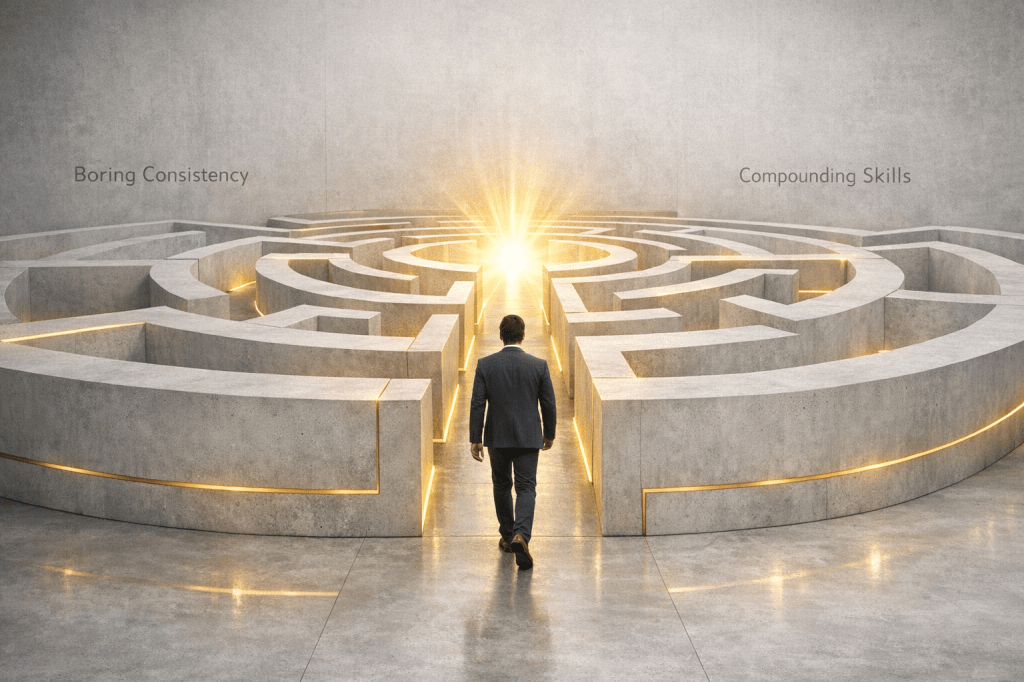
Most people work to pay bills; wealth builders work to buy freedom. Instead of asking, “How can I earn enough this month?” they ask, “How can I increase my value so I earn more every year?” They invest in skills that compound: Writing, Sales, Technology, and Finance. Skills are the only assets no one can take away from you.
2. Systems Over Chasing
Rich people don’t rely on a single income source. They build systems that earn while they sleep:
Digital Assets: Writing online, ebooks, and templates.
Smart Investing: Stocks, ETFs, and SIPs.
The Goal: Turn active income into semi-passive, then fully passive. Even ₹1,000/month is a victory because it proves your system works.
3. The Discipline of the “Boring”
Wealth is not built in a viral moment. It’s built in quiet repetition: writing when nobody is reading, and saving when it feels insignificant. Over 5 years, this “boring” consistency starts to look like “luck” to everyone else.
4. Killing Lifestyle Inflation
This is the silent killer. When most people get a raise, they upgrade their phone. I’ve used the same iPhone for 4 years. While others eat out, I eat out once every two months. By cutting my spending in half, I doubled my ability to invest.
The Truth: Wealth is not what you earn; it’s what you keep and grow.
5. Think in Decades, Not Days
Most people want results in 30 days. Wealthy individuals think in decades. I made the mistake of not investing early, but I’m fixing that now. Compounding requires a “patient” mindset—the goal isn’t just to get rich fast, but to ensure you cannot stay poor.
6. The Power of Leverage
Hard work alone doesn’t create wealth; leverage does. Whether it’s Content Leverage (writing one article that earns for months) or Money Leverage (investments), you must learn to multiply your effort.
The Final Word
You don’t need a rich family or a lucky break. You need a skill, a system, and the belief that it is possible for you. If you are starting from zero, remember: every wealthy person you admire once had no audience and no shortcuts.
They just didn’t stop. And that is the only advantage that truly compounds.
I don’t have time.” It’s the phrase that slips out of our mouths like a reflex.
It’s the universal apology for missed calls, unread books, and distant hearts. But if we look at the math of modern life, the statement isn’t just sad—it’s factually impossible.
The Paradox of Speed.
Once, a journey took 12 hours. Today, it takes four. We “gained” 8 hours. Where did that go?
Once, news took four days to cross the country. Now, it takes four seconds. We “gained” days. Where did that go?
We live in a world where the world’s knowledge, your bank, and your family’s faces are in your pocket. We should be the most relaxed generation in history. Instead, we are the most breathless.
The Mental Trap We’ve traded warmth for WiFi. We live with two people under a roof instead of ten, yet the house feels quieter and the connection feels thinner. We watch mimicry, endless reels, and digital noise while the person sitting next to us waits for a glance. We ride bikes while on the phone. We scroll through WhatsApp at traffic lights. We cut lines because we “can’t wait.” We have become addicts of the shortcut, yet we never seem to arrive at a place of peace.
The Mirror Test. Our parents had the same 24 hours. They didn’t have apps, high-speed rail, or instant grocery delivery. Yet, they lived with grace. They had time for tea, for neighbours, and for silence. We don’t “lack” time. We abuse it. We give our hours to IPL matches, celebrity gossip, and political debates, then claim we are too busy to listen to a friend or hug our children.
The Wake-Up Call. I wrote these words because I made time. I stopped chasing the clock and started honouring it. Before you close this tab and say, “I don’t have time to think about this,” pause. Are you actually busy, or are you just distracted? The clock isn’t your enemy—your choices are. Stop chasing time. Start respecting it.
Reflection: Do not say you do not have time. Value it.
You have read the theory. You have understood the points. Now it comes down to this: twenty-one days of showing up for your own body. Not perfectly. Just consistently.Why 21 Days?
The popular notion that habits form in twenty-one days is, strictly speaking, an oversimplification. Research on habit formation suggests that the timeline varies widely — anywhere from eighteen to sixty-six days depending on the complexity of the behaviour and the individual. But twenty-one days is not arbitrary. It represents three complete biological cycles of several key systems: the gut lining renews itself every three to five days (so twenty-one days is four to seven full cycles), and many hormonal rhythms operate on seven-day patterns.
More practically: twenty-one days is long enough to produce measurable change and short enough to feel achievable. It is a commitment you can make without it feeling like forever. And the changes you will notice by Day 21 — if the practice is consistent — are real enough that continuing becomes its own motivation.
This post is your complete map. Morning routine, evening routine, crisis protocol for acute stress moments, the dietary framework, and the sleep hygiene protocol. Everything from Posts 1, 2, and 3 comes together here into a single, coherent daily practice. You do not need all of it at once. Start with what feels most accessible, and build.
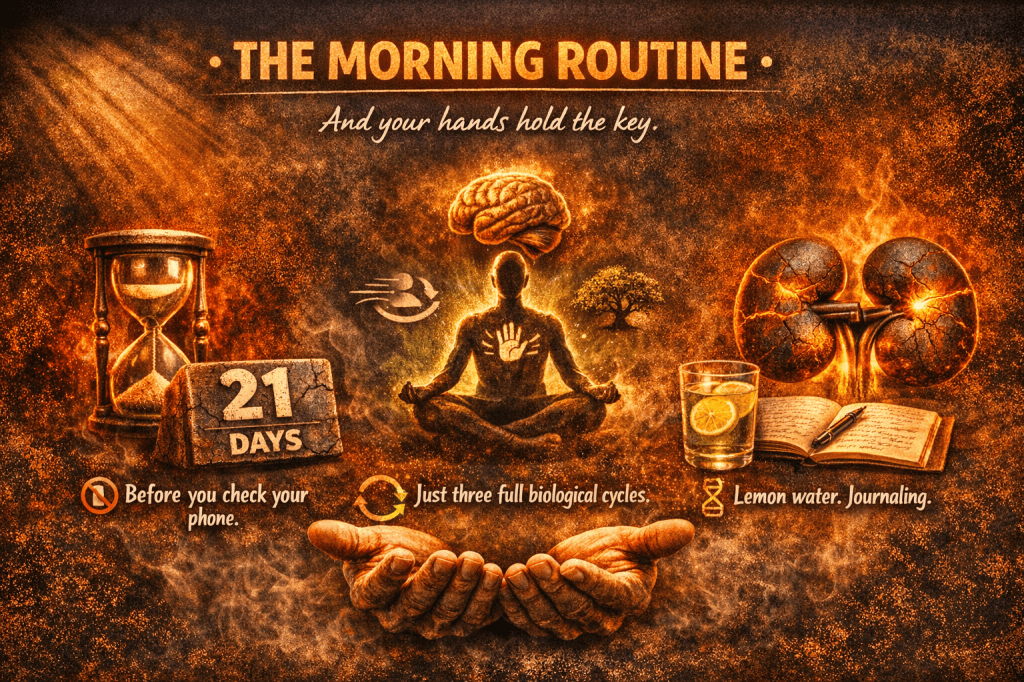
The Morning Routine – Before You Check Your Phone.
This is the most important instruction in the entire series: do the morning practice before you look at your phone. The moment you check your phone, your nervous system receives input — news, messages, social media, notifications — that begins the sympathetic activation cycle. Once that cycle starts, you are already managing its consequences rather than preventing them. Give your nervous system twenty-one minutes of its own signal before you give it the world’s.
The Full Morning Sequence — 21 Minutes
1. Wake without reaching for your phone. Lie still for one minute. Notice your body.
2. Three rounds of 4-7-8 breathing: In 4, hold 7, out 8. Vagus nerve activated.
4. HT 7 + PC 6 on both wrists: 2 minutes simultaneously. The emotional anchors.
5. KD 1 (soles, both feet): 2 minutes. Grounding before you stand up.
6. LV 3 (between toes 1 and 2): 90 seconds each foot. Releasing the night’s holding.
7. Warm water with lemon: before any food, before any caffeine. Sit while drinking it.
8. Three minutes of journalling: one question only — ‘What is within my control today?’
Total: 21 minutes. This is not self-indulgence. It is the most productive thing you will do all day.
Everything that follows in the next sixteen waking hours will be qualitatively different.
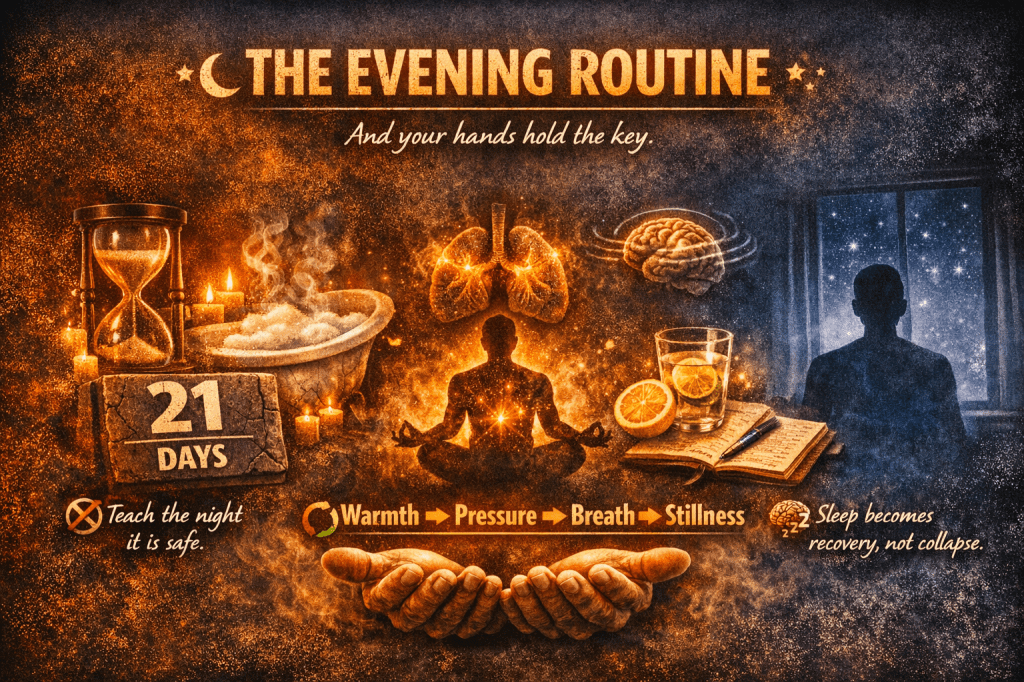
The Evening Routine – Teaching the Night it is Safe.
The Evening Routine — Teaching the Night It Is Safe
The evening practice has one job: to send the nervous system a clear, consistent signal that the day is over and safety has arrived. This signal is not just psychological — it is physiological, and it requires physical inputs to be received. The sequence below provides those inputs in the correct order: sensory input reduction first, then warming, then acupressure, then breath, then stillness.
The Full Evening Sequence — Last 25 Minutes Before Sleep
1. Screens off or night mode: hard stop on news, social media, anything requiring decisions.
2. Warm shower or hot foot soak: temperature drop after warmth triggers sleep hormones.
3. GB 21 + BL 10: shoulder summit and skull base release — where the day’s stress is stored.
4. SP 6 + KD 1: inner ankle and soles — the deepest calming points in the lower body.
5. Yintang + CV 17: third eye and heart centre — quieting the mind and the emotional body.
6. 4-7-8 breath, five rounds: lying down, eyes closed. This is the final physiological signal.
7. Three things you are grateful for: not performance — genuine noticing. The brain records safety.
8. Sleep — the nervous system in genuine rest mode, not collapsed exhaustion.
This sequence, practiced for seven consecutive nights, will change the quality of your sleep.
After twenty-one nights, it will have changed your relationship with the night entirely.
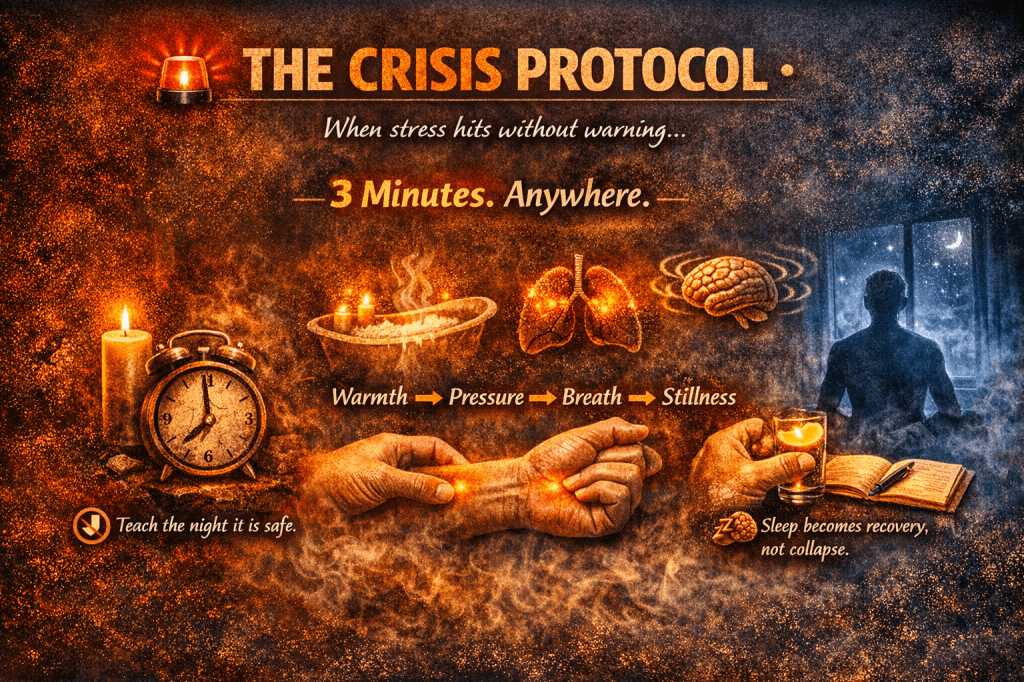
The Crisis Protocol – For When Stress Hits Without Warning.
The Crisis Protocol — For When Stress Hits Without Warning
The daily practice addresses chronic stress. But acute stress — the sudden confrontation, the unexpected bad news, the panic that arrives without warning — needs its own protocol. The three-minute sequence below is designed to be used anywhere, invisibly, at the moment stress arrives rather than hours later.
The 3-Minute Crisis Protocol
STEP 1 — 30 seconds: Two rounds of 4-7-8 breath. Eyes can stay open. Nobody needs to know.
STEP 2 — 45 seconds: One finger pressed firmly on Yintang (between eyebrows). Eyes closed if possible.
STEP 3 — 45 seconds: HT 7 + PC 6 on both wrists simultaneously. Breathe into the pressure.
STEP 4 — 30 seconds: LI 4 (web of thumb): firm pinch, both hands. Exhale with the pressure.
STEP 5 — 30 seconds: Return to breath. 4 counts in, 6 counts out. Return to presence.
Use this in the car, in a meeting break, in a bathroom, before a difficult conversation.
Cortisol measurably drops within three minutes of vagal activation. This protocol delivers it.
The 21-Day Dietary Framework.
Daily Foundations (Non-Negotiable)
Warm water with lemon: First thing, before anything else. Every single morning.
One serving fermented food: Curd, kefir, kanji, kimchi, or buttermilk. Non-negotiable for the gut-brain axis.
Handful of walnuts or pumpkin seeds: Omega-3 and magnesium in one small handful. Morning snack.
Two Brazil nuts: Daily selenium for thyroid hormone conversion. Two only — more is unnecessary and counterproductive.
One tablespoon ground flaxseed: In porridge, smoothie, or curd. Omega-3, lignans, and prebiotic fibre.
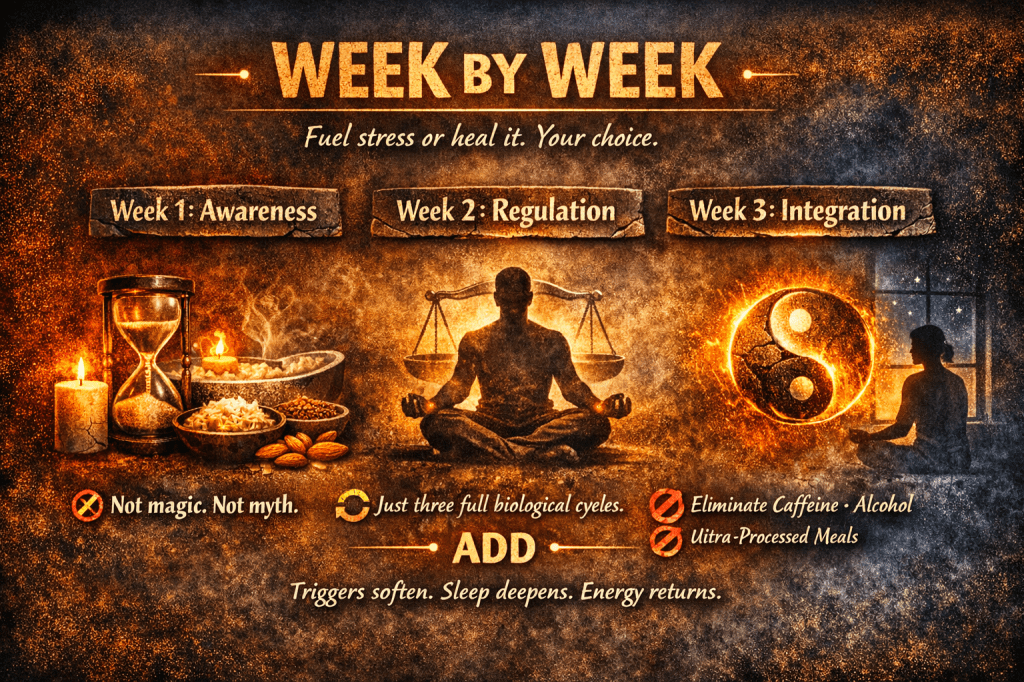
This Week, Eliminate These (One at a Time):
Week 1: No caffeine after 1pm. This single change will shift sleep quality faster than almost anything else.
Week 2: No alcohol on weekdays. Alcohol is a cortisol trigger and a sleep architecture disruptor — two things you cannot afford during a stress reset.
Week 3: Replace one ultra-processed meal per day with something whole. Not perfection — one meal. The compounded effect of three weeks of this is measurable in inflammatory markers.
What to Add (One at a Time):
Week 1: Ashwagandha root extract (300mg) with dinner. The most evidence-supported adaptogen for cortisol reduction.
Week 2: Magnesium glycinate (200-400mg) before sleep. Research consistently shows improvement in both sleep quality and stress response.
Week 3: One meal eaten in complete silence, without a screen. The nervous system needs to experience food as safe, not as background to stimulation.
Week by Week – What to Watch For.
Change with stress does not arrive in a straight line. There are days in Week 1 when you will feel more tired than before — that is the parasympathetic system finally getting enough space to process what has accumulated. This is not failure. It is the beginning of genuine recovery. Here is a more detailed map of what each week brings:
Days 1 to 7 — The Awareness Week
The most important thing that happens in Week 1 is not physical improvement — it is the beginning of awareness. You start to notice when your shoulders tighten.
You catch yourself holding your breath. You feel the difference between the morning of Day 7 and the morning of Day 1 — and the difference, while not dramatic, is real. The points will be tender, particularly KD 1, HT 7, and GB 21. Tender means engaged. Stay with it.
Sleep will likely show the first changes: not necessarily that you sleep more, but that the quality of the sleep you do get deepens. The 4-7-8 breath paired with the evening points is usually responsible for this. Some people notice it from Night 3 onward.
Days 8 to 14 — The Regulation Week
By Day 8, the practice is beginning to feel less like a task and more like a ritual. The nervous system has now received fourteen days of consistent parasympathetic input — enough to begin establishing a new pattern. Cortisol output starts to regulate more predictably. The morning spike that launches many stressed people into reactivity before they have even had breakfast begins to soften.
Point tenderness decreases measurably. HT 7 in particular — which is often exquisitely tender in the first week — becomes more comfortable under pressure.
This is a direct indicator of reduced cardiac stress load. BL 23 (lower back kidney point) tenderness also reduces, reflecting adrenal recovery. Track these changes — they are your body’s own progress report.
Days 15 to 21 — The Integration Week
This is where the shift becomes qualitative, not just quantitative. People in Week 3 of this practice consistently report the same cluster of observations: things that would have triggered a stress response two weeks ago now feel manageable.
The internal distance between stimulus and response has grown. This is not detachment — it is regulation. The nervous system, given consistent signalling, has recalibrated its threat threshold.
Physically: resting heart rate has typically dropped several beats per minute. Blood pressure, if it was elevated, shows improvement. Digestion has normalised — the gut responds rapidly to nervous system regulation. Skin, if stress was affecting it, begins to clear. Energy — not the jittery energy of cortisol, but the sustained, even energy of a body that is genuinely resting and genuinely working in turn — returns.
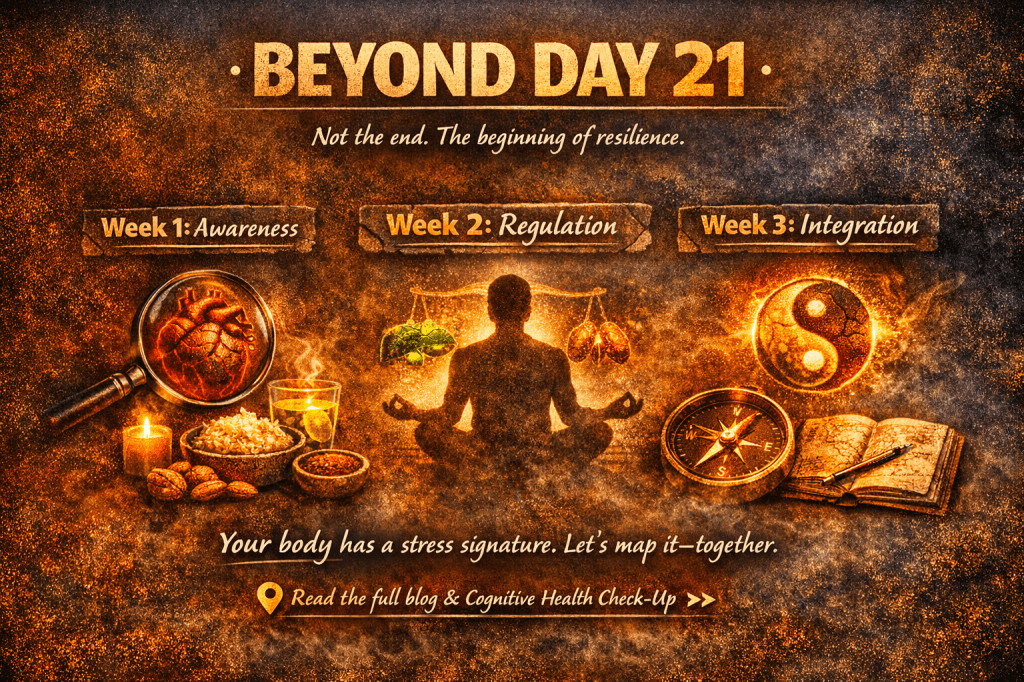
Beyond Day 21 – Making it Yours.
Beyond Day 21 — Making It Yours
Twenty-one days is the beginning, not the destination. Once the practice is established — once it has become as automatic as brushing your teeth — the question becomes: how do you deepen it? How do you move from stress management to genuine stress resilience?
The answer, in my experience, is personalisation. The sequences in this series are designed to be broadly effective for most people. But your body has a specific stress signature — particular points that are more relevant to you than others, particular times of day when you are most vulnerable, particular organ systems that carry the heaviest load. A personalised protocol, built around your specific pattern, is significantly more efficient than a general one.
That is what I offer in a consultation — not a replacement for this series, but a deepening of it. If you have done the twenty-one days and want to go further, I can help you read what your body is showing us and design the next stage of your practice with precision.
Ready to Go Deeper?
Book a personalized consultation to map your stress-organ pattern and build your protocol.
In Association with World Health Journey Take your Cognitive Health Check-Up: www.whjonline.com/mmpi-2
Series Complete – The Heal Yourself First series continues daily.
Your body has been keeping a very detailed record of everything you have been through. It is written in your organs. Time to read it — and respond.
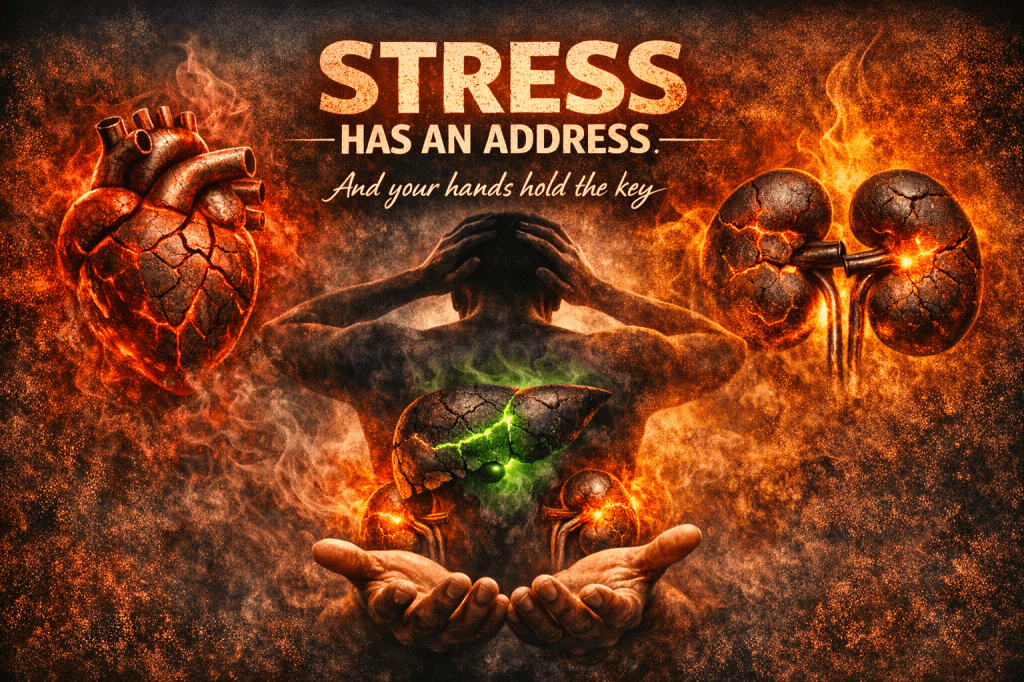
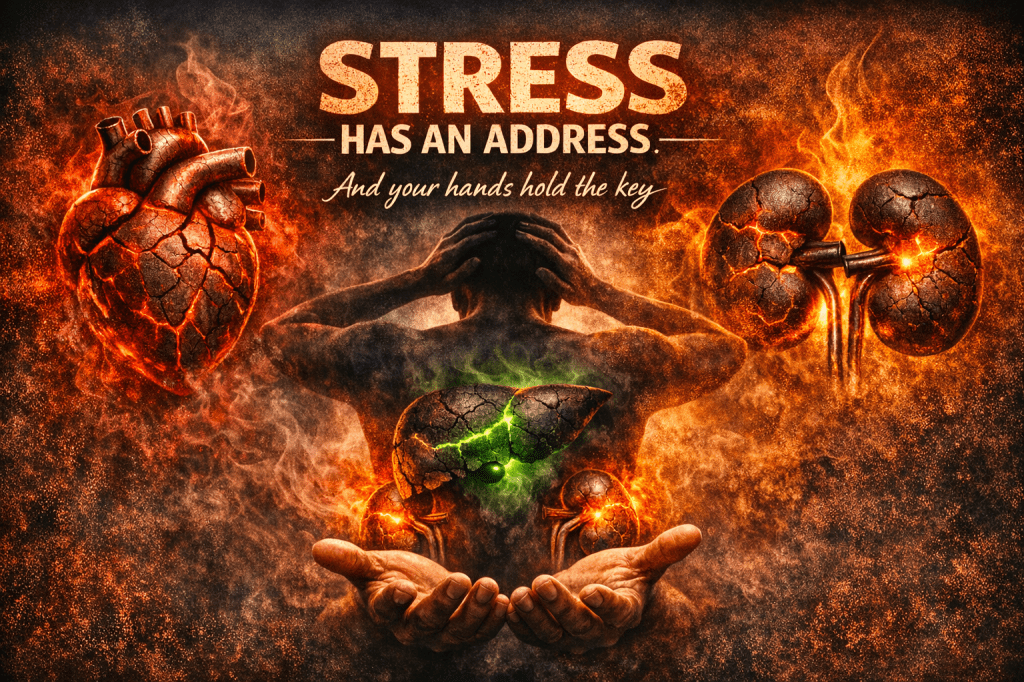
There is a reason this phrase has become famous in the world of trauma and stress research. The body does not experience stress as an abstract event that happens to the mind. It experiences it as a physical event that happens to tissue, glands, organs, and cells. And over time, the tissue remembers.
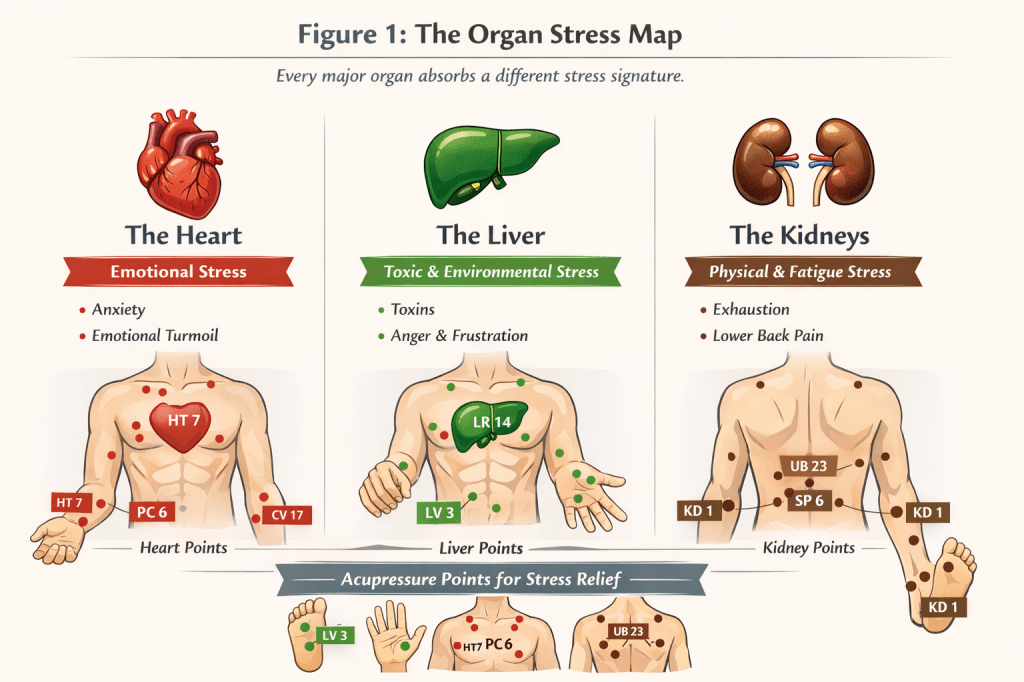
In traditional Chinese Medicine, this understanding is thousands of years old — and expressed with elegant precision. Each major organ is associated not just with a physiological function but with an emotional domain. The heart with joy and its absence. The liver with smooth flow and, when disrupted, with anger and frustration. The kidneys with the capacity to face life without fear. The lungs with the ability to take in and let go — breath by breath. When stress persists, these emotional-organ relationships become sites of accumulation. The organ that carries the load eventually shows it.
Today’s post maps exactly where your specific stress pattern might be living — and gives you a targeted acupressure protocol for each organ system. You will likely recognise your own pattern before you finish reading.
The Heart — When Stress Becomes a Feeling You Cannot Name
The Chinese medical classics describe the Heart as the emperor of all organs — the one that must remain calm and clear for all the others to function. When stress is relentless and the Heart is disturbed, the first sign is rarely physical. It is the inability to feel settled. The sense that something is wrong even when nothing specific is wrong. The racing thoughts at night. The disproportionate emotional response to small things. These are signs that the Heart’s Shen — its governing spirit and consciousness — is disturbed.
Physically, the heart under stress shows up as palpitations, elevated resting heart rate, blood pressure that is persistently high even when you are trying to rest, and a strange kind of chest tightness that comes and goes without a clear cause. Long-term, the cardiovascular consequences of unresolved stress are among the most serious and well-documented in medicine.
Heart Protocol
CV 17 (sternum centre): 2 minutes, sustained and gentle, with slow breath
BL 15 (back, level with heart): Tennis ball or partner press, 90 seconds, eyes closed
HT 7 (wrist crease, Spirit Gate): 2 minutes, press steadily while breathing out slowly
PC 6 (inner wrist, 2.5 fingers up): 90 seconds each wrist — the Heart’s protector point
Lifestyle addition: One tablespoon of raw honey in warm water each morning has been used across traditional medicine systems to support the heart and calm the spirit. Add a small pinch of cardamom — a heart-supportive spice with documented vasodilatory properties.
The Liver — Where Frustration Goes to Live
Of all the organ-stress relationships in Chinese medicine, the Liver-stress connection is perhaps the most immediately recognisable to a modern audience. When the Liver qi is constrained — when the smooth flow of energy through the body is blocked — the emotional signature is unmistakable: irritability that arrives before you have even had time to think, a short fuse that surprises even you, the feeling of things being stuck or obstructed, tension in the sides of the body and the ribcage.
Sound familiar? For most people living with chronic stress, the liver meridian is involved. And the physical consequences of long-term liver qi stagnation are not trivial: disrupted hormone metabolism, impaired detoxification, elevated inflammatory markers, digestive disturbance (the liver and the digestive system are intimately linked), and increasingly, research connecting liver health to mood disorders in ways that blur the traditional line between ‘physical’ and ‘mental’ health.
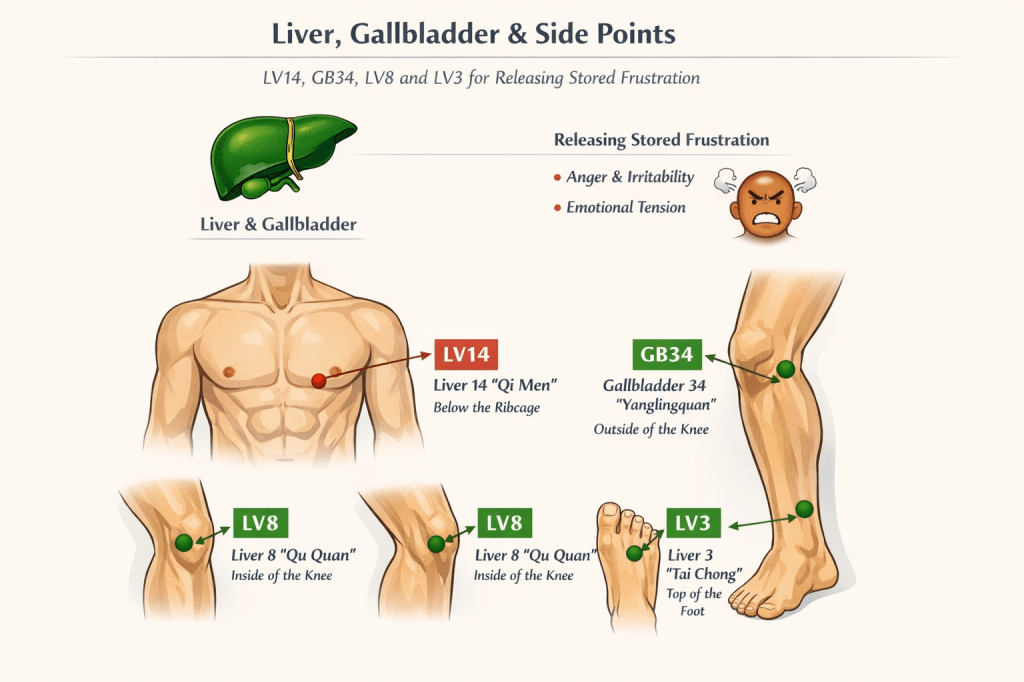
Liver Protocol
LV 3 (between first and second toes): The liver’s primary release valve — 90 seconds each foot, firm press, breathe through the tenderness
LV 14 (below breast, 6th intercostal): 90 seconds each side — the liver’s alarm point on the chest, often exquisitely tender
GB 34 (below outer knee): Influential point of the sinews — releases muscle tension from stress and frustration
LV 8 (inner knee crease): Nourishes liver blood — important for those with fatigue and emotional volatility from long-term stress
Lifestyle addition: The liver performs most of its detoxification work between 1am and 3am — which is exactly when stressed individuals with liver qi stagnation tend to wake. Going to bed by 11pm, drinking warm lemon water on waking, and avoiding alcohol entirely during stressful periods are the three most impactful liver lifestyle choices.
The Kidneys — When Fear Has Been the Background Note for Too Long
In Chinese medicine, the Kidney is the organ of fear and of fundamental vitality. When fear — not acute fright, but the low-grade existential anxiety of modern life, the worry about the future that never fully resolves — becomes chronic, it depletes the Kidney system. What this looks like physiologically is adrenal exhaustion: the state of being tired but unable to rest, depleted but unable to switch off, anxious without a specific cause.
The kidneys govern the bones, the lower back, the knees, the ears, and the hair. Chronic stress-induced kidney depletion shows up as persistent lower back ache, knee weakness, tinnitus, premature greying, and the specific kind of exhaustion that sleep does not fully resolve. If this description feels accurate to you, the kidney protocol below is where to begin.
Kidney Protocol
BL 23 (lower back, L2 level): The Kidney’s back-shu point — tennis ball method, 2 minutes, daily
KD 1 (sole of foot, centre): The grounding point — 2 minutes each foot, morning barefoot is ideal
KD 3 (inner ankle, behind bone): The Kidney’s source point— just behind and below the inner ankle bone; press firmly for 90 seconds each side
GV 4 (Ming Men, between L2-L3): Warm palm or heating pad, 2 minutes — rebuilds the Yang fire the kidneys need
Lifestyle addition: Black sesame seeds, kidney beans, walnuts, and bone broth are the four most kidney-nourishing foods in both Chinese dietary therapy and modern nutritional science. A tablespoon of black sesame daily — ground and added to porridge or smoothies — is one of the simplest kidney-supportive habits there is. Reduce salt intake: chronically high sodium places direct strain on the kidney’s filtration function.
The Lungs — Carrying Grief and the Inability to Let Go
The lungs govern not just breathing but, in Chinese medicine, the rhythm of taking in and letting go that applies as much to experiences, relationships, and emotions as it does to air. Grief — unprocessed loss of any kind, including the smaller but cumulative losses of a stressful life: opportunities, time, health, ease — is the emotion that damages the lung system most acutely.
People with lung-dominant stress often present with persistent respiratory symptoms (frequent colds, recurrent chest infections, chronic cough, asthma that worsens under emotional stress), a shallow, high breathing pattern that never quite settles, and a tendency to sigh frequently — which is the lung’s attempt to self-correct the breathing rhythm. They may also experience skin problems, because in Chinese medicine the lungs govern the skin and the body’s exterior.
Lung Protocol
LU 1 (upper chest, below clavicle): Lung’s alarm point — press firmly for 90 seconds, expect tenderness if grief is present
LU 7 (inner wrist, above thumb side): 1.5 finger-widths above the wrist crease on the thumb side — Lung’s command point; 90 seconds each
CV 17 (sternum centre): Opens the chest, deepens breath — 2 minutes with conscious expansion breathing.
Breathing practice: Grief-dominant stress responds particularly well to extended exhale breathing. Breathe in for 4 counts. Breathe out for 8. The longer exhale directly stimulates the vagus nerve and physiologically represents ‘letting go.’ Five minutes of this breathing daily, specifically paired with LU 1 pressure, is a practice of profound emotional as well as physical effect.
The Thyroid — Where Stress Disrupts the Hormonal Axis
The thyroid gland sits at the front of the throat, and its relationship with stress is direct and increasingly well-documented. Chronic cortisol elevation suppresses thyroid hormone conversion — specifically the conversion of the inactive form (T4) to the active form (T3). This is why many people with chronic stress develop subclinical hypothyroid symptoms: persistent fatigue, weight gain that does not respond to diet, hair thinning, cold intolerance, cognitive slowing, and depression — even when a standard TSH blood test returns as ‘normal.’
The throat is also — in both the physiological and energetic sense — the site of self-expression. The stress of suppressing what you need to say, of swallowing words and feelings, of living in environments where authentic expression feels unsafe, concentrates here. The sensation of a lump in the throat during emotional stress is not metaphor. It is the physical manifestation of unexpressed content held at the throat level.
Figure 3: Throat, Neck & Thyroid Points — CV22, ST9, TW17 for hormonal balance and jaw tension
Thyroid & Throat Protocol
CV 22 (hollow at base of throat): One finger, very gentle pressure — never hard on the throat. Circular motion, 60 seconds. Releases the thyroid zone and the throat’s holding pattern.ST 9 (side of neck, beside Adam’s apple): CAUTION: Apply one side at a time only. Light touch — this point is near the carotid artery. 30 seconds each side, alternating. Regulates blood pressure and supports thyroid circulation.
TW 17 (behind earlobe): In the bony depression behind each ear — press firmly but gently for 60 seconds each side. Releases jaw clenching, TMJ tension, and the neck tightening that stress produces.
Lifestyle addition: Iodine-rich foods support thyroid function directly: seaweed (nori, kelp), eggs, and iodised salt in moderation. Selenium, found in Brazil nuts (two daily is sufficient), is essential for thyroid hormone conversion. Avoid raw cruciferous vegetables in large quantities if thyroid function is already compromised — lightly cook them instead.
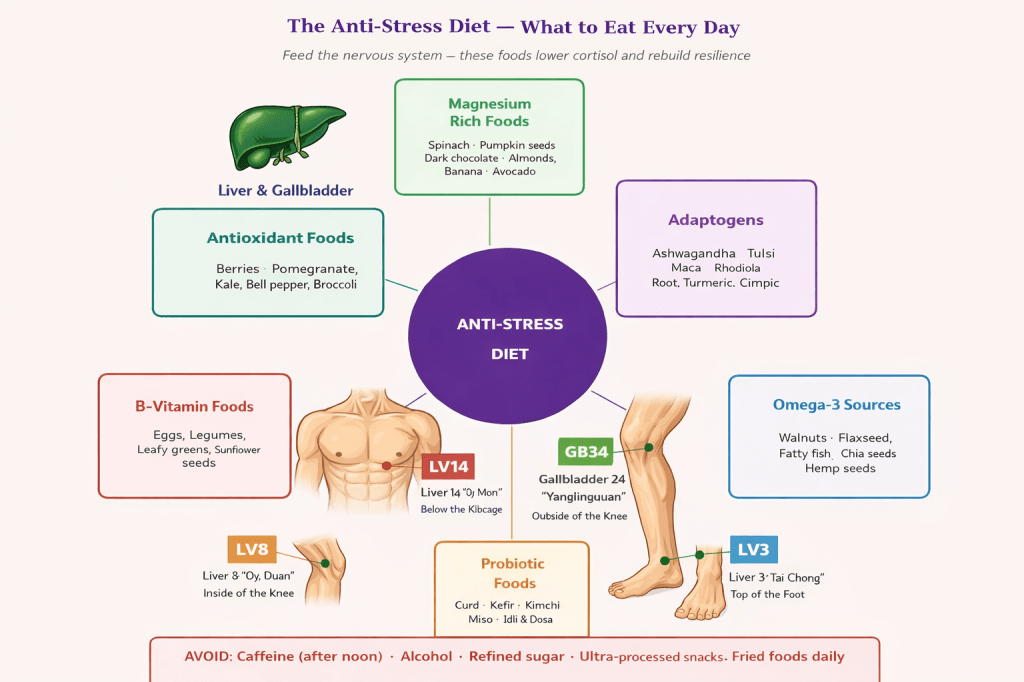
The Anti-Stress Diet — Feeding Your Nervous System
Food is information. Every meal you eat sends a signal to the nervous system, the immune system, and the hormonal axis either in the direction of resilience or in the direction of greater vulnerability to stress. The diagram below maps the most important food categories for stress recovery — not a complicated diet, but a daily orientation toward the foods that actively support the systems stress most damages.
The 5 Daily Non-Negotiables for a Stressed Body
1. MAGNESIUM — Most stressed people are magnesium-deficient. Stress depletes it; deficiency worsens stress. A handful of pumpkin seeds or a tablespoon of ground flaxseed daily covers a significant portion of requirements.
2. PROBIOTICS — The gut-brain axis is a two-way street. Stressed guts produce stressed minds, and vice versa. One serving of fermented food daily (curd, kefir, kanji, kimchi) maintains the microbiome that produces 90% of your serotonin.
3. OMEGA-3 — Directly reduces neuroinflammation, which chronic stress generates. Walnuts, flaxseed, and fatty fish are the most accessible sources. These fats literally lubricate the nervous system.
4. B VITAMINS — The entire B-complex is stress-depleted and stress-essential simultaneously. Eggs, legumes, and leafy greens cover the full spectrum. Avoid single-B supplements — they work as a team.
5. ASHWAGANDHA — An adaptogenic herb with the most robust clinical evidence base for cortisol reduction. 300-600mg of root extract daily. Not a cure — an adaptation tool. Pair with the acupressure practice for compounded effect.
The Sleep-Cortisol Loop — Breaking the Cycle
Here is the vicious cycle that most stressed people are caught in: poor sleep raises cortisol; elevated cortisol disrupts the next night’s sleep; the resulting exhaustion lowers stress tolerance; everything feels more stressful; cortisol stays high. Around and around.
Breaking this cycle requires targeting both ends simultaneously. The acupressure practices in this series address the cortisol side. The sleep hygiene practices below address the sleep side. Together, they give the loop somewhere to break.
Consistent sleep and wake times — even on weekends. The circadian rhythm is the single most powerful regulator of cortisol, and it requires consistency to function.
No caffeine after 1pm. Caffeine has a half-life of five to seven hours. A 3pm coffee is still partly in your system at midnight.
The evening acupressure sequence (SP 6, KD 1, Yintang, HT 7) done lying in bed — this is detailed in full in Post 4 [To be published soon.
Magnesium glycinate 200-400mg before sleep: the most evidence-supported supplement for sleep quality and cortisol reduction, with an excellent safety profile.
No alcohol within three hours of sleep. Alcohol initially sedates but severely fragments sleep architecture in the second half of the night — producing the early-morning waking that stressed people so commonly report.
Your organs do not hold stress against you. They are simply waiting for the signal that it is safe to let go. These practices are that signal.
Work With Me
Understanding which organ system is carrying the primary load of your stress — and tailoring the acupressure practice accordingly — makes the practice significantly more efficient. The same hour invested, but directed precisely.
In a consultation, we identify your specific stress-organ pattern through a combination of symptom mapping, lifestyle history, and the classical diagnostic approaches that Chinese medicine uses to locate where in the body the stress has taken deepest root.
Then we build your protocol — points, sequence, timing, dietary adjustments, and lifestyle shifts calibrated to your specific picture.
Reach out: skcjos@gmail.com
Coming in Post 4: ‘The 21-Day Stress Reset — A Daily Practice That Actually Holds’
In Association with World Health Journey | Oman
Chronic stress does not just strain your body — it leaves lasting psychological patterns that shape every decision, relationship, and response you have. These patterns are measurable.
The Cognitive Health Check-Up from World Health Journey maps your psychological stress architecture — identifying the emotional patterns, cognitive distortions, and resilience gaps that chronic stress has created, before they become something harder to address.
For the fourth installment, we are moving from the “brick” in our pocket to the soundtrack in our ears.
The Sony Walkman wasn’t just a gadget; it was the first time in human history that we could curate our own reality. It took music out of the living room and onto the streets. Quite a few iterations did come out, but it was always a “catch-me-if-you-can” game with Sony.
Before 1979, music was a destination. You went to a concert, you sat by a radio, or you stood in your living room next to a massive mahogany record player. You were tethered to the spot.
Then came a blue-and-silver rectangle that changed the way we walked, thought, and existed in public. This week in our nostalgia series, we’re honoring the device that gave us our first taste of true mobile freedom: The Sony Walkman.
The nostalgia of getting the assorted songs of our choice, recorded (not downloaded in a Playlist) on a 90 Minute Cassette either at home or at one of the professional “shops” dealing in this “business”.
The gadget that Became a Legend.
The origins of the Walkman are almost accidental. Sony’s co-founder, Masaru Ibuka, just wanted to listen to opera on long flights without lugging a giant recorder around. The engineers stripped the recording head out of a journalist’s tape recorder, added a stereo amplifier, and the TPS-L2 was born.
It was tiny (for the time), it ran on two AA batteries, and it had those glorious, chunky silver buttons that made a deep, mechanical chunk when you hit play. It didn’t just play music; it launched a lifestyle.
Sharing the “Guys and Dolls” Experience
In its original version, the Walkman had something the modern iPhone would never dream of: Two headphone jacks. They were labeled “Guys” and “Dolls.” There was even a “Hot Line” button that would mute the music and turn on a tiny microphone so you could talk to your friend without taking your headphones off. Sony thought we’d want to listen together.
But as it turned out, the world wanted something else. We wanted the “Walkman Effect”—the ability to put on a pair of foam-covered headphones and turn a boring commute into a cinematic experience. For the first time, you could be in a crowd but in your own world.
Lost in Translation: The Tangible Soul of the Cassette
To a generation that sees music as a digital “cloud,” the Walkman feels like heavy machinery. But there was a soul to the cassette.
You didn’t just “skip” a song; you had to commit to the fast-forward. You knew the exact weight of a 90-minute TDK or SONY tape in your hand. You knew the heartbreak of the tape “spilling” and the frantic surgery required with a plastic pencil to wind it back in.
We’ve traded that tactile connection for the infinite scroll. We’ve traded the “Hot Line” button for “Noise Cancellation.” But every time you put on your AirPods to ignore the world, you’re walking in the footsteps of the 1980s teenagers who first realized that life is just better when it has a soundtrack.
The Walkman taught us that our inner world was just as important as the one outside.
Three weeks before his death, Carl Jung wrote something that sent shockwaves through the world of psychology: “God is not a belief. It is a psychological fact.“
This wasn’t a sudden leap of faith or a religious conversion. It was the clinical observation of a man who had spent decades documenting the transformation of the human psyche as it approaches the finish line.
Having studied hundreds of patients, Jung identified a pattern so consistent it transcended culture, creed, and personal conviction. What he found suggests that we have been looking at our lives entirely backward.
The Four Stages of the Ego’s Dissolution Jung documented a specific, four-stage preparation process that the psyche undergoes. It is not a process of “fading away,” but one of intense emergence.
The Ego’s Retreat: The persona we’ve spent a lifetime building—the job titles, the social standing, the “version” of ourselves we defend—begins to lose its grip.
The Dissolution: The boundaries of the individual “I” start to soften.
The Emergence of the Self: As the ego shrinks, the Self—the totality of the psyche—begins to take center stage.
The Union: A realization that the internal psychological reality is more “solid” than the external world. Through this lens of depth psychology, Jung reached a startling conclusion: We are not bodies that happen to have souls; we are souls who happen to have bodies.
5 Signs the “Self” is Calling You You don’t have to be at the end of your life to experience this shift. In fact, Jung’s final message was about waking up while you are still alive. Here are five signs that your “Self” is calling you toward this individuation:
A Growing Distaste for the “Performative”: You find it increasingly exhausting to maintain a version of yourself that feels “unreal”.
Vivid, Archetypal Dreams: Your subconscious begins using powerful, universal symbols to grab your attention.
The Weight of Material Success: A realization that external achievements no longer provide the “soul-filling” sustenance they once did.
A Pull Toward Solitude: Not out of depression, but out of a need to finally meet what has been waiting beneath the surface your entire life.
Synchronicity: You begin to notice “meaningful coincidences” that suggest a deeper relationship between your consciousness and the physical world. The Final Message: It’s Not About Death Jung’s discovery changed everything because it shifted the focus from the end of life to the depth of life. His final weeks weren’t spent mourning the loss of the body, but celebrating the discovery of the eternal Self. If you are ready to stop defending a ghost and start living as the soul you are, the journey doesn’t start at the end. It starts today.
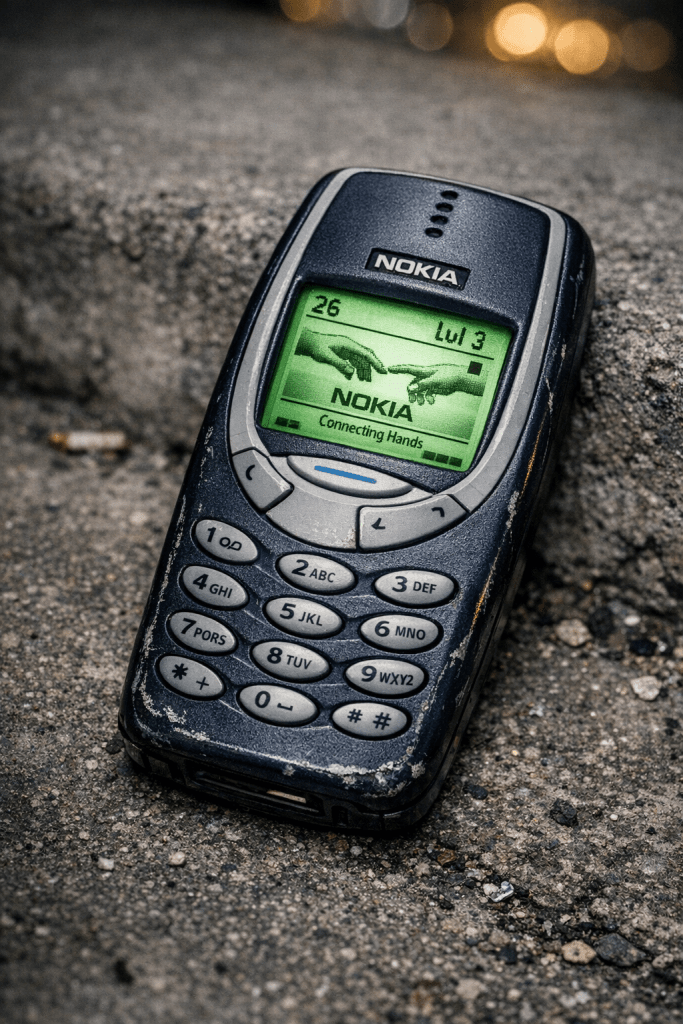
We live in an era of “planned obsolescence.” We treat our $1,200 glass smartphones like fragile artefacts, swaddling them in silicone cases and praying they don’t meet a hardwood floor.
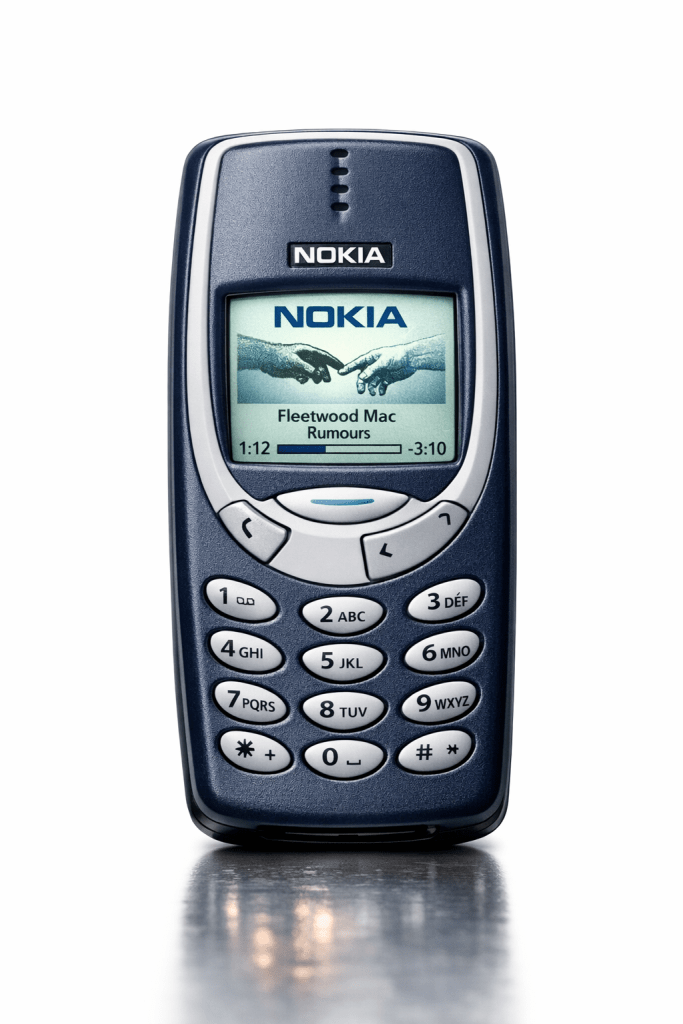
But once upon a time, there was a blue-and-silver titan that defied the laws of physics. The third entry in our nostalgia series is a tribute to the undisputed heavyweight champion of the mobile world: The Nokia 3310.
The Weaponised Phone
The 3310 didn’t need a case. It was the case.
There was a rugged, utilitarian honesty to its design. It was chunky, curved, and felt like a smooth river stone in your hand. If you dropped it, you didn’t check the screen for cracks; you checked the floor for a dent. It was the last time we truly trusted our technology to survive our lives.
And if you got bored with the look? You didn’t buy a new phone. You snapped off the “Xpress-on” covers and changed its entire identity at a mall kiosk.
The 8-Bit Obsession
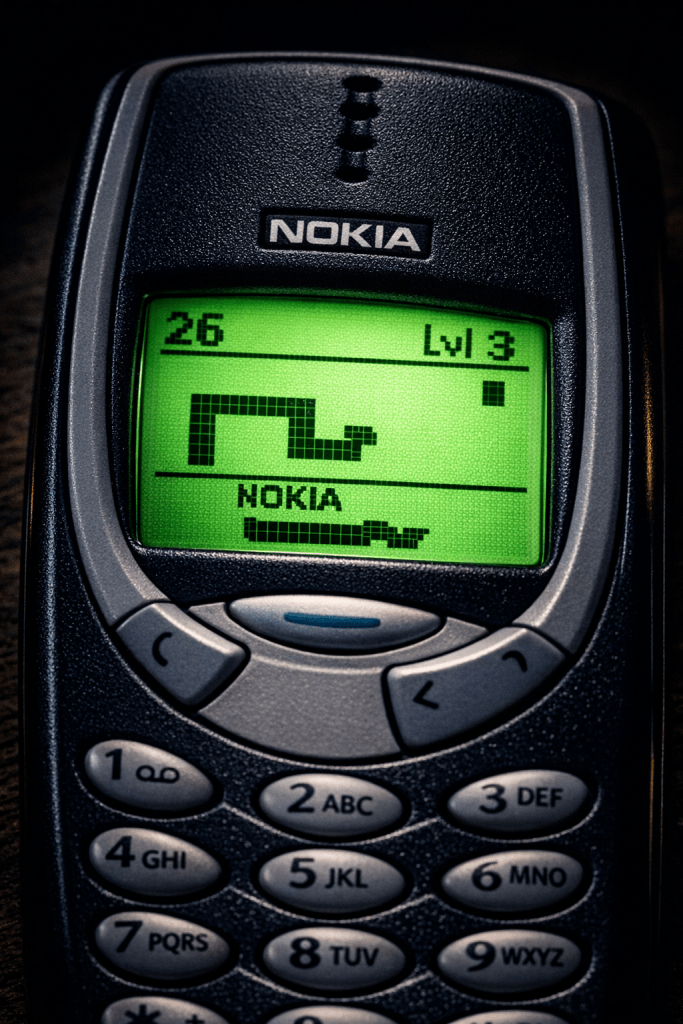
Long before Genshin Impact or Call of Duty Mobile, we had Snake II.
There was no high-definition graphics, no haptic feedback, and no micro-transactions. Just a pixelated line growing longer and longer on a monochrome green screen. It was the ultimate test of reflexes, played out in the back of classrooms and on long bus rides. It was simple, addictive, and perfect.
The 3310 didn’t want to steal your data; it just wanted you to beat your high score.
Lost in Translation: The Week-Long Battery
To a generation that carries power banks like oxygen tanks, the battery life of a 3310 sounds like a myth. You didn’t charge this phone every night. You charged it on a Sunday, forgot where you put the charger, and it would still be at two bars by Thursday.
We’ve traded that peace of mind for “Retina displays” and “5G speeds.” But looking back, the 3310 represents a lost philosophy: technology that serves you, rather than you serving the technology. It was a phone that worked when you needed it, stayed silent when you didn’t, and refused to break under pressure.
In a world of fragile glass, we could all use a little more of that 3310 energy.
The Unseen Foundation. In the chaotic symphony of life, we often miss the soft, consistent melody that plays in the background. It’s the silent support, the unwavering belief, the hands that steady us when we stumble. It’s the love that has no conditions, no fine print, and no expectations. This profound, boundless love comes from two people: our parents. The Power of Unconditional Love While the world operates on a system of reciprocity, where love is often tied to actions or worthiness, parental love stands as a stark and beautiful exception. Think back to your earliest memories. The scraped knees comforted, the nightmares banished, the milestones celebrated with genuine joy. This love didn’t depend on your grades, your career choices, or your social standing. It existed purely because you were their child. They were your first cheerleaders, your confidants, and your safest harbour. This type of love, given freely without any underlying motive, is a rare and precious gift.
When Life Gets in the Way As we grow older, we get absorbed by our own ambitions, challenges, and relationships. We build our own lives, and in the process, we sometimes forget the very foundation that allowed us to build. We become busy. We forget to call. We miss birthdays. We take their presence for granted, assuming they will always be there, just as they have always been. This neglect, however unintentional, can be a silent wound for our parents. They might not complain, but the void left by our absence or lack of expressed affection can be felt deeply.
The aspersions We Cast by way of misunderstanding their Motives. Sometimes, our parents’ words or actions can be misinterpreted. Their concerns might sound like nagging, their advice might feel like interference, and their questions might seem like intrusions. In our desire for independence, we might push them away, labelling their care as control. However, if we peel back the layers, we’ll often find that their words and actions are rooted in deep-seated love and a desire to protect and guide us. They have seen more of the world, experienced more its challenges, and their wisdom, though perhaps delivered in a way that feels outdated, comes from a place of genuine concern.
Cultivating a Culture of Gratitude and Respect So, how can we bridge the gap and honor this profound love?
Express Your Affection without waiting for a special occasion. Simple gestures can mean the world. A spontaneous phone call, a thoughtful message, a warm hug, or a simple “I love you” can brighten their day.
Make Time, Not Excuses: Prioritise quality time with them. Go for a walk, share a meal, or just sit and talk. Be fully present in those moments.
Listen with Empathy when they speak. Genuinely listen to understand their perspectives and feelings. Ask about their lives, their dreams, and their worries.
Forgive and Move Forward because No parent is perfect. They might have made mistakes. But letting go of past grievances and focusing on the love they have shown can bring peace to your relationship.
Show Your Respect with Simple acts of respect, like asking for their advice (even if you don’t always follow it) or listening attentively, can convey that you value their wisdom and experience.
A Love to Be Cherished Our parents’ love is a beacon that guides us, a safety net that catches us, and a constant in an ever-changing world. It is a love that asks for nothing in return but is fulfilled by seeing us thrive. Let’s not wait for “someday” to express our love and gratitude. Let’s not let the busyness of our life dim the brightness of this connection. Let’s honour the two people who loved us first, and who continue to love us, unconditionally and without aspersions. For in cherishing them, we honour the very essence of love and connection.
We live in a culture obsessed with “the grind.” The prevalent narrative is that if you just work harder, sleep less, and exert more willpower, you can bridge the gap between where you are and where you want to be. But for many, this relentless effort results in burnout, frustration, and an enduring sense of “lack.”
The truth is, effort is only half the equation. You cannot outwork a subconscious mind that believes you are not ready for what you desire.
As Carl Jung famously said, “Until you make the unconscious conscious, it will direct your life and you will call it fate.”
True manifestation isn’t about wishing or pretending; it is about psychological integration. It’s about moving beyond the ego’s desire to get and shifting into the subconscious’s capacity to be.
The Trap of Chasing from Lack. Most manifestation advice, focusing on affirmations and “positive thinking,” accidentally reinforces the very problem it tries to solve. When you desperately “chase” a desire, you are operating from a core frequency of not having.
You are communicating to your subconscious that you are lacking, and the subconscious—which is the projector of your reality—loyally continues to create a reality where you are still lacking.
This is the psychological paradox: the more desperately you pursue a thing from a state of need, the further you push it away. You are essentially telling the universe, “I don’t have this, and I need it to be happy,” reinforcing the identity of “someone who lacks.”
Shifting to Embodiment: The Law of Psychic Reality. The breakthrough comes when you stop seeking and start embodying. Start embodying the subconscious mind of someone who already lives inside their fulfilled reality.
This is the Jungian “Law of Psychic Reality.” Your psyche does not distinguish between an event that is physically happening and an event that is vividly imagined and emotionally felt. To the subconscious, they are equally “real.”
Manifestation, in this deeper sense, is the art of practicing the feeling of your wish fulfilled before the physical event occurs. You must align your “inner vibration” with the version of yourself who already has achieved the goal. You have to reprogram your subconscious identity.
The Four-Minute Shift. This shift doesn’t require decades of therapy; it requires consistent, intentional practice. The gap between your current life and your desired life exists only in your consciousness, not in outer circumstances.
Here is how you bridge that internal gap:
Stop Chasing: Acknowledge your desire, but notice when that desire feels like desperate need.
Reprogram the Subconscious: Commit to a small daily practice—just four minutes. In a quiet state, visualize your desired reality vividly.
Prioritize Feeling: Crucially, focus not just on the image of your success, but on the feeling of fulfillment. What would your life feel like the moment it became real?
Practice Gratitude in Advance: Shift the statement of “I want” to “Thank you that this is already a part of my experience.” When you move from needing to embodying, your outward efforts cease to be a desperate struggle and become inspired actions. You are no longer fighting your fate; you are creating it from the inside out.The Illusion of Effort Start by addressing the frustration most people feel: working incredibly hard but staying in the same place.
Carl Gustav Jung Says, “Until you make the unconscious conscious, it will direct your life and you will call it fate.”
We are often told that history is a series of accidents—a stray bullet in Sarajevo, a sudden move across a border, a flash of lightning in the desert. But if you look at the ledger instead of the headlines, a different pattern emerges.
World Wars aren’t just tragedies; they are transitions. The Century of the Ledger.
In 1914, the world “stumbled” into the Great War. Yet, behind the mud of the trenches, the machinery of credit was humming. Thirty nations were pulled into a fire fuelled by $30 billion in loans. When the smoke cleared, the map of the Middle East had been redrawn, and the League of Nations rose as the first blueprint for a centralised world.
By 1939, the playbook had been refined. We are taught about the ideologies, but we rarely talk about the invoices. Even as the world split into Allies and Axis, the “neutral” banks processed the gold, and global corporations kept the assembly lines moving on both sides of the fence. The result of 85 million lives lost? The birth of the Dollar Hegemony at Bretton Woods. The world didn’t just find peace; it found a new CEO.
Fast forward to today. The headlines point to the Strait of Hormuz and Operation Epic Fury. They speak of assassinations and “cycles of violence.” But look at the boardrooms:
Defence stocks are hitting all-time highs.
Energy prices are being recalibrated.
Trade routes are being forcibly shifted from West to East. What we are witnessing in 2026 isn’t a “war on terror”—it is the decommissioning of an old model. The petrodollar, the SWIFT system, and the unipolar world are being dismantled by the same hands that built them, because the contract has reached its expiration date.
The Great Recalibration The shift toward 2030 isn’t about one nation winning. It’s about the Controlled Demolition of the Familiar. Digital Identity is replacing the passport.
Programmable Currency (CBDC) is replacing the physical note.
Supply Chains are becoming the new nuclear deterrent. While the world stares at the Middle East, the real movement is happening in the silence of the semiconductor labs and the rare-earth mines.
The Takeaway History doesn’t repeat, but it certainly rhymes in the same key. We are living through a “Global Reset” that was published in plain sight years ago. To be afraid is to be a spectator; to be aware is to be a participant. The map is being redrawn. The ink is still wet. The question isn’t “Who is to blame?” but “Where do we stand when the music stops?”
























 Capt. Shaji Kumar