Tag: #PersonalGrowth

  • The Bhagavad Gita’s Secret to Fearless Leadership.

    The Bhagavad Gita’s Secret to Fearless Leadership.

    What a 5,000-Year-Old Battlefield Conversation can teach us About Leadership.

    I used to think the Bhagavad Gita was just another religious text. Then I discovered it’s actually the most practical leadership guide ever written. Since then I have held on to this sacred book in different forms. The Printed Version, the Kindle eBook, Cards for daily reference.

    When Everything’s on the Line, when you know that moment when you’re staring at a decision that could make or break everything? I’m talking about those tough situations which everyone faces in their lives, you don’t necessarily have to be a Leader, nevertheless running through scenarios, knowing that whatever you choose tomorrow will ripple through your team, your company, maybe even your entire career.

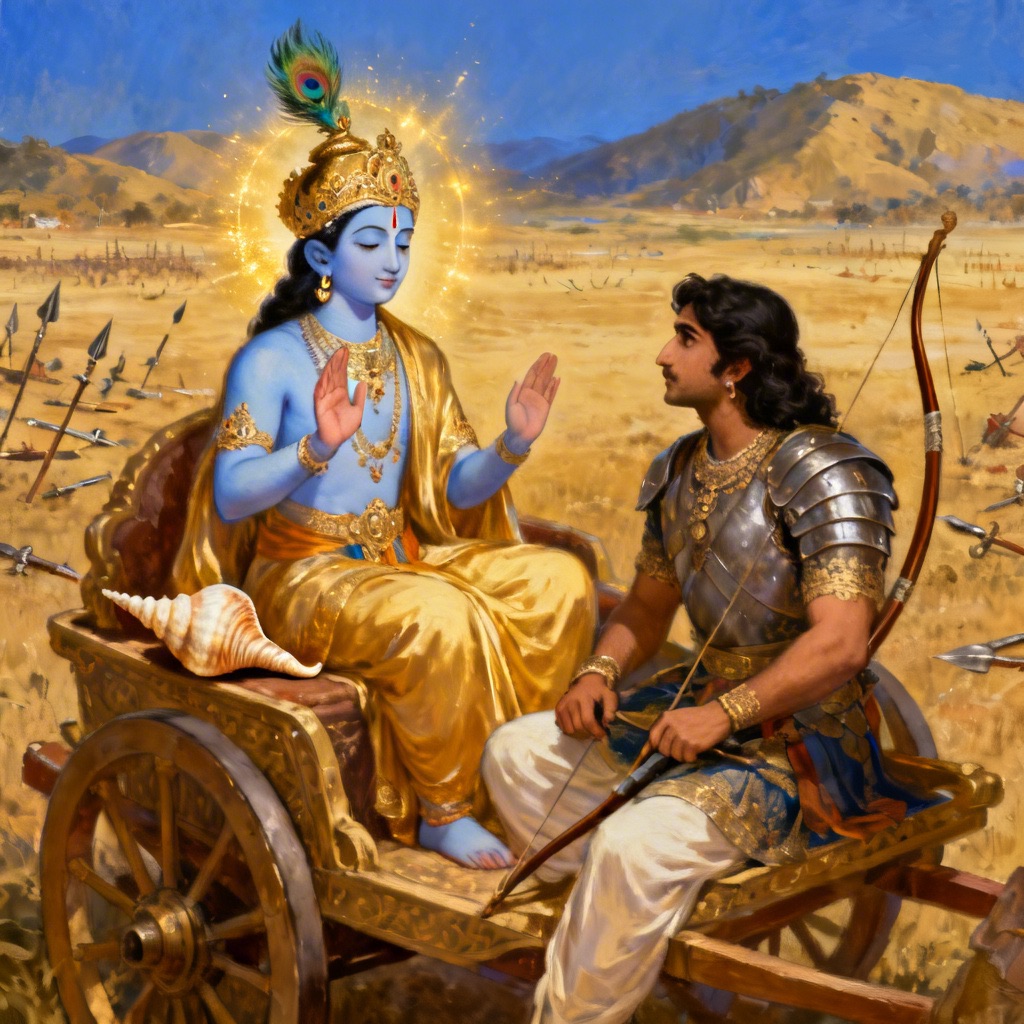
    That’s where Arjuna was standing—literally on a battlefield, facing his cousins in what would be the bloodiest war in ancient history. And he completely froze. What happened next changed how I think about leadership forever.

    Here’s what I got wrong about the Gita for years: I thought it was some mystical conversation between holy men sitting under trees, talking about detaching from the world.

    No. This is two warriors having a very real conversation about duty, fear, and making impossible choices when lives hang in the balance. Arjuna isn’t asking for spiritual enlightenment—he’s asking for practical advice on how to lead when the stakes are crushing.

    Sound familiar?

    In today’s context it would look like this:

    – Quarterly numbers. The Agony or Ecstacy.

    – A product launch that could save or sink the company.

    – Choosing between short-term profits and long-term values.

    – Managing a team through a recession, merger, layoffs, or industry disruption. The pressure is different, but the paralysis feels exactly the same.

    The Counter intuitive Secret That Changes Everything

    Krishna’s advice to Arjuna seems backwards at first: “Do your absolute best work, then let go of the results.”

    Wait, what? Isn’t caring about results what separates leaders from… well, everyone else?

    But here’s what I’ve learned after trying this approach for years:

    When you stop being desperately attached to specific outcomes, you actually get better outcomes. Try it. It holds true.

    Why This Actually Works is, just think about it—when was the last time you made a great decision while panicking about the consequences?

    When you’re white-knuckling the steering wheel, worried about where you’ll end up, you can’t actually steer very well.

    But when you know you’ve done everything possible and you trust the process? That’s when the magic happens. You think clearer. You take smarter risks. You inspire confidence instead of spreading anxiety.

    I saw this firsthand during my company’s worst times. Not once, but many times. Instead of running around like my hair was on fire, I focused on what we could control: our response time, our communication with clients, our team’s morale. We came out stronger. And honestly? I slept better. In fact I have never lost sleep over anything ever. Whatever may have been the situation I have managed to keep my wit’s cool.

    Life Happens TO You, and you cannot stop that from happening, But You can definitely choose Your Response – on how to deal with it.

    The Gita has this concept that basically divides everything into two buckets: stuff that happens to you (prarabdha) and how you respond to it (purushartha).

    This sounds obvious until you realise how much energy we waste trying to control the first bucket. You Cannot.

    Here’s What I Mean:

    Sometime back one of our biggest and longest standing Client decided not to renew. One year of revenue, gone. That’s prarabdha—it happened, period.

    But everything else? That’s on me:

    – How I broke the news to the team- Whether I spiralled into worst-case scenarios or started planning our next move.

    – Whether I used this as a learning opportunity or just complained about “disloyal clients”!!

    You could spend days obsessing over what we could have done differently. Or you sit and analyse, make an last ditch effort to save if possible, and if even after giving it your best shot, then instead of ruminating look at alternative solutions. How to make up the lost revenue in the shortest span so that the effect is cushioned in the shortest span of time.

    The Balance That Actually Matters

    There’s this verse (Chapter 4, Verse 22, if you’re keeping track) that basically says balanced people don’t get thrown off by wins or losses. They just keep moving forward.

    This isn’t about being emotionless—it’s about being consistent.

    What This Looks Like in Practice

    Good news: Celebrate for five minutes, then ask “What’s next?”

    Bad news: Feel it for five minutes, then ask “What can we learn and Do next?”

    Uncertainty: Work with what you know, then adapt as you learn more.

    My Son figured this out before I did. He told me, “You used to be a roller coaster—amazing when things went well, impossible when they didn’t. Now we actually know what to expect from you.” He just told me to look at my old Photographs when I was younger.

    That hit harder than any performance review.

    The Best Analogy I’ve Ever Heard About Ambition.

    The Gita compares desires to paan—that sweet digestive you have after a good meal. It’s nice, but you don’t need it to feel satisfied.

    This completely reframed how I think about professional goals.

    Instead of: “I need this promotion/deal/metric to prove I’m successful”

    I started thinking: “I’m already pretty fortunate. This would be a nice bonus.”

    Why This Isn’t Just Feel-Good Philosophy

    When you’re not operating from desperation:

    – You negotiate better (you’re not afraid to walk away).

    – You make clearer decisions (you’re not clouded by need).

    Actually Trying This Stuff (Not Just Nodding Along).

    Look, reading about this is one thing. Actually doing it when your boss is breathing down your neck and wants answers is completely different.

    Practice it in your daily life. Concentrate on doing great work without bothering on specific outcome. See what happens. How it balances your stress level.

    When problems come up, spend your energy on your response, not on  not on complaining about the problem.

    Try to maintain same tone in meetings whether you’re delivering good news or bad news. It will have an impact on your Team. The energy percolates down.

    None of this is groundbreaking. But doing it consistently? That’s where the real change happens.

    Why a Battlefield Guide Still Works.

    The reason the Gita works for modern leadership isn’t because it’s ancient wisdom (though it is). It’s because it was written for someone who had to make life-or-death decisions under impossible pressure.

    The details are different, but the core challenge is the same: How do you lead effectively when the outcome matters desperately but you can’t guarantee success?

    Answer: You control what you can control, you do your best work, and you trust the process. It’s not magic. But it works.

    What’s your version of standing on that battlefield? The moment when everything you’ve worked for hangs on a decision you have to make? Remember: it’s not about predicting the future perfectly—it’s about showing up fully to the present.

    P.S. – If this resonated with you, I’d love to hear about your own battlefield moments. Because honestly, We’re all just figuring this out as we go, and sometimes it helps to know we’re not alone out there.


  • The Grass Isn’t Always Greener: 27 Years of Entrepreneurial Truth

    The Grass Isn’t Always Greener: 27 Years of Entrepreneurial Truth

    The Grass Isn’t Always Greener: 27 Years of Entrepreneurial Truth.

    A candid reflection on the realities of building a business, the myths that mislead aspiring entrepreneurs, and what it truly takes to survive—and occasionally thrive—in the entrepreneurial wilderness.

    When I started my entrepreneurial journey 27 years ago, I thought I understood what lay ahead. I was wrong. Like most first-time founders, I believed the grass would be greener on the entrepreneurial side of the fence. Today, with salt-and-pepper hair as my witness, I can tell you that the grass isn’t uniformly green—it’s patchy at best, with occasional verdant spots interspersed among the brown patches of struggle.

    The Myth of Instant Green.

    Over the years, I’ve watched many former employees take the entrepreneurial plunge. Some jumped with grand visions, others with detailed roadmaps that looked flawless on paper: secure funding, build valuation, execute an IPO or acquisition, then walk away with “tons and tons of money.

    The reality? I rarely hear success stories from these departures.

    This silence speaks volumes. The entrepreneurial graveyard is littered with dreams built on the myth of the get-rich-quick scheme. We live in an era where a select few have struck gold, creating a narrative that entrepreneurship is a lottery ticket rather than a marathon. This misconception fuels the current startup stampede—and explains why 90% of startups fail.

    The harsh truth: those few who “hit pay dirt are statistical outliers, not the norm.

    The Long Gestation of Success.

    Real entrepreneurship isn’t a sprint to riches—it’s an endurance test that would make an Olympian proud.

    Just as athletes don’t accidentally stumble onto podiums, successful entrepreneurs don’t stumble into success. There are no shortcuts.

    What It Actually Takes

    1. A Burning Desire That Survives Reality.

    You need more than enthusiasm; you need an obsession that can withstand years of setbacks. This isn’t passion—it’s something deeper, more primal. It’s the difference between wanting something and needing it to define your existence.

    2. The “Why” Factor.

    Before you quit your job or pitch investors, answer this: Why does your venture need to exist? Not why you want it to exist, but why the world needs it. If you can’t articulate this clearly, you’re building on sand.

    3. Start Small, Think Big.

    Remember Birbal finding warmth from a candle burning miles away? Your vision might be distant and dim, but it must be visible enough to guide you through dark periods. Start with minimal viable steps while keeping that distant light in sight.

    4. Embrace the Mistake Factory.

    Mistakes aren’t just inevitable—they’re your primary education. Each failure should strengthen your resolve, not weaken it. The entrepreneurs who survive aren’t those who make fewer mistakes; they’re those who learn faster from them.

    The Price of the Entrepreneurial Path

    Here’s what most people don’t tell you about entrepreneurship: it demands sacrifice that employed life never does.

    What You’ll Likely Sacrifice:

    Financial security (for years, possibly decades).

    Work-life balance (your business becomes your life).

    Predictable income (feast or famine becomes normal).

    Professional safety nets (no HR department, no guaranteed paycheck)

    Social time (while friends advance in corporate careers, you’ll be grinding).

    What You Might Gain:

    Autonomy over your decisions and destiny.

    The possibility of significant financial returns (emphasis on possibility).

    Deep satisfaction from building something meaningful.

    Resilience that serves you in every life area.

    Stories that make for interesting dinner conversations.

    The Relentless Test. Twenty-seven years in, I can confirm that the test never stops being severe and relentless. Market conditions change, competitors emerge, team members leave, funding dries up, customers disappoint, and sometimes everything goes wrong simultaneously.

    The question isn’t whether you’ll face adversity—it’s whether you’ll maintain that “fire in the belly” when adversity becomes your daily companion.

    Surviving the Long Haul

    Perseverance Over Perfection: Your first idea probably won’t work. Neither will your second or third.

    Success often comes from persistence through iterations, not brilliance on attempt one.

    Work Ethic as Oxygen: If you’re looking for better work-life balance, stay employed. Entrepreneurship demands a work ethic that borders on obsessive. This isn’t sustainable for everyone, and that’s okay.

    Never Give Up (But Know When to Pivot): There’s a fine line between persistence and stubbornness.

    The situation will change eventually, but sometimes you need to change your approach to the situation.

    The Uncomfortable Truth About Green Grass.

    After 27 years, my grass has some green patches—moments of success, financial wins, personal satisfaction from building something lasting. But it’s not the uniform, lush green that entrepreneurship mythology promises.

    And you know what? That’s perfectly fine.

    The real victory isn’t achieving some fantasy of endless green grass. It’s building something meaningful while accepting that entrepreneurship is inherently messy, uncertain, and often unrewarding in traditional metrics.

    For Aspiring Entrepreneurs.

    Before you leap, ask yourself:

    – Are you prepared for a decades-long journey with no guarantees?

    – Can you find fulfilment in the process, not just the outcome?

    – Do you have the financial runway and personal support for extended uncertainty?

    – Is your “why” strong enough to sustain you through years of difficulty?

    If your answers give you pause, consider staying employed while building something on the side. There’s no shame in choosing stability—and there’s wisdom in understanding your own tolerance for risk and uncertainty.

    Final Thoughts

    Entrepreneurship isn’t for everyone, despite what startup culture suggests. It’s not a fast track to wealth, freedom, or happiness. It’s a difficult path that demands everything you have and offers no guarantees in return.

    But for those with the right combination of vision, persistence, and perhaps a touch of madness, it can be profoundly rewarding—just not in the ways you initially expect.

    The grass may not be uniformly greener, but those patches of green you do cultivate? They’re genuinely yours. And after 27 years of tending to them, that means something.

    Sometimes the most honest thing you can tell someone about entrepreneurship is this: if you can imagine being happy doing anything else, do that instead. But if you can’t shake the vision of building something meaningful, then welcome to the long, difficult, occasionally rewarding journey of entrepreneurship.

  • 🚀 Your Enterprise is Your Baby: Lessons from an Entrepreneurial Journey.

    🚀 Your Enterprise is Your Baby: Lessons from an Entrepreneurial Journey.

    They say entrepreneurship is not for the faint-hearted, and after years of riding the rollercoaster of business ownership, I can tell you—they’re absolutely right. But what they don’t tell you is that it’s also one of the most rewarding journeys you’ll ever embark on, filled with lessons that shape not just your business, but your character.

    🏢 Be Proud of Your Baby

    Your enterprise is your baby. Be proud of it. Never be dazzled by what’s around you.

    I’ll never forget when a very senior person made a remark about the location of my office. For a moment, I felt that familiar pang of self-doubt creeping in. But then reality hit me—this is MY office, and I am proud of it. I built this from the ground up. I am the employer here.

    Here’s what I’ve learned: if employees don’t want to compromise and have their own locational preferences, that’s their restricted mindset, and I cannot help it. After all, whoever heard of a well walking up to a thirsty person? The value lies not in the glamorous address or the fancy furnishings—it lies in what you can provide: genuine value addition.

    To young entrepreneurs reading this: don’t let anyone make you feel small about where you started or where you currently are. Every successful business empire started somewhere, often in the most humble of places. Your garage, your spare bedroom, that small rented space—embrace it.

    Own it. Be proud of it.

    🤝 Integrity: The Foundation of Everything

    Over the years, I have built goodwill by practicing integrity, and this has definitely resulted in very positive customer retention. Let me be crystal clear about something: your customers should not stop believing in your venture. Never take them for granted. You exist only because of them, and it can never be the other way around.

    I’ve discovered something remarkable—if your reputation and integrity exceed expectations, customers will be willing to associate with you regardless of cost. It won’t matter if you’re more expensive than your competitors. They’ll choose you because they trust you.

    Think about it: in a world where consumers are bombarded with options, what makes them stick with one business over another? It’s not always the lowest price or the fanciest marketing. It’s the confidence that you’ll deliver on your promises, every single time.

    Here are the integrity principles that have guided my journey:

    • Always under-promise and over-deliver.
    • Be transparent about limitations and challenges.
    • Admit mistakes quickly and fix them faster.
    • Treat every customer interaction as an opportunity to build trust.

    🎢 The Rollercoaster: Risk vs. Gamble

    When you embarked on your entrepreneurial journey, was it a ‘risk’ or a ‘gamble’? I’ve spent many sleepless nights pondering this question, especially during the tough times.

    Just like success is never guaranteed, failure does not mean the end. Nothing is final. Let me share something personal: at one point, I scaled heights that I had only dreamed of. The business was thriving, revenues were soaring, and I felt invincible. Then, in the very next year, my business plummeted. It was devastating.

    The slide seemed unstoppable. Customers were leaving, revenue was drying up, and doubt crept in like a persistent shadow. But here’s the thing about entrepreneurship—it has its flips and flops. The key is never to be discouraged.

    I could have given up. Many people expected me to. Some even suggested I should. But something inside me refused to surrender. I held on to one simple belief: if you do not give up, there is nothing that can stop you from succeeding.

    And you know what? The slide could be stopped only recently, and I have again regained that upward momentum. This isn’t just business theory—this is a true life story, happening right now.

    đź’Ş Lessons for Young Entrepreneurs

    If you’re just starting out or struggling through a difficult phase, here’s what I want you to remember:

    1. Your current circumstances are not your final destination. That small office, limited budget, or lack of fancy resources? They’re temporary. What matters is your vision and determination.
    2. Build relationships, not just transactions. Every customer interaction is an investment in your future. Treat them with respect, deliver value, and watch how loyalty transforms your business.
    3. Embrace the uncertainty. Entrepreneurship isn’t about eliminating risk—it’s about managing it intelligently while staying true to your values.
    4. Define success on your own terms. Don’t let others dictate what your business should look like or where it should be located. Your vision, your rules.
    5. Persistence beats perfection. You don’t need to have all the answers from day one. You just need to keep moving forward, learning, and adapting.

    🌟 The Journey Continues

    As I write this, I’m reminded that entrepreneurship is not a destination—it’s a journey. There will be days when you feel like you’re on top of the world, and others when you question every decision you’ve made. Both are part of the process.

    What I’ve learned is that success isn’t measured just in revenue or market share. It’s measured in the relationships you build, the integrity you maintain, and the resilience you develop. It’s about creating something meaningful, something you can be genuinely proud of.

    Your enterprise is your baby. Nurture it with passion, protect it with integrity, and never let anyone make you feel ashamed of where you are in your journey. Every giant oak tree was once just an acorn that held its ground.

    To every young entrepreneur reading this: trust the process, believe in yourself, and remember—if you don’t give up, there’s nothing that can stop you from succeeding. This isn’t just motivation; it’s a promise backed by experience.

    Keep building, keep believing, and keep moving forward. Your success story is being written every single day.

    What’s your entrepreneurial story? Share your journey in the comments below—I’d love to hear about the challenges you’ve overcome and the lessons you’ve learned along the way.

  • Finding Your True North: When Life’s Journey Finally Becomes Your Own.

    Finding Your True North: When Life’s Journey Finally Becomes Your Own.

    Finding Your True North: When Life’s Journey Finally Becomes Your Own.

    Have you ever been stopped in your tracks by a seemingly simple question? The kind that appears innocent on the surface but sends you tumbling down a rabbit hole of self-reflection? That’s exactly what happened to me recently when a friend casually asked: 

    What are you passionate about? 

    Are you following what your heart and mind desire?”

    On the surface, it seemed like an easy question to answer. After all, I’ve built and run a fairly successful small business for 27 years. As a first-generation entrepreneur, I could confidently say that passion drove me to achieve something meaningful. But when I looked deeper—really looked—I wasn’t quite sure anymore.

    The Passenger Syndrome: When Life Drives You.

    For years, I wondered: Have I been in control of my life, or has life been driving me along its own predetermined path while I sat as a mere passenger?

    Looking back, my early years were anything but deliberate:

    • School: I finished in a stream that wasn’t my forte at all. Barely made through.

    • College: Switched to a subject that was, once again, everything but a choice.

    • Military: Joined the Armed Forces without much deliberation, deciding within the first year that I’d only stay for the stipulated five years.

    Each step felt like following the Darwinian theory of survival—adapting, persisting, but not necessarily thriving in alignment with my true self.

    The First Real Choice: Entrepreneurship as Awakening.

    The turning point came when I decided to become an entrepreneur. For the first time in my life, this felt like a deliberated choice—not just going through the motions or following societal expectations.

    Despite the usual “rollicking” of Army life, this decision set me going in a direction that felt authentically mine. Yes, there were troughs and crests, the inevitable tempests of establishing something new. But through it all, I found myself enjoying what I was doing for the first time in my life.

    That’s when I realised something profound: the need to be creative and keep creating new vistas and avenues is what I’m truly passionate about.

    Life Lessons Learned Along the Way.

    1. Passion Isn’t Always Obvious from the Start.

    Sometimes passion isn’t a lightning bolt of clarity. It’s something you discover through experience, through trying different paths, even through the things you initially resist. My journey through various streams and careers wasn’t wasted time—it was research for finding my true calling.

    2. Being a “Passenger” Isn’t Always Wrong.

    There’s wisdom in allowing life to guide you sometimes, especially in your early years. Those experiences I thought were just “going through the motions” actually equipped me with skills, resilience, and perspectives that later proved invaluable in entrepreneurship.

    3. Calculated Risks Are Worth Taking.

    I’ve never gambled in the conventional sense, but I realize I’ve been “gambling with life” all this while— taking chances, betting on myself, choosing uncertainty over security. This kind of calculated risk-taking has been the gateway to my most fulfilling experiences.

    4. Transformation Is Ongoing.

    The usual transformational changes keep happening. What excites me today might evolve tomorrow, and that’s not inconsistency—it’s growth. The key is staying open to these changes rather than rigidly sticking to outdated versions of ourselves.

    5. Creation Is Its Own Reward.

    The passion I’ve discovered isn’t just about business success—it’s about the act of creation itself. Building new vistas, exploring fresh avenues, bringing ideas to life. This creative drive transcends any single venture or achievement.

    Questions for Your Own Reflection.

    As I’ve learned, sometimes the most valuable questions are the ones that initially make us uncomfortable:

    1. When did you last make a truly deliberated choice? Not just going with the flow, but actively choosing your direction?

    2. What activities make you lose track of time? These might point toward your genuine passions.

    3. If you could start over, what would you do differently? More importantly, what would you keep the same?

    4. What kind of “gambling” are you avoiding? Sometimes the biggest risk is not taking any risks at all.

    5. How has being a “passenger” in some areas of your life actually served you? 

    Not all unplanned journeys are wasted journeys.

    The Journey Continues.

    Today, I’m more comfortable with the idea that life is part deliberate choice and part surrender to circumstances beyond our control. The key is recognising when to take the wheel and when to trust the process.

    My 27-year entrepreneurial journey taught me that passion isn’t just about following your heart—it’s about creating a life where your heart and mind can thrive together. It’s about embracing both the planned destinations and the unexpected detours.

    The most important realisation? You’re never too late to start making deliberated choices. Whether you’re 25 or 55, whether you’re just starting out or pivoting after decades in one direction, you always have the power to become the driver of your own life.

    Sometimes the best journeys begin not with knowing exactly where you’re going, but with the courage to finally take the wheel.

    What deliberated choice will you make today

  • Soaring to Success: Leadership Principles from the Majestic Eagle.

    Soaring to Success: Leadership Principles from the Majestic Eagle.

    I have personally always been in awe of Eagles. These majestic creatures of the sky stand as the chief amongst all winged beings, commanding respect and admiration across cultures and centuries. Even though a lot has been written in the past by other more accomplished writers, I could not resist writing about this favourite topic. Even though it may sound repetitive and also borrowed heavily from my more accomplished predecessors.

    Several authors and poets have explored eagle symbolism—particularly themes of leadership, strength, vision, courage, and overcoming adversity—in literature, poetry, and non-fiction.

    Alfred Lord Tennyson (“The Eagle”): Portrays the eagle as a symbol of bravery, survival, and victory, watching from mountain heights before striking like a thunderbolt.

    Robert Francis (“Eagle Plain”): Uses the American eagle to represent discipline, honesty, and hard work, unaware of its own virtues.

    Dejan Stojanovic (“The Creator”): Compares the eagle’s eyesight to human thought, symbolizing power, persistence, and success.

    Gift Gugu Mona (“The Essence of Faith”): Draws from Isaiah, likening faith to mounting wings like an eagle for strength and perseverance.

    Jack E. Davis (The Bald Eagle: The Improbable Journey of America’s Bird): Examines the bald eagle’s history as a national symbol of strength and environmental resilience, covering its cultural reverence and near-extinctions.

    EAGLES have, since ancient times been as a sacred symbol of LEADERSHIP, STRENGTH, and VISION. Throughout history, it has also been revered as an emblem of HOPE, STRENGTH, and SALVATION. From the ancient empires of Babylon and Egypt to the mighty Roman Empire and the modern United States of America, the Eagle has graced countless banners, becoming a legendary symbol of POWER, STRENGTH, and LEADERSHIP.

    There exist seven primary leadership principles that we can and should learn from these magnificent beings—principles that can help us reach the epitome of success in our personal and professional endeavours.

    The Seven Eagle Leadership Principles

    1. Eagles Fly High and Fly Alone

    The first leadership principle we can learn from eagles is their unique attitude towards life. Eagles soar to great heights and often journey alone, unperturbed by solitude. Similarly, true leaders are distinguished from the masses by their individual focus and aspirations. They understand that the path to excellence often requires traveling alone, making difficult decisions, and reaching peaks that others dare not attempt.

    Great leaders embrace the loneliness that comes with responsibility, knowing that their vision may not always be understood or supported by everyone around them.

    2. Eagles Have Great Vision – Both Penetrative and Accurate

    An eagle’s vision is both penetrative and remarkably accurate. From tremendous heights, they can spot their prey through all environmental clutter with precision that is simply astounding. As leaders, we must cultivate a similar visionary capability—maintaining a clear, long-term goal that we can focus on without becoming distracted by the noise around us. If you can maintain unwavering focus on your objectives, regardless of obstacles and distractions, success becomes inevitable.

    3. Eagles Do Not Eat Dead Things – They Feed Only on Fresh Prey

    Perhaps one of the most important lessons leaders can learn from eagles is their refusal to rely on stale sustenance. Eagles hunt fresh prey, never settling for what is old or decaying. Similarly, effective leaders must never become overly dependent on past accomplishments or outdated strengths.

    Continuous growth demands that we discover new skills, strive toward unknown frontiers, and courageously conquer fresh challenges. Living on past glory is the enemy of future success.

    4. Eagles Love the Storm

    By far the most crucial similarity between eagles and true leaders is their remarkable comfort during stormy weather. While other birds seek shelter during storms, eagles actually thrive in these conditions, using the powerful winds to soar even higher with minimal energy expenditure.

    True achievers are not afraid of challenges—they view turbulent times as opportunities for growth and advancement. They understand that storms, while difficult, often provide the strongest winds for reaching new heights.

    5. Female Eagles Test Male Eagles for Commitment

    This principle speaks directly to the human resource skills essential for effective leadership. Female eagles engage in elaborate courtship rituals that test the commitment, skill, and reliability of potential mates before choosing a partner.

    Similarly, leaders must carefully evaluate the commitment of people in their professional sphere. The ability to select the right individuals for the right positions—people who share your vision and demonstrate unwavering commitment—is crucial for organisational success.

    6. Eagles Prepare for Training

    True leaders, like eagles, are forever ready to leave their comfort zones because they understand that growth cannot occur in familiar territory. Eagles continually hone their hunting skills, adapt to new environments, and refine their techniques throughout their lives.

    Exceptional leaders maintain a similar mindset—always prepared for training, forever ready to learn something new, and willing to challenge themselves in ways that expand their capabilities and effectiveness.

    7. When Eagles Grow Old, They Undergo Renewal

    Perhaps the most profound lesson comes from the eagle’s renewal process. When eagles reach approximately 40 years of age, they face a critical decision: undergo a painful but necessary transformation or perish. They retreat to a high place and begin the arduous process of removing old feathers, breaking off worn talons, and even breaking their beaks—all to grow new, stronger replacements.

    Leaders must occasionally undergo similar renewal processes, shedding outdated habits, obsolete methods, and limiting beliefs. Those who recognise this need and courageously embrace transformation emerge as true leaders, equipped for continued success in an ever-changing world.

    Conclusion: Embracing the Eagle Spirit

    Eagle people are the visionaries and seekers who are not afraid to push the limits of self-discovery and growth. The eagle person is the true leader—ready to embark on any challenge and forever prepared to fly high above the ordinary.

    By embodying these seven principles—flying high and alone when necessary, maintaining clear vision, seeking fresh opportunities, embracing challenges, testing commitment, preparing for continuous learning, and undergoing periodic renewal—we can transform ourselves into the kind of leaders who inspire others and achieve extraordinary results.

    The eagle soars not because the journey is easy, but because it has developed the strength, vision, and courage necessary to rise above every storm. As leaders, we must cultivate these same qualities if we hope to reach our own magnificent heights.

  • The Weight We Carry: How Hidden Resentments Shape our Lives – And How to let them Go.

    The Hidden Burden: We all carry invisible weights—those hardened chunks of anger and hurt that accumulate over months, years, sometimes decades. Resentments aren’t just fleeting emotions; they’re psychological anchors that keep us tethered to painful moments long after they’ve passed.

    What Resentments Really Do to Us!

    1. They steal our present moments.
    2. They build invisible barriers.
    3. They distort our reality.

    The Misunderstood Path: What Letting Go Really Means.

    • Letting go is not weakness—it’s liberation.
    • We can release resentment AND maintain boundaries.
    • We can forgive someone AND never trust them again.
    • We can let go of the past AND protect our future.

    Without self-blame, honestly assess: What was your part? What patterns might you want to change going forward? This isn’t about justifying others’ harmful behavior—it’s about reclaiming your power to make different choices.

    The Choice Is Always Yours.

    Every morning, you wake up with a choice: Will you carry yesterday’s hurts into today’s possibilities? Or will you set down that burden and walk forward with open hands, ready to receive whatever good this day might bring?

    The heaviest thing you carry may not be in your backpack—it may be in your heart. But unlike physical weight, this burden disappears the moment you decide you’re tired of carrying it.

    Your peace is too precious to sacrifice to people who may have already forgotten they ever hurt you.

    Choose yourself. Choose freedom. Choose to finally let go.

    Ready to transform your approach to life? Follow me for more insights on building resilience, embracing change, and finding meaning in the present moment.

    #PersonalDevelopment