Tag: #PositiveThinking

  • Stress Isn’t the Problem. The Way We Fight It Is.

    We live in a world that has almost normalized stress.

    Being busy is worn like a badge of honour. Sleepless nights are celebrated as dedication. Anxiety is dismissed as part of ambition. Burnout is called success.

    But let me ask you one simple question.

    If stress is the problem, why do so many people eliminate one source of stress only to find another waiting for them?

    Someone changes jobs.

    The work stress disappears.

    Financial stress arrives.

    They earn more.

    Relationship stress begins.

    They improve relationships.

    Health anxiety takes over.

    It is an endless cycle.

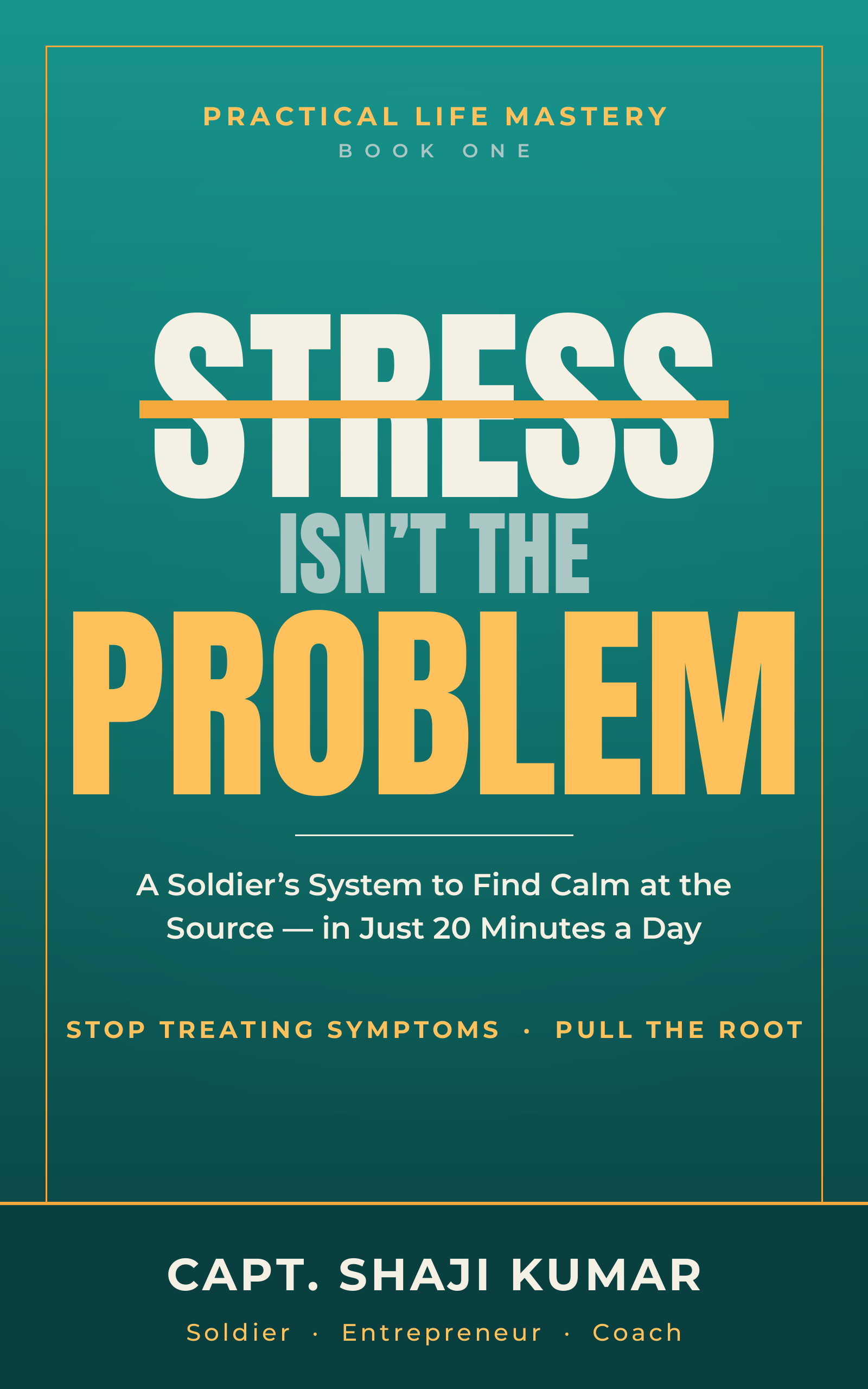
    That is precisely why I wrote “Stress Isn’t The Problem.”

    Because after spending decades in the Indian Army, building businesses, leading teams, facing personal setbacks and rebuilding life more than once, I realised something profound.

    Stress is rarely the real problem.

    It is only the symptom.

    We Keep Treating Symptoms

    Modern life offers countless solutions.

    Meditation apps.

    Music.

    Vacations.

    Weekend breaks.

    Motivational videos.

    Breathing exercises.

    Most of them work.

    For a while.

    But then stress quietly returns wearing a different mask.

    Why?

    Because we keep removing leaves while the roots remain untouched.

    Imagine a tree whose leaves keep turning yellow.

    You can polish the leaves.

    Trim them.

    Spray them.

    Replace them.

    But unless you fix the roots, nothing changes.

    Stress works exactly like that.

    My Journey Changed the Way I Understood Stress

    The lessons in this book did not come from a laboratory.

    They came from life.

    From military service.

    From entrepreneurship.

    From leadership.

    From financial uncertainty.

    From success.

    From failure.

    From rebuilding after losing almost everything.

    There were moments when I realised something remarkable.

    The people who stayed calm under immense pressure were not necessarily stronger.

    They simply understood where stress was actually coming from.

    That became the foundation of this book.

    Stress Has Many Faces

    Most people believe stress is just one thing.

    It isn’t.

    Stress appears in many forms.

    Financial stress.

    Career stress.

    Family stress.

    Health stress.

    Relationship stress.

    Identity stress.

    Purpose stress.

    Treating all of them with one generic solution is like prescribing the same medicine for every illness.

    It simply doesn’t work.

    One of the central ideas in my book is identifying the seven branches of stress so that you stop fighting the wrong battle.

    Stop Asking, “How Do I Reduce Stress?”

    Start asking,

    “What is creating this stress?”

    That single shift changes everything.

    Instead of becoming reactive, you become aware.

    Instead of suppressing emotions, you begin understanding them.

    Instead of surviving every day, you begin designing a better life.

    Clarity Is the Real Antidote

    Throughout my coaching programmes under Clarity Under Pressure™, I have observed one common pattern.

    People rarely lack intelligence.

    They rarely lack capability.

    They lack clarity.

    Unclear priorities.

    Unclear goals.

    Unclear expectations.

    Unclear boundaries.

    And uncertainty is one of the greatest generators of stress.

    When clarity increases, stress naturally begins to decrease.

    That is why this book is not another motivational book.

    It is a practical system.

    A Soldier’s Framework

    Military training teaches something invaluable.

    When pressure increases, you don’t panic.

    You return to your system.

    That philosophy shaped this book.

    Inside, you’ll discover:

    • Why chasing symptoms keeps you exhausted.
    • The seven branches of stress and how to identify which one is affecting you.
    • A practical 20-minute daily practice that helps reset your mind.
    • A simple seven-day reset.
    • A Pocket Protocol you can use whenever life feels overwhelming.

    Nothing complicated.

    Nothing theoretical.

    Just practical methods that can be applied immediately.

    Who Should Read This Book?

    This book is for you if:

    • You constantly feel mentally exhausted.
    • Your mind refuses to switch off.
    • Work follows you home.
    • Small problems feel overwhelming.
    • You’re successful on the outside but restless within.
    • You want practical solutions instead of motivational speeches.

    Whether you’re a professional, entrepreneur, student, leader, parent or someone simply trying to regain control of life, this book was written with you in mind.

    Stress Doesn’t Need Another Escape Route

    It needs understanding.

    When you understand its source, you stop fearing it.

    When you stop fearing it, you begin leading your life instead of reacting to it.

    That is the transformation I hope every reader experiences.

    A Personal Invitation

    If this article resonated with you, I invite you to read my latest book:

    📘 Stress Isn’t The Problem: A Soldier’s System to Find Calm at the Source in Just 20 Minutes a Dayhttps://www.amazon.in/dp/B0GX2XRCFD

    This isn’t just another book about managing stress.

    It is about understanding why stress keeps returning and learning how to deal with it at its source.

    If you believe someone in your family, your workplace or your circle of friends could benefit from this message, please share this article with them.

    Sometimes the greatest gift we can give another person isn’t advice.

    It’s clarity.

    Get Your Copy Here.https://www.amazon.in/dp/B0GX2XRCFD

    Thank you for reading.

    Would request you to please rate and leave a comment on Amazon as it would help someone else, besides me.

    Capt. Shaji Kumar
    Author | Army Veteran | Entrepreneur | Executive Coach
    Founder, Clarity Under Pressure™
  • I watched a bird this morning. It asked no permission of the sky.

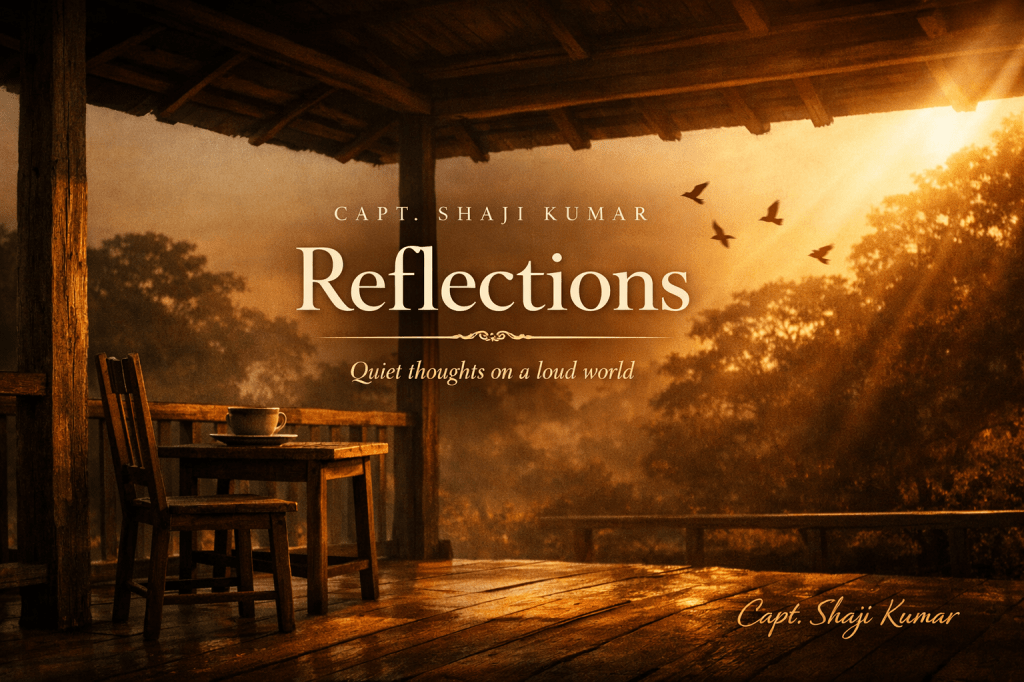
    I watched a bird this morning. It asked no permission of the sky.

    I watched a bird this morning. It had no agenda. It asked no permission of the sky.

    It tilted its head — once, twice — pecked at something invisible to me, then lifted off as though gravity were merely a suggestion. There was no weight to it. Not the kind we carry, anyway.

    And I stood there, a grown man with a full calendar and an emptier soul, wondering — why not us? Why were we handed this extraordinary gift of consciousness only to fill it with noise? With grudges and deadlines and a gnawing sense that we are always, always behind?

    The bird does not scroll through what it missed. It does not compare its nest to another’s. It drinks when thirsty. It rests when tired. It sings — not for applause, but because the morning simply calls for it.

    We, on the other hand, have built a world that hums with fury. Look around — truly look. What you see is not progress dressed up in conflict. It is something rawer. A collage of exhausted souls, each one pushing, shoving, performing some version of urgency they no longer remember choosing. Intolerance has become our mother tongue. Anger, our default expression. The chaos is not just out there in the headlines — it is in the kitchen, in the commute, in the quiet contempt that lives behind polite smiles.

    And it is everywhere. Every continent. Every culture. Every household, in varying degrees, tuned to the same restless, maddening frequency.

    Where does it lead, all of this? I do not have the answer. But I feel it — the way you feel a storm before the first drop falls. A reckoning is building, slow and enormous, in the place where our collective patience used to live.

    The bird has since disappeared into the treeline. It does not know I watched it. It does not know I envied it.

    God — what exactly did we do wrong, and when was the precise moment we forgot how to simply be?

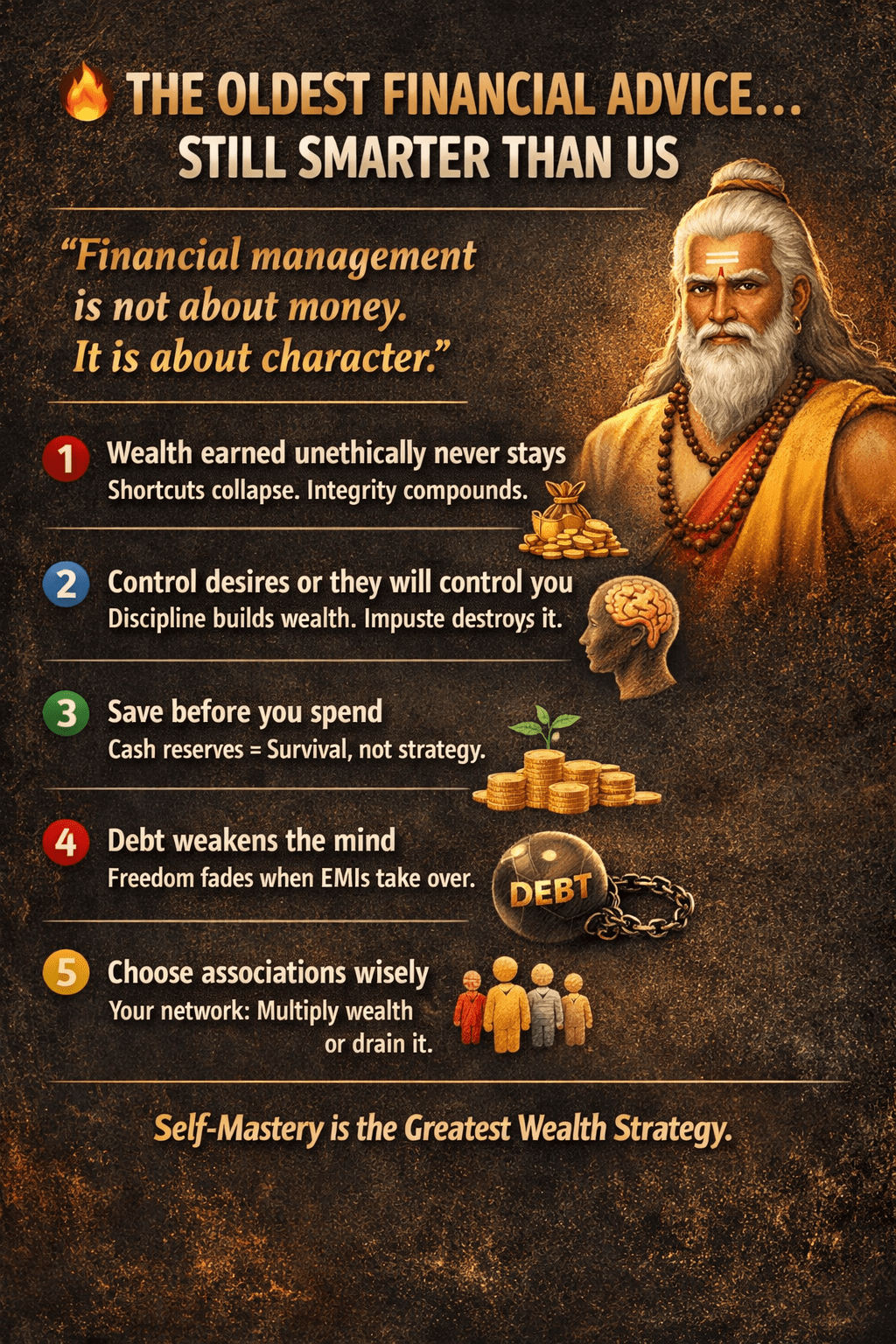
  • 🔥 The Oldest Financial Advice in the World — Still Smarter Than Us.

    🔥 The Oldest Financial Advice in the World — Still Smarter Than Us.

    We live in an age of abundance and anxiety.

    Money flows faster than ever, yet peace of mind feels rarer than gold.

    Every generation believes it invented financial wisdom — until it meets Vidur Niti.

    Three thousand years ago, Vidur, the royal advisor in the Mahabharata, spoke truths that still cut through the noise of modern finance. His words weren’t about numbers or markets. They were about character — the foundation of every sustainable fortune.

    Wealth Earned Unethically Never Stays.

    Vidur warned that wealth gained through deceit destroys the one who holds it.

    It’s not karma — it’s mathematics.

    Unethical gains create instability, distrust, and eventual collapse.

    In today’s world, this translates to:

    Shortcuts collapse. Integrity compounds.

    The most valuable currency is credibility.

    Control Desires or They Will Control You

    Vidur didn’t blame poverty on lack of income. He blamed it on lack of restraint.

    Desire, when unchecked, becomes debt.

    We call it lifestyle inflation, impulse buying, or social comparison — but it’s the same disease.

    Discipline builds wealth. Impulse destroys it.

    The richest people aren’t those who earn the most — they’re those who can say no.

    Save Before You Spend

    Vidur insisted that a wise person always keeps reserves for difficult times.

    In modern language: build your emergency fund before your dream fund.

    Savings are not a financial strategy.

    They are a survival strategy.

    Debt Weakens the Mind

    Vidur saw debt as a spiritual and psychological burden.

    Today, it’s disguised as convenience — EMIs, credit cards, “buy now, pay later.”

    But the truth remains:

    Freedom disappears the moment debt takes over.

    Debt doesn’t just cost money. It costs peace.

    Choose Associations Wisely

    Vidur said that associating with fools, greedy people, or unstable minds leads to ruin.

    In modern business, this means:

    Avoid toxic partnerships, unstable investors, and energy‑draining networks.

    Your network can multiply your wealth or drain it.

    Choose wisely.

    Invest in Wisdom, Not Just Wealth.

    Vidur believed that knowledge is the greatest asset.

    Money grows only when the mind grows.

    Skill development, financial literacy, emotional intelligence — these are the modern equivalents of Vidur’s “inner wealth.”

    Protect Your Wealth from the Five Dangers

    Vidur listed them clearly: fire, water, kings, thieves, and bad relatives.

    Translated to today’s world:

    Insurance, compliance, fraud prevention, documentation, and estate planning.

    Wealth is not just earned — it must be protected.

    Charity Must Be Wise, Not Emotional.

    Vidur said charity should go to the deserving, not the demanding.

    Modern philanthropy echoes this: impact over impulse.

    Give with intention, not emotion.

    True generosity builds ecosystems, not dependency.

    The Real Lesson.

    Vidur Niti isn’t ancient philosophy.

    It’s a financial operating system for anyone seeking stability, clarity, and long‑term prosperity.

    Money doesn’t respond to intelligence.

    Money responds to discipline.

    And discipline, Vidur reminds us, is not a punishment — it’s freedom.

    #VidurNiti #AncientWisdom #FinancialDiscipline #LeadershipMindset #WealthManagement #ModernLeadership #PersonalGrowth #StrategicThinking #ShajiKumarWrites

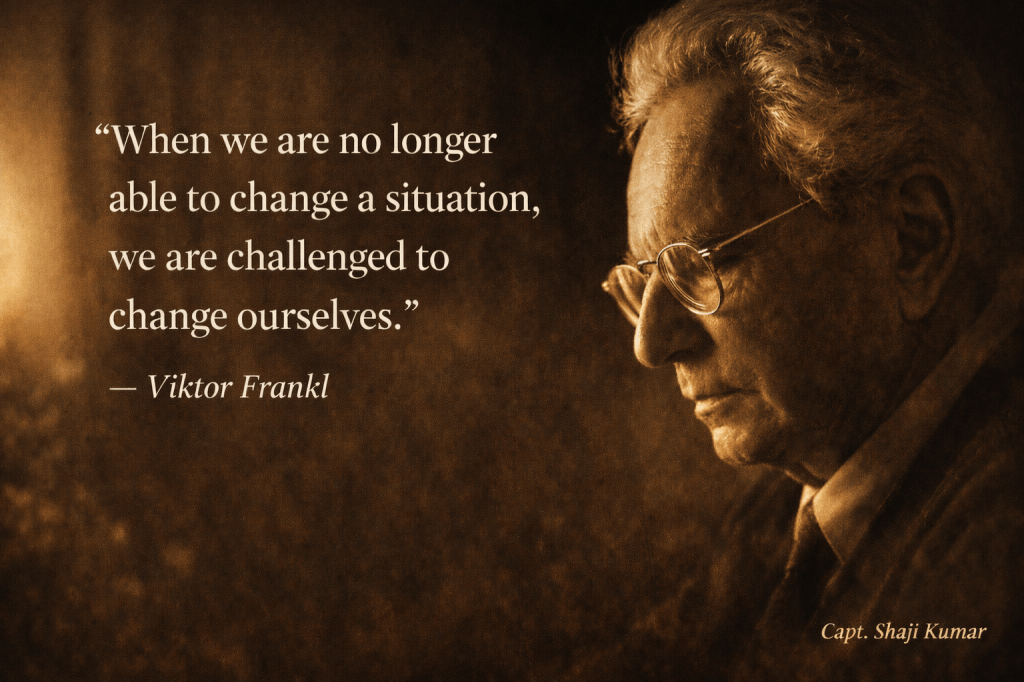
  • 🔥 The moment you realise you cannot change your situation… is the moment your real work begins.

    🔥 The moment you realise you cannot change your situation… is the moment your real work begins.

    “When we are no longer able to change a situation, we are challenged to change ourselves.” — Viktor Frankl

    There is something deeply uncomfortable… almost painfully ironic… about feeling powerless in life.

    Because in that moment—when nothing bends, nothing shifts, nothing listens—you are brought face to face with the only question that truly matters:

    How do I respond to what is happening to me?

    Do I resist?

    Do I accept?

    Do I fight harder… or do I surrender?

    I have lived both sides of this question.

    There were times I fought relentlessly—pushing against reality, trying to force outcomes, refusing to accept what was. And there were moments I surrendered—not out of wisdom, but out of exhaustion.

    Neither gave me lasting peace.

    But over time, something shifted. Through the wisdom of thinkers like Viktor Frankl, I began to see a deeper truth:

    👉 The real battle is not outside. It is within.

    Today, when life refuses to change, I pause. Instead of asking, “Why is this happening to me?”

    I ask, “What is this trying to show me about myself?”

    Because every external event—especially the painful ones—is a mirror.

    A mirror reflecting:

    • My fears

    • My attachments

    • My expectations

    • My ego

    And sometimes… my illusions.

    It takes courage to look into that mirror.

    It is far easier to blame circumstances.

    It is far easier to point fingers.

    But growth does not live there.

    Growth lives in this quiet, difficult shift:

    👉 From controlling the world…

    👉 To understanding yourself.

    This doesn’t mean we stop striving.

    It doesn’t mean we become passive.

    It means we become aware.

    Aware enough to know that while we may not control what happens…

    we always control who we become because of it.

    ✨ FINAL THOUGHT:

    When life takes away your power to change the outside world…

    it is giving you the opportunity to master your inner one.

  • The Wealth Code: Why “Money Makes Money” is a Dangerous Myth (And How to Build it From Zero).

    The Wealth Code: Why “Money Makes Money” is a Dangerous Myth (And How to Build it From Zero).

    The Myth We Inherited

    There’s a quiet myth we all grow up hearing: “You need money to make money.” While that’s partly true, it’s also dangerously incomplete. If wealth were only inherited, the world would never produce new millionaires. Yet every year, thousands of people rise from ordinary backgrounds to build extraordinary financial lives.

    What are they doing differently? Let’s break it down—not with clichés, but with real, actionable truths.

    1. Trade Survival for Growth

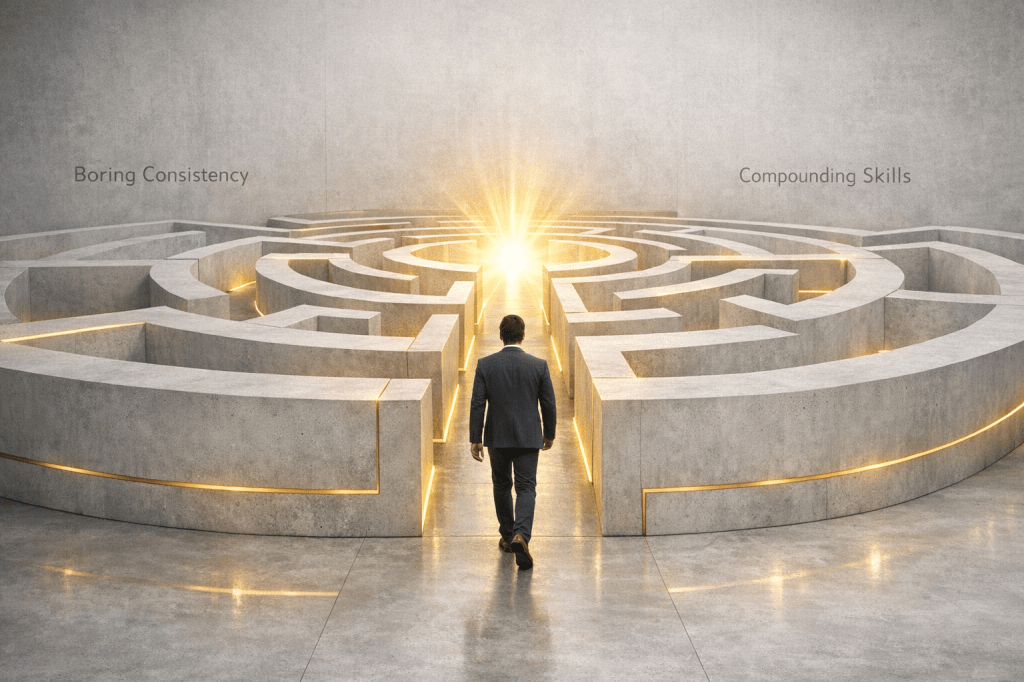
    Most people work to pay bills; wealth builders work to buy freedom. Instead of asking, “How can I earn enough this month?” they ask, “How can I increase my value so I earn more every year?” They invest in skills that compound: Writing, Sales, Technology, and Finance. Skills are the only assets no one can take away from you.

    2. Systems Over Chasing

    Rich people don’t rely on a single income source. They build systems that earn while they sleep:

    • Digital Assets: Writing online, ebooks, and templates.
    • Smart Investing: Stocks, ETFs, and SIPs.
    • The Goal: Turn active income into semi-passive, then fully passive. Even ₹1,000/month is a victory because it proves your system works.

    3. The Discipline of the “Boring”

    Wealth is not built in a viral moment. It’s built in quiet repetition: writing when nobody is reading, and saving when it feels insignificant. Over 5 years, this “boring” consistency starts to look like “luck” to everyone else.

    4. Killing Lifestyle Inflation

    This is the silent killer. When most people get a raise, they upgrade their phone. I’ve used the same iPhone for 4 years. While others eat out, I eat out once every two months. By cutting my spending in half, I doubled my ability to invest.

    The Truth: Wealth is not what you earn; it’s what you keep and grow.

    5. Think in Decades, Not Days

    Most people want results in 30 days. Wealthy individuals think in decades. I made the mistake of not investing early, but I’m fixing that now. Compounding requires a “patient” mindset—the goal isn’t just to get rich fast, but to ensure you cannot stay poor.

    6. The Power of Leverage

    Hard work alone doesn’t create wealth; leverage does. Whether it’s Content Leverage (writing one article that earns for months) or Money Leverage (investments), you must learn to multiply your effort.

    The Final Word

    You don’t need a rich family or a lucky break. You need a skill, a system, and the belief that it is possible for you. If you are starting from zero, remember: every wealthy person you admire once had no audience and no shortcuts.

    They just didn’t stop. And that is the only advantage that truly compounds.

  • Waking Up Before the End: Carl Jung’s Final Discovery.

    Waking Up Before the End: Carl Jung’s Final Discovery.

    Three weeks before his death, Carl Jung wrote something that sent shockwaves through the world of psychology: “God is not a belief. It is a psychological fact.

    This wasn’t a sudden leap of faith or a religious conversion. It was the clinical observation of a man who had spent decades documenting the transformation of the human psyche as it approaches the finish line.

    Having studied hundreds of patients, Jung identified a pattern so consistent it transcended culture, creed, and personal conviction. What he found suggests that we have been looking at our lives entirely backward.

    The Four Stages of the Ego’s Dissolution Jung documented a specific, four-stage preparation process that the psyche undergoes. It is not a process of “fading away,” but one of intense emergence.

    • The Ego’s Retreat: The persona we’ve spent a lifetime building—the job titles, the social standing, the “version” of ourselves we defend—begins to lose its grip.
    • The Dissolution: The boundaries of the individual “I” start to soften.
    • The Emergence of the Self: As the ego shrinks, the Self—the totality of the psyche—begins to take center stage.
    • The Union: A realization that the internal psychological reality is more “solid” than the external world. Through this lens of depth psychology, Jung reached a startling conclusion: We are not bodies that happen to have souls; we are souls who happen to have bodies.

    5 Signs the “Self” is Calling You You don’t have to be at the end of your life to experience this shift. In fact, Jung’s final message was about waking up while you are still alive. Here are five signs that your “Self” is calling you toward this individuation:

    • A Growing Distaste for the “Performative”: You find it increasingly exhausting to maintain a version of yourself that feels “unreal”.
    • Vivid, Archetypal Dreams: Your subconscious begins using powerful, universal symbols to grab your attention.
    • The Weight of Material Success: A realization that external achievements no longer provide the “soul-filling” sustenance they once did.
    • A Pull Toward Solitude: Not out of depression, but out of a need to finally meet what has been waiting beneath the surface your entire life.
    • Synchronicity: You begin to notice “meaningful coincidences” that suggest a deeper relationship between your consciousness and the physical world. The Final Message: It’s Not About Death Jung’s discovery changed everything because it shifted the focus from the end of life to the depth of life. His final weeks weren’t spent mourning the loss of the body, but celebrating the discovery of the eternal Self. If you are ready to stop defending a ghost and start living as the soul you are, the journey doesn’t start at the end. It starts today.

  • The Power of the Right People 🌟

    The Power of the Right People 🌟

    Finding Your Inner Circle: The Art of Building Your S10

    A journey toward authentic leadership and meaningful connections.

    The Power of the Few.

    In our hyper-connected world, we often forget a fundamental truth: you don’t need everyone to believe in your vision—you just need the right ones.

    Throughout history, the most impactful leaders understood this principle. They cultivated a select group of trusted advisors, confidants, and supporters who became the backbone of their success. I call this your S10**—your Strategic 10. These are the people who will stand by you, challenge you, and help you reach the culmination of your real objectives.

    The Ancient Wisdom of Oral Tradition

    There’s something profound about the spoken word that written text can never fully capture. Consider how the Vedas were passed down through generations—not through scrolls or tablets, but from mouth to ear, creating an unbroken chain of wisdom and understanding.

    When we speak our truths, when we share our visions verbally, something magical happens:

    – Our passion becomes palpable.

    – Our conviction carries weight.

    – Our humanity shines through.

    This is why great rulers maintained councils—not just for their knowledge, but for their ability to communicate, inspire, and deliver results through authentic connection.

    The S10 Project: A Labor of Love

    Like preparing the perfect biryani over a slow flame, identifying your S10 requires patience, intention, and careful attention to detail. This isn’t a process you can rush—it’s a continuous quality endeavor that deserves the same dedication you’d give to any masterpiece.

    The Selection Principles:

    No Elimination Without Cause Every person in your consideration deserves fair evaluation. Names don’t get crossed off lightly.

    Holistic Assessment One conversation, one interaction, one moment doesn’t define someone’s potential value to your circle.

    Continuous Evolution Like quality itself, this is an ongoing process. Your S10 may shift as you grow and your mission evolves.

    Time-Tested Validation Just as the finest biryanis need time to develop their full flavor, the best relationships reveal their true worth over time.

    The Multimedia Advantage

    While I write these words now, I recognise that written content only captures part of the story. The tremor in a voice when someone shares their deepest conviction, the sparkle in eyes when passion ignites, the pause that speaks volumes—these elements transform mere information into transformation.

    This is why the greatest teachers, from ancient gurus to modern thought leaders, understand that multi-sensory communication creates deeper impact:

    – Visual elements engage imagination.

    – Audio conveys emotion and nuance.

    – Written words provide structure and reference.

    – Personal interaction builds trust and connection.

    Building Your Own Council

    As you work toward becoming a thought leader who makes a real difference, ask yourself:

    Who are the people that

    – Challenge your thinking without crushing your spirit?

    – Celebrate your wins authentically?

    – Offer honest feedback when you need course correction?

    – Stand by you when others doubt?

    – Amplify your message because they truly believe in it?These are your potential S10 members. They’re not necessarily the loudest voices or the most obvious choices—they’re the ones whose values align with yours and whose presence makes you a better version of yourself.

    The Marathon Mindset

    Remember, this isn’t a sprint to a finish line—it’s a 25-year journey of continuous growth, refinement, and impact. Your S10 today might look different from your S10 in five years, and that’s not just okay—it’s expected and healthy.

    The goal isn’t perfection; it’s authentic progress toward meaningful impact.

    Closing Wisdom: The Rules for a Happy Life

    As we navigate this journey of building our circles and our influence, let’s anchor ourselves in timeless wisdom:

    1. Don’t HATE – Life is too short to waste time hating. That energy could be channeled into building something beautiful instead.

    2. Don’t COMPARE – Don’t try to be someone else. The world already has them—what it needs is the best version of YOU.

    3. Don’t WORRY trust yourself.

    The day you stop worrying will be the FIRST day of your NEW LIFE.

    Trust the process, trust your S10.

    What started as a pet project has become a profound reminder: we’re not meant to journey alone. We’re meant to find our people, nurture those relationships, and together, create the change we wish to see in the world.

    Who’s in your S10?

  • Build Your Business: Why Smart Leaders Choose Foundation Over Speed.

    Build Your Business: Why Smart Leaders Choose Foundation Over Speed.

    In the fast-paced world of entrepreneurship, it’s easy to get caught up in the rush to grow, to scale, to succeed. But what separates thriving businesses from those that collapse under their own weight? The answer lies in two fundamental leadership principles that have proven their worth time and again: building a solid foundation and understanding that scalability is a science, not a gamble.

    The most important phase is the first phase which is primarily the development stage.  It is during this time that every decision feels urgent. You’re bootstrapping, hustling, and trying to make every rupee count. In these crucial early days, it’s tempting to look for quick fixes—cheap systems that promise rapid results with minimal effort. But this is precisely where mistakes are made. Penny wise and pound foolish.

    A visionary leader understands that investing in a robust, reliable foundation is not an expense—it’s an investment in the future. It is difficult but doable. Remember Business is like a rocket that you want to send into orbit. As in any Rocket, there is the initial propulsion which takes the Rocket out of the Earth’s gravitational pull, which in terms of a Business is the first 2-3 years, and then the propulsion stage where the Rocket moves into orbit, which is the 10-12 Year phase. Both these phases are absolutely important.

    Why Foundation Matters

    Consider the foundation of building or any infrastructure. Architects don’t cut corners on the base to save money on the upper floors. They know that without a fortress-like foundation, the entire structure will eventually crumble, no matter how beautiful the facade. Your business foundation works the same way. And we know the consequences of this neglect when newly constructed flyovers or buildings collapse. The same happens for your business as well.

    When you resist the temptation for quick fixes and instead pour your resources—time, energy, capital, and talent—into building something robust and reliable, you create an ideal platform for sustainable growth Systems that can handle increased demand without breaking. A culture of excellence that attracts top talent Operational efficiency that scales naturally. The credibility and trust needed to pursue expansion plans.

    When leaders opt for sloppy, makeshift solutions to save time or money upfront, they inevitably pay a much steeper price later. Technical debt accumulates. The team becomes frustrated with unreliable systems. Customers experience inconsistencies. And when you finally try to scale, everything comes crashing down because the foundation was never adequate to support growth.

    The companies that dominate their industries—the Amazons, the Apples, the organisations that survive economic downturns and industry disruptions—are those that invested heavily in their foundations. They didn’t cut corners. They built fortresses.

    Once your foundation is solid, the next critical phase is scaling. But here’s what many leaders get wrong: they treat scalability like a lottery ticket, hoping that growth will happen if they just push harder or spend more money. The truth is far more elegant—scalability is a science. Scalability isn’t about explosive growth; it’s about linear strategic growth achieved methodically over time. When you scale a business properly, you’re not just increasing revenue—you’re doing more with proportionally less effort. You’re creating leverage.

    For a business to truly be scalable, it must focus on two core principles:

    1. Increasing efficiency: Doing more with fewer resources, time, and effort.
    2. Adding value: Ensuring that each increment of growth delivers proportional or greater value to customers and stakeholders.

    Before you make the critical decision to scale, a thorough evaluation is essential. Ask yourself these questions:

    • Are my systems and processes optimised for growth? Do I have the right team in place to support expansion?
    • Is my market large enough to justify the investment?
    • What are the financial implications of scaling?
    • How will this growth affect my brand and customer experience?

    Strategic scaling requires intentional planning. You must establish a clear growth trajectory that answers these critical questions:

    1. What speed? How fast do you want to grow—and more importantly, how fast can you grow without sacrificing quality?What route? Which markets, channels, or customer segments will drive your growth? What resources? What investments in capital, talent, and technology do you need?When to pause? Recognising when to slow down to maintain quality or reassess your strategy.
    2. When to finish? Knowing your end goal—whether it’s a specific market share, revenue target, or operational maturity.

    These two lessons aren’t separate paths—they’re interconnected. Your solid foundation enables you to scale confidently. And your understanding of scalability as a science ensures that your foundation will continue to support your growth without buckling under pressure.

    As a leader, your responsibility is to resist the siren song of shortcuts and quick wins. Build something that lasts. Be intentional about your growth. Treat scaling like the serious, scientific endeavour it truly is.

    The businesses that thrive aren’t the ones that grew fastest—they’re the ones that grew smartest. And that smartness starts with a leader who understands these two timeless principles.

    Build your fortress. Scale with science. Lead with vision.

  • 🚀 Your Enterprise is Your Baby: Lessons from an Entrepreneurial Journey.

    🚀 Your Enterprise is Your Baby: Lessons from an Entrepreneurial Journey.

    They say entrepreneurship is not for the faint-hearted, and after years of riding the rollercoaster of business ownership, I can tell you—they’re absolutely right. But what they don’t tell you is that it’s also one of the most rewarding journeys you’ll ever embark on, filled with lessons that shape not just your business, but your character.

    🏢 Be Proud of Your Baby

    Your enterprise is your baby. Be proud of it. Never be dazzled by what’s around you.

    I’ll never forget when a very senior person made a remark about the location of my office. For a moment, I felt that familiar pang of self-doubt creeping in. But then reality hit me—this is MY office, and I am proud of it. I built this from the ground up. I am the employer here.

    Here’s what I’ve learned: if employees don’t want to compromise and have their own locational preferences, that’s their restricted mindset, and I cannot help it. After all, whoever heard of a well walking up to a thirsty person? The value lies not in the glamorous address or the fancy furnishings—it lies in what you can provide: genuine value addition.

    To young entrepreneurs reading this: don’t let anyone make you feel small about where you started or where you currently are. Every successful business empire started somewhere, often in the most humble of places. Your garage, your spare bedroom, that small rented space—embrace it.

    Own it. Be proud of it.

    🤝 Integrity: The Foundation of Everything

    Over the years, I have built goodwill by practicing integrity, and this has definitely resulted in very positive customer retention. Let me be crystal clear about something: your customers should not stop believing in your venture. Never take them for granted. You exist only because of them, and it can never be the other way around.

    I’ve discovered something remarkable—if your reputation and integrity exceed expectations, customers will be willing to associate with you regardless of cost. It won’t matter if you’re more expensive than your competitors. They’ll choose you because they trust you.

    Think about it: in a world where consumers are bombarded with options, what makes them stick with one business over another? It’s not always the lowest price or the fanciest marketing. It’s the confidence that you’ll deliver on your promises, every single time.

    Here are the integrity principles that have guided my journey:

    • Always under-promise and over-deliver.
    • Be transparent about limitations and challenges.
    • Admit mistakes quickly and fix them faster.
    • Treat every customer interaction as an opportunity to build trust.

    🎢 The Rollercoaster: Risk vs. Gamble

    When you embarked on your entrepreneurial journey, was it a ‘risk’ or a ‘gamble’? I’ve spent many sleepless nights pondering this question, especially during the tough times.

    Just like success is never guaranteed, failure does not mean the end. Nothing is final. Let me share something personal: at one point, I scaled heights that I had only dreamed of. The business was thriving, revenues were soaring, and I felt invincible. Then, in the very next year, my business plummeted. It was devastating.

    The slide seemed unstoppable. Customers were leaving, revenue was drying up, and doubt crept in like a persistent shadow. But here’s the thing about entrepreneurship—it has its flips and flops. The key is never to be discouraged.

    I could have given up. Many people expected me to. Some even suggested I should. But something inside me refused to surrender. I held on to one simple belief: if you do not give up, there is nothing that can stop you from succeeding.

    And you know what? The slide could be stopped only recently, and I have again regained that upward momentum. This isn’t just business theory—this is a true life story, happening right now.

    💪 Lessons for Young Entrepreneurs

    If you’re just starting out or struggling through a difficult phase, here’s what I want you to remember:

    1. Your current circumstances are not your final destination. That small office, limited budget, or lack of fancy resources? They’re temporary. What matters is your vision and determination.
    2. Build relationships, not just transactions. Every customer interaction is an investment in your future. Treat them with respect, deliver value, and watch how loyalty transforms your business.
    3. Embrace the uncertainty. Entrepreneurship isn’t about eliminating risk—it’s about managing it intelligently while staying true to your values.
    4. Define success on your own terms. Don’t let others dictate what your business should look like or where it should be located. Your vision, your rules.
    5. Persistence beats perfection. You don’t need to have all the answers from day one. You just need to keep moving forward, learning, and adapting.

    🌟 The Journey Continues

    As I write this, I’m reminded that entrepreneurship is not a destination—it’s a journey. There will be days when you feel like you’re on top of the world, and others when you question every decision you’ve made. Both are part of the process.

    What I’ve learned is that success isn’t measured just in revenue or market share. It’s measured in the relationships you build, the integrity you maintain, and the resilience you develop. It’s about creating something meaningful, something you can be genuinely proud of.

    Your enterprise is your baby. Nurture it with passion, protect it with integrity, and never let anyone make you feel ashamed of where you are in your journey. Every giant oak tree was once just an acorn that held its ground.

    To every young entrepreneur reading this: trust the process, believe in yourself, and remember—if you don’t give up, there’s nothing that can stop you from succeeding. This isn’t just motivation; it’s a promise backed by experience.

    Keep building, keep believing, and keep moving forward. Your success story is being written every single day.

    What’s your entrepreneurial story? Share your journey in the comments below—I’d love to hear about the challenges you’ve overcome and the lessons you’ve learned along the way.

  • Finding Your True North: When Life’s Journey Finally Becomes Your Own.

    Finding Your True North: When Life’s Journey Finally Becomes Your Own.

    Finding Your True North: When Life’s Journey Finally Becomes Your Own.

    Have you ever been stopped in your tracks by a seemingly simple question? The kind that appears innocent on the surface but sends you tumbling down a rabbit hole of self-reflection? That’s exactly what happened to me recently when a friend casually asked: 

    What are you passionate about? 

    Are you following what your heart and mind desire?”

    On the surface, it seemed like an easy question to answer. After all, I’ve built and run a fairly successful small business for 27 years. As a first-generation entrepreneur, I could confidently say that passion drove me to achieve something meaningful. But when I looked deeper—really looked—I wasn’t quite sure anymore.

    The Passenger Syndrome: When Life Drives You.

    For years, I wondered: Have I been in control of my life, or has life been driving me along its own predetermined path while I sat as a mere passenger?

    Looking back, my early years were anything but deliberate:

    • School: I finished in a stream that wasn’t my forte at all. Barely made through.

    • College: Switched to a subject that was, once again, everything but a choice.

    • Military: Joined the Armed Forces without much deliberation, deciding within the first year that I’d only stay for the stipulated five years.

    Each step felt like following the Darwinian theory of survival—adapting, persisting, but not necessarily thriving in alignment with my true self.

    The First Real Choice: Entrepreneurship as Awakening.

    The turning point came when I decided to become an entrepreneur. For the first time in my life, this felt like a deliberated choice—not just going through the motions or following societal expectations.

    Despite the usual “rollicking” of Army life, this decision set me going in a direction that felt authentically mine. Yes, there were troughs and crests, the inevitable tempests of establishing something new. But through it all, I found myself enjoying what I was doing for the first time in my life.

    That’s when I realised something profound: the need to be creative and keep creating new vistas and avenues is what I’m truly passionate about.

    Life Lessons Learned Along the Way.

    1. Passion Isn’t Always Obvious from the Start.

    Sometimes passion isn’t a lightning bolt of clarity. It’s something you discover through experience, through trying different paths, even through the things you initially resist. My journey through various streams and careers wasn’t wasted time—it was research for finding my true calling.

    2. Being a “Passenger” Isn’t Always Wrong.

    There’s wisdom in allowing life to guide you sometimes, especially in your early years. Those experiences I thought were just “going through the motions” actually equipped me with skills, resilience, and perspectives that later proved invaluable in entrepreneurship.

    3. Calculated Risks Are Worth Taking.

    I’ve never gambled in the conventional sense, but I realize I’ve been “gambling with life” all this while— taking chances, betting on myself, choosing uncertainty over security. This kind of calculated risk-taking has been the gateway to my most fulfilling experiences.

    4. Transformation Is Ongoing.

    The usual transformational changes keep happening. What excites me today might evolve tomorrow, and that’s not inconsistency—it’s growth. The key is staying open to these changes rather than rigidly sticking to outdated versions of ourselves.

    5. Creation Is Its Own Reward.

    The passion I’ve discovered isn’t just about business success—it’s about the act of creation itself. Building new vistas, exploring fresh avenues, bringing ideas to life. This creative drive transcends any single venture or achievement.

    Questions for Your Own Reflection.

    As I’ve learned, sometimes the most valuable questions are the ones that initially make us uncomfortable:

    1. When did you last make a truly deliberated choice? Not just going with the flow, but actively choosing your direction?

    2. What activities make you lose track of time? These might point toward your genuine passions.

    3. If you could start over, what would you do differently? More importantly, what would you keep the same?

    4. What kind of “gambling” are you avoiding? Sometimes the biggest risk is not taking any risks at all.

    5. How has being a “passenger” in some areas of your life actually served you? 

    Not all unplanned journeys are wasted journeys.

    The Journey Continues.

    Today, I’m more comfortable with the idea that life is part deliberate choice and part surrender to circumstances beyond our control. The key is recognising when to take the wheel and when to trust the process.

    My 27-year entrepreneurial journey taught me that passion isn’t just about following your heart—it’s about creating a life where your heart and mind can thrive together. It’s about embracing both the planned destinations and the unexpected detours.

    The most important realisation? You’re never too late to start making deliberated choices. Whether you’re 25 or 55, whether you’re just starting out or pivoting after decades in one direction, you always have the power to become the driver of your own life.

    Sometimes the best journeys begin not with knowing exactly where you’re going, but with the courage to finally take the wheel.

    What deliberated choice will you make today