Category: Health in your Hands

  • Stress Isn’t the Problem.

    Stress Isn’t the Problem.

    Stop Managing Your Time. Start Managing the Pressure.

    A soldier-founder’s take on why your calendar isn’t the problem — and what actually is.

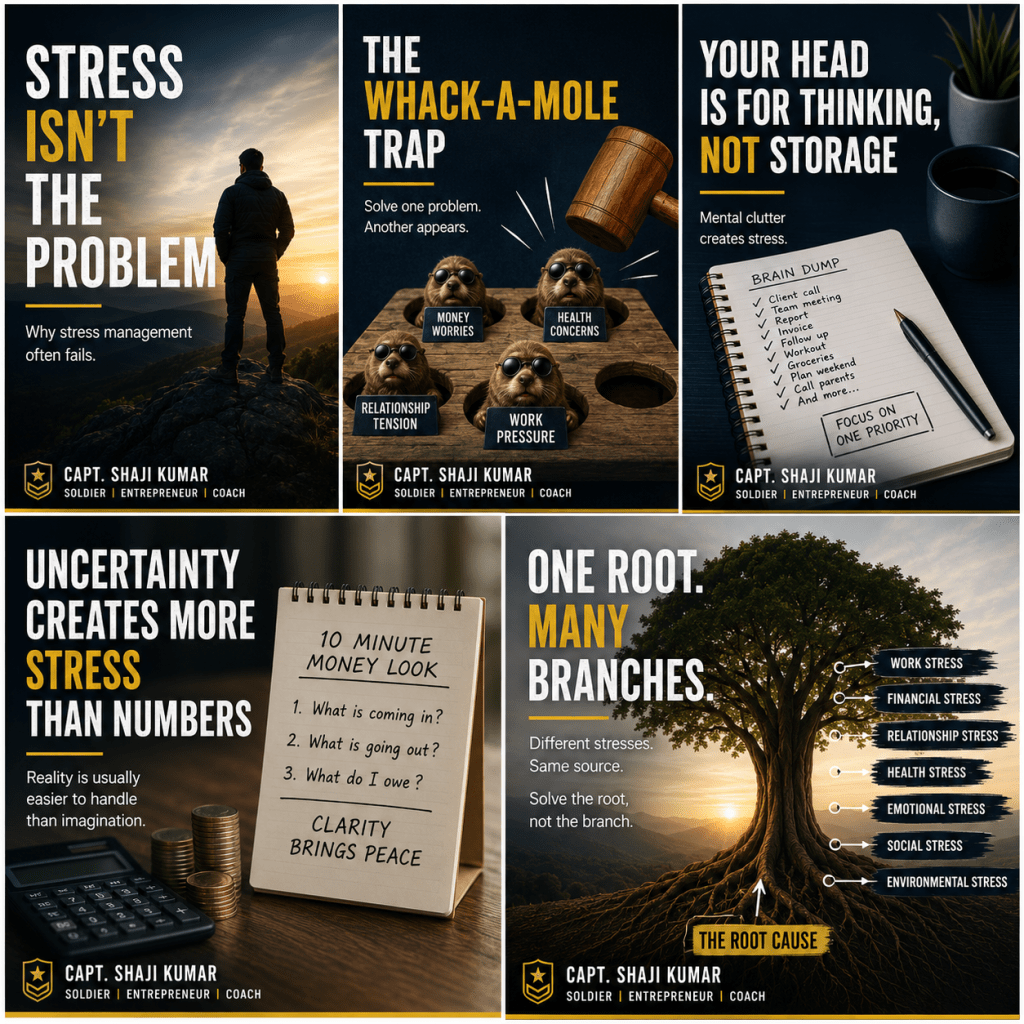
    There is a game at every fair. A row of holes, a soft mallet, and a plastic mole that pops its head up. You hit it. It drops. Another appears somewhere else. You hit that one. A third pops up. The faster you swing, the faster they come. You never win. You only get tired.

    That game is the most honest picture I know of how most of us manage our time.

    We feel stressed, so we go looking for a better system. A new planner. A new app. Time-blocking. The two-minute rule. Eat the frog. Inbox zero. Each one works — for about a week. The relief drains away, the pressure resurfaces somewhere else, and off we go to buy the next mallet.

    I played that game for the better part of twenty years. I want to tell you what I finally understood, because it changed how I work — and, more importantly, how I feel while I work.

    I had it backwards

    I am a former soldier and a first-generation businessman. I built a services business across India from almost nothing — no outside investor, close to four decades around people and pressure. Solving problems by force of will is, frankly, what I am good at. Give me an objective and I will take it head-on, with discipline, one task at a time.

    That approach worked on everything except one thing: the constant, low-grade hum of feeling stressed and behind.

    I treated it the way I treated every other problem — as a time problem. If I felt stressed, I must be disorganised. So I organised harder. Better lists. Tighter schedules. Earlier mornings. And every system handed me the same result: a short burst of control, then the pressure quietly seeping back in.

    It took me an embarrassingly long time to see the obvious. I was hitting moles. I was never touching whatever sent them up.

    Your to-do list is a symptom, not a cause

    Here is the distinction that finally set me free.

    Your overflowing to-do list is not the cause of your stress. It is a symptom of it.

    Sit with that for a moment, because everything turns on it.

    When you are calm, a long list is just a long list. You pick up the item on top and you start. When you are already stressed, that same list becomes a threat. Every item shouts at once. You freeze, you scatter, you refresh your inbox for the ninth time, and three hours vanish with nothing real to show for them.

    Same list. Same hours. Completely different experience.

    The difference was never the schedule. It was the state of the person reading it.

    This is why the productivity hack always disappoints in the end. It is excellent at trimming the branches — and the branches do need trimming. But it never goes near the root. So the tree keeps producing. You stay busy, you stay behind, and you stay tired.

    The hidden tax of a hot nervous system

    We talk about stress as if it were only a feeling. It is also a thief of time, and a quiet, expensive one.

    A stressed mind makes worse decisions, so you redo work. It cannot hold attention, so simple tasks take twice as long. It catastrophises, so you spend energy on problems that never arrive. It reaches for distraction, so an hour leaks away in scrolling you barely remember. None of this shows up on your calendar, but all of it is billed to your day.

    So when you feel you have no time, look closer. Often you have plenty of time — you are simply paying a heavy tax on every hour because the operator is running hot. Lower the temperature, and hours you thought were lost quietly come back.

    I have watched this in my own week, plainly. On the days I am calm, I do a full day’s work by mid-afternoon and wonder where the pressure went. On the days I am wound tight, I am at my desk from dawn to dark and finish convinced I never caught up. The workload on both days is roughly the same. The only variable that moved was me.

    Which means the real work happens on two levels at once. The branch and the root. Let me give you one practical thing for each. Today. No app required.

    The trap of the perfect system

    There is a particular cruelty in the productivity industry, and it took me years to name it. The search for the perfect system becomes a stressor of its own.

    Think about what actually happens when you adopt a new method. There is the reading. The setting up. The migrating of old lists into the new format. The learning curve. The quiet guilt the first time you fall off it. And then, when it inevitably fails to deliver the calm it promised, there is the disappointment — followed by the search for the next one. The tool that was meant to reduce your load has become another item on it.

    I am not telling you to throw your systems away. A sensible list and a clear calendar are good servants. I am telling you to stop expecting them to do a job they were never built for. A calendar can order your hours. It cannot calm your mind. Asking it to is like asking a sharper axe to make the tree stop growing. The axe is fine. You are aiming it at the wrong place.

    Once you stop demanding peace from your planner, something relaxes. The planner goes back to being a simple, useful thing. And your attention is freed for the two moves that genuinely change how a day feels.

    The branch: do one thing at a time

    We have been sold a lie about multitasking. We were told it makes us efficient. It does the opposite.

    Your attention is not a floodlight that fills the whole room. It is a torch. It points at one thing. When you “multitask,” you are not doing two things at once — you are whipping the torch back and forth, and every swing leaves a smear of the last task on the next. Researchers call it attention residue. You know it as that foggy, frazzled feeling of being busy all day and accomplishing nothing.

    Here is the fix, and it is almost insultingly simple.

    One thing. Phone in another room.

    Not on silent. Not face-down. In another room. The mere sight of it on your desk taxes you, because some part of your mind is standing guard over it. Move it, and that guard goes off duty.

    Then take the single most important task on your list and give it one clean, undivided hour. When your mind reaches for something else — and it will, within ninety seconds — notice the pull and gently bring the torch back. Drift, notice, return. That is the whole discipline.

    You will get more done in that one clean hour than in a whole frantic morning of switching. And — this is the part that matters for stress — you will finish it calmer than you started. Focus is not only productive. It is settling. A mind doing one thing is a mind at rest.

    That is branch work. It is real and it works. But it is first-aid, not the cure.

    The root: the most productive thing you will do all day is nothing

    Now the part almost nobody wants to hear.

    If your nervous system is running hot, no system on earth will hold. You will time-block a flawless day and then spend it anxious. You will clear your inbox and feel no lighter. Because the pressure was never in the inbox. It was in you — a stored backlog of stress that colours everything you look at.

    You cannot out-organise that backlog. You can only drain it. And it drains through rest — a specific, deliberate kind of rest, not collapsing in front of a screen.

    For me, that rest is meditation. Twenty minutes, twice a day. Sit comfortably, eyes closed, let your attention rest lightly on the breath or on a soft repeated word. When you drift, return. Drift, notice, return. That is all of it. No incense, no perfect posture, no belief required.

    “But I don’t have forty minutes”

    I know exactly how that sounds to a results-driven person. Forty minutes a day doing nothing, while the list is screaming? It feels like the least productive thing imaginable.

    It is the most productive thing I do, and I do not say that loosely.

    Those forty minutes change the quality of the other fifteen hours. The same workload stops feeling like a threat. I make sharper decisions. I stop reacting and start choosing. I waste far less of the day on the scattered, frantic busywork that stress manufactures. The reservoir lowers, and the moles stop popping up so fast.

    You will not feel any of this from reading about it. That is the honest truth of the thing. The reservoir does not drain because you understood the idea. It drains because you sit.

    A day rebuilt around the root

    Let me show you the shape of it. Not theory — something you could copy tomorrow.

    Begin with the rest, before the noise. Twenty minutes before the inbox owns you. You are not stealing time from your work; you are setting the temperature of everything that follows.

    Then, one clean hour on the thing that matters most. Phone in another room. Torch on one task.

    Do the small, sane things that keep the branches in check. When the work feels like too much, stop and empty your head onto a single page — every loose task, every worry, out of the mind and onto paper. Then pick the one item that, once done, makes the rest lighter. Do that one. The list shrinks faster than you expect, and the panic shrinks with it.

    In the late afternoon — when most people hit the slump and reach for caffeine and another round of frantic switching — sit again. The second rest. It carries you into the evening as a person rather than a wrung-out version of one.

    I watched a young founder I mentor try exactly this. He came to me convinced he needed a better app. His real problem was that he started every morning by opening his phone in bed, and by the time his feet hit the floor he was already behind, already reacting, already at a sprint. We changed nothing about his tools. We changed the first and the last forty minutes of his day. Within a fortnight he told me the work hadn’t got any smaller — but it had stopped feeling like it was chasing him.

    Notice what that is. It is not a tighter schedule. It is a calmer operator running an ordinary one.

    The belief to carry

    I will leave you with the line I now keep close, because it reframes the whole business.

    Stress is not happening to you. It is happening in you — and what happens in you, you can learn to tend.

    Your calendar is not your enemy. Your task list is not your enemy. The frantic swinging is. The belief that if you could just find the perfect system the pressure would finally lift — that is the mole you have to stop chasing.

    So trim the branches: one thing at a time, phone in another room. But do the quieter, harder, more valuable work as well. Tend the root. Sit. Drain the reservoir.

    Manage the pressure, and you will find the time was never really the problem.

    — Capt. Shaji Kumar

    If this landed, it’s the spine of a handbook I’ve been working on — Stress Isn’t the Problem: A Do-It-Yourself Handbook to Stop Chasing Stress and Solve It at the Source. It’s the full method: the seven branches and the one root. Out on Amazon, first week of July. I’ll share the link here the day it’s live. 🌱
  • Why Stress Management Doesn’t Work

    Why Stress Management Doesn’t Work

    Why Stress Management Doesn’t Work.

    And the day I realised I had been fighting the wrong enemy.

    For nearly twenty-eight years, I believed stress was the problem. So I did what most of us are taught to do. I managed it.

    I slept more. I exercised every day. I rebuilt my diet from a hundred YouTube videos. I worked fewer hours — which, for a man building a business, was no small thing. I took breaks. I tried every sensible solution I could find.

    And every one of them worked. For a while.

    Then the stress came back. If it wasn’t work, it was money. If it wasn’t money, it was a relationship. If it wasn’t a relationship, it was my health. It felt like a game I was never meant to win.

    Then one day a simple thought stopped me cold.

    Stress wasn’t the problem. Whatever was feeding it was.

    The Whack-a-Mole Game We All Play

    Most of us treat stress the way we would treat a leaking roof. Find the problem. Patch it. Move on. But stress almost never behaves like a roof.

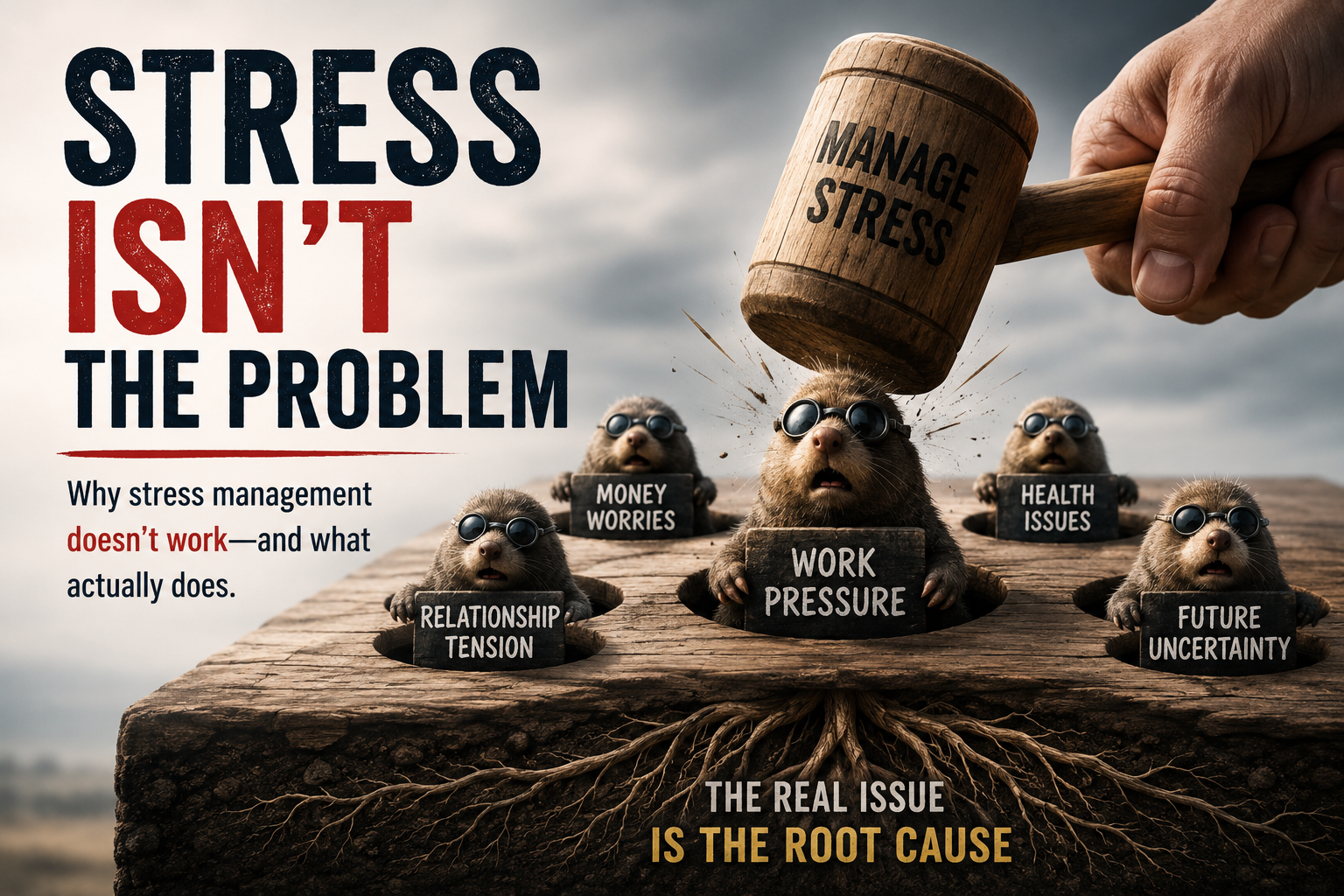
    You finally fix your sleep, and anxiety shows up. You settle the anxiety, and work pressure climbs. You handle the work, and money worries arrive. You sort out the money, and a relationship begins to strain. Stress simply changes its disguise.

    Picture that carnival game where little moles pop up from a grid of holes. You hammer one down, another springs up. You hammer that one, and a third appears. You can become very, very good at hitting moles and still never win the game.

    Most of us are playing exactly that game with our lives.

    Why Stress Keeps Coming Back

    Every hard experience leaves a mark. And most of the time, we never finish feeling it. We suppress it. We ignore it. We distract ourselves. We promise to deal with it later.

    Later rarely arrives.

    So those unfinished experiences do not disappear. They go quiet. They wait, just beneath the surface. Then one ordinary day, something small happens. A comment. An email. A deadline. A memory.

    And the reaction that comes out of us is far bigger than the moment deserves. Why? Because we are not only reacting to what is in front of us. We are reacting to years of backlog.

    The event is small. The reservoir behind it is not.

    The Mistake Modern Life Encourages

    Modern life has one piece of advice about stress: get better at managing it. More apps. More planners. More productivity systems. More hacks.

    Almost no one talks about emptying the reservoir itself.

    So we become experts at coping, and never actually become calmer. We survive. We function. We perform. And underneath it all, we stay tired.

    What Changed Everything for Me

    The turn came when I stopped asking one question and started asking another. I stopped asking, “How do I get rid of this stress?” I started asking, “Why does it keep coming back?”

    That second question changed everything. It showed me that stress was not my enemy. It was my messenger. It was simply telling me that something deeper was asking for attention.

    When I began tending the root instead of swatting the branches, things changed. Not overnight. Not by magic. But steadily. The reactions grew smaller. The mind grew quieter. The body let go of a tension it had been holding for years.

    Life did not get easier. I got calmer. That is a different thing entirely.

    A Seven-Day Experiment

    You do not have to take my word for any of this. Test it.

    For the next seven days, whenever you feel stress rising, pause and ask yourself one question:

    “Is my reaction bigger than the event in front of me?”

    If the honest answer is yes, then what you are feeling is probably older than today. That single piece of awareness changes your relationship with stress. You stop fighting it. You start understanding it. And understanding is almost always the first step toward freedom.

    The Real Goal

    For years I was certain that stress was ruining my life. I see it differently now.

    Stress was not ruining my life. Whatever I refused to face was.

    The moment we stop chasing symptoms and start looking for the source, stress becomes easier to understand, easier to carry, and — in time — easier to overcome.

    Maybe the goal was never to get better at handling stress. Maybe the goal is to stop feeding the thing that creates it.

    Capt. Shaji Kumar is a former soldier, entrepreneur, and coach. He writes on discipline, stress, personal growth, and practical life mastery. His latest book, Stress Isn’t the Problem, explores the real roots of stress — and a simple, soldier’s system for finding calm at the source.

  • HEALTH in your HANDS. Part 8 “HEAL YOURSELF FIRST. STRESS SERIES 4 OF 4. The 21-Day Stress Reset — A Daily Practice That Actually Holds

    HEALTH in your HANDS. Part 8 “HEAL YOURSELF FIRST. STRESS SERIES 4 OF 4. The 21-Day Stress Reset — A Daily Practice That Actually Holds

    You have read the theory. You have understood the points. Now it comes down to this: twenty-one days of showing up for your own body. Not perfectly. Just consistently.
    Why 21 Days?

    The popular notion that habits form in twenty-one days is, strictly speaking, an oversimplification. Research on habit formation suggests that the timeline varies widely — anywhere from eighteen to sixty-six days depending on the complexity of the behaviour and the individual. But twenty-one days is not arbitrary. It represents three complete biological cycles of several key systems: the gut lining renews itself every three to five days (so twenty-one days is four to seven full cycles), and many hormonal rhythms operate on seven-day patterns.

    More practically: twenty-one days is long enough to produce measurable change and short enough to feel achievable. It is a commitment you can make without it feeling like forever. And the changes you will notice by Day 21 — if the practice is consistent — are real enough that continuing becomes its own motivation.

    This post is your complete map. Morning routine, evening routine, crisis protocol for acute stress moments, the dietary framework, and the sleep hygiene protocol. Everything from Posts 1, 2, and 3 comes together here into a single, coherent daily practice. You do not need all of it at once. Start with what feels most accessible, and build.

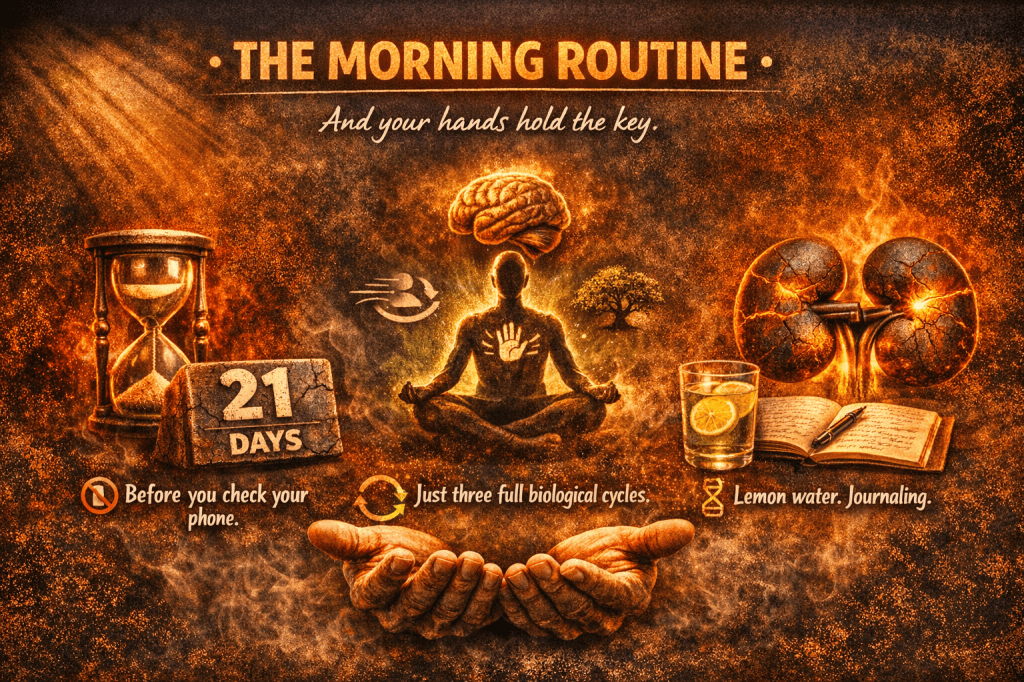
    The Morning Routine – Before You Check Your Phone.

    This is the most important instruction in the entire series: do the morning practice before you look at your phone. The moment you check your phone, your nervous system receives input — news, messages, social media, notifications — that begins the sympathetic activation cycle. Once that cycle starts, you are already managing its consequences rather than preventing them. Give your nervous system twenty-one minutes of its own signal before you give it the world’s.

    The Full Morning Sequence — 21 Minutes

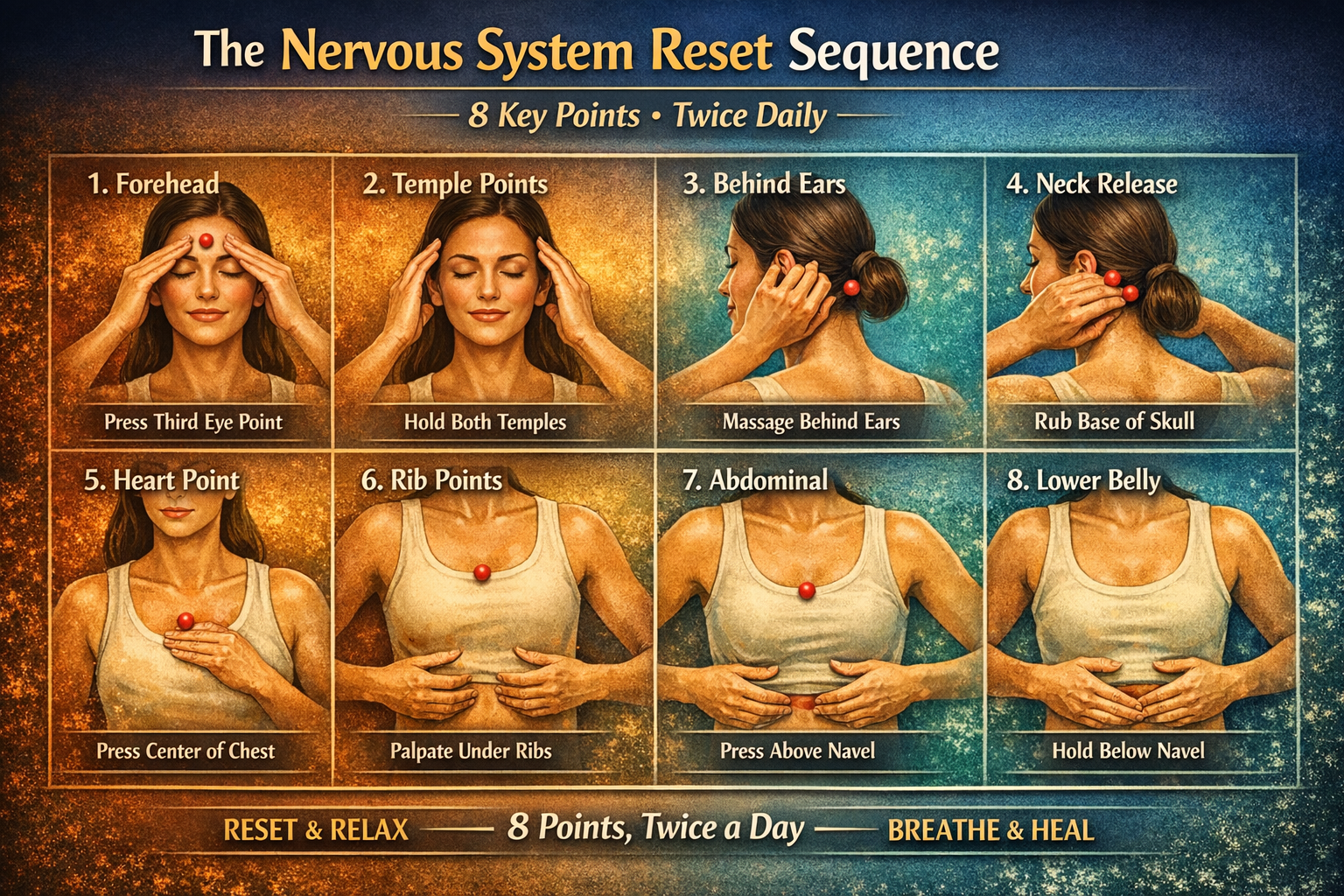
    1. Wake without reaching for your phone. Lie still for one minute. Notice your body.

    2. Three rounds of 4-7-8 breathing: In 4, hold 7, out 8. Vagus nerve activated.

    3. GV 20 (crown) + Yintang (third eye): 90 seconds each, gentle sustained pressure.

    4. HT 7 + PC 6 on both wrists: 2 minutes simultaneously. The emotional anchors.

    5. KD 1 (soles, both feet): 2 minutes. Grounding before you stand up.

    6. LV 3 (between toes 1 and 2): 90 seconds each foot. Releasing the night’s holding.

    7. Warm water with lemon: before any food, before any caffeine. Sit while drinking it.

    8. Three minutes of journalling: one question only — ‘What is within my control today?’

    Total: 21 minutes. This is not self-indulgence. It is the most productive thing you will do all day.

    Everything that follows in the next sixteen waking hours will be qualitatively different.

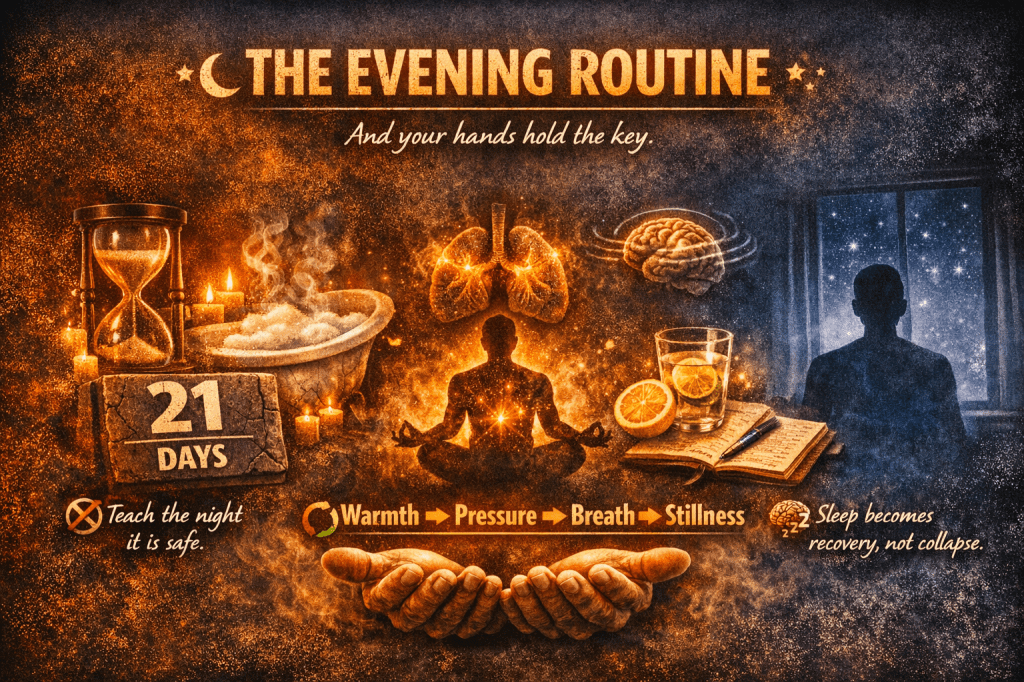
    The Evening Routine – Teaching the Night it is Safe.

    The Evening Routine — Teaching the Night It Is Safe

    The evening practice has one job: to send the nervous system a clear, consistent signal that the day is over and safety has arrived. This signal is not just psychological — it is physiological, and it requires physical inputs to be received. The sequence below provides those inputs in the correct order: sensory input reduction first, then warming, then acupressure, then breath, then stillness.

    The Full Evening Sequence — Last 25 Minutes Before Sleep

    1. Screens off or night mode: hard stop on news, social media, anything requiring decisions.

    2. Warm shower or hot foot soak: temperature drop after warmth triggers sleep hormones.

    3. GB 21 + BL 10: shoulder summit and skull base release — where the day’s stress is stored.

    4. SP 6 + KD 1: inner ankle and soles — the deepest calming points in the lower body.

    5. Yintang + CV 17: third eye and heart centre — quieting the mind and the emotional body.

    6. 4-7-8 breath, five rounds: lying down, eyes closed. This is the final physiological signal.

    7. Three things you are grateful for: not performance — genuine noticing. The brain records safety.

    8. Sleep — the nervous system in genuine rest mode, not collapsed exhaustion.

    This sequence, practiced for seven consecutive nights, will change the quality of your sleep.

    After twenty-one nights, it will have changed your relationship with the night entirely.

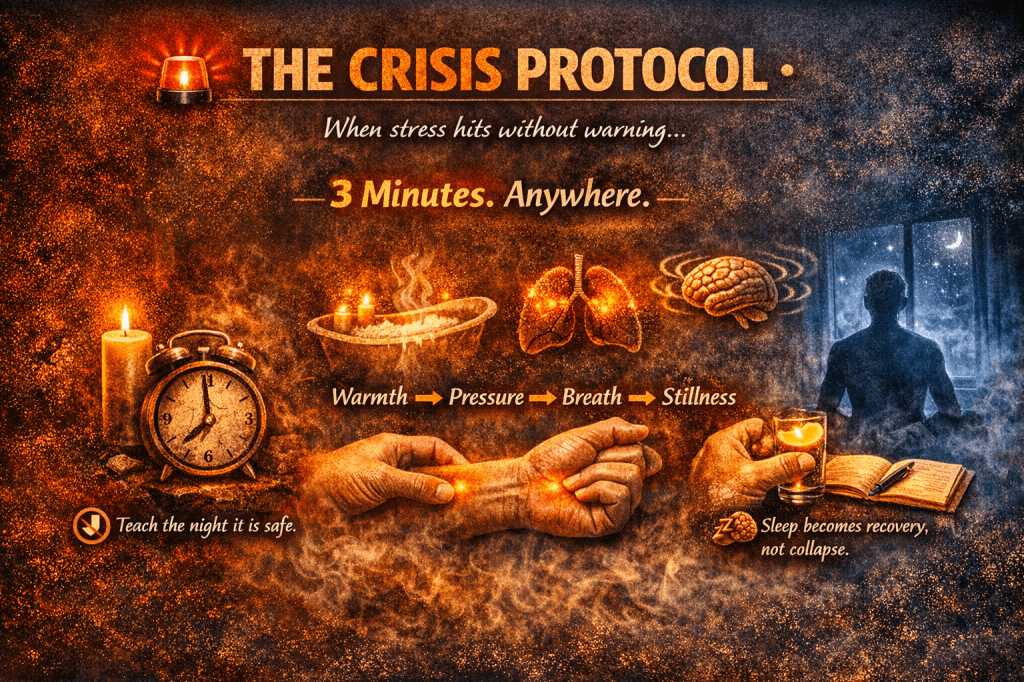
    The Crisis Protocol – For When Stress Hits Without Warning.

    The Crisis Protocol — For When Stress Hits Without Warning

    The daily practice addresses chronic stress. But acute stress — the sudden confrontation, the unexpected bad news, the panic that arrives without warning — needs its own protocol. The three-minute sequence below is designed to be used anywhere, invisibly, at the moment stress arrives rather than hours later.

    The 3-Minute Crisis Protocol

    STEP 1 — 30 seconds: Two rounds of 4-7-8 breath. Eyes can stay open. Nobody needs to know.

    STEP 2 — 45 seconds: One finger pressed firmly on Yintang (between eyebrows). Eyes closed if possible.

    STEP 3 — 45 seconds: HT 7 + PC 6 on both wrists simultaneously. Breathe into the pressure.

    STEP 4 — 30 seconds: LI 4 (web of thumb): firm pinch, both hands. Exhale with the pressure.

    STEP 5 — 30 seconds: Return to breath. 4 counts in, 6 counts out. Return to presence.

    Use this in the car, in a meeting break, in a bathroom, before a difficult conversation.

    Cortisol measurably drops within three minutes of vagal activation. This protocol delivers it.

    The 21-Day Dietary Framework.

    Daily Foundations (Non-Negotiable)

    Warm water with lemon: First thing, before anything else. Every single morning.

    One serving fermented food: Curd, kefir, kanji, kimchi, or buttermilk. Non-negotiable for the gut-brain axis.

    Handful of walnuts or pumpkin seeds: Omega-3 and magnesium in one small handful. Morning snack.

    Two Brazil nuts: Daily selenium for thyroid hormone conversion. Two only — more is unnecessary and counterproductive.

    One tablespoon ground flaxseed: In porridge, smoothie, or curd. Omega-3, lignans, and prebiotic fibre.

    This Week, Eliminate These (One at a Time):

    Week 1: No caffeine after 1pm. This single change will shift sleep quality faster than almost anything else.

    Week 2: No alcohol on weekdays. Alcohol is a cortisol trigger and a sleep architecture disruptor — two things you cannot afford during a stress reset.

    Week 3: Replace one ultra-processed meal per day with something whole. Not perfection — one meal. The compounded effect of three weeks of this is measurable in inflammatory markers.

    What to Add (One at a Time):

    Week 1: Ashwagandha root extract (300mg) with dinner. The most evidence-supported adaptogen for cortisol reduction.

    Week 2: Magnesium glycinate (200-400mg) before sleep. Research consistently shows improvement in both sleep quality and stress response.

    Week 3: One meal eaten in complete silence, without a screen. The nervous system needs to experience food as safe, not as background to stimulation.

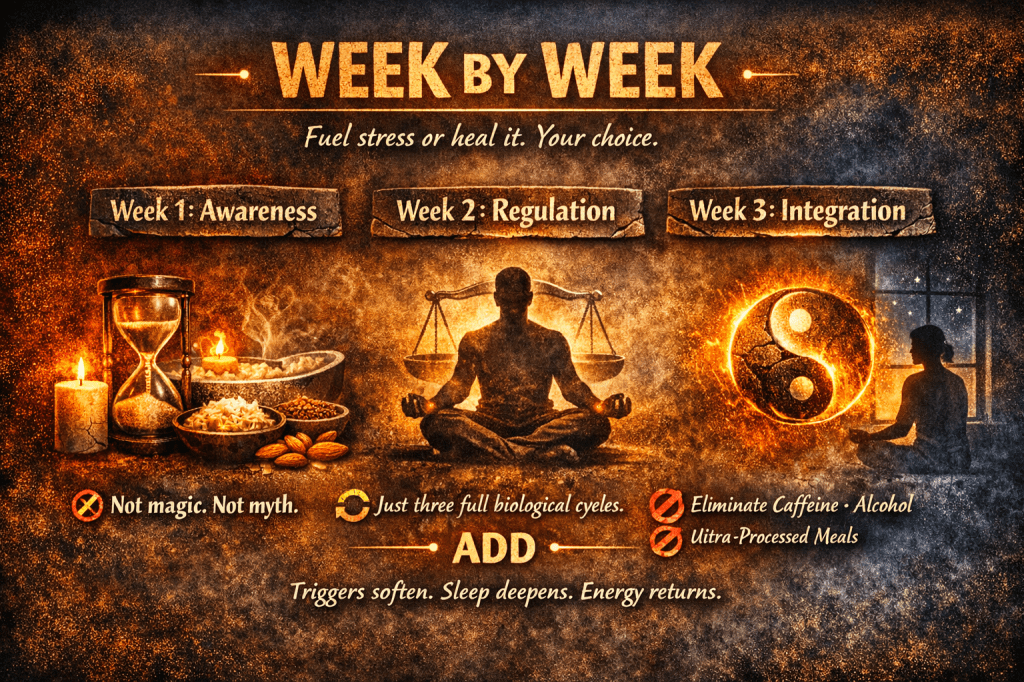
    Week by Week – What to Watch For.

    Change with stress does not arrive in a straight line. There are days in Week 1 when you will feel more tired than before — that is the parasympathetic system finally getting enough space to process what has accumulated. This is not failure. It is the beginning of genuine recovery. Here is a more detailed map of what each week brings:

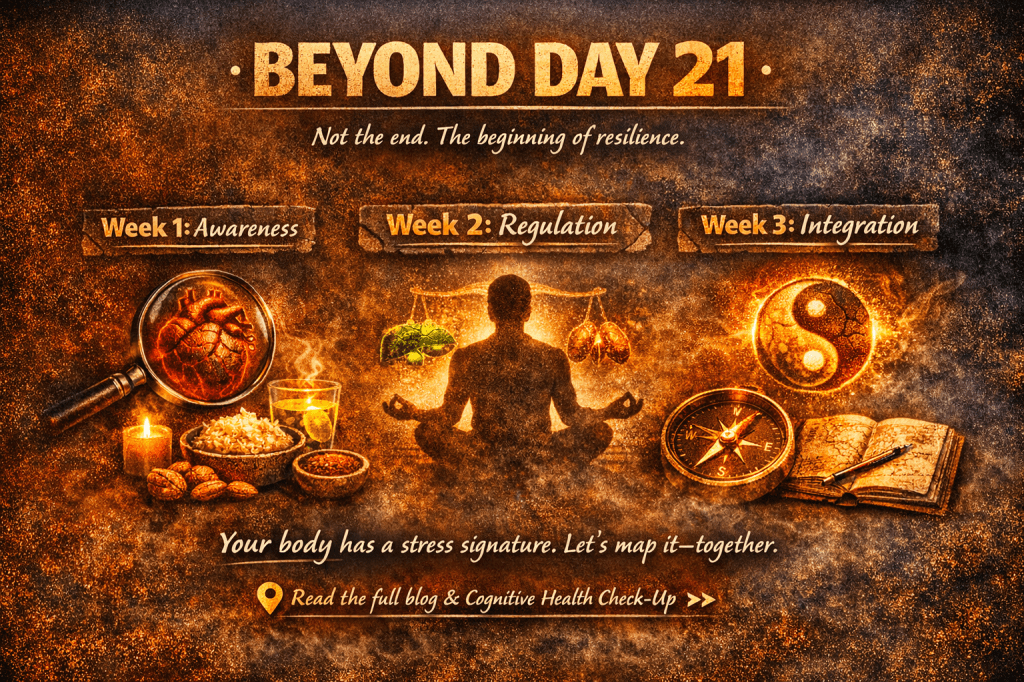
    Days 1 to 7 — The Awareness Week

    The most important thing that happens in Week 1 is not physical improvement — it is the beginning of awareness. You start to notice when your shoulders tighten.

    You catch yourself holding your breath. You feel the difference between the morning of Day 7 and the morning of Day 1 — and the difference, while not dramatic, is real. The points will be tender, particularly KD 1, HT 7, and GB 21. Tender means engaged. Stay with it.

    Sleep will likely show the first changes: not necessarily that you sleep more, but that the quality of the sleep you do get deepens. The 4-7-8 breath paired with the evening points is usually responsible for this. Some people notice it from Night 3 onward. 

    Days 8 to 14 — The Regulation Week

    By Day 8, the practice is beginning to feel less like a task and more like a ritual. The nervous system has now received fourteen days of consistent parasympathetic input — enough to begin establishing a new pattern. Cortisol output starts to regulate more predictably. The morning spike that launches many stressed people into reactivity before they have even had breakfast begins to soften.

    Point tenderness decreases measurably. HT 7 in particular — which is often exquisitely tender in the first week — becomes more comfortable under pressure.

    This is a direct indicator of reduced cardiac stress load. BL 23 (lower back kidney point) tenderness also reduces, reflecting adrenal recovery. Track these changes — they are your body’s own progress report.

    Days 15 to 21 — The Integration Week

    This is where the shift becomes qualitative, not just quantitative. People in Week 3 of this practice consistently report the same cluster of observations: things that would have triggered a stress response two weeks ago now feel manageable.

    The internal distance between stimulus and response has grown. This is not detachment — it is regulation. The nervous system, given consistent signalling, has recalibrated its threat threshold.

    Physically: resting heart rate has typically dropped several beats per minute. Blood pressure, if it was elevated, shows improvement. Digestion has normalised — the gut responds rapidly to nervous system regulation. Skin, if stress was affecting it, begins to clear. Energy — not the jittery energy of cortisol, but the sustained, even energy of a body that is genuinely resting and genuinely working in turn — returns.

    Beyond Day 21 – Making it Yours.

    Beyond Day 21 — Making It Yours

    Twenty-one days is the beginning, not the destination. Once the practice is established — once it has become as automatic as brushing your teeth — the question becomes: how do you deepen it? How do you move from stress management to genuine stress resilience?

    The answer, in my experience, is personalisation. The sequences in this series are designed to be broadly effective for most people. But your body has a specific stress signature — particular points that are more relevant to you than others, particular times of day when you are most vulnerable, particular organ systems that carry the heaviest load. A personalised protocol, built around your specific pattern, is significantly more efficient than a general one.

    That is what I offer in a consultation — not a replacement for this series, but a deepening of it. If you have done the twenty-one days and want to go further, I can help you read what your body is showing us and design the next stage of your practice with precision.

     Ready to Go Deeper?

    Book a personalized consultation to map your stress-organ pattern and build your protocol.

    In Association with World Health Journey Take your Cognitive Health Check-Up: www.whjonline.com/mmpi-2

    Series Complete – The Heal Yourself First series continues daily.

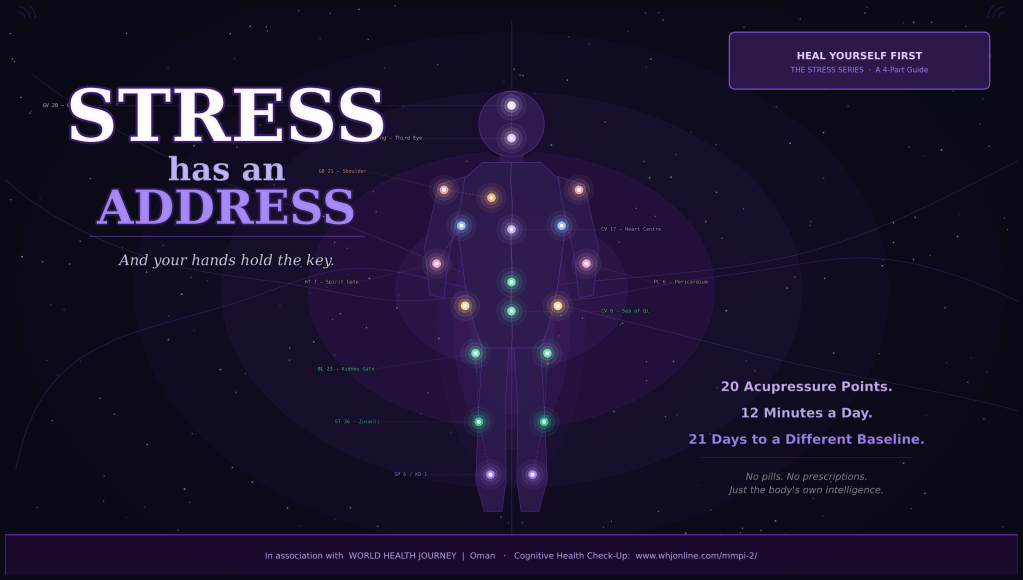
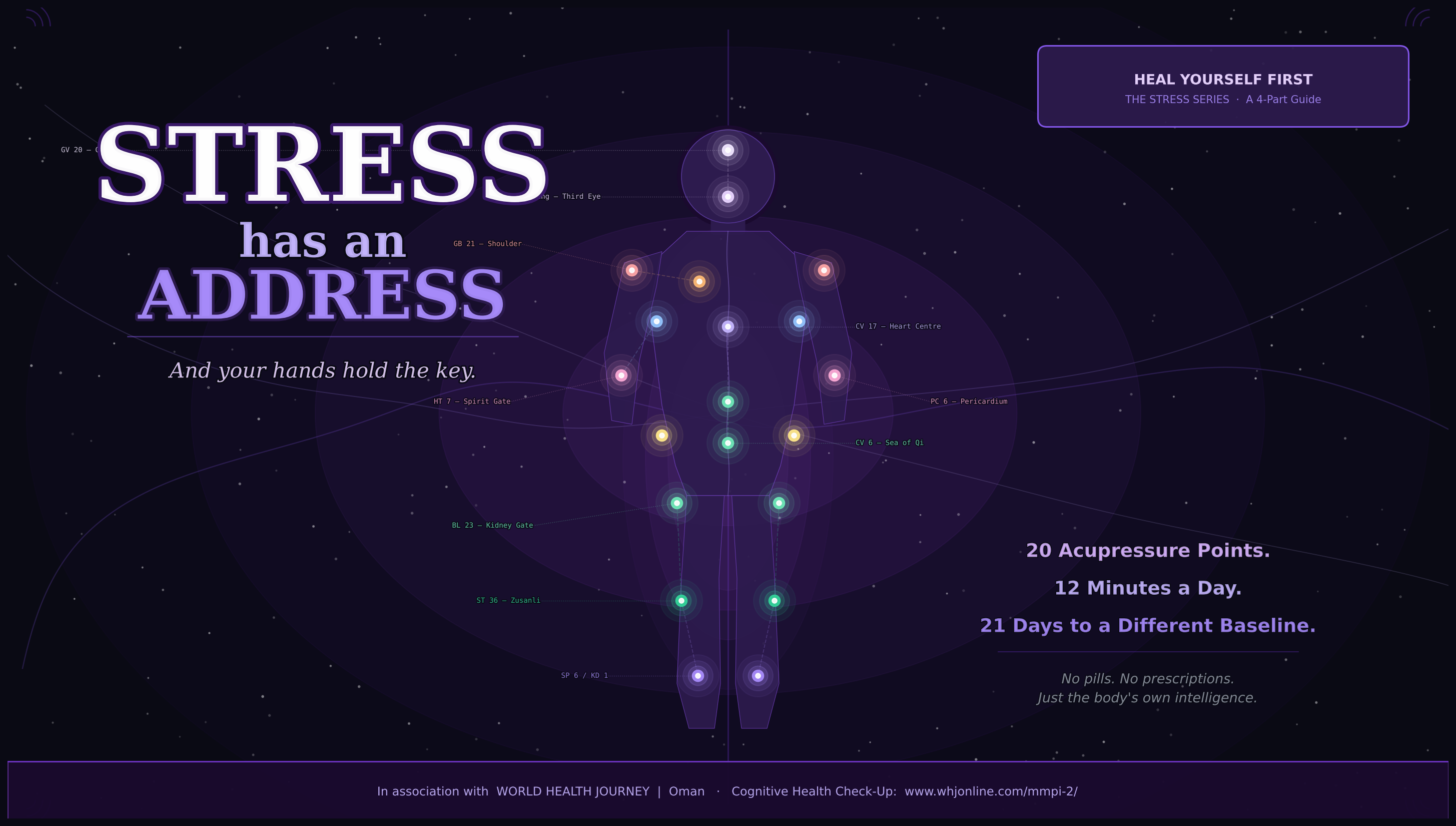
  • HEALTH in your HANDS. Part 7 “HEAL YOURSELF FIRST. STRESS SERIES 3 OF 4 Stress Has an Address — It Lives in Your Organs (And Here Is How to Evict It)

    HEALTH in your HANDS. Part 7 “HEAL YOURSELF FIRST. STRESS SERIES 3 OF 4 Stress Has an Address — It Lives in Your Organs (And Here Is How to Evict It)

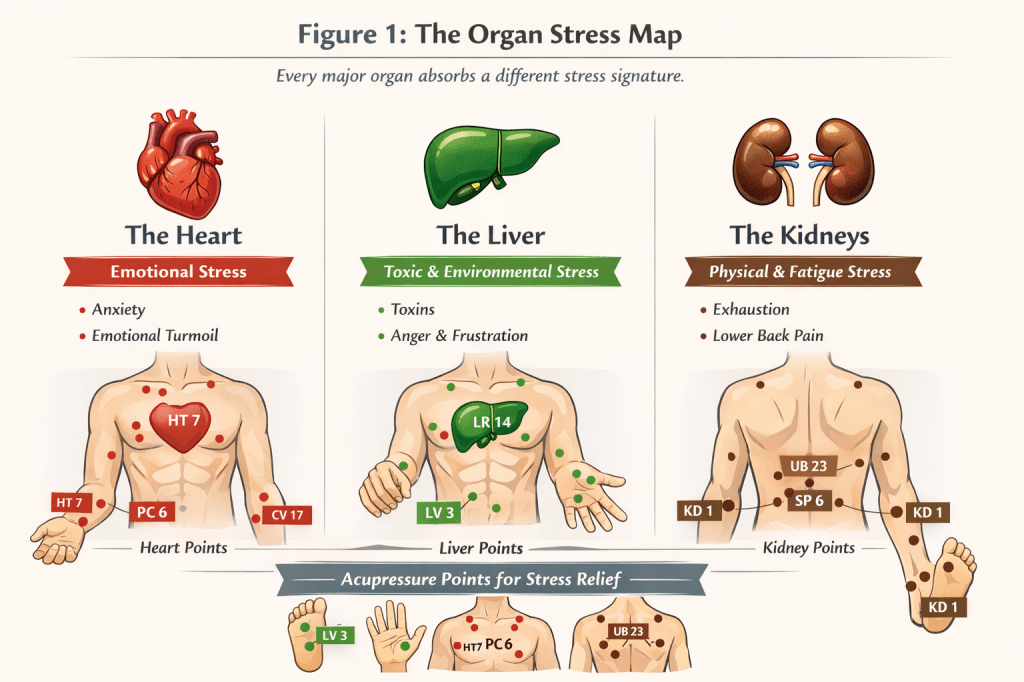
    The Body Keeps the Score — Organ by Organ.

    Your body has been keeping a very detailed record of everything you have been through. It is written in your organs. Time to read it — and respond.

    There is a reason this phrase has become famous in the world of trauma and stress research. The body does not experience stress as an abstract event that happens to the mind. It experiences it as a physical event that happens to tissue, glands, organs, and cells. And over time, the tissue remembers.

    In traditional Chinese Medicine, this understanding is thousands of years old — and expressed with elegant precision. Each major organ is associated not just with a physiological function but with an emotional domain. The heart with joy and its absence. The liver with smooth flow and, when disrupted, with anger and frustration. The kidneys with the capacity to face life without fear. The lungs with the ability to take in and let go — breath by breath. When stress persists, these emotional-organ relationships become sites of accumulation. The organ that carries the load eventually shows it.

    Today’s post maps exactly where your specific stress pattern might be living — and gives you a targeted acupressure protocol for each organ system. You will likely recognise your own pattern before you finish reading.

    The Heart — When Stress Becomes a Feeling You Cannot Name

    The Chinese medical classics describe the Heart as the emperor of all organs — the one that must remain calm and clear for all the others to function. When stress is relentless and the Heart is disturbed, the first sign is rarely physical. It is the inability to feel settled. The sense that something is wrong even when nothing specific is wrong. The racing thoughts at night. The disproportionate emotional response to small things. These are signs that the Heart’s Shen — its governing spirit and consciousness — is disturbed.

    Physically, the heart under stress shows up as palpitations, elevated resting heart rate, blood pressure that is persistently high even when you are trying to rest, and a strange kind of chest tightness that comes and goes without a clear cause. Long-term, the cardiovascular consequences of unresolved stress are among the most serious and well-documented in medicine.

    Heart Protocol

    CV 17 (sternum centre): 2 minutes, sustained and gentle, with slow breath

    BL 15 (back, level with heart): Tennis ball or partner press, 90 seconds, eyes closed

    HT 7 (wrist crease, Spirit Gate): 2 minutes, press steadily while breathing out slowly

    PC 6 (inner wrist, 2.5 fingers up): 90 seconds each wrist — the Heart’s protector point

    Lifestyle addition: One tablespoon of raw honey in warm water each morning has been used across traditional medicine systems to support the heart and calm the spirit. Add a small pinch of cardamom — a heart-supportive spice with documented vasodilatory properties.

    The Liver — Where Frustration Goes to Live

    Of all the organ-stress relationships in Chinese medicine, the Liver-stress connection is perhaps the most immediately recognisable to a modern audience. When the Liver qi is constrained — when the smooth flow of energy through the body is blocked — the emotional signature is unmistakable: irritability that arrives before you have even had time to think, a short fuse that surprises even you, the feeling of things being stuck or obstructed, tension in the sides of the body and the ribcage.

    Sound familiar? For most people living with chronic stress, the liver meridian is involved. And the physical consequences of long-term liver qi stagnation are not trivial: disrupted hormone metabolism, impaired detoxification, elevated inflammatory markers, digestive disturbance (the liver and the digestive system are intimately linked), and increasingly, research connecting liver health to mood disorders in ways that blur the traditional line between ‘physical’ and ‘mental’ health.

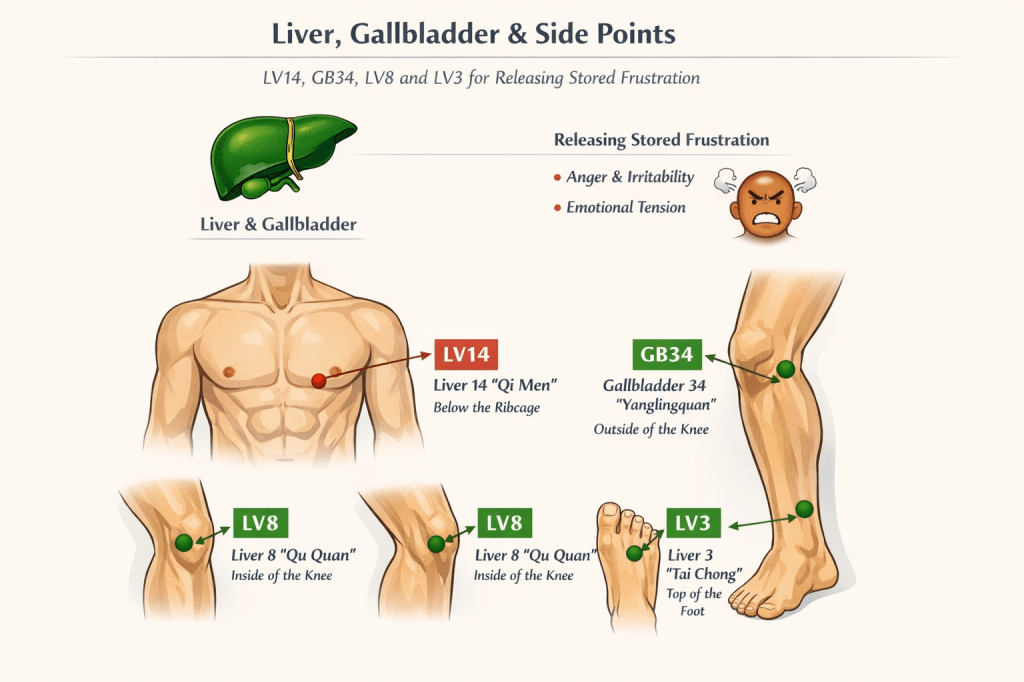
    Liver Protocol

    LV 3 (between first and second toes): The liver’s primary release valve — 90 seconds each foot, firm press, breathe through the tenderness

    LV 14 (below breast, 6th intercostal): 90 seconds each side — the liver’s alarm point on the chest, often exquisitely tender

    GB 34 (below outer knee): Influential point of the sinews — releases muscle tension from stress and frustration

    LV 8 (inner knee crease): Nourishes liver blood — important for those with fatigue and emotional volatility from long-term stress

    Lifestyle addition: The liver performs most of its detoxification work between 1am and 3am — which is exactly when stressed individuals with liver qi stagnation tend to wake. Going to bed by 11pm, drinking warm lemon water on waking, and avoiding alcohol entirely during stressful periods are the three most impactful liver lifestyle choices.

     The Kidneys — When Fear Has Been the Background Note for Too Long

    In Chinese medicine, the Kidney is the organ of fear and of fundamental vitality. When fear — not acute fright, but the low-grade existential anxiety of modern life, the worry about the future that never fully resolves — becomes chronic, it depletes the Kidney system. What this looks like physiologically is adrenal exhaustion: the state of being tired but unable to rest, depleted but unable to switch off, anxious without a specific cause.

    The kidneys govern the bones, the lower back, the knees, the ears, and the hair. Chronic stress-induced kidney depletion shows up as persistent lower back ache, knee weakness, tinnitus, premature greying, and the specific kind of exhaustion that sleep does not fully resolve. If this description feels accurate to you, the kidney protocol below is where to begin.

    Kidney Protocol

    BL 23 (lower back, L2 level): The Kidney’s back-shu point — tennis ball method, 2 minutes, daily

    KD 1 (sole of foot, centre): The grounding point — 2 minutes each foot, morning barefoot is ideal

    KD 3 (inner ankle, behind bone): The Kidney’s source point— just behind and below the inner ankle bone; press firmly for 90 seconds each side

    GV 4 (Ming Men, between L2-L3): Warm palm or heating pad, 2 minutes — rebuilds the Yang fire the kidneys need

    Lifestyle addition: Black sesame seeds, kidney beans, walnuts, and bone broth are the four most kidney-nourishing foods in both Chinese dietary therapy and modern nutritional science. A tablespoon of black sesame daily — ground and added to porridge or smoothies — is one of the simplest kidney-supportive habits there is. Reduce salt intake: chronically high sodium places direct strain on the kidney’s filtration function.

    The Lungs — Carrying Grief and the Inability to Let Go

    The lungs govern not just breathing but, in Chinese medicine, the rhythm of taking in and letting go that applies as much to experiences, relationships, and emotions as it does to air. Grief — unprocessed loss of any kind, including the smaller but cumulative losses of a stressful life: opportunities, time, health, ease — is the emotion that damages the lung system most acutely.

    People with lung-dominant stress often present with persistent respiratory symptoms (frequent colds, recurrent chest infections, chronic cough, asthma that worsens under emotional stress), a shallow, high breathing pattern that never quite settles, and a tendency to sigh frequently — which is the lung’s attempt to self-correct the breathing rhythm. They may also experience skin problems, because in Chinese medicine the lungs govern the skin and the body’s exterior.

    Lung Protocol

    LU 1 (upper chest, below clavicle): Lung’s alarm point — press firmly for 90 seconds, expect tenderness if grief is present

    LU 7 (inner wrist, above thumb side): 1.5 finger-widths above the wrist crease on the thumb side — Lung’s command point; 90 seconds each

    CV 17 (sternum centre): Opens the chest, deepens breath — 2 minutes with conscious expansion breathing.

    Breathing practice: Grief-dominant stress responds particularly well to extended exhale breathing. Breathe in for 4 counts. Breathe out for 8. The longer exhale directly stimulates the vagus nerve and physiologically represents ‘letting go.’ Five minutes of this breathing daily, specifically paired with LU 1 pressure, is a practice of profound emotional as well as physical effect.

    The Thyroid — Where Stress Disrupts the Hormonal Axis

    The thyroid gland sits at the front of the throat, and its relationship with stress is direct and increasingly well-documented. Chronic cortisol elevation suppresses thyroid hormone conversion — specifically the conversion of the inactive form (T4) to the active form (T3). This is why many people with chronic stress develop subclinical hypothyroid symptoms: persistent fatigue, weight gain that does not respond to diet, hair thinning, cold intolerance, cognitive slowing, and depression — even when a standard TSH blood test returns as ‘normal.’

    The throat is also — in both the physiological and energetic sense — the site of self-expression. The stress of suppressing what you need to say, of swallowing words and feelings, of living in environments where authentic expression feels unsafe, concentrates here. The sensation of a lump in the throat during emotional stress is not metaphor. It is the physical manifestation of unexpressed content held at the throat level.

    Figure 3: Throat, Neck & Thyroid   Points — CV22, ST9, TW17 for hormonal balance and jaw tension

    Thyroid & Throat Protocol

    • CV 22 (hollow at base of throat): One finger, very gentle pressure — never hard on the throat. Circular motion, 60 seconds. Releases the thyroid zone and the throat’s holding pattern.ST 9 (side of neck, beside Adam’s apple): CAUTION: Apply one side at a time only. Light touch — this point is near the carotid artery. 30 seconds each side, alternating. Regulates blood pressure and supports thyroid circulation.
    • TW 17 (behind earlobe): In the bony depression behind each ear — press firmly but gently for 60 seconds each side. Releases jaw clenching, TMJ tension, and the neck tightening that stress produces.

    Lifestyle addition: Iodine-rich foods support thyroid function directly: seaweed (nori, kelp), eggs, and iodised salt in moderation. Selenium, found in Brazil nuts (two daily is sufficient), is essential for thyroid hormone conversion. Avoid raw cruciferous vegetables in large quantities if thyroid function is already compromised — lightly cook them instead.

    The Anti-Stress Diet — Feeding Your Nervous System

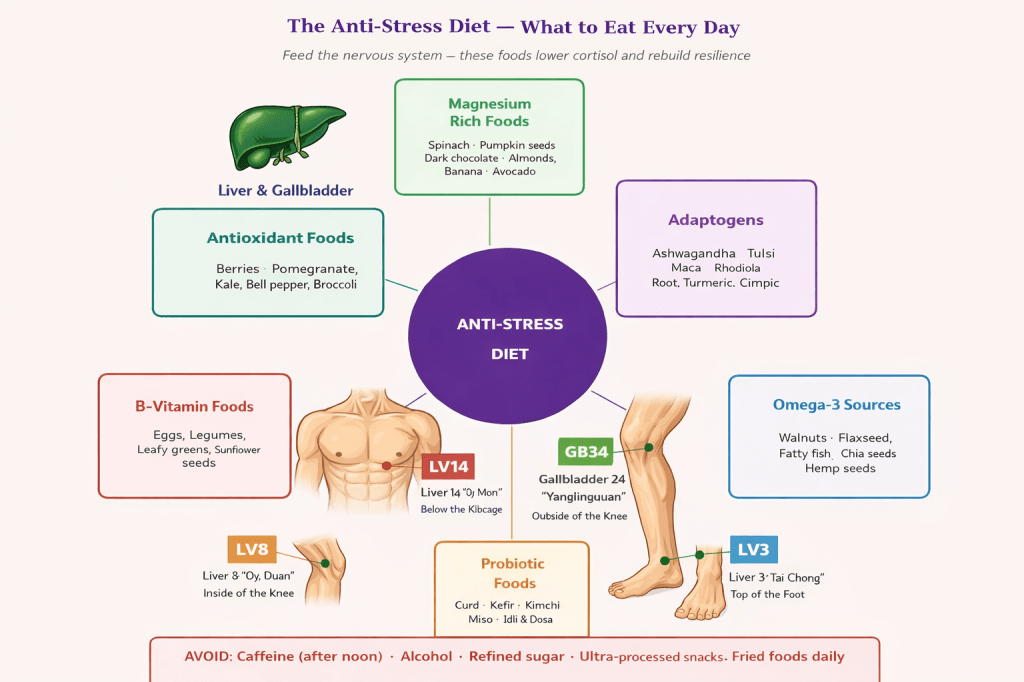
    Food is information. Every meal you eat sends a signal to the nervous system, the immune system, and the hormonal axis either in the direction of resilience or in the direction of greater vulnerability to stress. The diagram below maps the most important food categories for stress recovery — not a complicated diet, but a daily orientation toward the foods that actively support the systems stress most damages.

    The 5 Daily Non-Negotiables for a Stressed Body

    1. MAGNESIUM — Most stressed people are magnesium-deficient. Stress depletes it; deficiency worsens stress. A handful of pumpkin seeds or a tablespoon of ground flaxseed daily covers a significant portion of requirements.

    2. PROBIOTICS — The gut-brain axis is a two-way street. Stressed guts produce stressed minds, and vice versa. One serving of fermented food daily (curd, kefir, kanji, kimchi) maintains the microbiome that produces 90% of your serotonin.

    3. OMEGA-3 — Directly reduces neuroinflammation, which chronic stress generates. Walnuts, flaxseed, and fatty fish are the most accessible sources. These fats literally lubricate the nervous system.

    4. B VITAMINS — The entire B-complex is stress-depleted and stress-essential simultaneously. Eggs, legumes, and leafy greens cover the full spectrum. Avoid single-B supplements — they work as a team.

    5. ASHWAGANDHA — An adaptogenic herb with the most robust clinical evidence base for cortisol reduction. 300-600mg of root extract daily. Not a cure — an adaptation tool. Pair with the acupressure practice for compounded effect.

    The Sleep-Cortisol Loop — Breaking the Cycle

    Here is the vicious cycle that most stressed people are caught in: poor sleep raises cortisol; elevated cortisol disrupts the next night’s sleep; the resulting exhaustion lowers stress tolerance; everything feels more stressful; cortisol stays high. Around and around.

    Breaking this cycle requires targeting both ends simultaneously. The acupressure practices in this series address the cortisol side. The sleep hygiene practices below address the sleep side. Together, they give the loop somewhere to break.

    Consistent sleep and wake times — even on weekends. The circadian rhythm is the single most powerful regulator of cortisol, and it requires consistency to function.

    No caffeine after 1pm. Caffeine has a half-life of five to seven hours. A 3pm coffee is still partly in your system at midnight.

    The evening acupressure sequence (SP 6, KD 1, Yintang, HT 7) done lying in bed — this is detailed in full in Post 4 [To be published soon.

    Magnesium glycinate 200-400mg before sleep: the most evidence-supported supplement for sleep quality and cortisol reduction, with an excellent safety profile.

    No alcohol within three hours of sleep. Alcohol initially sedates but severely fragments sleep architecture in the second half of the night — producing the early-morning waking that stressed people so commonly report.

    Your organs do not hold stress against you. They are simply waiting for the signal that it is safe to let go. These practices are that signal.

    Work With Me

    Understanding which organ system is carrying the primary load of your stress — and tailoring the acupressure practice accordingly — makes the practice significantly more efficient. The same hour invested, but directed precisely.

    In a consultation, we identify your specific stress-organ pattern through a combination of symptom mapping, lifestyle history, and the classical diagnostic approaches that Chinese medicine uses to locate where in the body the stress has taken deepest root.

    Then we build your protocol — points, sequence, timing, dietary adjustments, and lifestyle shifts calibrated to your specific picture.

    Reach out: skcjos@gmail.com

    Coming in Post 4: ‘The 21-Day Stress Reset — A Daily Practice That Actually Holds’

    In Association with    World Health Journey  |  Oman

    Chronic stress does not just strain   your body — it leaves lasting psychological patterns that shape every   decision, relationship, and response you have. These patterns are measurable.

    The Cognitive Health Check-Up from   World Health Journey maps your psychological stress architecture —   identifying the emotional patterns, cognitive distortions, and resilience   gaps that chronic stress has created, before they become something harder to address.

    Begin your assessment: www.whjonline.com/mmpi-2/

    Know the pattern. Then you can change it.

  • HEALTH in your HANDS. Part 6 “HEAL YOURSELF FIRST. STRESS SERIES 2 OF 4.

    HEALTH in your HANDS. Part 6 “HEAL YOURSELF FIRST. STRESS SERIES 2 OF 4.

    Your Nervous System is Struck on Alarm.

    How to Switch it Off without a Single Pill.

    The problem is not that you cannot relax. The problem is that your nervous system has forgotten how. Let’s teach it again.

    Why You Cannot Just ‘Calm Down

    If than one person has told you to simply relax, breathe, or think positive thoughts when you are in stress, the advice is not wrong — it is just incomplete. The reason it fails is that stress does not live in your thoughts. It lives in your body. In your nervous system. In the precise calibration between two biological modes that govern every function you have: the sympathetic and the parasympathetic.

    When you are stuck on alarm — where the sympathetic nervous system is chronically dominant — telling yourself to calm down is like asking a fire alarm to stop ringing by itself. The alarm does not respond to thoughts. It responds to signals. Specific, physiological signals. And acupressure is one of the most precise ways to send those signals.

    In Post 1, [https://shajikumar.com/2026/03/16/heal-yourself-first-stress-series-1-of-4/] we looked at what stress does to your body and introduced the first tier of points. Today we go deeper: into the nervous system itself, into why some people seem permanently wired and cannot switch off even on holiday, and into the second layer of points — the ones that specifically target the adrenals, the heart, the lungs, and the spinal nervous system.

    Two Modes — One Nervous System

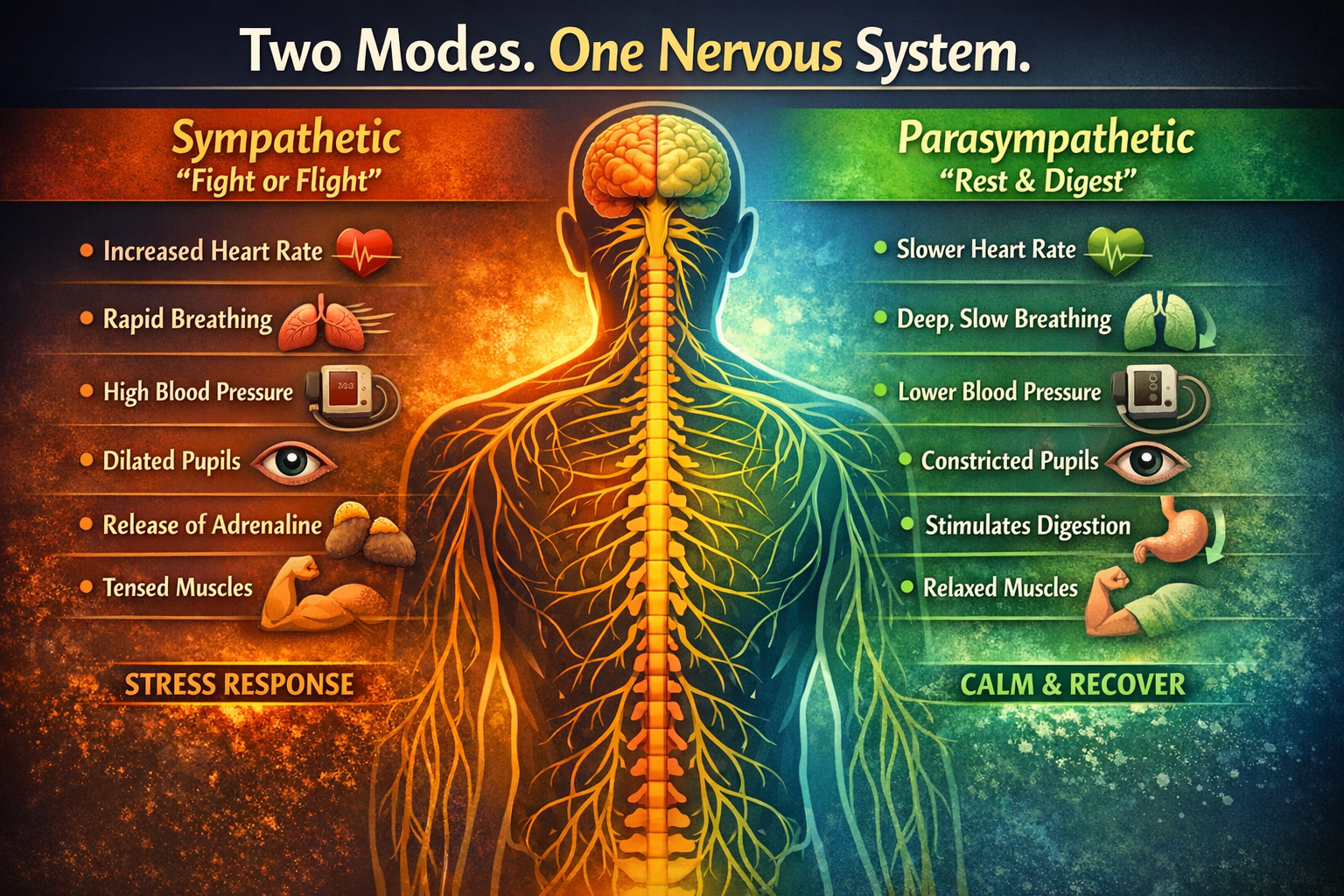
    Your autonomic nervous system runs everything that keeps you alive without you having to think about it: your heart rate, your breathing rhythm, your digestion, your immune response, your hormonal output. It has two branches, and they are meant to alternate — like breathing in and breathing out.

    The diagram above shows what each mode actually does at the organ level. What it cannot show is how profoundly unbalanced most modern lives are: for millions of people, the sympathetic system has been the default for so long that the parasympathetic feels foreign. Rest feels unearned. Stillness feels dangerous. Relaxing makes them more anxious, not less — because their nervous system does not trust it.

    This condition has a name in polyvagal* theory: chronic sympathetic activation, or more colloquial, a nervous system stuck in a low-grade fight-or-flight that never fully resolves. And the way out is not willpower. It is repetition of the parasympathetic signal, delivered consistently, until the nervous system learns a new default. That is exactly what a daily acupressure practice does.

    *The Polyvagal Theory —  In Plain Language Dr. Stephen Porges’ polyvagal theory explains why simply telling yourself to calm down does not work. The nervous system has a hierarchy of safety responses:
    Level 1 — Social engagement (safe): You feel connected, calm, curious. Vagal tone is high.
    Level 2 — Fight or flight (threatened): Sympathetic system mobilises. You are vigilant, reactive.
    Level 3 — Freeze (overwhelmed): The system shuts down. Dissociation, numbness, collapse.

    Most chronically stressed people oscillate between Levels 1 and 2, never quite fully accessing Level 1. The acupressure points in this series work by directly stimulating the vagal pathways that pull the nervous system back to genuine safety — not performed calm, but physiological calm.

    The Back Points — Where Your Nervous System’s Engine Room Sits

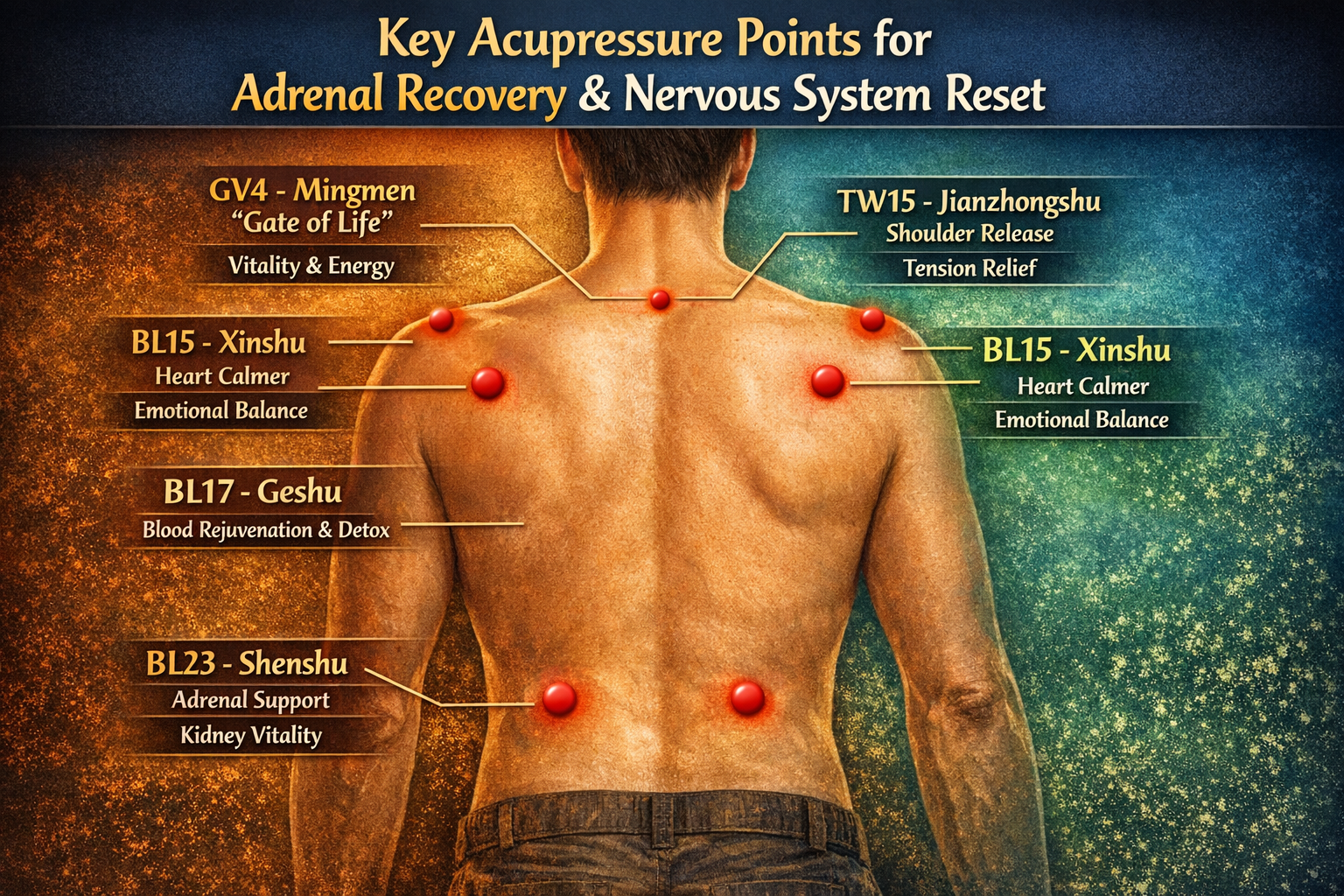
    The back of the body is, in many ways, the most important region in acupressure for stress — and the most neglected in self-care. The bladder meridian runs the full length of the spine on both sides, and along it sit the ‘back-shu’ points: direct access points to every major organ in the body. The adrenal glands, which produce cortisol, sit just above the kidneys at the L2 level of the lower back. The heart sits at the T5 level of the mid-back. Stimulating these points sends a direct signal to the corresponding organ to regulate.

    BL 23 — Shenshu: The Adrenal Recovery Point

    One and a half finger-widths either side of the spine, at the level of the second lumbar vertebra — roughly at the waist level, in line with the navel. BL 23 is the back-shu (association) point of the Kidney organ system — which in Chinese medicine governs the adrenals and the fundamental energy of the body. Chronic stress depletes what Chinese medicine calls Kidney Jing (essence): the reserve energy that keeps you functioning when the surface reserves are gone.

    When BL 23 is chronically tight and tender, it is a clinical indicator of adrenal burden. When it is regularly stimulated, research has demonstrated improvements in adrenal hormone regulation, reduction in lower back pain caused by tension, and enhanced recovery from fatigue. This is the point for people who are tired but cannot sleep — the paradox of adrenal exhaustion.

    How to apply: Place two tennis balls in a sock. Lie on your back on a firm surface. Position the tennis balls either side of your spine at the waist. Breathe deeply and let the weight of your body apply pressure. Two minutes. This is the single most effective self-help method for BL 23. Alternatively, coax someone to apply firm thumb pressure directly into the point.

    GV 4 — Mingmen: The Gate of Life

    On the spine itself, between the second and third lumbar vertebrae. Mingmen — the Gate of Life — is considered one of the most important points in classical Chinese medicine for rebuilding constitutional vitality. It governs what the tradition calls Yang energy: the warming, activating force that stress chronically depletes. People with adrenal exhaustion and chronic stress often feel cold in the lower back — and Mingmen is cold when the energy here is deficient.

    How to apply: Warm your palm by rubbing both hands together vigorously for thirty seconds. Then place the warmpalm directly over GV 4 (between the lower vertebrae at waist level). Hold for two minutes, breathing into the lower back. The warmth is part of the therapy. A warm wheat bag or heating pad placed here for ten minutes daily is a simple but powerful supplementary practice.

    BL 15 — Jueyinshu: The Heart’s Back Door.

    One and a half finger-widths either side of the fifth thoracic vertebra — between the shoulder blades, roughly level with the heart itself. BL 15 is the back-shu point of the Heart, and it is used clinically for the stress patterns that manifest in the chest: palpitations, racing heartbeat, the tightness that arrives with anxiety. In Chinese medicine, the Heart is not just a pump — it houses the Shen, the spirit or consciousness. When the heart is disturbed by chronic stress, the spirit becomes restless. BL 15 calms both.

    How to apply: A partner pressing both points simultaneously is ideal. For solo application: two tennis balls in a sock at mid-back level, same as BL 23. Or lean back into a chair with a firm back and let the chair edge press into the points. Hold ninety seconds. You may feel your heart rate noticeably settle.

    The Chest Points — Opening What Stress Has Closed

    Stress contracts the chest. This is not metaphor — it is a measurable postural and physiological change. The pectorals tighten, the shoulders round forward, the sternum drops, and the breathing becomes shallow and high. All of this reduces lung capacity, increases sympathetic tone, and perpetuates the cycle. The chest points below reverse this process directly.

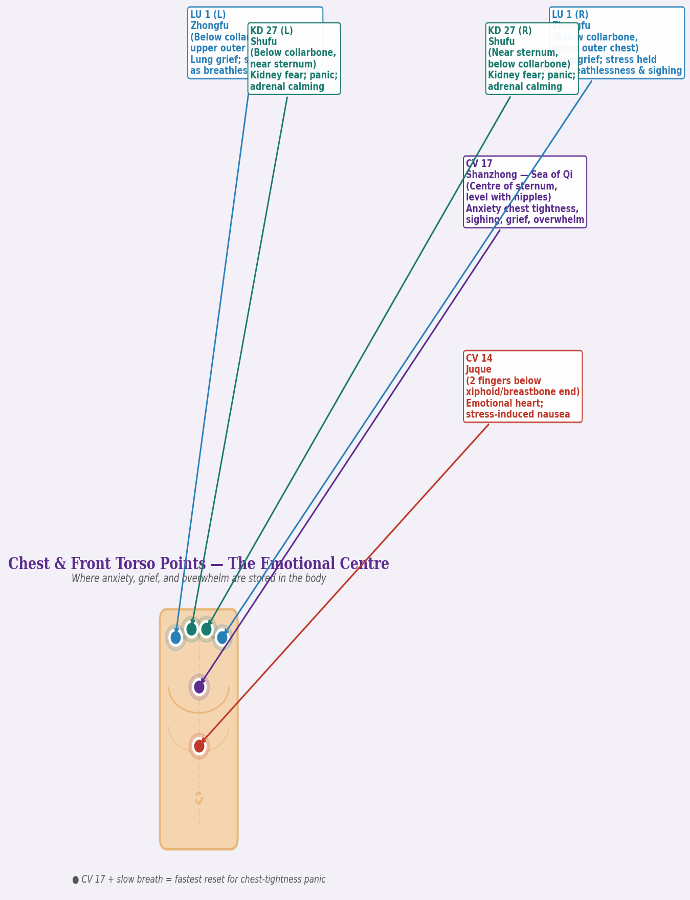
    CV 17 — Shanzhong: The Sea of Qi and the Seat of Emotional Pain

    At the centre of the sternum, level with the fourth intercostal space (roughly level with the nipples in men). CV 17 is the Influential Point of Qi — meaning it governs the movement of vital energy through the chest and throughout the body. It is also the point most associated with the kind of pain that stress produces in the emotional body: grief that sits in the chest, the tightness of anxiety that will not let you take a full breath, the ache of prolonged worry.

    There is a reason we press our hand to our chest when we are moved, frightened, or heartbroken. The body knows this point intuitively. Regular stimulation of CV 17 opens the chest, deepens breathing, reduces the physical sensation of anxiety, and over time, processes the emotional weight that chronic stress accumulates here.

    How to apply: Three fingers flat at the centre of the sternum [exact centre of the chest]. Gentle sustained downward pressure — not painful, but with presence. Eyes closed. Breathe into the chest and feel it expand against your fingers. Hold ninety seconds. Then make slow upward strokes along the sternum from CV 17 toward the throat — this opens the channel. Do this morning and evening.

    LU 1 — Zhongfu: Where the Lungs Hold Grief

    On the upper outer chest, just below the clavicle, approximately one hand-width down from the shoulder. In Chinese medicine, the Lung is the organ of grief — and every practitioner knows that LU 1 is tender in clients who have been carrying unprocessed sadness, loss, or the kind of exhaustion that comes from trying to hold everything together for too long. Stimulating this point releases both physical chest tightness and the emotional holding pattern beneath it.

    How to apply: Use two fingers to press firmly into the hollow just below the collarbone on each side. Hold six seconds. The sensation is often intensely tender in stressed individuals — particularly those who have experienced loss or prolonged anxiety. Release slowly. Repeat five times per side. Then make small circles for thirty seconds.

    KD 27 — Shufu: The Kidney’s Calming Point on the Chest

    In the depression below the clavicle [Commonly known as the collarbone, is a long, S-shaped bone situated horizontally at the top of the chest], just lateral to the sternum. These two points are the highest points on the Kidney meridian — they are where the kidney’s calming, fear-resolving energy surfaces at the top of the body. Pressing KD 27 on both sides simultaneously is one of the fastest self-help techniques for acute panic, because it simultaneously addresses the adrenal component (fear, cortisol) and the chest component (tightness, breathlessness).

    How to apply: Index and middle fingers of both hands pressed simultaneously into KD 27 on each side. Hold firmly for sixty seconds while breathing slowly through the nose. This is your first-response protocol for panic attacks when they arrive — not a replacement for medical care in severe panic disorder, but a powerful immediate intervention.

    The 5-5-5 Regulation Technique.

    This is a simple tool that pairs with the acupressure points and can be used anywhere, at any moment of acute stress. It takes ninety seconds and works by engaging three different regulatory pathways simultaneously.

    The 5-5-5 Technique — 90 Seconds to Regulation
    SENSE: Name 5 things you can see right now. Look at each one for a full second.
    Then name 4 things you can physically feel (your feet on the floor, the chair against your back).
    Then name 3 things you can hear.
    BREATHE: 5 counts in through the nose. 5 counts hold. 5 counts out through the mouth. Repeat 5 times.
    PRESS: With eyes closed, press KD 27 (below collarbones) with both hands simultaneously. Hold for 30 seconds while continuing to breathe slowly.
    Why it works: The sensory naming engages the prefrontal cortex, overriding the amygdala’s alarm.The extended exhale activates the vagus nerve. The KD 27 press closes the adrenal loop.
    Together, these three steps move the nervous system from alarm to regulation in under two minutes.

    Today’s Lifestyle Shift: The Two-Hour Wind-Down Protocol

    The most common sleep complaint in stressed individuals is not the inability to fall asleep — it is the inability to stop thinking once the body is finally still. This is a nervous system problem, not a sleep problem. The sympathetic system does not switch off at bedtime because it has been on all day and has not received a clear ‘safe now’ signal.

    The two-hour wind-down is the protocol that sends that signal. It works by gradually reducing sympathetic input and building parasympathetic momentum, so that by the time you lie down, the transition to sleep is physiological rather than a battle of willpower.

    • Two hours before sleep: screens on night mode or off entirely. Not because screens are evil — because blue light is a cortisol trigger.
    • Ninety minutes before sleep: warm shower or hot foot soak. Temperature drop after warmth triggers sleep hormone release.
    • One hour before sleep: the evening acupressure circuit [I will discuss this in Detail in the next Post Part 4.  Ten to twelve minutes.
    • Thirty minutes before sleep: reading on paper, light conversation, or silence. No input that requires decision-making.
    • At the bedside: the 4-7-8 breath, three rounds. Then sleep.

    This sequence, practiced for seven consecutive days, produces measurable improvements in sleep onset time and subjective sleep quality for the vast majority of people who try it. The nervous system learns the pattern quickly — it is extraordinarily responsive to consistent signals.

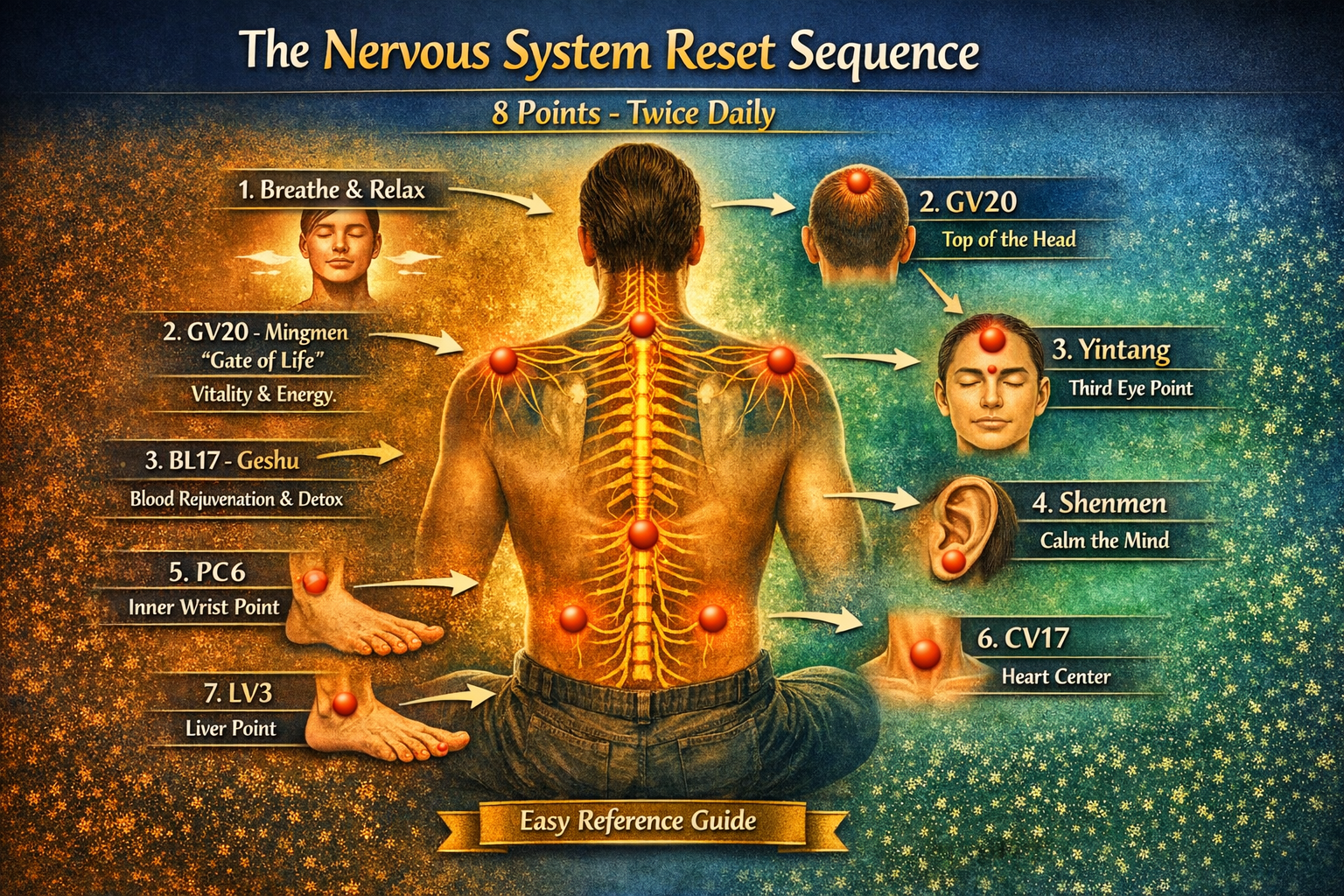
    The Post 2 Circuit — Your Nervous System Reset Sequence

    Post 2 Daily Practice — Add These to Your Post 1 Foundation
    ① CV 17 — Chest centre  (2 minutes, 4-7-8 breath throughout)
    ② KD 27 — Below collarbones  (90 seconds each side, simultaneously)
    ③ LU 1 — Upper outer chest  (90 seconds each side, gentle but sustained)
    ④ BL 23 — Lower back  (2 minutes, tennis ball or partner press)
    ⑤ GV 4 — Ming Men / Gate of Life  (90 seconds, warm palm pressure)
    ⑥ BL 15 — Mid-back heart point  (90 seconds each side)
    ⑦ TW 15 — Shoulder summit  (90 seconds each side, firm grip and release)
    ⑧ ST 36 — Below knee  (2 minutes each leg, rebuilds depleted energy)
    Combined with the Post 1 sequence across morning and evening: a complete nervous system re-calibration.

    What to Expect After Two Weeks

    By the end of two weeks of consistent practice — both the Post 1 and Post 2 sequences — you should notice several specific changes. Sleep onset becomes easier. The period between lying down and falling asleep shortens. Morning awakening is less abrupt — the cortisol spike that jolts many stressed people awake begins to soften into something more gradual and manageable.

    The shoulder points GB 21 and TW 15 will feel measurably less tender. This is not because you have become desensitised — it is because the tissue is genuinely releasing stored tension. The difference between a point that is simply not being pressed and a point whose underlying tension has resolved is something you will feel clearly.

    And you may notice something more subtle: moments of stillness that are comfortable rather than anxious. Brief windows where the background hum of stress is simply not there. Hold those moments. Notice them. They are not accidents — they are the nervous system remembering what it was built to feel.

    The nervous system does not need to be broken to be reset. It just needs to be heard.

    Coming in Post 3: ‘Stress Has an Address — It Lives in Your Organs (And Here Is How to Evict It)’

    Work With Me

    For a Personalised Nervous System & Stress Profile
    The points in this series address the most common stress patterns — but the nervous system is individual. The sequence that most benefits someone with anxiety-dominant stress is different from the one that serves someone with shutdown and exhaustion. Someone carrying grief needs a different emphasis than someone driven by frustration and anger.A one-on-one consultation lets me understand your specific stress architecture: where it lives in your body, how long it has been there, and what the most direct pathway to your particular form of resolution looks like.Reach out: skcjos@gmail.com | www.linkedin.com/in/shajikumar

    In Association with    World Health Journey  |  Oman | http://www.whjonline.com

    Is stress affecting your mental health in ways you haven’t fully recognised yet? 

    Consider taking a Cognitive Health   Check-Up — a clinically validated assessment that maps your stress profile, emotional health, and psychological resilience with precision.

    Take the assessment here: www.whjonline.com/mmpi-2/

    or Drop a Mail to shaji@whjonline.com

    Because knowing where you   stand is always the first step to getting better.

  • HEAL YOURSELF FIRST. STRESS SERIES 1 OF 4

    HEAL YOURSELF FIRST. STRESS SERIES 1 OF 4

    THE SILENT KILLER NOBODY TALKS ABOUT.

    What Stress is Really Doing Inside Your Body.

    The favorite line every Doctor utters after He/She has finished writing the prescription is, “Control your Stress”. I have always wondered as to how easy it is for the Doctor to comments and how difficult it is for the patient to adhere to.

    You know the feeling. The shoulders that never fully drop. The sleep that never quite restores. The sense that something is running in the background you cannot switch off. This is not just life. That is your body under siege. Your body has been invaded by the “stealth killer”. Diabetes may be known as the silent killer, but one of the chief causes of Diabetes is also STRESS.

    Let’s Stop Calling it “Just Stress”.

    We have normalized something that should alarm us. ‘I’m stressed’ has become the answer to every question — why you are tired, why you snapped at someone, why you cannot concentrate, why your back aches, why your digestion is off, why you have not slept properly in weeks. We say it with a shrug, the way you might mention the weather. But stress is not weather. It is not background noise. It is one of the most potent biological events your body can undergo — and when it becomes chronic, it is one of the most destructive.

    The World Health Organization has called stress the epidemic of the twenty-first century. Not high blood pressure. Not obesity. Stress — because stress is the upstream cause of most of what we are actually treating downstream. And yet, in most conversations about health, it still gets a footnote rather than a headline.

    This four-part series is that headline. We are going to look at what stress actually does to your body — not in vague terms, but system by system, organ by organ. And then we are going to give you the tools to actively intervene in that process using acupressure — one of the oldest and most underused physiological levers available to us.

    First things First – See the full Picture.

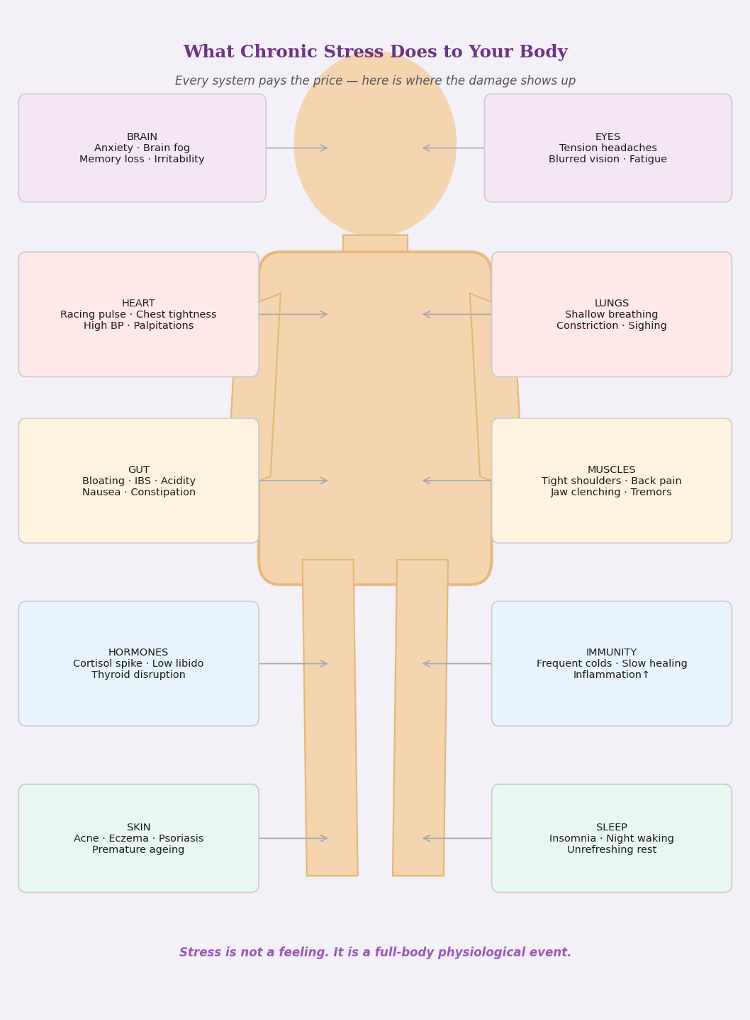
    Before we talk about solutions, spend a moment with this. Most people understand stress as a feeling. What the diagram below shows is that stress is, in fact, a full-body physiological event that touches every single system you have.

    Figure 1: What Chronic Stress Does to Your Body – a system-by-system breakdown.

    Look at the map carefully. The brain, the heart, the lungs, the gut, the immune system, the hormones, the skin — there is not a single system that chronic stress leaves untouched. This is why the person with persistent stress-related headaches also has gut issues. Why the person who cannot sleep also gets frequent colds. Why the person with chronic back tension also feels emotionally depleted. It is all the same storm.

    The Cortisol Problem Nobody Warned You AboutWhen you experience stress — whether it is a deadline, an argument, financial pressure, or even a disturbing news cycle — your adrenal glands release cortisol. This is your body’s emergency fuel: it sharpens your focus, floods your muscles with glucose, and temporarily suppresses everything your body considers non-essential (digestion, immunity, reproduction, deep repair).That emergency response was designed to last minutes. A predator appears; you run; cortisol spikes and drops. In modern life, the predator never leaves. Cortisol stays elevated. And a body running on chronic cortisol is a body that is steadily, quietly consuming itself — degrading muscle, inflaming tissue, disrupting hormones, and eroding the very brain structures responsible for keeping you calm.This is not metaphor. This is measurable, documented physiology. And it is entirely addressable.

    The Vagus Nerve: Your Body’s Built-In Antidote to Stress.

    Here is the good news that often gets buried under the alarm: your body has its own anti-stress system, and it is extraordinarily powerful. It is called the parasympathetic nervous system, and its primary vehicle is the vagus nerve — a long, wandering nerve that runs from the base of your brainstem all the way down to your gut, touching your heart, your lungs, your liver, and your digestive tract along the way.

    When the vagus nerve is active, you are in what physiologists call ‘rest and digest’ mode. Your heart rate drops. Your blood pressure normalises. Your gut motility resumes. Your immune system rebuilds. Cortisol decreases. Inflammation reduces. Your brain’s prefrontal cortex — the seat of rational thought and emotional regulation — comes back online.

    The question is: how do you activate the vagus nerve when your nervous system is locked in stress mode? There are several well-documented approaches — slow diaphragmatic breathing, cold water on the face, humming, and yes, acupressure at specific points that directly stimulate vagal tone. That last one is what this series is about.

    The Acupressure Approach: Calming the Storm from the Top.

    We begin today with the points that address the neurological and muscular manifestations of stress — the racing mind, the tight shoulders, the clenched jaw, the tension headache that arrives like clockwork. These are the points you can reach most easily, and they work fastest.

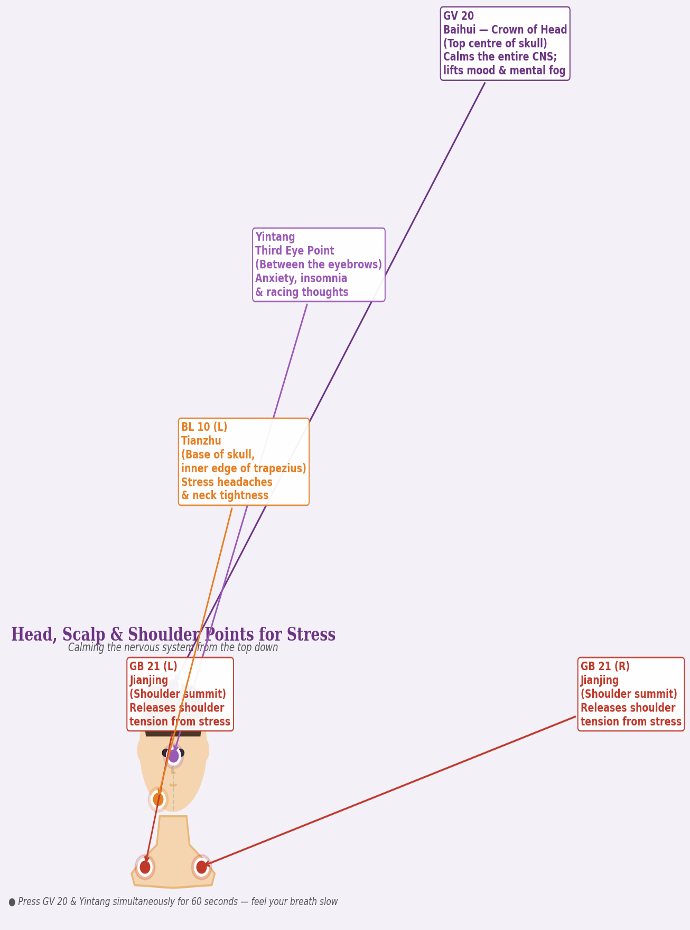
    Figure 2: Head, Scalp & Shoulder Points – the first line of acupressure defence against stress.

    GV 20 — Baihui: The Crown That Calms Everything

    At the very top of the skull, in the centre — if you draw a line from the tip of one ear straight up over the head, and another from the bridge of your nose straight up over the crown, they meet at GV 20. This is the Governing Vessel’s highest point, and in Chinese medicine it is considered the meeting place of all yang energy in the body. Stimulating it draws energy upward, clears the mind, and has a documented calming effect on the central nervous system.

    Research has shown that acupressure at GV 20 significantly reduces self-reported anxiety scores, lowers heart rate in stressed subjects, and influences the prefrontal cortex — the part of your brain that stress most aggressively disables. In short: when you cannot think clearly because you are overwhelmed, this is the point to press first.

    How to apply: Place three fingers flat at the crown of the head. Apply gentle downward pressure — not a hard push, but sustained and intentional weight. Close your eyes. Take five slow breaths. Hold the pressure for sixty seconds. You may feel a sense of warmth or mild pulsing. That is normal. Repeat morning and evening.

    Yintang — The Third Eye Point: Your Emergency Calm Button

    Between the eyebrows, in the slight depression at the bridge of the nose. You already know this point — you press it instinctively when you have a headache, or when you are trying to concentrate. In acupressure, Yintang is one of the most potent points for quieting the mind. It has a direct sedating effect on the nervous system and is used clinically for anxiety, insomnia, and the kind of relentless mental churning that stress produces.

    A particularly powerful combination: press GV 20 and Yintang simultaneously. One hand at the crown, one index finger at the third eye. Close your eyes. Breathe. Ninety seconds. This two-point pairing is one of the fastest-acting self-help acupressure protocols for acute anxiety.

    How to apply: Single index finger, pressing gently but firmly inward and slightly upward. Circular micro-movements. Eyes closed. Breathe into the belly. This point can be held for up to two minutes. It is safe to use as many times a day as needed — before a difficult conversation, during a moment of panic, before sleep.

    GB 21 — Jianjing: Releasing the Shoulders You Have Been Holding for Months

    At the highest point of each shoulder — the midpoint between the base of the neck and the edge of the shoulder. If you have ever had someone press there when you are tense and felt an almost overwhelming release, you have found GB 21. This point is the body’s primary storage location for unexpressed stress. Tight GB 21 points are a clinical indicator of chronic stress load. The tighter they are, the longer the stress has been there.

    In traditional texts, this point is described as ‘the shoulder well’ — a place where stress collects and stagnates. Releasing it is not just locally relieving. It sends a signal through the gallbladder meridian that travels down the side of the body, reducing tension in the neck, mid-back, and hip.

    How to apply: Use the opposite hand’s thumb and first two fingers to grip the shoulder muscle firmly. Squeeze and hold — it will be uncomfortable if you carry a lot of tension there. Hold ten seconds, release, repeat five times. Then make slow circles with the fingers at the point. Do both shoulders.

    Note: avoid deep GB 21 pressure during pregnancy.

    BL 10 — Tianzhu: Where Stress Lives at the Base of Your Skull

    At the base of the skull, about one finger-width out from the midline on each side, in the thick muscles just below the bony ridge. This point — Heavenly Pillar — is the body’s junction between the head and the rest of the nervous system. Chronic stress creates extraordinary tension here: it compresses blood vessels feeding the brain, contributes to tension headaches, and maintains a low-level fight-or-flight signal that is very hard to break without directly addressing this point.

    How to apply: Interlace your fingers behind your head. Use both thumbs to press upward and inward into the muscles on each side of the spine at the skull’s base. Tilt your head back slightly onto the pressure. Hold thirty seconds. Release. Repeat three times. The relief — especially if you spend hours at a desk — is often immediate.

    The Wrist Points — What to Do When Stress Hits Without Warning

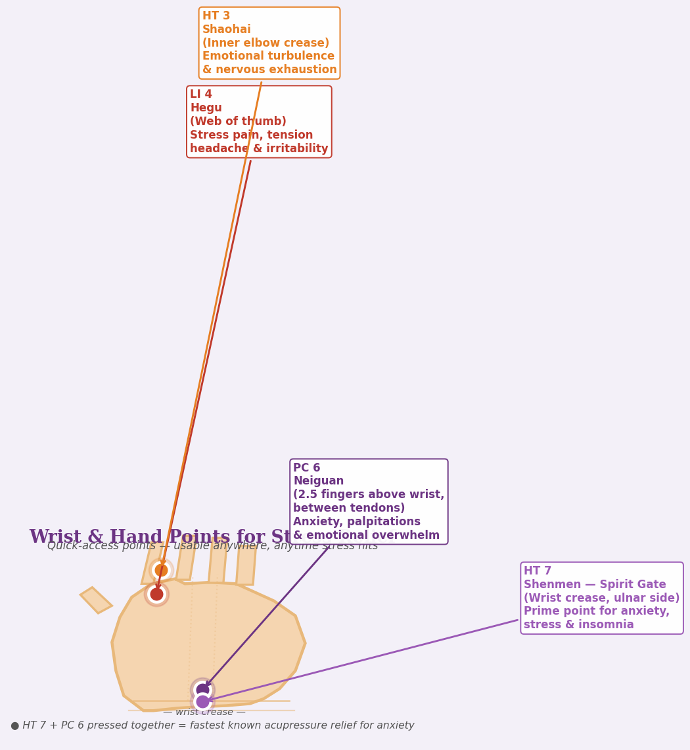
    The beauty of the next set of points is their accessibility. You are at a meeting that is turning adversarial. You are sitting in traffic. You are lying awake at 2 am with thoughts that will not stop. These points are there, in your own wrists and hands, always. No one needs to know you are using them.

    Figure 3: Wrist and Hand Points – fast access stress relief that works anywhere anytime.

    HT 7 — Shenmen: The Spirit Gate

    At the wrist crease, on the little-finger side, in the small hollow just inside the tendon. Shenmen means ‘Spirit Gate’ in Chinese — and the name is not poetic exaggeration. This is the primary point of the Heart meridian for emotional disturbance. Anxiety, panic, emotional pain, the physical sensation of a racing heart during stress — all of these respond to HT 7. In clinical acupuncture practice, it is one of the most-used points for anxiety and insomnia, alongside its neighbour PC 6.

    How to apply: Use the thumb of the opposite hand to apply firm pressure at the wrist crease hollow. The sensation should be slightly achy, like pressing on a bruise. Hold six seconds, release two seconds. Repeat ten times. Then switch wrists. For acute anxiety or panic, maintain continuous pressure for three minutes while breathing slowly through the nose.

    PC 6 — Neiguan: Calming the Heart-Mind Axis

    Two and a half finger-widths above the wrist crease, between the two central tendons of the inner forearm. We met this point in our gut health post, where it excels at nausea and reflux. But its primary classical function is emotional: it governs the Pericardium meridian, which in Chinese medicine is the heart’s protector. Stress that manifests as chest tightness, palpitations, emotional overwhelm, and the inability to ‘close down’ thoughts at the end of the day — PC 6 addresses all of these.

    The research on PC 6 for anxiety is extensive enough that wristbands pressing this point are now sold in mainstream pharmacies for travel sickness and morning sickness. But the full range of its effect on the nervous system goes far beyond nausea.

    Combination technique: Press HT 7 and PC 6 on the same wrist simultaneously — one thumb on each. Hold for ninety seconds. This paired application is faster-acting than either point alone for acute emotional stress.

    The Grounding Points — When Stress Has You Spinning

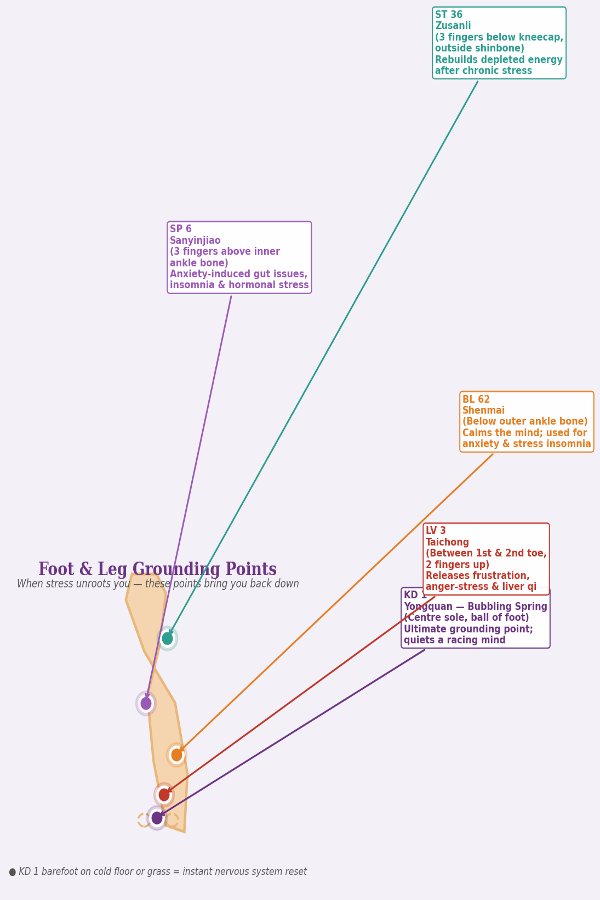
    There is a concept in mind-body practice called ‘grounding’ — the idea of reconnecting with the body when stress has pulled you entirely into your head. In acupressure, this is not metaphor. The foot points below literally bring energy downward from an overactive head and nervous system, reducing the physiological arousal that keeps stress cycling.

    Figure 4: Foot & Leg Grounding Points – When your mind won’t stop, press your feet.

    KD 1 — Yongquan: The Bubbling Spring (Your Most Powerful Grounding Point)

    At the centre of the sole of the foot, in the depression just below the ball. We first encountered KD 1 in our eye health discussion, but its relationship with stress is perhaps its most important function. Kidney 1 is the body’s only acupressure point on the sole of the foot, and it is the most inferior point on the entire meridian system — as far down as you can go. In Chinese medicine, it grounds the spirit, anchors the mind, and pulls hyperactive energy down from the head.

    There is a beautiful old practice in Chinese wellness tradition: walking barefoot on morning dew-wet grass. Not because the grass is special, but because the cold, textured ground stimulates KD 1 with every step. You do not need morning dew. A firm thumb, two minutes, daily.

    How to apply: Sit comfortably. Cross one leg. Use the thumb to press firmly into the centre of the sole. Hold and make small circles. The pressure should feel intense — this point is often quite sensitive in stressed or anxious individuals. Sixty seconds each foot. You may feel a wave of calm almost immediately.

    LV 3 — Taichong: For the Stress That Comes With Anger and Frustration.

    Between the first and second toes, two finger-widths up from the webbing. This is the source point of the Liver meridian — and in Chinese medicine, the liver governs the smooth flow of qi throughout the body. When stress comes with frustration, irritability, a sense of things being stuck, rage that has nowhere to go — the liver meridian is involved. LV 3 is its release valve.

    Combine LV 3 with LI 4 in the hand (the web between thumb and index finger) for what practitioners call the ‘Four Gates’ — two points pressed simultaneously on both hands and feet that create a powerful circuit for releasing stagnant energy and reducing systemic tension. Many people who try the Four Gates for the first time feel an emotional release within minutes.

    How to apply: Thumb pressed firmly into the point between the first and second metatarsals. It will be tender — often notably so in people carrying a lot of suppressed frustration.

    Hold, breathe, rotate slowly. Ninety seconds per foot.

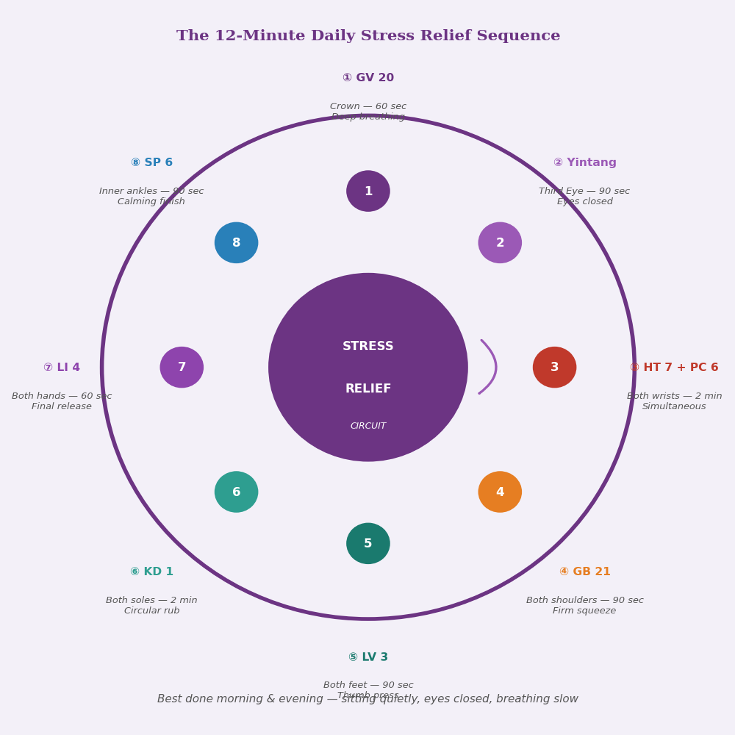
    Putting It Together: Your Daily 12-Minute Stress Relief Sequence

    Each of the points above works individually. But done in sequence — moving from the head down through the wrists and finally to the feet — they create a cumulative calming effect that systematically addresses every layer of the stress response. Morning and evening is ideal. Even once a day, consistently, will produce measurable change within ten days.

    Figure 5: The 12-minute Daily Stress Relief Sequence – Follow in order, twice daily.

    The 12-Minute Stress Relief Circuit① GV 20 — Crown of head  (60 seconds, gentle sustained pressure, deep breathing)② Yintang — Third eye  (90 seconds, eyes closed, full focus on slowing breath)③ HT 7 + PC 6 — Both wrists together  (2 minutes, press both simultaneously)④ GB 21 — Both shoulders  (90 seconds, firm grip and release, not just touch)⑤ LV 3 — Both feet  (90 seconds, thumb press between first and second toes)⑥ KD 1 — Both soles  (2 minutes, firm circular rub with thumb)⑦ LI 4 — Both hands  (60 seconds, web of thumb, firm rotational pressure)⑧ SP 6 — Inner ankles  (90 seconds each, calm closing point)Total: approximately 12 minutes. Do this before checking your phone in the morning.Repeat in the evening before sleep. You will sleep differently within a week.

    Beyond the Points: Three Lifestyle Pivots for This Week.

    The 4-7-8 Breath (Use It Before the Points, Every Time).

    Breathe in through the nose for 4 counts. Hold for 7. Breathe out through the mouth for 8. The extended exhale activates the vagus nerve directly— it is the fastest non-pharmaceutical intervention known to reduce acute anxiety. Do this three times before beginning any acupressure session. It primes the nervous system for the points that follow.

    Name the Stress — Write It Down

    Unprocessed stress is physically heavier than named stress. There is neuroscience behind this: the act of labeling an emotion in writing activates the prefrontal cortex and quiets the amygdala — the brain’s alarm center. A five-minute journal entry before bed asking ‘What stressed me today, and what is actually within my control?’ is not therapy. It is basic neural hygiene. Do it for seven days and notice how different mornings feel.

    One Meal, Eaten Without a Screen.

    We talked about this in the gut health post, but it deserves repeating from a stress angle: eating in a sympathetic (stressed) state raises cortisol, reduces serotonin, impairs nutrient absorption, and — crucially — teaches your nervous system that there is no safe moment to rest. One meal a day, eaten slowly, with attention, without your phone, sends the opposite signal. It is a physiological practice, not a mindfulness exercise. 

    What to Expect After One Week

    You will not eliminate stress in a week. But you will notice the edge is softer. Sleep will begin to shift — not dramatically, but the difference between lying awake for forty minutes and lying awake for twenty is enough to change your next day. The shoulder tension will begin to map — you will notice when it arrives and have a tool to use. The racing mind at 2am will have something to engage with rather than just spiral.

    These are not minor improvements. These are the first cracks in a pattern that stress relies on to perpetuate itself. Keep the practice going for three weeks — which is what Posts 2, 3, and 4 of this series will walk you through — and the changes become structural. Not just symptom relief. A genuinely different baseline.

    Stress is not the price of ambition. It is the cost of not knowing your own body well enough. Let’s change that.

    About the Author

    Your Guide on This JourneyI have been an avid acupressure and alternative treatment methodologies enthusiast and have spent years researching. Stress, in my experience, responds faster and more deeply to body-based intervention than almost any other health condition — because it lives in the body, not just in the mind.This series is a starting point. If you want a personalised acupressure protocol tailored to your specific stress patterns, sleep profile, and health history, I offer one-on-one consultations in collaboration with trained and qualified Acupressure specialists that go beyond what any blog post can provide.

    Coming in Post 2: ‘Your Nervous System Is Stuck on Alarm — How to Switch It Off Without a Single Pill’

    In Association with    World Health Journey  |  Oman | http://www.whjonline.comIs stress affecting your mental health in ways you haven’t fully recognised yet?Consider taking a Cognitive Health   Check-Up — a clinically validated assessment that maps your stress profile, emotional health, and psychological resilience with precision.Take the assessment here: www.whjonline.com/mmpi-2/or Drop a Mail to shaji@whjonline.comBecause knowing where you   stand is always the first step to getting better.
  • HEALTH in your HANDS. Part 4 “Your Stomach is Talking. Are You Listening?”

    The Gut Doesn’t Lie – And it’s Been Trying to Talk to you for Years.

    Ever wonder why we get “butterflies in the Stomach” when we’re nervous?

    Our gut is our second brain. Most of us reach for an antacid the moment we feel a bloat, but that’s just putting a band-aid on a biological protest. Instead of suppressed symptoms, let’s talk about flow.

    You don’t need a prescription to start healing your digestion. You need your hands, ten minutes, and the willingness to listen.

    For a great part of my life, I have battled with this problem of my gut not behaving. Like an errant child, it has troubled me for years, till I found the remedies and took the matter in my own hands. Though this happened after I had consumed countless “pills” & trying other alternative treatments like Ayurveda. Now for the first time in decades, I am at peace because I have devoted 10 minutes every morning massaging the root cause areas on my body.

    If you have ever sat across from a doctor with a complaint about bloating, constipation, acidity, or that persistent heaviness after a meal, chances are you walked out with an antacid, a laxative, or at best a referral to a gastroenterologist. What you almost certainly did not walk out with is the knowledge that your own hands hold some of the most effective tools for digestive relief known to medicine — tools that have been refined over three thousand years, validated by modern neuroscience, and available to you free of charge, right now.

    The gut is extraordinary. It has its own nervous system — the enteric nervous system — with roughly 500 million neurons embedded in its lining. Scientists call it the ‘second brain,’ and they mean that literally, not poetically. This second brain communicates constantly with your head brain via the vagus nerve, and it responds powerfully to what you eat, how you breathe, how much you sleep — and yes, to touch and pressure applied at specific points on the body.

    That last part is where acupressure comes in. And once you understand how it works, you will wonder why nobody ever taught you this alongside how to brush your teeth.

    Before You Read Further

    This post covers acupressure techniques for everyday gut wellness — bloating, acidity, sluggish digestion, constipation, and general gut fatigue. If you are experiencing severe abdominal pain, blood in stool, unexplained weight loss, or any symptoms that concern you, please see a doctor first. These practices work beautifully alongside medical care — not in place of it when something serious is happening, because you failed to listen to it’s woeful cries of distress.

    Why Your Gut Is So Much More Than a Digestive Tube

    Here is something that might shift your entire view of health: approximately 70 percent of your immune system lives in your gut. Your gut lining produces serotonin — the very same molecule that anti-depressants target — in quantities that dwarf what your brain makes. When your gut is inflamed, sluggish, or dysbiotic (that means the bacteria colony inside it is out of balance), you do not just feel bloated. You feel tired, anxious, foggy-headed, and often inexplicably low.

    The reverse is also true. A well-functioning gut — one with good motility, a diverse microbiome, and a healthy mucosal lining — shows up in your energy levels, your skin, your mood, and your ability to fight infections. The gut is not a side conversation in your health. It is the main event.

    And the single most underused, most overlooked tool for maintaining it? Daily, deliberate pressure on a small set of points that your body has been waiting or you to discover.

    Section 1: The Abdominal Points — Working Directly at the Source

    These are the points on the belly itself. Many people are hesitant to massage their own abdomen — it feels intrusive somehow. But the abdominal wall is packed with lymph nodes, fascia, and pressure receptors that, when stimulated correctly, directly influence intestinal motility, reduce visceral tension, and improve blood flow to the digestive organs. Think of it as manually waking your gut up.

    CV 12 — Zhongwan: The Master Switch for Digestion

    Located exactly four finger-widths above your navel, CV 12 is arguably the most important single point for upper digestive function. In Traditional Chinese Medicine, it governs the Stomach and is used to treat everything from acid reflux and bloating to nausea and lack of appetite. Modern research has shown that stimulation of this point activates gastric acid regulation and promotes gastric emptying — which is exactly what you need when food feels like it is sitting in your stomach like a stone.

    How to apply: Place three fingers of your right hand flat over this point (just above navel centre). Apply gentle but firm downward pressure — not poking, but sustained weight. Hold for a slow count of ten. Release. Repeat six to eight times. Then make small clockwise circles with the same three fingers for ninety seconds. You may feel mild gurgling. That is not a bad sign — that is your gut waking up. TRY IT NOW.

    ST 25 — Tianshu: The Two Points That Balance Everything

    These two points sit two finger-widths to the left and right of the navel, and they are bilateral — meaning you work both sides. ST 25 is the ‘Heavenly Pivot,’ and the name gives a clue to its function: it balances the intestines between too much and too little. Constipated? Stimulating ST 25 promotes peristalsis. Dealing with loose stools or IBS-D? The same point, applied more gently, helps regulate and calm the gut. This bidirectional action is one of the things that makes acupressure genuinely different from a pharmaceutical intervention.

    How to apply: Place one thumb on the left ST 25 and one on the right simultaneously. Apply steady circular pressure — clockwise for constipation, counter-clockwise if dealing with urgency or loose stools. Two minutes. Breathe deeply throughout. Do not rush this one. TRY IT NOW.

    CV 6 — Qihai: The Sea of Energy Beneath Your Navel

    One and a half finger-widths below the navel. This point — literally called the ‘Sea of Qi’ — governs the body’s core energy and, importantly for us, intestinal motility. When digestion is sluggish, this point feels dull and sometimes slightly tender when pressed. Regular stimulation of CV 6 improves lower gut function, reduces the bloating that sits heavily in the lower abdomen, and over time strengthens what Chinese medicine calls ‘digestive fire’— the body’s fundamental capacity to process food.

    How to apply: Two fingers flat, pressing slowly inward. Hold at a depth that feels like mild pressure — not pain. Hold for six counts. Release. Repeat eight times. Then keep your fingers there and breathe into the abdomen for sixty seconds, feeling the belly rise against your hand.TRY IT NOW.

    Section 2: The Leg Points — Why Your Knee Area Controls Your Stomach.

    During our growing up years, we have often heard this statement, “your brains are in your knees” especially as a slander remark for tall people. Little did I realise then as to how true this statement is.

    This surprises everyone the first time they hear it. The idea that pressing a point below the knee could affect the stomach, intestines, or liver seems counterintuitive until you understand the meridian system. In Chinese medicine — and increasingly in the acupuncture research literature — the Stomach meridian runs from the face all the way down to the second toe, passing through the knee and lower leg. Stimulating points along this channel creates measurable physiological changes in gastric function.

    ST 36 — Zusanli: The Single Most Studied Acupressure Point on the Planet

    This point deserves its own paragraph, because it has earned it. Zusanli — ‘Three Mile Leg’ — sits three finger-widths below the kneecap, just outside the shinbone. It has been the subject of hundreds of clinical trials and is used across traditional systems in China, Japan, Korea, and increasingly in integrative medicine settings worldwide. Its effects on digestion are well-documented: it increases gastric motility, regulates gut microbiome diversity, reduces post-operative nausea, improves nutrient absorption, and stimulates the vagus nerve.

    But here is the thing that really captures people: in Chinese medical tradition, this point is considered one of the longevity points. Farmers in ancient China would press this point every morning before a long day of work. The phrase associated with it translates roughly as: ‘Press Zusanli daily and live a hundred years.’ Whether or not you plan on a century, the point delivers.

    How to apply: Sit with one leg bent. Place your thumb on ST 36 and press firmly downward and slightly inward toward the bone. You will likely feel a distinct ache or a sensation that radiates down the leg. That is the point. Hold for six counts, release, repeat eight times. Then switch legs. Two minutes per leg. Do this every single morning.

    SP 6 — Sanyinjiao: Three Meridians, One Powerful Point

    Four finger-widths above the inner ankle bone, on the back edge of the shinbone. This is the meeting point of three major meridians — Spleen, Liver, and Kidney — and its effects ripple through all three organ systems simultaneously. For the gut, SP 6 is invaluable: it aids in the transformation and transportation of food, reduces abdominal distension, calms IBS, and helps with the emotional component of gut dysfunction (the anxiety-gut connection that so many people experience but nobody talks about enough).

    Note: SP 6 is contraindicated in pregnancy as it can stimulate uterine contractions. Pregnant women should skip this point.

    Section 3: Hand and Wrist Points — Fast Relief at Your Fingertips.

    The hands are perhaps the most convenient acupressure tools you have, because you always have access to them — at a desk, in a car, in a meeting, on a flight when your stomach is rebelling against airline food at thirty thousand feet. The points here are particularly useful for acute symptoms: sudden nausea, heartburn, food regret.

    PC 6 — Neiguan: The Nausea Point That Actually Works

    Two and a half finger-widths above the wrist crease, between the two prominent tendons on the inner wrist. If you have ever worn acupressure wristbands for travel sickness, this is the point they press. PC 6 is so well-validated for nausea that it is included in multiple clinical guidelines for chemotherapy-induced nausea and post-operative nausea alongside conventional anti-emetics.

    But its effects go further than nausea. Regular stimulation of this point calms the cardiac plexus, reduces the nervous system’s contribution to gut symptoms, and eases the kind of reflux that gets worse when you are stressed. The gut-brain axis runs directly through this point.

    How to apply: Use the thumb of the opposite hand. Press firmly inward between the tendons. Hold for six counts. For acute nausea, stimulate rhythmically — press, hold, release, repeat — for three continuous minutes. You should feel relief within five minutes of consistent application.

    LI 4 — Hegu: The Universal Pain and Motility Point

    In the fleshy web between the thumb and index finger. This is one of the first points every acupressure student learns, and with good reason — it is a master point for pain anywhere in the body, and for the large intestine specifically. LI 4 stimulates intestinal contractions, helps with constipation, and relieves the cramping pain associated with IBS and spastic colon.

    How to apply: Pinch the web firmly between thumb and index finger of the opposite hand. Apply deep, rotating pressure for ninety seconds. It should feel intense — this point is rarely dull in people with gut issues. Switch hands. Do this twice a day on difficult gut days.

    Your Daily 12-Minute Gut Circuit — The Full Sequence

    Below is the recommended daily sequence. Done in order, these six points create a cumulative effect that is greater than any one of them individually. The sequence moves energy from the stomach downward through the intestines and out — which is the natural direction of healthy digestion. Working clockwise at each point reinforces this direction.

    The 12-Minute Daily Morning Gut Routine

    ① CV 12 — Stomach centre (2 minutes, clockwise circles)

    ② ST 25 — Either side of navel (1 minute each side, clockwise)

    ③ CV 6 — Below navel (2 minutes, slow sustained press)

    ④ ST 36 — Below knee (2 minutes each leg)

    ⑤ SP 6 — Inner ankle (90 seconds each leg)

    ⑥ LI 4 — Web of thumb (1 minute each hand)

    Best done on an empty stomach, first thing in the morning. Lie down for the abdominal points. Sit comfortably for the leg and hand points. Breathe slowly throughout — never hold your breath while pressing.

    How I do it…

    Every morning I would put on some soothing music which keeps playing in the background while I continue these routine. I devote over 45 minutes daily, apart from other regular morning routine like waking up, brushing teeth, consuming warm water with a dash of lemon, walking or jogging etc. Time we all have, it is just how we learn to use it. Out of 24 Hours, everyday I would suggest give 90 minutes at the most to your own body. You love your body and the body will love you back.

    There is more to it, but then this article has taken the length of our intestines. So in case I get better response, I might bring in a second part where I can talk about how to make lifestyle changes to boost your gut health. I started by asking a question, “Your Stomach is Talking, Are You Listening”. My advise – please do, it is your Stomach.

    Want a personalised Gut-care plan?

    I can design a tailored acupressure and lifestyle program based on your health history, current symptoms, and goals. Reach out to book a consultation — I’m happy to help.

    Tomorrow’s trailer…

    Day 5 and for a few more days beyond that I will focus on STRESS (the stealth enemy or root cause of most of our health issues) : simple acupressure points and belly routines to manage STRESS. See you then!

    With warmth and wellness,

    Shaji Kumar

  • HEALTH in your HANDS. Part 3 “The Workhorse of our Body : THE LIVER”

    HEALTH in your HANDS. Part 3 “The Workhorse of our Body : THE LIVER”

    The gentle giant – The Liver. Possibly the largest and one very hardworking Organ of the Body. It is like a giant processor – which will process anything and everything we keep throwing down the throat quite literally. However, there are limits to which anyone can suffer – and so does the Liver. I call it the traffic police with barricades.

    That is why a great percentage of all who get an ultrasound of the Liver comes back with a minimum Stage 1 fatty Liver.

    Learn to love your Liver. Don’t treat it like it is adopted. However Gentle Acupressure & Habits will Support Your Liver.

    Hello there — welcome to Day 3 of our self-care series Health in Your Hands. Today we will give some loving attention to one of our body’s most hardworking organs: the liver. When our liver is happy, energy, digestion, and even mood get a boost. Little, regular self-care for the liver can pay big dividends.

    Why the liver matters?

    – The liver detoxifies, stores nutrients, helps regulate blood sugar, and supports digestion.

    – Modern life—alcohol, smoking, processed foods, stress, irregular sleep—can overwork the liver.

    – Acupressure can stimulate points that support liver circulation, drainage, and balance without needing any equipment.

    The 7-Minute Liver Support Routine.

    – Time: max 7 minutes (do once daily; morning is ideal)

    – Goal: gently stimulate liver meridians, improve circulation, and promote relaxation.

    Step-by-step routine

    1. Sit comfortably or lie down. Take three slow, deep breaths. Make your touch warm—rub your hands together for a few seconds.

    2. Liver 3 (Taichong) — the cornerstone (2 minutes)

    – Location: On the top of the foot, in the depression between the big toe and second toe, about 1–2 finger-widths back from the web.

    – Action: Using your thumb, apply steady, comfortable pressure to the point. Hold for 30 seconds, then massage in small clockwise circles for 1–2 minutes. Repeat on the other foot.

    – Why: Taichong (LV-3) is a primary liver point in acupressure and acupuncture; it helps soothe liver qi, reduce tension, and improve circulation.

    3. Spleen 6 (Sanyinjiao) — support and balance (1.5 minutes)

    – Location: On the inside of the lower leg, about four finger-widths above the inner ankle bone, just behind the tibia.

    – Action: Press gently with your thumb or knuckle for 30 seconds, then use small circular motions for another 30–60 seconds per leg.

    – Why: Spleen 6 harmonises the digestive and reproductive systems and supports liver function indirectly by improving fluid metabolism and qi flow.

    4. Gallbladder 34 (Yanglingquan) — unblock and move (1 minute)

    – Location: On the outside of the lower leg, in the depression just below and in front of the head of the fibula (the outer bone).

    – Action: Firm pressure and a few circles for 30 seconds per leg.

    – Why: GB-34 supports bile flow and helps “unclog” stagnant liver energy—excellent when you feel irritable or sluggish.

    5. Abdomen palm massage — downward drainage (1 minute)

    – Action: Place both palms on your right upper abdomen (below the ribcage). Make gentle clockwise

    circular strokes for 30–60 seconds, imagining lymph and blood gently moving toward the liver for processing.

    – Why: Encourages gentle liver circulation and supports digestion.

    Breathing + visualisation (30 seconds)

    – Finish with slow deep breaths. Visualise a warm, golden light bathing your liver, helping it filter and renew.

    Quick signs that it’s working

    – A sense of warmth or looseness in the abdomen.

    – Reduced bloating or heaviness after meals.

    – Feeling calmer and less irritable.

    Lifestyle & diet nudges for liver resilience is equally important. Choose what you eat, how you eat.

    Disclaimers & when to seek advice.

    These are just precautions. These techniques are gentle and safe for most people, but if you have diagnosed liver disease, are pregnant, on blood thinners, or have serious health conditions, check with your healthcare provider before starting these new routines. If, you are already ailing with any form of Liver disease please continue the regular treatment plan as suggested by your Doctor or Health Care professional. If you feel sharp pain, dizziness, or any alarming symptoms during a session, stop and consult a professional.

    But indulge in the suggested 7 minute routine daily so that it gives a boost to the pills that you are consuming daily. You can also refer to your Doctor for advise.

    Want a personalised liver-care plan?

    I can design a tailored acupressure and lifestyle program based on your health history, current symptoms, and goals. Reach out to book a consultation — I’m happy to help.

    Tomorrow’s trailer…

    Day 4 will focus on digestion: simple acupressure points and belly routines to ease bloating and improve nutrient absorption. See you then!

    With warmth and wellness,

    Shaji Kumar

  • HEALTH in your HANDS. Part 2 “Sharp Eyes Start at Your Feet: Acupressure for Better Eyesight”

    HEALTH in your HANDS. Part 2 “Sharp Eyes Start at Your Feet: Acupressure for Better Eyesight”

    Better Eyesight

    Sharp Eyes Start at Your Feet: Acupressure for Better Eyesight.

    Remember yesterday I said we’d explore a surprising connection? 👀 Today’s topic is one of my personal favourites because the results are often noticeable within just a few weeks of consistent practice.

    Our eyes are working harder than ever. Between all types of screens, artificial lighting, and constant digital stimulation, it’s no wonder so many of us are reaching for glasses or eye drops. But before you resign yourself to thicker prescriptions, consider this: your feet and hands hold the keys to clearer vision.

    In acupressure, the eyes are intimately connected to the liver and kidney meridians. These meridians run through specific points on the feet and thumbs, which—when stimulated—can improve eye circulation, reduce strain, and enhance your natural vision.

    Your Feet & Thumbs Matter for Vision.

    Think of your feet as a miniature map of your entire body. The eyes correspond to specific zones on your soles and the web between your big toe and second toe. Your thumbs, too, contain powerful reflex points. By massaging these areas, you’re essentially sending a ‘refresh’ signal directly to your optical system.

    Benefits of this daily practice:

    • Improved blood flow to the eyes and surrounding tissues.
    • Reduced eye strain and fatigue from screen time.
    • Enhanced nutrient and oxygen delivery to the retina.
    • Natural relief from dry eyes and irritation.
    • Support for the liver and kidney organs (which govern vision in traditional medicine).

    Day 2: The Eye-Brightening Foot & Thumb Massage (10 Minutes)

    Part A: Foot Massage (5 minutes)

    1. Sit comfortably with one foot resting on your opposite knee (or use a footrest).

    2. Locate the eye reflex point. On the sole of your foot, find the area just below your second and third toes. This is your eye zone. It should feel slightly tender when you press it—that’s normal and a sign you’re in the right spot.

    3. Apply firm pressure. Using your thumb or index finger, press this point steadily for 30 seconds. Breathe deeply and imagine sending healing energy to your eyes.

    4. Work the entire zone. Gently massage the area with circular motions, covering the space below all your toes on the sole. Spend 2–3 minutes per foot.

    5. Don’t forget the inner edge. Massage along the inner edge of your sole (near the arch), as this corresponds to the kidney meridian, which also supports eye health.

    Part B: Thumb Massage (5 minutes)

    1. Hold your hand palm-up. Look at the web of skin between your thumb and index finger.

    2. Pinch and massage. Using the thumb and index finger of your opposite hand, gently pinch and massage this webbed area. This point is called LI-4 (Large Intestine-4) and supports overall vitality, including eye health.

    3. Now massage the thumb itself. Pay special attention to the inner side of your thumb (the side facing your palm). Use small circular motions, working from the base to the tip. Do both thumbs for about 2 minutes each.

    4. Press the tip. Gently press the pad of your thumb for 10–15 seconds with your index finger. Release and repeat 3–4 times on each hand.

    A Quick Note on Expectations

    You won’t suddenly wake up with 20/20 vision tomorrow. But consistent practice over 2–4 weeks often brings noticeable improvements: sharper focus, less eye fatigue, and reduced strain. Many people report clearer vision by the end of this 30-day journey. I have done myself.

    A Little Extra: Eye Care + Nutrition

    Today, pair your massage with these natural vision boosters:

    • Eat : Carrots, spinach, blueberries, and sweet potatoes are packed with lutein and beta-carotene—natural eye vitamins. Aim to eat at least one orange or dark leafy green per day.
    • The 20-20-20 rule: Every 20 minutes of screen time, look at something 20 feet away for 20 seconds. This simple habit reduces digital eye strain dramatically.

    Let’s Keep Going

    If you’re feeling the benefits already or want to dive deeper into how acupressure can transform your specific vision concerns, I’m here for a one-on-one consultation. Together, we can identify any underlying imbalances and create a targeted plan just for you.

    What’s Coming Tomorrow?

    Tomorrow, we shift our focus upward (literally!) to explore powerful eye exercises that complement your acupressure work. These movements strengthen the eye muscles and boost circulation even further. Trust me—your eyes will thank you.

    We keep saying that we need to make money work and not let it remain idle. I would go a little further and say keep using your HANDS, don’t let them be idle for better health. Keep seeing clearly. 👁️✨

    Wishing wellness,

    Shaji Kumar

  • HEALTH in your HANDS. Part 1

    HEALTH in your HANDS. Part 1

    For a long time now I have been personally enamoured by the alternative healing methods. So I thought of sharing what I have learnt (self-practised) for quite a long period. At some point in the distant past, I used to consume a lot of pills for every kind of ailment. Diabetes, Blood Pressure, Gastroenteritis etc. When I got fed up, I started doing research on the alternatives. These are my experiments which have helped me. I am not advocating it, just sharing. It is entirely your choice. But it works. And worst case scenario no harm will be done.

    How many times have you reached for a painkiller at the first sign of a headache, or immediately booked a doctor’s appointment for a minor ache?

    Unlike in the good old days, in our fast-paced world today, we’ve been conditioned to seek quick fixes—often in the form of pills and professional interventions—while overlooking the incredible healing power we hold in our own hands.

    Yes. If we just devoted 30 minutes every day for our body we can keep our bodies tuned.

    I have tried all these and have experienced a great benefit. My tryst with Accupressure and alternative healing methodologies started a few years back. I have always abhorred the “pills” and was always looking at ways to have some alternative remedies. I switched from Allopathy to Ayurveda. But then I discovered the healing touch of our hands, which when used diligently on a daily basis massaging certain parts of our body can do wonders. Best case scenario – there can never be any side-effects. Does not suit – forget it, no harm done.

    Welcome to the start of something transformative. Over the next few days, I’ll guide you through simple, daily acupressure techniques and lifestyle tweaks that can help you reconnect with your body, boost your well-being, and potentially reduce your reliance on external remedies. Like I already mentioned, this isn’t about rejecting modern medicine—it’s about empowering yourself with preventive, natural self-care that costs nothing but a few minutes of your time.

    I’m not a certified acupressure practitioner, but an avid enthusiast, and through this series, I want to share the wisdom that our bodies are equipped with their own pharmacy. You just need to know where the ‘buttons’ are, and I want to disclose those buttons.

    Let’s Start with the Heart?

    The heart isn’t just a physical organ; in many holistic traditions, it’s considered the seat of vitality and emotional balance. Stress, sedentary habits, and poor circulation silently strains this vital everlasting pump. Today’s technique is a gentle way to show your heart some love—literally.

    Day 1: The 5-Minute Calf Massage for Heart Health

    You might be surprised: what do calf muscles have to do with the heart? The Calf Muscle is also known as the second Heart. In acupressure, the calf region houses key points (like Sanyinjiao SP-6) that influence blood circulation and heart function. Massaging this area helps:

    • Improve venous blood return from the legs, reducing the heart’s workload.
    • Stimulate meridians connected to the cardiovascular system.
    • Release tension that can contribute to high blood pressure.
    • Promote overall relaxation, which is directly beneficial for heart health.

    How to Do It (Step-by-Step)

    1. Find a comfortable seat. Sit on a chair or the edge of your bed, with both feet flat on the floor.

    2. Place your hands on the back of one calf, between the knee and the ankle.

    3. Apply gentle pressure. Using your thumbs or the heels of your palms, press firmly but comfortably into the muscle. You should feel a pleasant sensation, not pain.

    4. Use circular motions. Move your thumbs in small circles, working your way from the top of the calf down to the ankle and back up. Spend about 2–3 minutes on each leg.

    5. Breathe deeply. As you massage, take slow, deep breaths. Imagine sending oxygen-rich blood to your heart with each inhale.

    That’s it! Do this once or twice today—perhaps in the morning and before bed.

    A Little Extra: Lifestyle & Diet Nudges

    While acupressure is powerful, combining it with conscious habits amplifies the benefits. Today, try one of these:

    • Hydrate with a twist: Start your day with a glass of warm water with a squeeze of lemon. It aids digestion and alkalises the body.
    • Take a 5-minute walk after meals. This simple habit improves circulation and helps regulate blood sugar.

    Invitation to Go Deeper

    If this resonates with you and you’d like a personalised acupressure plan or have specific health concerns, I offer one-on-one consultations. Together, we can map out the points that will best support your unique constitution. Feel free to reach out for a detailed analysis—I’m here to help you on your journey to sustainable wellness.

    What’s Next?

    Coming Soon, I’ll  discuss a surprising connection: how massaging your feet and big toes can sharpen your eyesight. Yes, you read that right! Get ready to give your eyes some love from the ground up.

    Until then, be kind to your heart—and your calves. 💖

    With warmth and wellness.