
Tag: #Mindset

  • I watched a bird this morning. It asked no permission of the sky.

    I watched a bird this morning. It asked no permission of the sky.

    I watched a bird this morning. It had no agenda. It asked no permission of the sky.

    It tilted its head — once, twice — pecked at something invisible to me, then lifted off as though gravity were merely a suggestion. There was no weight to it. Not the kind we carry, anyway.

    And I stood there, a grown man with a full calendar and an emptier soul, wondering — why not us? Why were we handed this extraordinary gift of consciousness only to fill it with noise? With grudges and deadlines and a gnawing sense that we are always, always behind?

    The bird does not scroll through what it missed. It does not compare its nest to another’s. It drinks when thirsty. It rests when tired. It sings — not for applause, but because the morning simply calls for it.

    We, on the other hand, have built a world that hums with fury. Look around — truly look. What you see is not progress dressed up in conflict. It is something rawer. A collage of exhausted souls, each one pushing, shoving, performing some version of urgency they no longer remember choosing. Intolerance has become our mother tongue. Anger, our default expression. The chaos is not just out there in the headlines — it is in the kitchen, in the commute, in the quiet contempt that lives behind polite smiles.

    And it is everywhere. Every continent. Every culture. Every household, in varying degrees, tuned to the same restless, maddening frequency.

    Where does it lead, all of this? I do not have the answer. But I feel it — the way you feel a storm before the first drop falls. A reckoning is building, slow and enormous, in the place where our collective patience used to live.

    The bird has since disappeared into the treeline. It does not know I watched it. It does not know I envied it.

    God — what exactly did we do wrong, and when was the precise moment we forgot how to simply be?

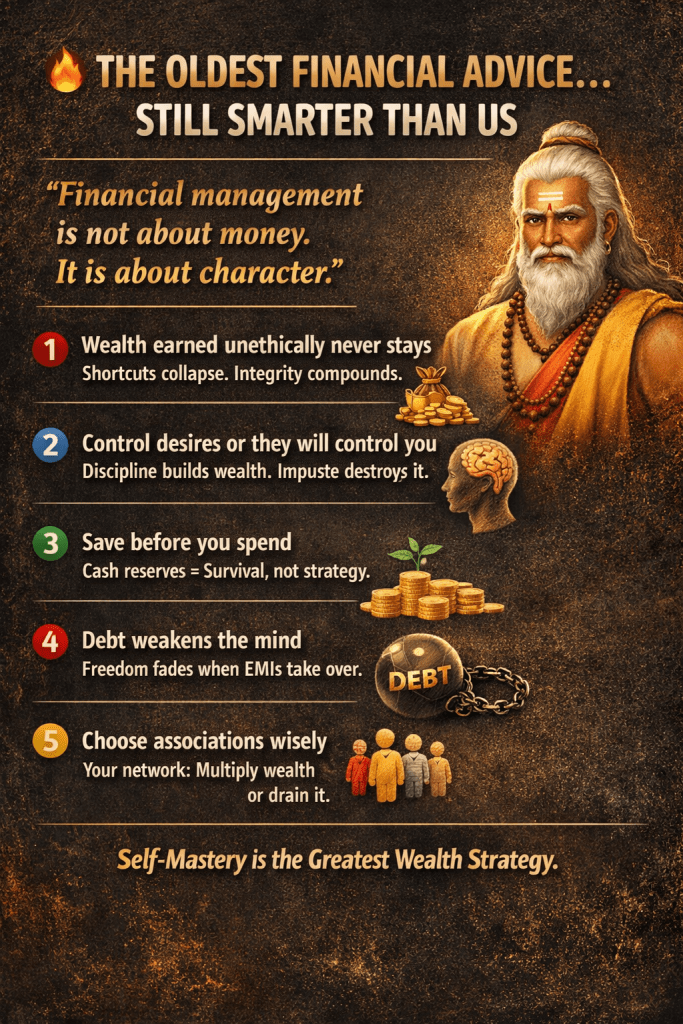
  • 🔥 The Oldest Financial Advice in the World — Still Smarter Than Us.

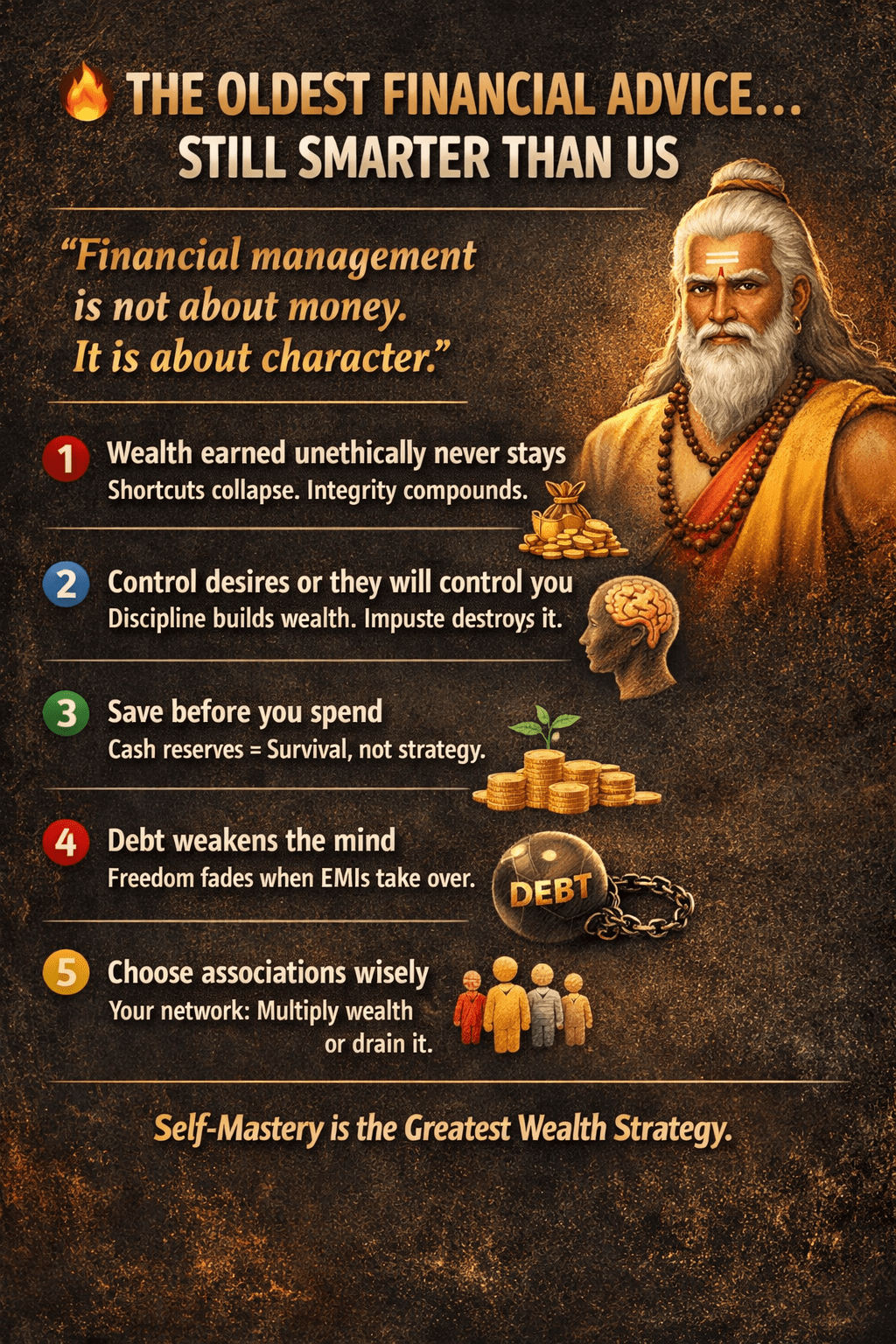
    🔥 The Oldest Financial Advice in the World — Still Smarter Than Us.

    We live in an age of abundance and anxiety.

    Money flows faster than ever, yet peace of mind feels rarer than gold.

    Every generation believes it invented financial wisdom — until it meets Vidur Niti.

    Three thousand years ago, Vidur, the royal advisor in the Mahabharata, spoke truths that still cut through the noise of modern finance. His words weren’t about numbers or markets. They were about character — the foundation of every sustainable fortune.

    Wealth Earned Unethically Never Stays.

    Vidur warned that wealth gained through deceit destroys the one who holds it.

    It’s not karma — it’s mathematics.

    Unethical gains create instability, distrust, and eventual collapse.

    In today’s world, this translates to:

    Shortcuts collapse. Integrity compounds.

    The most valuable currency is credibility.

    Control Desires or They Will Control You

    Vidur didn’t blame poverty on lack of income. He blamed it on lack of restraint.

    Desire, when unchecked, becomes debt.

    We call it lifestyle inflation, impulse buying, or social comparison — but it’s the same disease.

    Discipline builds wealth. Impulse destroys it.

    The richest people aren’t those who earn the most — they’re those who can say no.

    Save Before You Spend

    Vidur insisted that a wise person always keeps reserves for difficult times.

    In modern language: build your emergency fund before your dream fund.

    Savings are not a financial strategy.

    They are a survival strategy.

    Debt Weakens the Mind

    Vidur saw debt as a spiritual and psychological burden.

    Today, it’s disguised as convenience — EMIs, credit cards, “buy now, pay later.”

    But the truth remains:

    Freedom disappears the moment debt takes over.

    Debt doesn’t just cost money. It costs peace.

    Choose Associations Wisely

    Vidur said that associating with fools, greedy people, or unstable minds leads to ruin.

    In modern business, this means:

    Avoid toxic partnerships, unstable investors, and energy‑draining networks.

    Your network can multiply your wealth or drain it.

    Choose wisely.

    Invest in Wisdom, Not Just Wealth.

    Vidur believed that knowledge is the greatest asset.

    Money grows only when the mind grows.

    Skill development, financial literacy, emotional intelligence — these are the modern equivalents of Vidur’s “inner wealth.”

    Protect Your Wealth from the Five Dangers

    Vidur listed them clearly: fire, water, kings, thieves, and bad relatives.

    Translated to today’s world:

    Insurance, compliance, fraud prevention, documentation, and estate planning.

    Wealth is not just earned — it must be protected.

    Charity Must Be Wise, Not Emotional.

    Vidur said charity should go to the deserving, not the demanding.

    Modern philanthropy echoes this: impact over impulse.

    Give with intention, not emotion.

    True generosity builds ecosystems, not dependency.

    The Real Lesson.

    Vidur Niti isn’t ancient philosophy.

    It’s a financial operating system for anyone seeking stability, clarity, and long‑term prosperity.

    Money doesn’t respond to intelligence.

    Money responds to discipline.

    And discipline, Vidur reminds us, is not a punishment — it’s freedom.

    #VidurNiti #AncientWisdom #FinancialDiscipline #LeadershipMindset #WealthManagement #ModernLeadership #PersonalGrowth #StrategicThinking #ShajiKumarWrites

  • 🔥 The moment you realise you cannot change your situation… is the moment your real work begins.

    🔥 The moment you realise you cannot change your situation… is the moment your real work begins.

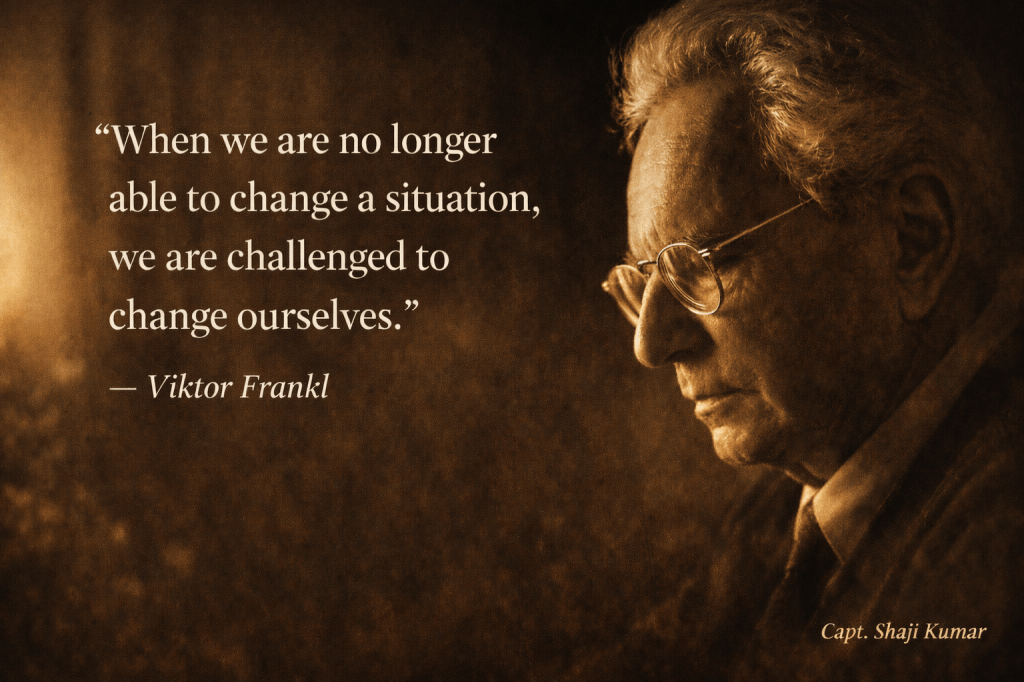
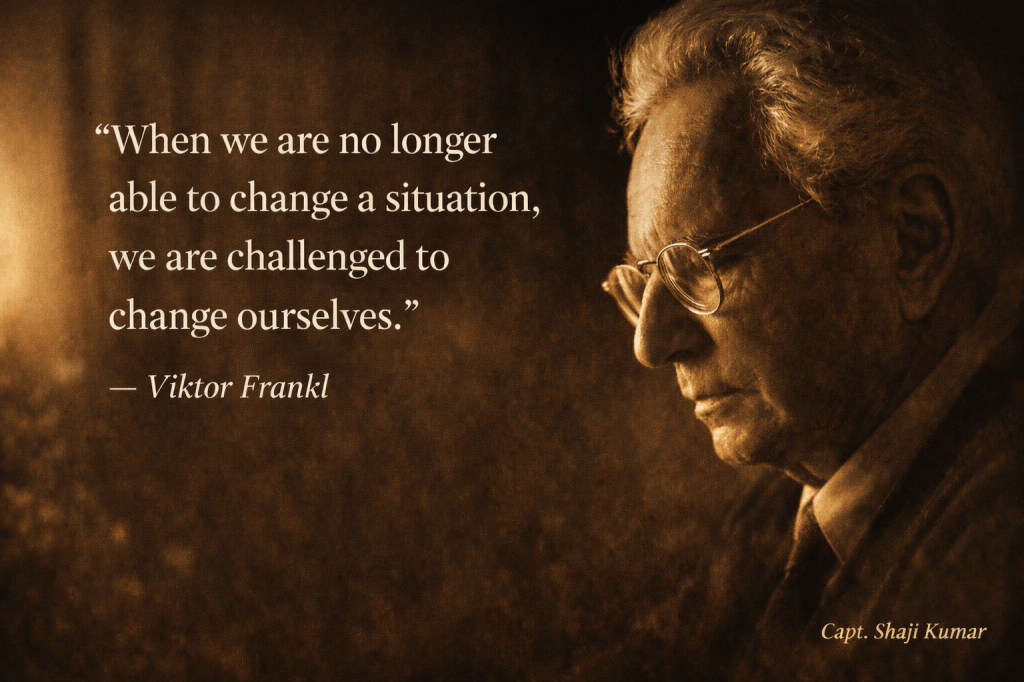
    “When we are no longer able to change a situation, we are challenged to change ourselves.” — Viktor Frankl

    There is something deeply uncomfortable… almost painfully ironic… about feeling powerless in life.

    Because in that moment—when nothing bends, nothing shifts, nothing listens—you are brought face to face with the only question that truly matters:

    How do I respond to what is happening to me?

    Do I resist?

    Do I accept?

    Do I fight harder… or do I surrender?

    I have lived both sides of this question.

    There were times I fought relentlessly—pushing against reality, trying to force outcomes, refusing to accept what was. And there were moments I surrendered—not out of wisdom, but out of exhaustion.

    Neither gave me lasting peace.

    But over time, something shifted. Through the wisdom of thinkers like Viktor Frankl, I began to see a deeper truth:

    👉 The real battle is not outside. It is within.

    Today, when life refuses to change, I pause. Instead of asking, “Why is this happening to me?”

    I ask, “What is this trying to show me about myself?”

    Because every external event—especially the painful ones—is a mirror.

    A mirror reflecting:

    • My fears

    • My attachments

    • My expectations

    • My ego

    And sometimes… my illusions.

    It takes courage to look into that mirror.

    It is far easier to blame circumstances.

    It is far easier to point fingers.

    But growth does not live there.

    Growth lives in this quiet, difficult shift:

    👉 From controlling the world…

    👉 To understanding yourself.

    This doesn’t mean we stop striving.

    It doesn’t mean we become passive.

    It means we become aware.

    Aware enough to know that while we may not control what happens…

    we always control who we become because of it.

    ✨ FINAL THOUGHT:

    When life takes away your power to change the outside world…

    it is giving you the opportunity to master your inner one.

  • “Broken crayons still colour.” — Toni Collier.

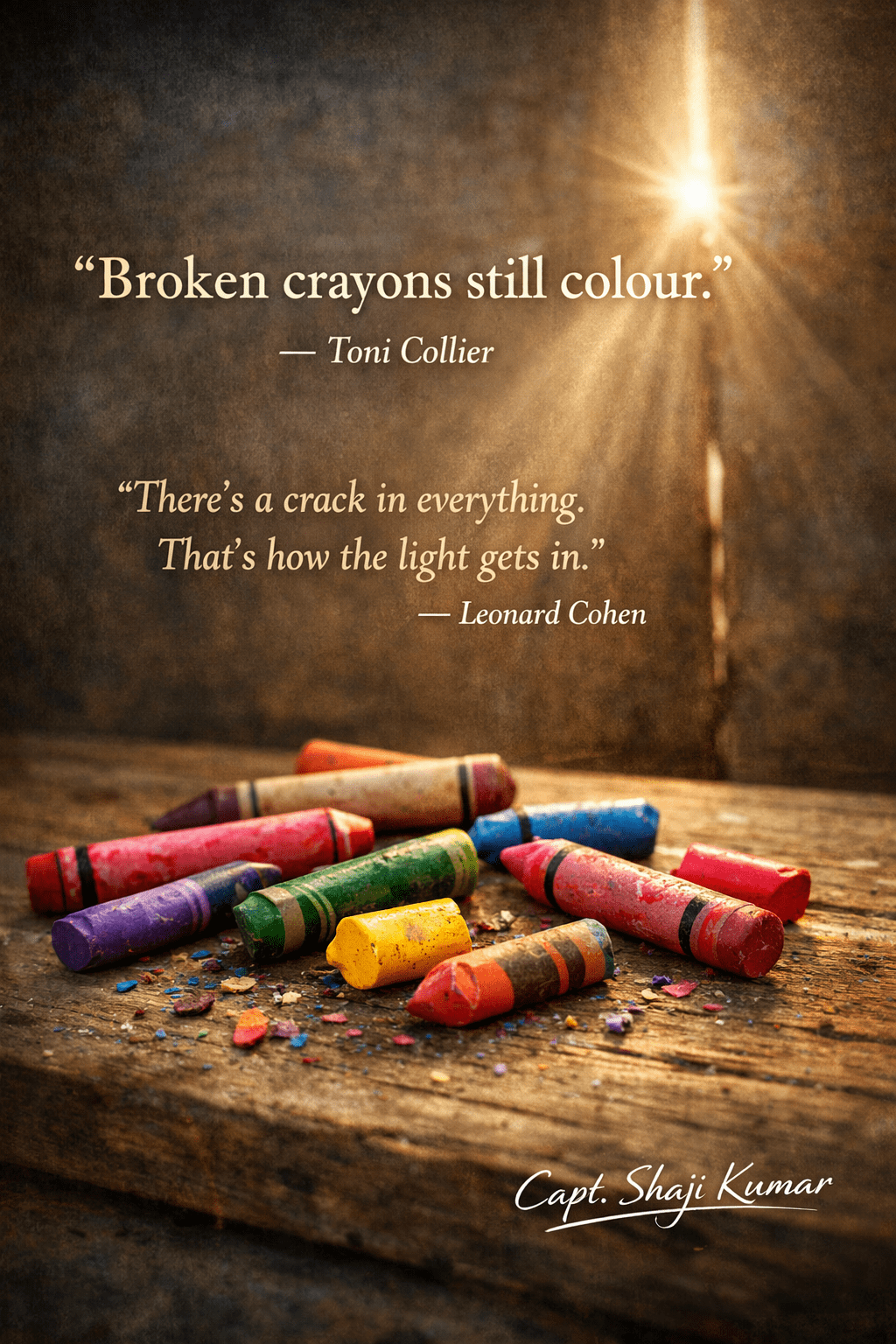
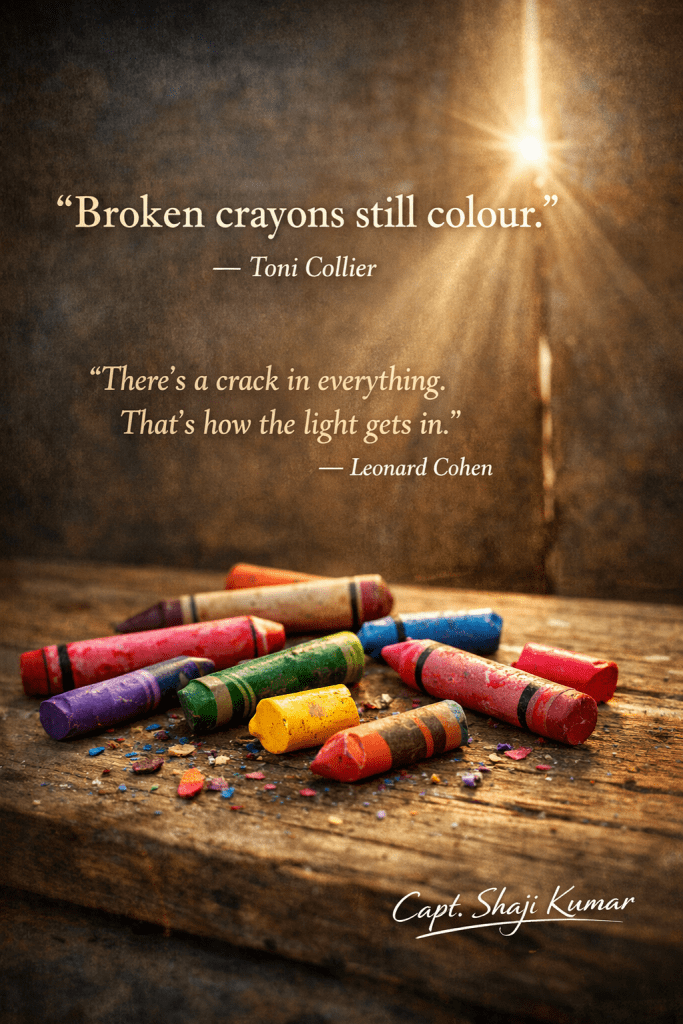
    “Broken crayons still colour.” — Toni Collier.

    “Broken crayons still colour.” — Toni Collier

    We spend so much of our lives trying to hide the cracks.

    The imperfections. The moments we wish we could erase. The parts of ourselves that don’t look “complete.”

    But what if those are the very things that make us… human?

    Dare I say—it’s not despite the brokenness that we create meaningful lives, but because of it.

    I haven’t met a single person who isn’t carrying something. A disappointment. A regret. A quiet battle no one else sees.

    And yet, they show up. They try. They build. They love.

    That’s not weakness. That’s courage in its rawest form.

    As Leonard Cohen once said, “There’s a crack in everything. That’s how the light gets in.”

    So maybe the goal isn’t perfection.

    Maybe the goal is to colour anyway. To create anyway. To live anyway.

    Because sometimes… the most beautiful art comes from the most unexpected pieces.

  • The Wealth Code: Why “Money Makes Money” is a Dangerous Myth (And How to Build it From Zero).

    The Wealth Code: Why “Money Makes Money” is a Dangerous Myth (And How to Build it From Zero).

    The Myth We Inherited

    There’s a quiet myth we all grow up hearing: “You need money to make money.” While that’s partly true, it’s also dangerously incomplete. If wealth were only inherited, the world would never produce new millionaires. Yet every year, thousands of people rise from ordinary backgrounds to build extraordinary financial lives.

    What are they doing differently? Let’s break it down—not with clichés, but with real, actionable truths.

    1. Trade Survival for Growth

    Most people work to pay bills; wealth builders work to buy freedom. Instead of asking, “How can I earn enough this month?” they ask, “How can I increase my value so I earn more every year?” They invest in skills that compound: Writing, Sales, Technology, and Finance. Skills are the only assets no one can take away from you.

    2. Systems Over Chasing

    Rich people don’t rely on a single income source. They build systems that earn while they sleep:

    • Digital Assets: Writing online, ebooks, and templates.
    • Smart Investing: Stocks, ETFs, and SIPs.
    • The Goal: Turn active income into semi-passive, then fully passive. Even ₹1,000/month is a victory because it proves your system works.

    3. The Discipline of the “Boring”

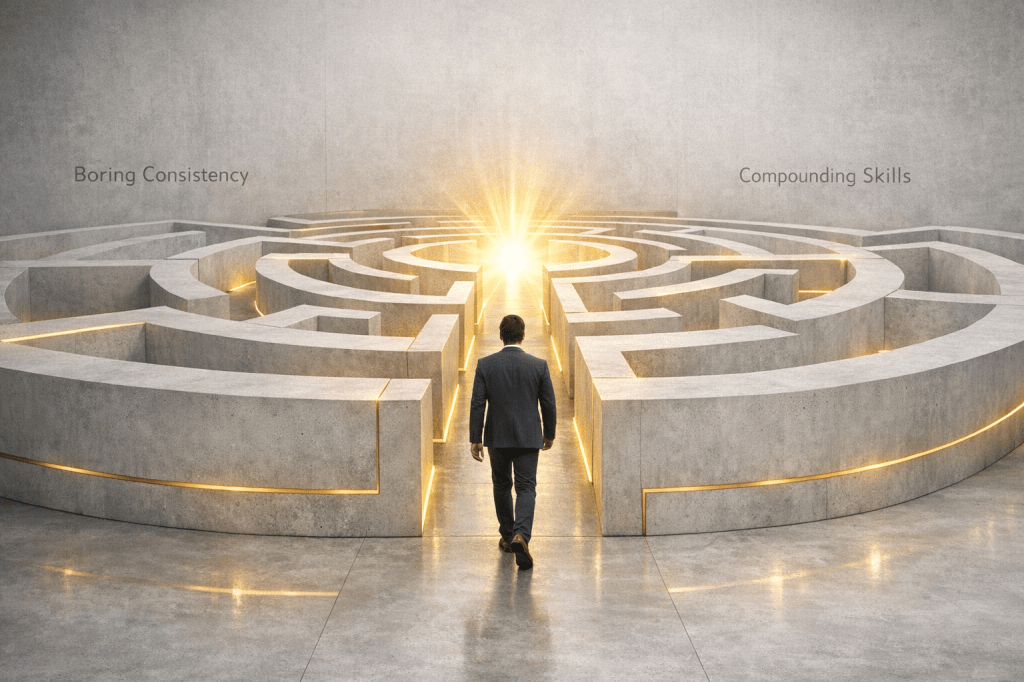
    Wealth is not built in a viral moment. It’s built in quiet repetition: writing when nobody is reading, and saving when it feels insignificant. Over 5 years, this “boring” consistency starts to look like “luck” to everyone else.

    4. Killing Lifestyle Inflation

    This is the silent killer. When most people get a raise, they upgrade their phone. I’ve used the same iPhone for 4 years. While others eat out, I eat out once every two months. By cutting my spending in half, I doubled my ability to invest.

    The Truth: Wealth is not what you earn; it’s what you keep and grow.

    5. Think in Decades, Not Days

    Most people want results in 30 days. Wealthy individuals think in decades. I made the mistake of not investing early, but I’m fixing that now. Compounding requires a “patient” mindset—the goal isn’t just to get rich fast, but to ensure you cannot stay poor.

    6. The Power of Leverage

    Hard work alone doesn’t create wealth; leverage does. Whether it’s Content Leverage (writing one article that earns for months) or Money Leverage (investments), you must learn to multiply your effort.

    The Final Word

    You don’t need a rich family or a lucky break. You need a skill, a system, and the belief that it is possible for you. If you are starting from zero, remember: every wealthy person you admire once had no audience and no shortcuts.

    They just didn’t stop. And that is the only advantage that truly compounds.

  • The Power of the Right People 🌟

    The Power of the Right People 🌟

    Finding Your Inner Circle: The Art of Building Your S10

    A journey toward authentic leadership and meaningful connections.

    The Power of the Few.

    In our hyper-connected world, we often forget a fundamental truth: you don’t need everyone to believe in your vision—you just need the right ones.

    Throughout history, the most impactful leaders understood this principle. They cultivated a select group of trusted advisors, confidants, and supporters who became the backbone of their success. I call this your S10**—your Strategic 10. These are the people who will stand by you, challenge you, and help you reach the culmination of your real objectives.

    The Ancient Wisdom of Oral Tradition

    There’s something profound about the spoken word that written text can never fully capture. Consider how the Vedas were passed down through generations—not through scrolls or tablets, but from mouth to ear, creating an unbroken chain of wisdom and understanding.

    When we speak our truths, when we share our visions verbally, something magical happens:

    – Our passion becomes palpable.

    – Our conviction carries weight.

    – Our humanity shines through.

    This is why great rulers maintained councils—not just for their knowledge, but for their ability to communicate, inspire, and deliver results through authentic connection.

    The S10 Project: A Labor of Love

    Like preparing the perfect biryani over a slow flame, identifying your S10 requires patience, intention, and careful attention to detail. This isn’t a process you can rush—it’s a continuous quality endeavor that deserves the same dedication you’d give to any masterpiece.

    The Selection Principles:

    No Elimination Without Cause Every person in your consideration deserves fair evaluation. Names don’t get crossed off lightly.

    Holistic Assessment One conversation, one interaction, one moment doesn’t define someone’s potential value to your circle.

    Continuous Evolution Like quality itself, this is an ongoing process. Your S10 may shift as you grow and your mission evolves.

    Time-Tested Validation Just as the finest biryanis need time to develop their full flavor, the best relationships reveal their true worth over time.

    The Multimedia Advantage

    While I write these words now, I recognise that written content only captures part of the story. The tremor in a voice when someone shares their deepest conviction, the sparkle in eyes when passion ignites, the pause that speaks volumes—these elements transform mere information into transformation.

    This is why the greatest teachers, from ancient gurus to modern thought leaders, understand that multi-sensory communication creates deeper impact:

    – Visual elements engage imagination.

    – Audio conveys emotion and nuance.

    – Written words provide structure and reference.

    – Personal interaction builds trust and connection.

    Building Your Own Council

    As you work toward becoming a thought leader who makes a real difference, ask yourself:

    Who are the people that

    – Challenge your thinking without crushing your spirit?

    – Celebrate your wins authentically?

    – Offer honest feedback when you need course correction?

    – Stand by you when others doubt?

    – Amplify your message because they truly believe in it?These are your potential S10 members. They’re not necessarily the loudest voices or the most obvious choices—they’re the ones whose values align with yours and whose presence makes you a better version of yourself.

    The Marathon Mindset

    Remember, this isn’t a sprint to a finish line—it’s a 25-year journey of continuous growth, refinement, and impact. Your S10 today might look different from your S10 in five years, and that’s not just okay—it’s expected and healthy.

    The goal isn’t perfection; it’s authentic progress toward meaningful impact.

    Closing Wisdom: The Rules for a Happy Life

    As we navigate this journey of building our circles and our influence, let’s anchor ourselves in timeless wisdom:

    1. Don’t HATE – Life is too short to waste time hating. That energy could be channeled into building something beautiful instead.

    2. Don’t COMPARE – Don’t try to be someone else. The world already has them—what it needs is the best version of YOU.

    3. Don’t WORRY trust yourself.

    The day you stop worrying will be the FIRST day of your NEW LIFE.

    Trust the process, trust your S10.

    What started as a pet project has become a profound reminder: we’re not meant to journey alone. We’re meant to find our people, nurture those relationships, and together, create the change we wish to see in the world.

    Who’s in your S10?

  • The Unstoppable Force: Why Educating Women Transforms Everything.

    The Unstoppable Force: Why Educating Women Transforms Everything.

    The statistics are stark, yet inspiring: when we invest in a girl’s education, we don’t just change her life—we transform entire communities, economies, and futures. Despite centuries of progress, the fight for women’s education and advancement remains one of the most critical battles of our time, with ripple effects that extend far beyond classroom walls.

    The Foundation That Changes Everything.

    Education serves as the great equaliser, but for women, it becomes something even more powerful—a tool of liberation. When girls receive quality education, the benefits cascade through generations like stones thrown into still water, creating waves of change that touch every corner of society.

    The Immediate Impact: Lives Transformed

    The data speaks volumes about education’s transformative power:

    Health Revolution: Educated women make informed healthcare decisions, leading to lower maternal mortality rates and healthier families.

    Economic Powerhouse: Each additional year of schooling increases a woman’s earnings by 10-20%, injecting vital funds into local economies.

    Population Stability: Educated women have fewer children and invest more in each child’s future, creating a cycle of opportunity.

    Leadership Pipeline: Education builds confidence and critical thinking skills, preparing women to lead in their communities and beyond

    Breaking the Chains of Child Marriage

    In many parts of the world, education becomes a shield against harmful traditional practices. When families see their daughters gaining knowledge, skills, and confidence, the girl’s perceived value shifts dramatically. Education delays marriage, reduces teenage pregnancy, and opens doors to possibilities that seemed impossible just one generation ago.

    The Persistent Barriers: What Still Stands in Our Way.

    Despite overwhelming evidence of education’s benefits, obstacles remain stubbornly entrenched across the globe.

    In Developing Nations: The Triple Threat

    1. Poverty’s Cruel Mathematics

    Families facing survival often view girls as economic burdens rather than investments. The immediate need for income outweighs long-term benefits, forcing girls into work or early marriage.

    2. Violence and Safety Concerns

    The journey to school becomes dangerous for girls in areas where gender-based violence is common. Parents, seeking to protect their daughters, often keep them home.

    3. Cultural Resistance

    Deep-rooted beliefs about women’s roles continue to limit educational opportunities. Traditional societies may view educated women as threats to established hierarchies.

    In Developed Nations: The Paradox of Progress

    Here lies one of the most frustrating ironies of our time: countries with the highest female enrolment rates still struggle with gender equity in leadership positions.

    The Pipeline Problem

    – Women earn 60% of university degrees in the US and Europe.

    – Yet they hold only 20% of senior executive positions.

    – The gap between education and leadership roles reveals systemic barriers that persist despite formal equality.

    The Confidence Gap

    Even in nations where legal barriers have fallen, cultural expectations and unconscious biases continue to limit women’s advancement, creating what researchers call the “confidence penalty.”

    The Ripple Effect: How Educated Women Transform Society.

    When women succeed, everyone wins. This isn’t just feel-good rhetoric—it’s economic reality backed by decades of research.

    Economic Multipliers

    Community Investment

    Women reinvest 90% of their earnings back into their families and communities, compared to 35% for men.

    This means every educated woman becomes an economic catalyst, multiplying prosperity throughout her network.

    Innovation Drivers

    Companies with diverse leadership teams are 21% more likely to experience above-average profitability. Women bring different perspectives, experiences, and problem-solving approaches that drive innovation and growth.

    Social Transformation.

    Breaking Generational Cycles

    Educated mothers are more likely to educate their own children, creating positive feedback loops that elevate entire communities over time.

    Political Participation

    Education correlates strongly with civic engagement. Educated women vote more frequently, run for office more often, and advocate more effectively for social change.

    The Path Forward: From Potential to Reality

    The solution isn’t just about getting more girls into classrooms—it’s about creating comprehensive support systems that carry them from education to empowerment.

    1. Address Root Causes

    Economic Support: Conditional cash transfer programs that pay families to keep girls in school.

    Safety Measures: Safe transportation, secure school environments, and community protection programs.

    Cultural Engagement: Working with community leaders and families to shift perspectives on women’s roles

    2. Bridge the Leadership Gap

    Mentorship Programs: Connecting educated women with role models and sponsors.

    Policy Reform: Implementing family-friendly workplace policies and addressing systemic biases.

    Entrepreneurship Support: Providing access to capital and business training for women-led ventures.

    3. Sustain Long-term Change

    Institutional Reform: Ensuring educational institutions are equipped to support and advance women.

    Community Building: Creating networks that support women throughout their careers.

    Measurement and Accountability: Tracking progress and holding institutions accountable for gender equity.

    The Moral Imperative: Why This Matters Now In an interconnected world facing complex challenges—from climate change to economic inequality to global health crises—we cannot afford to waste half of our human talent. The problems we face require all minds, all perspectives, and all the innovation we can muster.

    Educating women isn’t just about fairness or equality—it’s about survival and prosperity in an increasingly competitive world. Countries that fail to fully utilise their female talent will find themselves at a significant disadvantage in the global economy.

    The Call to Action

    Every stakeholder has a role to play:

    Governments must invest in education infrastructure and remove legal barriers.

    Communities need to challenge harmful traditional practices and support girls’ aspirations.

    Employers should create pathways for women’s advancement and address workplace biases.

    Individuals can mentor, advocate, and vote for policies that support women’s education and empowerment.

    Conclusion: The Future We Can Build

    The evidence is overwhelming: educating women creates a better world for everyone. Yet millions of girls still lack access to quality education, and millions more face barriers in translating their education into meaningful opportunities.

    This isn’t just a women’s issue—it’s a human issue. It’s an economic issue. It’s a survival issue for our species and our planet.

    The question isn’t whether we can afford to invest in women’s education and advancement. The question is whether we can afford not to. The cost of inaction—in lost potential, stunted economies, and persistent

    inequality—far exceeds the investment required to create change.

    The path forward is clear. The tools are available. What we need now is the collective will to turn this knowledge into action, ensuring that every girl has the chance to fulfil her potential and contribute to our shared future.

    The time for half-measures and good intentions has passed. The future demands nothing less than our complete commitment to unleashing the full power of educated, empowered women. Our world depends on it.

    United Nations has designated the theme on International Women’s Day this year as “Rights. Justice. Action. For ALL Women and Girls.

    HAPPY WOMEN’S DAY.

  • The Grass Isn’t Always Greener: 27 Years of Entrepreneurial Truth

    The Grass Isn’t Always Greener: 27 Years of Entrepreneurial Truth

    The Grass Isn’t Always Greener: 27 Years of Entrepreneurial Truth.

    A candid reflection on the realities of building a business, the myths that mislead aspiring entrepreneurs, and what it truly takes to survive—and occasionally thrive—in the entrepreneurial wilderness.

    When I started my entrepreneurial journey 27 years ago, I thought I understood what lay ahead. I was wrong. Like most first-time founders, I believed the grass would be greener on the entrepreneurial side of the fence. Today, with salt-and-pepper hair as my witness, I can tell you that the grass isn’t uniformly green—it’s patchy at best, with occasional verdant spots interspersed among the brown patches of struggle.

    The Myth of Instant Green.

    Over the years, I’ve watched many former employees take the entrepreneurial plunge. Some jumped with grand visions, others with detailed roadmaps that looked flawless on paper: secure funding, build valuation, execute an IPO or acquisition, then walk away with “tons and tons of money.

    The reality? I rarely hear success stories from these departures.

    This silence speaks volumes. The entrepreneurial graveyard is littered with dreams built on the myth of the get-rich-quick scheme. We live in an era where a select few have struck gold, creating a narrative that entrepreneurship is a lottery ticket rather than a marathon. This misconception fuels the current startup stampede—and explains why 90% of startups fail.

    The harsh truth: those few who “hit pay dirt are statistical outliers, not the norm.

    The Long Gestation of Success.

    Real entrepreneurship isn’t a sprint to riches—it’s an endurance test that would make an Olympian proud.

    Just as athletes don’t accidentally stumble onto podiums, successful entrepreneurs don’t stumble into success. There are no shortcuts.

    What It Actually Takes

    1. A Burning Desire That Survives Reality.

    You need more than enthusiasm; you need an obsession that can withstand years of setbacks. This isn’t passion—it’s something deeper, more primal. It’s the difference between wanting something and needing it to define your existence.

    2. The “Why” Factor.

    Before you quit your job or pitch investors, answer this: Why does your venture need to exist? Not why you want it to exist, but why the world needs it. If you can’t articulate this clearly, you’re building on sand.

    3. Start Small, Think Big.

    Remember Birbal finding warmth from a candle burning miles away? Your vision might be distant and dim, but it must be visible enough to guide you through dark periods. Start with minimal viable steps while keeping that distant light in sight.

    4. Embrace the Mistake Factory.

    Mistakes aren’t just inevitable—they’re your primary education. Each failure should strengthen your resolve, not weaken it. The entrepreneurs who survive aren’t those who make fewer mistakes; they’re those who learn faster from them.

    The Price of the Entrepreneurial Path

    Here’s what most people don’t tell you about entrepreneurship: it demands sacrifice that employed life never does.

    What You’ll Likely Sacrifice:

    Financial security (for years, possibly decades).

    Work-life balance (your business becomes your life).

    Predictable income (feast or famine becomes normal).

    Professional safety nets (no HR department, no guaranteed paycheck)

    Social time (while friends advance in corporate careers, you’ll be grinding).

    What You Might Gain:

    Autonomy over your decisions and destiny.

    The possibility of significant financial returns (emphasis on possibility).

    Deep satisfaction from building something meaningful.

    Resilience that serves you in every life area.

    Stories that make for interesting dinner conversations.

    The Relentless Test. Twenty-seven years in, I can confirm that the test never stops being severe and relentless. Market conditions change, competitors emerge, team members leave, funding dries up, customers disappoint, and sometimes everything goes wrong simultaneously.

    The question isn’t whether you’ll face adversity—it’s whether you’ll maintain that “fire in the belly” when adversity becomes your daily companion.

    Surviving the Long Haul

    Perseverance Over Perfection: Your first idea probably won’t work. Neither will your second or third.

    Success often comes from persistence through iterations, not brilliance on attempt one.

    Work Ethic as Oxygen: If you’re looking for better work-life balance, stay employed. Entrepreneurship demands a work ethic that borders on obsessive. This isn’t sustainable for everyone, and that’s okay.

    Never Give Up (But Know When to Pivot): There’s a fine line between persistence and stubbornness.

    The situation will change eventually, but sometimes you need to change your approach to the situation.

    The Uncomfortable Truth About Green Grass.

    After 27 years, my grass has some green patches—moments of success, financial wins, personal satisfaction from building something lasting. But it’s not the uniform, lush green that entrepreneurship mythology promises.

    And you know what? That’s perfectly fine.

    The real victory isn’t achieving some fantasy of endless green grass. It’s building something meaningful while accepting that entrepreneurship is inherently messy, uncertain, and often unrewarding in traditional metrics.

    For Aspiring Entrepreneurs.

    Before you leap, ask yourself:

    – Are you prepared for a decades-long journey with no guarantees?

    – Can you find fulfilment in the process, not just the outcome?

    – Do you have the financial runway and personal support for extended uncertainty?

    – Is your “why” strong enough to sustain you through years of difficulty?

    If your answers give you pause, consider staying employed while building something on the side. There’s no shame in choosing stability—and there’s wisdom in understanding your own tolerance for risk and uncertainty.

    Final Thoughts

    Entrepreneurship isn’t for everyone, despite what startup culture suggests. It’s not a fast track to wealth, freedom, or happiness. It’s a difficult path that demands everything you have and offers no guarantees in return.

    But for those with the right combination of vision, persistence, and perhaps a touch of madness, it can be profoundly rewarding—just not in the ways you initially expect.

    The grass may not be uniformly greener, but those patches of green you do cultivate? They’re genuinely yours. And after 27 years of tending to them, that means something.

    Sometimes the most honest thing you can tell someone about entrepreneurship is this: if you can imagine being happy doing anything else, do that instead. But if you can’t shake the vision of building something meaningful, then welcome to the long, difficult, occasionally rewarding journey of entrepreneurship.

  • 🚀 Your Enterprise is Your Baby: Lessons from an Entrepreneurial Journey.

    🚀 Your Enterprise is Your Baby: Lessons from an Entrepreneurial Journey.

    They say entrepreneurship is not for the faint-hearted, and after years of riding the rollercoaster of business ownership, I can tell you—they’re absolutely right. But what they don’t tell you is that it’s also one of the most rewarding journeys you’ll ever embark on, filled with lessons that shape not just your business, but your character.

    🏢 Be Proud of Your Baby

    Your enterprise is your baby. Be proud of it. Never be dazzled by what’s around you.

    I’ll never forget when a very senior person made a remark about the location of my office. For a moment, I felt that familiar pang of self-doubt creeping in. But then reality hit me—this is MY office, and I am proud of it. I built this from the ground up. I am the employer here.

    Here’s what I’ve learned: if employees don’t want to compromise and have their own locational preferences, that’s their restricted mindset, and I cannot help it. After all, whoever heard of a well walking up to a thirsty person? The value lies not in the glamorous address or the fancy furnishings—it lies in what you can provide: genuine value addition.

    To young entrepreneurs reading this: don’t let anyone make you feel small about where you started or where you currently are. Every successful business empire started somewhere, often in the most humble of places. Your garage, your spare bedroom, that small rented space—embrace it.

    Own it. Be proud of it.

    🤝 Integrity: The Foundation of Everything

    Over the years, I have built goodwill by practicing integrity, and this has definitely resulted in very positive customer retention. Let me be crystal clear about something: your customers should not stop believing in your venture. Never take them for granted. You exist only because of them, and it can never be the other way around.

    I’ve discovered something remarkable—if your reputation and integrity exceed expectations, customers will be willing to associate with you regardless of cost. It won’t matter if you’re more expensive than your competitors. They’ll choose you because they trust you.

    Think about it: in a world where consumers are bombarded with options, what makes them stick with one business over another? It’s not always the lowest price or the fanciest marketing. It’s the confidence that you’ll deliver on your promises, every single time.

    Here are the integrity principles that have guided my journey:

    • Always under-promise and over-deliver.
    • Be transparent about limitations and challenges.
    • Admit mistakes quickly and fix them faster.
    • Treat every customer interaction as an opportunity to build trust.

    🎢 The Rollercoaster: Risk vs. Gamble

    When you embarked on your entrepreneurial journey, was it a ‘risk’ or a ‘gamble’? I’ve spent many sleepless nights pondering this question, especially during the tough times.

    Just like success is never guaranteed, failure does not mean the end. Nothing is final. Let me share something personal: at one point, I scaled heights that I had only dreamed of. The business was thriving, revenues were soaring, and I felt invincible. Then, in the very next year, my business plummeted. It was devastating.

    The slide seemed unstoppable. Customers were leaving, revenue was drying up, and doubt crept in like a persistent shadow. But here’s the thing about entrepreneurship—it has its flips and flops. The key is never to be discouraged.

    I could have given up. Many people expected me to. Some even suggested I should. But something inside me refused to surrender. I held on to one simple belief: if you do not give up, there is nothing that can stop you from succeeding.

    And you know what? The slide could be stopped only recently, and I have again regained that upward momentum. This isn’t just business theory—this is a true life story, happening right now.

    💪 Lessons for Young Entrepreneurs

    If you’re just starting out or struggling through a difficult phase, here’s what I want you to remember:

    1. Your current circumstances are not your final destination. That small office, limited budget, or lack of fancy resources? They’re temporary. What matters is your vision and determination.
    2. Build relationships, not just transactions. Every customer interaction is an investment in your future. Treat them with respect, deliver value, and watch how loyalty transforms your business.
    3. Embrace the uncertainty. Entrepreneurship isn’t about eliminating risk—it’s about managing it intelligently while staying true to your values.
    4. Define success on your own terms. Don’t let others dictate what your business should look like or where it should be located. Your vision, your rules.
    5. Persistence beats perfection. You don’t need to have all the answers from day one. You just need to keep moving forward, learning, and adapting.

    🌟 The Journey Continues

    As I write this, I’m reminded that entrepreneurship is not a destination—it’s a journey. There will be days when you feel like you’re on top of the world, and others when you question every decision you’ve made. Both are part of the process.

    What I’ve learned is that success isn’t measured just in revenue or market share. It’s measured in the relationships you build, the integrity you maintain, and the resilience you develop. It’s about creating something meaningful, something you can be genuinely proud of.

    Your enterprise is your baby. Nurture it with passion, protect it with integrity, and never let anyone make you feel ashamed of where you are in your journey. Every giant oak tree was once just an acorn that held its ground.

    To every young entrepreneur reading this: trust the process, believe in yourself, and remember—if you don’t give up, there’s nothing that can stop you from succeeding. This isn’t just motivation; it’s a promise backed by experience.

    Keep building, keep believing, and keep moving forward. Your success story is being written every single day.

    What’s your entrepreneurial story? Share your journey in the comments below—I’d love to hear about the challenges you’ve overcome and the lessons you’ve learned along the way.

  • Finding Your True North: When Life’s Journey Finally Becomes Your Own.

    Finding Your True North: When Life’s Journey Finally Becomes Your Own.

    Finding Your True North: When Life’s Journey Finally Becomes Your Own.

    Have you ever been stopped in your tracks by a seemingly simple question? The kind that appears innocent on the surface but sends you tumbling down a rabbit hole of self-reflection? That’s exactly what happened to me recently when a friend casually asked: 

    What are you passionate about? 

    Are you following what your heart and mind desire?”

    On the surface, it seemed like an easy question to answer. After all, I’ve built and run a fairly successful small business for 27 years. As a first-generation entrepreneur, I could confidently say that passion drove me to achieve something meaningful. But when I looked deeper—really looked—I wasn’t quite sure anymore.

    The Passenger Syndrome: When Life Drives You.

    For years, I wondered: Have I been in control of my life, or has life been driving me along its own predetermined path while I sat as a mere passenger?

    Looking back, my early years were anything but deliberate:

    • School: I finished in a stream that wasn’t my forte at all. Barely made through.

    • College: Switched to a subject that was, once again, everything but a choice.

    • Military: Joined the Armed Forces without much deliberation, deciding within the first year that I’d only stay for the stipulated five years.

    Each step felt like following the Darwinian theory of survival—adapting, persisting, but not necessarily thriving in alignment with my true self.

    The First Real Choice: Entrepreneurship as Awakening.

    The turning point came when I decided to become an entrepreneur. For the first time in my life, this felt like a deliberated choice—not just going through the motions or following societal expectations.

    Despite the usual “rollicking” of Army life, this decision set me going in a direction that felt authentically mine. Yes, there were troughs and crests, the inevitable tempests of establishing something new. But through it all, I found myself enjoying what I was doing for the first time in my life.

    That’s when I realised something profound: the need to be creative and keep creating new vistas and avenues is what I’m truly passionate about.

    Life Lessons Learned Along the Way.

    1. Passion Isn’t Always Obvious from the Start.

    Sometimes passion isn’t a lightning bolt of clarity. It’s something you discover through experience, through trying different paths, even through the things you initially resist. My journey through various streams and careers wasn’t wasted time—it was research for finding my true calling.

    2. Being a “Passenger” Isn’t Always Wrong.

    There’s wisdom in allowing life to guide you sometimes, especially in your early years. Those experiences I thought were just “going through the motions” actually equipped me with skills, resilience, and perspectives that later proved invaluable in entrepreneurship.

    3. Calculated Risks Are Worth Taking.

    I’ve never gambled in the conventional sense, but I realize I’ve been “gambling with life” all this while— taking chances, betting on myself, choosing uncertainty over security. This kind of calculated risk-taking has been the gateway to my most fulfilling experiences.

    4. Transformation Is Ongoing.

    The usual transformational changes keep happening. What excites me today might evolve tomorrow, and that’s not inconsistency—it’s growth. The key is staying open to these changes rather than rigidly sticking to outdated versions of ourselves.

    5. Creation Is Its Own Reward.

    The passion I’ve discovered isn’t just about business success—it’s about the act of creation itself. Building new vistas, exploring fresh avenues, bringing ideas to life. This creative drive transcends any single venture or achievement.

    Questions for Your Own Reflection.

    As I’ve learned, sometimes the most valuable questions are the ones that initially make us uncomfortable:

    1. When did you last make a truly deliberated choice? Not just going with the flow, but actively choosing your direction?

    2. What activities make you lose track of time? These might point toward your genuine passions.

    3. If you could start over, what would you do differently? More importantly, what would you keep the same?

    4. What kind of “gambling” are you avoiding? Sometimes the biggest risk is not taking any risks at all.

    5. How has being a “passenger” in some areas of your life actually served you? 

    Not all unplanned journeys are wasted journeys.

    The Journey Continues.

    Today, I’m more comfortable with the idea that life is part deliberate choice and part surrender to circumstances beyond our control. The key is recognising when to take the wheel and when to trust the process.

    My 27-year entrepreneurial journey taught me that passion isn’t just about following your heart—it’s about creating a life where your heart and mind can thrive together. It’s about embracing both the planned destinations and the unexpected detours.

    The most important realisation? You’re never too late to start making deliberated choices. Whether you’re 25 or 55, whether you’re just starting out or pivoting after decades in one direction, you always have the power to become the driver of your own life.

    Sometimes the best journeys begin not with knowing exactly where you’re going, but with the courage to finally take the wheel.

    What deliberated choice will you make today