Tag: #Personal Development

  • The Buck Stops Here.

    The Buck Stops Here.

    ✦  THE REFLECTION SERIES  ·  CAPT. SHAJI KUMAR

    The Buck Stops Here.

    On the weight that only one person in the room can never put down — and why that weight, carried rightly, is the highest privilege of leadership.

    By Capt. Shaji Kumar  ·  The Reflection Series

    There is a phrase that has echoed through every corridor of power, every boardroom, every command post, and every founder’s office since Harry Truman first placed a small wooden sign on his desk in the Oval Office.

    The buck stops here.

    Five words. No ambiguity. No footnotes. No asterisk leading to a clause that redistributes the weight.

    Most people who quote it have never truly felt its meaning. Because understanding those five words intellectually is entirely different from waking up at 3am with them sitting on your chest.

    The leader is the only person in the organisation who does not have the luxury of pointing anywhere but inward.

    The Architecture of Accountability

    Here is the truth that no leadership manual fully prepares you for: every person in your organisation has an exit from accountability that you do not.

    The team member who made the error can apologise. They can resign. They can move to another company, update their LinkedIn profile, and begin again with a largely clean slate. Their mistake follows them — but at a manageable distance. Time erodes it. A new role reframes it.

    The middle manager who missed the target can point upward. They were working within a framework they did not design, executing a strategy they did not author, with resources that were not sufficient. There is always something above them to gesture toward.

    Even the senior executive, one step below the top, carries the comfort of collective decision-making. The board approved it. The committee endorsed it. The consensus was clear.

    But the leader — the one at the top, the founder, the CEO, the head of the organisation — has none of these exits. The apology is not enough. The resignation is not a resolution. The pointing upward finds only open sky. Every decision, every failure, every consequence of every call ever made under their watch circles back — inevitably, reliably, without exception — to their table.

    The Word Everyone Else Gets to Use

    Let us talk honestly about the word “sorry.”

    It is a powerful word. In the right hands, offered with genuine remorse and a commitment to repair, it can rebuild trust, restore relationships, and close wounds that seemed permanent.

    For most people in an organisation, sorry is also sufficient. It is the price of the mistake. Pay it, absorb the consequences — which may include losing the job — and move forward. The maximum cost is bounded. A job lost is a job that can be found again. A career disrupted is a career that can be rebuilt.

    The leader does not have this arithmetic.

    For everyone else, sorry is a settlement. For the leader, sorry is only the beginning of a much longer reckoning.

    When a leader says sorry — genuinely, publicly, with weight — they are not closing the file. They are opening it. Because what follows sorry, for the person at the top, is a cascade of consequences that cannot be contained by a single word or a single act of contrition.

    • Investors who trusted the vision reassess.
    • Teams who believed in the direction begin to question their own loyalty to it.
    • Clients who built their own plans around yours recalibrate.
    • Competitors who were watching take note — and move.
    • Boards who extended confidence begin to sharpen their pencils.
    • And the market — indifferent, unsentimental, and without mercy — simply adjusts its valuation.

    Sorry does not stop any of that. For the leader, accountability is not an event. It is a condition. Permanent, unrelenting, and non-negotiable.

    The Catch-22 That No One Warned You About

    Here is where leadership becomes genuinely, structurally unfair — and the sooner a leader accepts this, the more effective they become.

    The leader must take the risk. That is the job. Without risk, there is no vision, no growth, no transformation, no reason for the organisation to exist beyond the maintenance of the status quo. Risk is not a feature of leadership — it is the definition of it.

    And yet every risk the leader takes is a risk that, if it fails, lands entirely and exclusively on them.

    They did not design the economic conditions that shifted. They did not engineer the competitor’s move that changed the landscape. They did not anticipate the geopolitical event, the regulatory change, the technology disruption. And yet — when the outcome falls short — the risk was theirs. The judgment was theirs. The decision to proceed was theirs.

    This is the Catch-22: You must take the risk to lead. But there is no one to share it with when it does not work. You step forward alone. You carry it alone. And you answer for it alone.

    The Leader’s Catch-22 — No Exit, Only Ownership

    EVERYONE ELSE   •  Can say sorry and move on   •  Can lose the job — and start again   •  Risk is bounded and recoverable   •  Reputation is personal, containable   •  Can point upward — “I was told to”   •  Tomorrow is still relatively cleanTHE LEADER   •  Sorry is not a strategy   •  Losing the role is the beginning, not the end   •  Risk is total — financial, reputational, human   •  Reputation carries the weight of every decision   •  There is no upward to point to   •  Tomorrow carries everything that happened today

    The columns above are not a complaint. They are a contract. A contract that every genuine leader signs — usually without reading the fine print — the moment they accept the responsibility of the top seat.

    The Loneliness That Comes With the Title

    Leadership at the top is lonely. Not in the way that word is sometimes used casually — as a synonym for solitude or introversion. Lonely in a structural, existential sense.

    Everyone around the leader has someone above them to consult, to defer to, to share the weight with. The leader has no one above. The board is not above — they are alongside, with their own interests and mandates. The mentor is not above — they advise, but they do not carry.

    And this loneliness is not something to be fixed. It is something to be inhabited. The leader who spends their time searching for someone to share the ultimate accountability with is a leader who has not yet truly accepted the role.

    The loneliness of the top is not a problem to be solved. It is a condition to be led from.

    The most effective leaders I have worked with have made a quiet peace with this. They build strong teams — not to distribute the accountability, but to increase the quality of the decisions that accountability demands. They seek counsel — not to avoid the weight, but to carry it more wisely. They stay close to people who tell them the truth — not because truth makes the burden lighter, but because it makes the decisions cleaner.

    The Reframe That Changes Everything

    Here is where I want to shift the arc of this reflection. Because everything I have written above is true — and it is only half the story.

    The buck stops here is not only a burden. It is a distinction.

    In an entire organisation — sometimes hundreds, sometimes thousands of people — there is exactly one person for whom the full weight of every outcome, every decision, every risk, and every result is non-negotiable. One person whose name is on the line in a way that no one else’s is.

    That is not a curse. It is the mark of genuine leadership. And it is extraordinarily rare.

    Most people will live their entire professional lives never truly knowing what it means to be the final answer. Never experiencing the particular clarity — and the particular terror — of a decision that is entirely, irreversibly, consequentially yours. They will always have someone above them. Always have a committee to hide in. Always have the word sorry available as a genuine resolution.

    You do not. And that is not a misfortune. It is an identity.

    The leader who understands this — who stops grieving the exits they do not have and starts inhabiting the seat they do — becomes something qualitatively different from the people around them. Not better. Not superior. But different in a way that matters. Tested in a way that cannot be faked. Forged in a way that cannot be replicated by anyone who has not stood where they stand.

    The buck does not stop at your table because life is unfair. It stops there because you are the only one equipped to answer it.

    What the Leader Who Carries It Well Looks Like

    In my years of coaching leaders across industries, the ones who carry this weight with genuine effectiveness share a handful of traits that are worth naming.

    1. They never pretend the weight isn’t there. They do not perform invulnerability. They acknowledge — to themselves, and often to their teams — that the accountability is real, the stakes are high, and the decisions are hard. This honesty does not weaken them. It earns the trust of everyone watching.
    2. They decide anyway. The weight does not become paralysis. They take the council, absorb the analysis, listen to the room — and then they decide. Clearly. On time. Without the endless deferral that masquerades as due diligence.
    3. They own the outcomes — all of them. Not only the ones that worked. They stand in front of the team, the board, the client, the market — when things fall short — and they say: this was mine. Not the team’s. Not the conditions. Mine. And then they say what comes next.
    4. They do not confuse accountability with self-destruction. Owning the outcome does not mean flagellating yourself indefinitely. The leader who makes peace with a bad decision, extracts the lesson, and moves forward is infinitely more effective than one who carries every past failure as a permanent indictment.
    5. They remember why they accepted the seat. The vision. The mission. The people they are building something for. On the days when the weight is heaviest, it is the reason for carrying it that makes it possible to keep going.

    The Privilege in the Burden

    I want to close this reflection with something that may seem counterintuitive — but which I believe with complete conviction, having seen it in the lives of the leaders who do this well.

    The buck stopping at your table is a privilege.

    Not a comfortable one. Not an easy one. Not one that comes without cost, without sleepless nights, without the particular exhaustion of being the person who cannot pass it on.

    But a privilege nonetheless.

    Because the alternative — a life in which nothing of ultimate consequence is ever yours, in which every decision can be softened with a committee and every failure can be redirected with an apology — is a life lived at a remove from the thing that makes leadership meaningful.

    You were not put at the top of the table to be comfortable. You were put there to answer. And the fact that you are the only one who can — in your organisation, in your context, in your moment — is not a sentence.

    It is a calling.

    The weight of the buck is the price of the vision. Pay it. Carry it. And lead from it. Because no one else in the room can.

    ✦  FROM THE AUTHOR Words that go deeper than the blog. If this reflection stirred something in you, these books were written for exactly that moment.
    📖  Health in Your Hands Your body is your first boardroom. The leader who cannot manage their own health cannot sustain the weight of accountability. Read on Amazon  →🧠  Stress — The Silent Killer Within A 21-Day Acupressure system to reset your nervous system, reduce anxiety and reclaim your health naturally. Read on Amazon  →
    COMING SOON Built, Not Given A new book for young entrepreneurs in Tier 2 and Tier 3 cities who were never handed a headstart — but refuse to let that be their story. Be the first to know when it drops →  skcjos@gmail.com
    ABOUT THE AUTHOR Capt. Shaji Kumar Capt. Shaji Kumar is a Leadership Coach, Author, and Speaker working with professionals and entrepreneurs who are ready to lead with clarity and courage. He is the author of Health in Your Hands and Stress — The Silent Killer Within, and his upcoming book Built, Not Given is written for entrepreneurs who were never handed a headstart. Connect with him, access his books, and join his inner circle at: linktr.ee/skcjos
    LET’S STAY CONNECTED Join the inner circle. Leadership insights. Early access to Built, Not Given. Coaching opportunities. No noise — just substance, when it matters. ✉️  Sign up here: linktr.ee/skcjos 📅  Book a coaching appointment: LinkedIn → ✉️  Write directly: skcjos@gmail.com

    The buck stops here.

    Not because you have no choice.

    Because you are the choice.

    — Capt. Shaji Kumar  ·  The Reflection Series

    #TheBuckStopsHere   #TheReflectionSeries   #LeadershipAccountability   #LeadershipDevelopment   #ExecutiveCoaching   #CaptShajiKumar   #LeadWithCourage   #Accountability   #LeadershipBurden   #GrowthMindset   #DecisionMaking   #EntrepreneurMindset   #LeadershipReflection   #BuiltNotGiven   #MediumBlog

  • Frozen at the Edge.

    Frozen at the Edge.

    ✦  THE REFLECTION SERIES  ·  CAPT. SHAJI KUMAR

    Frozen at the Edge.

    Why fear — not ignorance — is the silent executioner of leadership decisions, and what happens when the ghosts of the past and the shadows of the future converge at exactly the wrong moment.

    By Capt. Shaji Kumar  ·  The Reflection Series

    There is a moment every leader knows.

    It does not announce itself. It arrives quietly — usually in the middle of the night, or in the silence just before a meeting begins. It is the moment when you know exactly what decision needs to be made. You can see it clearly. You understand what it requires.

    And you do not move.

    Not because you lack information. Not because the timing is wrong. But because somewhere between your mind and your action, fear has built a wall. And on either side of that wall lies a ditch — one filled with the wreckage of the past, and one filled with the shadows of a future you cannot yet see.

    This is the double ditch. And it has swallowed more leadership potential than failure ever has.

    The Architecture of Leadership Fear

    Fear in leadership is rarely the dramatic kind. It does not announce itself as cowardice. It wears more sophisticated disguises — prudence, patience, further due diligence, waiting for the right moment. It borrows the language of wisdom to justify inaction.

    But underneath every delayed decision, every hedged commitment, every conversation that never quite happens — fear is the architect.

    And it draws its blueprints from two very specific sources:

    The first source is the past. The leader who once trusted the wrong person and paid dearly for it. Who launched with conviction and landed badly. Who spoke up in a room and was humiliated for it. That leader does not forget. And when a similar moment arrives — when the terrain looks familiar, when the stakes feel comparable — the past rises up like a witness for the prosecution.

    The second source is the future. The formless, unwritten territory of what has not yet happened. The catastrophe that exists only as possibility. The judgment that has not yet been passed. The failure that is still entirely theoretical. And yet — the mind treats it as real. Vivid. Inevitable. The future, imagined in fear, is more paralyzing than any past defeat.

    The Double Ditch — Where Leaders Fall

    I call it the double ditch because it traps from both sides simultaneously. The leader stands at the point of decision — and finds themselves unable to move forward or backward. The past pulls one way. The future frightens from the other. And in between, the decision waits.

    The Double Ditch — Where Leaders Get Trapped

    DITCH 1 — The Past   •  Fear of repeating old mistakes   •  Replaying past failures in HD   •  Letting yesterday veto today   •  Over-analysis paralysis   •  “Last time I tried this…”DITCH 2 — The Future   •  Fear of an unknown outcome   •  Dread of peer judgment   •  Catastrophising what hasn’t happened   •  Waiting for perfect conditions   •  “What if it all goes wrong?”

    What makes the double ditch so lethal is its invisibility. From the outside, a leader trapped in it looks composed. Measured. Even considered. The paralysis is internal. The organisation moves on. Opportunities close. And the leader remains exactly where fear left them — frozen at the edge.

    What the Regressed Past Actually Costs

    When we explored “What If?” in our last reflection, we discussed how the past can be either a professor or a prison. Fear tips the balance decisively toward the prison.

    A leader governed by the regressed past does not just make slower decisions. They make fundamentally different ones — ones shaped by the emotional residue of old wounds rather than the actual demands of the present moment.

    • They under-invest in people because they once trusted the wrong one.
    • They avoid bold market moves because one launch failed publicly.
    • They soften feedback until it loses all meaning, because directness once cost them a relationship.
    • They defer strategy decisions until the window closes, because they are still refighting an old battle.

    Every one of these is not caution. It is fear wearing caution’s clothing. And the organisation pays the price — in missed opportunity, in eroded trust, in a culture that learns to read the leader’s hesitation as permission to hesitate themselves.

    Fear is contagious in a leadership culture. When the leader flinches, the team learns to flinch.

    The Shadow of the Uncertain Future

    The second ditch is subtler — and in some ways, more powerful. Because the future has not yet happened, the mind fills it with whatever it fears most.

    I have coached leaders who were extraordinarily capable by any measure — experience, track record, emotional intelligence — and yet were unable to commit to decisions because of what might happen. Not what would happen. Not even what was likely to happen. What might.

    This is not strategic risk assessment. That is a cognitive process that weighs probability and prepares contingencies. What I am describing is something different — a paralysis born of imagined catastrophe. A ditch dug not by reality, but by the fearful imagination of a mind that has been burned before and is determined, above all else, never to be burned again.

    The cruel irony: The determination never to fail again is precisely what guarantees a different kind of failure — the failure of the unlived decision. The strategy never executed. The team never mobilised. The moment never seized. Fear of failure produces its own, quieter variety of failure. And this one leaves no dramatic story to tell. Only absence.

    The Falter at the Edge — Why Good Leaders Freeze

    Let us be specific about what the double ditch looks like in practice. Because it is not limited to weak leaders. Some of the most accomplished people I have worked with have found themselves standing at the edge, unable to step forward.

    It typically happens in three distinct moments:

    1. The promotion or transition decision. The leader who has earned the next level but cannot claim it. Who second-guesses their readiness not because the evidence is ambiguous, but because a past failure — a role they stumbled in, a project that came apart — has convinced them the floor might give way again.
    2. The people decision. The leader who knows a team member needs to be moved on, but cannot bring themselves to act. Previous guilt over a similar decision, or fear of conflict, or dread of being seen as ruthless — any one of these is enough to delay action that the team desperately needs.
    3. The strategic bet. The leader who can see the opportunity. Who understands the window. Who has done the analysis. But who stands at the edge of commitment and retreats — because what if this is the time it all unravels? What if the past was not an anomaly but a pattern?

    In each case, the decision is not difficult because it is unclear. It is difficult because fear has made it feel dangerous.

    Crossing the Double Ditch — The Leader’s Path Forward

    I want to be clear: the answer is not fearlessness. Fearlessness in a leader is not courage — it is recklessness with other people’s futures. The goal is not to eliminate the ditch. It is to build a bridge across it.

    That bridge is built from three materials:

    • Honest reckoning with the past.  Not replaying it. Not exorcising it. But sitting with it long enough to separate the lesson from the scar. The lesson is yours to keep. The scar does not have to drive.
    • Calibrated courage about the future.  Not blind optimism. Not catastrophising. But a clear-eyed assessment of what is actually probable versus what fear has convinced you is inevitable. Fear is a terrible statistician. Challenge its numbers.
    • A committed first step.  Not the entire journey — just the next step. The double ditch is crossed not in a single leap but in a series of deliberate moves. The first commitment breaks the paralysis. Everything after becomes possible.

    “Courage is not the absence of fear. It is the decision that something else matters more.” — Ambrose Redmoon

    A Word for the Young Leader in the Smaller City

    I want to speak directly to a particular kind of leader right now — one who perhaps did not grow up with every advantage. Who built what they have from ground that was not always even. Who carries the weight of having come from somewhere that the world did not immediately take seriously.

    You know the double ditch better than most. Because your past contains not just personal failures but systemic ones — moments when the doors were not opened, when the room did not make space, when the credibility had to be earned twice over just to be believed once.

    And your future contains not just uncertainty but the particular anxiety of the first generation — the one who cannot afford to fall back on what was handed to them, because nothing was.

    I am writing a book for you. It is called Built, Not Given. And its entire premise is this: the fact that you were not given it is not your disadvantage. It is your foundation. Because what is built is sturdier than what is handed. What is earned cannot be taken. And the leader who has wrestled their way to where they are carries a depth of conviction that no inheritance can replicate.

    The double ditch is real. But so is the bridge. And you already know how to build things.

    Built, Not Given — Coming Soon. A book for the entrepreneur who started with hunger instead of headstarts. To be among the first to hear when it drops, write to skcjos@gmail.com with the subject: “Built, Not Given — Notify Me”

    The Decision That Changes Everything

    Fear will always be present in leadership. The question is never whether it shows up. It always does. The question is whether you let it make the decision — or whether you make it anyway.

    The leader who crosses the double ditch does not do so without fear. They do so in spite of it. They acknowledge the past, they respect the future, and they step forward anyway — because they understand that the cost of inaction is a bill that comes due slowly, quietly, and with compound interest.

    Your next decision is already forming. Fear is already weighing in. Acknowledge it. Name it. Extract the lesson it carries.

    Then step.

    Because the leader your team needs is not the one who never fears. It is the one who moves despite it.

    “The most courageous act a leader will ever perform is the one they were most afraid to make.”  — Capt. Shaji Kumar

    ✦  FROM THE AUTHOR Words that go deeper than the blog. If this reflection stirred something in you, these books were written for exactly that moment.
    📖  Health in Your Hands Your body is your first boardroom. Take command of it. Read on Amazon  →🧠  Stress — The Silent Killer Within Understand the cortisol loop that hijacks every fearful decision. Read now  →
    COMING SOON Built, Not Given A new book for young entrepreneurs in Tier 2 and Tier 3 cities who were never handed a headstart — but refuse to let that be their story. You were not given the connections, the capital, or the classroom. But you were given hunger. And hunger, channelled right, builds empires. Be the first to know when it drops →  skcjos@gmail.com
    LET’S WORK TOGETHER Is fear holding your leadership back? Capt. Shaji Kumar works with professionals and entrepreneurs who are ready to move from hesitation to decision — and from decision to momentum. If this blog spoke to something you are navigating right now, let us have that conversation. Two ways to connect:   📅  Book an Appointment: LinkedIn →   ✉️  Send a DM: skcjos@gmail.com Want exclusive insights, early access to Built, Not Given, and leadership tools delivered to your inbox?   Drop your email at skcjos@gmail.com with the subject line: “Add me to the list”

    Fear does not disqualify you from leading.

    It is simply the price of admission.

    Pay it. Then lead.

    — Capt. Shaji Kumar  ·  The Reflection Series

    #FearInLeadership   #TheReflectionSeries   #LeadershipDevelopment   #BuiltNotGiven   #ExecutiveCoaching   #DecisionMaking   #GrowthMindset   #YoungEntrepreneurs   #LeadWithCourage   #OvercomingFear   #CaptShajiKumar   #MindfulLeadership   #Resilience   #TierTwoEntrepreneurs   #MediumBlog

    ABOUT THE AUTHOR Capt. Shaji Kumar Capt. Shaji Kumar is a Leadership Coach, Author, and Speaker working with professionals and entrepreneurs who are ready to lead with clarity and courage. He is the author of Health in Your Hands and Stress — The Silent Killer Within, and his upcoming book Built, Not Given is written for entrepreneurs who were never handed a headstart. Connect with him, access his books, and join his inner circle at: linktr.ee/captshajikumar
    LET’S STAY CONNECTED Join the inner circle. Leadership insights. Early access to Built, Not Given. Coaching opportunities. No noise — just substance, when it matters. ✉️  Sign up here: linktr.ee/captshajikumar 📅  Book a coaching appointment: LinkedIn → ✉️  Write directly: skcjos@gmail.com
  • Stop Fighting Your Habits. Start Watching Them.

    Stop Fighting Your Habits. Start Watching Them.

    PRODUCTIVITY  ·  MINDSET  ·  WELLNESS

    Stop Fighting Your Habits. Start Watching Them.

    The harder you push against a bad habit, the stronger it pushes back. There is a Japanese approach that flips this completely — and it actually works.

    By Capt. Shaji Kumar   ·   8 min read   ·   Habits & High Performance

    You have been here before. You decide — really decide — that this time you are quitting. No more mindlessly checking your phone before bed. No more skipping the gym. No more that third cup of coffee at 4 PM. You white-knuckle it for a few days, maybe a week. Then, like a compressed spring, the habit snaps back harder than before.

    This is not weakness. This is not lack of discipline. This is what happens when you bring a sword to a philosophy fight.

    Most high-performers are wired to tackle problems head-on — push harder, want it more, build stronger systems. But when it comes to habits, brute-force willpower is the wrong tool. And the Japanese have known this for centuries.

    “You cannot fight your way out of a pattern you have unconsciously chosen to live in.”

    Why Willpower Fails — Every Single Time

    Here is the science behind the frustration. Every habit lives in a loop: cue → craving → routine → reward. When you try to suppress a habit by sheer force, you are attacking the routine while leaving the craving completely intact. You have not solved the loop. You have just added tension to it.

    Neuroscience backs this up. The habit pathways in your brain are carved deep — through the basal ganglia, not the prefrontal cortex where rational decision-making lives. When you fight a craving, you are using your newest, most exhaustible neural resource (willpower) against one of the oldest, most efficient systems your brain has. You will lose. Not because you are weak — but because it was never a fair fight.

    The relapse is not a failure. It is physics.

    THE WESTERN APPROACH
    Resist the craving
    Suppress the urge
    Force the behavior
    Punish the relapse
    Define yourself by failures
    THE JAPANESE APPROACH
    Observe the craving
    Acknowledge the urge
    Understand the reward
    Redirect with curiosity
    Detach identity from behavior

    The Japanese Frameworks You Have Never Applied to Habits

    CONCEPT 01

    Mushin — “No Mind”

    In Zen martial arts, mushin (無心) refers to a state of mental clarity where the practitioner does not react — they simply move. Applied to habits, mushin means creating a gap between the cue and your response. You notice the urge to reach for your phone. You do not fight it. You do not obey it. You simply observe it — like watching a cloud pass. That gap is where your power lives.

    CONCEPT 02

    Kaizen — Small, Relentless Improvement

    Everyone knows kaizen as “continuous improvement.” But its real power in habit change is the idea that smallness is not weakness — it is strategy. Do not try to overhaul the habit. Shrink it. If you scroll social media for 90 minutes a night, do not quit cold turkey. Observe when you reach for the phone. Notice the emotion. Then reduce by five minutes. The goal is not dramatic transformation — it is quiet, undeniable momentum.

    CONCEPT 03

    Wabi-Sabi — Embracing Imperfection

    Wabi-sabi (侘寂) is the Japanese aesthetic of finding beauty in imperfection and impermanence. For professionals trying to break habits, this is liberating: you do not need a perfect streak. The relapse is not the enemy — treating it as catastrophic is what drives people back into the habit loop in shame. Wabi-sabi says: the crack in the bowl is part of the bowl. Begin again without drama.

    CONCEPT 04

    Ikigai — The Deeper “Why”

    Ikigai (生き甲斐) is often translated as “reason for being.” When applied to habit change, it asks a sharper question: what deeper need is this habit actually serving? The late-night doom-scrolling might be avoidance of an unresolved decision. The excess caffeine might be masking low-grade anxiety. Until you meet that underlying need, no surface-level habit fix will hold.

    The 5-Step Practice: Observe, Do Not Fight

    Here is how you actually apply this — not as a system, but as a daily practice.

    1Name it before you do it The moment you feel the pull of the habit, say it out loud or in your head: “I want to check my phone.” This small act of labeling activates the prefrontal cortex and creates the mushin gap. You are no longer inside the urge — you are watching it.
    2Get curious about the cue Ask: what triggered this? Was it boredom, stress, a specific time of day, a person, a location? Habits are far more situational than we think. Curiosity — not judgment — is the detective tool here.
    3Identify what reward you are actually seeking Dig one layer deeper. The reward is never the surface thing — it is connection, relief, stimulation, validation, or escape. Name the actual reward. Now you have something to redirect toward, not just something to suppress.
    4Take the smallest possible different action Kaizen in action. Do not replace the habit with a heroic new behavior. Replace it with something fractionally better. Reaching for your phone? Put it face-down for two minutes first. The two minutes becomes five. Five becomes the new norm.
    5Review without self-punishment At the end of each day, spend 90 seconds noting: when did the habit appear, what cue preceded it, did I observe or obey? No grades. No streaks. Just data. Wabi-sabi in practice.

    Why This Works for High-Performers Specifically

    Most productivity literature targets the average person trying to build basic routines. You are not that person. You have already built systems. You have read the books. You are still here because the habits you are fighting are not about lack of knowledge — they are about unmanaged cognitive load, performance pressure, and identity.

    High-performers often develop habits as coping mechanisms for high-stakes environments. The scrolling is decompression. The late nights are control. The avoidance is protection. These are not weaknesses to be crushed — they are signals to be decoded.

    “The executive who cannot stop checking email at midnight is not undisciplined. They are anxious about losing control. Fix the anxiety — the email habit dissolves.”

    The Japanese observational approach respects your intelligence. It does not ask you to follow a 30-day plan or reward yourself with stickers. It asks you to think more clearly about what is actually happening — and to trust that clarity, not force, is what changes behavior at the root.

    The Uncomfortable Truth About Habit Change

    Here it is: the habits you most want to break are usually serving you in some way you have not fully acknowledged yet. They are efficient solutions your brain found to real problems. Fighting them without understanding them is like ripping out a load-bearing wall because you do not like where it is.

    The Japanese approach does not ask you to be more disciplined. It asks you to be more honest. To sit with discomfort long enough to understand it. To be, for a few minutes each day, less warrior and more witness.

    That shift — from combatant to curious observer — is where lasting change begins. Not with a dramatic declaration. Not with a new app. With the quiet, repeated act of watching yourself clearly, and choosing, one small moment at a time, something different.

    The habit is not the enemy. The unawareness is. Start there.

    TAKE THIS FURTHER

    Go Deeper With These Books by Capt. Shaji Kumar

    If this article resonated with you, these two books take the conversation much further — with practical, body-based tools for lasting transformation.

    Book 1 Health in Your Hands Discover how your body holds the power to heal. This book puts practical health tools directly in your hands — literally. Available on Amazon →  https://www.amazon.in/gp/product/B0FV4BCC7K
    Book 2 Stress: The Silent Killer Within A 21-Day Acupressure system to reset your Nervous System, Reduce Anxiety and Reclaim your health naturally. The science of stress has never been more accessible — or more urgent. This 21-day system uses ancient acupressure techniques to rewire your nervous system response from the ground up. Get it now →  https://books2read.com/u/bMLojv

    #HabitChange  #JapaneseWisdom  #Mushin  #Kaizen  #WabiSabi  #Ikigai  #Mindfulness  #ProductivityMindset  #HighPerformance  #LeadershipDevelopment  #BehaviorChange  #MentalClarity  #ProfessionalGrowth  #WellnessAtWork  #StressManagement  #NervousSystemHealth  #Acupressure  #HolisticHealth  #MindBodyConnection  #HealthInYourHands

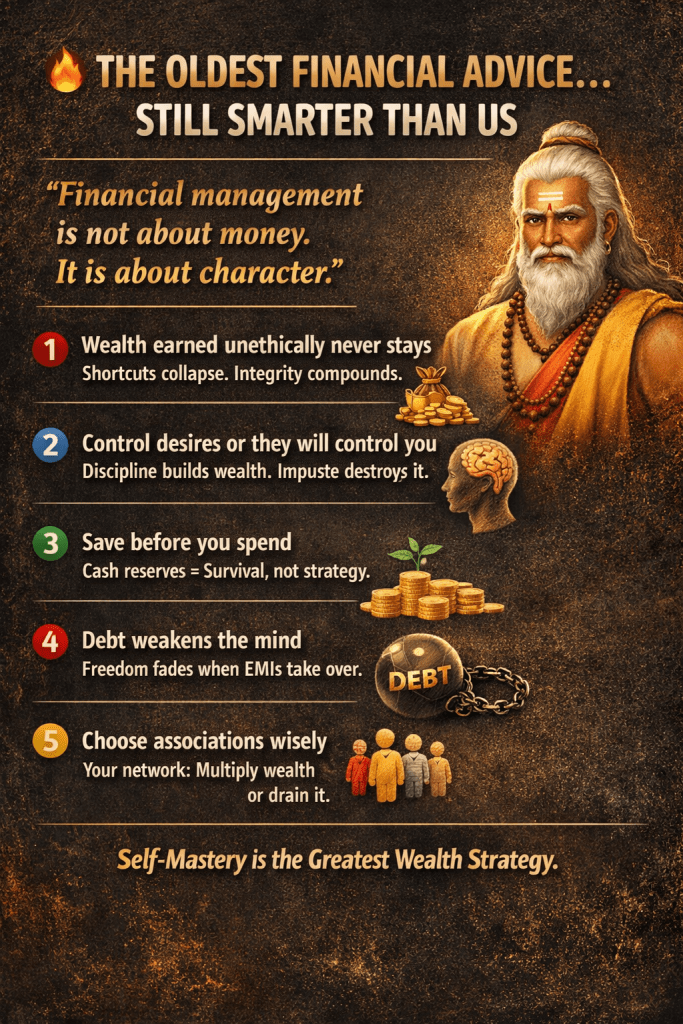
  • 🔥 The Oldest Financial Advice in the World — Still Smarter Than Us.

    🔥 The Oldest Financial Advice in the World — Still Smarter Than Us.

    We live in an age of abundance and anxiety.

    Money flows faster than ever, yet peace of mind feels rarer than gold.

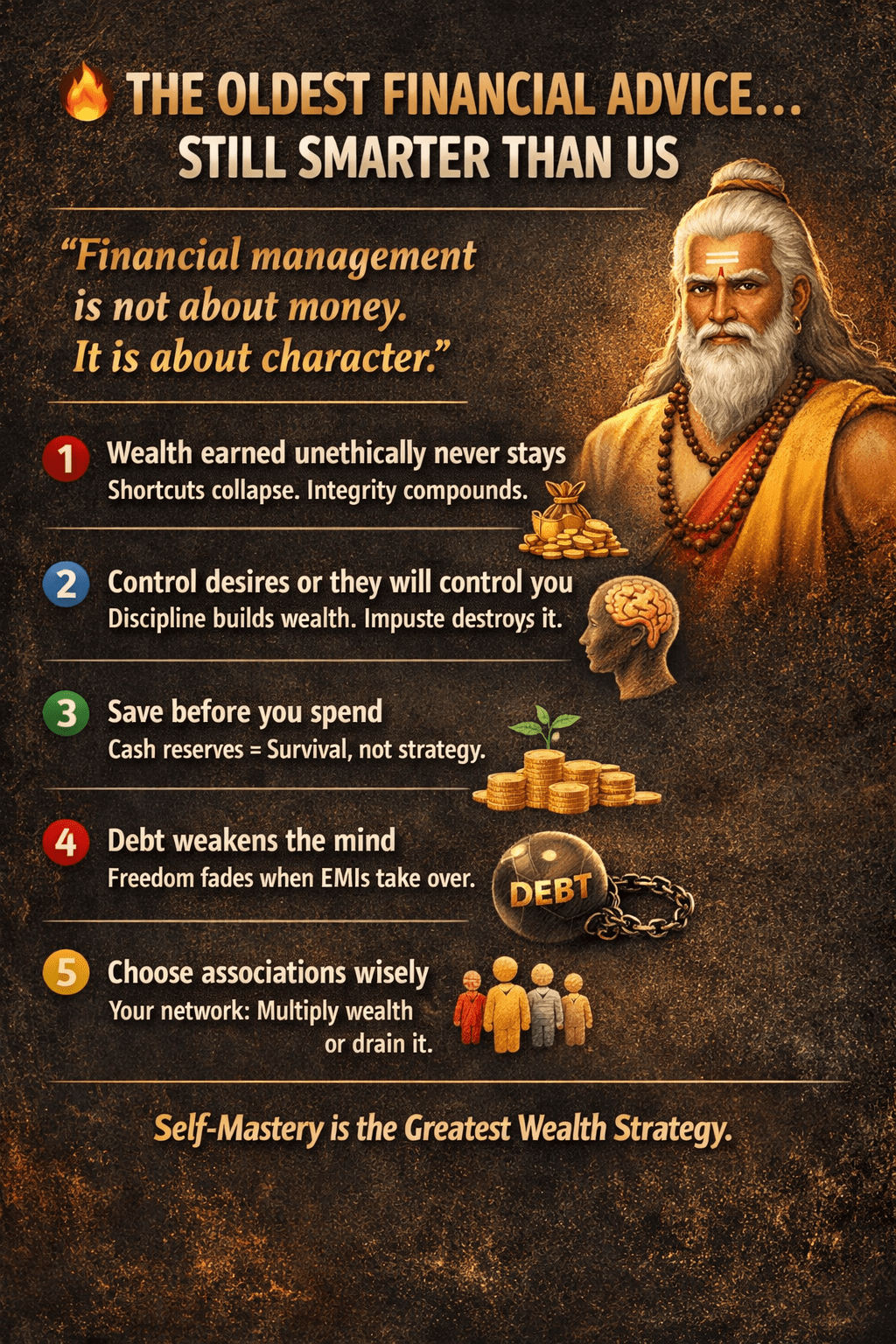
    Every generation believes it invented financial wisdom — until it meets Vidur Niti.

    Three thousand years ago, Vidur, the royal advisor in the Mahabharata, spoke truths that still cut through the noise of modern finance. His words weren’t about numbers or markets. They were about character — the foundation of every sustainable fortune.

    Wealth Earned Unethically Never Stays.

    Vidur warned that wealth gained through deceit destroys the one who holds it.

    It’s not karma — it’s mathematics.

    Unethical gains create instability, distrust, and eventual collapse.

    In today’s world, this translates to:

    Shortcuts collapse. Integrity compounds.

    The most valuable currency is credibility.

    Control Desires or They Will Control You

    Vidur didn’t blame poverty on lack of income. He blamed it on lack of restraint.

    Desire, when unchecked, becomes debt.

    We call it lifestyle inflation, impulse buying, or social comparison — but it’s the same disease.

    Discipline builds wealth. Impulse destroys it.

    The richest people aren’t those who earn the most — they’re those who can say no.

    Save Before You Spend

    Vidur insisted that a wise person always keeps reserves for difficult times.

    In modern language: build your emergency fund before your dream fund.

    Savings are not a financial strategy.

    They are a survival strategy.

    Debt Weakens the Mind

    Vidur saw debt as a spiritual and psychological burden.

    Today, it’s disguised as convenience — EMIs, credit cards, “buy now, pay later.”

    But the truth remains:

    Freedom disappears the moment debt takes over.

    Debt doesn’t just cost money. It costs peace.

    Choose Associations Wisely

    Vidur said that associating with fools, greedy people, or unstable minds leads to ruin.

    In modern business, this means:

    Avoid toxic partnerships, unstable investors, and energy‑draining networks.

    Your network can multiply your wealth or drain it.

    Choose wisely.

    Invest in Wisdom, Not Just Wealth.

    Vidur believed that knowledge is the greatest asset.

    Money grows only when the mind grows.

    Skill development, financial literacy, emotional intelligence — these are the modern equivalents of Vidur’s “inner wealth.”

    Protect Your Wealth from the Five Dangers

    Vidur listed them clearly: fire, water, kings, thieves, and bad relatives.

    Translated to today’s world:

    Insurance, compliance, fraud prevention, documentation, and estate planning.

    Wealth is not just earned — it must be protected.

    Charity Must Be Wise, Not Emotional.

    Vidur said charity should go to the deserving, not the demanding.

    Modern philanthropy echoes this: impact over impulse.

    Give with intention, not emotion.

    True generosity builds ecosystems, not dependency.

    The Real Lesson.

    Vidur Niti isn’t ancient philosophy.

    It’s a financial operating system for anyone seeking stability, clarity, and long‑term prosperity.

    Money doesn’t respond to intelligence.

    Money responds to discipline.

    And discipline, Vidur reminds us, is not a punishment — it’s freedom.

    #VidurNiti #AncientWisdom #FinancialDiscipline #LeadershipMindset #WealthManagement #ModernLeadership #PersonalGrowth #StrategicThinking #ShajiKumarWrites

  • The Wealth Code: Why “Money Makes Money” is a Dangerous Myth (And How to Build it From Zero).

    The Wealth Code: Why “Money Makes Money” is a Dangerous Myth (And How to Build it From Zero).

    The Myth We Inherited

    There’s a quiet myth we all grow up hearing: “You need money to make money.” While that’s partly true, it’s also dangerously incomplete. If wealth were only inherited, the world would never produce new millionaires. Yet every year, thousands of people rise from ordinary backgrounds to build extraordinary financial lives.

    What are they doing differently? Let’s break it down—not with clichés, but with real, actionable truths.

    1. Trade Survival for Growth

    Most people work to pay bills; wealth builders work to buy freedom. Instead of asking, “How can I earn enough this month?” they ask, “How can I increase my value so I earn more every year?” They invest in skills that compound: Writing, Sales, Technology, and Finance. Skills are the only assets no one can take away from you.

    2. Systems Over Chasing

    Rich people don’t rely on a single income source. They build systems that earn while they sleep:

    • Digital Assets: Writing online, ebooks, and templates.
    • Smart Investing: Stocks, ETFs, and SIPs.
    • The Goal: Turn active income into semi-passive, then fully passive. Even ₹1,000/month is a victory because it proves your system works.

    3. The Discipline of the “Boring”

    Wealth is not built in a viral moment. It’s built in quiet repetition: writing when nobody is reading, and saving when it feels insignificant. Over 5 years, this “boring” consistency starts to look like “luck” to everyone else.

    4. Killing Lifestyle Inflation

    This is the silent killer. When most people get a raise, they upgrade their phone. I’ve used the same iPhone for 4 years. While others eat out, I eat out once every two months. By cutting my spending in half, I doubled my ability to invest.

    The Truth: Wealth is not what you earn; it’s what you keep and grow.

    5. Think in Decades, Not Days

    Most people want results in 30 days. Wealthy individuals think in decades. I made the mistake of not investing early, but I’m fixing that now. Compounding requires a “patient” mindset—the goal isn’t just to get rich fast, but to ensure you cannot stay poor.

    6. The Power of Leverage

    Hard work alone doesn’t create wealth; leverage does. Whether it’s Content Leverage (writing one article that earns for months) or Money Leverage (investments), you must learn to multiply your effort.

    The Final Word

    You don’t need a rich family or a lucky break. You need a skill, a system, and the belief that it is possible for you. If you are starting from zero, remember: every wealthy person you admire once had no audience and no shortcuts.

    They just didn’t stop. And that is the only advantage that truly compounds.

  • Waking Up Before the End: Carl Jung’s Final Discovery.

    Waking Up Before the End: Carl Jung’s Final Discovery.

    Three weeks before his death, Carl Jung wrote something that sent shockwaves through the world of psychology: “God is not a belief. It is a psychological fact.

    This wasn’t a sudden leap of faith or a religious conversion. It was the clinical observation of a man who had spent decades documenting the transformation of the human psyche as it approaches the finish line.

    Having studied hundreds of patients, Jung identified a pattern so consistent it transcended culture, creed, and personal conviction. What he found suggests that we have been looking at our lives entirely backward.

    The Four Stages of the Ego’s Dissolution Jung documented a specific, four-stage preparation process that the psyche undergoes. It is not a process of “fading away,” but one of intense emergence.

    • The Ego’s Retreat: The persona we’ve spent a lifetime building—the job titles, the social standing, the “version” of ourselves we defend—begins to lose its grip.
    • The Dissolution: The boundaries of the individual “I” start to soften.
    • The Emergence of the Self: As the ego shrinks, the Self—the totality of the psyche—begins to take center stage.
    • The Union: A realization that the internal psychological reality is more “solid” than the external world. Through this lens of depth psychology, Jung reached a startling conclusion: We are not bodies that happen to have souls; we are souls who happen to have bodies.

    5 Signs the “Self” is Calling You You don’t have to be at the end of your life to experience this shift. In fact, Jung’s final message was about waking up while you are still alive. Here are five signs that your “Self” is calling you toward this individuation:

    • A Growing Distaste for the “Performative”: You find it increasingly exhausting to maintain a version of yourself that feels “unreal”.
    • Vivid, Archetypal Dreams: Your subconscious begins using powerful, universal symbols to grab your attention.
    • The Weight of Material Success: A realization that external achievements no longer provide the “soul-filling” sustenance they once did.
    • A Pull Toward Solitude: Not out of depression, but out of a need to finally meet what has been waiting beneath the surface your entire life.
    • Synchronicity: You begin to notice “meaningful coincidences” that suggest a deeper relationship between your consciousness and the physical world. The Final Message: It’s Not About Death Jung’s discovery changed everything because it shifted the focus from the end of life to the depth of life. His final weeks weren’t spent mourning the loss of the body, but celebrating the discovery of the eternal Self. If you are ready to stop defending a ghost and start living as the soul you are, the journey doesn’t start at the end. It starts today.

  • The Bhagavad Gita’s Secret to Fearless Leadership.

    The Bhagavad Gita’s Secret to Fearless Leadership.

    What a 5,000-Year-Old Battlefield Conversation can teach us About Leadership.

    I used to think the Bhagavad Gita was just another religious text. Then I discovered it’s actually the most practical leadership guide ever written. Since then I have held on to this sacred book in different forms. The Printed Version, the Kindle eBook, Cards for daily reference.

    When Everything’s on the Line, when you know that moment when you’re staring at a decision that could make or break everything? I’m talking about those tough situations which everyone faces in their lives, you don’t necessarily have to be a Leader, nevertheless running through scenarios, knowing that whatever you choose tomorrow will ripple through your team, your company, maybe even your entire career.

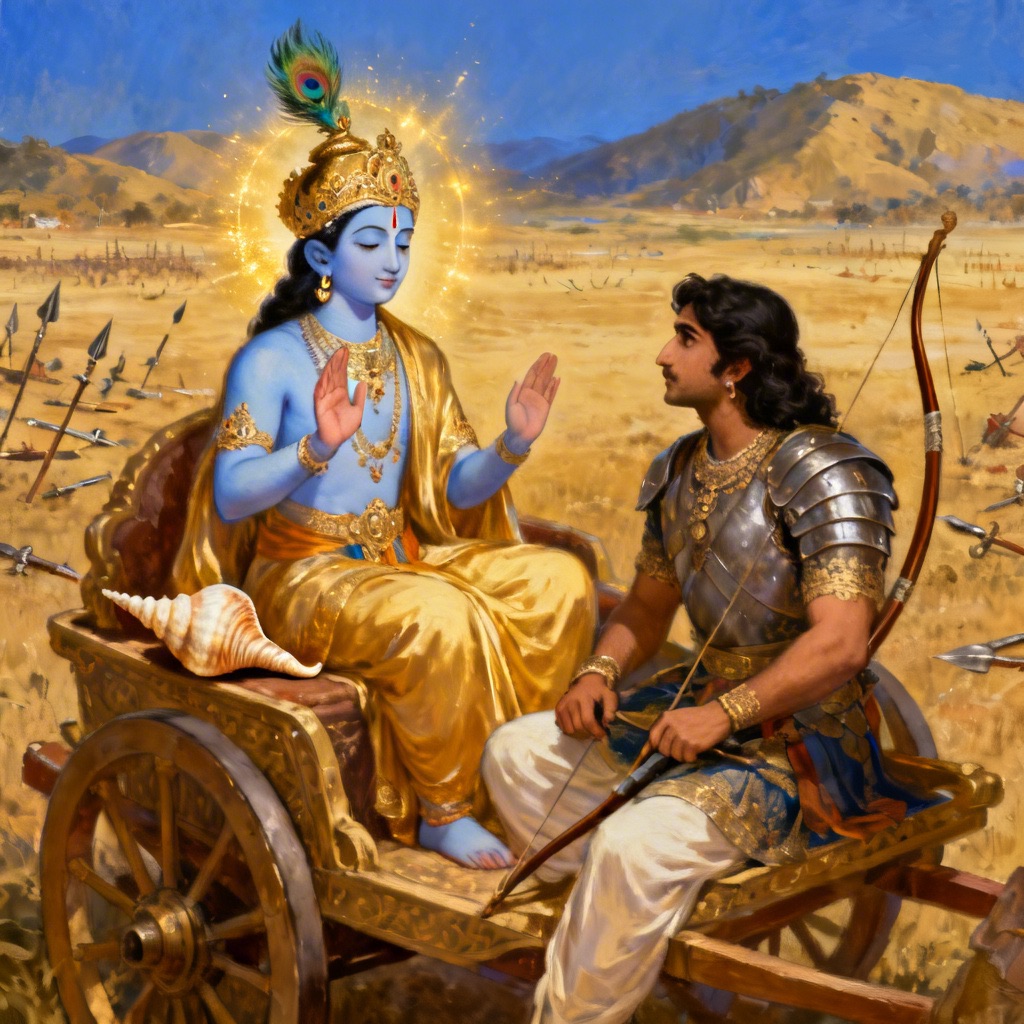
    That’s where Arjuna was standing—literally on a battlefield, facing his cousins in what would be the bloodiest war in ancient history. And he completely froze. What happened next changed how I think about leadership forever.

    Here’s what I got wrong about the Gita for years: I thought it was some mystical conversation between holy men sitting under trees, talking about detaching from the world.

    No. This is two warriors having a very real conversation about duty, fear, and making impossible choices when lives hang in the balance. Arjuna isn’t asking for spiritual enlightenment—he’s asking for practical advice on how to lead when the stakes are crushing.

    Sound familiar?

    In today’s context it would look like this:

    – Quarterly numbers. The Agony or Ecstacy.

    – A product launch that could save or sink the company.

    – Choosing between short-term profits and long-term values.

    – Managing a team through a recession, merger, layoffs, or industry disruption. The pressure is different, but the paralysis feels exactly the same.

    The Counter intuitive Secret That Changes Everything

    Krishna’s advice to Arjuna seems backwards at first: “Do your absolute best work, then let go of the results.”

    Wait, what? Isn’t caring about results what separates leaders from… well, everyone else?

    But here’s what I’ve learned after trying this approach for years:

    When you stop being desperately attached to specific outcomes, you actually get better outcomes. Try it. It holds true.

    Why This Actually Works is, just think about it—when was the last time you made a great decision while panicking about the consequences?

    When you’re white-knuckling the steering wheel, worried about where you’ll end up, you can’t actually steer very well.

    But when you know you’ve done everything possible and you trust the process? That’s when the magic happens. You think clearer. You take smarter risks. You inspire confidence instead of spreading anxiety.

    I saw this firsthand during my company’s worst times. Not once, but many times. Instead of running around like my hair was on fire, I focused on what we could control: our response time, our communication with clients, our team’s morale. We came out stronger. And honestly? I slept better. In fact I have never lost sleep over anything ever. Whatever may have been the situation I have managed to keep my wit’s cool.

    Life Happens TO You, and you cannot stop that from happening, But You can definitely choose Your Response – on how to deal with it.

    The Gita has this concept that basically divides everything into two buckets: stuff that happens to you (prarabdha) and how you respond to it (purushartha).

    This sounds obvious until you realise how much energy we waste trying to control the first bucket. You Cannot.

    Here’s What I Mean:

    Sometime back one of our biggest and longest standing Client decided not to renew. One year of revenue, gone. That’s prarabdha—it happened, period.

    But everything else? That’s on me:

    – How I broke the news to the team- Whether I spiralled into worst-case scenarios or started planning our next move.

    – Whether I used this as a learning opportunity or just complained about “disloyal clients”!!

    You could spend days obsessing over what we could have done differently. Or you sit and analyse, make an last ditch effort to save if possible, and if even after giving it your best shot, then instead of ruminating look at alternative solutions. How to make up the lost revenue in the shortest span so that the effect is cushioned in the shortest span of time.

    The Balance That Actually Matters

    There’s this verse (Chapter 4, Verse 22, if you’re keeping track) that basically says balanced people don’t get thrown off by wins or losses. They just keep moving forward.

    This isn’t about being emotionless—it’s about being consistent.

    What This Looks Like in Practice

    Good news: Celebrate for five minutes, then ask “What’s next?”

    Bad news: Feel it for five minutes, then ask “What can we learn and Do next?”

    Uncertainty: Work with what you know, then adapt as you learn more.

    My Son figured this out before I did. He told me, “You used to be a roller coaster—amazing when things went well, impossible when they didn’t. Now we actually know what to expect from you.” He just told me to look at my old Photographs when I was younger.

    That hit harder than any performance review.

    The Best Analogy I’ve Ever Heard About Ambition.

    The Gita compares desires to paan—that sweet digestive you have after a good meal. It’s nice, but you don’t need it to feel satisfied.

    This completely reframed how I think about professional goals.

    Instead of: “I need this promotion/deal/metric to prove I’m successful”

    I started thinking: “I’m already pretty fortunate. This would be a nice bonus.”

    Why This Isn’t Just Feel-Good Philosophy

    When you’re not operating from desperation:

    – You negotiate better (you’re not afraid to walk away).

    – You make clearer decisions (you’re not clouded by need).

    Actually Trying This Stuff (Not Just Nodding Along).

    Look, reading about this is one thing. Actually doing it when your boss is breathing down your neck and wants answers is completely different.

    Practice it in your daily life. Concentrate on doing great work without bothering on specific outcome. See what happens. How it balances your stress level.

    When problems come up, spend your energy on your response, not on  not on complaining about the problem.

    Try to maintain same tone in meetings whether you’re delivering good news or bad news. It will have an impact on your Team. The energy percolates down.

    None of this is groundbreaking. But doing it consistently? That’s where the real change happens.

    Why a Battlefield Guide Still Works.

    The reason the Gita works for modern leadership isn’t because it’s ancient wisdom (though it is). It’s because it was written for someone who had to make life-or-death decisions under impossible pressure.

    The details are different, but the core challenge is the same: How do you lead effectively when the outcome matters desperately but you can’t guarantee success?

    Answer: You control what you can control, you do your best work, and you trust the process. It’s not magic. But it works.

    What’s your version of standing on that battlefield? The moment when everything you’ve worked for hangs on a decision you have to make? Remember: it’s not about predicting the future perfectly—it’s about showing up fully to the present.

    P.S. – If this resonated with you, I’d love to hear about your own battlefield moments. Because honestly, We’re all just figuring this out as we go, and sometimes it helps to know we’re not alone out there.

  • The Power of the Right People 🌟

    The Power of the Right People 🌟

    Finding Your Inner Circle: The Art of Building Your S10

    A journey toward authentic leadership and meaningful connections.

    The Power of the Few.

    In our hyper-connected world, we often forget a fundamental truth: you don’t need everyone to believe in your vision—you just need the right ones.

    Throughout history, the most impactful leaders understood this principle. They cultivated a select group of trusted advisors, confidants, and supporters who became the backbone of their success. I call this your S10**—your Strategic 10. These are the people who will stand by you, challenge you, and help you reach the culmination of your real objectives.

    The Ancient Wisdom of Oral Tradition

    There’s something profound about the spoken word that written text can never fully capture. Consider how the Vedas were passed down through generations—not through scrolls or tablets, but from mouth to ear, creating an unbroken chain of wisdom and understanding.

    When we speak our truths, when we share our visions verbally, something magical happens:

    – Our passion becomes palpable.

    – Our conviction carries weight.

    – Our humanity shines through.

    This is why great rulers maintained councils—not just for their knowledge, but for their ability to communicate, inspire, and deliver results through authentic connection.

    The S10 Project: A Labor of Love

    Like preparing the perfect biryani over a slow flame, identifying your S10 requires patience, intention, and careful attention to detail. This isn’t a process you can rush—it’s a continuous quality endeavor that deserves the same dedication you’d give to any masterpiece.

    The Selection Principles:

    No Elimination Without Cause Every person in your consideration deserves fair evaluation. Names don’t get crossed off lightly.

    Holistic Assessment One conversation, one interaction, one moment doesn’t define someone’s potential value to your circle.

    Continuous Evolution Like quality itself, this is an ongoing process. Your S10 may shift as you grow and your mission evolves.

    Time-Tested Validation Just as the finest biryanis need time to develop their full flavor, the best relationships reveal their true worth over time.

    The Multimedia Advantage

    While I write these words now, I recognise that written content only captures part of the story. The tremor in a voice when someone shares their deepest conviction, the sparkle in eyes when passion ignites, the pause that speaks volumes—these elements transform mere information into transformation.

    This is why the greatest teachers, from ancient gurus to modern thought leaders, understand that multi-sensory communication creates deeper impact:

    – Visual elements engage imagination.

    – Audio conveys emotion and nuance.

    – Written words provide structure and reference.

    – Personal interaction builds trust and connection.

    Building Your Own Council

    As you work toward becoming a thought leader who makes a real difference, ask yourself:

    Who are the people that

    – Challenge your thinking without crushing your spirit?

    – Celebrate your wins authentically?

    – Offer honest feedback when you need course correction?

    – Stand by you when others doubt?

    – Amplify your message because they truly believe in it?These are your potential S10 members. They’re not necessarily the loudest voices or the most obvious choices—they’re the ones whose values align with yours and whose presence makes you a better version of yourself.

    The Marathon Mindset

    Remember, this isn’t a sprint to a finish line—it’s a 25-year journey of continuous growth, refinement, and impact. Your S10 today might look different from your S10 in five years, and that’s not just okay—it’s expected and healthy.

    The goal isn’t perfection; it’s authentic progress toward meaningful impact.

    Closing Wisdom: The Rules for a Happy Life

    As we navigate this journey of building our circles and our influence, let’s anchor ourselves in timeless wisdom:

    1. Don’t HATE – Life is too short to waste time hating. That energy could be channeled into building something beautiful instead.

    2. Don’t COMPARE – Don’t try to be someone else. The world already has them—what it needs is the best version of YOU.

    3. Don’t WORRY trust yourself.

    The day you stop worrying will be the FIRST day of your NEW LIFE.

    Trust the process, trust your S10.

    What started as a pet project has become a profound reminder: we’re not meant to journey alone. We’re meant to find our people, nurture those relationships, and together, create the change we wish to see in the world.

    Who’s in your S10?

  • Build Your Business: Why Smart Leaders Choose Foundation Over Speed.

    Build Your Business: Why Smart Leaders Choose Foundation Over Speed.

    In the fast-paced world of entrepreneurship, it’s easy to get caught up in the rush to grow, to scale, to succeed. But what separates thriving businesses from those that collapse under their own weight? The answer lies in two fundamental leadership principles that have proven their worth time and again: building a solid foundation and understanding that scalability is a science, not a gamble.

    The most important phase is the first phase which is primarily the development stage.  It is during this time that every decision feels urgent. You’re bootstrapping, hustling, and trying to make every rupee count. In these crucial early days, it’s tempting to look for quick fixes—cheap systems that promise rapid results with minimal effort. But this is precisely where mistakes are made. Penny wise and pound foolish.

    A visionary leader understands that investing in a robust, reliable foundation is not an expense—it’s an investment in the future. It is difficult but doable. Remember Business is like a rocket that you want to send into orbit. As in any Rocket, there is the initial propulsion which takes the Rocket out of the Earth’s gravitational pull, which in terms of a Business is the first 2-3 years, and then the propulsion stage where the Rocket moves into orbit, which is the 10-12 Year phase. Both these phases are absolutely important.

    Why Foundation Matters

    Consider the foundation of building or any infrastructure. Architects don’t cut corners on the base to save money on the upper floors. They know that without a fortress-like foundation, the entire structure will eventually crumble, no matter how beautiful the facade. Your business foundation works the same way. And we know the consequences of this neglect when newly constructed flyovers or buildings collapse. The same happens for your business as well.

    When you resist the temptation for quick fixes and instead pour your resources—time, energy, capital, and talent—into building something robust and reliable, you create an ideal platform for sustainable growth Systems that can handle increased demand without breaking. A culture of excellence that attracts top talent Operational efficiency that scales naturally. The credibility and trust needed to pursue expansion plans.

    When leaders opt for sloppy, makeshift solutions to save time or money upfront, they inevitably pay a much steeper price later. Technical debt accumulates. The team becomes frustrated with unreliable systems. Customers experience inconsistencies. And when you finally try to scale, everything comes crashing down because the foundation was never adequate to support growth.

    The companies that dominate their industries—the Amazons, the Apples, the organisations that survive economic downturns and industry disruptions—are those that invested heavily in their foundations. They didn’t cut corners. They built fortresses.

    Once your foundation is solid, the next critical phase is scaling. But here’s what many leaders get wrong: they treat scalability like a lottery ticket, hoping that growth will happen if they just push harder or spend more money. The truth is far more elegant—scalability is a science. Scalability isn’t about explosive growth; it’s about linear strategic growth achieved methodically over time. When you scale a business properly, you’re not just increasing revenue—you’re doing more with proportionally less effort. You’re creating leverage.

    For a business to truly be scalable, it must focus on two core principles:

    1. Increasing efficiency: Doing more with fewer resources, time, and effort.
    2. Adding value: Ensuring that each increment of growth delivers proportional or greater value to customers and stakeholders.

    Before you make the critical decision to scale, a thorough evaluation is essential. Ask yourself these questions:

    • Are my systems and processes optimised for growth? Do I have the right team in place to support expansion?
    • Is my market large enough to justify the investment?
    • What are the financial implications of scaling?
    • How will this growth affect my brand and customer experience?

    Strategic scaling requires intentional planning. You must establish a clear growth trajectory that answers these critical questions:

    1. What speed? How fast do you want to grow—and more importantly, how fast can you grow without sacrificing quality?What route? Which markets, channels, or customer segments will drive your growth? What resources? What investments in capital, talent, and technology do you need?When to pause? Recognising when to slow down to maintain quality or reassess your strategy.
    2. When to finish? Knowing your end goal—whether it’s a specific market share, revenue target, or operational maturity.

    These two lessons aren’t separate paths—they’re interconnected. Your solid foundation enables you to scale confidently. And your understanding of scalability as a science ensures that your foundation will continue to support your growth without buckling under pressure.

    As a leader, your responsibility is to resist the siren song of shortcuts and quick wins. Build something that lasts. Be intentional about your growth. Treat scaling like the serious, scientific endeavour it truly is.

    The businesses that thrive aren’t the ones that grew fastest—they’re the ones that grew smartest. And that smartness starts with a leader who understands these two timeless principles.

    Build your fortress. Scale with science. Lead with vision.

  • The Grass Isn’t Always Greener: 27 Years of Entrepreneurial Truth

    The Grass Isn’t Always Greener: 27 Years of Entrepreneurial Truth

    The Grass Isn’t Always Greener: 27 Years of Entrepreneurial Truth.

    A candid reflection on the realities of building a business, the myths that mislead aspiring entrepreneurs, and what it truly takes to survive—and occasionally thrive—in the entrepreneurial wilderness.

    When I started my entrepreneurial journey 27 years ago, I thought I understood what lay ahead. I was wrong. Like most first-time founders, I believed the grass would be greener on the entrepreneurial side of the fence. Today, with salt-and-pepper hair as my witness, I can tell you that the grass isn’t uniformly green—it’s patchy at best, with occasional verdant spots interspersed among the brown patches of struggle.

    The Myth of Instant Green.

    Over the years, I’ve watched many former employees take the entrepreneurial plunge. Some jumped with grand visions, others with detailed roadmaps that looked flawless on paper: secure funding, build valuation, execute an IPO or acquisition, then walk away with “tons and tons of money.

    The reality? I rarely hear success stories from these departures.

    This silence speaks volumes. The entrepreneurial graveyard is littered with dreams built on the myth of the get-rich-quick scheme. We live in an era where a select few have struck gold, creating a narrative that entrepreneurship is a lottery ticket rather than a marathon. This misconception fuels the current startup stampede—and explains why 90% of startups fail.

    The harsh truth: those few who “hit pay dirt are statistical outliers, not the norm.

    The Long Gestation of Success.

    Real entrepreneurship isn’t a sprint to riches—it’s an endurance test that would make an Olympian proud.

    Just as athletes don’t accidentally stumble onto podiums, successful entrepreneurs don’t stumble into success. There are no shortcuts.

    What It Actually Takes

    1. A Burning Desire That Survives Reality.

    You need more than enthusiasm; you need an obsession that can withstand years of setbacks. This isn’t passion—it’s something deeper, more primal. It’s the difference between wanting something and needing it to define your existence.

    2. The “Why” Factor.

    Before you quit your job or pitch investors, answer this: Why does your venture need to exist? Not why you want it to exist, but why the world needs it. If you can’t articulate this clearly, you’re building on sand.

    3. Start Small, Think Big.

    Remember Birbal finding warmth from a candle burning miles away? Your vision might be distant and dim, but it must be visible enough to guide you through dark periods. Start with minimal viable steps while keeping that distant light in sight.

    4. Embrace the Mistake Factory.

    Mistakes aren’t just inevitable—they’re your primary education. Each failure should strengthen your resolve, not weaken it. The entrepreneurs who survive aren’t those who make fewer mistakes; they’re those who learn faster from them.

    The Price of the Entrepreneurial Path

    Here’s what most people don’t tell you about entrepreneurship: it demands sacrifice that employed life never does.

    What You’ll Likely Sacrifice:

    Financial security (for years, possibly decades).

    Work-life balance (your business becomes your life).

    Predictable income (feast or famine becomes normal).

    Professional safety nets (no HR department, no guaranteed paycheck)

    Social time (while friends advance in corporate careers, you’ll be grinding).

    What You Might Gain:

    Autonomy over your decisions and destiny.

    The possibility of significant financial returns (emphasis on possibility).

    Deep satisfaction from building something meaningful.

    Resilience that serves you in every life area.

    Stories that make for interesting dinner conversations.

    The Relentless Test. Twenty-seven years in, I can confirm that the test never stops being severe and relentless. Market conditions change, competitors emerge, team members leave, funding dries up, customers disappoint, and sometimes everything goes wrong simultaneously.

    The question isn’t whether you’ll face adversity—it’s whether you’ll maintain that “fire in the belly” when adversity becomes your daily companion.

    Surviving the Long Haul

    Perseverance Over Perfection: Your first idea probably won’t work. Neither will your second or third.

    Success often comes from persistence through iterations, not brilliance on attempt one.

    Work Ethic as Oxygen: If you’re looking for better work-life balance, stay employed. Entrepreneurship demands a work ethic that borders on obsessive. This isn’t sustainable for everyone, and that’s okay.

    Never Give Up (But Know When to Pivot): There’s a fine line between persistence and stubbornness.

    The situation will change eventually, but sometimes you need to change your approach to the situation.

    The Uncomfortable Truth About Green Grass.

    After 27 years, my grass has some green patches—moments of success, financial wins, personal satisfaction from building something lasting. But it’s not the uniform, lush green that entrepreneurship mythology promises.

    And you know what? That’s perfectly fine.

    The real victory isn’t achieving some fantasy of endless green grass. It’s building something meaningful while accepting that entrepreneurship is inherently messy, uncertain, and often unrewarding in traditional metrics.

    For Aspiring Entrepreneurs.

    Before you leap, ask yourself:

    – Are you prepared for a decades-long journey with no guarantees?

    – Can you find fulfilment in the process, not just the outcome?

    – Do you have the financial runway and personal support for extended uncertainty?

    – Is your “why” strong enough to sustain you through years of difficulty?

    If your answers give you pause, consider staying employed while building something on the side. There’s no shame in choosing stability—and there’s wisdom in understanding your own tolerance for risk and uncertainty.

    Final Thoughts

    Entrepreneurship isn’t for everyone, despite what startup culture suggests. It’s not a fast track to wealth, freedom, or happiness. It’s a difficult path that demands everything you have and offers no guarantees in return.

    But for those with the right combination of vision, persistence, and perhaps a touch of madness, it can be profoundly rewarding—just not in the ways you initially expect.

    The grass may not be uniformly greener, but those patches of green you do cultivate? They’re genuinely yours. And after 27 years of tending to them, that means something.

    Sometimes the most honest thing you can tell someone about entrepreneurship is this: if you can imagine being happy doing anything else, do that instead. But if you can’t shake the vision of building something meaningful, then welcome to the long, difficult, occasionally rewarding journey of entrepreneurship.