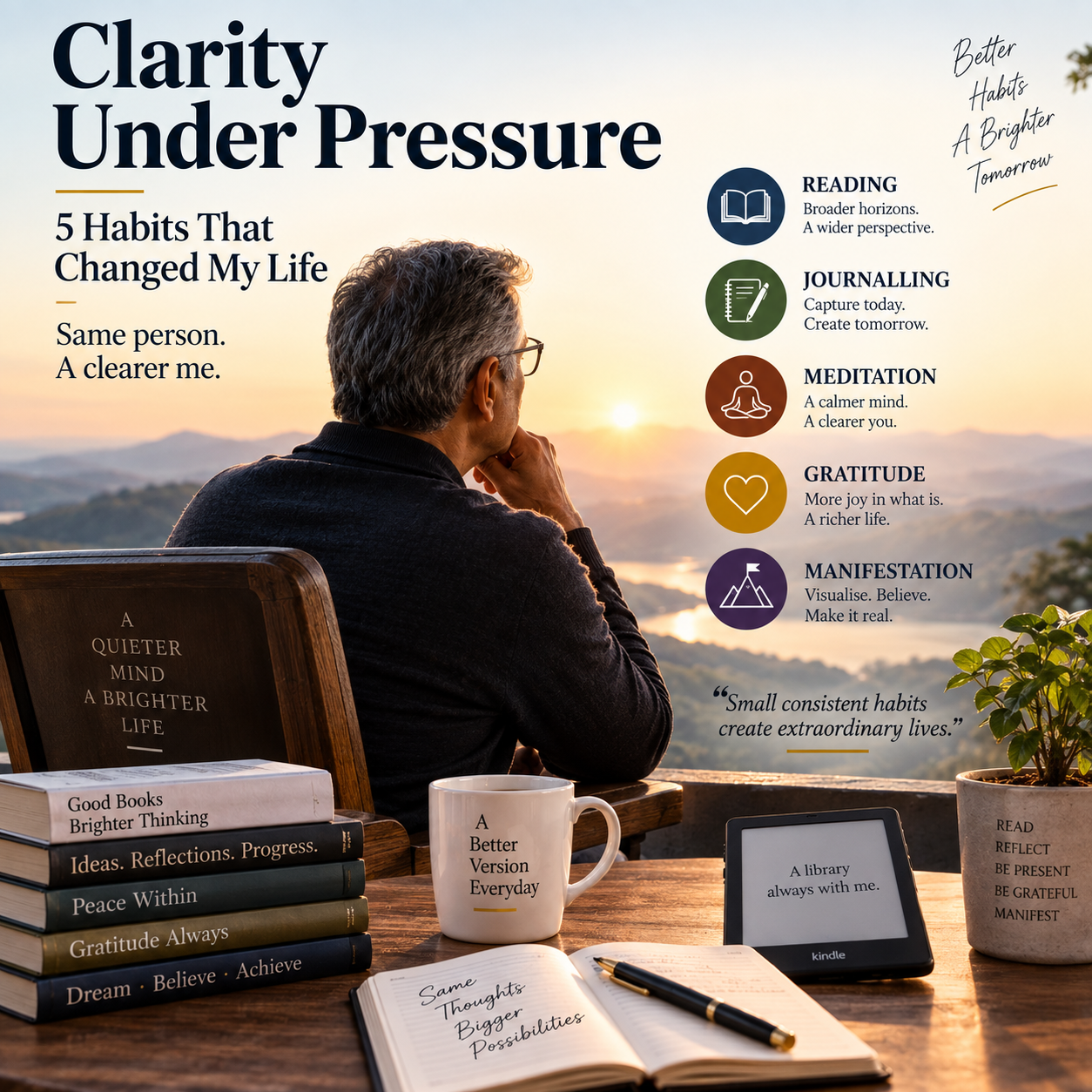
Looking back, I realise that my life changed because of a few habits I practised repeatedly, often without fully understanding how much they were shaping me.
These are not theories I learnt from a motivational seminar.
They are habits I have lived.
1. Reading
I have always had a love affair with books.
I have a large personal collection, and honestly, my books are among my prized possessions. Sometimes I simply look at them and admire them.
Books gave me something formal education alone could not.
Perspective.
Coming from a background where I did not have the advantage of an advanced formal degree, I consciously educated myself by reading.
Books became my teachers.
They broadened my horizons and allowed me to learn from people I would probably never meet.
There was a time when I travelled with four or five books in my bag.
Today, thankfully, my Kindle carries a large part of my library. It has become an inseparable companion on my travels.
Never underestimate what one good book can do to your thinking.
2. Journalling
Thoughts are fleeting.
An idea can arrive while travelling, bathing, eating or in the middle of a conversation. If you don’t capture it, it can disappear forever.
I have kept journals for most of my adult life.
I now have close to 50 of them.
Going back and reading something I wrote twenty or thirty years ago is an experience difficult to describe. It is nostalgia, reflection and sometimes even surprise.
Many ideas I captured in those pages eventually found their way into my life.
My belief is simple:
Our mind is for creating ideas, not storing them.
Write them down.
3. Meditation
I struggled with meditation when I first started.
Like most people, my mind wandered everywhere.
Then I came across Osho’s interpretation of meditation: concentrating your consciousness in one channel.
That changed my approach.
I began by simply being present.
If I was brushing my teeth, I brushed my teeth.
Nothing else.
No planning.
No worrying.
No mental conversation.
Slowly, learning to be fully present in small activities led me towards meditation.
Meditation, for me, is not about asking for something.
It is about expecting nothing.
And somehow, receiving peace.
4. Gratitude
This habit has probably changed my emotional life more than any other.
I consciously remain grateful.
For what I have.
For the people in my life.
Even for waking up to another day.
When I travel from Delhi to my hometown in Adoor, Kerala, I consciously pause to appreciate something as simple as breathing fresh air.
We often postpone happiness until something bigger happens.
A promotion.
More money.
A better house.
A future achievement.
But happiness is also a choice about what we notice today.
There is always something to be grateful for.
5. Manifestation
Aladdin had a Genie.
I believe all of us do too.
We simply need to pick up the lamp.
For me, manifestation is visualisation combined with faith and consistent action.
From humble beginnings, I spent years visualising the life I wanted.
Every morning, I would imagine what I wanted to create and, more importantly, feel grateful as though life had already blessed me with it.
Was it magic?
I don’t know.
But I do know this.
What we repeatedly focus on influences how we think, act and make decisions.
And many things I once visualised are today part of my life.
These five habits did not make life perfect.
They made me clearer.
And when life becomes difficult, clarity is often more valuable than motivation.
Reading expanded my mind.
Journalling captured my thoughts.
Meditation calmed my mind.
Gratitude changed my perspective.
Manifestation gave direction to my dreams.
None of them requires extraordinary talent.
Only consistency.
My question to you:
If you had to name one habit that genuinely changed the direction of your life, what would it be, and when did you realise its impact?
I would genuinely like to know. Perhaps your answer will inspire someone else reading this post.
The Journey is yours. The Learning doesn’t have to be.
Global Learning Centre (GLC) is being built around two journeys:
FOR YOUNG ENTREPRENEURS
Helping aspiring and emerging entrepreneurs develop the clarity, capability and confidence to turn ideas into sustainable businesses.
FOR VETERANS — THE SECOND INNINGS
Helping Armed Forces veterans translate their leadership, discipline, experience and capabilities into meaningful opportunities beyond uniform.
Why quitting today may be the most profitable decision you ever make.
Every smoker knows smoking is harmful.
Every cigarette packet says it.Doctors say it.Family members say it.Governments spend millions on campaigns saying it.
Yet millions continue to smoke.
Why?
Because smoking is rarely about nicotine alone.
It becomes a habit.A routine.A stress reliever.A companion during loneliness.A reward after work.A way of fitting in socially.
Over time, the cigarette stops becoming a choice and starts becoming a command.
The frightening part is that the damage begins long before you feel it.
The Silent Damage Begins Early
Many smokers proudly say,
“I’ve been smoking for 20 years and I’m perfectly fine.”
The truth is they are not.
Human bodies are remarkably good at hiding damage until it reaches a tipping point.
While you continue smoking, your body is quietly fighting a battle every single day.
Inside your lungs, tiny air sacs called alveoli begin to lose their elasticity.
Blood vessels gradually narrow.
The heart works harder.
Oxygen levels reduce.
Inflammation spreads throughout the body.
The immune system weakens.
Cells begin accumulating genetic damage.
Most people never notice these changes because they happen slowly.
Then one day, climbing a flight of stairs becomes exhausting.
A persistent cough refuses to go away.
Breathing becomes laboured.
The warning signs appear only after years of silent destruction.
What Smoking Actually Does to Your Body.
Smoking affects nearly every organ.
Your Lungs
Smoking destroys lung tissue permanently.
It causes chronic bronchitis, emphysema and Chronic Obstructive Pulmonary Disease (COPD), conditions that make even simple activities like walking or talking exhausting.
Lung cancer remains one of the leading causes of cancer deaths worldwide.
Your Heart
Every cigarette temporarily increases your heart rate and blood pressure.
Over years, this dramatically increases the risk of:
Heart attacks
Stroke
High blood pressure
Peripheral artery disease
Many smokers don’t die from lung disease.
They die because their cardiovascular system simply gives up.
Your Brain
Nicotine creates one of the strongest addictions known.
It rewires reward pathways.
Without nicotine, the brain begins demanding another cigarette.
This creates the illusion that smoking reduces stress.
In reality, smoking temporarily relieves nicotine withdrawal.
The stress returns quickly, creating an endless cycle.
Your Mouth
Smoking causes:
Bad breath
Yellow teeth
Gum disease
Tooth loss
Oral cancers
Your smile often reveals your smoking habit before your lungs do.
Your Skin
Smoking accelerates ageing.
Wrinkles appear earlier.
Skin loses elasticity.
Complexion becomes dull.
Blood circulation decreases.
Many people spend thousands on skincare while continuing to smoke.
The two simply cannot coexist.
The Financial Cost Nobody Calculates
Most smokers underestimate how much they spend.
Suppose someone smokes one pack a day costing ₹350.
That becomes approximately:
₹10,500 every month
₹1,26,000 every year
₹12.6 lakh in ten years
Now imagine investing that amount instead.
With disciplined investing and compounding, the figures become astonishing over time.
Smoking doesn’t just burn tobacco.
It burns wealth.
It burns opportunities.
It burns financial freedom.
The Good News: Your Body Starts Healing Immediately
This is perhaps the most encouraging part.
Your body wants to recover.
The moment you stop smoking, healing begins.
Within 20 minutes, heart rate and blood pressure begin moving towards normal.
Within 12 hours, carbon monoxide levels fall significantly and oxygen levels improve.
Within weeks, circulation improves.
Breathing becomes easier.
Walking becomes less tiring.
Within months, lung function improves noticeably.
Within years, the risks of heart disease, stroke and several cancers decline substantially compared to continuing smokers.
The body possesses an extraordinary ability to repair itself when given the opportunity.
Why Most People Fail to Quit
Most smokers don’t fail because they lack willpower.
They fail because they fight the wrong battle.
They focus only on resisting cigarettes.
They don’t change:
their routines
emotional triggers
habits
environment
mindset
The cigarette itself isn’t always the real addiction.
The behaviour surrounding it is.
Without changing that behaviour, quitting becomes unnecessarily difficult.
Quitting Is Not About Suffering
Many people imagine quitting means endless cravings and misery.
It doesn’t have to be that way.
Successful quitting follows a structured process.
You prepare.
You understand your triggers.
You replace habits.
You create accountability.
You develop new routines.
You learn how to manage cravings without feeling deprived.
Once the mind accepts the decision, the body gradually follows.
Your Future Self Is Waiting
Imagine waking up without coughing.
Walking without breathlessness.
Travelling without looking for smoking zones.
Playing with your children or grandchildren without fatigue.
Sleeping better.
Eating better.
Smelling better.
Feeling proud instead of guilty.
Every cigarette you don’t smoke is a vote for that future.
The Best Time to Quit Was Yesterday. The Second Best Time Is Today.
There is never a perfect day.
Never a perfect Monday.
Never a perfect New Year.
Never a perfect birthday.
The decision begins with one cigarette not smoked.
Then another.
Then another.
Eventually, the identity changes.
You no longer become someone trying to quit.
You become someone who simply does not smoke.
That transformation changes everything.
If You’re Serious About Quitting, I’ve Written the Roadmap
Quitting smoking isn’t merely about giving up cigarettes.
It’s about reclaiming your health, your confidence, your time and your financial future.
This isn’t another book filled with lectures or scare tactics.
It is a practical, step-by-step guide that helps you:
Understand why you smoke.
Break the psychological addiction.
Handle cravings effectively.
Build habits that replace smoking.
Save the money you would have spent on cigarettes.
Turn those savings into long-term wealth through disciplined financial habits.
Because quitting smoking is not just about living longer.
It’s about living better.
And becoming financially stronger along the way.
You can get your copy on Amazon here or read for Free:
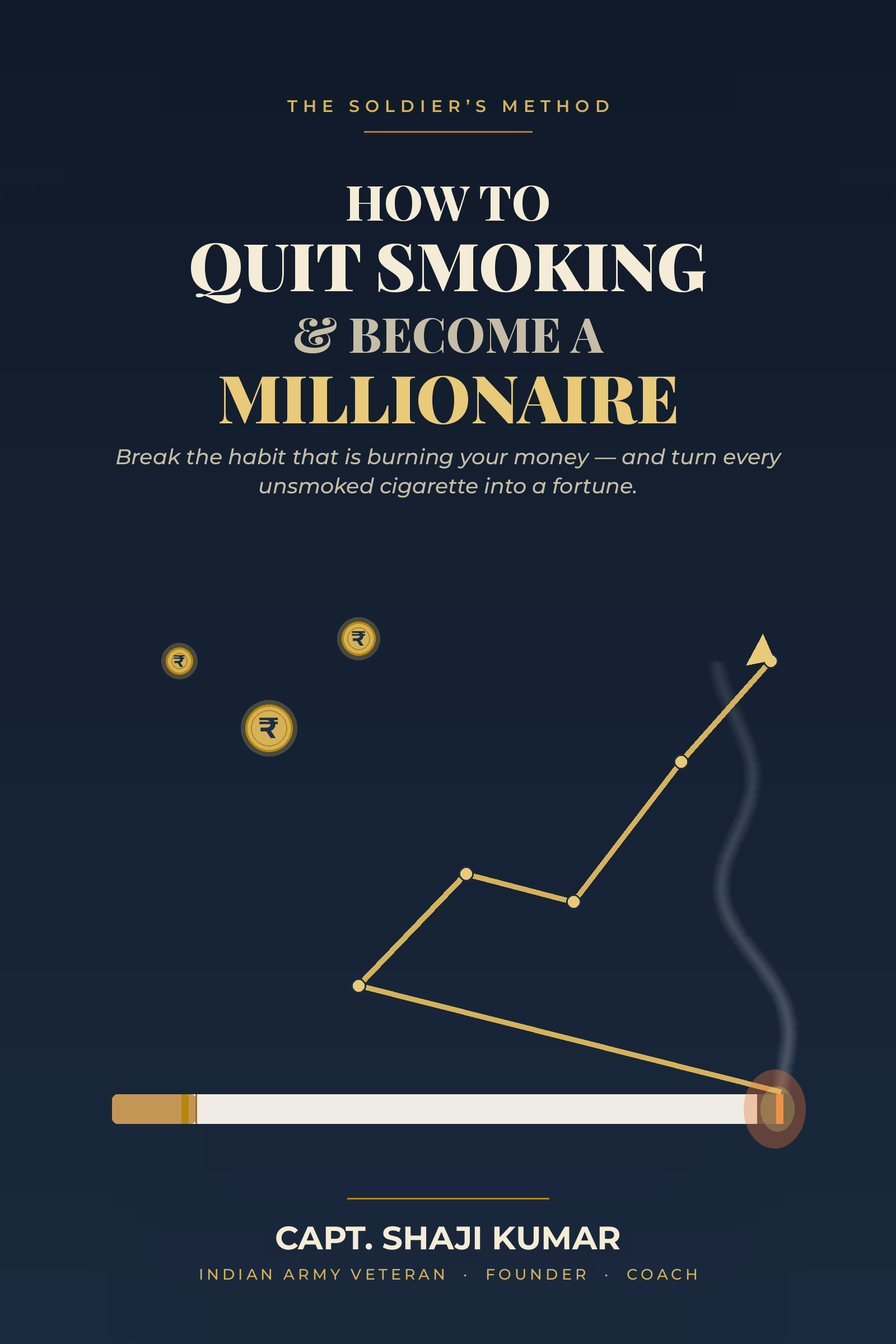
📘 How to Quit Smoking and Become a Millionaire
If this article made you pause and think, please share it. Someone in your network may be waiting for the one message that finally helps them make the decision to quit.
Sometimes, changing one life begins with sharing one article.
Field notes for first-generation founders — building calm, judgment, and momentum when everything’s on the line.
Pressure Was Never the Problem
Picture the founder at 11 p.m. Payroll runs in nine hours. The number in the account doesn’t cover it. He opens the same spreadsheet for the fourth time, as if the figures might have changed since the third.
They haven’t.
Here’s what’s actually happening in that room — and it has nothing to do with the money. Under that kind of pressure, his thinking has narrowed to a tunnel. He isn’t weighing options anymore. He’s bracing. And a man who is bracing makes bad calls, because bracing is not the same as deciding.
That’s the whole game. Pressure doesn’t break you by making you afraid — fear is manageable. It breaks you by quietly removing your judgment at the exact moment you need it most. The first casualty isn’t your nerve. It’s your ability to think clearly.
I learned this young, in uniform. Commissioned in March 1988. The Army never trains you to feel no pressure — that’s a fantasy, and a dangerous one. It trains you so that when the pressure arrives, your judgment is still standing. The drill, the repetition, the checklist run a hundred times — none of it exists to make the moment calm. It exists so you can still make a sound decision inside a moment that isn’t.
Then I spent 28 years building a staffing & Facility Management business from nothing. Bootstrapped. No safety net. No family money behind me, no investor to call at midnight. Just payroll that had to clear, clients who had to be served, and a team that had to be paid whether or not the receivables came in on time. Pan-India, sixteen cities, one decision at a time.
And I found the same law operating that I’d first met in uniform: the people who survive pressure aren’t the ones who feel less of it. They’re the ones who keep their judgment intact while everyone around them loses theirs.
That’s the difference between built and given. Nobody handed me a calm nervous system. I built one — under load, on the job, the hard way. And the good news, the reason this newsletter exists, is that it’s *buildable*. It’s a system, not a personality trait. You don’t have to be born unshakeable. You can train it.
**That’s what this is for.**
Clarity Under Pressure™ is a fortnightly field manual for first-generation founders and professionals making hard transitions — the ones doing it without a template, without a network that already believes in them, without the luxury of a soft landing if it goes wrong. Every edition gives you one usable tool for keeping your head when the stakes spike: in the business, in the boardroom, in the room where the decision actually gets made.
No theory you can’t use by Friday. No motivational noise. Field notes from someone who’s been bracing at 11 p.m. and learned how to stop.
This edition’s tool: the 90-second triage
Next time pressure spikes and you feel the tunnel closing, don’t decide anything yet. First, run three questions out loud — on paper, not in your head, because the head is where the spiral lives:
1. **What’s actually true right now?** Facts only. Not the fear, not the worst case — the verifiable situation in front of you.
2. **What’s the single next action?** Not the whole solution. The *next step*. One.
3. **What can wait until morning?** Most of it can. Pressure lies about what’s urgent.
Ninety seconds. That’s a triage drill, and triage is what soldiers do when everything is on fire and the worst response is to freeze. It won’t make the problem smaller. It will keep your judgment standing while you solve it — which is the only thing that ever actually mattered.
Stop Managing Your Time. Start Managing the Pressure.
A soldier-founder’s take on why your calendar isn’t the problem — and what actually is.
There is a game at every fair. A row of holes, a soft mallet, and a plastic mole that pops its head up. You hit it. It drops. Another appears somewhere else. You hit that one. A third pops up. The faster you swing, the faster they come. You never win. You only get tired.
That game is the most honest picture I know of how most of us manage our time.
We feel stressed, so we go looking for a better system. A new planner. A new app. Time-blocking. The two-minute rule. Eat the frog. Inbox zero. Each one works — for about a week. The relief drains away, the pressure resurfaces somewhere else, and off we go to buy the next mallet.
I played that game for the better part of twenty years. I want to tell you what I finally understood, because it changed how I work — and, more importantly, how I feel while I work.
I had it backwards
I am a former soldier and a first-generation businessman. I built a services business across India from almost nothing — no outside investor, close to four decades around people and pressure. Solving problems by force of will is, frankly, what I am good at. Give me an objective and I will take it head-on, with discipline, one task at a time.
That approach worked on everything except one thing: the constant, low-grade hum of feeling stressed and behind.
I treated it the way I treated every other problem — as a time problem. If I felt stressed, I must be disorganised. So I organised harder. Better lists. Tighter schedules. Earlier mornings. And every system handed me the same result: a short burst of control, then the pressure quietly seeping back in.
It took me an embarrassingly long time to see the obvious. I was hitting moles. I was never touching whatever sent them up.
Your to-do list is a symptom, not a cause
Here is the distinction that finally set me free.
Your overflowing to-do list is not the cause of your stress. It is a symptom of it.
Sit with that for a moment, because everything turns on it.
When you are calm, a long list is just a long list. You pick up the item on top and you start. When you are already stressed, that same list becomes a threat. Every item shouts at once. You freeze, you scatter, you refresh your inbox for the ninth time, and three hours vanish with nothing real to show for them.
Same list. Same hours. Completely different experience.
The difference was never the schedule. It was the state of the person reading it.
This is why the productivity hack always disappoints in the end. It is excellent at trimming the branches — and the branches do need trimming. But it never goes near the root. So the tree keeps producing. You stay busy, you stay behind, and you stay tired.
The hidden tax of a hot nervous system
We talk about stress as if it were only a feeling. It is also a thief of time, and a quiet, expensive one.
A stressed mind makes worse decisions, so you redo work. It cannot hold attention, so simple tasks take twice as long. It catastrophises, so you spend energy on problems that never arrive. It reaches for distraction, so an hour leaks away in scrolling you barely remember. None of this shows up on your calendar, but all of it is billed to your day.
So when you feel you have no time, look closer. Often you have plenty of time — you are simply paying a heavy tax on every hour because the operator is running hot. Lower the temperature, and hours you thought were lost quietly come back.
I have watched this in my own week, plainly. On the days I am calm, I do a full day’s work by mid-afternoon and wonder where the pressure went. On the days I am wound tight, I am at my desk from dawn to dark and finish convinced I never caught up. The workload on both days is roughly the same. The only variable that moved was me.
Which means the real work happens on two levels at once. The branch and the root. Let me give you one practical thing for each. Today. No app required.
The trap of the perfect system
There is a particular cruelty in the productivity industry, and it took me years to name it. The search for the perfect system becomes a stressor of its own.
Think about what actually happens when you adopt a new method. There is the reading. The setting up. The migrating of old lists into the new format. The learning curve. The quiet guilt the first time you fall off it. And then, when it inevitably fails to deliver the calm it promised, there is the disappointment — followed by the search for the next one. The tool that was meant to reduce your load has become another item on it.
I am not telling you to throw your systems away. A sensible list and a clear calendar are good servants. I am telling you to stop expecting them to do a job they were never built for. A calendar can order your hours. It cannot calm your mind. Asking it to is like asking a sharper axe to make the tree stop growing. The axe is fine. You are aiming it at the wrong place.
Once you stop demanding peace from your planner, something relaxes. The planner goes back to being a simple, useful thing. And your attention is freed for the two moves that genuinely change how a day feels.
The branch: do one thing at a time
We have been sold a lie about multitasking. We were told it makes us efficient. It does the opposite.
Your attention is not a floodlight that fills the whole room. It is a torch. It points at one thing. When you “multitask,” you are not doing two things at once — you are whipping the torch back and forth, and every swing leaves a smear of the last task on the next. Researchers call it attention residue. You know it as that foggy, frazzled feeling of being busy all day and accomplishing nothing.
Here is the fix, and it is almost insultingly simple.
One thing. Phone in another room.
Not on silent. Not face-down. In another room. The mere sight of it on your desk taxes you, because some part of your mind is standing guard over it. Move it, and that guard goes off duty.
Then take the single most important task on your list and give it one clean, undivided hour. When your mind reaches for something else — and it will, within ninety seconds — notice the pull and gently bring the torch back. Drift, notice, return. That is the whole discipline.
You will get more done in that one clean hour than in a whole frantic morning of switching. And — this is the part that matters for stress — you will finish it calmer than you started. Focus is not only productive. It is settling. A mind doing one thing is a mind at rest.
That is branch work. It is real and it works. But it is first-aid, not the cure.
The root: the most productive thing you will do all day is nothing
Now the part almost nobody wants to hear.
If your nervous system is running hot, no system on earth will hold. You will time-block a flawless day and then spend it anxious. You will clear your inbox and feel no lighter. Because the pressure was never in the inbox. It was in you — a stored backlog of stress that colours everything you look at.
You cannot out-organise that backlog. You can only drain it. And it drains through rest — a specific, deliberate kind of rest, not collapsing in front of a screen.
For me, that rest is meditation. Twenty minutes, twice a day. Sit comfortably, eyes closed, let your attention rest lightly on the breath or on a soft repeated word. When you drift, return. Drift, notice, return. That is all of it. No incense, no perfect posture, no belief required.
“But I don’t have forty minutes”
I know exactly how that sounds to a results-driven person. Forty minutes a day doing nothing, while the list is screaming? It feels like the least productive thing imaginable.
It is the most productive thing I do, and I do not say that loosely.
Those forty minutes change the quality of the other fifteen hours. The same workload stops feeling like a threat. I make sharper decisions. I stop reacting and start choosing. I waste far less of the day on the scattered, frantic busywork that stress manufactures. The reservoir lowers, and the moles stop popping up so fast.
You will not feel any of this from reading about it. That is the honest truth of the thing. The reservoir does not drain because you understood the idea. It drains because you sit.
A day rebuilt around the root
Let me show you the shape of it. Not theory — something you could copy tomorrow.
Begin with the rest, before the noise. Twenty minutes before the inbox owns you. You are not stealing time from your work; you are setting the temperature of everything that follows.
Then, one clean hour on the thing that matters most. Phone in another room. Torch on one task.
Do the small, sane things that keep the branches in check. When the work feels like too much, stop and empty your head onto a single page — every loose task, every worry, out of the mind and onto paper. Then pick the one item that, once done, makes the rest lighter. Do that one. The list shrinks faster than you expect, and the panic shrinks with it.
In the late afternoon — when most people hit the slump and reach for caffeine and another round of frantic switching — sit again. The second rest. It carries you into the evening as a person rather than a wrung-out version of one.
I watched a young founder I mentor try exactly this. He came to me convinced he needed a better app. His real problem was that he started every morning by opening his phone in bed, and by the time his feet hit the floor he was already behind, already reacting, already at a sprint. We changed nothing about his tools. We changed the first and the last forty minutes of his day. Within a fortnight he told me the work hadn’t got any smaller — but it had stopped feeling like it was chasing him.
Notice what that is. It is not a tighter schedule. It is a calmer operator running an ordinary one.
The belief to carry
I will leave you with the line I now keep close, because it reframes the whole business.
Stress is not happening to you. It is happening in you — and what happens in you, you can learn to tend.
Your calendar is not your enemy. Your task list is not your enemy. The frantic swinging is. The belief that if you could just find the perfect system the pressure would finally lift — that is the mole you have to stop chasing.
So trim the branches: one thing at a time, phone in another room. But do the quieter, harder, more valuable work as well. Tend the root. Sit. Drain the reservoir.
Manage the pressure, and you will find the time was never really the problem.
— Capt. Shaji Kumar
If this landed, it’s the spine of a handbook I’ve been working on — Stress Isn’t the Problem: A Do-It-Yourself Handbook to Stop Chasing Stress and Solve It at the Source. It’s the full method: the seven branches and the one root. Out on Amazon, first week of July. I’ll share the link here the day it’s live. 🌱
The harder you push against a bad habit, the stronger it pushes back. There is a Japanese approach that flips this completely — and it actually works.
By Capt. Shaji Kumar · 8 min read · Habits & High Performance
You have been here before. You decide — really decide — that this time you are quitting. No more mindlessly checking your phone before bed. No more skipping the gym. No more that third cup of coffee at 4 PM. You white-knuckle it for a few days, maybe a week. Then, like a compressed spring, the habit snaps back harder than before.
This is not weakness. This is not lack of discipline. This is what happens when you bring a sword to a philosophy fight.
Most high-performers are wired to tackle problems head-on — push harder, want it more, build stronger systems. But when it comes to habits, brute-force willpower is the wrong tool. And the Japanese have known this for centuries.
“You cannot fight your way out of a pattern you have unconsciously chosen to live in.”
Why Willpower Fails — Every Single Time
Here is the science behind the frustration. Every habit lives in a loop: cue → craving → routine → reward. When you try to suppress a habit by sheer force, you are attacking the routine while leaving the craving completely intact. You have not solved the loop. You have just added tension to it.
Neuroscience backs this up. The habit pathways in your brain are carved deep — through the basal ganglia, not the prefrontal cortex where rational decision-making lives. When you fight a craving, you are using your newest, most exhaustible neural resource (willpower) against one of the oldest, most efficient systems your brain has. You will lose. Not because you are weak — but because it was never a fair fight.
The relapse is not a failure. It is physics.
THE WESTERN APPROACH Resist the craving Suppress the urge Force the behavior Punish the relapse Define yourself by failures
THE JAPANESE APPROACH Observe the craving Acknowledge the urge Understand the reward Redirect with curiosity Detach identity from behavior
The Japanese Frameworks You Have Never Applied to Habits
CONCEPT 01
Mushin — “No Mind”
In Zen martial arts, mushin (無心) refers to a state of mental clarity where the practitioner does not react — they simply move. Applied to habits, mushin means creating a gap between the cue and your response. You notice the urge to reach for your phone. You do not fight it. You do not obey it. You simply observe it — like watching a cloud pass. That gap is where your power lives.
CONCEPT 02
Kaizen — Small, Relentless Improvement
Everyone knows kaizen as “continuous improvement.” But its real power in habit change is the idea that smallness is not weakness — it is strategy. Do not try to overhaul the habit. Shrink it. If you scroll social media for 90 minutes a night, do not quit cold turkey. Observe when you reach for the phone. Notice the emotion. Then reduce by five minutes. The goal is not dramatic transformation — it is quiet, undeniable momentum.
CONCEPT 03
Wabi-Sabi — Embracing Imperfection
Wabi-sabi (侘寂) is the Japanese aesthetic of finding beauty in imperfection and impermanence. For professionals trying to break habits, this is liberating: you do not need a perfect streak. The relapse is not the enemy — treating it as catastrophic is what drives people back into the habit loop in shame. Wabi-sabi says: the crack in the bowl is part of the bowl. Begin again without drama.
CONCEPT 04
Ikigai — The Deeper “Why”
Ikigai (生き甲斐) is often translated as “reason for being.” When applied to habit change, it asks a sharper question: what deeper need is this habit actually serving? The late-night doom-scrolling might be avoidance of an unresolved decision. The excess caffeine might be masking low-grade anxiety. Until you meet that underlying need, no surface-level habit fix will hold.
The 5-Step Practice: Observe, Do Not Fight
Here is how you actually apply this — not as a system, but as a daily practice.
1
Name it before you do it The moment you feel the pull of the habit, say it out loud or in your head: “I want to check my phone.” This small act of labeling activates the prefrontal cortex and creates the mushin gap. You are no longer inside the urge — you are watching it.
2
Get curious about the cue Ask: what triggered this? Was it boredom, stress, a specific time of day, a person, a location? Habits are far more situational than we think. Curiosity — not judgment — is the detective tool here.
3
Identify what reward you are actually seeking Dig one layer deeper. The reward is never the surface thing — it is connection, relief, stimulation, validation, or escape. Name the actual reward. Now you have something to redirect toward, not just something to suppress.
4
Take the smallest possible different action Kaizen in action. Do not replace the habit with a heroic new behavior. Replace it with something fractionally better. Reaching for your phone? Put it face-down for two minutes first. The two minutes becomes five. Five becomes the new norm.
5
Review without self-punishment At the end of each day, spend 90 seconds noting: when did the habit appear, what cue preceded it, did I observe or obey? No grades. No streaks. Just data. Wabi-sabi in practice.
Why This Works for High-Performers Specifically
Most productivity literature targets the average person trying to build basic routines. You are not that person. You have already built systems. You have read the books. You are still here because the habits you are fighting are not about lack of knowledge — they are about unmanaged cognitive load, performance pressure, and identity.
High-performers often develop habits as coping mechanisms for high-stakes environments. The scrolling is decompression. The late nights are control. The avoidance is protection. These are not weaknesses to be crushed — they are signals to be decoded.
“The executive who cannot stop checking email at midnight is not undisciplined. They are anxious about losing control. Fix the anxiety — the email habit dissolves.”
The Japanese observational approach respects your intelligence. It does not ask you to follow a 30-day plan or reward yourself with stickers. It asks you to think more clearly about what is actually happening — and to trust that clarity, not force, is what changes behavior at the root.
The Uncomfortable Truth About Habit Change
Here it is: the habits you most want to break are usually serving you in some way you have not fully acknowledged yet. They are efficient solutions your brain found to real problems. Fighting them without understanding them is like ripping out a load-bearing wall because you do not like where it is.
The Japanese approach does not ask you to be more disciplined. It asks you to be more honest. To sit with discomfort long enough to understand it. To be, for a few minutes each day, less warrior and more witness.
That shift — from combatant to curious observer — is where lasting change begins. Not with a dramatic declaration. Not with a new app. With the quiet, repeated act of watching yourself clearly, and choosing, one small moment at a time, something different.
The habit is not the enemy. The unawareness is. Start there.
TAKE THIS FURTHER
Go Deeper With These Books by Capt. Shaji Kumar
If this article resonated with you, these two books take the conversation much further — with practical, body-based tools for lasting transformation.
Book 1Health in Your Hands Discover how your body holds the power to heal. This book puts practical health tools directly in your hands — literally. Available on Amazon → https://www.amazon.in/gp/product/B0FV4BCC7K
Book 2Stress: The Silent Killer WithinA 21-Day Acupressure system to reset your Nervous System, Reduce Anxiety and Reclaim your health naturally. The science of stress has never been more accessible — or more urgent. This 21-day system uses ancient acupressure techniques to rewire your nervous system response from the ground up. Get it now → https://books2read.com/u/bMLojv
You have read the theory. You have understood the points. Now it comes down to this: twenty-one days of showing up for your own body. Not perfectly. Just consistently.Why 21 Days?
The popular notion that habits form in twenty-one days is, strictly speaking, an oversimplification. Research on habit formation suggests that the timeline varies widely — anywhere from eighteen to sixty-six days depending on the complexity of the behaviour and the individual. But twenty-one days is not arbitrary. It represents three complete biological cycles of several key systems: the gut lining renews itself every three to five days (so twenty-one days is four to seven full cycles), and many hormonal rhythms operate on seven-day patterns.
More practically: twenty-one days is long enough to produce measurable change and short enough to feel achievable. It is a commitment you can make without it feeling like forever. And the changes you will notice by Day 21 — if the practice is consistent — are real enough that continuing becomes its own motivation.
This post is your complete map. Morning routine, evening routine, crisis protocol for acute stress moments, the dietary framework, and the sleep hygiene protocol. Everything from Posts 1, 2, and 3 comes together here into a single, coherent daily practice. You do not need all of it at once. Start with what feels most accessible, and build.
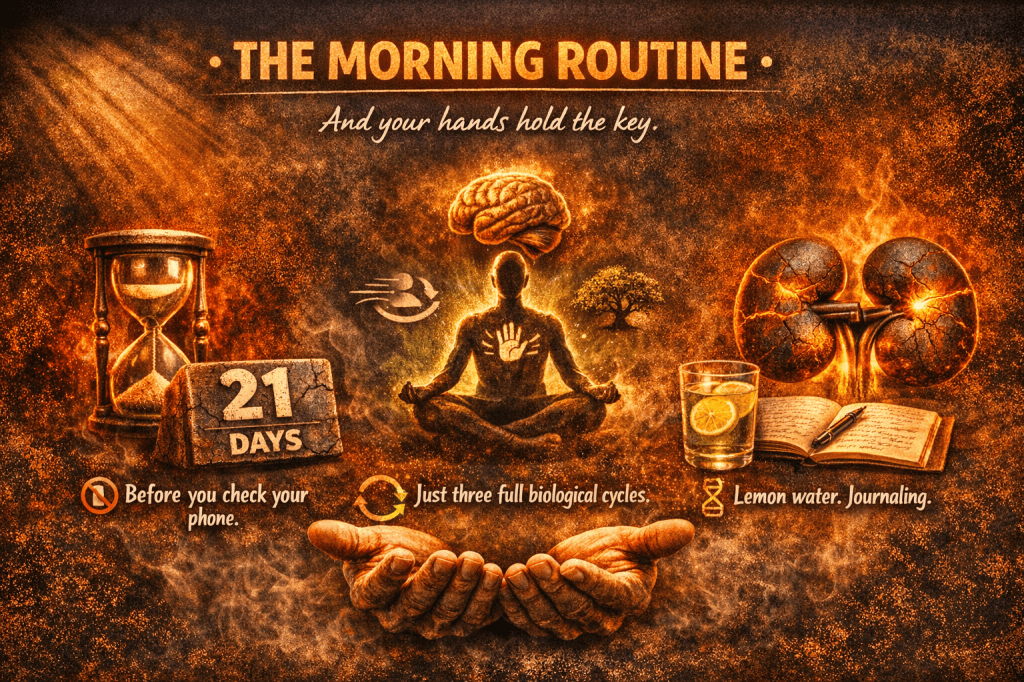
The Morning Routine – Before You Check Your Phone.
This is the most important instruction in the entire series: do the morning practice before you look at your phone. The moment you check your phone, your nervous system receives input — news, messages, social media, notifications — that begins the sympathetic activation cycle. Once that cycle starts, you are already managing its consequences rather than preventing them. Give your nervous system twenty-one minutes of its own signal before you give it the world’s.
The Full Morning Sequence — 21 Minutes
1. Wake without reaching for your phone. Lie still for one minute. Notice your body.
2. Three rounds of 4-7-8 breathing: In 4, hold 7, out 8. Vagus nerve activated.
4. HT 7 + PC 6 on both wrists: 2 minutes simultaneously. The emotional anchors.
5. KD 1 (soles, both feet): 2 minutes. Grounding before you stand up.
6. LV 3 (between toes 1 and 2): 90 seconds each foot. Releasing the night’s holding.
7. Warm water with lemon: before any food, before any caffeine. Sit while drinking it.
8. Three minutes of journalling: one question only — ‘What is within my control today?’
Total: 21 minutes. This is not self-indulgence. It is the most productive thing you will do all day.
Everything that follows in the next sixteen waking hours will be qualitatively different.
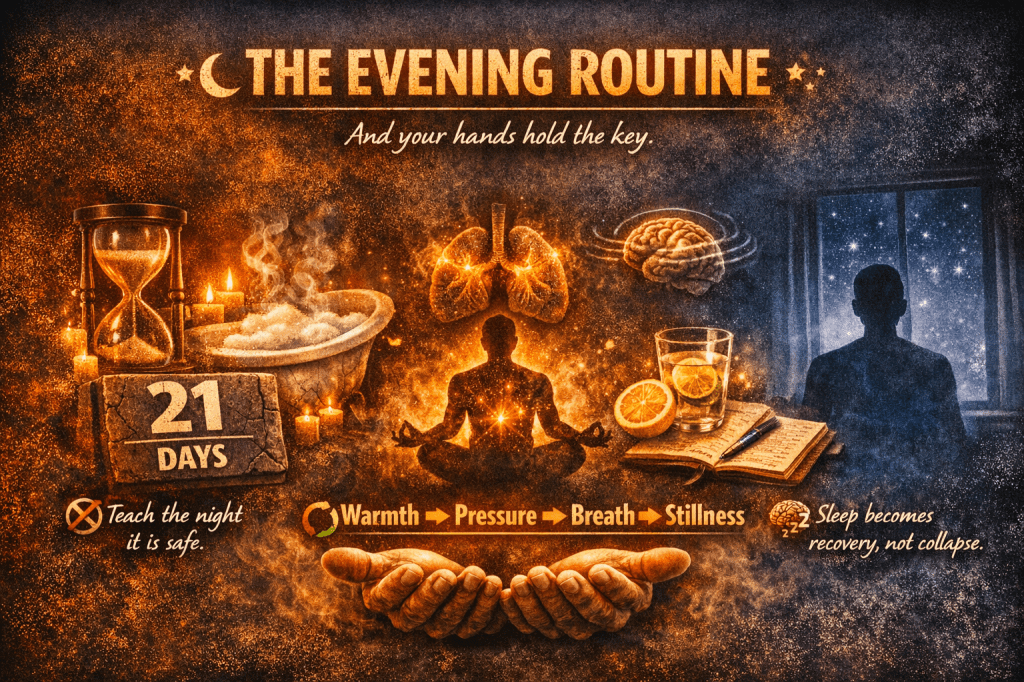
The Evening Routine – Teaching the Night it is Safe.
The Evening Routine — Teaching the Night It Is Safe
The evening practice has one job: to send the nervous system a clear, consistent signal that the day is over and safety has arrived. This signal is not just psychological — it is physiological, and it requires physical inputs to be received. The sequence below provides those inputs in the correct order: sensory input reduction first, then warming, then acupressure, then breath, then stillness.
The Full Evening Sequence — Last 25 Minutes Before Sleep
1. Screens off or night mode: hard stop on news, social media, anything requiring decisions.
2. Warm shower or hot foot soak: temperature drop after warmth triggers sleep hormones.
3. GB 21 + BL 10: shoulder summit and skull base release — where the day’s stress is stored.
4. SP 6 + KD 1: inner ankle and soles — the deepest calming points in the lower body.
5. Yintang + CV 17: third eye and heart centre — quieting the mind and the emotional body.
6. 4-7-8 breath, five rounds: lying down, eyes closed. This is the final physiological signal.
7. Three things you are grateful for: not performance — genuine noticing. The brain records safety.
8. Sleep — the nervous system in genuine rest mode, not collapsed exhaustion.
This sequence, practiced for seven consecutive nights, will change the quality of your sleep.
After twenty-one nights, it will have changed your relationship with the night entirely.
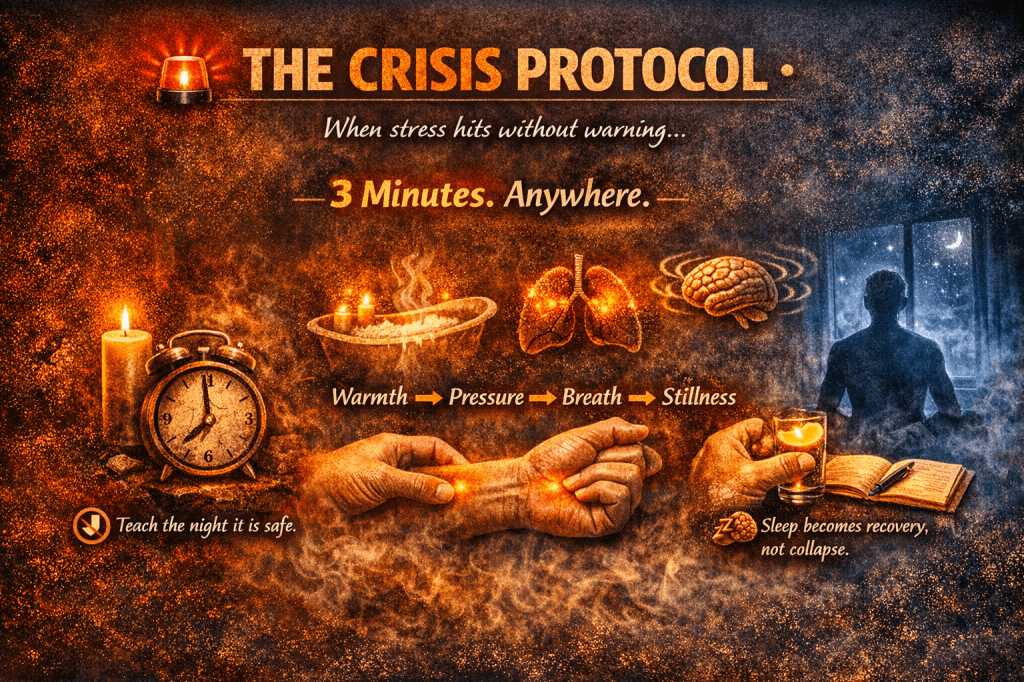
The Crisis Protocol – For When Stress Hits Without Warning.
The Crisis Protocol — For When Stress Hits Without Warning
The daily practice addresses chronic stress. But acute stress — the sudden confrontation, the unexpected bad news, the panic that arrives without warning — needs its own protocol. The three-minute sequence below is designed to be used anywhere, invisibly, at the moment stress arrives rather than hours later.
The 3-Minute Crisis Protocol
STEP 1 — 30 seconds: Two rounds of 4-7-8 breath. Eyes can stay open. Nobody needs to know.
STEP 2 — 45 seconds: One finger pressed firmly on Yintang (between eyebrows). Eyes closed if possible.
STEP 3 — 45 seconds: HT 7 + PC 6 on both wrists simultaneously. Breathe into the pressure.
STEP 4 — 30 seconds: LI 4 (web of thumb): firm pinch, both hands. Exhale with the pressure.
STEP 5 — 30 seconds: Return to breath. 4 counts in, 6 counts out. Return to presence.
Use this in the car, in a meeting break, in a bathroom, before a difficult conversation.
Cortisol measurably drops within three minutes of vagal activation. This protocol delivers it.
The 21-Day Dietary Framework.
Daily Foundations (Non-Negotiable)
Warm water with lemon: First thing, before anything else. Every single morning.
One serving fermented food: Curd, kefir, kanji, kimchi, or buttermilk. Non-negotiable for the gut-brain axis.
Handful of walnuts or pumpkin seeds: Omega-3 and magnesium in one small handful. Morning snack.
Two Brazil nuts: Daily selenium for thyroid hormone conversion. Two only — more is unnecessary and counterproductive.
One tablespoon ground flaxseed: In porridge, smoothie, or curd. Omega-3, lignans, and prebiotic fibre.
This Week, Eliminate These (One at a Time):
Week 1: No caffeine after 1pm. This single change will shift sleep quality faster than almost anything else.
Week 2: No alcohol on weekdays. Alcohol is a cortisol trigger and a sleep architecture disruptor — two things you cannot afford during a stress reset.
Week 3: Replace one ultra-processed meal per day with something whole. Not perfection — one meal. The compounded effect of three weeks of this is measurable in inflammatory markers.
What to Add (One at a Time):
Week 1: Ashwagandha root extract (300mg) with dinner. The most evidence-supported adaptogen for cortisol reduction.
Week 2: Magnesium glycinate (200-400mg) before sleep. Research consistently shows improvement in both sleep quality and stress response.
Week 3: One meal eaten in complete silence, without a screen. The nervous system needs to experience food as safe, not as background to stimulation.
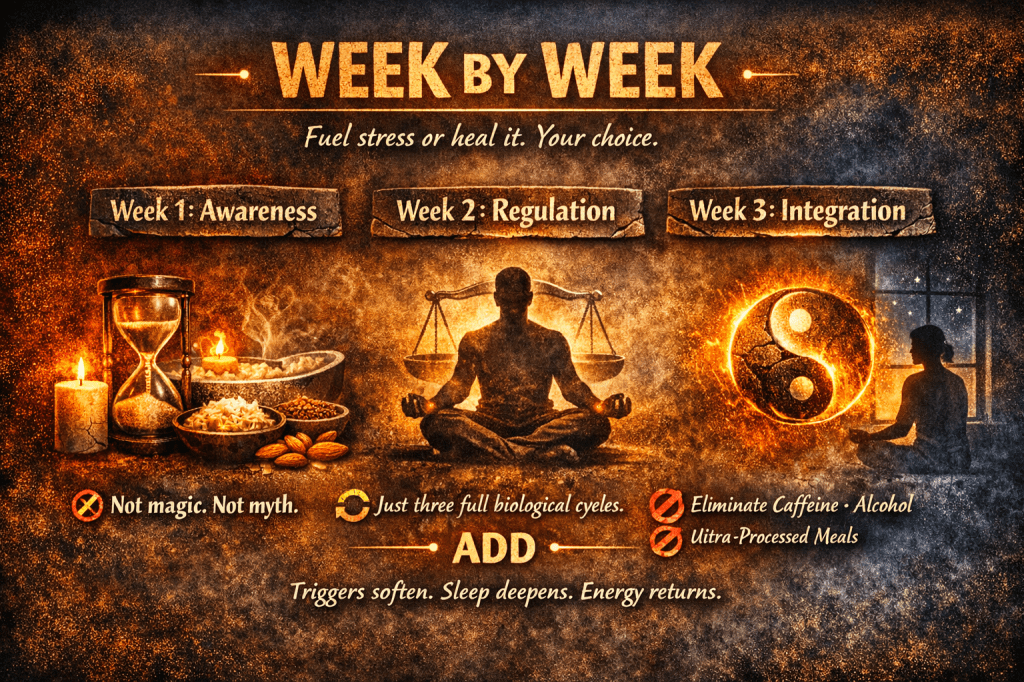
Week by Week – What to Watch For.
Change with stress does not arrive in a straight line. There are days in Week 1 when you will feel more tired than before — that is the parasympathetic system finally getting enough space to process what has accumulated. This is not failure. It is the beginning of genuine recovery. Here is a more detailed map of what each week brings:
Days 1 to 7 — The Awareness Week
The most important thing that happens in Week 1 is not physical improvement — it is the beginning of awareness. You start to notice when your shoulders tighten.
You catch yourself holding your breath. You feel the difference between the morning of Day 7 and the morning of Day 1 — and the difference, while not dramatic, is real. The points will be tender, particularly KD 1, HT 7, and GB 21. Tender means engaged. Stay with it.
Sleep will likely show the first changes: not necessarily that you sleep more, but that the quality of the sleep you do get deepens. The 4-7-8 breath paired with the evening points is usually responsible for this. Some people notice it from Night 3 onward.
Days 8 to 14 — The Regulation Week
By Day 8, the practice is beginning to feel less like a task and more like a ritual. The nervous system has now received fourteen days of consistent parasympathetic input — enough to begin establishing a new pattern. Cortisol output starts to regulate more predictably. The morning spike that launches many stressed people into reactivity before they have even had breakfast begins to soften.
Point tenderness decreases measurably. HT 7 in particular — which is often exquisitely tender in the first week — becomes more comfortable under pressure.
This is a direct indicator of reduced cardiac stress load. BL 23 (lower back kidney point) tenderness also reduces, reflecting adrenal recovery. Track these changes — they are your body’s own progress report.
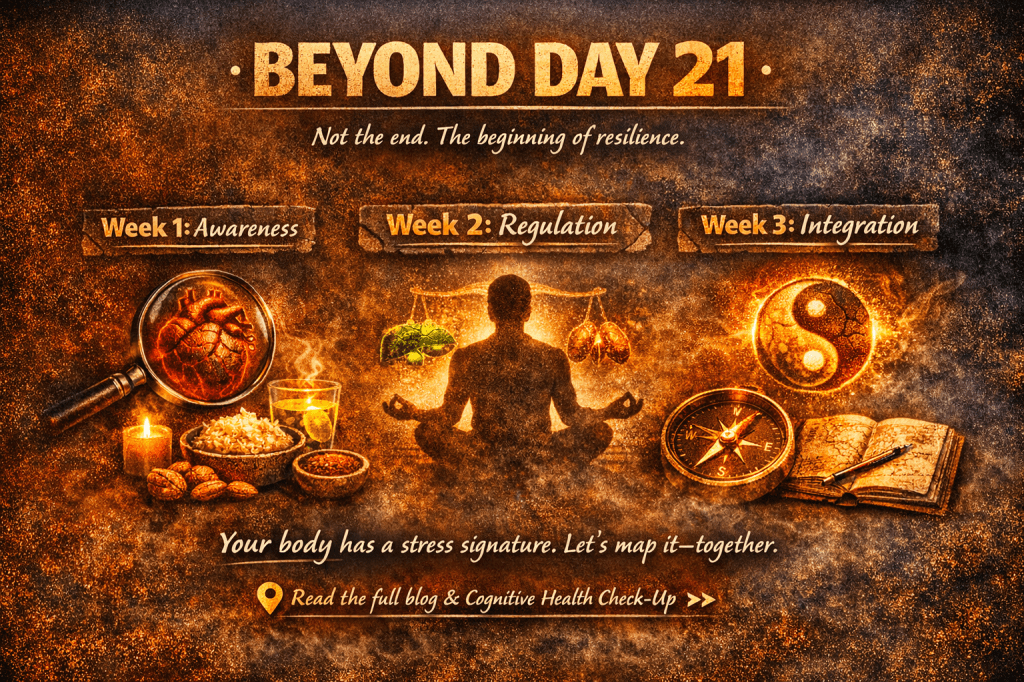
Days 15 to 21 — The Integration Week
This is where the shift becomes qualitative, not just quantitative. People in Week 3 of this practice consistently report the same cluster of observations: things that would have triggered a stress response two weeks ago now feel manageable.
The internal distance between stimulus and response has grown. This is not detachment — it is regulation. The nervous system, given consistent signalling, has recalibrated its threat threshold.
Physically: resting heart rate has typically dropped several beats per minute. Blood pressure, if it was elevated, shows improvement. Digestion has normalised — the gut responds rapidly to nervous system regulation. Skin, if stress was affecting it, begins to clear. Energy — not the jittery energy of cortisol, but the sustained, even energy of a body that is genuinely resting and genuinely working in turn — returns.
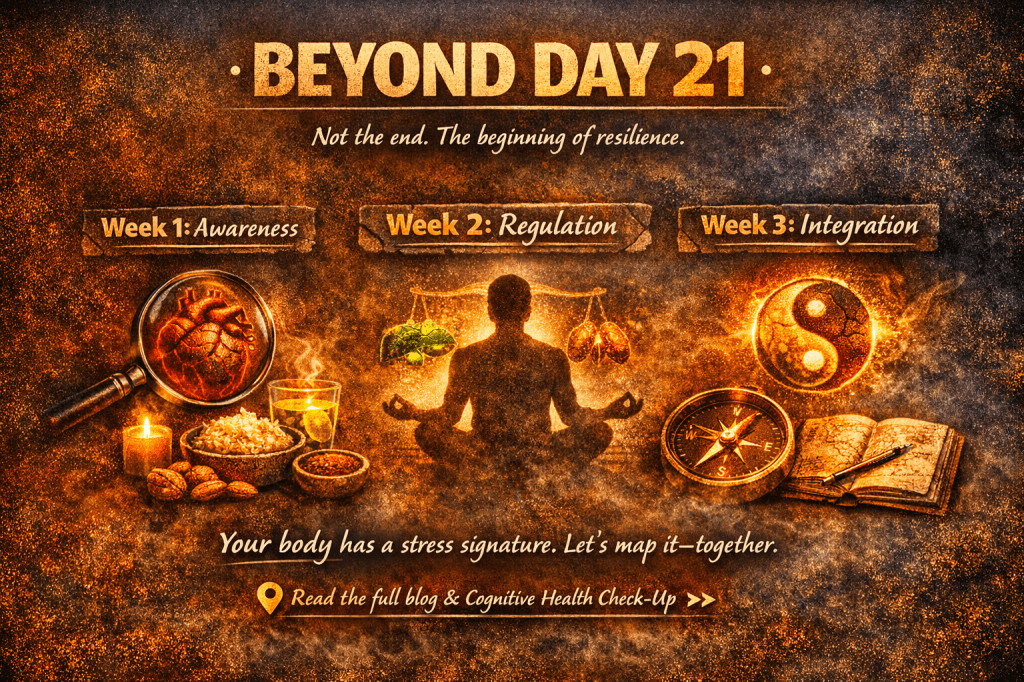
Beyond Day 21 – Making it Yours.
Beyond Day 21 — Making It Yours
Twenty-one days is the beginning, not the destination. Once the practice is established — once it has become as automatic as brushing your teeth — the question becomes: how do you deepen it? How do you move from stress management to genuine stress resilience?
The answer, in my experience, is personalisation. The sequences in this series are designed to be broadly effective for most people. But your body has a specific stress signature — particular points that are more relevant to you than others, particular times of day when you are most vulnerable, particular organ systems that carry the heaviest load. A personalised protocol, built around your specific pattern, is significantly more efficient than a general one.
That is what I offer in a consultation — not a replacement for this series, but a deepening of it. If you have done the twenty-one days and want to go further, I can help you read what your body is showing us and design the next stage of your practice with precision.
Ready to Go Deeper?
Book a personalized consultation to map your stress-organ pattern and build your protocol.
In Association with World Health Journey Take your Cognitive Health Check-Up: www.whjonline.com/mmpi-2
Series Complete – The Heal Yourself First series continues daily.
Your body has been keeping a very detailed record of everything you have been through. It is written in your organs. Time to read it — and respond.
There is a reason this phrase has become famous in the world of trauma and stress research. The body does not experience stress as an abstract event that happens to the mind. It experiences it as a physical event that happens to tissue, glands, organs, and cells. And over time, the tissue remembers.
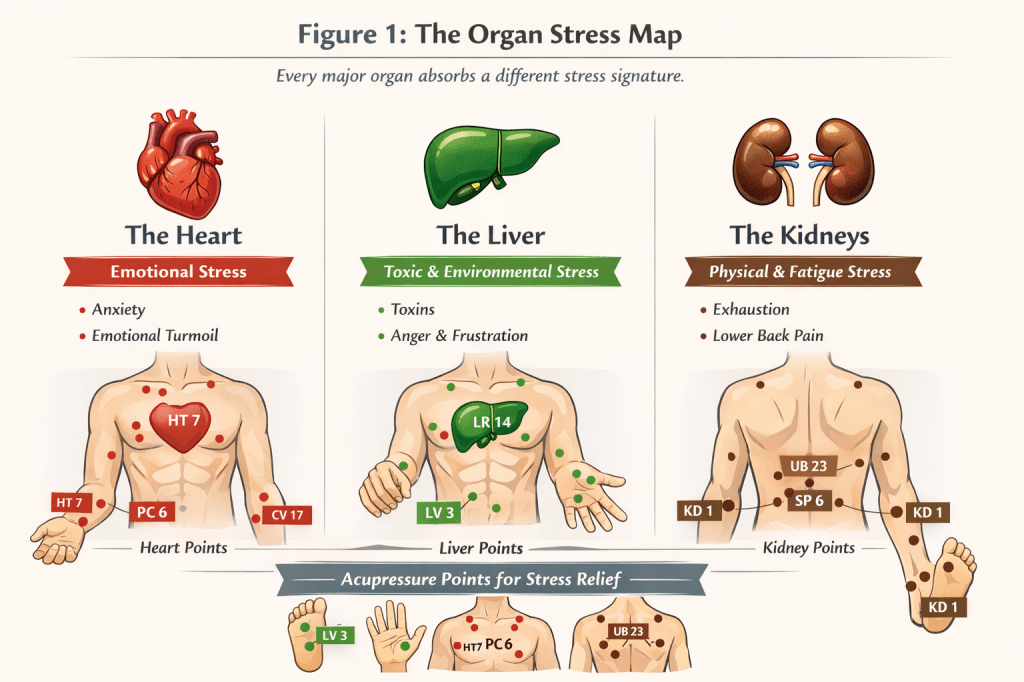
In traditional Chinese Medicine, this understanding is thousands of years old — and expressed with elegant precision. Each major organ is associated not just with a physiological function but with an emotional domain. The heart with joy and its absence. The liver with smooth flow and, when disrupted, with anger and frustration. The kidneys with the capacity to face life without fear. The lungs with the ability to take in and let go — breath by breath. When stress persists, these emotional-organ relationships become sites of accumulation. The organ that carries the load eventually shows it.
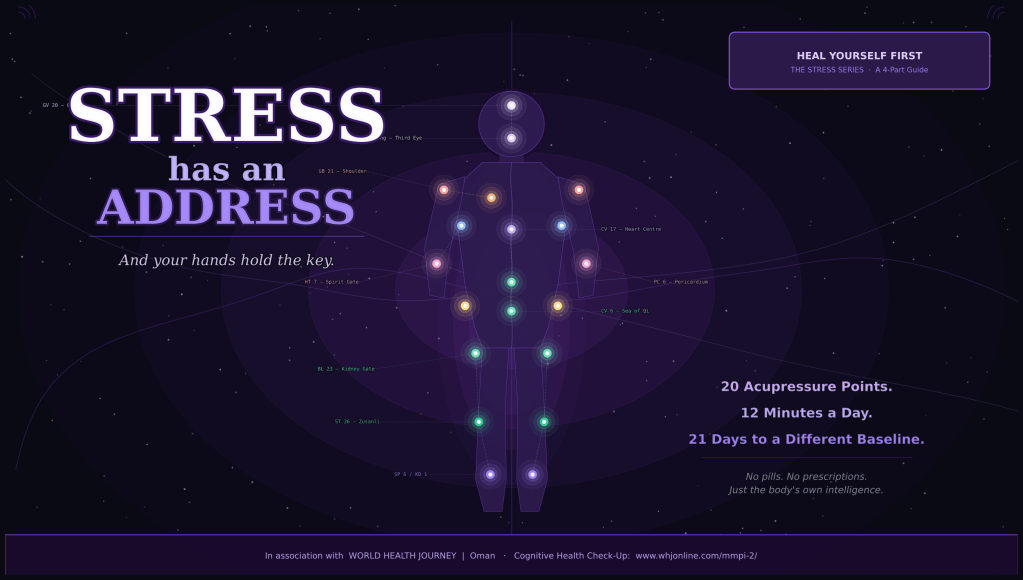
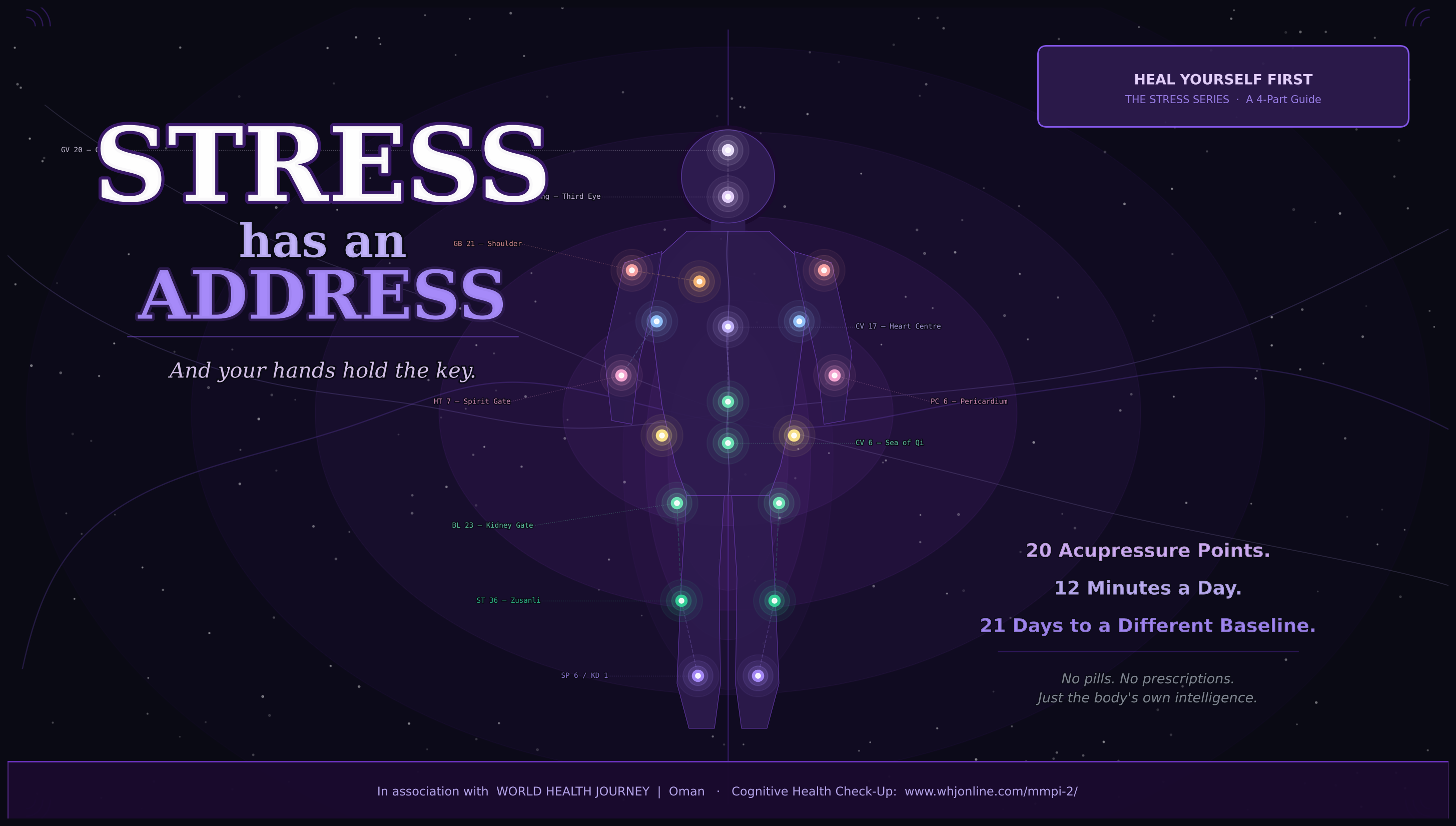
Today’s post maps exactly where your specific stress pattern might be living — and gives you a targeted acupressure protocol for each organ system. You will likely recognise your own pattern before you finish reading.
The Heart — When Stress Becomes a Feeling You Cannot Name
The Chinese medical classics describe the Heart as the emperor of all organs — the one that must remain calm and clear for all the others to function. When stress is relentless and the Heart is disturbed, the first sign is rarely physical. It is the inability to feel settled. The sense that something is wrong even when nothing specific is wrong. The racing thoughts at night. The disproportionate emotional response to small things. These are signs that the Heart’s Shen — its governing spirit and consciousness — is disturbed.
Physically, the heart under stress shows up as palpitations, elevated resting heart rate, blood pressure that is persistently high even when you are trying to rest, and a strange kind of chest tightness that comes and goes without a clear cause. Long-term, the cardiovascular consequences of unresolved stress are among the most serious and well-documented in medicine.
Heart Protocol
CV 17 (sternum centre): 2 minutes, sustained and gentle, with slow breath
BL 15 (back, level with heart): Tennis ball or partner press, 90 seconds, eyes closed
HT 7 (wrist crease, Spirit Gate): 2 minutes, press steadily while breathing out slowly
PC 6 (inner wrist, 2.5 fingers up): 90 seconds each wrist — the Heart’s protector point
Lifestyle addition: One tablespoon of raw honey in warm water each morning has been used across traditional medicine systems to support the heart and calm the spirit. Add a small pinch of cardamom — a heart-supportive spice with documented vasodilatory properties.
The Liver — Where Frustration Goes to Live
Of all the organ-stress relationships in Chinese medicine, the Liver-stress connection is perhaps the most immediately recognisable to a modern audience. When the Liver qi is constrained — when the smooth flow of energy through the body is blocked — the emotional signature is unmistakable: irritability that arrives before you have even had time to think, a short fuse that surprises even you, the feeling of things being stuck or obstructed, tension in the sides of the body and the ribcage.
Sound familiar? For most people living with chronic stress, the liver meridian is involved. And the physical consequences of long-term liver qi stagnation are not trivial: disrupted hormone metabolism, impaired detoxification, elevated inflammatory markers, digestive disturbance (the liver and the digestive system are intimately linked), and increasingly, research connecting liver health to mood disorders in ways that blur the traditional line between ‘physical’ and ‘mental’ health.
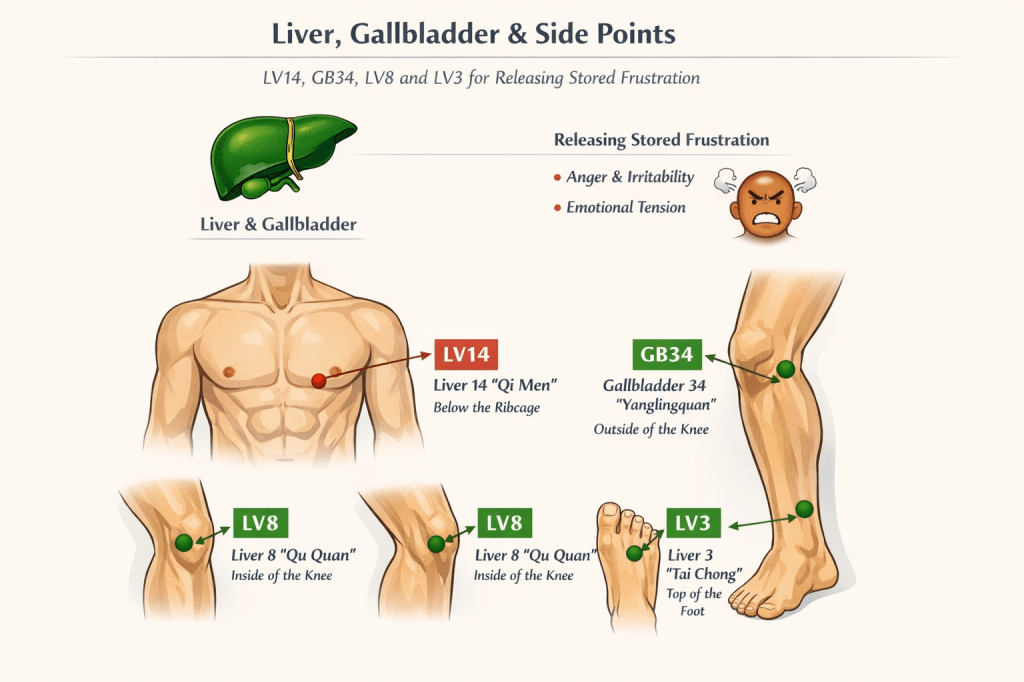
Liver Protocol
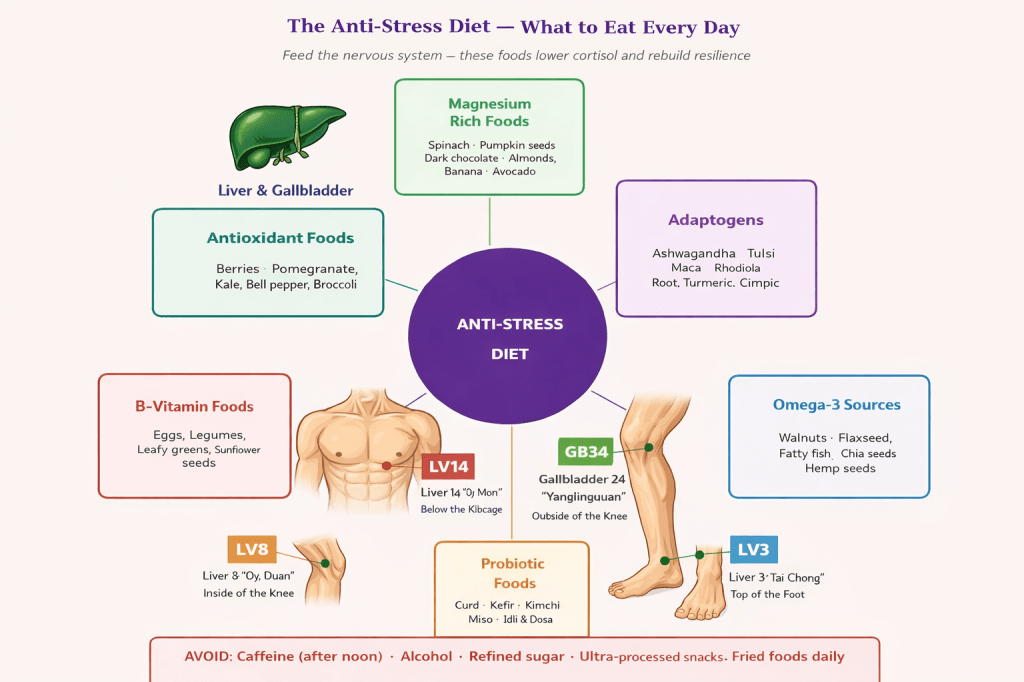
LV 3 (between first and second toes): The liver’s primary release valve — 90 seconds each foot, firm press, breathe through the tenderness
LV 14 (below breast, 6th intercostal): 90 seconds each side — the liver’s alarm point on the chest, often exquisitely tender
GB 34 (below outer knee): Influential point of the sinews — releases muscle tension from stress and frustration
LV 8 (inner knee crease): Nourishes liver blood — important for those with fatigue and emotional volatility from long-term stress
Lifestyle addition: The liver performs most of its detoxification work between 1am and 3am — which is exactly when stressed individuals with liver qi stagnation tend to wake. Going to bed by 11pm, drinking warm lemon water on waking, and avoiding alcohol entirely during stressful periods are the three most impactful liver lifestyle choices.
The Kidneys — When Fear Has Been the Background Note for Too Long
In Chinese medicine, the Kidney is the organ of fear and of fundamental vitality. When fear — not acute fright, but the low-grade existential anxiety of modern life, the worry about the future that never fully resolves — becomes chronic, it depletes the Kidney system. What this looks like physiologically is adrenal exhaustion: the state of being tired but unable to rest, depleted but unable to switch off, anxious without a specific cause.
The kidneys govern the bones, the lower back, the knees, the ears, and the hair. Chronic stress-induced kidney depletion shows up as persistent lower back ache, knee weakness, tinnitus, premature greying, and the specific kind of exhaustion that sleep does not fully resolve. If this description feels accurate to you, the kidney protocol below is where to begin.
Kidney Protocol
BL 23 (lower back, L2 level): The Kidney’s back-shu point — tennis ball method, 2 minutes, daily
KD 1 (sole of foot, centre): The grounding point — 2 minutes each foot, morning barefoot is ideal
KD 3 (inner ankle, behind bone): The Kidney’s source point— just behind and below the inner ankle bone; press firmly for 90 seconds each side
GV 4 (Ming Men, between L2-L3): Warm palm or heating pad, 2 minutes — rebuilds the Yang fire the kidneys need
Lifestyle addition: Black sesame seeds, kidney beans, walnuts, and bone broth are the four most kidney-nourishing foods in both Chinese dietary therapy and modern nutritional science. A tablespoon of black sesame daily — ground and added to porridge or smoothies — is one of the simplest kidney-supportive habits there is. Reduce salt intake: chronically high sodium places direct strain on the kidney’s filtration function.
The Lungs — Carrying Grief and the Inability to Let Go
The lungs govern not just breathing but, in Chinese medicine, the rhythm of taking in and letting go that applies as much to experiences, relationships, and emotions as it does to air. Grief — unprocessed loss of any kind, including the smaller but cumulative losses of a stressful life: opportunities, time, health, ease — is the emotion that damages the lung system most acutely.
People with lung-dominant stress often present with persistent respiratory symptoms (frequent colds, recurrent chest infections, chronic cough, asthma that worsens under emotional stress), a shallow, high breathing pattern that never quite settles, and a tendency to sigh frequently — which is the lung’s attempt to self-correct the breathing rhythm. They may also experience skin problems, because in Chinese medicine the lungs govern the skin and the body’s exterior.
Lung Protocol
LU 1 (upper chest, below clavicle): Lung’s alarm point — press firmly for 90 seconds, expect tenderness if grief is present
LU 7 (inner wrist, above thumb side): 1.5 finger-widths above the wrist crease on the thumb side — Lung’s command point; 90 seconds each
CV 17 (sternum centre): Opens the chest, deepens breath — 2 minutes with conscious expansion breathing.
Breathing practice: Grief-dominant stress responds particularly well to extended exhale breathing. Breathe in for 4 counts. Breathe out for 8. The longer exhale directly stimulates the vagus nerve and physiologically represents ‘letting go.’ Five minutes of this breathing daily, specifically paired with LU 1 pressure, is a practice of profound emotional as well as physical effect.
The Thyroid — Where Stress Disrupts the Hormonal Axis
The thyroid gland sits at the front of the throat, and its relationship with stress is direct and increasingly well-documented. Chronic cortisol elevation suppresses thyroid hormone conversion — specifically the conversion of the inactive form (T4) to the active form (T3). This is why many people with chronic stress develop subclinical hypothyroid symptoms: persistent fatigue, weight gain that does not respond to diet, hair thinning, cold intolerance, cognitive slowing, and depression — even when a standard TSH blood test returns as ‘normal.’
The throat is also — in both the physiological and energetic sense — the site of self-expression. The stress of suppressing what you need to say, of swallowing words and feelings, of living in environments where authentic expression feels unsafe, concentrates here. The sensation of a lump in the throat during emotional stress is not metaphor. It is the physical manifestation of unexpressed content held at the throat level.
Figure 3: Throat, Neck & Thyroid Points — CV22, ST9, TW17 for hormonal balance and jaw tension
Thyroid & Throat Protocol
CV 22 (hollow at base of throat): One finger, very gentle pressure — never hard on the throat. Circular motion, 60 seconds. Releases the thyroid zone and the throat’s holding pattern.ST 9 (side of neck, beside Adam’s apple): CAUTION: Apply one side at a time only. Light touch — this point is near the carotid artery. 30 seconds each side, alternating. Regulates blood pressure and supports thyroid circulation.
TW 17 (behind earlobe): In the bony depression behind each ear — press firmly but gently for 60 seconds each side. Releases jaw clenching, TMJ tension, and the neck tightening that stress produces.
Lifestyle addition: Iodine-rich foods support thyroid function directly: seaweed (nori, kelp), eggs, and iodised salt in moderation. Selenium, found in Brazil nuts (two daily is sufficient), is essential for thyroid hormone conversion. Avoid raw cruciferous vegetables in large quantities if thyroid function is already compromised — lightly cook them instead.
The Anti-Stress Diet — Feeding Your Nervous System
Food is information. Every meal you eat sends a signal to the nervous system, the immune system, and the hormonal axis either in the direction of resilience or in the direction of greater vulnerability to stress. The diagram below maps the most important food categories for stress recovery — not a complicated diet, but a daily orientation toward the foods that actively support the systems stress most damages.
The 5 Daily Non-Negotiables for a Stressed Body
1. MAGNESIUM — Most stressed people are magnesium-deficient. Stress depletes it; deficiency worsens stress. A handful of pumpkin seeds or a tablespoon of ground flaxseed daily covers a significant portion of requirements.
2. PROBIOTICS — The gut-brain axis is a two-way street. Stressed guts produce stressed minds, and vice versa. One serving of fermented food daily (curd, kefir, kanji, kimchi) maintains the microbiome that produces 90% of your serotonin.
3. OMEGA-3 — Directly reduces neuroinflammation, which chronic stress generates. Walnuts, flaxseed, and fatty fish are the most accessible sources. These fats literally lubricate the nervous system.
4. B VITAMINS — The entire B-complex is stress-depleted and stress-essential simultaneously. Eggs, legumes, and leafy greens cover the full spectrum. Avoid single-B supplements — they work as a team.
5. ASHWAGANDHA — An adaptogenic herb with the most robust clinical evidence base for cortisol reduction. 300-600mg of root extract daily. Not a cure — an adaptation tool. Pair with the acupressure practice for compounded effect.
The Sleep-Cortisol Loop — Breaking the Cycle
Here is the vicious cycle that most stressed people are caught in: poor sleep raises cortisol; elevated cortisol disrupts the next night’s sleep; the resulting exhaustion lowers stress tolerance; everything feels more stressful; cortisol stays high. Around and around.
Breaking this cycle requires targeting both ends simultaneously. The acupressure practices in this series address the cortisol side. The sleep hygiene practices below address the sleep side. Together, they give the loop somewhere to break.
Consistent sleep and wake times — even on weekends. The circadian rhythm is the single most powerful regulator of cortisol, and it requires consistency to function.
No caffeine after 1pm. Caffeine has a half-life of five to seven hours. A 3pm coffee is still partly in your system at midnight.
The evening acupressure sequence (SP 6, KD 1, Yintang, HT 7) done lying in bed — this is detailed in full in Post 4 [To be published soon.
Magnesium glycinate 200-400mg before sleep: the most evidence-supported supplement for sleep quality and cortisol reduction, with an excellent safety profile.
No alcohol within three hours of sleep. Alcohol initially sedates but severely fragments sleep architecture in the second half of the night — producing the early-morning waking that stressed people so commonly report.
Your organs do not hold stress against you. They are simply waiting for the signal that it is safe to let go. These practices are that signal.
Work With Me
Understanding which organ system is carrying the primary load of your stress — and tailoring the acupressure practice accordingly — makes the practice significantly more efficient. The same hour invested, but directed precisely.
In a consultation, we identify your specific stress-organ pattern through a combination of symptom mapping, lifestyle history, and the classical diagnostic approaches that Chinese medicine uses to locate where in the body the stress has taken deepest root.
Then we build your protocol — points, sequence, timing, dietary adjustments, and lifestyle shifts calibrated to your specific picture.
Reach out: skcjos@gmail.com
Coming in Post 4: ‘The 21-Day Stress Reset — A Daily Practice That Actually Holds’
In Association with World Health Journey | Oman
Chronic stress does not just strain your body — it leaves lasting psychological patterns that shape every decision, relationship, and response you have. These patterns are measurable.
The Cognitive Health Check-Up from World Health Journey maps your psychological stress architecture — identifying the emotional patterns, cognitive distortions, and resilience gaps that chronic stress has created, before they become something harder to address.
The problem is not that you cannot relax. The problem is that your nervous system has forgotten how. Let’s teach it again.
Why You Cannot Just ‘Calm Down‘
If than one person has told you to simply relax, breathe, or think positive thoughts when you are in stress, the advice is not wrong — it is just incomplete. The reason it fails is that stress does not live in your thoughts. It lives in your body. In your nervous system. In the precise calibration between two biological modes that govern every function you have: the sympathetic and the parasympathetic.
When you are stuck on alarm — where the sympathetic nervous system is chronically dominant — telling yourself to calm down is like asking a fire alarm to stop ringing by itself. The alarm does not respond to thoughts. It responds to signals. Specific, physiological signals. And acupressure is one of the most precise ways to send those signals.
In Post 1, [https://shajikumar.com/2026/03/16/heal-yourself-first-stress-series-1-of-4/] we looked at what stress does to your body and introduced the first tier of points. Today we go deeper: into the nervous system itself, into why some people seem permanently wired and cannot switch off even on holiday, and into the second layer of points — the ones that specifically target the adrenals, the heart, the lungs, and the spinal nervous system.
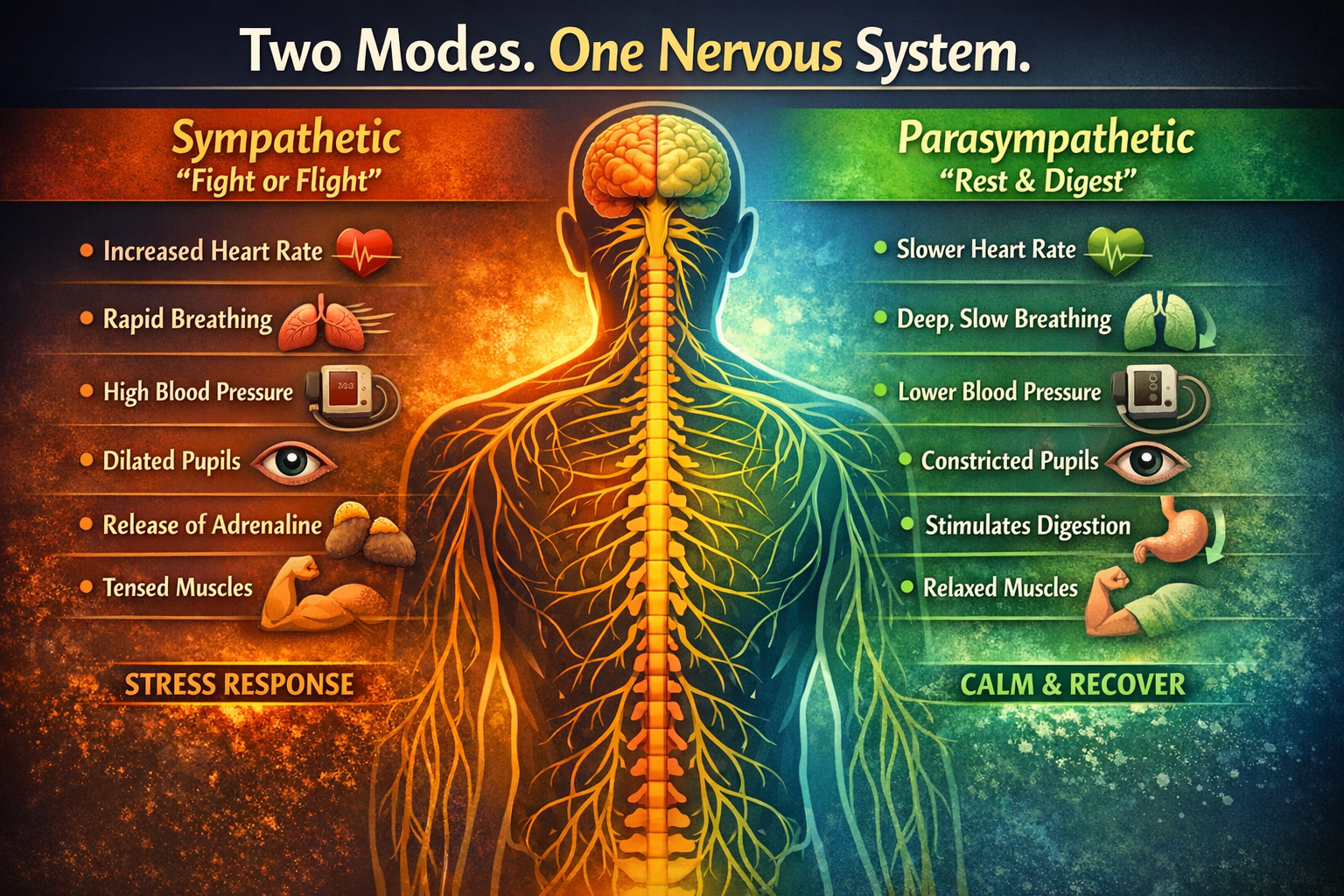
Two Modes — One Nervous System
Your autonomic nervous system runs everything that keeps you alive without you having to think about it: your heart rate, your breathing rhythm, your digestion, your immune response, your hormonal output. It has two branches, and they are meant to alternate — like breathing in and breathing out.
The diagram above shows what each mode actually does at the organ level. What it cannot show is how profoundly unbalanced most modern lives are: for millions of people, the sympathetic system has been the default for so long that the parasympathetic feels foreign. Rest feels unearned. Stillness feels dangerous. Relaxing makes them more anxious, not less — because their nervous system does not trust it.
This condition has a name in polyvagal* theory: chronic sympathetic activation, or more colloquial, a nervous system stuck in a low-grade fight-or-flight that never fully resolves. And the way out is not willpower. It is repetition of the parasympathetic signal, delivered consistently, until the nervous system learns a new default. That is exactly what a daily acupressure practice does.
*The Polyvagal Theory — In Plain Language Dr. Stephen Porges’ polyvagal theory explains why simply telling yourself to calm down does not work. The nervous system has a hierarchy of safety responses: Level 1 — Social engagement (safe): You feel connected, calm, curious. Vagal tone is high. Level 2 — Fight or flight (threatened): Sympathetic system mobilises. You are vigilant, reactive. Level 3 — Freeze (overwhelmed): The system shuts down. Dissociation, numbness, collapse.
Most chronically stressed people oscillate between Levels 1 and 2, never quite fully accessing Level 1. The acupressure points in this series work by directly stimulating the vagal pathways that pull the nervous system back to genuine safety — not performed calm, but physiological calm.
The Back Points — Where Your Nervous System’s Engine Room Sits
The back of the body is, in many ways, the most important region in acupressure for stress — and the most neglected in self-care. The bladder meridian runs the full length of the spine on both sides, and along it sit the ‘back-shu’ points: direct access points to every major organ in the body. The adrenal glands, which produce cortisol, sit just above the kidneys at the L2 level of the lower back. The heart sits at the T5 level of the mid-back. Stimulating these points sends a direct signal to the corresponding organ to regulate.
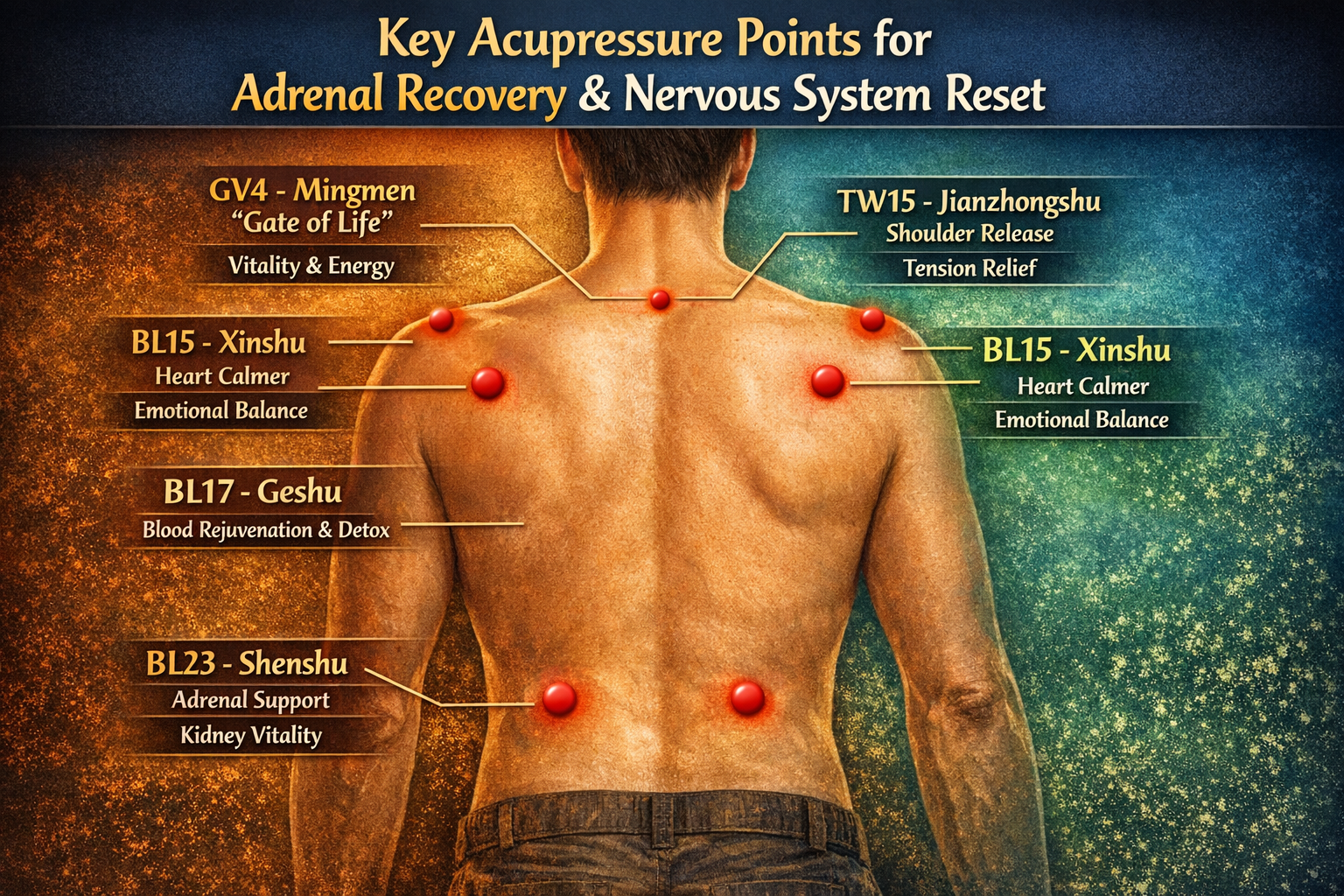
BL 23 — Shenshu: The Adrenal Recovery Point
One and a half finger-widths either side of the spine, at the level of the second lumbar vertebra — roughly at the waist level, in line with the navel. BL 23 is the back-shu (association) point of the Kidney organ system — which in Chinese medicine governs the adrenals and the fundamental energy of the body. Chronic stress depletes what Chinese medicine calls Kidney Jing (essence): the reserve energy that keeps you functioning when the surface reserves are gone.
When BL 23 is chronically tight and tender, it is a clinical indicator of adrenal burden. When it is regularly stimulated, research has demonstrated improvements in adrenal hormone regulation, reduction in lower back pain caused by tension, and enhanced recovery from fatigue. This is the point for people who are tired but cannot sleep — the paradox of adrenal exhaustion.
How to apply: Place two tennis balls in a sock. Lie on your back on a firm surface. Position the tennis balls either side of your spine at the waist. Breathe deeply and let the weight of your body apply pressure. Two minutes. This is the single most effective self-help method for BL 23. Alternatively, coax someone to apply firm thumb pressure directly into the point.
GV 4 — Mingmen: The Gate of Life
On the spine itself, between the second and third lumbar vertebrae. Mingmen — the Gate of Life — is considered one of the most important points in classical Chinese medicine for rebuilding constitutional vitality. It governs what the tradition calls Yang energy: the warming, activating force that stress chronically depletes. People with adrenal exhaustion and chronic stress often feel cold in the lower back — and Mingmen is cold when the energy here is deficient.
How to apply: Warm your palm by rubbing both hands together vigorously for thirty seconds. Then place the warmpalm directly over GV 4 (between the lower vertebrae at waist level). Hold for two minutes, breathing into the lower back. The warmth is part of the therapy. A warm wheat bag or heating pad placed here for ten minutes daily is a simple but powerful supplementary practice.
BL 15 — Jueyinshu: The Heart’s Back Door.
One and a half finger-widths either side of the fifth thoracic vertebra — between the shoulder blades, roughly level with the heart itself. BL 15 is the back-shu point of the Heart, and it is used clinically for the stress patterns that manifest in the chest: palpitations, racing heartbeat, the tightness that arrives with anxiety. In Chinese medicine, the Heart is not just a pump — it houses the Shen, the spirit or consciousness. When the heart is disturbed by chronic stress, the spirit becomes restless. BL 15 calms both.
How to apply: A partner pressing both points simultaneously is ideal. For solo application: two tennis balls in a sock at mid-back level, same as BL 23. Or lean back into a chair with a firm back and let the chair edge press into the points. Hold ninety seconds. You may feel your heart rate noticeably settle.
The Chest Points — Opening What Stress Has Closed
Stress contracts the chest. This is not metaphor — it is a measurable postural and physiological change. The pectorals tighten, the shoulders round forward, the sternum drops, and the breathing becomes shallow and high. All of this reduces lung capacity, increases sympathetic tone, and perpetuates the cycle. The chest points below reverse this process directly.
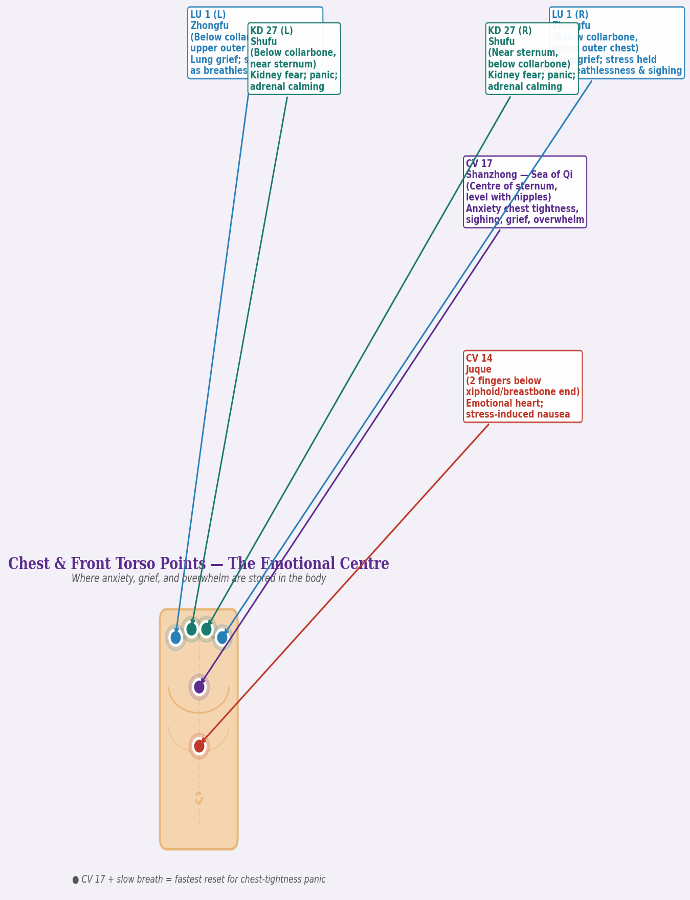
CV 17 — Shanzhong: The Sea of Qi and the Seat of Emotional Pain
At the centre of the sternum, level with the fourth intercostal space (roughly level with the nipples in men). CV 17 is the Influential Point of Qi — meaning it governs the movement of vital energy through the chest and throughout the body. It is also the point most associated with the kind of pain that stress produces in the emotional body: grief that sits in the chest, the tightness of anxiety that will not let you take a full breath, the ache of prolonged worry.
There is a reason we press our hand to our chest when we are moved, frightened, or heartbroken. The body knows this point intuitively. Regular stimulation of CV 17 opens the chest, deepens breathing, reduces the physical sensation of anxiety, and over time, processes the emotional weight that chronic stress accumulates here.
How to apply: Three fingers flat at the centre of the sternum [exact centre of the chest]. Gentle sustained downward pressure — not painful, but with presence. Eyes closed. Breathe into the chest and feel it expand against your fingers. Hold ninety seconds. Then make slow upward strokes along the sternum from CV 17 toward the throat — this opens the channel. Do this morning and evening.
LU 1 — Zhongfu: Where the Lungs Hold Grief
On the upper outer chest, just below the clavicle, approximately one hand-width down from the shoulder. In Chinese medicine, the Lung is the organ of grief — and every practitioner knows that LU 1 is tender in clients who have been carrying unprocessed sadness, loss, or the kind of exhaustion that comes from trying to hold everything together for too long. Stimulating this point releases both physical chest tightness and the emotional holding pattern beneath it.
How to apply: Use two fingers to press firmly into the hollow just below the collarbone on each side. Hold six seconds. The sensation is often intensely tender in stressed individuals — particularly those who have experienced loss or prolonged anxiety. Release slowly. Repeat five times per side. Then make small circles for thirty seconds.
KD 27 — Shufu: The Kidney’s Calming Point on the Chest
In the depression below the clavicle [Commonly known as the collarbone, is a long, S-shaped bone situated horizontally at the top of the chest], just lateral to the sternum. These two points are the highest points on the Kidney meridian — they are where the kidney’s calming, fear-resolving energy surfaces at the top of the body. Pressing KD 27 on both sides simultaneously is one of the fastest self-help techniques for acute panic, because it simultaneously addresses the adrenal component (fear, cortisol) and the chest component (tightness, breathlessness).
How to apply: Index and middle fingers of both hands pressed simultaneously into KD 27 on each side. Hold firmly for sixty seconds while breathing slowly through the nose. This is your first-response protocol for panic attacks when they arrive — not a replacement for medical care in severe panic disorder, but a powerful immediate intervention.
The 5-5-5 Regulation Technique.
This is a simple tool that pairs with the acupressure points and can be used anywhere, at any moment of acute stress. It takes ninety seconds and works by engaging three different regulatory pathways simultaneously.
The 5-5-5 Technique — 90 Seconds to Regulation SENSE: Name 5 things you can see right now. Look at each one for a full second. Then name 4 things you can physically feel (your feet on the floor, the chair against your back). Then name 3 things you can hear. BREATHE: 5 counts in through the nose. 5 counts hold. 5 counts out through the mouth. Repeat 5 times. PRESS: With eyes closed, press KD 27 (below collarbones) with both hands simultaneously. Hold for 30 seconds while continuing to breathe slowly. Why it works: The sensory naming engages the prefrontal cortex, overriding the amygdala’s alarm.The extended exhale activates the vagus nerve. The KD 27 press closes the adrenal loop. Together, these three steps move the nervous system from alarm to regulation in under two minutes.
Today’s Lifestyle Shift: The Two-Hour Wind-Down Protocol
The most common sleep complaint in stressed individuals is not the inability to fall asleep — it is the inability to stop thinking once the body is finally still. This is a nervous system problem, not a sleep problem. The sympathetic system does not switch off at bedtime because it has been on all day and has not received a clear ‘safe now’ signal.
The two-hour wind-down is the protocol that sends that signal. It works by gradually reducing sympathetic input and building parasympathetic momentum, so that by the time you lie down, the transition to sleep is physiological rather than a battle of willpower.
Two hours before sleep: screens on night mode or off entirely. Not because screens are evil — because blue light is a cortisol trigger.
Ninety minutes before sleep: warm shower or hot foot soak. Temperature drop after warmth triggers sleep hormone release.
One hour before sleep: the evening acupressure circuit [I will discuss this in Detail in the next Post Part 4. Ten to twelve minutes.
Thirty minutes before sleep: reading on paper, light conversation, or silence. No input that requires decision-making.
At the bedside: the 4-7-8 breath, three rounds. Then sleep.
This sequence, practiced for seven consecutive days, produces measurable improvements in sleep onset time and subjective sleep quality for the vast majority of people who try it. The nervous system learns the pattern quickly — it is extraordinarily responsive to consistent signals.
The Post 2 Circuit — Your Nervous System Reset Sequence
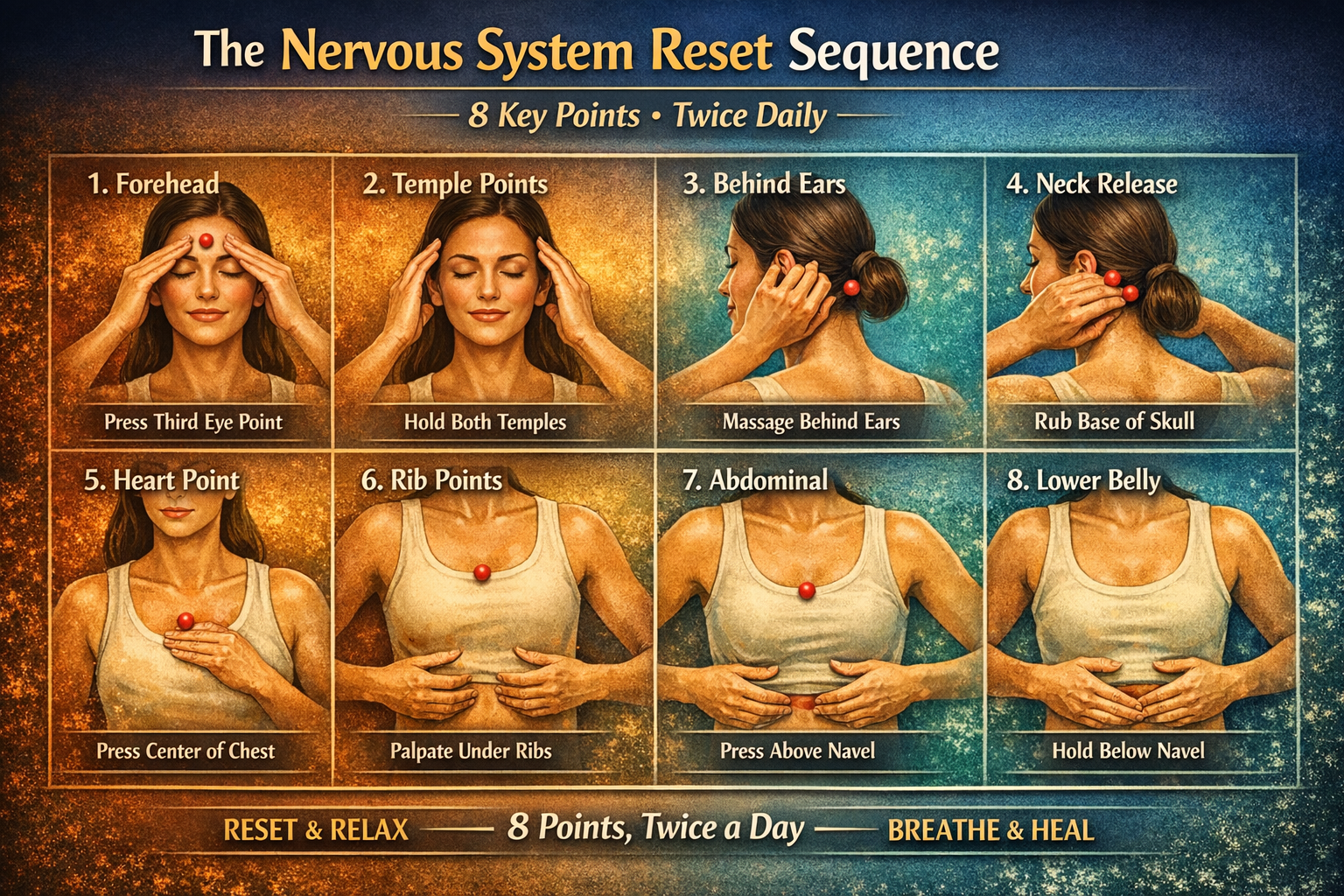
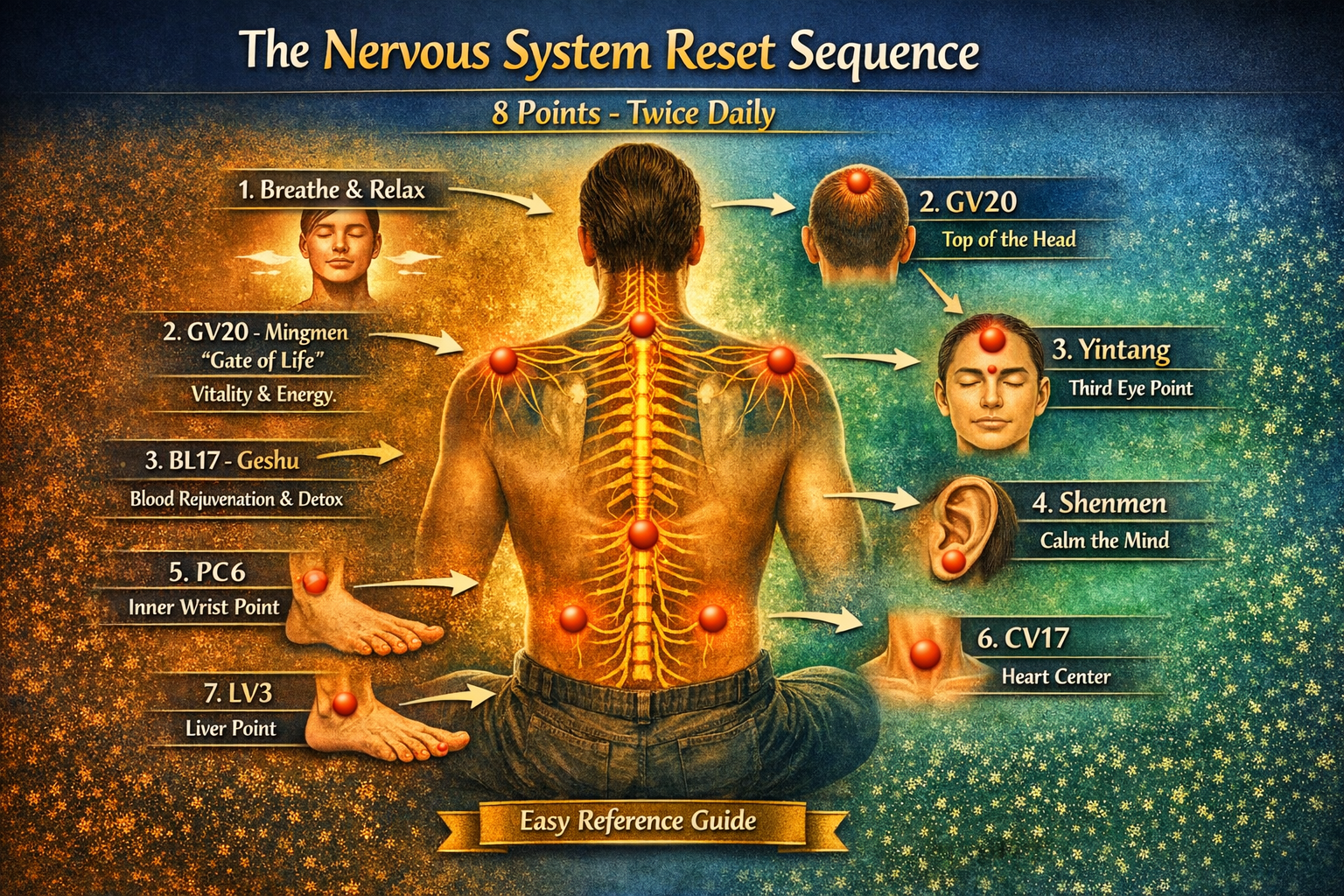
Post 2 Daily Practice — Add These to Your Post 1 Foundation ① CV 17 — Chest centre (2 minutes, 4-7-8 breath throughout) ② KD 27 — Below collarbones (90 seconds each side, simultaneously) ③ LU 1 — Upper outer chest (90 seconds each side, gentle but sustained) ④ BL 23 — Lower back (2 minutes, tennis ball or partner press) ⑤ GV 4 — Ming Men / Gate of Life (90 seconds, warm palm pressure) ⑥ BL 15 — Mid-back heart point (90 seconds each side) ⑦ TW 15 — Shoulder summit (90 seconds each side, firm grip and release) ⑧ ST 36 — Below knee (2 minutes each leg, rebuilds depleted energy) Combined with the Post 1 sequence across morning and evening: a complete nervous system re-calibration.
What to Expect After Two Weeks
By the end of two weeks of consistent practice — both the Post 1 and Post 2 sequences — you should notice several specific changes. Sleep onset becomes easier. The period between lying down and falling asleep shortens. Morning awakening is less abrupt — the cortisol spike that jolts many stressed people awake begins to soften into something more gradual and manageable.
The shoulder points GB 21 and TW 15 will feel measurably less tender. This is not because you have become desensitised — it is because the tissue is genuinely releasing stored tension. The difference between a point that is simply not being pressed and a point whose underlying tension has resolved is something you will feel clearly.
And you may notice something more subtle: moments of stillness that are comfortable rather than anxious. Brief windows where the background hum of stress is simply not there. Hold those moments. Notice them. They are not accidents — they are the nervous system remembering what it was built to feel.
The nervous system does not need to be broken to be reset. It just needs to be heard.
Coming in Post 3: ‘Stress Has an Address — It Lives in Your Organs (And Here Is How to Evict It)’
Work With Me
For a Personalised Nervous System & Stress Profile The points in this series address the most common stress patterns — but the nervous system is individual. The sequence that most benefits someone with anxiety-dominant stress is different from the one that serves someone with shutdown and exhaustion. Someone carrying grief needs a different emphasis than someone driven by frustration and anger.A one-on-one consultation lets me understand your specific stress architecture: where it lives in your body, how long it has been there, and what the most direct pathway to your particular form of resolution looks like.Reach out: skcjos@gmail.com | www.linkedin.com/in/shajikumar
Is stress affecting your mental health in ways you haven’t fully recognised yet?
Consider taking a Cognitive Health Check-Up — a clinically validated assessment that maps your stress profile, emotional health, and psychological resilience with precision.
The Gut Doesn’t Lie – And it’s Been Trying to Talk to you for Years.
Ever wonder why we get “butterflies in the Stomach” when we’re nervous?
Our gut is our second brain. Most of us reach for an antacid the moment we feel a bloat, but that’s just putting a band-aid on a biological protest. Instead of suppressed symptoms, let’s talk about flow.
You don’t need a prescription to start healing your digestion. You need your hands, ten minutes, and the willingness to listen.
For a great part of my life, I have battled with this problem of my gut not behaving. Like an errant child, it has troubled me for years, till I found the remedies and took the matter in my own hands. Though this happened after I had consumed countless “pills” & trying other alternative treatments like Ayurveda. Now for the first time in decades, I am at peace because I have devoted 10 minutes every morning massaging the root cause areas on my body.
If you have ever sat across from a doctor with a complaint about bloating, constipation, acidity, or that persistent heaviness after a meal, chances are you walked out with an antacid, a laxative, or at best a referral to a gastroenterologist. What you almost certainly did not walk out with is the knowledge that your own hands hold some of the most effective tools for digestive relief known to medicine — tools that have been refined over three thousand years, validated by modern neuroscience, and available to you free of charge, right now.
The gut is extraordinary. It has its own nervous system — the enteric nervous system — with roughly 500 million neurons embedded in its lining. Scientists call it the ‘second brain,’ and they mean that literally, not poetically. This second brain communicates constantly with your head brain via the vagus nerve, and it responds powerfully to what you eat, how you breathe, how much you sleep — and yes, to touch and pressure applied at specific points on the body.
That last part is where acupressure comes in. And once you understand how it works, you will wonder why nobody ever taught you this alongside how to brush your teeth.
Before You Read Further
This post covers acupressure techniques for everyday gut wellness — bloating, acidity, sluggish digestion, constipation, and general gut fatigue. If you are experiencing severe abdominal pain, blood in stool, unexplained weight loss, or any symptoms that concern you, please see a doctor first. These practices work beautifully alongside medical care — not in place of it when something serious is happening, because you failed to listen to it’s woeful cries of distress.
Why Your Gut Is So Much More Than a Digestive Tube
Here is something that might shift your entire view of health: approximately 70 percent of your immune system lives in your gut. Your gut lining produces serotonin — the very same molecule that anti-depressants target — in quantities that dwarf what your brain makes. When your gut is inflamed, sluggish, or dysbiotic (that means the bacteria colony inside it is out of balance), you do not just feel bloated. You feel tired, anxious, foggy-headed, and often inexplicably low.
The reverse is also true. A well-functioning gut — one with good motility, a diverse microbiome, and a healthy mucosal lining — shows up in your energy levels, your skin, your mood, and your ability to fight infections. The gut is not a side conversation in your health. It is the main event.
And the single most underused, most overlooked tool for maintaining it? Daily, deliberate pressure on a small set of points that your body has been waiting or you to discover.
Section 1: The Abdominal Points — Working Directly at the Source
These are the points on the belly itself. Many people are hesitant to massage their own abdomen — it feels intrusive somehow. But the abdominal wall is packed with lymph nodes, fascia, and pressure receptors that, when stimulated correctly, directly influence intestinal motility, reduce visceral tension, and improve blood flow to the digestive organs. Think of it as manually waking your gut up.
CV 12 — Zhongwan: The Master Switch for Digestion
Located exactly four finger-widths above your navel, CV 12 is arguably the most important single point for upper digestive function. In Traditional Chinese Medicine, it governs the Stomach and is used to treat everything from acid reflux and bloating to nausea and lack of appetite. Modern research has shown that stimulation of this point activates gastric acid regulation and promotes gastric emptying — which is exactly what you need when food feels like it is sitting in your stomach like a stone.
How to apply: Place three fingers of your right hand flat over this point (just above navel centre). Apply gentle but firm downward pressure — not poking, but sustained weight. Hold for a slow count of ten. Release. Repeat six to eight times. Then make small clockwise circles with the same three fingers for ninety seconds. You may feel mild gurgling. That is not a bad sign — that is your gut waking up. TRY IT NOW.
ST 25 — Tianshu: The Two Points That Balance Everything
These two points sit two finger-widths to the left and right of the navel, and they are bilateral — meaning you work both sides. ST 25 is the ‘Heavenly Pivot,’ and the name gives a clue to its function: it balances the intestines between too much and too little. Constipated? Stimulating ST 25 promotes peristalsis. Dealing with loose stools or IBS-D? The same point, applied more gently, helps regulate and calm the gut. This bidirectional action is one of the things that makes acupressure genuinely different from a pharmaceutical intervention.
How to apply: Place one thumb on the left ST 25 and one on the right simultaneously. Apply steady circular pressure — clockwise for constipation, counter-clockwise if dealing with urgency or loose stools. Two minutes. Breathe deeply throughout. Do not rush this one. TRY IT NOW.
CV 6 — Qihai: The Sea of Energy Beneath Your Navel
One and a half finger-widths below the navel. This point — literally called the ‘Sea of Qi’ — governs the body’s core energy and, importantly for us, intestinal motility. When digestion is sluggish, this point feels dull and sometimes slightly tender when pressed. Regular stimulation of CV 6 improves lower gut function, reduces the bloating that sits heavily in the lower abdomen, and over time strengthens what Chinese medicine calls ‘digestive fire’— the body’s fundamental capacity to process food.
How to apply: Two fingers flat, pressing slowly inward. Hold at a depth that feels like mild pressure — not pain. Hold for six counts. Release. Repeat eight times. Then keep your fingers there and breathe into the abdomen for sixty seconds, feeling the belly rise against your hand.TRY IT NOW.
Section 2: The Leg Points — Why Your Knee Area Controls Your Stomach.
During our growing up years, we have often heard this statement, “your brains are in your knees” especially as a slander remark for tall people. Little did I realise then as to how true this statement is.
This surprises everyone the first time they hear it. The idea that pressing a point below the knee could affect the stomach, intestines, or liver seems counterintuitive until you understand the meridian system. In Chinese medicine — and increasingly in the acupuncture research literature — the Stomach meridian runs from the face all the way down to the second toe, passing through the knee and lower leg. Stimulating points along this channel creates measurable physiological changes in gastric function.
ST 36 — Zusanli: The Single Most Studied Acupressure Point on the Planet
This point deserves its own paragraph, because it has earned it. Zusanli — ‘Three Mile Leg’ — sits three finger-widths below the kneecap, just outside the shinbone. It has been the subject of hundreds of clinical trials and is used across traditional systems in China, Japan, Korea, and increasingly in integrative medicine settings worldwide. Its effects on digestion are well-documented: it increases gastric motility, regulates gut microbiome diversity, reduces post-operative nausea, improves nutrient absorption, and stimulates the vagus nerve.
But here is the thing that really captures people: in Chinese medical tradition, this point is considered one of the longevity points. Farmers in ancient China would press this point every morning before a long day of work. The phrase associated with it translates roughly as: ‘Press Zusanli daily and live a hundred years.’ Whether or not you plan on a century, the point delivers.
How to apply: Sit with one leg bent. Place your thumb on ST 36 and press firmly downward and slightly inward toward the bone. You will likely feel a distinct ache or a sensation that radiates down the leg. That is the point. Hold for six counts, release, repeat eight times. Then switch legs. Two minutes per leg. Do this every single morning.
SP 6 — Sanyinjiao: Three Meridians, One Powerful Point
Four finger-widths above the inner ankle bone, on the back edge of the shinbone. This is the meeting point of three major meridians — Spleen, Liver, and Kidney — and its effects ripple through all three organ systems simultaneously. For the gut, SP 6 is invaluable: it aids in the transformation and transportation of food, reduces abdominal distension, calms IBS, and helps with the emotional component of gut dysfunction (the anxiety-gut connection that so many people experience but nobody talks about enough).
Note: SP 6 is contraindicated in pregnancy as it can stimulate uterine contractions. Pregnant women should skip this point.
Section 3: Hand and Wrist Points — Fast Relief at Your Fingertips.
The hands are perhaps the most convenient acupressure tools you have, because you always have access to them — at a desk, in a car, in a meeting, on a flight when your stomach is rebelling against airline food at thirty thousand feet. The points here are particularly useful for acute symptoms: sudden nausea, heartburn, food regret.
PC 6 — Neiguan: The Nausea Point That Actually Works
Two and a half finger-widths above the wrist crease, between the two prominent tendons on the inner wrist. If you have ever worn acupressure wristbands for travel sickness, this is the point they press. PC 6 is so well-validated for nausea that it is included in multiple clinical guidelines for chemotherapy-induced nausea and post-operative nausea alongside conventional anti-emetics.
But its effects go further than nausea. Regular stimulation of this point calms the cardiac plexus, reduces the nervous system’s contribution to gut symptoms, and eases the kind of reflux that gets worse when you are stressed. The gut-brain axis runs directly through this point.
How to apply: Use the thumb of the opposite hand. Press firmly inward between the tendons. Hold for six counts. For acute nausea, stimulate rhythmically — press, hold, release, repeat — for three continuous minutes. You should feel relief within five minutes of consistent application.
LI 4 — Hegu: The Universal Pain and Motility Point
In the fleshy web between the thumb and index finger. This is one of the first points every acupressure student learns, and with good reason — it is a master point for pain anywhere in the body, and for the large intestine specifically. LI 4 stimulates intestinal contractions, helps with constipation, and relieves the cramping pain associated with IBS and spastic colon.
How to apply: Pinch the web firmly between thumb and index finger of the opposite hand. Apply deep, rotating pressure for ninety seconds. It should feel intense — this point is rarely dull in people with gut issues. Switch hands. Do this twice a day on difficult gut days.
Your Daily 12-Minute Gut Circuit — The Full Sequence
Below is the recommended daily sequence. Done in order, these six points create a cumulative effect that is greater than any one of them individually. The sequence moves energy from the stomach downward through the intestines and out — which is the natural direction of healthy digestion. Working clockwise at each point reinforces this direction.
The 12-Minute Daily Morning Gut Routine
① CV 12 — Stomach centre (2 minutes, clockwise circles)
② ST 25 — Either side of navel (1 minute each side, clockwise)
Best done on an empty stomach, first thing in the morning. Lie down for the abdominal points. Sit comfortably for the leg and hand points. Breathe slowly throughout — never hold your breath while pressing.
How I do it…
Every morning I would put on some soothing music which keeps playing in the background while I continue these routine. I devote over 45 minutes daily, apart from other regular morning routine like waking up, brushing teeth, consuming warm water with a dash of lemon, walking or jogging etc. Time we all have, it is just how we learn to use it. Out of 24 Hours, everyday I would suggest give 90 minutes at the most to your own body. You love your body and the body will love you back.
There is more to it, but then this article has taken the length of our intestines. So in case I get better response, I might bring in a second part where I can talk about how to make lifestyle changes to boost your gut health. I started by asking a question, “Your Stomach is Talking, Are You Listening”. My advise – please do, it is your Stomach.
Want a personalised Gut-care plan?
I can design a tailored acupressure and lifestyle program based on your health history, current symptoms, and goals. Reach out to book a consultation — I’m happy to help.
Tomorrow’s trailer…
Day 5 and for a few more days beyond that I will focus on STRESS (the stealth enemy or root cause of most of our health issues) : simple acupressure points and belly routines to manage STRESS. See you then!
The gentle giant – The Liver. Possibly the largest and one very hardworking Organ of the Body. It is like a giant processor – which will process anything and everything we keep throwing down the throat quite literally. However, there are limits to which anyone can suffer – and so does the Liver. I call it the traffic police with barricades.
That is why a great percentage of all who get an ultrasound of the Liver comes back with a minimum Stage 1 fatty Liver.
Learn to love your Liver. Don’t treat it like it is adopted. However Gentle Acupressure & Habits will Support Your Liver.
Hello there — welcome to Day 3 of our self-care series Health in Your Hands. Today we will give some loving attention to one of our body’s most hardworking organs: the liver. When our liver is happy, energy, digestion, and even mood get a boost. Little, regular self-care for the liver can pay big dividends.
Why the liver matters?
– The liver detoxifies, stores nutrients, helps regulate blood sugar, and supports digestion.
– Modern life—alcohol, smoking, processed foods, stress, irregular sleep—can overwork the liver.
– Acupressure can stimulate points that support liver circulation, drainage, and balance without needing any equipment.
The 7-Minute Liver Support Routine.
– Time: max 7 minutes (do once daily; morning is ideal)
1. Sit comfortably or lie down. Take three slow, deep breaths. Make your touch warm—rub your hands together for a few seconds.
2. Liver 3 (Taichong) — the cornerstone (2 minutes)
– Location: On the top of the foot, in the depression between the big toe and second toe, about 1–2 finger-widths back from the web.
– Action: Using your thumb, apply steady, comfortable pressure to the point. Hold for 30 seconds, then massage in small clockwise circles for 1–2 minutes. Repeat on the other foot.
– Why: Taichong (LV-3) is a primary liver point in acupressure and acupuncture; it helps soothe liver qi, reduce tension, and improve circulation.
3. Spleen 6 (Sanyinjiao) — support and balance (1.5 minutes)
– Location: On the inside of the lower leg, about four finger-widths above the inner ankle bone, just behind the tibia.
– Action: Press gently with your thumb or knuckle for 30 seconds, then use small circular motions for another 30–60 seconds per leg.
– Why: Spleen 6 harmonises the digestive and reproductive systems and supports liver function indirectly by improving fluid metabolism and qi flow.
4. Gallbladder 34 (Yanglingquan) — unblock and move (1 minute)
– Location: On the outside of the lower leg, in the depression just below and in front of the head of the fibula (the outer bone).
– Action: Firm pressure and a few circles for 30 seconds per leg.
– Why: GB-34 supports bile flow and helps “unclog” stagnant liver energy—excellent when you feel irritable or sluggish.
– Action: Place both palms on your right upper abdomen (below the ribcage). Make gentle clockwise
circular strokes for 30–60 seconds, imagining lymph and blood gently moving toward the liver for processing.
– Why: Encourages gentle liver circulation and supports digestion.
Breathing + visualisation (30 seconds)
– Finish with slow deep breaths. Visualise a warm, golden light bathing your liver, helping it filter and renew.
Quick signs that it’s working
– A sense of warmth or looseness in the abdomen.
– Reduced bloating or heaviness after meals.
– Feeling calmer and less irritable.
Lifestyle & diet nudges for liver resilience is equally important. Choose what you eat, how you eat.
Disclaimers & when to seek advice.
These are just precautions. These techniques are gentle and safe for most people, but if you have diagnosed liver disease, are pregnant, on blood thinners, or have serious health conditions, check with your healthcare provider before starting these new routines. If, you are already ailing with any form of Liver disease please continue the regular treatment plan as suggested by your Doctor or Health Care professional. If you feel sharp pain, dizziness, or any alarming symptoms during a session, stop and consult a professional.
But indulge in the suggested 7 minute routine daily so that it gives a boost to the pills that you are consuming daily. You can also refer to your Doctor for advise.
Want a personalised liver-care plan?
I can design a tailored acupressure and lifestyle program based on your health history, current symptoms, and goals. Reach out to book a consultation — I’m happy to help.
Tomorrow’s trailer…
Day 4 will focus on digestion: simple acupressure points and belly routines to ease bloating and improve nutrient absorption. See you then!