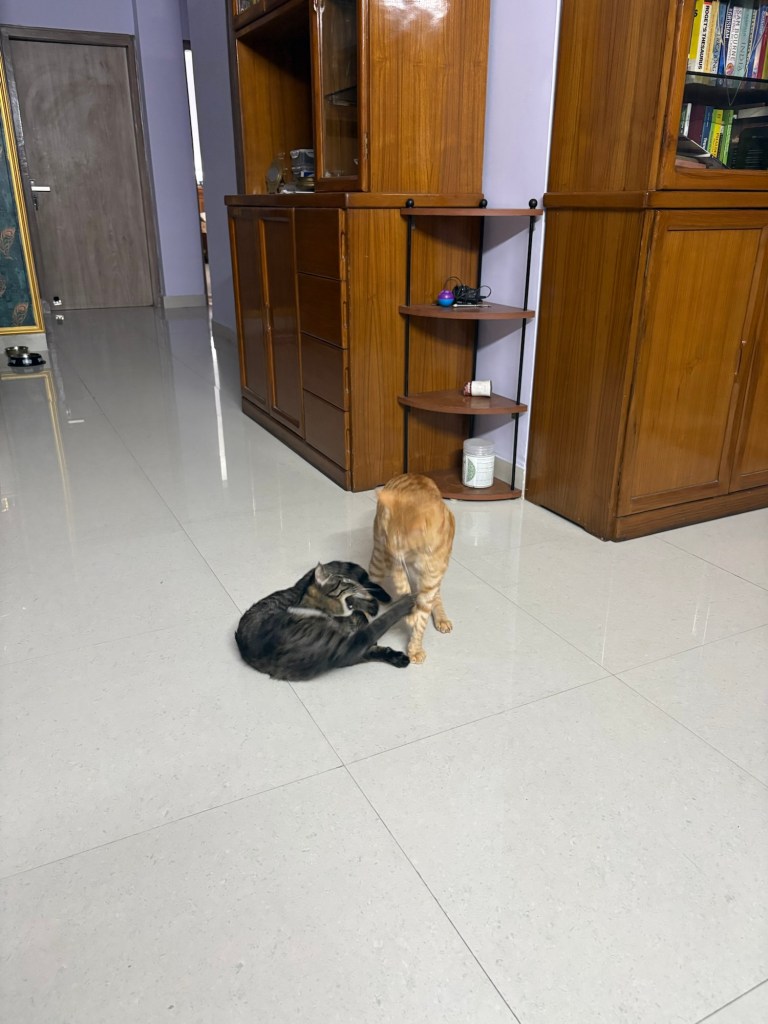
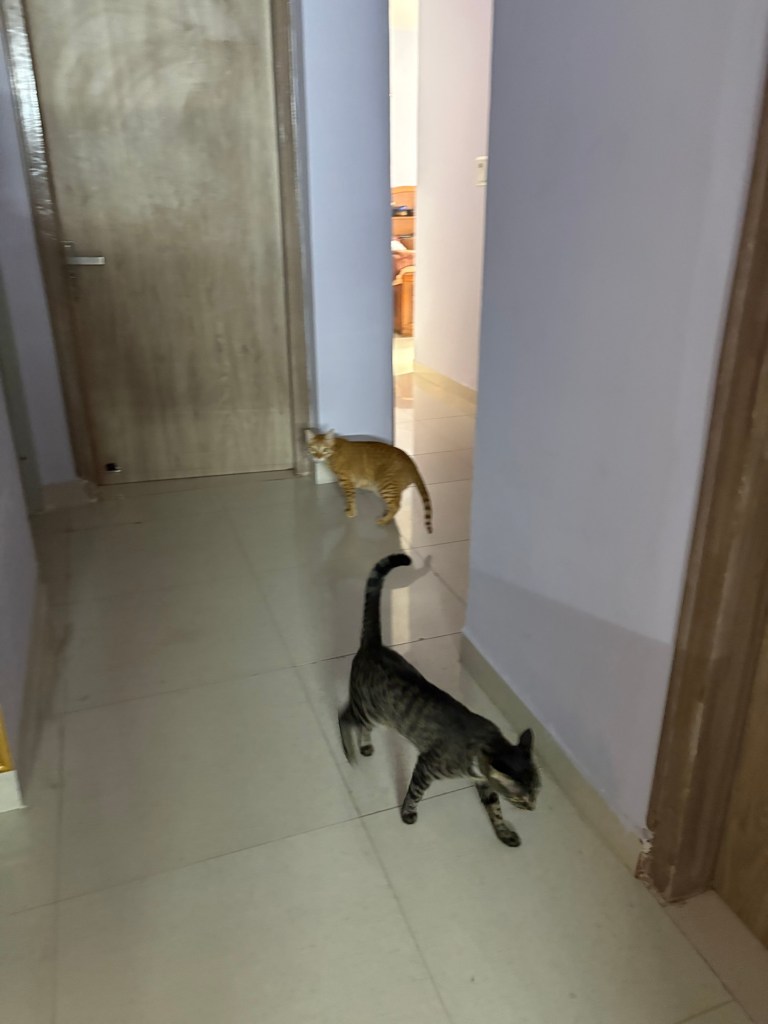
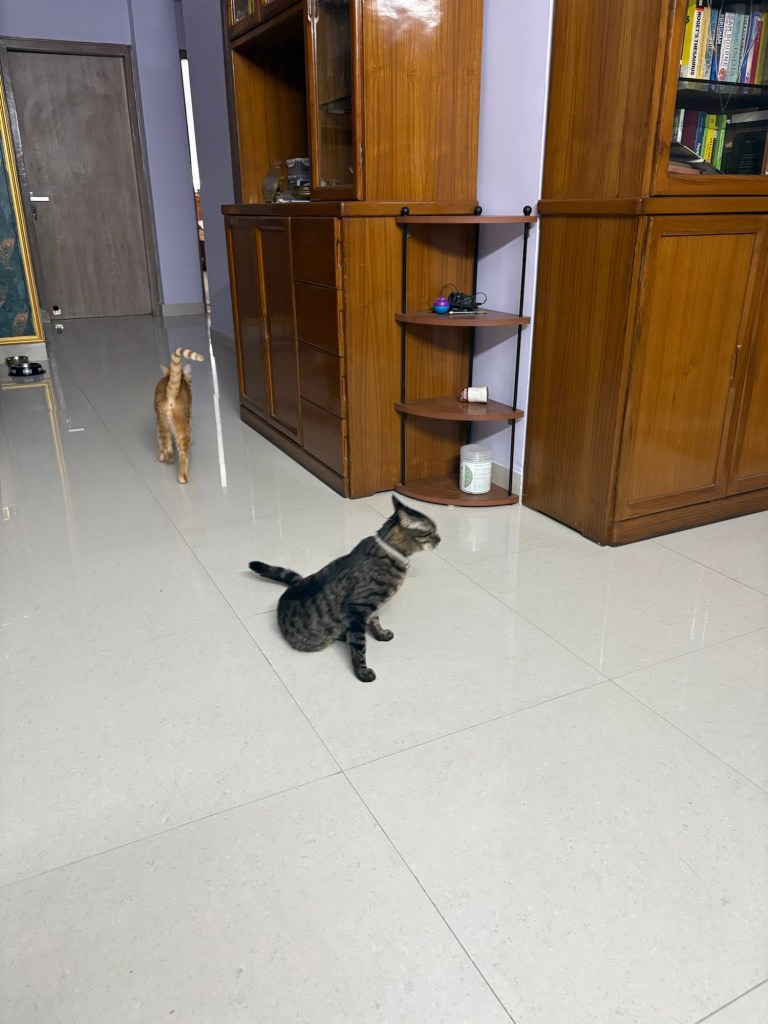
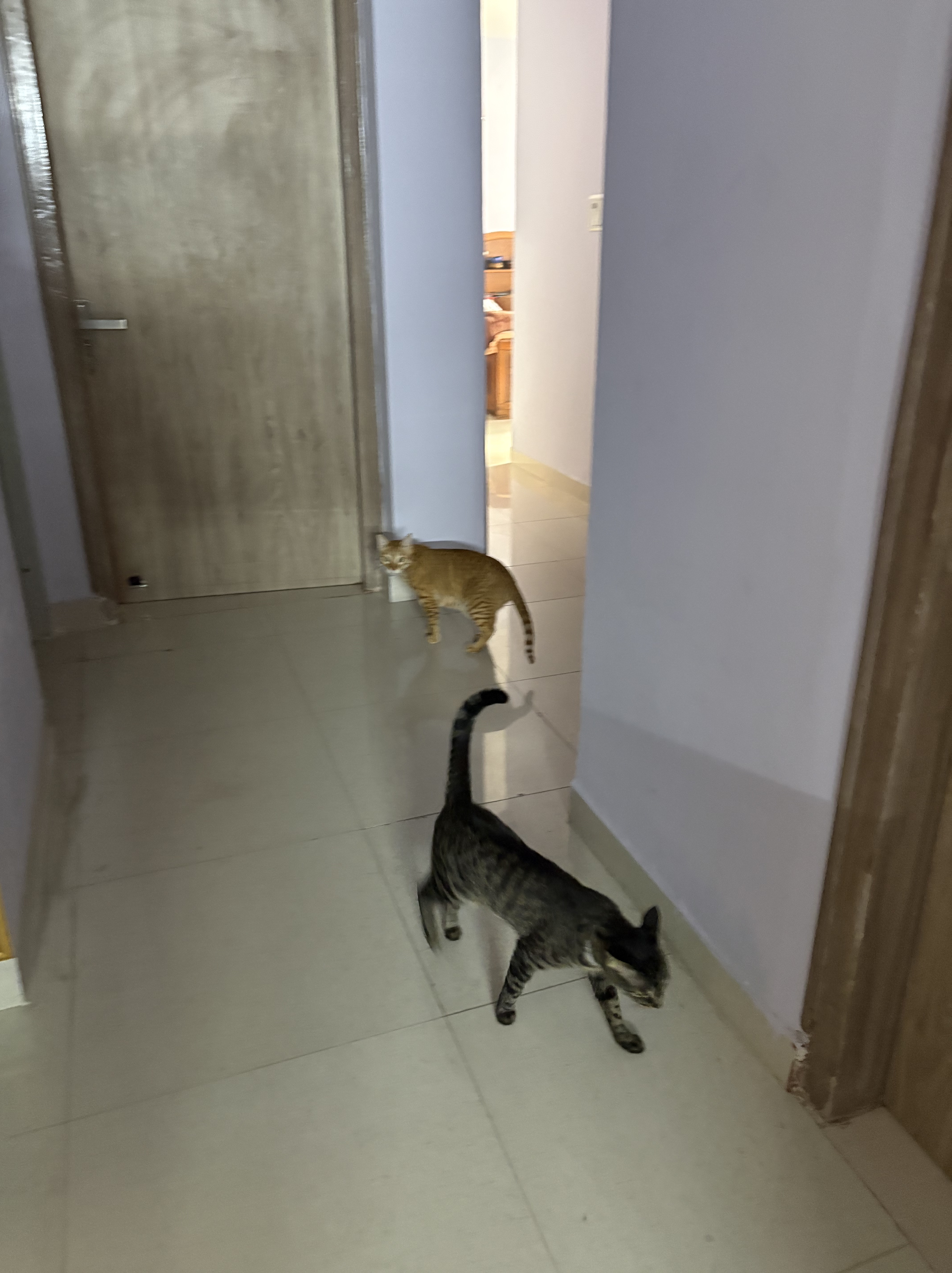
The Chronicles of Kiwi & Luna, Episode 2. The Great Chair Conspiracy.

The Great Chair Conspiracy 🪑

After the overwhelming success of their first adventure, our dynamic duo returns with even more hilarious hijinks! 😸

Chapter 1: The Throne Wars Begin đŸ‘‘

It was a Tuesday morning when Luna, our sleek black mastermind, discovered what she believed to be the ultimate power move in feline politics: chair domination. 😼

“Kiwi!” Luna announced from her perch atop the office chair, her green eyes gleaming with mischief. “I have made a groundbreaking discovery!”

Kiwi, currently engaged in the very important business of napping on his purple blanket below, opened one amber eye sceptically. “Let me guess… you’ve figured out how to open the treat cabinet?” 🍪

“Better!” Luna declared, dramatically gesturing with her paw. “I have discovered that whoever controls the chair… controls the ENTIRE household!”

Kiwi’s other eye popped open. This was either genius or completely ridiculous — and with Luna, it was usually both. 🤔

Chapter 2: Operation Chair-man of the Board đŸ“‹

Within hours, Luna had developed what she called “The Chair Strategy” — a comprehensive plan to claim every seat in the house. Her logic was flawless (in her mind): if humans always sat in chairs to do important things, then chairs must be the source of all power! 💺

“Phase One,” Luna explained to Kiwi while demonstrating her ‘intimidating chair pose’ (which looked suspiciously like a regular cat loaf), “we establish dominance over the office chair. This is clearly the command centre.”

Kiwi watched as Luna attempted to look regal while simultaneously trying not to slide off the leather seat. “Luna, you do realize you’re basically just… sitting there, right?” 😂

“EXACTLY!” Luna exclaimed, nearly losing her balance. “Strategic sitting! It’s all about the attitude, Kiwi. Watch and learn!”

● What followed was Luna’s attempt at ‘power poses’ on the chair, which included:

● The ‘CEO Loaf’ (looking important while doing absolutely nothing) 💼

● The ‘Boardroom Stretch’ (dramatically extending one paw) ✋

● The ‘Executive Nap’ (sleeping with one eye open to maintain authority) 😴

Chapter 3: Kiwi’s Counter-Strategy 🎯

Meanwhile, Kiwi had developed his own approach to the chair situation. While Luna was busy being ‘important’ up top, she had discovered the true secret: the chair’s secret compartment — also known as the space underneath where his purple blanket created the perfect cozy cave! 🏠

“You know, Luna,” Kiwi called up from his blanket fortress, “while you’re up there trying to rule the world, I’m down here actually comfortable. Plus, I have the advantage of being able to attack your tail anytime I want!” 🎯

This had not occurred to Luna. She peered down suspiciously. “Kiwi… you wouldn’t dare…”

“Wouldn’t I?” Kiwi’s eyes twinkled with mischief as he wiggled his bottom, preparing to pounce. 😈

Chapter 4: The Great Chair Chase đŸƒâ€â™€ď¸

What happened next could only be described as ‘controlled chaos.’ Kiwi launched himself at Luna’s dangling tail, Luna leaped from the chair with a dramatic yowl, and both cats proceeded to engage in what their humans would later describe as ‘the Great Living Room Chase of Tuesday Afternoon.’ 🌪️

● The chase route included:

● Three laps around the coffee table (nearly knocking over the plant) 🌿

● A dramatic leap over the food bowls (with Kiwi pausing mid-chase for a quick snack) 🍽️

● An epic standoff in the hallway that lasted exactly 3.7 seconds ⏱️

● A strategic retreat to opposite ends of the living room carpet 📍

Chapter 5: The Peace Treaty đŸ•Šď¸

After their epic chase, both cats found themselves panting on the geometric rug, staring at each other across the vast expanse of… three feet. 📏

“You know,” Luna panted, “maybe this chair thing is bigger than both of us.”

“Agreed,” Kiwi replied, already eyeing a sunny spot by the window. “Plus, I just remembered that the best seat in the house is actually that warm patch of sunlight that moves around the living room.” ☀️

Luna’s eyes lit up. “Ooh! The mysterious moving warm spot! I’ve been trying to figure out how to catch that for weeks!”

And so, their great chair conspiracy evolved into something far more important: a joint investigation into the phenomenon of ‘traveling sunshine.’ Because really, what’s the point of ruling from a chair when you could be basking in a sunbeam? 🌞

Chapter 6: The Plot Thickens… 🕵️‍♀️

As our story comes to a close, Luna and Kiwi have formed an unlikely alliance. Luna, with her strategic mind, and Kiwi, with his laid-back wisdom, make the perfect team for investigating the house’s greatest mysteries. 🔍

● Their current theories about the moving sunbeam include:

● It’s controlled by the same force that moves the red dot (highly suspicious) 🔴

● The humans are secretly operating a giant outdoor flashlight (plausible) 🔦

● It’s magic (Luna’s favorite theory) ✨

● It’s just physics (Kiwi’s boring but probably correct theory) 🔬

Epilogue: The Continuing Adventures 📖

As the sun sets on another day in the household, Luna can be found conducting ‘important research’ from her new favorite spot (the top of the bookshelf, because elevation equals authority, obviously), while Kiwi has mastered the art of the ‘strategic blanket burrow.’ 📚

Their humans remain blissfully unaware that they’re living with two furry masterminds who spend their days developing complex theories about household management and the fundamental forces of nature. 🤓

But Luna and Kiwi know the truth: every day is an adventure when you have a best friend to share your ridiculous ideas with — even if those ideas involve treating furniture like thrones and sunbeams like treasure. 💎

Stay tuned for the next episode, where our dynamic duo attempts to solve the mystery of the ‘Midnight Food Bowl Bandit’ (spoiler alert: it’s probably also them). 🌙

The End… for now! đŸ˜¸

 — -

💭 What did you think of Luna and Kiwi’s latest adventure? Share your favorite moment in the comments below! And if your pets have their own quirky theories about how the world works, we’d love to hear about them! 🐾

#ChroniclesOfKiwiAndLuna #CatStories #FelineComedy #PetHumor #CatsOfInstagram #FunnyPets #CatLife #PetBlogger #AnimalStories #FelineFriends 🏷️

Posted in Kiwi & Luna | Tagged , | Leave a comment

The Power of the Right People đŸŒŸ

Finding Your Inner Circle: The Art of Building Your S10

A journey toward authentic leadership and meaningful connections.

The Power of the Few.

In our hyper-connected world, we often forget a fundamental truth: you don’t need everyone to believe in your vision—you just need the right ones.

Throughout history, the most impactful leaders understood this principle. They cultivated a select group of trusted advisors, confidants, and supporters who became the backbone of their success. I call this your S10**—your Strategic 10. These are the people who will stand by you, challenge you, and help you reach the culmination of your real objectives.

The Ancient Wisdom of Oral Tradition

There’s something profound about the spoken word that written text can never fully capture. Consider how the Vedas were passed down through generations—not through scrolls or tablets, but from mouth to ear, creating an unbroken chain of wisdom and understanding.

When we speak our truths, when we share our visions verbally, something magical happens:

– Our passion becomes palpable.

– Our conviction carries weight.

– Our humanity shines through.

This is why great rulers maintained councils—not just for their knowledge, but for their ability to communicate, inspire, and deliver results through authentic connection.

The S10 Project: A Labor of Love

Like preparing the perfect biryani over a slow flame, identifying your S10 requires patience, intention, and careful attention to detail. This isn’t a process you can rush—it’s a continuous quality endeavor that deserves the same dedication you’d give to any masterpiece.

The Selection Principles:

No Elimination Without Cause Every person in your consideration deserves fair evaluation. Names don’t get crossed off lightly.

Holistic Assessment One conversation, one interaction, one moment doesn’t define someone’s potential value to your circle.

Continuous Evolution Like quality itself, this is an ongoing process. Your S10 may shift as you grow and your mission evolves.

Time-Tested Validation Just as the finest biryanis need time to develop their full flavor, the best relationships reveal their true worth over time.

The Multimedia Advantage

While I write these words now, I recognise that written content only captures part of the story. The tremor in a voice when someone shares their deepest conviction, the sparkle in eyes when passion ignites, the pause that speaks volumes—these elements transform mere information into transformation.

This is why the greatest teachers, from ancient gurus to modern thought leaders, understand that multi-sensory communication creates deeper impact:

– Visual elements engage imagination.

– Audio conveys emotion and nuance.

– Written words provide structure and reference.

– Personal interaction builds trust and connection.

Building Your Own Council

As you work toward becoming a thought leader who makes a real difference, ask yourself:

Who are the people that

– Challenge your thinking without crushing your spirit?

– Celebrate your wins authentically?

– Offer honest feedback when you need course correction?

– Stand by you when others doubt?

– Amplify your message because they truly believe in it?These are your potential S10 members. They’re not necessarily the loudest voices or the most obvious choices—they’re the ones whose values align with yours and whose presence makes you a better version of yourself.

The Marathon Mindset

Remember, this isn’t a sprint to a finish line—it’s a 25-year journey of continuous growth, refinement, and impact. Your S10 today might look different from your S10 in five years, and that’s not just okay—it’s expected and healthy.

The goal isn’t perfection; it’s authentic progress toward meaningful impact.

Closing Wisdom: The Rules for a Happy Life

As we navigate this journey of building our circles and our influence, let’s anchor ourselves in timeless wisdom:

1. Don’t HATE – Life is too short to waste time hating. That energy could be channeled into building something beautiful instead.

2. Don’t COMPARE – Don’t try to be someone else. The world already has them—what it needs is the best version of YOU.

3. Don’t WORRY trust yourself.

The day you stop worrying will be the FIRST day of your NEW LIFE.

Trust the process, trust your S10.

What started as a pet project has become a profound reminder: we’re not meant to journey alone. We’re meant to find our people, nurture those relationships, and together, create the change we wish to see in the world.

Who’s in your S10?

Posted in Personal Reflections | Tagged , , , , , , , , , | Leave a comment

Build Your Business: Why Smart Leaders Choose Foundation Over Speed.

In the fast-paced world of entrepreneurship, it’s easy to get caught up in the rush to grow, to scale, to succeed. But what separates thriving businesses from those that collapse under their own weight? The answer lies in two fundamental leadership principles that have proven their worth time and again: building a solid foundation and understanding that scalability is a science, not a gamble.

The most important phase is the first phase which is primarily the development stage.  It is during this time that every decision feels urgent. You’re bootstrapping, hustling, and trying to make every rupee count. In these crucial early days, it’s tempting to look for quick fixes—cheap systems that promise rapid results with minimal effort. But this is precisely where mistakes are made. Penny wise and pound foolish.

A visionary leader understands that investing in a robust, reliable foundation is not an expense—it’s an investment in the future. It is difficult but doable. Remember Business is like a rocket that you want to send into orbit. As in any Rocket, there is the initial propulsion which takes the Rocket out of the Earth’s gravitational pull, which in terms of a Business is the first 2-3 years, and then the propulsion stage where the Rocket moves into orbit, which is the 10-12 Year phase. Both these phases are absolutely important.

Why Foundation Matters

Consider the foundation of building or any infrastructure. Architects don’t cut corners on the base to save money on the upper floors. They know that without a fortress-like foundation, the entire structure will eventually crumble, no matter how beautiful the facade. Your business foundation works the same way. And we know the consequences of this neglect when newly constructed flyovers or buildings collapse. The same happens for your business as well.

When you resist the temptation for quick fixes and instead pour your resources—time, energy, capital, and talent—into building something robust and reliable, you create an ideal platform for sustainable growth Systems that can handle increased demand without breaking. A culture of excellence that attracts top talent Operational efficiency that scales naturally. The credibility and trust needed to pursue expansion plans.

When leaders opt for sloppy, makeshift solutions to save time or money upfront, they inevitably pay a much steeper price later. Technical debt accumulates. The team becomes frustrated with unreliable systems. Customers experience inconsistencies. And when you finally try to scale, everything comes crashing down because the foundation was never adequate to support growth.

The companies that dominate their industries—the Amazons, the Apples, the organisations that survive economic downturns and industry disruptions—are those that invested heavily in their foundations. They didn’t cut corners. They built fortresses.

Once your foundation is solid, the next critical phase is scaling. But here’s what many leaders get wrong: they treat scalability like a lottery ticket, hoping that growth will happen if they just push harder or spend more money. The truth is far more elegant—scalability is a science. Scalability isn’t about explosive growth; it’s about linear strategic growth achieved methodically over time. When you scale a business properly, you’re not just increasing revenue—you’re doing more with proportionally less effort. You’re creating leverage.

For a business to truly be scalable, it must focus on two core principles:

  1. Increasing efficiency: Doing more with fewer resources, time, and effort.
  2. Adding value: Ensuring that each increment of growth delivers proportional or greater value to customers and stakeholders.

Before you make the critical decision to scale, a thorough evaluation is essential. Ask yourself these questions:

  • Are my systems and processes optimised for growth? Do I have the right team in place to support expansion?
  • Is my market large enough to justify the investment?
  • What are the financial implications of scaling?
  • How will this growth affect my brand and customer experience?

Strategic scaling requires intentional planning. You must establish a clear growth trajectory that answers these critical questions:

  1. What speed? How fast do you want to grow—and more importantly, how fast can you grow without sacrificing quality?What route? Which markets, channels, or customer segments will drive your growth? What resources? What investments in capital, talent, and technology do you need?When to pause? Recognising when to slow down to maintain quality or reassess your strategy.
  2. When to finish? Knowing your end goal—whether it’s a specific market share, revenue target, or operational maturity.

These two lessons aren’t separate paths—they’re interconnected. Your solid foundation enables you to scale confidently. And your understanding of scalability as a science ensures that your foundation will continue to support your growth without buckling under pressure.

As a leader, your responsibility is to resist the siren song of shortcuts and quick wins. Build something that lasts. Be intentional about your growth. Treat scaling like the serious, scientific endeavour it truly is.

The businesses that thrive aren’t the ones that grew fastest—they’re the ones that grew smartest. And that smartness starts with a leader who understands these two timeless principles.

Build your fortress. Scale with science. Lead with vision.

Posted in Personal Reflections | Tagged , , , , | Leave a comment

The Unstoppable Force: Why Educating Women Transforms Everything.

The statistics are stark, yet inspiring: when we invest in a girl’s education, we don’t just change her life—we transform entire communities, economies, and futures. Despite centuries of progress, the fight for women’s education and advancement remains one of the most critical battles of our time, with ripple effects that extend far beyond classroom walls.

The Foundation That Changes Everything.

Education serves as the great equaliser, but for women, it becomes something even more powerful—a tool of liberation. When girls receive quality education, the benefits cascade through generations like stones thrown into still water, creating waves of change that touch every corner of society.

The Immediate Impact: Lives Transformed

The data speaks volumes about education’s transformative power:

• Health Revolution: Educated women make informed healthcare decisions, leading to lower maternal mortality rates and healthier families.

• Economic Powerhouse: Each additional year of schooling increases a woman’s earnings by 10-20%, injecting vital funds into local economies.

• Population Stability: Educated women have fewer children and invest more in each child’s future, creating a cycle of opportunity.

• Leadership Pipeline: Education builds confidence and critical thinking skills, preparing women to lead in their communities and beyond

Breaking the Chains of Child Marriage

In many parts of the world, education becomes a shield against harmful traditional practices. When families see their daughters gaining knowledge, skills, and confidence, the girl’s perceived value shifts dramatically. Education delays marriage, reduces teenage pregnancy, and opens doors to possibilities that seemed impossible just one generation ago.

The Persistent Barriers: What Still Stands in Our Way.

Despite overwhelming evidence of education’s benefits, obstacles remain stubbornly entrenched across the globe.

In Developing Nations: The Triple Threat

1. Poverty’s Cruel Mathematics

Families facing survival often view girls as economic burdens rather than investments. The immediate need for income outweighs long-term benefits, forcing girls into work or early marriage.

2. Violence and Safety Concerns

The journey to school becomes dangerous for girls in areas where gender-based violence is common. Parents, seeking to protect their daughters, often keep them home.

3. Cultural Resistance

Deep-rooted beliefs about women’s roles continue to limit educational opportunities. Traditional societies may view educated women as threats to established hierarchies.

In Developed Nations: The Paradox of Progress

Here lies one of the most frustrating ironies of our time: countries with the highest female enrolment rates still struggle with gender equity in leadership positions.

The Pipeline Problem

– Women earn 60% of university degrees in the US and Europe.

– Yet they hold only 20% of senior executive positions.

– The gap between education and leadership roles reveals systemic barriers that persist despite formal equality.

The Confidence Gap

Even in nations where legal barriers have fallen, cultural expectations and unconscious biases continue to limit women’s advancement, creating what researchers call the “confidence penalty.”

The Ripple Effect: How Educated Women Transform Society.

When women succeed, everyone wins. This isn’t just feel-good rhetoric—it’s economic reality backed by decades of research.

Economic Multipliers

Community Investment

Women reinvest 90% of their earnings back into their families and communities, compared to 35% for men.

This means every educated woman becomes an economic catalyst, multiplying prosperity throughout her network.

Innovation Drivers

Companies with diverse leadership teams are 21% more likely to experience above-average profitability. Women bring different perspectives, experiences, and problem-solving approaches that drive innovation and growth.

Social Transformation.

Breaking Generational Cycles

Educated mothers are more likely to educate their own children, creating positive feedback loops that elevate entire communities over time.

Political Participation

Education correlates strongly with civic engagement. Educated women vote more frequently, run for office more often, and advocate more effectively for social change.

The Path Forward: From Potential to Reality

The solution isn’t just about getting more girls into classrooms—it’s about creating comprehensive support systems that carry them from education to empowerment.

1. Address Root Causes

Economic Support: Conditional cash transfer programs that pay families to keep girls in school.

Safety Measures: Safe transportation, secure school environments, and community protection programs.

Cultural Engagement: Working with community leaders and families to shift perspectives on women’s roles

2. Bridge the Leadership Gap

Mentorship Programs: Connecting educated women with role models and sponsors.

Policy Reform: Implementing family-friendly workplace policies and addressing systemic biases.

Entrepreneurship Support: Providing access to capital and business training for women-led ventures.

3. Sustain Long-term Change

Institutional Reform: Ensuring educational institutions are equipped to support and advance women.

Community Building: Creating networks that support women throughout their careers.

Measurement and Accountability: Tracking progress and holding institutions accountable for gender equity.

The Moral Imperative: Why This Matters Now In an interconnected world facing complex challenges—from climate change to economic inequality to global health crises—we cannot afford to waste half of our human talent. The problems we face require all minds, all perspectives, and all the innovation we can muster.

Educating women isn’t just about fairness or equality—it’s about survival and prosperity in an increasingly competitive world. Countries that fail to fully utilise their female talent will find themselves at a significant disadvantage in the global economy.

The Call to Action

Every stakeholder has a role to play:

Governments must invest in education infrastructure and remove legal barriers.

Communities need to challenge harmful traditional practices and support girls’ aspirations.

Employers should create pathways for women’s advancement and address workplace biases.

Individuals can mentor, advocate, and vote for policies that support women’s education and empowerment.

Conclusion: The Future We Can Build

The evidence is overwhelming: educating women creates a better world for everyone. Yet millions of girls still lack access to quality education, and millions more face barriers in translating their education into meaningful opportunities.

This isn’t just a women’s issue—it’s a human issue. It’s an economic issue. It’s a survival issue for our species and our planet.

The question isn’t whether we can afford to invest in women’s education and advancement. The question is whether we can afford not to. The cost of inaction—in lost potential, stunted economies, and persistent

inequality—far exceeds the investment required to create change.

The path forward is clear. The tools are available. What we need now is the collective will to turn this knowledge into action, ensuring that every girl has the chance to fulfil her potential and contribute to our shared future.

The time for half-measures and good intentions has passed. The future demands nothing less than our complete commitment to unleashing the full power of educated, empowered women. Our world depends on it.

United Nations has designated the theme on International Women’s Day this year as “Rights. Justice. Action. For ALL Women and Girls.

HAPPY WOMEN’S DAY.

Posted in Social Relevance | Tagged , , , , , | Leave a comment

The Grass Isn’t Always Greener: 27 Years of Entrepreneurial Truth

The Grass Isn’t Always Greener: 27 Years of Entrepreneurial Truth.

A candid reflection on the realities of building a business, the myths that mislead aspiring entrepreneurs, and what it truly takes to survive—and occasionally thrive—in the entrepreneurial wilderness.

When I started my entrepreneurial journey 27 years ago, I thought I understood what lay ahead. I was wrong. Like most first-time founders, I believed the grass would be greener on the entrepreneurial side of the fence. Today, with salt-and-pepper hair as my witness, I can tell you that the grass isn’t uniformly green—it’s patchy at best, with occasional verdant spots interspersed among the brown patches of struggle.

The Myth of Instant Green.

Over the years, I’ve watched many former employees take the entrepreneurial plunge. Some jumped with grand visions, others with detailed roadmaps that looked flawless on paper: secure funding, build valuation, execute an IPO or acquisition, then walk away with “tons and tons of money.

The reality? I rarely hear success stories from these departures.

This silence speaks volumes. The entrepreneurial graveyard is littered with dreams built on the myth of the get-rich-quick scheme. We live in an era where a select few have struck gold, creating a narrative that entrepreneurship is a lottery ticket rather than a marathon. This misconception fuels the current startup stampede—and explains why 90% of startups fail.

The harsh truth: those few who “hit pay dirt are statistical outliers, not the norm.

The Long Gestation of Success.

Real entrepreneurship isn’t a sprint to riches—it’s an endurance test that would make an Olympian proud.

Just as athletes don’t accidentally stumble onto podiums, successful entrepreneurs don’t stumble into success. There are no shortcuts.

What It Actually Takes

1. A Burning Desire That Survives Reality.

You need more than enthusiasm; you need an obsession that can withstand years of setbacks. This isn’t passion—it’s something deeper, more primal. It’s the difference between wanting something and needing it to define your existence.

2. The “Why” Factor.

Before you quit your job or pitch investors, answer this: Why does your venture need to exist? Not why you want it to exist, but why the world needs it. If you can’t articulate this clearly, you’re building on sand.

3. Start Small, Think Big.

Remember Birbal finding warmth from a candle burning miles away? Your vision might be distant and dim, but it must be visible enough to guide you through dark periods. Start with minimal viable steps while keeping that distant light in sight.

4. Embrace the Mistake Factory.

Mistakes aren’t just inevitable—they’re your primary education. Each failure should strengthen your resolve, not weaken it. The entrepreneurs who survive aren’t those who make fewer mistakes; they’re those who learn faster from them.

The Price of the Entrepreneurial Path

Here’s what most people don’t tell you about entrepreneurship: it demands sacrifice that employed life never does.

What You’ll Likely Sacrifice:

Financial security (for years, possibly decades).

Work-life balance (your business becomes your life).

Predictable income (feast or famine becomes normal).

Professional safety nets (no HR department, no guaranteed paycheck)

Social time (while friends advance in corporate careers, you’ll be grinding).

What You Might Gain:

Autonomy over your decisions and destiny.

The possibility of significant financial returns (emphasis on possibility).

Deep satisfaction from building something meaningful.

Resilience that serves you in every life area.

Stories that make for interesting dinner conversations.

The Relentless Test. Twenty-seven years in, I can confirm that the test never stops being severe and relentless. Market conditions change, competitors emerge, team members leave, funding dries up, customers disappoint, and sometimes everything goes wrong simultaneously.

The question isn’t whether you’ll face adversity—it’s whether you’ll maintain that “fire in the belly” when adversity becomes your daily companion.

Surviving the Long Haul

Perseverance Over Perfection: Your first idea probably won’t work. Neither will your second or third.

Success often comes from persistence through iterations, not brilliance on attempt one.

Work Ethic as Oxygen: If you’re looking for better work-life balance, stay employed. Entrepreneurship demands a work ethic that borders on obsessive. This isn’t sustainable for everyone, and that’s okay.

Never Give Up (But Know When to Pivot): There’s a fine line between persistence and stubbornness.

The situation will change eventually, but sometimes you need to change your approach to the situation.

The Uncomfortable Truth About Green Grass.

After 27 years, my grass has some green patches—moments of success, financial wins, personal satisfaction from building something lasting. But it’s not the uniform, lush green that entrepreneurship mythology promises.

And you know what? That’s perfectly fine.

The real victory isn’t achieving some fantasy of endless green grass. It’s building something meaningful while accepting that entrepreneurship is inherently messy, uncertain, and often unrewarding in traditional metrics.

For Aspiring Entrepreneurs.

Before you leap, ask yourself:

– Are you prepared for a decades-long journey with no guarantees?

– Can you find fulfilment in the process, not just the outcome?

– Do you have the financial runway and personal support for extended uncertainty?

– Is your “why” strong enough to sustain you through years of difficulty?

If your answers give you pause, consider staying employed while building something on the side. There’s no shame in choosing stability—and there’s wisdom in understanding your own tolerance for risk and uncertainty.

Final Thoughts

Entrepreneurship isn’t for everyone, despite what startup culture suggests. It’s not a fast track to wealth, freedom, or happiness. It’s a difficult path that demands everything you have and offers no guarantees in return.

But for those with the right combination of vision, persistence, and perhaps a touch of madness, it can be profoundly rewarding—just not in the ways you initially expect.

The grass may not be uniformly greener, but those patches of green you do cultivate? They’re genuinely yours. And after 27 years of tending to them, that means something.

Sometimes the most honest thing you can tell someone about entrepreneurship is this: if you can imagine being happy doing anything else, do that instead. But if you can’t shake the vision of building something meaningful, then welcome to the long, difficult, occasionally rewarding journey of entrepreneurship.

Posted in personal Milestones | Tagged , , , , , , , , | Leave a comment

🚀 Your Enterprise is Your Baby: Lessons from an Entrepreneurial Journey.

They say entrepreneurship is not for the faint-hearted, and after years of riding the rollercoaster of business ownership, I can tell you—they’re absolutely right. But what they don’t tell you is that it’s also one of the most rewarding journeys you’ll ever embark on, filled with lessons that shape not just your business, but your character.

🏢 Be Proud of Your Baby

Your enterprise is your baby. Be proud of it. Never be dazzled by what’s around you.

I’ll never forget when a very senior person made a remark about the location of my office. For a moment, I felt that familiar pang of self-doubt creeping in. But then reality hit me—this is MY office, and I am proud of it. I built this from the ground up. I am the employer here.

Here’s what I’ve learned: if employees don’t want to compromise and have their own locational preferences, that’s their restricted mindset, and I cannot help it. After all, whoever heard of a well walking up to a thirsty person? The value lies not in the glamorous address or the fancy furnishings—it lies in what you can provide: genuine value addition.

To young entrepreneurs reading this: don’t let anyone make you feel small about where you started or where you currently are. Every successful business empire started somewhere, often in the most humble of places. Your garage, your spare bedroom, that small rented space—embrace it.

Own it. Be proud of it.

🤝 Integrity: The Foundation of Everything

Over the years, I have built goodwill by practicing integrity, and this has definitely resulted in very positive customer retention. Let me be crystal clear about something: your customers should not stop believing in your venture. Never take them for granted. You exist only because of them, and it can never be the other way around.

I’ve discovered something remarkable—if your reputation and integrity exceed expectations, customers will be willing to associate with you regardless of cost. It won’t matter if you’re more expensive than your competitors. They’ll choose you because they trust you.

Think about it: in a world where consumers are bombarded with options, what makes them stick with one business over another? It’s not always the lowest price or the fanciest marketing. It’s the confidence that you’ll deliver on your promises, every single time.

Here are the integrity principles that have guided my journey:

  • Always under-promise and over-deliver.
  • Be transparent about limitations and challenges.
  • Admit mistakes quickly and fix them faster.
  • Treat every customer interaction as an opportunity to build trust.

🎢 The Rollercoaster: Risk vs. Gamble

When you embarked on your entrepreneurial journey, was it a ‘risk’ or a ‘gamble’? I’ve spent many sleepless nights pondering this question, especially during the tough times.

Just like success is never guaranteed, failure does not mean the end. Nothing is final. Let me share something personal: at one point, I scaled heights that I had only dreamed of. The business was thriving, revenues were soaring, and I felt invincible. Then, in the very next year, my business plummeted. It was devastating.

The slide seemed unstoppable. Customers were leaving, revenue was drying up, and doubt crept in like a persistent shadow. But here’s the thing about entrepreneurship—it has its flips and flops. The key is never to be discouraged.

I could have given up. Many people expected me to. Some even suggested I should. But something inside me refused to surrender. I held on to one simple belief: if you do not give up, there is nothing that can stop you from succeeding.

And you know what? The slide could be stopped only recently, and I have again regained that upward momentum. This isn’t just business theory—this is a true life story, happening right now.

💪 Lessons for Young Entrepreneurs

If you’re just starting out or struggling through a difficult phase, here’s what I want you to remember:

  1. Your current circumstances are not your final destination. That small office, limited budget, or lack of fancy resources? They’re temporary. What matters is your vision and determination.
  2. Build relationships, not just transactions. Every customer interaction is an investment in your future. Treat them with respect, deliver value, and watch how loyalty transforms your business.
  3. Embrace the uncertainty. Entrepreneurship isn’t about eliminating risk—it’s about managing it intelligently while staying true to your values.
  4. Define success on your own terms. Don’t let others dictate what your business should look like or where it should be located. Your vision, your rules.
  5. Persistence beats perfection. You don’t need to have all the answers from day one. You just need to keep moving forward, learning, and adapting.

🌟 The Journey Continues

As I write this, I’m reminded that entrepreneurship is not a destination—it’s a journey. There will be days when you feel like you’re on top of the world, and others when you question every decision you’ve made. Both are part of the process.

What I’ve learned is that success isn’t measured just in revenue or market share. It’s measured in the relationships you build, the integrity you maintain, and the resilience you develop. It’s about creating something meaningful, something you can be genuinely proud of.

Your enterprise is your baby. Nurture it with passion, protect it with integrity, and never let anyone make you feel ashamed of where you are in your journey. Every giant oak tree was once just an acorn that held its ground.

To every young entrepreneur reading this: trust the process, believe in yourself, and remember—if you don’t give up, there’s nothing that can stop you from succeeding. This isn’t just motivation; it’s a promise backed by experience.

Keep building, keep believing, and keep moving forward. Your success story is being written every single day.

What’s your entrepreneurial story? Share your journey in the comments below—I’d love to hear about the challenges you’ve overcome and the lessons you’ve learned along the way.

Posted in personal Milestones | Tagged , , , , , , , , , , , , | Leave a comment

The Arrow and the Karta: Why Every Decision Shapes Your Destiny.

The Arrow and the Karta: Why Every Decision Shapes Your Destiny.

The Weight of Choice.

Three years ago, I stood at the crossroads of my career, staring at two job offers on my desk. One was safe—a predictable role at an established company with steady pay. The other was risky—a startup position with equity instead of security. The data was inconclusive, the future uncertain, and the outcomes completely unpredictable. Yet I had to choose.

In that moment, I realised what ancient wisdom has always known: **we are all called to be the Karta**—the decision-maker who acts despite uncertainty, who shoulders the burden of choice when others hesitate.

The Subjective Nature of Every Call

Everyone looks to the Karta for a decision despite data being unreliable, the future being uncertain, and outcomes that are unpredictable. Not everyone can do it. He who is able to make decisions independently is the Karta. He who allows others to do so is Yajaman.

I’ve learned this truth through countless sleepless nights, weighing options that had no clear “right” answer.

When I decided to leave my corporate job to become a content creator, my spreadsheets showed financial risk. My family questioned the timing. My friends offered conflicting advice. The data was incomplete, biased by my own desires and fears.

Yet someone had to decide. Someone had to pull the trigger.

That someone was me—not because I had perfect information, but because I was willing to accept the responsibility of choice. The Karta doesn’t decide because they know more; they decide because they understand that indecision is also a decision, and that paralysis serves no one.

Context Changes Everything

All decisions are contextual. Laws by their very nature are arbitrary and depend on the context. What one community considers fair, another may not. What is considered fair by one generation is not considered fair by the next.

I remember a decision that haunted me for months. During a family crisis, I chose to prioritise my work commitments over being physically present with my loved ones. At the time, providing financial stability seemed like the responsible choice. My generation values professional reliability; my parents’ generation values physical presence during hardship.

Both perspectives were valid. Both came from love. Neither was universally “right.”

This taught me that no decision exists in a vacuum. The same choice that makes you a hero in one context makes you a villain in another. The strategy that works during prosperity fails during crisis. The rules that govern peacetime crumble in moments of emergency.

The weight of being Karta isn’t just making decisions—it’s accepting that your choices will be judged by standards that shift like sand.

The Arrow That Cannot Return

An arrow that has been released from the bow is a metaphor for a decision that cannot be undone.

Every morning, I publish content that reaches thousands of readers. Once I hit “publish,” that arrow flies beyond my control. I cannot recall harsh words, unsound advice, or poorly-timed opinions. Each piece of content creates ripples I cannot predict or contain.

This is the essence of karma—not some cosmic reward system, but the simple truth that every action creates consequences that extend far beyond our intention or control.

When I chose to write vulnerably about my failures, I expected judgment. Instead, I received messages from strangers saying my words helped them through dark times. When I shared what I thought was encouraging career advice, I later learned it contributed to someone making a decision that didn’t work out for them.

The arrow lands where it lands. Our job as Karta is not to control every outcome, but to aim with intention and accept responsibility for the flight.

The Burden Only Some Can Bear

Not everyone can handle the burden of uncertainty. We can never know everything and we can never be sure. All information is incomplete, and all readings distorted by personal prejudice. And yet we have to take decisions all the time and hope the results favour us.

The difference between Karta and Yajaman isn’t intelligence or wisdom—it’s tolerance for ambiguity.I’ve watched brilliant people freeze when faced with incomplete data. I’ve seen less capable individuals thrive simply because they could act despite uncertainty. The Karta learns to make peace with imperfect information, knowing that waiting for complete clarity means never moving at all.

This burden is real. Some nights, I lie awake replaying decisions, wondering about the paths not taken. The weight of choice is heavy because every decision forecloses other possibilities. When you choose one direction, you accept responsibility not just for where you go, but for where you don’t go.

Living with the Ecosystem of Consequences

The Indian concept of karma teaches us that no action exists in isolation. Every decision impacts the ecosystem around us. It’s not simply “as you sow, so shall you reap”—it’s more complex than that.

My decision to become a content creator didn’t just affect me. It changed my family’s financial stability, shifted the dynamics of my relationships, and created opportunities for others in my network. Some consequences were immediate and obvious; others won’t reveal themselves for years.

This interconnectedness means that being Karta requires humility. You’re not just choosing for yourself—you’re choosing for an entire web of relationships and circumstances you can barely comprehend, let alone control.

The Courage to Choose

In a world that demands decisions but offers no guarantees, the Karta learns to find peace in the process rather than the outcome. We aim the arrow with care, understanding our limitations, accepting our responsibility, and releasing it with courage.

The burden of choice is the price of agency. The weight of consequences is the cost of influence. Not everyone can bear this load—and that’s okay. The world needs both those who decide and those who support, both Kartas and Yajamans.

But for those called to choose, remember: your willingness to act despite uncertainty is not recklessness—it’s leadership. Your acceptance of consequence is not burden—it’s power.

The arrow flies whether we aim it or not. The only question is whether we’ll take responsibility for its direction.

What decisions are you avoiding because the data isn’t perfect? What arrows are you afraid to release?

Share your thoughts below—sometimes the burden of choice feels lighter when shared.

Posted in Uncategorized | Leave a comment

Finding Your True North: When Life’s Journey Finally Becomes Your Own.

Finding Your True North: When Life’s Journey Finally Becomes Your Own.

Have you ever been stopped in your tracks by a seemingly simple question? The kind that appears innocent on the surface but sends you tumbling down a rabbit hole of self-reflection? That’s exactly what happened to me recently when a friend casually asked: 

What are you passionate about? 

Are you following what your heart and mind desire?”

On the surface, it seemed like an easy question to answer. After all, I’ve built and run a fairly successful small business for 27 years. As a first-generation entrepreneur, I could confidently say that passion drove me to achieve something meaningful. But when I looked deeper—really looked—I wasn’t quite sure anymore.

The Passenger Syndrome: When Life Drives You.

For years, I wondered: Have I been in control of my life, or has life been driving me along its own predetermined path while I sat as a mere passenger?

Looking back, my early years were anything but deliberate:

• School: I finished in a stream that wasn’t my forte at all. Barely made through.

• College: Switched to a subject that was, once again, everything but a choice.

• Military: Joined the Armed Forces without much deliberation, deciding within the first year that I’d only stay for the stipulated five years.

Each step felt like following the Darwinian theory of survival—adapting, persisting, but not necessarily thriving in alignment with my true self.

The First Real Choice: Entrepreneurship as Awakening.

The turning point came when I decided to become an entrepreneur. For the first time in my life, this felt like a deliberated choice—not just going through the motions or following societal expectations.

Despite the usual “rollicking” of Army life, this decision set me going in a direction that felt authentically mine. Yes, there were troughs and crests, the inevitable tempests of establishing something new. But through it all, I found myself enjoying what I was doing for the first time in my life.

That’s when I realised something profound: the need to be creative and keep creating new vistas and avenues is what I’m truly passionate about.

Life Lessons Learned Along the Way.

1. Passion Isn’t Always Obvious from the Start.

Sometimes passion isn’t a lightning bolt of clarity. It’s something you discover through experience, through trying different paths, even through the things you initially resist. My journey through various streams and careers wasn’t wasted time—it was research for finding my true calling.

2. Being a “Passenger” Isn’t Always Wrong.

There’s wisdom in allowing life to guide you sometimes, especially in your early years. Those experiences I thought were just “going through the motions” actually equipped me with skills, resilience, and perspectives that later proved invaluable in entrepreneurship.

3. Calculated Risks Are Worth Taking.

I’ve never gambled in the conventional sense, but I realize I’ve been “gambling with life” all this while— taking chances, betting on myself, choosing uncertainty over security. This kind of calculated risk-taking has been the gateway to my most fulfilling experiences.

4. Transformation Is Ongoing.

The usual transformational changes keep happening. What excites me today might evolve tomorrow, and that’s not inconsistency—it’s growth. The key is staying open to these changes rather than rigidly sticking to outdated versions of ourselves.

5. Creation Is Its Own Reward.

The passion I’ve discovered isn’t just about business success—it’s about the act of creation itself. Building new vistas, exploring fresh avenues, bringing ideas to life. This creative drive transcends any single venture or achievement.

Questions for Your Own Reflection.

As I’ve learned, sometimes the most valuable questions are the ones that initially make us uncomfortable:

1. When did you last make a truly deliberated choice? Not just going with the flow, but actively choosing your direction?

2. What activities make you lose track of time? These might point toward your genuine passions.

3. If you could start over, what would you do differently? More importantly, what would you keep the same?

4. What kind of “gambling” are you avoiding? Sometimes the biggest risk is not taking any risks at all.

5. How has being a “passenger” in some areas of your life actually served you? 

Not all unplanned journeys are wasted journeys.

The Journey Continues.

Today, I’m more comfortable with the idea that life is part deliberate choice and part surrender to circumstances beyond our control. The key is recognising when to take the wheel and when to trust the process.

My 27-year entrepreneurial journey taught me that passion isn’t just about following your heart—it’s about creating a life where your heart and mind can thrive together. It’s about embracing both the planned destinations and the unexpected detours.

The most important realisation? You’re never too late to start making deliberated choices. Whether you’re 25 or 55, whether you’re just starting out or pivoting after decades in one direction, you always have the power to become the driver of your own life.

Sometimes the best journeys begin not with knowing exactly where you’re going, but with the courage to finally take the wheel.

What deliberated choice will you make today

Posted in personal Milestones | Tagged , , , , , , , , | Leave a comment

The Chronicles of Luna & Kiwi.

A Tale of Two Attention-Seeking Furballs.

Looking at these two adorable furballs, it’s clear that life with Luna and Kiwi is never boring. Here is the story of their daily adventures seeking.

Meet Luna, the golden tabby with the red collar who believes she’s the undisputed queen of the household. Her amber eyes hold the wisdom of someone who has knocked exactly 47 items off counters and regrets nothing.

Chapter 1: The Great Hallway Parade 🚶‍♂️

Then there’s Kiwi, the sleek tabby-and-white tuxedo cat who thinks subtlety is overrated. If Luna is the queen, Kiwi has appointed himself as the royal drama king.

Every morning at precisely 4:50 AM, the Great Hallway Parade begins. Luna leads the procession with the dignity of a military general, her collar jingling like a bell of authority. Kiwi follows behind, but not in submission—oh no—he’s plotting.

Chapter 2: The Strategic Positioning Committee 🎯

These two have turned attention-seeking into an art form. They’ve established what I like to call “Strategic Positioning Points” throughout the house:

  • Position Alpha: Right in front of any door you need to pass through
  • Position Beta: Directly in the path between you and your coffee
  • Position Gamma: The exact spot where you planned to step next

In the photos, you can see them executing “Formation Doorway”—a classic maneuver where they position themselves to create maximum adorable inconvenience. Luna takes point (because hierarchy), while Kiwi covers the rear flanks (because someone needs to look pathetic enough to earn sympathy treats).

Chapter 3: The Loneliness Conspiracy 💔

Here’s the thing about Luna and Kiwi—they’ve convinced themselves they’re tragic, neglected souls despite being photographed more than most celebrities.

Look at Luna’s posture! She’s practically auditioning for a cat food commercial with the theme “Feed the Forgotten Feline.” Meanwhile, Luna simply parks herself wherever you need to be and radiates an aura of “You cannot ignore royalty.”

Chapter 4: The Food Bowl Summit 🍽️

The final photo captures a rare moment of diplomacy—the Food Bowl Summit. Here we see both cats in the same frame without anyone’s tail being attacked, which is basically the feline equivalent of a peace treaty.

  1. The Approach: Both cats pretend they’re not desperately hoping for treats
  2. The Positioning: Strategic placement to maximize guilt-inducing adorability
  3. The Wait: Patient suffering while maintaining eye contact

The Truth About Their “Loneliness” 💕

The beautiful irony: these two aren’t actually lonely at all. They’re attention connoisseurs. They’ve trained their human to be the perfect audience for their daily performances. They’re not seeking attention because they lack it; they’re seeking it because they’re addicted to it.

They are masterful manipulators who’ve turned being adorable into a full-time career. And honestly? They’re absolutely crushing it.

Every day, they wake up and ask themselves: “How can we be even more irresistible today?” And every day, they succeed.

🎭 The End…their journey is to be continued.

Posted in Uncategorized | Leave a comment

Holi: The Festival of Colors—A Journey Through History, Tradition, and Lost Essence.

Every spring, as winter retreats and new life blooms across India, something magical happens. Streets transform into vibrant canvases. Strangers become friends. Enemies embrace. The air fills with laughter, music, and the sweet aroma of traditional sweets. This is Holi—the festival of colors, love, and renewal.

But have you ever wondered where this spectacular celebration originated? Or why, despite its enduring popularity, many feel that Holi has lost something essential along the way?

Let’s journey back in time, explore the rich traditions that once defined this festival, and understand what we may be losing in our modern pursuit of celebration.

The Ancient Roots: Where It All Began

Holi isn’t just a festival—it’s a narrative that’s been passed down for thousands of years, embedded in mythology, philosophy, and the seasonal rhythms of Indian civilisation.

The Legend of Holika and Prahlad

The most celebrated legend behind Holi traces back to ancient Hindu scriptures, particularly the Bhagavata Purana. Picture this: A powerful demon king named Hiranya kashyap rules the cosmos, so arrogant that he believes himself invincible. His son, Prahlad, is different—devoted entirely to Lord Vishnu despite his father’s tyranny.

Enraged by his son’s unwavering faith, Hiranya kashyap devises cruel punishments. Yet Prahlad survives every torment through his devotion. In desperation, the demon king enlists his sister, Holika—a demoness immune to fire—to carry Prahlad into blazing flames. But here’s where divine justice intervenes: Prahlad emerges unburned while Holika perishes in the fire.

This triumph of good over evil, righteousness over tyranny, faith over fear—is the beating heart of Holi. The festival commemorates not just a mythological victory, but a universal truth: that devotion and goodness ultimately triumph over malice.

The Spring Connection: Celebrating Renewal

Beyond mythology, Holi is deeply rooted in the agricultural calendar. Celebrated at the end of the winter harvest (around March), it marks the arrival of spring—nature’s ultimate symbol of renewal, fertility, and hope. The winter crops are gathered, ensuring food security for another year. The earth stirs awake, flowers bloom, and life bursts forth in new colors.

Ancient communities understood something profound: celebration should synchronise with nature’s cycles. Holi wasn’t arbitrary—it emerged from the land itself, reflecting humanity’s gratitude for abundance and its optimism for the future.

The Sacred Traditions: What Made Holi Truly Special

Understanding Holi’s original traditions is key to grasping what makes this festival spiritually significant. These weren’t just customs—they were embodiments of profound values.

1. Holika Dahan: The Night Before

On the evening before Holi, families gather around bonfires (Holika fires) in communal spaces. This wasn’t a recreational activity—it was deeply ceremonial. People brought wood symbolising negativity, old sorrows, and past grievances. As the fire blazed, these were symbolically burned away.

The bonfire also had practical significance. Winter grains were roasted as offerings (called Holika Prasad) to thanking the divine for the harvest. Families shared these roasted grains—a moment of collective gratitude and bonding. The warmth of the fire, the smell of roasting grains, the gathering of the community—all created a sacred space where old enmities were forgotten.

2. Playing with Colors: A Symbol, Not Just Fun

When dawn broke on Holi morning, the color-play began—but with a purpose far deeper than entertainment. In traditional Holi celebrations, natural colors derived from flowers, plants, and minerals were used. Turmeric produced golden yellow, henna gave warm orange, indigo flowers offered shades of blue, and charcoal provided black.

These colors weren’t random. Each carried symbolic meaning:

  • Red symbolised love, courage, and fertility.
  • Yellow represented purity, wisdom, and prosperity.
  • Green signified new beginnings and hope.
  • Blue embodied divinity and transcendence.

When someone applied color to another, they weren’t just playing—they were bestowing blessings. Enemies would seek each other out, apply colors, and embrace, symbolically wiping away grudges. Masters would play with servants, erasing temporary hierarchies.

Children would color their elders, parents would color their children. The colors were an equalizing force.

3. Forgiveness and Reconciliation

Perhaps the most sacred aspect of Holi was its emphasis on forgiveness. Before the festival began, people would visit neighbours, colleagues, and even estranged relatives with sincere apologies. “Holi milo”—”let’s celebrate Holi together”—became an invitation to reconciliation.

This wasn’t superficial. It was in the belief that festivals are moments of spiritual reset. To celebrate properly, one had to clear the slate—to genuinely forgive and be forgiven. Only then could the joy of the festival be authentic.

4. Sharing Sweets and Blessings

Holi sweets—gujhiya, kheer, ladoos—weren’t just treats. Sharing sweets was a ritual of goodwill and affection. When you offered sweets to someone, you were offering them sweetness in your heart. The phrase “Holi Mubarak” (Holi greetings) was often accompanied by these offerings, creating bonds of community and care.

The Modern Festival: What Has Changed?

Fast forward to today. Holi is still celebrated with enthusiasm, but something fundamental feels different. Let’s examine what’s shifted and what we may have lost.

1. The Shift from Natural to Chemical Colors

The most visible change is in the colors themselves. Traditional natural colors have been replaced by synthetic, chemical-based colored powders. While convenient and vibrant, these often contain toxic compounds—heavy metals, lead, and harmful chemicals that cause skin allergies, respiratory issues, and eye problems.

There’s a subtle irony here: A festival meant to celebrate nature and renewal now often harms it. Synthetic colors pollute water sources, affect aquatic life, and leave environmental scars. More importantly, the shift reflects our modern tendency to prioritise convenience and aesthetics over significance and sustainability.

2. From Reconciliation to Obligation

Holi was once a festival where reconciliation happened naturally—driven by genuine desire and spiritual conviction. Today, the emphasis has shifted. People exchange Holi greetings out of social obligation rather than heartfelt intention. A Holi greeting becomes a WhatsApp message sent to dozens of contacts. An apology becomes a perfunctory gesture rather than a sincere repair.

The fundamental ethos—that this festival is a moment to genuinely reset relationships—has diluted. Holi has become less about inner transformation and more about external celebration.

3. Commercialisation and Consumerism

Walk into any city market before Holi, and you’ll see aggressive consumerism in full swing. Luxury brands release special Holi editions. Restaurants advertise “exclusive Holi menus.” Shopping malls offer “Holi sale” discounts. Sweets that once carried personal meaning are now mass-produced, often by brands more interested in profit margins than tradition.

This commercialisation creates a new hierarchy based on what you can afford. The essence of Holi—where a servant and master were equals for a day—gets replaced by Instagram-worthy celebrations accessible primarily to the wealthy.

4. Water Wastage and Environmental Neglect

The color-play tradition, while joyful, now often involves water balloons, water guns, and unlimited water-throwing. In regions facing severe water scarcity, Holi has become increasingly problematic. What was once a celebration of harvest abundance now often represents careless wastage. The traditional approach used minimal water—just enough to apply colors. Modern Holi often turns into water wars, particularly in urban areas where water stress is acute.

5. Erosion of Community Spirit

Historically, Holi was deeply communal. Neighbours gathered around bonfires. The bonfire was a central meeting point where the entire community assembled. Today, many celebrate within their homes or among a select group of friends. The communal bonfire—a symbol of collective identity—has been replaced by apartment balconies and private parties. The festival that once broke down social hierarchies now often reinforces them—celebrated differently based on economic class, geographic location, and lifestyle choices.

The Deeper Loss: What Holi Meant Beyond the Celebration

Beyond the visible changes lies a more profound erosion. The fundamental philosophy underlying Holi—what made it truly sacred—seems to be fading.

Happy Holi. And this time, let’s make it count.

The Loss of Spiritual Intentionality

Holi was rooted in a spiritual understanding: that humans are cyclical beings who need regular moments of renewal, forgiveness, and reset. The festival provided a structured, socially-sanctioned space to do the deep inner work of reconciliation.

Modern Holi has become primarily about fun, colors, and photos. The spiritual architecture—the intentionality behind each ritual—has been replaced by a checklist of what you “should” do during Holi. It’s become a performance rather than a practice.

The Forgotten Principle of Equality

One of Holi’s most revolutionary aspects was its implicit rejection of hierarchy. On Holi, society’s built-in power structures temporarily dissolved. This wasn’t merely symbolic—it was philosophically significant. It suggested that beneath all social roles and divisions, humans are fundamentally equal.

Today, Holi celebrates often reinforce divisions. Those with resources celebrate lavishly; others celebrate modestly. The festival has become a mirror of economic inequality rather than a momentary escape from it.

The Disconnect from Nature

A festival born from humanity’s intimate relationship with agricultural cycles and natural rhythms has become divorced from its ecological roots. We’ve forgotten that Holi was originally humanity saying “thank you” to the earth, celebrating abundance responsibly.

Now, when we pollute water sources, waste resources, and use chemical colors to celebrate, we’re essentially performing a ritual in complete contradiction to its original meaning.

Can We Reclaim the True Spirit of Holi?

This might sound pessimistic, but there’s genuine hope. Across India and the diaspora, a growing movement is emerging—people who recognise what’s been lost and are intentionally working to reclaim authentic Holi.

Steps Toward Authentic Celebration

  1. Use Natural Colors: Return to traditional colors made from flowers, herbs, and natural pigments. Yes, they’re less vibrant and more expensive. But they’re safer and carry symbolic meaning.
  2. Prioritize Reconciliation: Before colors and sweets, have genuine conversations with people you’ve been at odds with. Let forgiveness precede celebration.
  3. Reduce Water Consumption: Skip water guns. Enjoy the colors without making it a water-wasting spectacle. In water-stressed regions, celebrate without water entirely.
  4. Revive Community Bonfires: If possible, gather in communal spaces for Holika Dahan. Let it be a moment of shared reflection, not just a performance.
  5. Expand Your Circle: On Holi, deliberately include people from different backgrounds, economic classes, and communities. Recreate the festival’s original promise of equality.
  6. Reflect Internally: Alongside external celebration, spend time reflecting. What negativity are you burning in your metaphorical Holika fire? What relationships need healing?

The Festival We Lost, The Festival We Can Find Again

Holi’s deterioration isn’t inevitable. It’s a consequence of choices—choices to prioritise convenience over meaning, consumption over community, performance over practice. But choices can be reversed.

Every Holi presents an opportunity to remember. To remember that this festival carries profound wisdom. That forgiveness and reconciliation are acts of courage. That equality isn’t just an ideal but a lived experience. That humans are part of nature, not separate from it.

Perhaps the most beautiful aspect of Holi is its cyclical nature. Every spring, it returns. And every spring, we have a fresh chance to celebrate it authentically. The colors are waiting. The bonfire is ready. Our neighbours are waiting for genuine connection.

The earth is waiting for our gratitude.

This Holi, let’s not just play with colors. Let’s play with meaning. Let’s paint our celebrations with intention, our greetings with sincerity, and our actions with consciousness.

Because the greatest gift this ancient festival offers isn’t a splash of colour on our clothes—it’s the possibility of renewal in our hearts.

Happy Holi. And this time, let’s make it count.

Posted in Social Relevance | Tagged , , , | Leave a comment