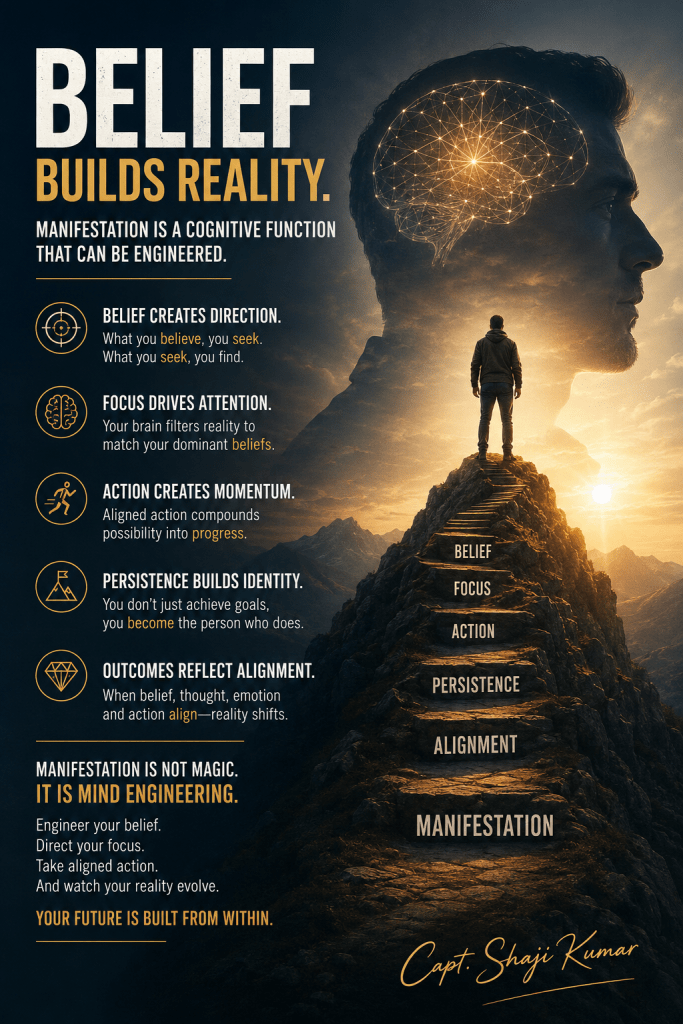
Your mind is constantly filtering reality through belief. What you repeatedly believe, emotionally reinforce, and focus on begins to shape your decisions, your actions, your resilience, and ultimately… your outcomes.
The human brain is not designed to pursue what it doubts.
It moves toward what it accepts as possible.
That is why belief matters. Not blind optimism. Not fantasy. Not wishful thinking.
Focused belief.
A belief system engineered through repetition, clarity, emotional conditioning, and disciplined action.
When you deeply believe something is achievable: your brain notices opportunities others ignore, attention sharpens and persistence expands.
Behaviour aligns with your objective
And slowly, what once felt impossible begins to look inevitable.
This is why two people can stand in the same storm and create entirely different futures.
One sees limitation. The other sees direction.
Manifestation is not sitting in a room imagining success while doing nothing.
It is training the mind so intensely that your internal world stops contradicting your external goals.
Because the greatest obstacle is rarely the world outside. It is the unconscious belief that you are incapable of creating something greater.
Your future changes the moment your belief becomes stronger than your fear.
That is when manifestation stops being philosophy…
Money flows faster than ever, yet peace of mind feels rarer than gold.
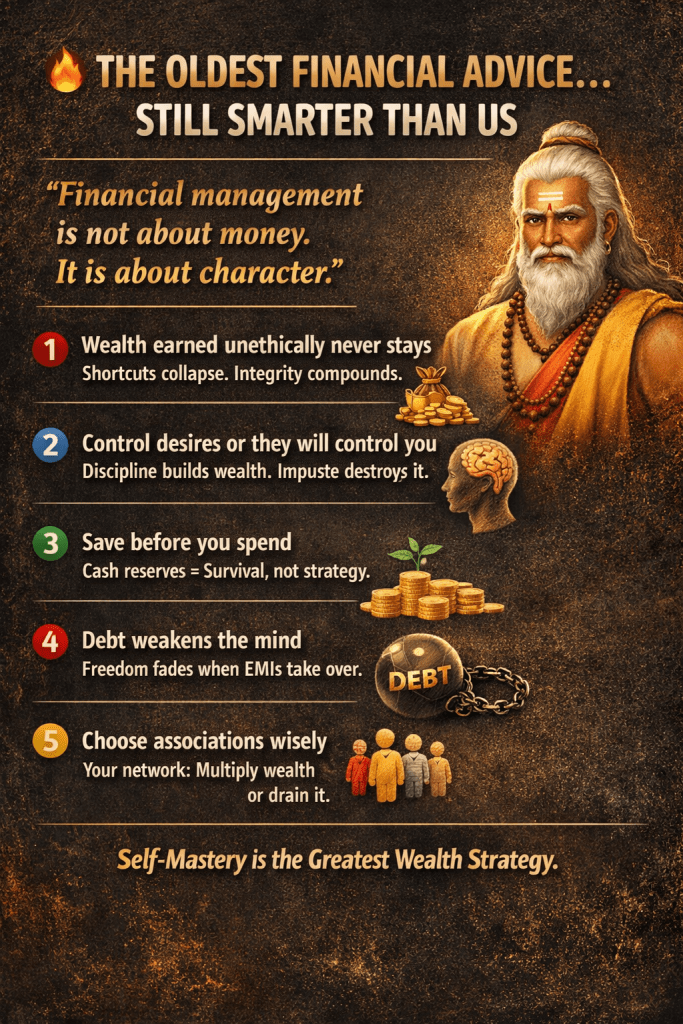
Every generation believes it invented financial wisdom — until it meets Vidur Niti.
Three thousand years ago, Vidur, the royal advisor in the Mahabharata, spoke truths that still cut through the noise of modern finance. His words weren’t about numbers or markets. They were about character — the foundation of every sustainable fortune.
Wealth Earned Unethically Never Stays.
Vidur warned that wealth gained through deceit destroys the one who holds it.
It’s not karma — it’s mathematics.
Unethical gains create instability, distrust, and eventual collapse.
In today’s world, this translates to:
Shortcuts collapse. Integrity compounds.
The most valuable currency is credibility.
Control Desires or They Will Control You
Vidur didn’t blame poverty on lack of income. He blamed it on lack of restraint.
Desire, when unchecked, becomes debt.
We call it lifestyle inflation, impulse buying, or social comparison — but it’s the same disease.
Discipline builds wealth. Impulse destroys it.
The richest people aren’t those who earn the most — they’re those who can say no.
Save Before You Spend
Vidur insisted that a wise person always keeps reserves for difficult times.
In modern language: build your emergency fund before your dream fund.
Savings are not a financial strategy.
They are a survival strategy.
Debt Weakens the Mind
Vidur saw debt as a spiritual and psychological burden.
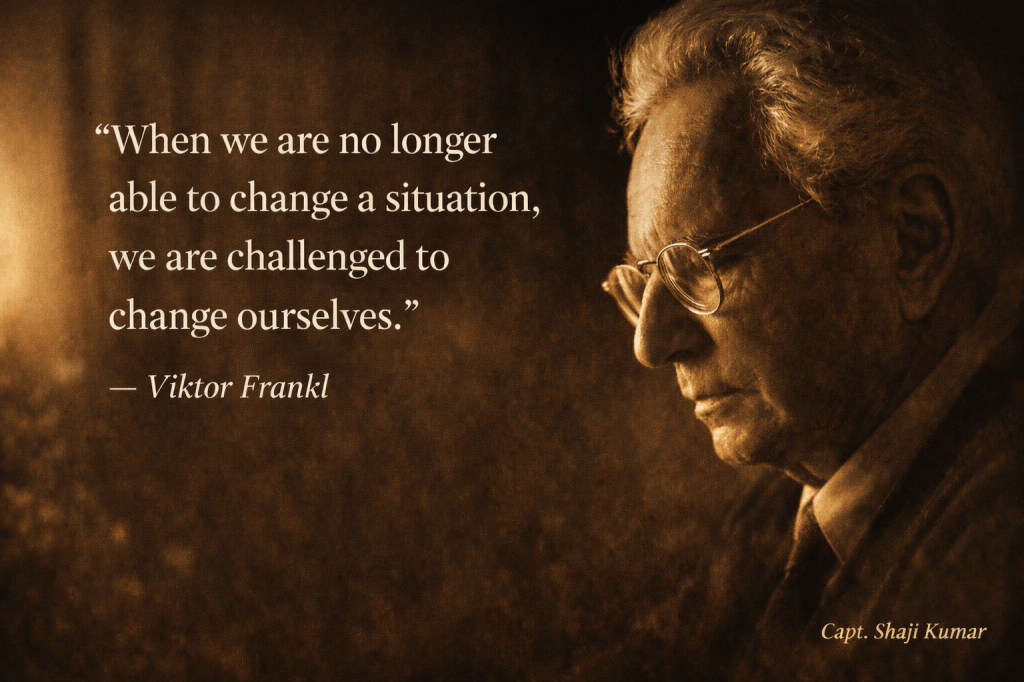
“When we are no longer able to change a situation, we are challenged to change ourselves.” — Viktor Frankl
There is something deeply uncomfortable… almost painfully ironic… about feeling powerless in life.
Because in that moment—when nothing bends, nothing shifts, nothing listens—you are brought face to face with the only question that truly matters:
How do I respond to what is happening to me?
Do I resist?
Do I accept?
Do I fight harder… or do I surrender?
I have lived both sides of this question.
There were times I fought relentlessly—pushing against reality, trying to force outcomes, refusing to accept what was. And there were moments I surrendered—not out of wisdom, but out of exhaustion.
Neither gave me lasting peace.
But over time, something shifted. Through the wisdom of thinkers like Viktor Frankl, I began to see a deeper truth:
👉 The real battle is not outside. It is within.
Today, when life refuses to change, I pause. Instead of asking, “Why is this happening to me?”
I ask, “What is this trying to show me about myself?”
Because every external event—especially the painful ones—is a mirror.
A mirror reflecting:
• My fears
• My attachments
• My expectations
• My ego
And sometimes… my illusions.
It takes courage to look into that mirror.
It is far easier to blame circumstances.
It is far easier to point fingers.
But growth does not live there.
Growth lives in this quiet, difficult shift:
👉 From controlling the world…
👉 To understanding yourself.
This doesn’t mean we stop striving.
It doesn’t mean we become passive.
It means we become aware.
Aware enough to know that while we may not control what happens…
we always control who we become because of it.
✨ FINAL THOUGHT:
When life takes away your power to change the outside world…
it is giving you the opportunity to master your inner one.
“People don’t buy Apple products. They buy the absence of friction.”
We often debate specs. Camera vs camera. RAM vs RAM. Price vs value.
But that’s not why people stay in the Apple Inc. ecosystem.
It’s not the iPhone. Not the Mac. Not even the Watch.
It’s the experience between them.
You take a photo on your iPhone… It’s already on your Mac.
You copy something on your laptop… It’s waiting on your iPad.
Your AirPods switch devices without asking you. Your watch unlocks your Mac before you even realize it was locked.
No noise. No effort. No thinking.
Just flow.
Yes — there are trade-offs.
Closed systems. Higher pricing. Limited customization. Less “freedom” compared to others.
And yet… people stay.
Why?
Because the mental load disappears.
In a world full of decisions, settings, compatibility issues, and constant switching… Apple quietly removes a thousand tiny frictions you didn’t even know were exhausting you.
This is the real lesson.
People don’t stay loyal to products. They stay loyal to experiences that make life simpler.
Not perfect. Not cheapest. But effortless.
And that applies far beyond technology.
In business. In leadership. In life.
If you can reduce friction… If you can make someone’s journey smoother, clearer, lighter…
They won’t just choose you.
They’ll stay.
Because in the end — experience always wins over features.
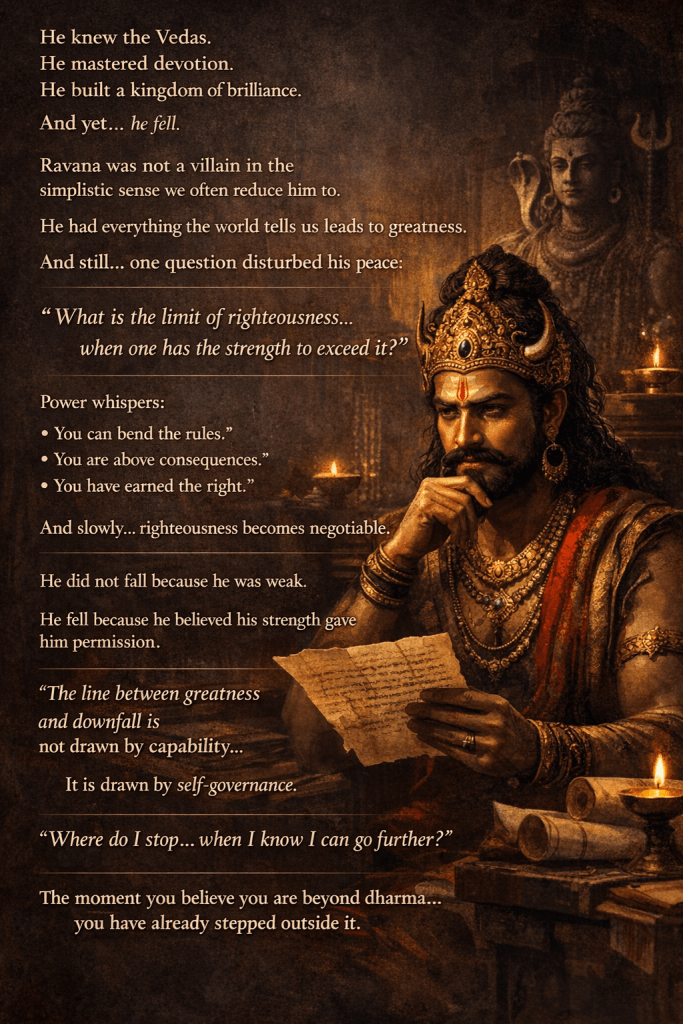
He knew the Vedas. He mastered devotion. He built a kingdom of brilliance. And yet… he fell.
Ravana was not a villain in the simplistic sense we often reduce him to.
He was a scholar of the highest order. A devotee of Lord Shiva whose hymns still echo through time. A ruler whose Lanka stood not just on power—but on knowledge, discipline, and learning.
He had everything the world tells us leads to greatness.
And still… one question disturbed his peace:
“What is the limit of righteousness… when one has the strength to exceed it?”
That question is not ancient. It is disturbingly modern.
Because the real test of a human being is not in what he can achieve…but in what he chooses not to do.
Power creates a dangerous illusion.
It whispers:
“You can bend the rules.” “You are above consequences.” “You have earned the right.”
And slowly… righteousness becomes negotiable.
Not in one dramatic fall—but in a series of quiet justifications.
Ravana did not lack knowledge. He lacked restraint. He did not fall because he was weak. He fell because he believed his strength gave him permission.
That is where most people misunderstand the story.
The line between greatness and downfall is not drawn by capability… It is drawn by self-governance.
Today, we may not be conquering kingdoms—but we command influence, decisions, authority over people and outcomes.
And the same question lingers within us:
“Where do I stop… when I know I can go further?”
Because character is revealed not at the edge of limitation…but at the peak of power.
Ravana’s story is not about myth.
It is about a timeless truth:
The moment you believe you are beyond dharma…you have already stepped outside it.
There’s a quiet myth we all grow up hearing: “You need money to make money.” While that’s partly true, it’s also dangerously incomplete. If wealth were only inherited, the world would never produce new millionaires. Yet every year, thousands of people rise from ordinary backgrounds to build extraordinary financial lives.
What are they doing differently? Let’s break it down—not with clichés, but with real, actionable truths.
1. Trade Survival for Growth
Most people work to pay bills; wealth builders work to buy freedom. Instead of asking, “How can I earn enough this month?” they ask, “How can I increase my value so I earn more every year?” They invest in skills that compound: Writing, Sales, Technology, and Finance. Skills are the only assets no one can take away from you.
2. Systems Over Chasing
Rich people don’t rely on a single income source. They build systems that earn while they sleep:
Digital Assets: Writing online, ebooks, and templates.
Smart Investing: Stocks, ETFs, and SIPs.
The Goal: Turn active income into semi-passive, then fully passive. Even ₹1,000/month is a victory because it proves your system works.
3. The Discipline of the “Boring”
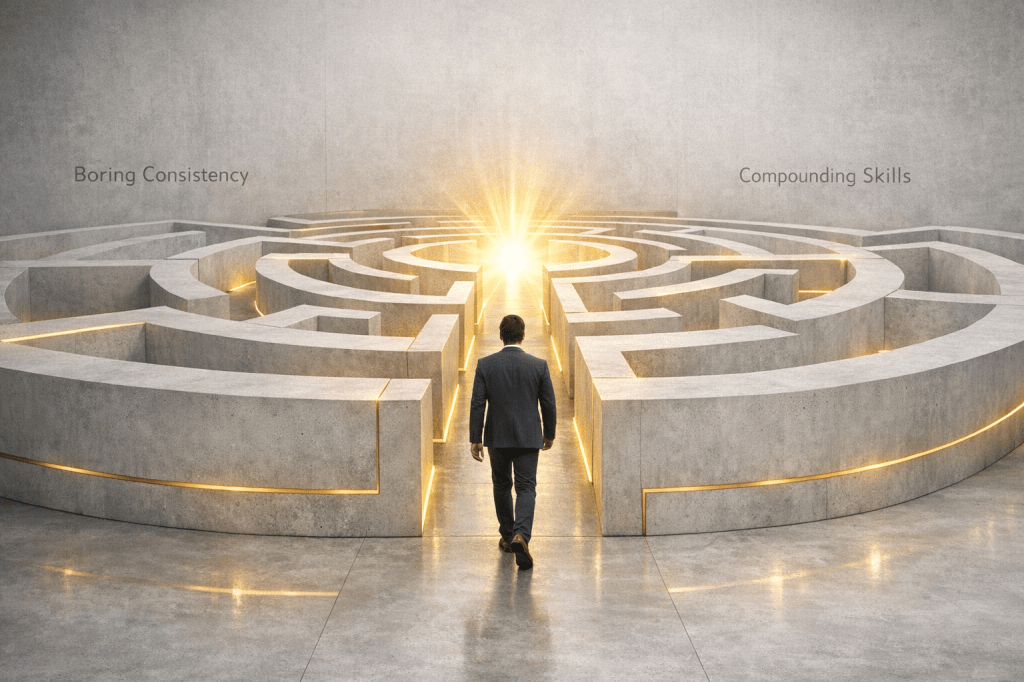
Wealth is not built in a viral moment. It’s built in quiet repetition: writing when nobody is reading, and saving when it feels insignificant. Over 5 years, this “boring” consistency starts to look like “luck” to everyone else.
4. Killing Lifestyle Inflation
This is the silent killer. When most people get a raise, they upgrade their phone. I’ve used the same iPhone for 4 years. While others eat out, I eat out once every two months. By cutting my spending in half, I doubled my ability to invest.
The Truth: Wealth is not what you earn; it’s what you keep and grow.
5. Think in Decades, Not Days
Most people want results in 30 days. Wealthy individuals think in decades. I made the mistake of not investing early, but I’m fixing that now. Compounding requires a “patient” mindset—the goal isn’t just to get rich fast, but to ensure you cannot stay poor.
6. The Power of Leverage
Hard work alone doesn’t create wealth; leverage does. Whether it’s Content Leverage (writing one article that earns for months) or Money Leverage (investments), you must learn to multiply your effort.
The Final Word
You don’t need a rich family or a lucky break. You need a skill, a system, and the belief that it is possible for you. If you are starting from zero, remember: every wealthy person you admire once had no audience and no shortcuts.
They just didn’t stop. And that is the only advantage that truly compounds.
I don’t have time.” It’s the phrase that slips out of our mouths like a reflex.
It’s the universal apology for missed calls, unread books, and distant hearts. But if we look at the math of modern life, the statement isn’t just sad—it’s factually impossible.
The Paradox of Speed.
Once, a journey took 12 hours. Today, it takes four. We “gained” 8 hours. Where did that go?
Once, news took four days to cross the country. Now, it takes four seconds. We “gained” days. Where did that go?
We live in a world where the world’s knowledge, your bank, and your family’s faces are in your pocket. We should be the most relaxed generation in history. Instead, we are the most breathless.
The Mental Trap We’ve traded warmth for WiFi. We live with two people under a roof instead of ten, yet the house feels quieter and the connection feels thinner. We watch mimicry, endless reels, and digital noise while the person sitting next to us waits for a glance. We ride bikes while on the phone. We scroll through WhatsApp at traffic lights. We cut lines because we “can’t wait.” We have become addicts of the shortcut, yet we never seem to arrive at a place of peace.
The Mirror Test. Our parents had the same 24 hours. They didn’t have apps, high-speed rail, or instant grocery delivery. Yet, they lived with grace. They had time for tea, for neighbours, and for silence. We don’t “lack” time. We abuse it. We give our hours to IPL matches, celebrity gossip, and political debates, then claim we are too busy to listen to a friend or hug our children.
The Wake-Up Call. I wrote these words because I made time. I stopped chasing the clock and started honouring it. Before you close this tab and say, “I don’t have time to think about this,” pause. Are you actually busy, or are you just distracted? The clock isn’t your enemy—your choices are. Stop chasing time. Start respecting it.
Reflection: Do not say you do not have time. Value it.
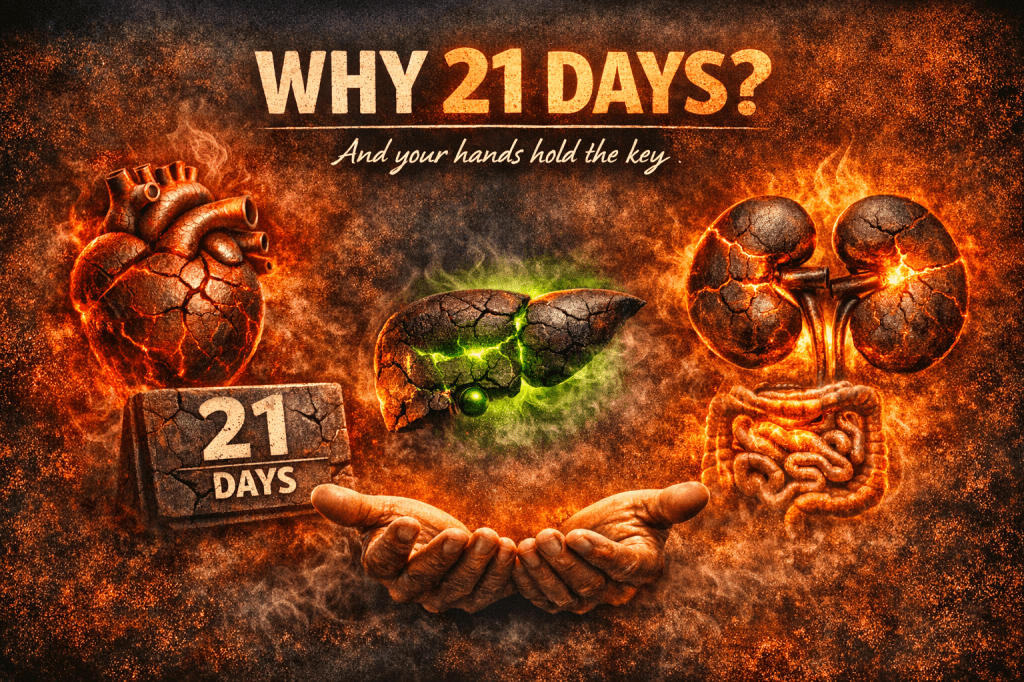
You have read the theory. You have understood the points. Now it comes down to this: twenty-one days of showing up for your own body. Not perfectly. Just consistently.Why 21 Days?
The popular notion that habits form in twenty-one days is, strictly speaking, an oversimplification. Research on habit formation suggests that the timeline varies widely — anywhere from eighteen to sixty-six days depending on the complexity of the behaviour and the individual. But twenty-one days is not arbitrary. It represents three complete biological cycles of several key systems: the gut lining renews itself every three to five days (so twenty-one days is four to seven full cycles), and many hormonal rhythms operate on seven-day patterns.
More practically: twenty-one days is long enough to produce measurable change and short enough to feel achievable. It is a commitment you can make without it feeling like forever. And the changes you will notice by Day 21 — if the practice is consistent — are real enough that continuing becomes its own motivation.
This post is your complete map. Morning routine, evening routine, crisis protocol for acute stress moments, the dietary framework, and the sleep hygiene protocol. Everything from Posts 1, 2, and 3 comes together here into a single, coherent daily practice. You do not need all of it at once. Start with what feels most accessible, and build.
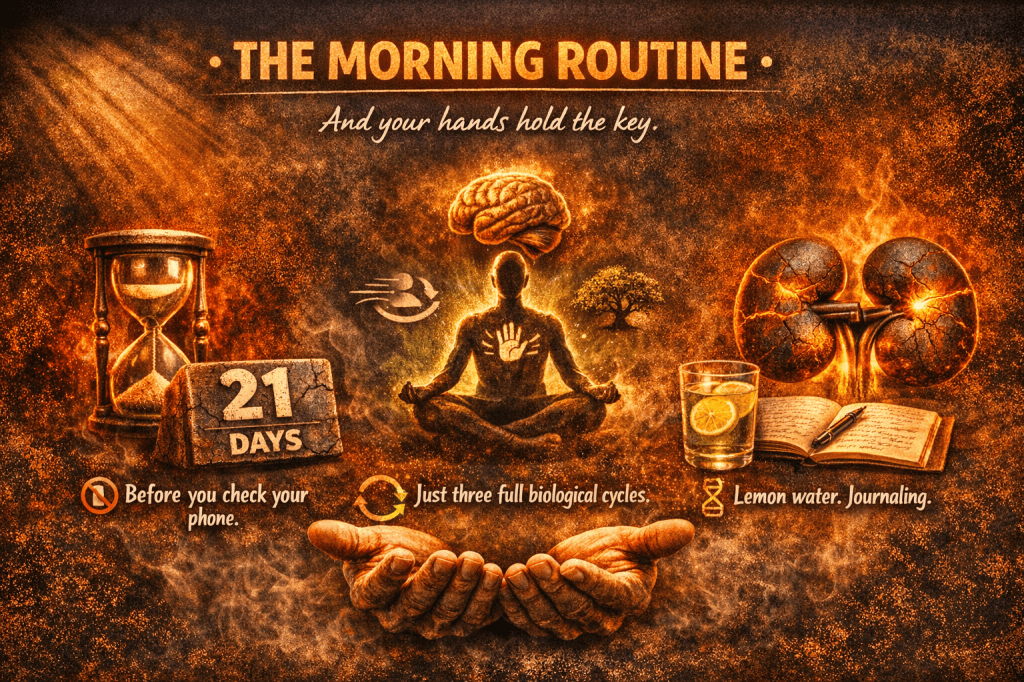
The Morning Routine – Before You Check Your Phone.
This is the most important instruction in the entire series: do the morning practice before you look at your phone. The moment you check your phone, your nervous system receives input — news, messages, social media, notifications — that begins the sympathetic activation cycle. Once that cycle starts, you are already managing its consequences rather than preventing them. Give your nervous system twenty-one minutes of its own signal before you give it the world’s.
The Full Morning Sequence — 21 Minutes
1. Wake without reaching for your phone. Lie still for one minute. Notice your body.
2. Three rounds of 4-7-8 breathing: In 4, hold 7, out 8. Vagus nerve activated.
4. HT 7 + PC 6 on both wrists: 2 minutes simultaneously. The emotional anchors.
5. KD 1 (soles, both feet): 2 minutes. Grounding before you stand up.
6. LV 3 (between toes 1 and 2): 90 seconds each foot. Releasing the night’s holding.
7. Warm water with lemon: before any food, before any caffeine. Sit while drinking it.
8. Three minutes of journalling: one question only — ‘What is within my control today?’
Total: 21 minutes. This is not self-indulgence. It is the most productive thing you will do all day.
Everything that follows in the next sixteen waking hours will be qualitatively different.
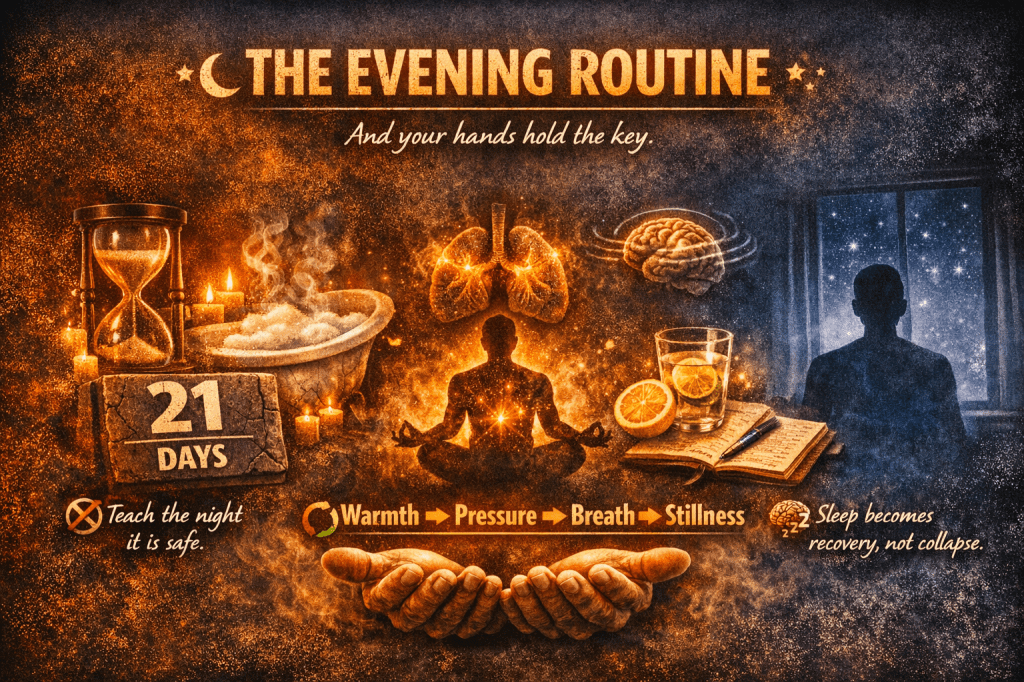
The Evening Routine – Teaching the Night it is Safe.
The Evening Routine — Teaching the Night It Is Safe
The evening practice has one job: to send the nervous system a clear, consistent signal that the day is over and safety has arrived. This signal is not just psychological — it is physiological, and it requires physical inputs to be received. The sequence below provides those inputs in the correct order: sensory input reduction first, then warming, then acupressure, then breath, then stillness.
The Full Evening Sequence — Last 25 Minutes Before Sleep
1. Screens off or night mode: hard stop on news, social media, anything requiring decisions.
2. Warm shower or hot foot soak: temperature drop after warmth triggers sleep hormones.
3. GB 21 + BL 10: shoulder summit and skull base release — where the day’s stress is stored.
4. SP 6 + KD 1: inner ankle and soles — the deepest calming points in the lower body.
5. Yintang + CV 17: third eye and heart centre — quieting the mind and the emotional body.
6. 4-7-8 breath, five rounds: lying down, eyes closed. This is the final physiological signal.
7. Three things you are grateful for: not performance — genuine noticing. The brain records safety.
8. Sleep — the nervous system in genuine rest mode, not collapsed exhaustion.
This sequence, practiced for seven consecutive nights, will change the quality of your sleep.
After twenty-one nights, it will have changed your relationship with the night entirely.
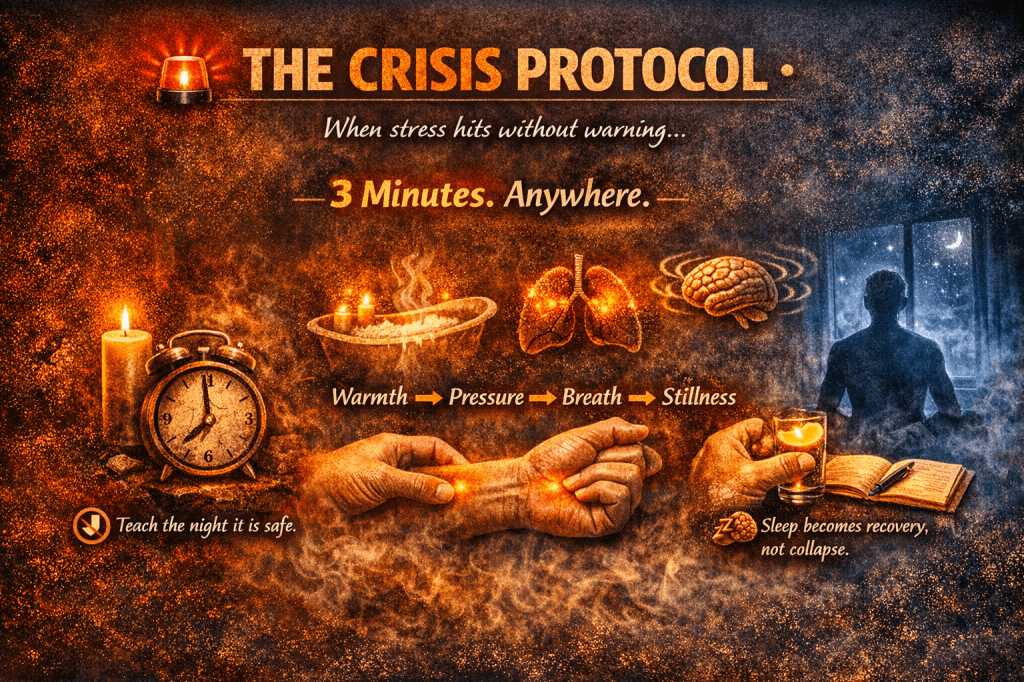
The Crisis Protocol – For When Stress Hits Without Warning.
The Crisis Protocol — For When Stress Hits Without Warning
The daily practice addresses chronic stress. But acute stress — the sudden confrontation, the unexpected bad news, the panic that arrives without warning — needs its own protocol. The three-minute sequence below is designed to be used anywhere, invisibly, at the moment stress arrives rather than hours later.
The 3-Minute Crisis Protocol
STEP 1 — 30 seconds: Two rounds of 4-7-8 breath. Eyes can stay open. Nobody needs to know.
STEP 2 — 45 seconds: One finger pressed firmly on Yintang (between eyebrows). Eyes closed if possible.
STEP 3 — 45 seconds: HT 7 + PC 6 on both wrists simultaneously. Breathe into the pressure.
STEP 4 — 30 seconds: LI 4 (web of thumb): firm pinch, both hands. Exhale with the pressure.
STEP 5 — 30 seconds: Return to breath. 4 counts in, 6 counts out. Return to presence.
Use this in the car, in a meeting break, in a bathroom, before a difficult conversation.
Cortisol measurably drops within three minutes of vagal activation. This protocol delivers it.
The 21-Day Dietary Framework.
Daily Foundations (Non-Negotiable)
Warm water with lemon: First thing, before anything else. Every single morning.
One serving fermented food: Curd, kefir, kanji, kimchi, or buttermilk. Non-negotiable for the gut-brain axis.
Handful of walnuts or pumpkin seeds: Omega-3 and magnesium in one small handful. Morning snack.
Two Brazil nuts: Daily selenium for thyroid hormone conversion. Two only — more is unnecessary and counterproductive.
One tablespoon ground flaxseed: In porridge, smoothie, or curd. Omega-3, lignans, and prebiotic fibre.
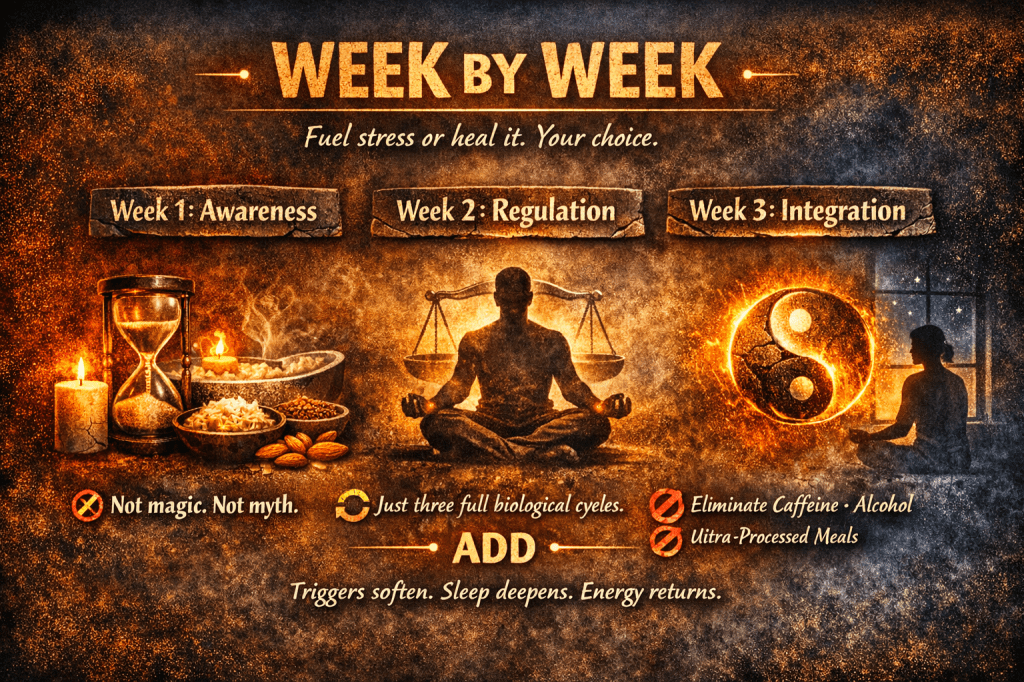
This Week, Eliminate These (One at a Time):
Week 1: No caffeine after 1pm. This single change will shift sleep quality faster than almost anything else.
Week 2: No alcohol on weekdays. Alcohol is a cortisol trigger and a sleep architecture disruptor — two things you cannot afford during a stress reset.
Week 3: Replace one ultra-processed meal per day with something whole. Not perfection — one meal. The compounded effect of three weeks of this is measurable in inflammatory markers.
What to Add (One at a Time):
Week 1: Ashwagandha root extract (300mg) with dinner. The most evidence-supported adaptogen for cortisol reduction.
Week 2: Magnesium glycinate (200-400mg) before sleep. Research consistently shows improvement in both sleep quality and stress response.
Week 3: One meal eaten in complete silence, without a screen. The nervous system needs to experience food as safe, not as background to stimulation.
Week by Week – What to Watch For.
Change with stress does not arrive in a straight line. There are days in Week 1 when you will feel more tired than before — that is the parasympathetic system finally getting enough space to process what has accumulated. This is not failure. It is the beginning of genuine recovery. Here is a more detailed map of what each week brings:
Days 1 to 7 — The Awareness Week
The most important thing that happens in Week 1 is not physical improvement — it is the beginning of awareness. You start to notice when your shoulders tighten.
You catch yourself holding your breath. You feel the difference between the morning of Day 7 and the morning of Day 1 — and the difference, while not dramatic, is real. The points will be tender, particularly KD 1, HT 7, and GB 21. Tender means engaged. Stay with it.
Sleep will likely show the first changes: not necessarily that you sleep more, but that the quality of the sleep you do get deepens. The 4-7-8 breath paired with the evening points is usually responsible for this. Some people notice it from Night 3 onward.
Days 8 to 14 — The Regulation Week
By Day 8, the practice is beginning to feel less like a task and more like a ritual. The nervous system has now received fourteen days of consistent parasympathetic input — enough to begin establishing a new pattern. Cortisol output starts to regulate more predictably. The morning spike that launches many stressed people into reactivity before they have even had breakfast begins to soften.
Point tenderness decreases measurably. HT 7 in particular — which is often exquisitely tender in the first week — becomes more comfortable under pressure.
This is a direct indicator of reduced cardiac stress load. BL 23 (lower back kidney point) tenderness also reduces, reflecting adrenal recovery. Track these changes — they are your body’s own progress report.
Days 15 to 21 — The Integration Week
This is where the shift becomes qualitative, not just quantitative. People in Week 3 of this practice consistently report the same cluster of observations: things that would have triggered a stress response two weeks ago now feel manageable.
The internal distance between stimulus and response has grown. This is not detachment — it is regulation. The nervous system, given consistent signalling, has recalibrated its threat threshold.
Physically: resting heart rate has typically dropped several beats per minute. Blood pressure, if it was elevated, shows improvement. Digestion has normalised — the gut responds rapidly to nervous system regulation. Skin, if stress was affecting it, begins to clear. Energy — not the jittery energy of cortisol, but the sustained, even energy of a body that is genuinely resting and genuinely working in turn — returns.
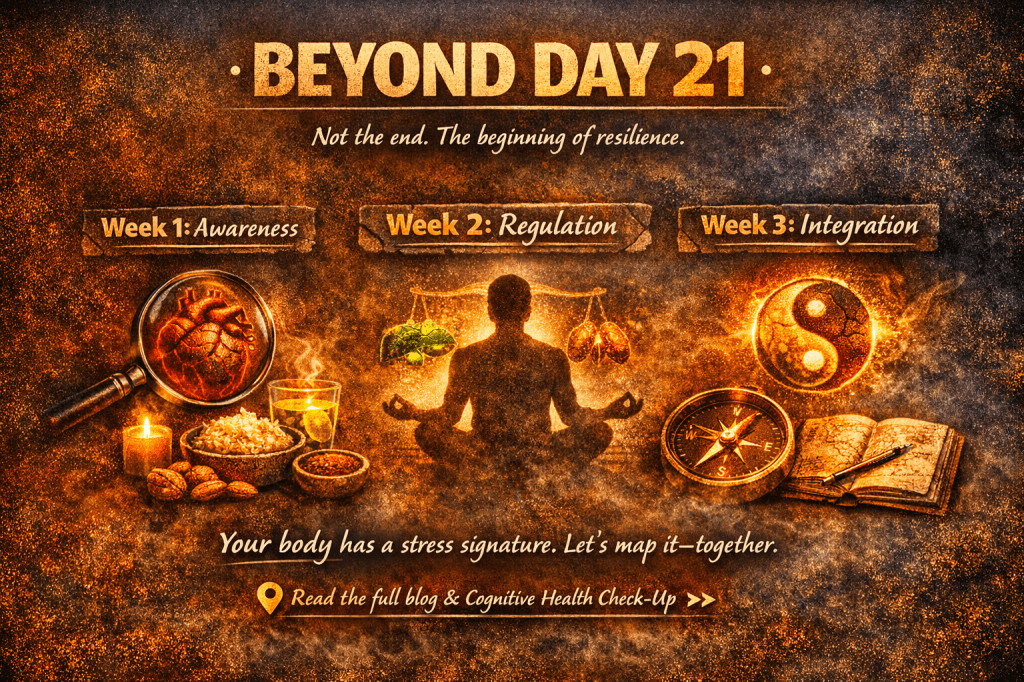
Beyond Day 21 – Making it Yours.
Beyond Day 21 — Making It Yours
Twenty-one days is the beginning, not the destination. Once the practice is established — once it has become as automatic as brushing your teeth — the question becomes: how do you deepen it? How do you move from stress management to genuine stress resilience?
The answer, in my experience, is personalisation. The sequences in this series are designed to be broadly effective for most people. But your body has a specific stress signature — particular points that are more relevant to you than others, particular times of day when you are most vulnerable, particular organ systems that carry the heaviest load. A personalised protocol, built around your specific pattern, is significantly more efficient than a general one.
That is what I offer in a consultation — not a replacement for this series, but a deepening of it. If you have done the twenty-one days and want to go further, I can help you read what your body is showing us and design the next stage of your practice with precision.
Ready to Go Deeper?
Book a personalized consultation to map your stress-organ pattern and build your protocol.
In Association with World Health Journey Take your Cognitive Health Check-Up: www.whjonline.com/mmpi-2
Series Complete – The Heal Yourself First series continues daily.










 Capt. Shaji Kumar