
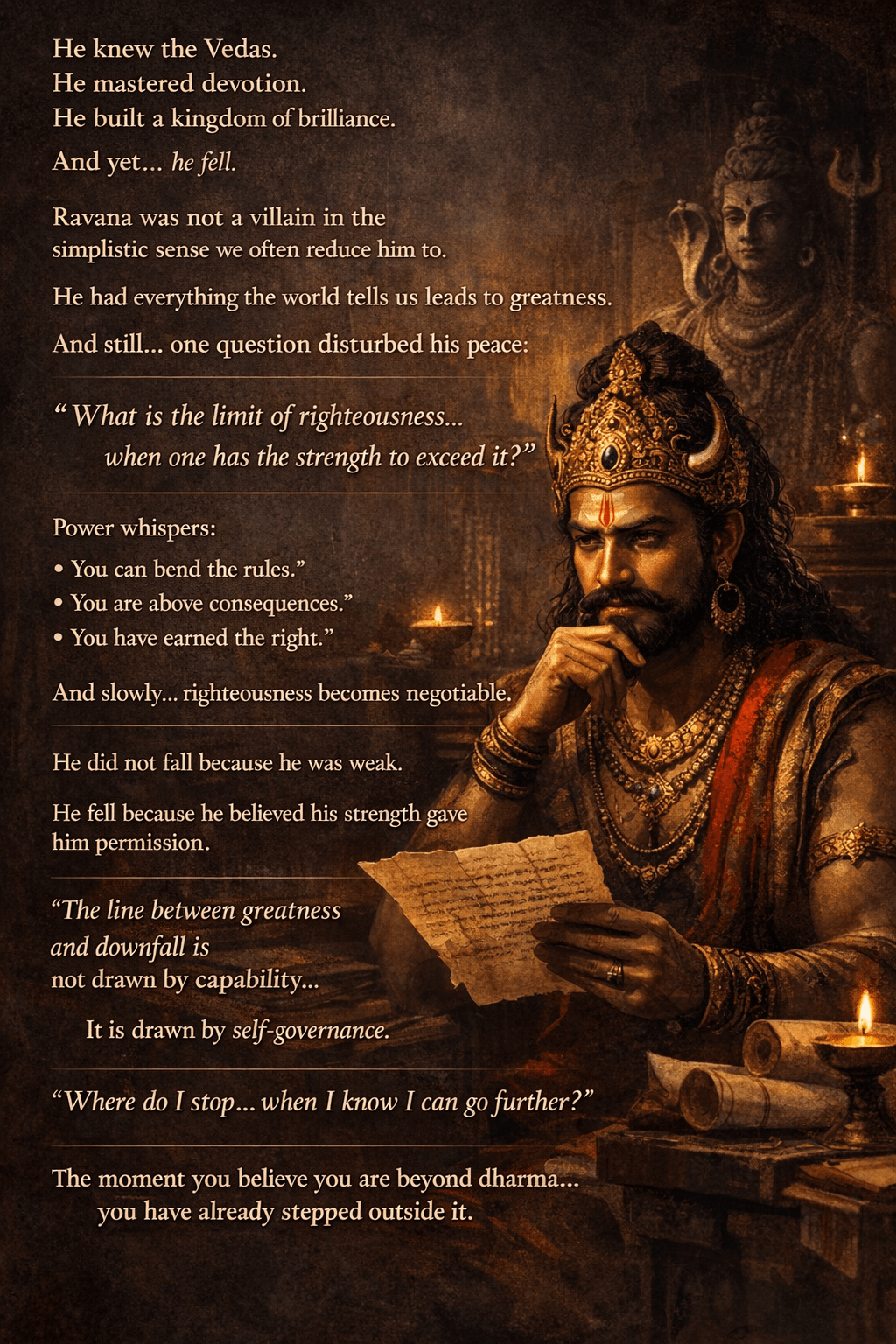
He knew the Vedas. He mastered devotion. He built a kingdom of brilliance. And yet… he fell.
Ravana was not a villain in the simplistic sense we often reduce him to.
He was a scholar of the highest order. A devotee of Lord Shiva whose hymns still echo through time. A ruler whose Lanka stood not just on power—but on knowledge, discipline, and learning.
He had everything the world tells us leads to greatness.
And still… one question disturbed his peace:
“What is the limit of righteousness… when one has the strength to exceed it?”
That question is not ancient. It is disturbingly modern.
Because the real test of a human being is not in what he can achieve…but in what he chooses not to do.
Power creates a dangerous illusion.
It whispers:
“You can bend the rules.” “You are above consequences.” “You have earned the right.”
And slowly… righteousness becomes negotiable.
Not in one dramatic fall—but in a series of quiet justifications.
Ravana did not lack knowledge. He lacked restraint. He did not fall because he was weak. He fell because he believed his strength gave him permission.
That is where most people misunderstand the story.
The line between greatness and downfall is not drawn by capability… It is drawn by self-governance.
Today, we may not be conquering kingdoms—but we command influence, decisions, authority over people and outcomes.
And the same question lingers within us:
“Where do I stop… when I know I can go further?”
Because character is revealed not at the edge of limitation…but at the peak of power.
Ravana’s story is not about myth.
It is about a timeless truth:
The moment you believe you are beyond dharma…you have already stepped outside it.


Leave a comment