
Stop Managing Your Time. Start Managing the Pressure.
A soldier-founder’s take on why your calendar isn’t the problem — and what actually is.
There is a game at every fair. A row of holes, a soft mallet, and a plastic mole that pops its head up. You hit it. It drops. Another appears somewhere else. You hit that one. A third pops up. The faster you swing, the faster they come. You never win. You only get tired.
That game is the most honest picture I know of how most of us manage our time.
We feel stressed, so we go looking for a better system. A new planner. A new app. Time-blocking. The two-minute rule. Eat the frog. Inbox zero. Each one works — for about a week. The relief drains away, the pressure resurfaces somewhere else, and off we go to buy the next mallet.
I played that game for the better part of twenty years. I want to tell you what I finally understood, because it changed how I work — and, more importantly, how I feel while I work.
I had it backwards
I am a former soldier and a first-generation businessman. I built a services business across India from almost nothing — no outside investor, close to four decades around people and pressure. Solving problems by force of will is, frankly, what I am good at. Give me an objective and I will take it head-on, with discipline, one task at a time.
That approach worked on everything except one thing: the constant, low-grade hum of feeling stressed and behind.
I treated it the way I treated every other problem — as a time problem. If I felt stressed, I must be disorganised. So I organised harder. Better lists. Tighter schedules. Earlier mornings. And every system handed me the same result: a short burst of control, then the pressure quietly seeping back in.
It took me an embarrassingly long time to see the obvious. I was hitting moles. I was never touching whatever sent them up.
Your to-do list is a symptom, not a cause
Here is the distinction that finally set me free.
Your overflowing to-do list is not the cause of your stress. It is a symptom of it.
Sit with that for a moment, because everything turns on it.
When you are calm, a long list is just a long list. You pick up the item on top and you start. When you are already stressed, that same list becomes a threat. Every item shouts at once. You freeze, you scatter, you refresh your inbox for the ninth time, and three hours vanish with nothing real to show for them.
Same list. Same hours. Completely different experience.
The difference was never the schedule. It was the state of the person reading it.
This is why the productivity hack always disappoints in the end. It is excellent at trimming the branches — and the branches do need trimming. But it never goes near the root. So the tree keeps producing. You stay busy, you stay behind, and you stay tired.
The hidden tax of a hot nervous system
We talk about stress as if it were only a feeling. It is also a thief of time, and a quiet, expensive one.
A stressed mind makes worse decisions, so you redo work. It cannot hold attention, so simple tasks take twice as long. It catastrophises, so you spend energy on problems that never arrive. It reaches for distraction, so an hour leaks away in scrolling you barely remember. None of this shows up on your calendar, but all of it is billed to your day.
So when you feel you have no time, look closer. Often you have plenty of time — you are simply paying a heavy tax on every hour because the operator is running hot. Lower the temperature, and hours you thought were lost quietly come back.
I have watched this in my own week, plainly. On the days I am calm, I do a full day’s work by mid-afternoon and wonder where the pressure went. On the days I am wound tight, I am at my desk from dawn to dark and finish convinced I never caught up. The workload on both days is roughly the same. The only variable that moved was me.
Which means the real work happens on two levels at once. The branch and the root. Let me give you one practical thing for each. Today. No app required.
The trap of the perfect system
There is a particular cruelty in the productivity industry, and it took me years to name it. The search for the perfect system becomes a stressor of its own.
Think about what actually happens when you adopt a new method. There is the reading. The setting up. The migrating of old lists into the new format. The learning curve. The quiet guilt the first time you fall off it. And then, when it inevitably fails to deliver the calm it promised, there is the disappointment — followed by the search for the next one. The tool that was meant to reduce your load has become another item on it.
I am not telling you to throw your systems away. A sensible list and a clear calendar are good servants. I am telling you to stop expecting them to do a job they were never built for. A calendar can order your hours. It cannot calm your mind. Asking it to is like asking a sharper axe to make the tree stop growing. The axe is fine. You are aiming it at the wrong place.
Once you stop demanding peace from your planner, something relaxes. The planner goes back to being a simple, useful thing. And your attention is freed for the two moves that genuinely change how a day feels.
The branch: do one thing at a time
We have been sold a lie about multitasking. We were told it makes us efficient. It does the opposite.
Your attention is not a floodlight that fills the whole room. It is a torch. It points at one thing. When you “multitask,” you are not doing two things at once — you are whipping the torch back and forth, and every swing leaves a smear of the last task on the next. Researchers call it attention residue. You know it as that foggy, frazzled feeling of being busy all day and accomplishing nothing.
Here is the fix, and it is almost insultingly simple.
One thing. Phone in another room.
Not on silent. Not face-down. In another room. The mere sight of it on your desk taxes you, because some part of your mind is standing guard over it. Move it, and that guard goes off duty.
Then take the single most important task on your list and give it one clean, undivided hour. When your mind reaches for something else — and it will, within ninety seconds — notice the pull and gently bring the torch back. Drift, notice, return. That is the whole discipline.
You will get more done in that one clean hour than in a whole frantic morning of switching. And — this is the part that matters for stress — you will finish it calmer than you started. Focus is not only productive. It is settling. A mind doing one thing is a mind at rest.
That is branch work. It is real and it works. But it is first-aid, not the cure.
The root: the most productive thing you will do all day is nothing
Now the part almost nobody wants to hear.
If your nervous system is running hot, no system on earth will hold. You will time-block a flawless day and then spend it anxious. You will clear your inbox and feel no lighter. Because the pressure was never in the inbox. It was in you — a stored backlog of stress that colours everything you look at.
You cannot out-organise that backlog. You can only drain it. And it drains through rest — a specific, deliberate kind of rest, not collapsing in front of a screen.
For me, that rest is meditation. Twenty minutes, twice a day. Sit comfortably, eyes closed, let your attention rest lightly on the breath or on a soft repeated word. When you drift, return. Drift, notice, return. That is all of it. No incense, no perfect posture, no belief required.
“But I don’t have forty minutes”
I know exactly how that sounds to a results-driven person. Forty minutes a day doing nothing, while the list is screaming? It feels like the least productive thing imaginable.
It is the most productive thing I do, and I do not say that loosely.
Those forty minutes change the quality of the other fifteen hours. The same workload stops feeling like a threat. I make sharper decisions. I stop reacting and start choosing. I waste far less of the day on the scattered, frantic busywork that stress manufactures. The reservoir lowers, and the moles stop popping up so fast.
You will not feel any of this from reading about it. That is the honest truth of the thing. The reservoir does not drain because you understood the idea. It drains because you sit.
A day rebuilt around the root
Let me show you the shape of it. Not theory — something you could copy tomorrow.
Begin with the rest, before the noise. Twenty minutes before the inbox owns you. You are not stealing time from your work; you are setting the temperature of everything that follows.
Then, one clean hour on the thing that matters most. Phone in another room. Torch on one task.
Do the small, sane things that keep the branches in check. When the work feels like too much, stop and empty your head onto a single page — every loose task, every worry, out of the mind and onto paper. Then pick the one item that, once done, makes the rest lighter. Do that one. The list shrinks faster than you expect, and the panic shrinks with it.
In the late afternoon — when most people hit the slump and reach for caffeine and another round of frantic switching — sit again. The second rest. It carries you into the evening as a person rather than a wrung-out version of one.
I watched a young founder I mentor try exactly this. He came to me convinced he needed a better app. His real problem was that he started every morning by opening his phone in bed, and by the time his feet hit the floor he was already behind, already reacting, already at a sprint. We changed nothing about his tools. We changed the first and the last forty minutes of his day. Within a fortnight he told me the work hadn’t got any smaller — but it had stopped feeling like it was chasing him.
Notice what that is. It is not a tighter schedule. It is a calmer operator running an ordinary one.
The belief to carry
I will leave you with the line I now keep close, because it reframes the whole business.
Stress is not happening to you. It is happening in you — and what happens in you, you can learn to tend.
Your calendar is not your enemy. Your task list is not your enemy. The frantic swinging is. The belief that if you could just find the perfect system the pressure would finally lift — that is the mole you have to stop chasing.
So trim the branches: one thing at a time, phone in another room. But do the quieter, harder, more valuable work as well. Tend the root. Sit. Drain the reservoir.
Manage the pressure, and you will find the time was never really the problem.
— Capt. Shaji Kumar
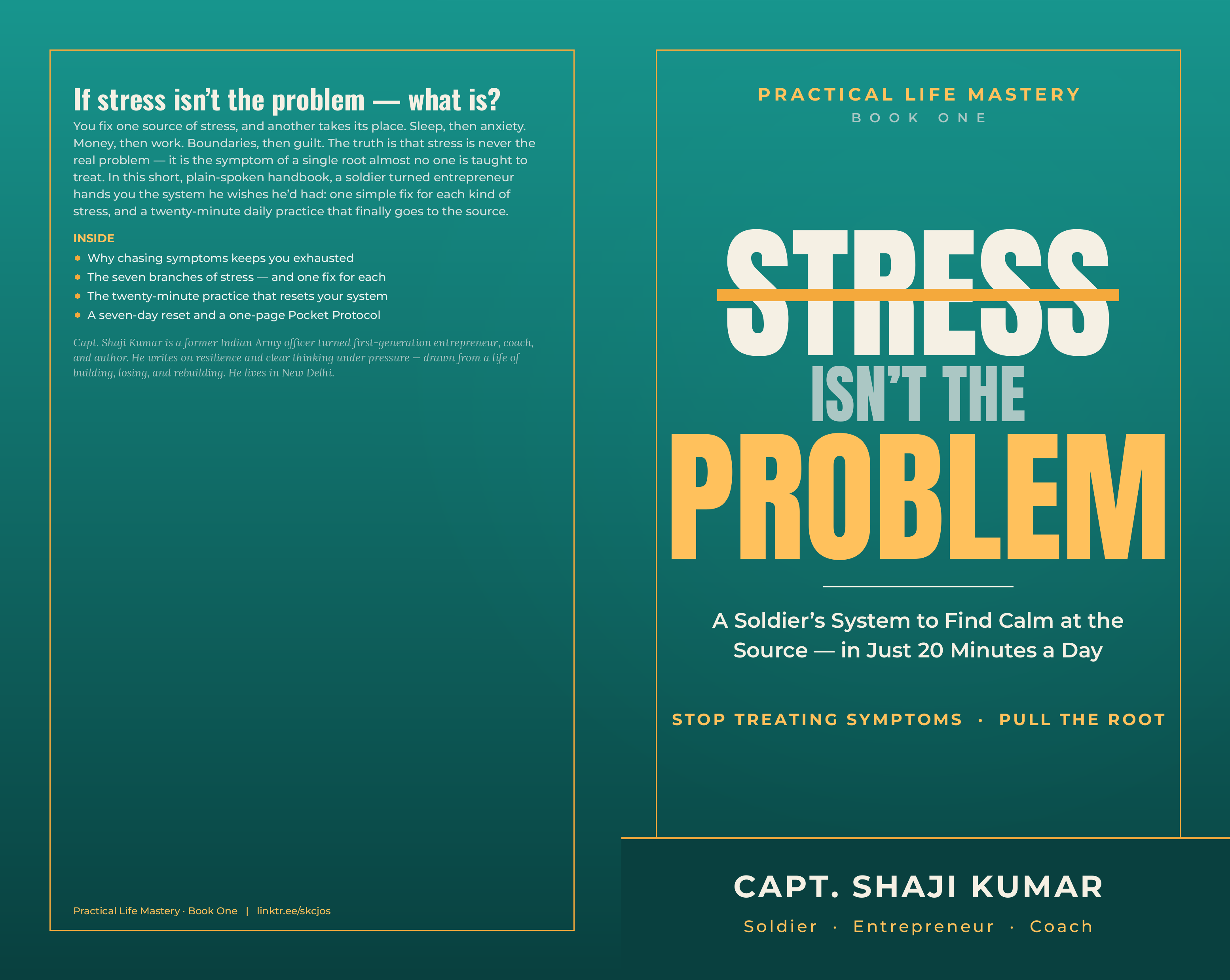
If this landed, it’s the spine of a handbook I’ve been working on — Stress Isn’t the Problem: A Do-It-Yourself Handbook to Stop Chasing Stress and Solve It at the Source. It’s the full method: the seven branches and the one root. Out on Amazon, first week of July. I’ll share the link here the day it’s live. 🌱


Leave a Reply