
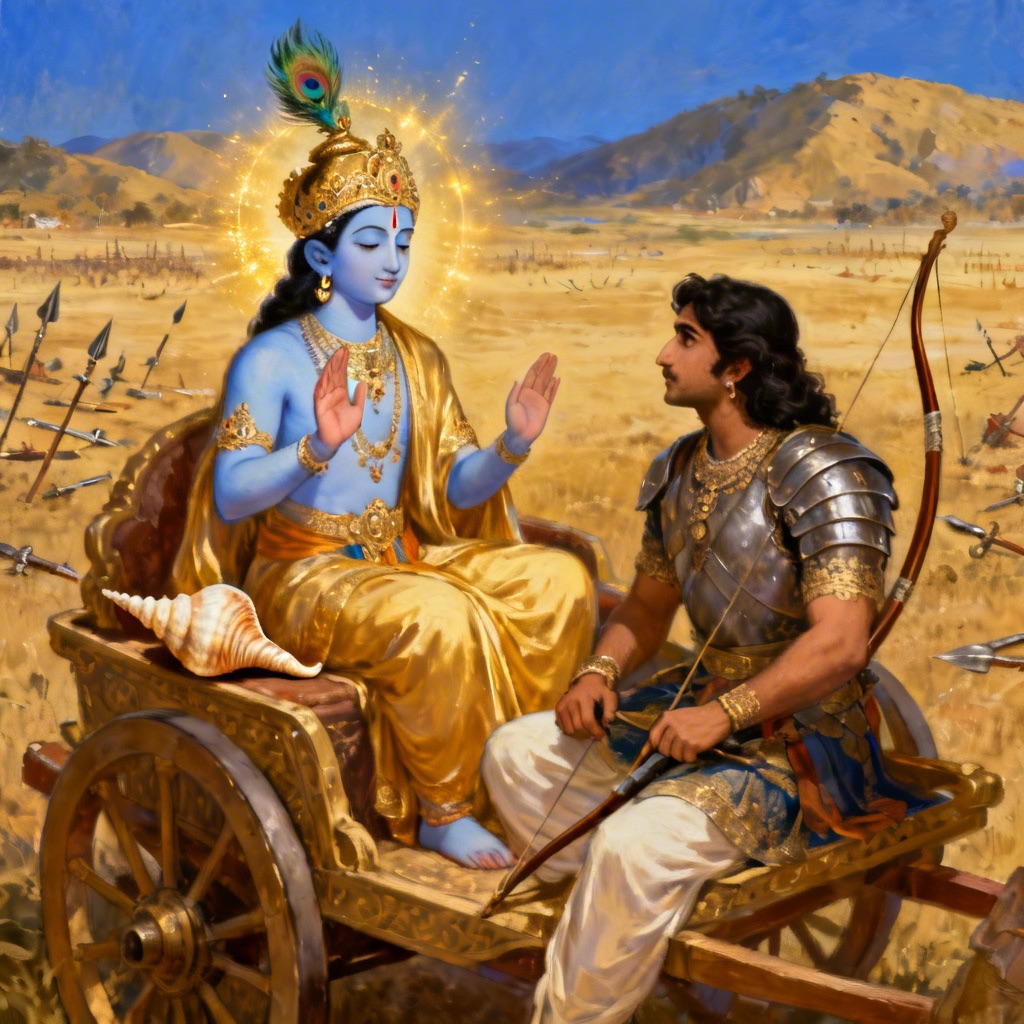
What a 5,000-Year-Old Battlefield Conversation can teach us About Leadership.
I used to think the Bhagavad Gita was just another religious text. Then I discovered it’s actually the most practical leadership guide ever written. Since then I have held on to this sacred book in different forms. The Printed Version, the Kindle eBook, Cards for daily reference.
When Everything’s on the Line, when you know that moment when you’re staring at a decision that could make or break everything? I’m talking about those tough situations which everyone faces in their lives, you don’t necessarily have to be a Leader, nevertheless running through scenarios, knowing that whatever you choose tomorrow will ripple through your team, your company, maybe even your entire career.
That’s where Arjuna was standing—literally on a battlefield, facing his cousins in what would be the bloodiest war in ancient history. And he completely froze. What happened next changed how I think about leadership forever.
Here’s what I got wrong about the Gita for years: I thought it was some mystical conversation between holy men sitting under trees, talking about detaching from the world.
No. This is two warriors having a very real conversation about duty, fear, and making impossible choices when lives hang in the balance. Arjuna isn’t asking for spiritual enlightenment—he’s asking for practical advice on how to lead when the stakes are crushing.
Sound familiar?
In today’s context it would look like this:
– Quarterly numbers. The Agony or Ecstacy.
– A product launch that could save or sink the company.
– Choosing between short-term profits and long-term values.
– Managing a team through a recession, merger, layoffs, or industry disruption. The pressure is different, but the paralysis feels exactly the same.
The Counter intuitive Secret That Changes Everything
Krishna’s advice to Arjuna seems backwards at first: “Do your absolute best work, then let go of the results.”
Wait, what? Isn’t caring about results what separates leaders from… well, everyone else?
But here’s what I’ve learned after trying this approach for years:
When you stop being desperately attached to specific outcomes, you actually get better outcomes. Try it. It holds true.
Why This Actually Works is, just think about it—when was the last time you made a great decision while panicking about the consequences?
When you’re white-knuckling the steering wheel, worried about where you’ll end up, you can’t actually steer very well.
But when you know you’ve done everything possible and you trust the process? That’s when the magic happens. You think clearer. You take smarter risks. You inspire confidence instead of spreading anxiety.
I saw this firsthand during my company’s worst times. Not once, but many times. Instead of running around like my hair was on fire, I focused on what we could control: our response time, our communication with clients, our team’s morale. We came out stronger. And honestly? I slept better. In fact I have never lost sleep over anything ever. Whatever may have been the situation I have managed to keep my wit’s cool.
Life Happens TO You, and you cannot stop that from happening, But You can definitely choose Your Response – on how to deal with it.
The Gita has this concept that basically divides everything into two buckets: stuff that happens to you (prarabdha) and how you respond to it (purushartha).
This sounds obvious until you realise how much energy we waste trying to control the first bucket. You Cannot.
Here’s What I Mean:
Sometime back one of our biggest and longest standing Client decided not to renew. One year of revenue, gone. That’s prarabdha—it happened, period.
But everything else? That’s on me:
– How I broke the news to the team- Whether I spiralled into worst-case scenarios or started planning our next move.
– Whether I used this as a learning opportunity or just complained about “disloyal clients”!!
You could spend days obsessing over what we could have done differently. Or you sit and analyse, make an last ditch effort to save if possible, and if even after giving it your best shot, then instead of ruminating look at alternative solutions. How to make up the lost revenue in the shortest span so that the effect is cushioned in the shortest span of time.
The Balance That Actually Matters
There’s this verse (Chapter 4, Verse 22, if you’re keeping track) that basically says balanced people don’t get thrown off by wins or losses. They just keep moving forward.
This isn’t about being emotionless—it’s about being consistent.
What This Looks Like in Practice
Good news: Celebrate for five minutes, then ask “What’s next?”
Bad news: Feel it for five minutes, then ask “What can we learn and Do next?”
Uncertainty: Work with what you know, then adapt as you learn more.
My Son figured this out before I did. He told me, “You used to be a roller coaster—amazing when things went well, impossible when they didn’t. Now we actually know what to expect from you.” He just told me to look at my old Photographs when I was younger.
That hit harder than any performance review.
The Best Analogy I’ve Ever Heard About Ambition.
The Gita compares desires to paan—that sweet digestive you have after a good meal. It’s nice, but you don’t need it to feel satisfied.
This completely reframed how I think about professional goals.
Instead of: “I need this promotion/deal/metric to prove I’m successful”
I started thinking: “I’m already pretty fortunate. This would be a nice bonus.”
Why This Isn’t Just Feel-Good Philosophy
When you’re not operating from desperation:
– You negotiate better (you’re not afraid to walk away).
– You make clearer decisions (you’re not clouded by need).
Actually Trying This Stuff (Not Just Nodding Along).
Look, reading about this is one thing. Actually doing it when your boss is breathing down your neck and wants answers is completely different.
Practice it in your daily life. Concentrate on doing great work without bothering on specific outcome. See what happens. How it balances your stress level.
When problems come up, spend your energy on your response, not on not on complaining about the problem.
Try to maintain same tone in meetings whether you’re delivering good news or bad news. It will have an impact on your Team. The energy percolates down.
None of this is groundbreaking. But doing it consistently? That’s where the real change happens.
Why a Battlefield Guide Still Works.
The reason the Gita works for modern leadership isn’t because it’s ancient wisdom (though it is). It’s because it was written for someone who had to make life-or-death decisions under impossible pressure.
The details are different, but the core challenge is the same: How do you lead effectively when the outcome matters desperately but you can’t guarantee success?
Answer: You control what you can control, you do your best work, and you trust the process. It’s not magic. But it works.
What’s your version of standing on that battlefield? The moment when everything you’ve worked for hangs on a decision you have to make? Remember: it’s not about predicting the future perfectly—it’s about showing up fully to the present.
P.S. – If this resonated with you, I’d love to hear about your own battlefield moments. Because honestly, We’re all just figuring this out as we go, and sometimes it helps to know we’re not alone out there.


 Capt. Shaji Kumar