
There is a version of the success story we have all been sold, and most of it is a lie.
Not the part about hard work. The part about speed. Open any feed and you will find it: the twenty-five-year-old who built a unicorn in eighteen months, the founder who “made it” before thirty, the overnight sensation who apparently arrived from nowhere. It makes for a good headline. It makes for a terrible blueprint, because it simply is not how success actually works for almost anyone, including the very people the headlines are about.
I want to make a different case in this post, and in the ones that will follow it. It is a case built on three things I have come to believe are true, not because I read them somewhere, but because I have lived long enough to watch them play out, in my own life and in the lives of hundreds of people I have coached and worked alongside.
First, results follow action, and significant results take time. Usually decades.
The gap between doing the work and seeing the payoff is almost always longer than we expect, and almost always longer than anyone advertises. What gets called an overnight success is, nearly every time, the visible tip of ten or fifteen years most people never saw. There may be signposts along the way if you know where to look, small proofs that you are on the right track. But the idea that meaningful achievement arrives quickly is, for practical purposes, a myth. Plan your life as though the real results are decades out, because they usually are.
Second, most people get more than one chance to succeed, if they are willing to commit the time.
This is the encouraging part, and it is also the part people resist. Most people are capable. Genuine capability is far more common than we like to admit. What is rare is not ability but appetite: the willingness to devote real years, not weeks, to getting good at one thing. Ten years of dedicated focus will take almost anyone from beginner to genuinely excellent at nearly anything worth doing. Few people have sufficient passion for any single pursuit to commit ten years to mastering it. That is not a comment on talent. It is a comment on staying power, and staying power can be built the same way anything else is built: deliberately, and over time.
Third, there is more time available to you than you think, and enough of it to do a few things exceptionally well.
Here is a way of looking at it I find useful. Assume your productive life runs from twenty to eighty. That is sixty years, or six separate ten-year periods. Six full decades, each one long enough on its own to take you from novice to master in a field, if you commit to it. That is roughly three times the productive runway most people could count on a century or two ago, when a working life ending at forty-five or fifty was the norm rather than the exception. We have been handed extra decades that no earlier generation had, and most of us are still living as though we only have the first two.
There is a reframe I keep coming back to on this point. The press tends to write about an ageing society as though it were some kind of calamity, a problem to be managed. I think that gets it backwards. The extra decades we now have are one of the genuinely great developments of our time, because they hand all of us second, third, fourth, even fifth chances at something close to greatness, chances earlier generations simply did not get. Somebody needed to say that plainly, so I am saying it.
I am also deliberately not going to load this post with examples of the truly exceptional: the people who built giant companies, made a billion dollars, won a major prize, or changed the world in some sweeping, documented way. Those stories exist, and they get written up precisely because they are rare. Most of us are not going to reach those heights, and if I am honest, most of us do not actually want to run that particular race. None of that diminishes the real message here, which is this: you should not give up on yourself, or on what you set out to build, simply because you are no longer young. Plenty of people have not given up, and they are doing extraordinary things at forty-five, at fifty-five, at seventy, with none of it making headlines and all of it mattering enormously to them and the people around them.
I want to speak directly to one group of people reading this, because their situation makes the whole argument concrete rather than theoretical.
If you are an officer approaching the end of your service, or you have already hung up the uniform and are wondering what comes next, you are standing at exactly the point this post is about. You gave the first part of your working life to discipline, to a mission larger than yourself, to a code most civilian careers never ask anyone to live by. And then, somewhere in your forties or early fifties, that chapter ends, often earlier than you would have chosen, and you are left looking at what feels like the back half of a life with no obvious script for it.
I would ask you to look at the arithmetic again. If your working life runs to eighty, and your uniformed service ended at fifty, you are not closing a book. You are between campaigns, with two, three, even four more ten-year periods still ahead of you, each one long enough to build something you would be genuinely proud of. That is the whole idea behind Hoplite: the citizen-soldier who serves, returns, and takes up the next fight in civilian life, with the same discipline that got him through the first one. Nothing about your training was wasted. It was preparation for a second campaign you have not fought yet.
This will be the first post in an ongoing series exploring exactly that: how officers rebuild after service, what actually transfers from a military career into corporate life, entrepreneurship, or consulting, and what tends to get in the way. I will not be pretending there is a formula that works for everyone. There is not. But there is a process, and there is a great deal that decades of watching people make this exact transition has taught me about what works and what does not.
If you are an officer thinking about this transition, or you know one who is, I would genuinely like to talk. Not a sales pitch, just a conversation about where you are and what your options actually look like. Reach me directly on WhatsApp at 9625675052, or by email at skcjos@gmail.com.
What would you attempt if you stopped measuring yourself against how young you are?

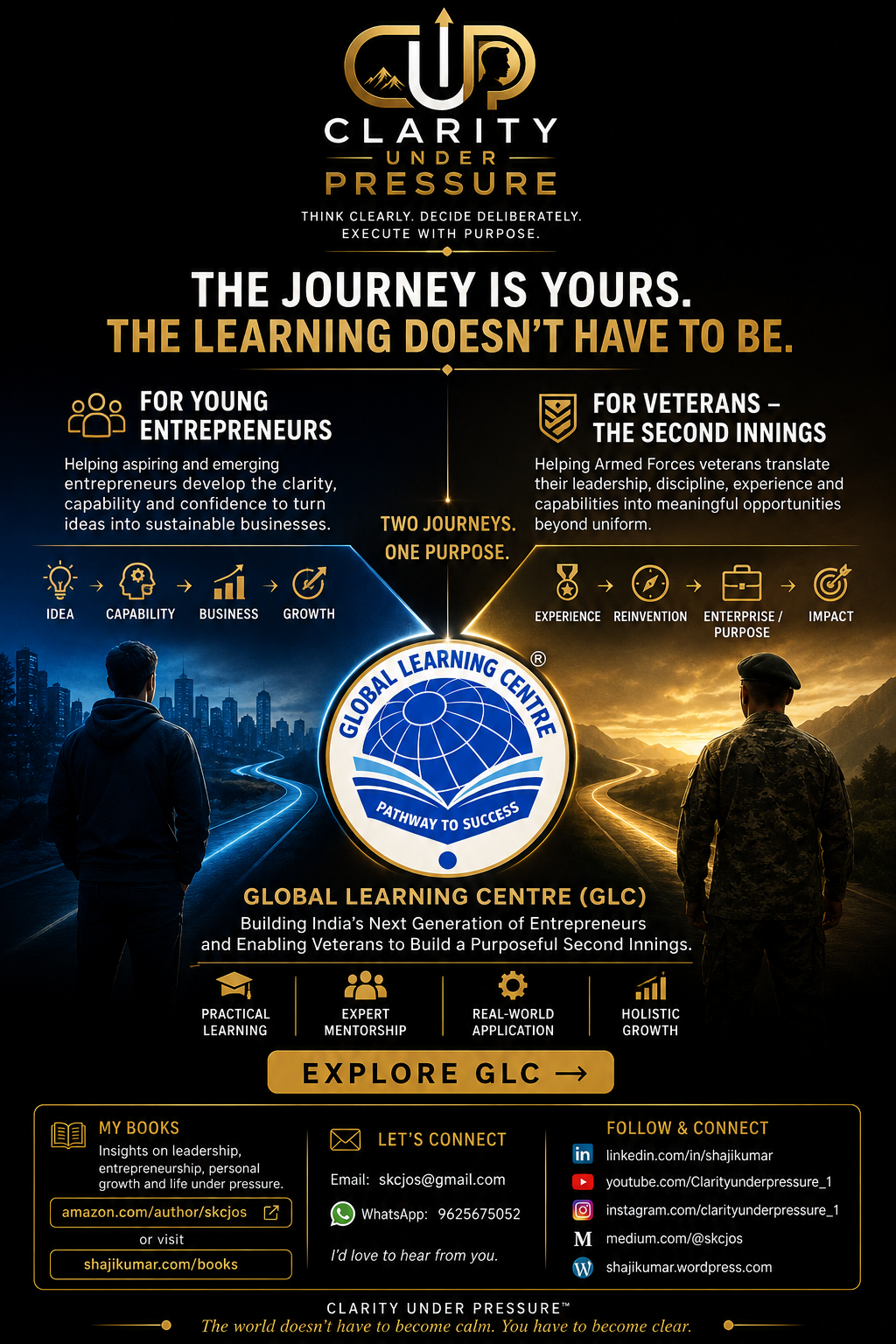
The Journey is yours. The Learning doesn’t have to be.
Global Learning Centre (GLC) is being built around two journeys:
FOR YOUNG ENTREPRENEURS
Helping aspiring and emerging entrepreneurs develop the clarity, capability and confidence to turn ideas into sustainable businesses.
FOR VETERANS — THE SECOND INNINGS
Helping Armed Forces veterans translate their leadership, discipline, experience and capabilities into meaningful opportunities beyond uniform.
The journey doesn’t end here. Let’s stay connected.
My Books | LinkedIn | YouTube | Instagram | Medium | Website


Leave a comment