We are constantly told to think big. Dream big. Set audacious goals. Aim for the extraordinary. There is certainly nothing wrong with that. Ambition has driven much of human progress. But over the years, I have begun to wonder whether there is another dimension to success that we do not talk about nearly enough. Perhaps the real advantage is not only in thinking big. Perhaps it is in thinking long.
We live in an age of extraordinary impatience. We want the business to grow quickly, the book to sell immediately, the promotion to come now and the recognition to arrive before we have had enough time to build the capability, credibility and experience that usually produce it. Social media has only intensified this impatience. We constantly encounter stories of overnight success. Someone built a company in two years. Someone became a millionaire before thirty. Someone wrote a book that became a bestseller. Someone transformed their life in six months. What we rarely see is the ten years of preparation, failure, experimentation, learning and persistence behind the headline. We see the harvest. We rarely see the planting.
That is why I find the idea of thinking long so compelling. Most meaningful achievements do not happen overnight. Signposts may appear along the way. There may be small victories, breakthroughs, recognition and moments when we suddenly realise that something is working. But significant results generally require time. Results follow action, certainly, but significant results often require years, sometimes decades, of sustained action. Mastery takes time. Building a respected business takes time. Building a reputation takes time. Developing wisdom takes time. Becoming the person capable of handling the success we desire takes time as well.
The problem is that we often confuse action with immediate results. We start something and expect immediate evidence that it will work. When that evidence does not appear, we begin to question the idea, the opportunity and sometimes even ourselves. We move to something else. Then the same cycle begins again. Eventually, we may conclude that nothing works. But perhaps the problem was not that the idea was wrong. Perhaps we simply did not stay with it long enough.
There is another perspective that I find particularly powerful. Consider the productive span of life broadly, from around twenty to eighty. That gives us sixty years. Six periods of ten years. Six potential decades in which we could dedicate ourselves to learning, building, experimenting and becoming exceptionally good at something. Of course, life does not operate in neat ten-year blocks. Careers overlap, responsibilities change, circumstances intervene and priorities evolve. Yet the arithmetic makes one thing clear. We have considerably more time than we often behave as though we have.
Earlier generations did not necessarily have the same longevity, access to information, technology, educational resources or opportunities to reinvent themselves that we have today. We now live longer and can continue learning and contributing much later in life. A person can start a business at fifty-five, write a book at sixty, learn a new discipline at sixty-five or begin an entirely new chapter at seventy. Yet we often behave as though our opportunities disappear once we cross some arbitrary age boundary.
Why?
Who decided that everything important must happen by thirty? Who decided that a career must be settled by forty? Who decided that sixty is the end of productive life? These may be common social expectations, but they are not laws of nature.
There is something else worth examining. We tend to celebrate people who achieve extraordinary things very quickly. The entrepreneur who builds a billion-dollar company. The person who becomes a global leader. The author who sells millions of books. The athlete who wins everything. Their stories are fascinating because they are exceptional. Biographies exist precisely because these lives are unusual. But most people are not going to become billionaires, win prestigious awards, or change the world in a way that makes history books. Nor do most people necessarily want to.
That does not make their aspirations less meaningful.
Success does not have to be spectacular to be significant. A person may want to build a good business, become an exceptional professional, raise a family well, mentor young people, write something meaningful, create employment, contribute to society or simply become a better version of themselves. These achievements may never make the front page of a newspaper. They can still have enormous significance.
The important message, therefore, is not that everyone can become extraordinary by conventional measures. It is that we should not give up on ourselves simply because we have reached middle age or beyond.
There are still possibilities.
There are still opportunities.
There is still time.
In fact, I would argue that one of the great advantages of living longer is precisely that we get additional chances. The ageing of society is often discussed as though it is some kind of calamity. I see another possibility. The extra decades we now have can provide second, third, fourth and even fifth chances to learn, build, contribute and perhaps achieve something we could not achieve earlier.
You may have failed at something at thirty. You can try again at forty. You may have chosen the wrong career at thirty-five. You can change direction at fifty. You may have built a business that did not work. You can build another. You may have spent decades working for someone else. You can create something of your own. You may have postponed writing that book. You can write it now. Just because something didn’t happen earlier doesn’t mean it cannot happen later.
Sometimes life simply takes longer than we expected.
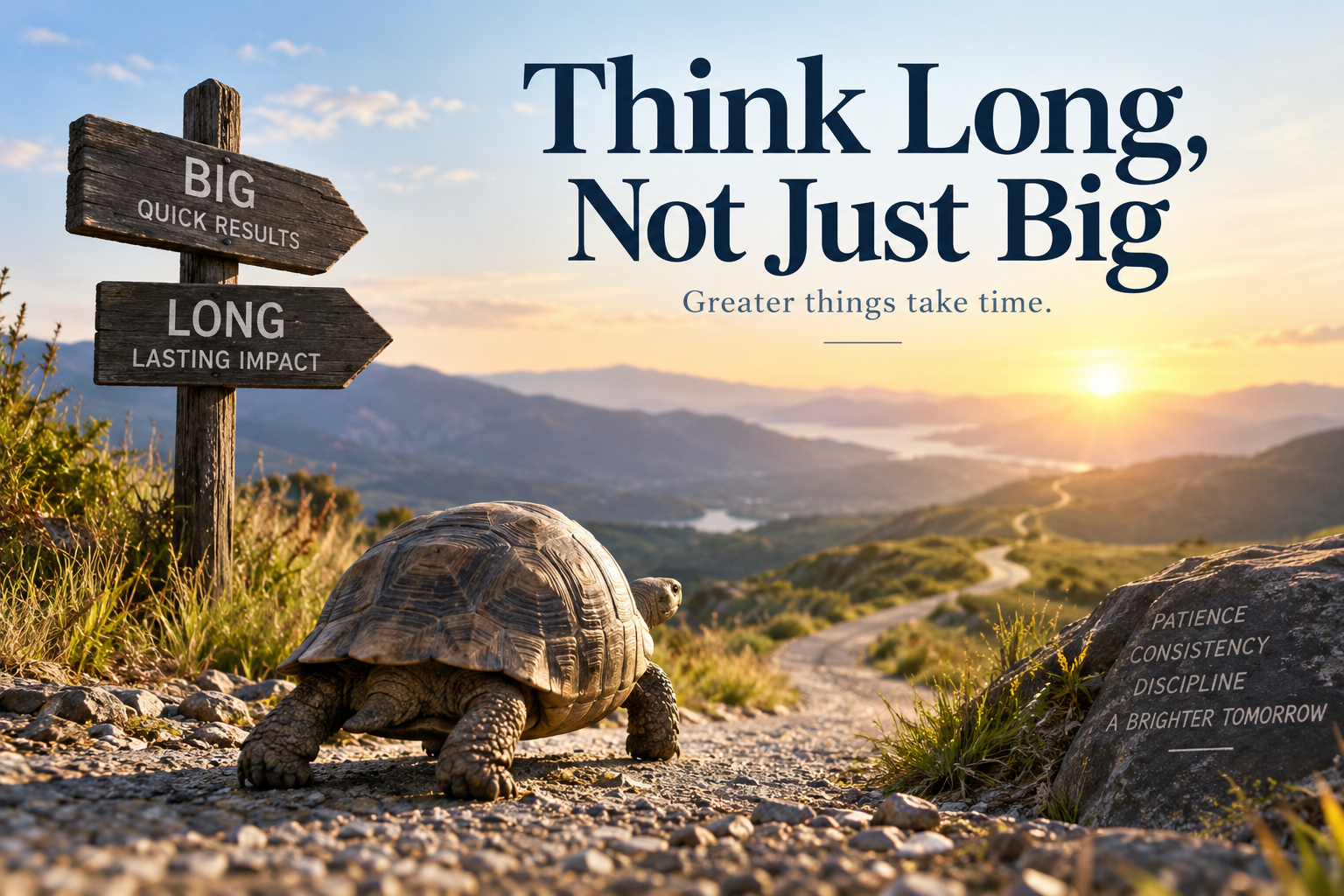
That brings me to the familiar story of the hare and the tortoise. Most of us encountered it as children. The hare was fast and confident. The tortoise was slow and seemingly insignificant. Yet the tortoise eventually reached the destination. We were probably taught that the lesson was about consistency and not underestimating the competition. But there is another lesson in that story that seems increasingly relevant today.
The tortoise understood time.
It did not need to be spectacular every day. It didn’t need to show dramatic progress every hour. It simply had to keep moving in the right direction.
That is becoming increasingly difficult in our world because we are surrounded by speed. Fast food. Fast communication. Fast delivery. Fast information. Fast careers. Fast money. Fast fame. Technology has made many things faster and artificial intelligence is accelerating that process even further. Speed is undoubtedly useful. But speed is not the same as progress. And progress is not the same as transformation.
Some things simply cannot be rushed.
A tree does not become a tree overnight. A child does not become an adult overnight. A reputation does not develop overnight. Wisdom certainly does not. Why should our most meaningful achievements be any different?
This is where I have begun to examine my own journey more honestly. I have always been fascinated by big ideas, big goals and big possibilities. Looking back, however, I sometimes wonder whether I spent too much time thinking about how big the outcome could be and not enough time thinking about how long I was prepared to stay with the journey.
I should have thought long instead of only thinking big.
That is something I rue.
The size of the goal is rarely the only issue. The more important question may be the timeframe we give ourselves to achieve it. If you want to write one book, perhaps you can do it in a year. If you want to become a respected author, you may need a decade. If you want to launch a business, perhaps you can do it in a few months. If you want to build an institution that outlives you, you may need decades. If you want to acquire a skill, you can learn its fundamentals relatively quickly. If you want mastery, prepare to stay.
That distinction matters.
Thinking big gives us direction. Thinking long gives us endurance. Thinking big can inspire us. Thinking long can sustain us. Thinking big can make us dream. Thinking long can give the dream a realistic chance of becoming reality.
Perhaps this is why some of life’s most important achievements are not the result of extraordinary bursts of effort. They are the result of ordinary effort sustained for an extraordinary length of time.
We underestimate the power of compounding in almost everything except money. We understand that investments grow when allowed to compound over decades, yet we often fail to apply the same principle to knowledge, relationships, reputation, skills, businesses and personal growth. Ten years of learning is not simply ten times one year of learning. Ten years of experience can fundamentally change the quality of our judgement. Ten years of building relationships can create a network that would be impossible to build quickly. Ten years of consistent work can create credibility that no amount of short-term publicity can manufacture.
The difficulty is that compounding is almost invisible in the beginning.
For a long time, it can appear as though nothing much is happening.
That is precisely when most people quit.
The desire for instant results, while completely understandable, can make us less open to the paths that lead to lasting achievement. What is quick and requires less work is naturally more attractive. But the things that matter most in life often ask something different from us. They ask us to stay when the excitement has disappeared. They ask us to continue when nobody is watching. They ask us to work without immediate applause.
That is not glamorous.
It is simply how many worthwhile things are built.
So perhaps we need to rethink what we mean when we tell people to “think big”. Think big, certainly. But attach that ambition to a long horizon. Instead of asking, “How quickly can I achieve this?”, perhaps we should sometimes ask, “What could I build if I stayed committed to this for ten years?”
That is a very different question.
It changes the way we look at failure because failure becomes information rather than a final verdict. It changes the way we measure progress because small improvements begin to matter. It changes how we respond to setbacks because a setback in year two doesn’t look quite so catastrophic when the horizon is ten years. Most importantly, it changes our relationship with age.
We stop seeing age as a countdown and begin seeing it as accumulated capital.
Experience becomes an asset. Mistakes become lessons. Relationships become resources. Perspective becomes an advantage. And the years that once seemed to have passed us by can become the foundation for what comes next.
Perhaps that is the real message we should take from the tortoise.
It was not that the tortoise was faster.
It was that the tortoise stayed in the race.
And maybe that is what many of us need to remember.
You do not have to achieve everything this year. You do not have to prove everything today. You do not have to become successful according to somebody else’s timetable. You do not even have to know exactly where the journey will end.
You simply need to keep moving towards something that matters.
Because sometimes the greatest advantage you have is not speed.
It is time.
As I look back at my own journey, I now believe that one of the most important questions we can ask ourselves is not, “How big is my goal?”
It is, “How long am I prepared to stay with it?”
Thinking big can lift our eyes.
Thinking long can keep our feet on the ground.
And perhaps the combination of the two creates lasting achievement.
But if I had to choose the lesson that I wish I had understood earlier in my own life, it would be this:
Do not just think big. Think long.
Because the power of thinking long may be what finally allows us to go further than we ever imagined.
What rings true for you?
Is it the power of thinking big, or the power of thinking long?

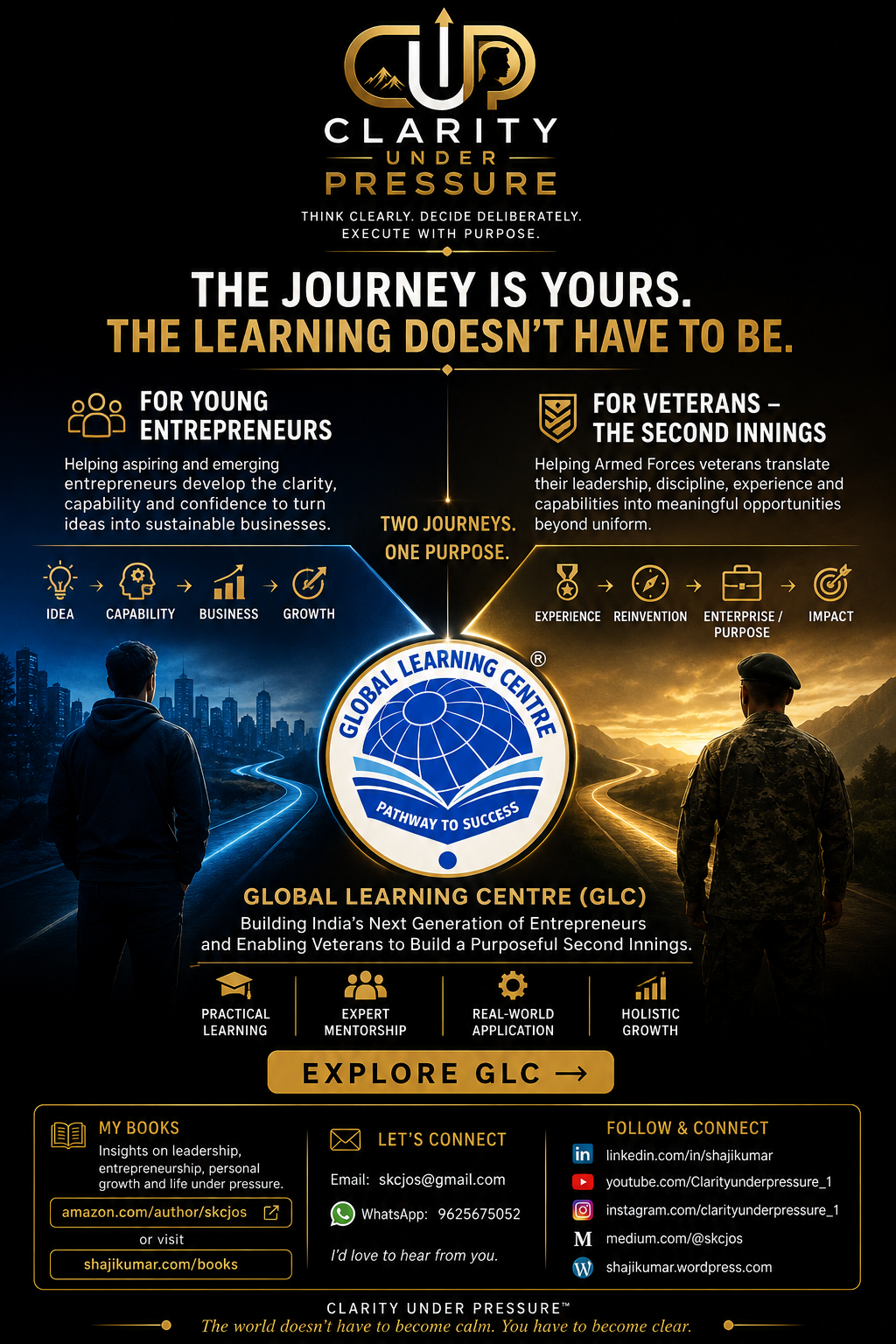
The Journey is yours. The Learning doesn’t have to be.
Global Learning Centre (GLC) is being built around two journeys:
FOR YOUNG ENTREPRENEURS
Helping aspiring and emerging entrepreneurs develop the clarity, capability and confidence to turn ideas into sustainable businesses.
FOR VETERANS — THE SECOND INNINGS
Helping Armed Forces veterans translate their leadership, discipline, experience and capabilities into meaningful opportunities beyond uniform.
The journey doesn’t end here. Let’s stay connected.
My Books | LinkedIn | YouTube | Instagram | Medium | Website