For years, I believed transformation had to hurt.
Not a little discomfort.
I believed real change required a dramatic declaration, an ambitious plan, and a complete life overhaul.
A new routine. An earlier morning. A stricter diet. More exercise. More reading. More writing. More discipline. More of everything.
Like many people who are obsessed with becoming a better version of themselves, I would occasionally sit down and redesign my entire life.
And, like many people, I would fail. Not immediately. The first few days were always exciting.
I would wake up with renewed determination. I’d write my new schedule neatly. My goals would look ambitious and inspiring. I would feel like a new man.
By the second week, reality would begin to interfere. Work pressures. Travel. Meetings. Unexpected commitments. Fatigue.
One missed morning routine would become two. One deviation from the plan would make me feel that the entire effort had failed.
Soon, I would find myself exactly where I started. Surrounded by the wreckage of another beautifully designed plan. And a familiar feeling of disappointment.
Perhaps you have experienced this too.
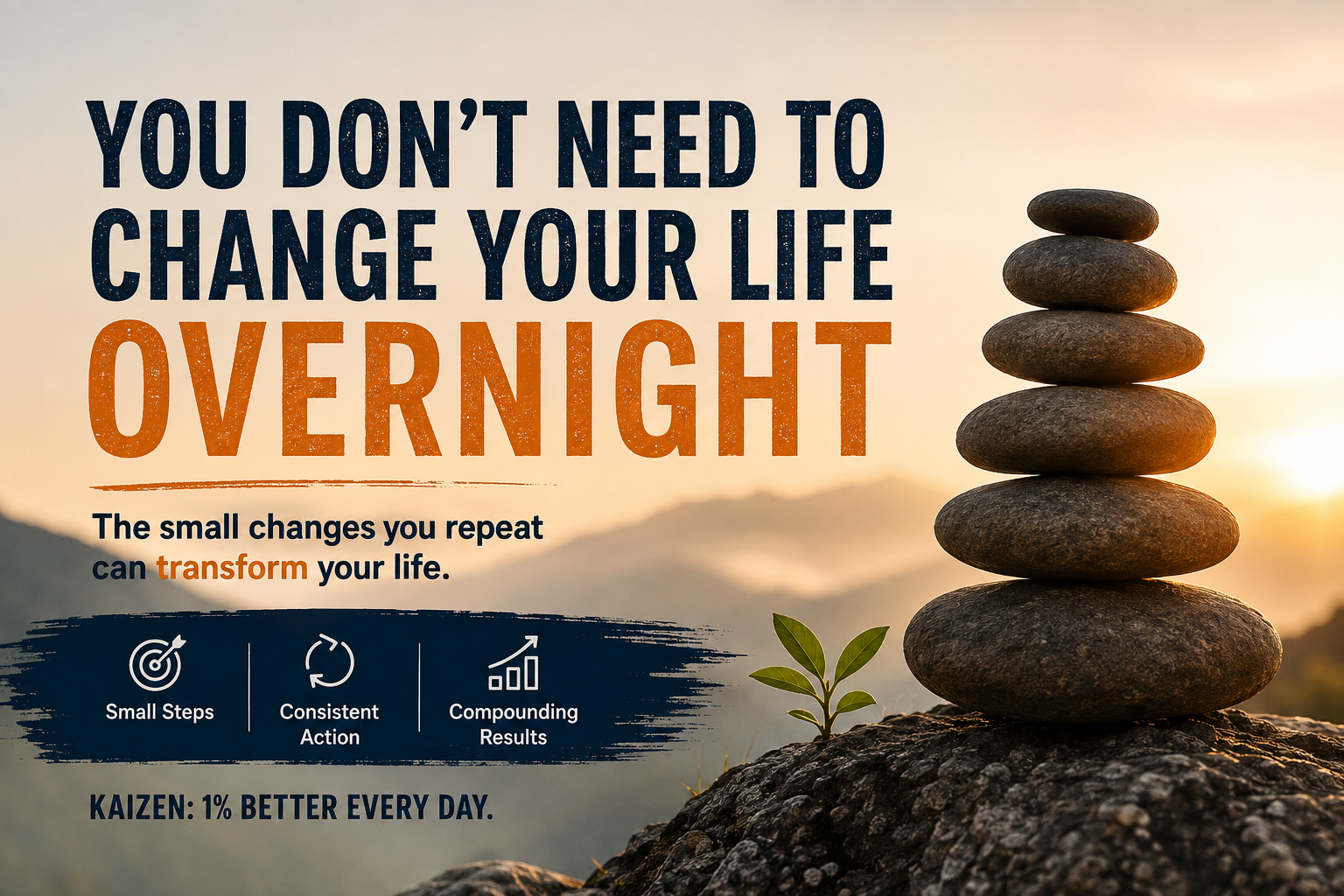
We don’t fail because we don’t want change badly enough. Sometimes we fail because we try to change too much, too quickly.
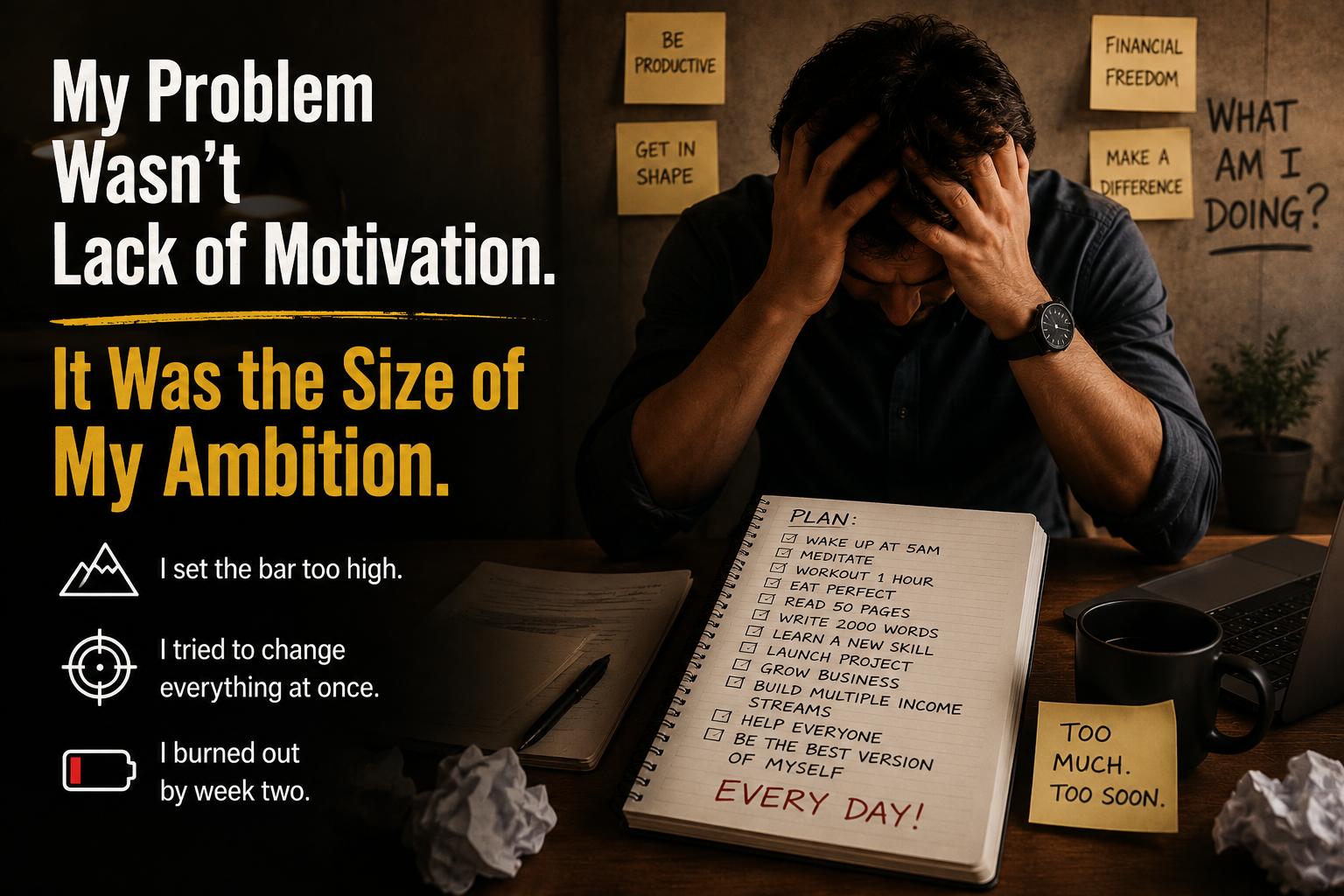
My Problem Wasn’t Lack of Motivation. It Was the Size of My Ambition.
Looking back at my career, I can see this pattern everywhere. Whether it was developing a new capability, improving my health, writing, or building something professionally, I was always attracted to the big picture.
The large goal. The transformation. The finished outcome.
That approach had served me well in many aspects of my professional life. Senior leadership roles require strategic thinking. You are expected to see the future, identify gaps and create large-scale change.
But a problem arises when you apply the same philosophy to your personal life.
You cannot always transform a life through a corporate-style transformation programme. Human beings are not organisations. We don’t respond well to endless PowerPoint plans, aggressive timelines and ambitious implementation charts.
Sometimes the smallest change is more powerful than the grandest strategy. I understood this much later when I came across a simple Japanese philosophy.
Kaizen.
Kai means change.
Zen means good or better.
Together, Kaizen represents continuous improvement.
Small improvements. Consistent improvements. Improvements that may appear insignificant today but become extraordinary over time.
Initially, I thought of Kaizen as another productivity concept. Another idea to help people become more efficient. Another fashionable word from the world of management. Then I began reading about where it actually came from. And the philosophy suddenly became far more meaningful.
Kaizen Was Born When Japan Had No Choice But to Improve.
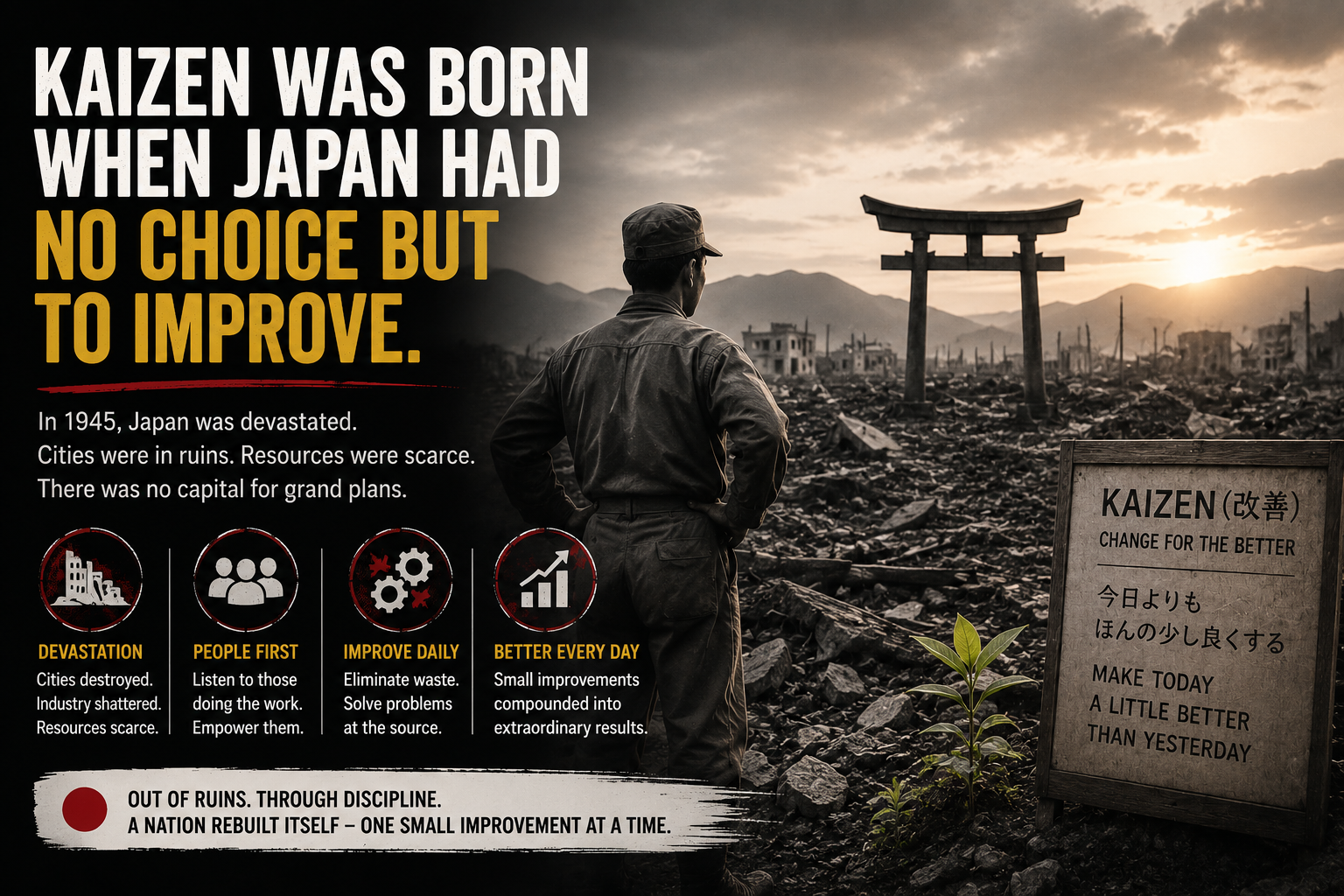
In 1945, Japan was devastated.
Its major cities had been destroyed. Infrastructure was damaged. Industries were struggling. The economy was in ruins. There was no luxury of starting everything again from scratch. No endless capital. No massive resources. No opportunity to simply demolish the old system and build a perfect new one overnight.
Japan had to learn how to improve with what it had.
And so, Japanese industry began focusing on something remarkably simple. Make things a little better. Every day. Eliminate one unnecessary step. Reduce one mistake. Improve one process. Solve one problem at its source. Listen to the person actually doing the work.
Quality thinkers such as W. Edwards Deming and Homer Sarasohn reinforced the philosophy, and leaders like Taiichi Ohno later embedded it deeply in companies such as Toyota.
The approach challenged conventional thinking.
Instead of waiting for senior management to design the perfect solution, people closest to the work were encouraged to identify problems. Instead of tolerating errors and fixing them later, organisations began addressing problems at their source. Instead of massive periodic transformations, improvement became a daily habit.
The famous Plan-Do-Check-Act cycle captured this beautifully.
Plan something small. Do it. Check the results. Act on what you learn.
Then repeat.
Again.
And again.
And again.
The result was extraordinary.
By the 1970s and 1980s, the world was watching Japan. The phrase “Made in Japan,” once associated in many Western markets with cheap products, came to mean reliability, precision, and quality. American and European companies began travelling to Japan to understand the Toyota Production System.
Everyone wanted to know the secret.
How had a nation devastated by war become a global industrial powerhouse? The answer was not one miraculous breakthrough. It was thousands of small improvements.
Compounded over time.
That’s when Kaizen Became Personal for me.
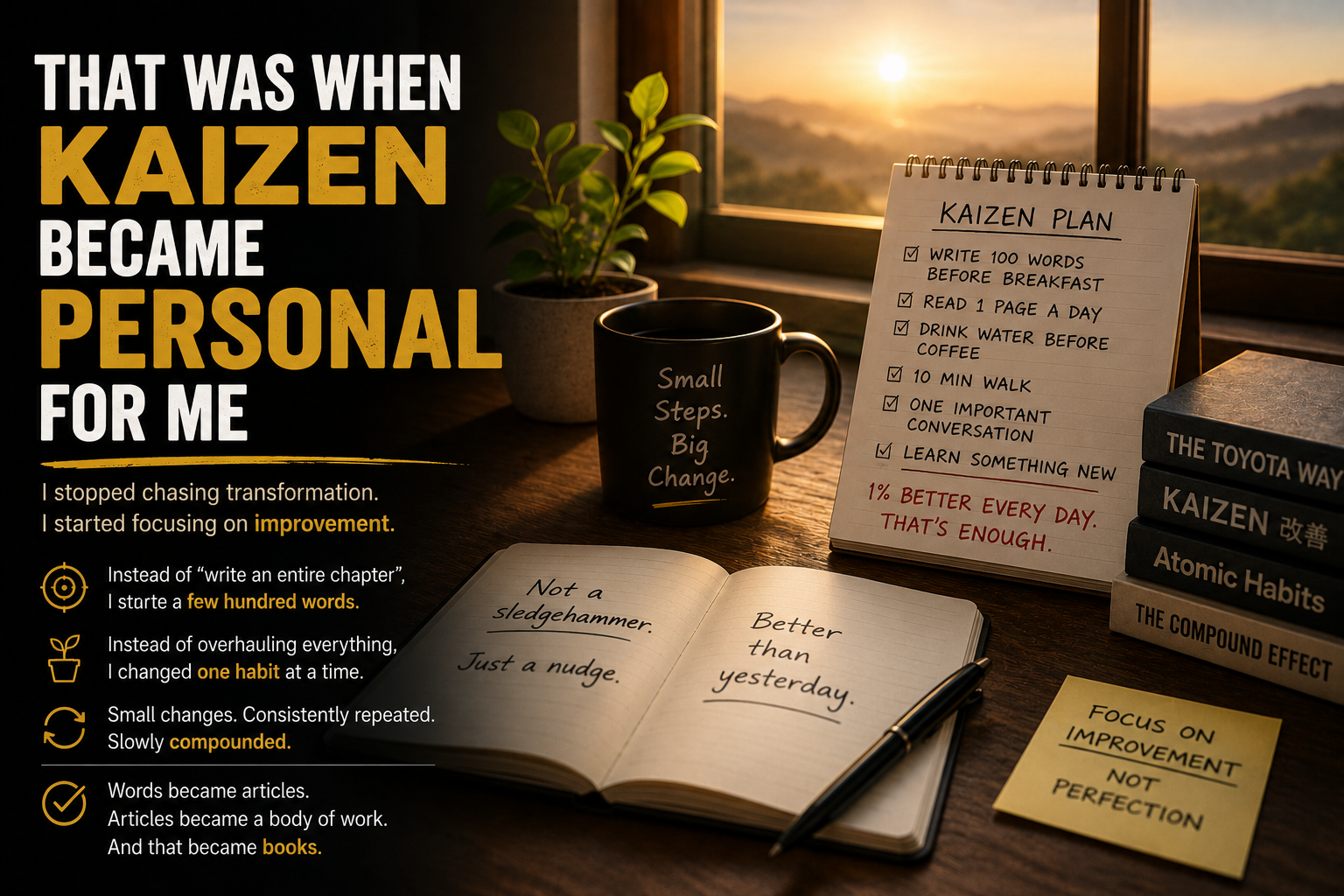
The more I thought about it, the more uncomfortable I became. Because I realised I had been approaching personal change in exactly the opposite way.
I wanted dramatic results. Immediately.
I would decide that I needed to become a more disciplined writer and then set myself an ambitious target. Write more. Write regularly. Finish chapters. Complete the manuscript. Produce something significant.
But staring at a blank page and expecting to produce something brilliant can be intimidating.
So I changed the approach. Instead of thinking about completing a chapter, I focused on writing a few hundred words. Sometimes even less. Just start. One idea. One paragraph. One page.
That was enough.
And something interesting happened. The pressure disappeared. I no longer had to be inspired enough to write an entire chapter. I simply had to write something. Those small writing sessions eventually became articles. Articles became blogs. Blogs became a body of work.
Over time, that body of work contributed to books and ideas I may never have produced if I’d waited for the perfect burst of motivation.
The same principle applied elsewhere.
Instead of completely redesigning my diet, I could change one habit. Instead of declaring that I would become extraordinarily fit, I could focus on moving more consistently.
Instead of trying to read fifty books in a year, I could simply read every day. The objective was no longer to impress myself with the size of my commitment. The objective was to make progress impossible to resist.
The Secret Is to Make the First Step Almost Embarrassingly Small.
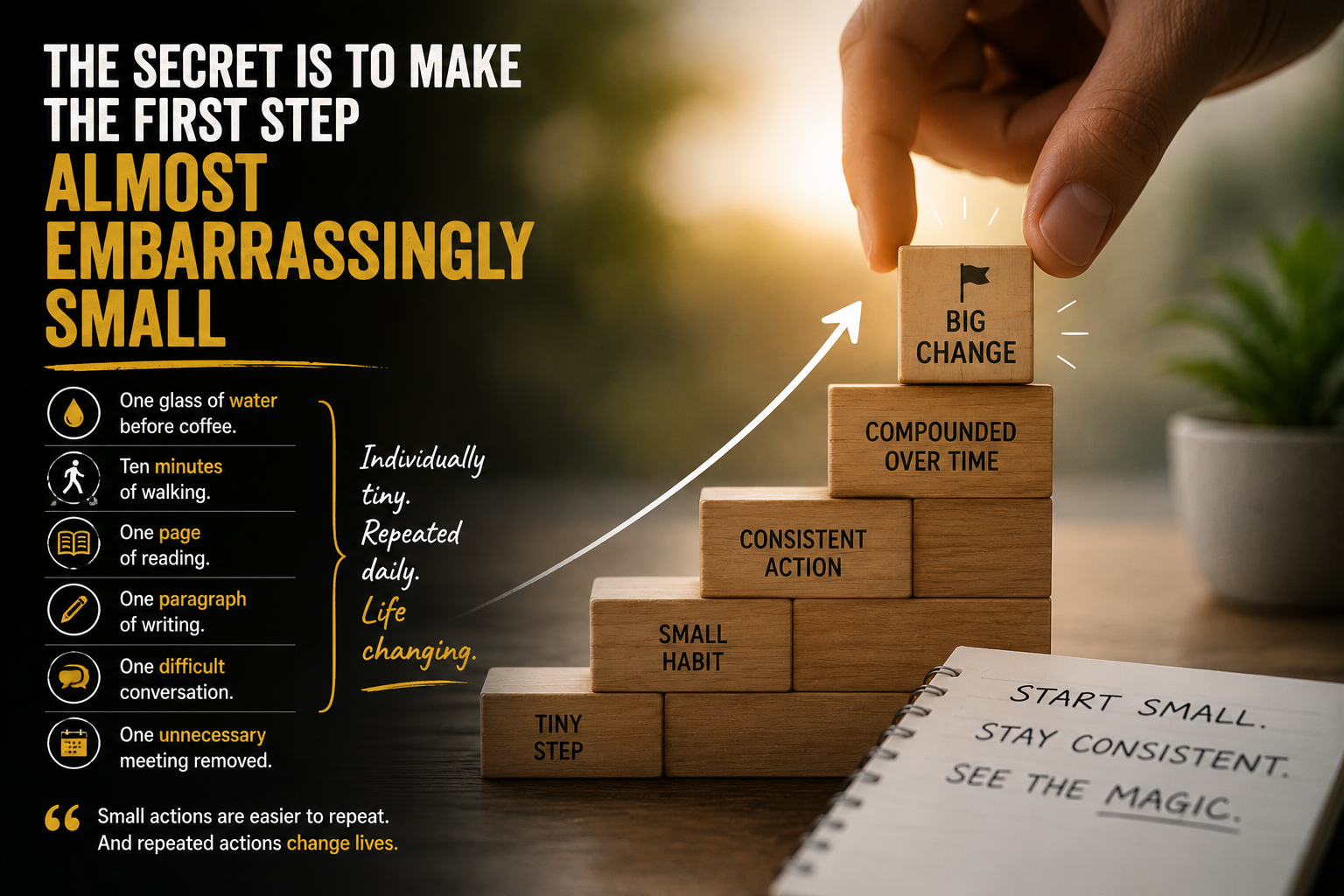
This is where I believe most of us misunderstand change. We think a goal’s difficulty proves how committed we are. So we create difficult routines.
Wake up at 5 a.m.
Exercise for an hour.
Meditate for thirty minutes.
Read fifty pages.
Write two thousand words.
Eat perfectly.
Do it every day.
And when life inevitably interrupts us, we conclude that we lack discipline. But perhaps discipline was never the problem. Perhaps the plan was.
The beauty of a tiny improvement is that it doesn’t frighten you.
One glass of water before your morning coffee.
Ten minutes of walking.
One page of reading.
One paragraph of writing.
One phone call you have been postponing.
One unnecessary meeting removed from your calendar. One difficult conversation you finally initiate. One small improvement to a process at work. Individually, these things look insignificant. Almost laughably insignificant. But Kaizen understands something we often forget.
Small actions are easier to repeat.
And repeated actions become habits. Habits shape behaviour. Behaviour shapes identity. And identity eventually shapes destiny.
In My Years in Leadership, I Saw This Principle Repeatedly.
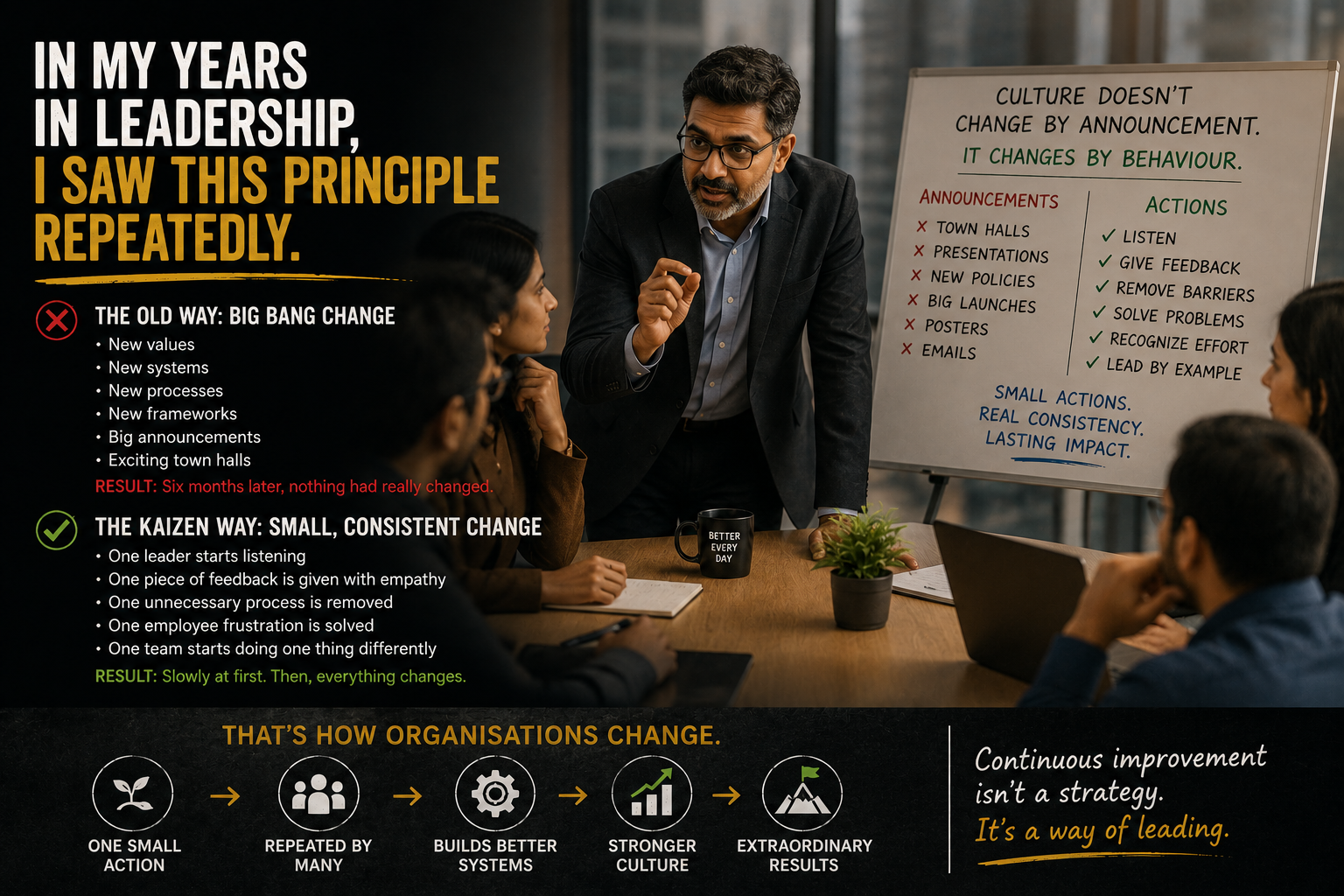
During my career in HR and business leadership, I have seen organisations launch magnificent transformation programmes. New vision statements. New values. New competency frameworks. New performance management systems. New leadership models. Everything announced with great enthusiasm. Posters are printed. Town halls are conducted. Presentations are shared.
Then, a few months later, everyone quietly returns to what they were doing before.
Why?
Because culture doesn’t change because someone announces it. Culture changes when behaviour changes. And behaviour changes when people begin doing small things differently. A manager who starts giving genuine feedback. A leader who begins listening before responding. A team that removes one unnecessary approval process. A company that solves one recurring employee frustration. A supervisor who starts recognising good work immediately rather than waiting for the annual awards ceremony.
These may not make headlines.
But they change organisations.
The same is true for people.
We often wait for a life-changing moment. The perfect Monday. The New Year. Our birthday. A new job. A health scare. A personal crisis.
We tell ourselves:
“From tomorrow, everything will change.”
But transformation rarely arrives with a dramatic drumroll. More often, it enters quietly. It begins with something so small that nobody else even notices. You wake up ten minutes earlier. You write one paragraph. You take the stairs. You make one difficult phone call. You stop postponing something. You learn one new skill.
And then you do it again tomorrow.
Compounding Is the Part Most People Underestimate.
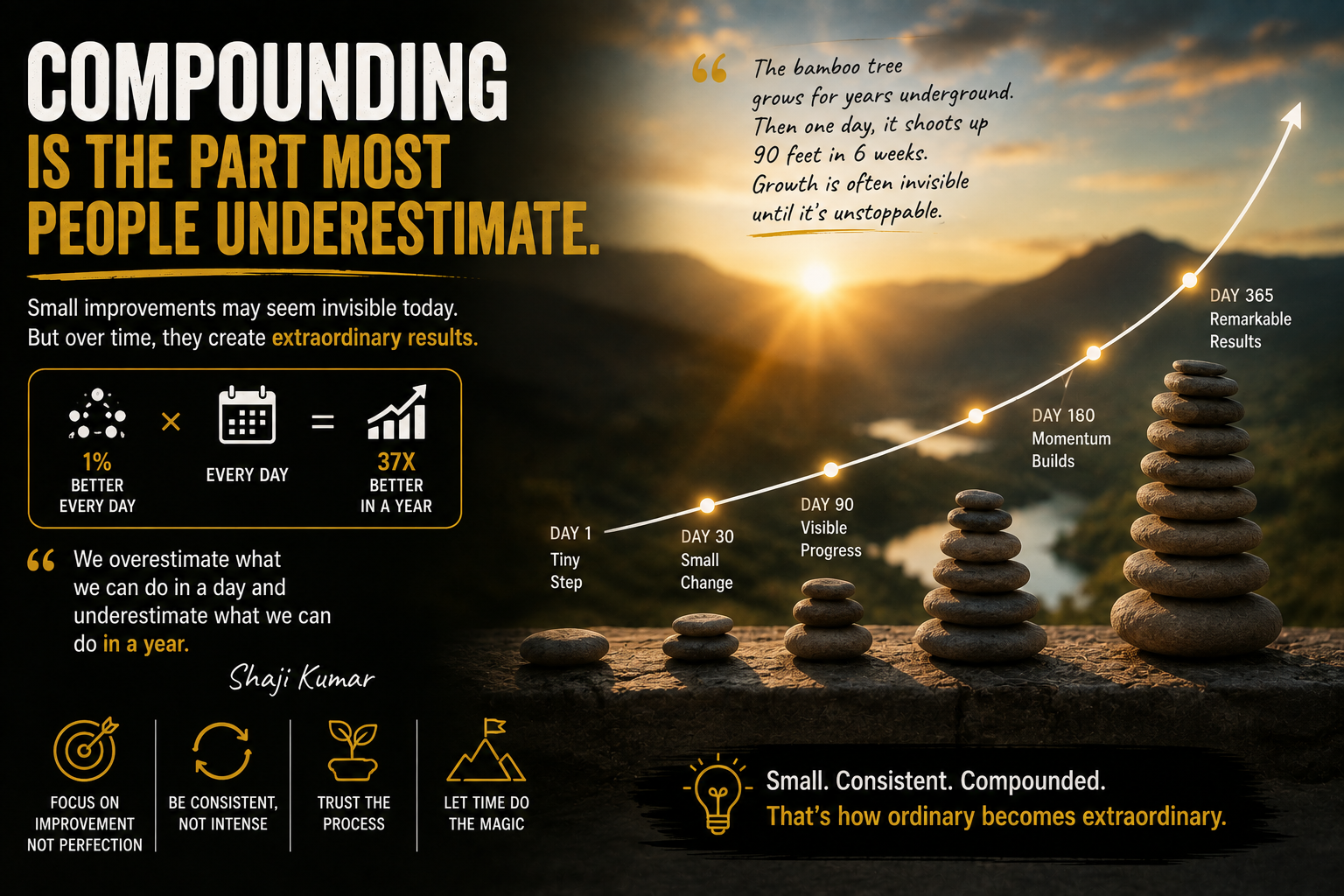
We are impatient creatures. We want to see results immediately. If we exercise for three days, we look in the mirror. If we write for a week, we wonder why we haven’t finished a book. If we save money for a month, we wonder why we aren’t financially secure.
But Kaizen requires patience.
Because its power is not in today’s improvement. Its power is in accumulated improvement. One per cent better may not look impressive tomorrow. But imagine becoming one per cent better consistently.
Imagine improving one professional skill every month.
Imagine strengthening one relationship through one meaningful conversation every week. Imagine writing 300 words a day. Imagine walking thirty minutes every day. Imagine learning something new every morning. The individual action is small. The accumulated result is not.
This is the mathematics of compounding applied to human behaviour.
And perhaps that is the most important lesson I have learned.
You don’t have to transform your life today.
You only have to improve something today.
Stop Waiting for the Sledgehammer.
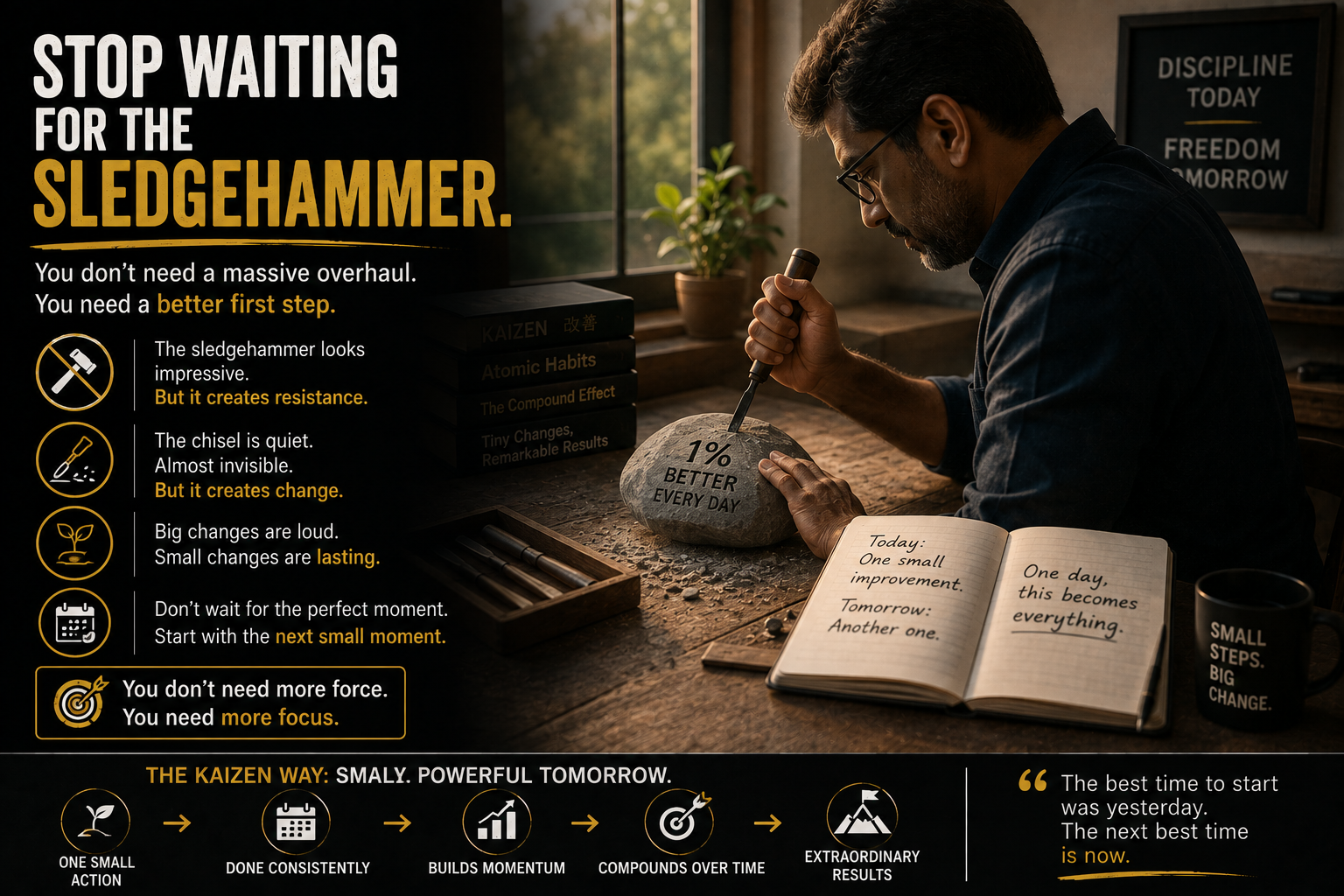
For years, I thought change required a sledgehammer. A dramatic intervention. A complete reinvention. Today, I believe differently.
Sometimes the most powerful transformation begins with something so small that your ego dismisses it.
That first paragraph. That ten-minute walk. That one healthier choice. That single conversation. That one improvement to the way you work.
That one thing you finally stop postponing.
The goal is not to become a different person overnight. The goal is to become slightly better than the person you were yesterday.
Then do it again tomorrow.
And the day after.
Because eventually, those tiny changes stop being tiny. They become your habits. Your habits become your character. And your character quietly builds the life you once thought required a dramatic transformation.
Japan did not rebuild its global reputation through one spectacular leap.
Toyota did not become synonymous with quality because of one brilliant idea.
And most of us will not change our lives because of one motivational speech, one New Year’s resolution or one perfect Monday morning.
We change through repetition. Through patience. Through small corrections. Through the willingness to look at what we do today and ask:
What is one thing I can make slightly better tomorrow?
That is Kaizen.
Not perfection.
Not dramatic reinvention.
Not exhausting yourself in the pursuit of an impossible new version of yourself.
Just continuous improvement.
Quietly.
Consistently.
Patiently.
One small step at a time.
And perhaps that is enough.
Perhaps it has always been enough.
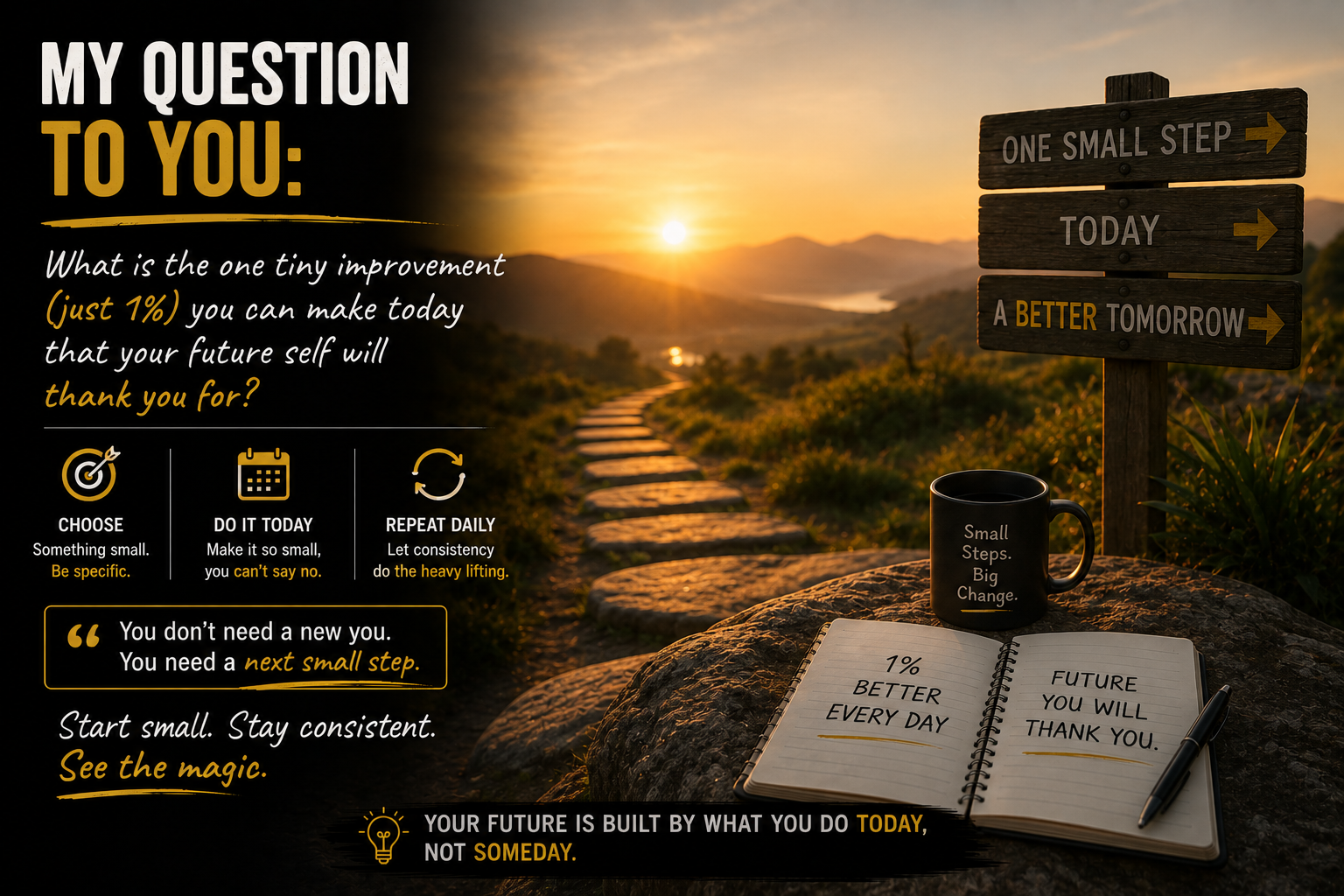
My question to you:

The Journey is yours. The Learning doesn’t have to be.
Global Learning Centre (GLC) is being built around two journeys:
FOR YOUNG ENTREPRENEURS
Helping aspiring and emerging entrepreneurs develop the clarity, capability and confidence to turn ideas into sustainable businesses.
FOR VETERANS — THE SECOND INNINGS
Helping Armed Forces veterans translate their leadership, discipline, experience and capabilities into meaningful opportunities beyond uniform.

The journey doesn’t end here. Let’s stay connected.
My Books | LinkedIn | YouTube | Instagram | Medium | Website


Leave a comment