I watched a bird this morning. It had no agenda. It asked no permission of the sky.
It tilted its head — once, twice — pecked at something invisible to me, then lifted off as though gravity were merely a suggestion. There was no weight to it. Not the kind we carry, anyway.
And I stood there, a grown man with a full calendar and an emptier soul, wondering — why not us? Why were we handed this extraordinary gift of consciousness only to fill it with noise? With grudges and deadlines and a gnawing sense that we are always, always behind?
The bird does not scroll through what it missed. It does not compare its nest to another’s. It drinks when thirsty. It rests when tired. It sings — not for applause, but because the morning simply calls for it.
We, on the other hand, have built a world that hums with fury. Look around — truly look. What you see is not progress dressed up in conflict. It is something rawer. A collage of exhausted souls, each one pushing, shoving, performing some version of urgency they no longer remember choosing. Intolerance has become our mother tongue. Anger, our default expression. The chaos is not just out there in the headlines — it is in the kitchen, in the commute, in the quiet contempt that lives behind polite smiles.
And it is everywhere. Every continent. Every culture. Every household, in varying degrees, tuned to the same restless, maddening frequency.
Where does it lead, all of this? I do not have the answer. But I feel it — the way you feel a storm before the first drop falls. A reckoning is building, slow and enormous, in the place where our collective patience used to live.
The bird has since disappeared into the treeline. It does not know I watched it. It does not know I envied it.
God — what exactly did we do wrong, and when was the precise moment we forgot how to simply be?
What Recruiters Silently Judge in Every Interview — And Why Smart Candidates Still Fail
By Capt. Shaji Kumar | Global Learning Centre
Most people walk into an interview believing the conversation begins when the first question is asked.
It does not.
In 38 years spent inside the world of recruitment — evaluating candidates, leading hiring teams, and running Chaque Jour for 28 years — I have observed one truth that cuts across every industry, every level, and every type of role:
The interview is decided long before you think it is.
And the candidates who understand this are the ones who consistently win offers.
What Recruiters Are Silently Judging — From the Moment You Walk In
Experienced interviewers are not simply listening to your answers. They are running a continuous, largely unconscious assessment that begins the moment you arrive and does not stop until you leave.
They are observing how you carry yourself before you sit down. They are noting whether you arrived prepared or scrambling. They are watching how you treat the receptionist, the assistant, the person who offers you water. They are registering whether your LinkedIn profile told the same story your CV did.
By the time the first question is posed, a preliminary impression has already formed. Your answers either confirm it, challenge it, or reinforce it. That is the game. Most candidates do not know they are already playing it.
What specifically are they evaluating? Four things, in every interview, without exception:
Clarity of thought. Can you organise your thinking and communicate it without rambling? Interviewers are not looking for perfection — they are looking for structure. A concise, well-ordered answer signals intelligence far more powerfully than an exhaustive one.
Knowledge of self. Do you know your own story? Can you articulate why you made the career decisions you made, what you learned, and where you are going? A candidate who cannot narrate their own professional journey confidently raises immediate doubts about self-awareness and direction.
Fit and intent. Have you done the work to understand this organisation, this role, and this team? Or did you apply broadly and hope for the best? Interviewers can feel the difference within the first three minutes.
Composure under pressure. When a difficult question arrives — and it will — do you think before you speak? Do you maintain your presence? Or do you visibly unravel? Composure is not the absence of nerves. It is the management of them.
Why Smart Candidates Still Fail
This is the part that surprises most people.
In my experience, the candidates who struggle most in interviews are not the under-qualified ones. They are often the most capable people in the process.
Intelligent professionals fail interviews for a specific set of reasons that have nothing to do with their competence:
They over-explain and under-structure. High-performing professionals are used to environments where thoroughness is valued. In an interview, thoroughness without brevity reads as inability to prioritise. A three-minute answer where two sentences would have sufficed does not demonstrate depth — it demonstrates poor communication.
They confuse experience with evidence. Saying “I have managed large teams” is not the same as saying “I led a team of 22 through a critical restructure and reduced attrition by 34% over 18 months.” The first is a claim. The second is evidence. Interviewers remember evidence.
They prepare for the wrong things. Most candidates rehearse answers. The best candidates prepare for the conversation. There is a significant difference. Rehearsed answers break down the moment an unexpected question arrives. A prepared mindset adapts.
They do not ask the right questions. Many candidates treat the “Do you have any questions for us?” moment as a formality. It is not. It is your opportunity to demonstrate strategic thinking, genuine curiosity, and the kind of engagement that signals you are already thinking like someone who works there.
The 5 Questions Every Interviewer Is Really Asking
Beneath every question an interviewer poses — regardless of how it is framed — there are five core assessments being made. Understanding these transforms how you approach every answer.
1. Can you actually do this job? This is the baseline. Your skills, qualifications, and relevant experience are being verified. But note: this is rarely the deciding factor. Most shortlisted candidates can do the job. The differentiators lie in the questions that follow.
2. Will you actually do this job? Motivation, commitment, and alignment with the role’s demands are being assessed. Are you genuinely interested in this opportunity, or is it simply available? Interviewers are skilled at detecting the difference.
3. Will you fit this team and culture? Values, working style, and interpersonal intelligence are all being evaluated here. A technically exceptional candidate who will fracture team dynamics is rarely hired. Culture fit is not a soft metric — for most organisations, it is a hard filter.
4. Will you create problems? This is the risk assessment. Every hiring decision carries a degree of risk. Interviewers are asking themselves: Will this person be difficult to manage? Will they cause friction? Will I regret this in six months? Your composure, self-awareness, and the way you discuss past challenges all feed this assessment.
5. Are you worth the investment? Hiring is expensive. Onboarding takes time. The question being asked — often unconsciously — is whether the return on this investment justifies the commitment. Your ability to articulate your value, your impact, and your trajectory directly determines the answer.
Answer these five questions across your interview — regardless of how they are worded — and you will stand apart from every other candidate in the room.
How to Make an Interviewer Remember You
The candidate who receives the offer is rarely the most qualified person who interviewed.
They are the person the panel could not stop thinking about after the room emptied.
Here is what creates that impression:
They opened with a clear, compelling narrative — not a summary of their CV, but a story of their professional journey that made the interviewer understand immediately why they were sitting in that chair.
They answered every question with the structure of a clear point, a specific example, and a demonstrated outcome. No rambling. No qualifications on every sentence. No excessive hedging.
They showed genuine intellectual engagement with the organisation — referencing something specific about the company’s direction, a challenge the industry faces, or a strategic question they had been thinking about since reading the job description.
They asked questions that revealed they had already been thinking about the role as if they were in it — not questions about benefits or holidays, but questions about priorities, team dynamics, and what success looks like in the first 90 days.
They followed up within 24 hours with a brief, personalised note that referenced something specific from the conversation and reaffirmed their interest with clarity and confidence.
None of these are extraordinary acts. All of them are rare.
A Final Word
Your qualifications got you the interview.
Your preparation — your structure, your self-awareness, your ability to communicate your value with precision and composure — will win you the offer.
One is in your past. The other is entirely in your hands.
If you have an important interview approaching and you want to walk in as the candidate they cannot afford to overlook, I would like to help.
In 38 years, I have seen what separates the candidates who get the call from the ones who wonder what went wrong. The gap is almost never talent. It is almost always preparation.
Let us close that gap — together.
Book a Free 15-Minute Clarity Call
About the Author
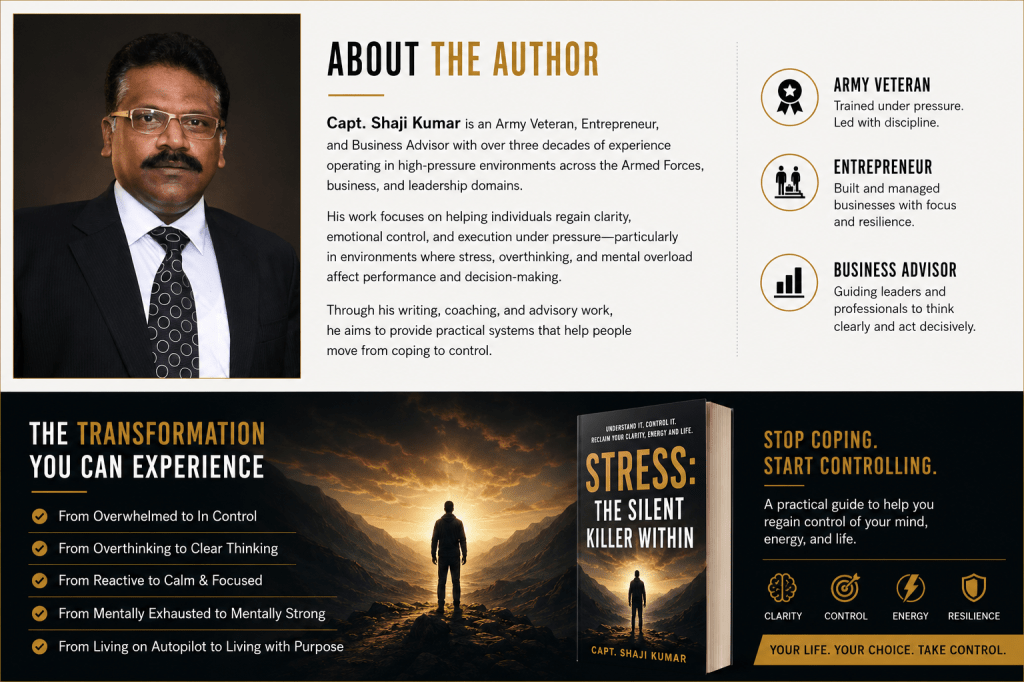
Capt. Shaji Kumar is an Executive Coach, Army Veteran, entrepreneur, and author focused on helping professionals navigate stress, overthinking, uncertainty, and high-pressure environments with clarity and precision.
Through his Clarity Under Pressure™ framework, he combines lessons from the Armed Forces, business leadership, entrepreneurship, and human behaviour to help individuals think clearly, act decisively, and build resilience in both life and career.
Explore the Books
Stress — The Silent Killer Within A practical 21-day guide designed to help young professionals manage workplace stress, emotional exhaustion, anxiety, and overthinking. Available on Amazon: https://www.amazon.in/dp/B0GX379YWG
Health in Your Hands Series Simple, practical, and awareness-driven books focused on health, stress management, emotional balance, and holistic well-being. Available on Amazon: https://www.amazon.in/gp/product/B0FV4BCC7K
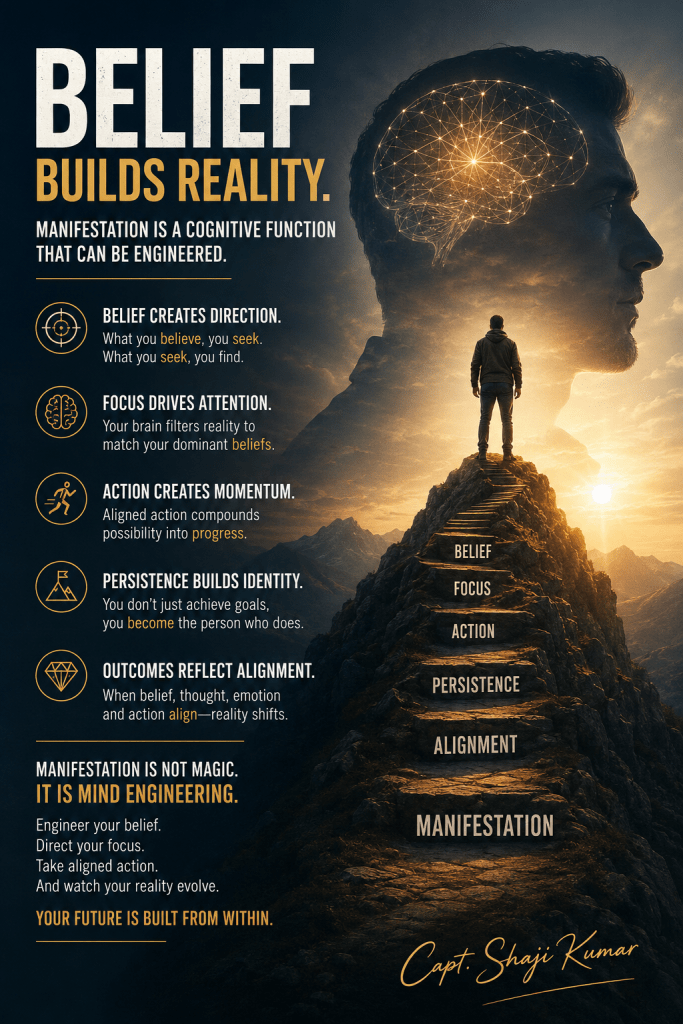
Your mind is constantly filtering reality through belief. What you repeatedly believe, emotionally reinforce, and focus on begins to shape your decisions, your actions, your resilience, and ultimately… your outcomes.
The human brain is not designed to pursue what it doubts.
It moves toward what it accepts as possible.
That is why belief matters. Not blind optimism. Not fantasy. Not wishful thinking.
Focused belief.
A belief system engineered through repetition, clarity, emotional conditioning, and disciplined action.
When you deeply believe something is achievable: your brain notices opportunities others ignore, attention sharpens and persistence expands.
Behaviour aligns with your objective
And slowly, what once felt impossible begins to look inevitable.
This is why two people can stand in the same storm and create entirely different futures.
One sees limitation. The other sees direction.
Manifestation is not sitting in a room imagining success while doing nothing.
It is training the mind so intensely that your internal world stops contradicting your external goals.
Because the greatest obstacle is rarely the world outside. It is the unconscious belief that you are incapable of creating something greater.
Your future changes the moment your belief becomes stronger than your fear.
That is when manifestation stops being philosophy…
Money flows faster than ever, yet peace of mind feels rarer than gold.
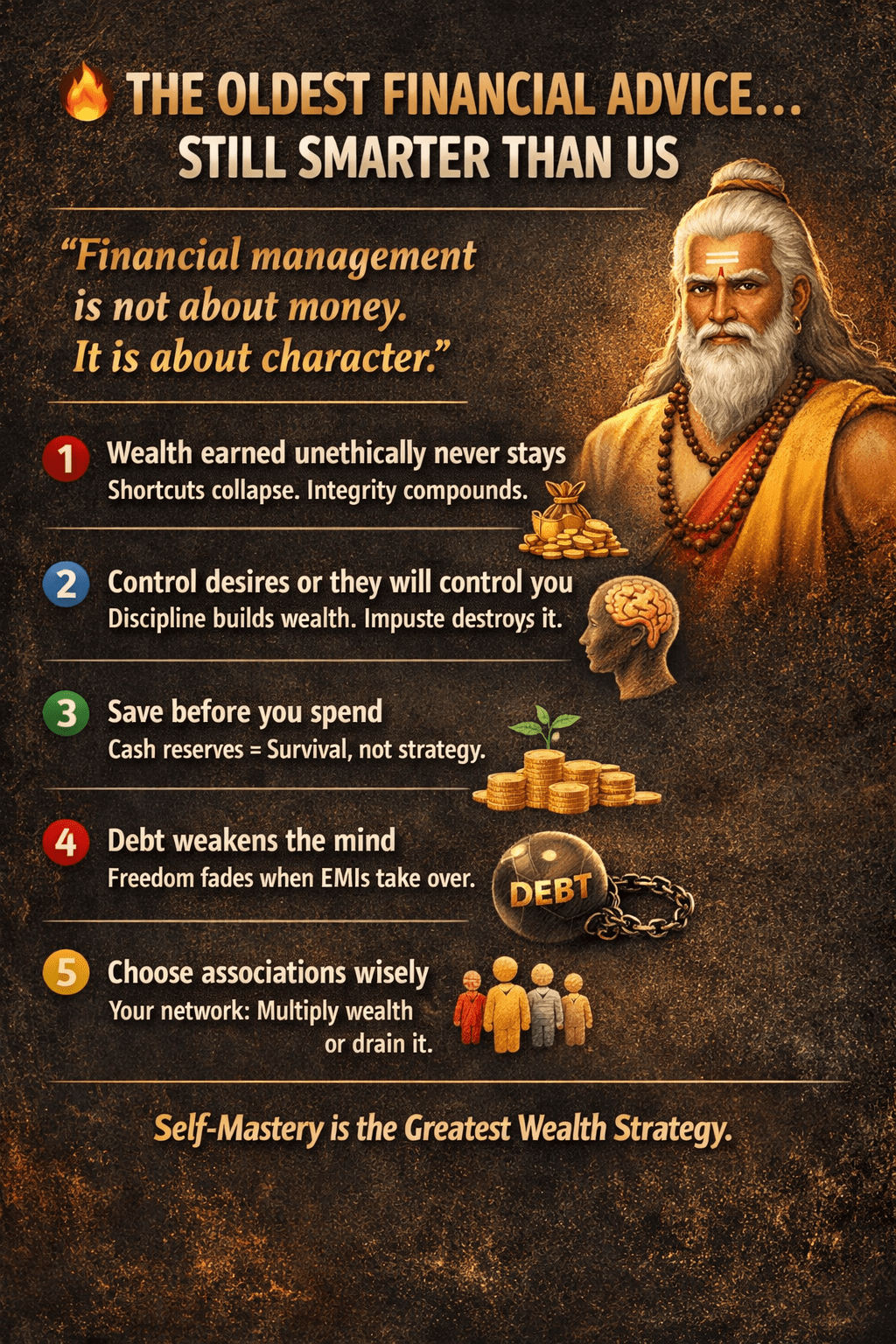
Every generation believes it invented financial wisdom — until it meets Vidur Niti.
Three thousand years ago, Vidur, the royal advisor in the Mahabharata, spoke truths that still cut through the noise of modern finance. His words weren’t about numbers or markets. They were about character — the foundation of every sustainable fortune.
Wealth Earned Unethically Never Stays.
Vidur warned that wealth gained through deceit destroys the one who holds it.
It’s not karma — it’s mathematics.
Unethical gains create instability, distrust, and eventual collapse.
In today’s world, this translates to:
Shortcuts collapse. Integrity compounds.
The most valuable currency is credibility.
Control Desires or They Will Control You
Vidur didn’t blame poverty on lack of income. He blamed it on lack of restraint.
Desire, when unchecked, becomes debt.
We call it lifestyle inflation, impulse buying, or social comparison — but it’s the same disease.
Discipline builds wealth. Impulse destroys it.
The richest people aren’t those who earn the most — they’re those who can say no.
Save Before You Spend
Vidur insisted that a wise person always keeps reserves for difficult times.
In modern language: build your emergency fund before your dream fund.
Savings are not a financial strategy.
They are a survival strategy.
Debt Weakens the Mind
Vidur saw debt as a spiritual and psychological burden.
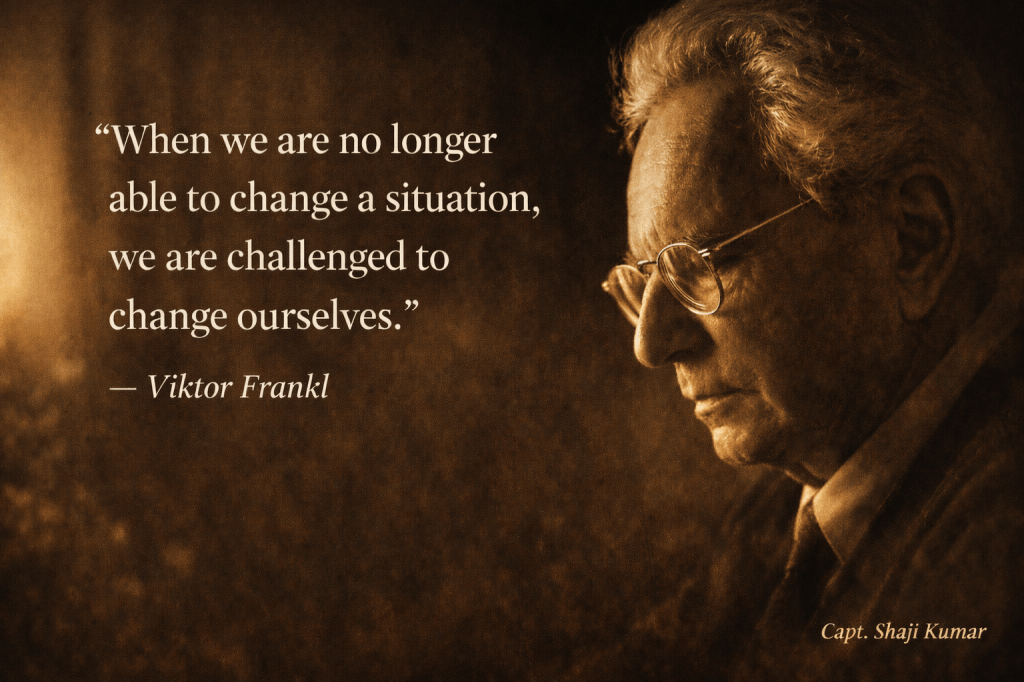
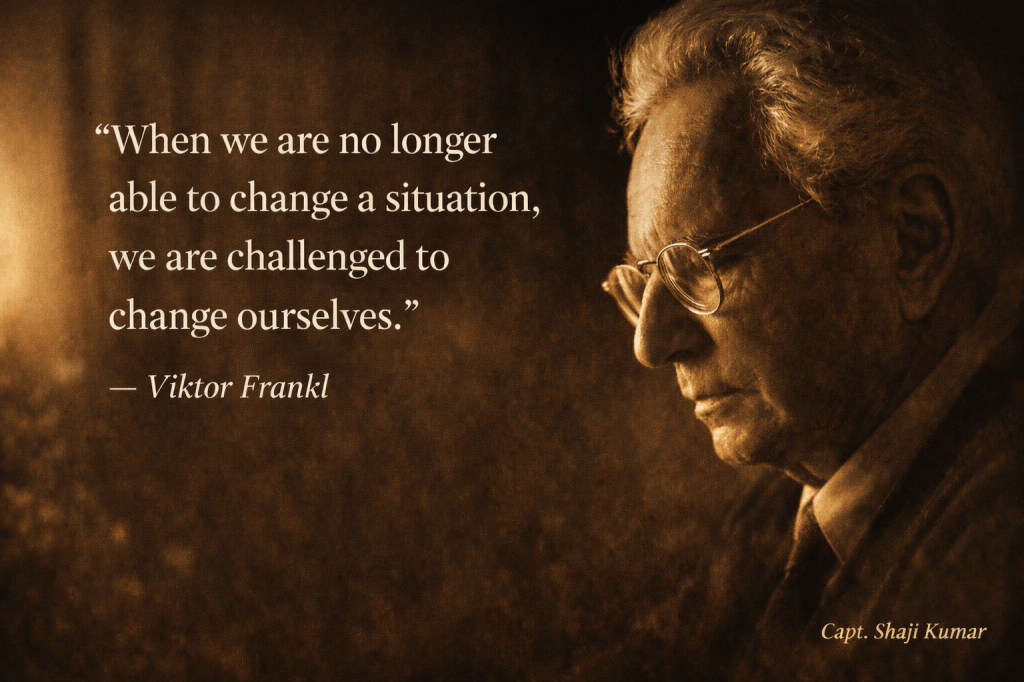
“When we are no longer able to change a situation, we are challenged to change ourselves.” — Viktor Frankl
There is something deeply uncomfortable… almost painfully ironic… about feeling powerless in life.
Because in that moment—when nothing bends, nothing shifts, nothing listens—you are brought face to face with the only question that truly matters:
How do I respond to what is happening to me?
Do I resist?
Do I accept?
Do I fight harder… or do I surrender?
I have lived both sides of this question.
There were times I fought relentlessly—pushing against reality, trying to force outcomes, refusing to accept what was. And there were moments I surrendered—not out of wisdom, but out of exhaustion.
Neither gave me lasting peace.
But over time, something shifted. Through the wisdom of thinkers like Viktor Frankl, I began to see a deeper truth:
👉 The real battle is not outside. It is within.
Today, when life refuses to change, I pause. Instead of asking, “Why is this happening to me?”
I ask, “What is this trying to show me about myself?”
Because every external event—especially the painful ones—is a mirror.
A mirror reflecting:
• My fears
• My attachments
• My expectations
• My ego
And sometimes… my illusions.
It takes courage to look into that mirror.
It is far easier to blame circumstances.
It is far easier to point fingers.
But growth does not live there.
Growth lives in this quiet, difficult shift:
👉 From controlling the world…
👉 To understanding yourself.
This doesn’t mean we stop striving.
It doesn’t mean we become passive.
It means we become aware.
Aware enough to know that while we may not control what happens…
we always control who we become because of it.
✨ FINAL THOUGHT:
When life takes away your power to change the outside world…
it is giving you the opportunity to master your inner one.
“People don’t buy Apple products. They buy the absence of friction.”
We often debate specs. Camera vs camera. RAM vs RAM. Price vs value.
But that’s not why people stay in the Apple Inc. ecosystem.
It’s not the iPhone. Not the Mac. Not even the Watch.
It’s the experience between them.
You take a photo on your iPhone… It’s already on your Mac.
You copy something on your laptop… It’s waiting on your iPad.
Your AirPods switch devices without asking you. Your watch unlocks your Mac before you even realize it was locked.
No noise. No effort. No thinking.
Just flow.
Yes — there are trade-offs.
Closed systems. Higher pricing. Limited customization. Less “freedom” compared to others.
And yet… people stay.
Why?
Because the mental load disappears.
In a world full of decisions, settings, compatibility issues, and constant switching… Apple quietly removes a thousand tiny frictions you didn’t even know were exhausting you.
This is the real lesson.
People don’t stay loyal to products. They stay loyal to experiences that make life simpler.
Not perfect. Not cheapest. But effortless.
And that applies far beyond technology.
In business. In leadership. In life.
If you can reduce friction… If you can make someone’s journey smoother, clearer, lighter…
They won’t just choose you.
They’ll stay.
Because in the end — experience always wins over features.
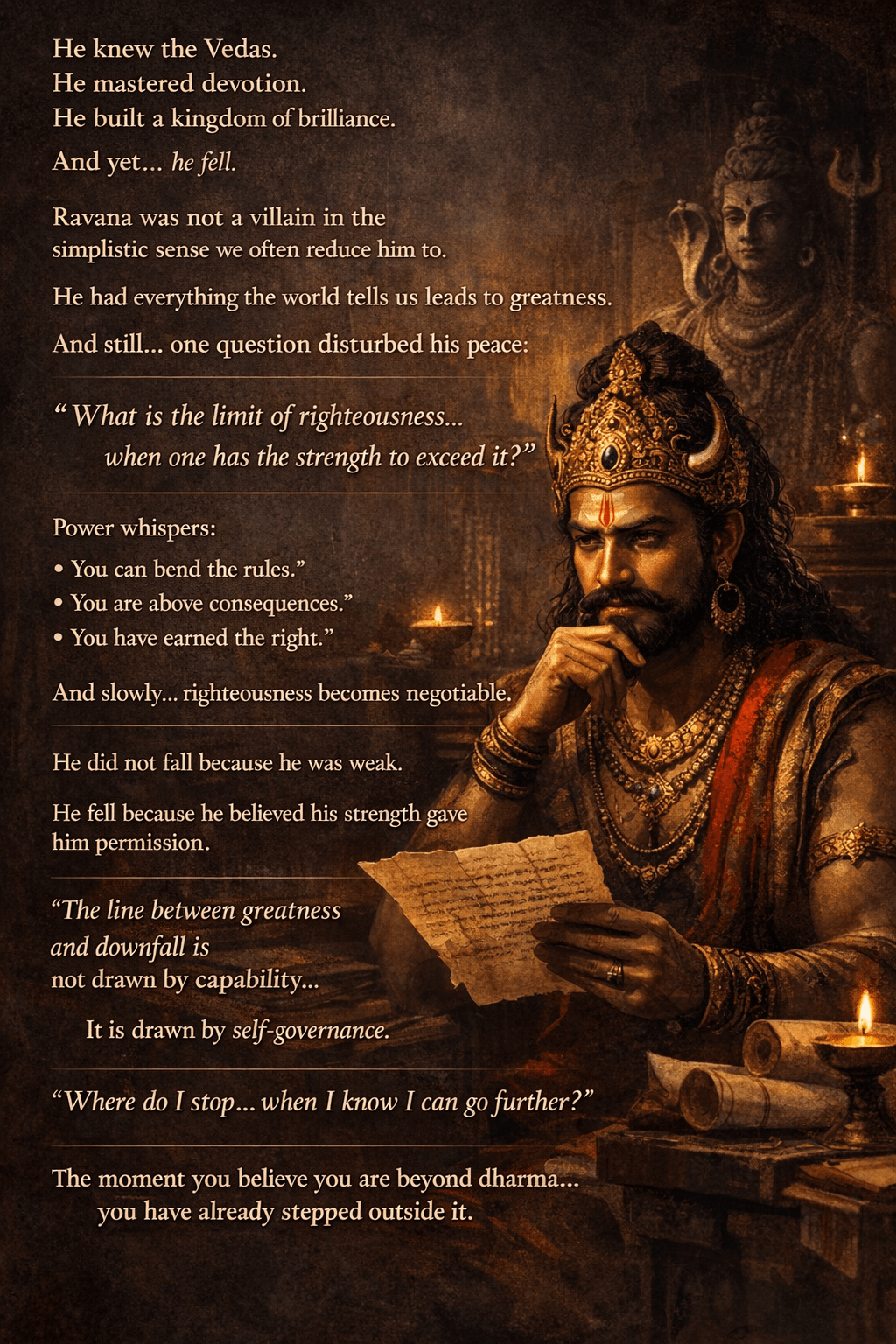
He knew the Vedas. He mastered devotion. He built a kingdom of brilliance. And yet… he fell.
Ravana was not a villain in the simplistic sense we often reduce him to.
He was a scholar of the highest order. A devotee of Lord Shiva whose hymns still echo through time. A ruler whose Lanka stood not just on power—but on knowledge, discipline, and learning.
He had everything the world tells us leads to greatness.
And still… one question disturbed his peace:
“What is the limit of righteousness… when one has the strength to exceed it?”
That question is not ancient. It is disturbingly modern.
Because the real test of a human being is not in what he can achieve…but in what he chooses not to do.
Power creates a dangerous illusion.
It whispers:
“You can bend the rules.” “You are above consequences.” “You have earned the right.”
And slowly… righteousness becomes negotiable.
Not in one dramatic fall—but in a series of quiet justifications.
Ravana did not lack knowledge. He lacked restraint. He did not fall because he was weak. He fell because he believed his strength gave him permission.
That is where most people misunderstand the story.
The line between greatness and downfall is not drawn by capability… It is drawn by self-governance.
Today, we may not be conquering kingdoms—but we command influence, decisions, authority over people and outcomes.
And the same question lingers within us:
“Where do I stop… when I know I can go further?”
Because character is revealed not at the edge of limitation…but at the peak of power.
Ravana’s story is not about myth.
It is about a timeless truth:
The moment you believe you are beyond dharma…you have already stepped outside it.
There’s a quiet myth we all grow up hearing: “You need money to make money.” While that’s partly true, it’s also dangerously incomplete. If wealth were only inherited, the world would never produce new millionaires. Yet every year, thousands of people rise from ordinary backgrounds to build extraordinary financial lives.
What are they doing differently? Let’s break it down—not with clichés, but with real, actionable truths.
1. Trade Survival for Growth
Most people work to pay bills; wealth builders work to buy freedom. Instead of asking, “How can I earn enough this month?” they ask, “How can I increase my value so I earn more every year?” They invest in skills that compound: Writing, Sales, Technology, and Finance. Skills are the only assets no one can take away from you.
2. Systems Over Chasing
Rich people don’t rely on a single income source. They build systems that earn while they sleep:
Digital Assets: Writing online, ebooks, and templates.
Smart Investing: Stocks, ETFs, and SIPs.
The Goal: Turn active income into semi-passive, then fully passive. Even ₹1,000/month is a victory because it proves your system works.
3. The Discipline of the “Boring”
Wealth is not built in a viral moment. It’s built in quiet repetition: writing when nobody is reading, and saving when it feels insignificant. Over 5 years, this “boring” consistency starts to look like “luck” to everyone else.
4. Killing Lifestyle Inflation
This is the silent killer. When most people get a raise, they upgrade their phone. I’ve used the same iPhone for 4 years. While others eat out, I eat out once every two months. By cutting my spending in half, I doubled my ability to invest.
The Truth: Wealth is not what you earn; it’s what you keep and grow.
5. Think in Decades, Not Days
Most people want results in 30 days. Wealthy individuals think in decades. I made the mistake of not investing early, but I’m fixing that now. Compounding requires a “patient” mindset—the goal isn’t just to get rich fast, but to ensure you cannot stay poor.
6. The Power of Leverage
Hard work alone doesn’t create wealth; leverage does. Whether it’s Content Leverage (writing one article that earns for months) or Money Leverage (investments), you must learn to multiply your effort.
The Final Word
You don’t need a rich family or a lucky break. You need a skill, a system, and the belief that it is possible for you. If you are starting from zero, remember: every wealthy person you admire once had no audience and no shortcuts.
They just didn’t stop. And that is the only advantage that truly compounds.