Field notes for first-generation founders — building calm, judgment, and momentum when everything’s on the line.
The Fog Doesn’t Lift. You Move Anyway.
The order you’re waiting for — the one that will finally make this decision obvious — is not coming.
There is no email, no advisor, no cell in the spreadsheet that resolves it for you. You already have most of the information you’re ever going to get. You’re just not moving, because moving feels like gambling and waiting feels like safety.
Here’s the hard part: waiting is a decision. It’s the decision to let the situation decide for you. And the situation does not have your interests at heart.
I see this in nearly every founder I coach, and I lived it myself for years. We’ve been taught that the responsible thing is to gather more data, run one more analysis, wait for clarity. So we sit. We call it diligence. It’s usually just fear wearing a respectable suit.
The Army taught me something about this early, and it has held up across 28 years of building a business with no safety net underneath me. In the field, you are trained on a simple truth: the fog of war never lifts. You will never have the full picture. The enemy won’t wait while you assemble it, and neither will the market, your competitors, or your runway. The commander who freezes until the situation is clear has already lost, because by the time it’s clear, it’s over.
So you’re trained to act on incomplete information — observe, decide, move, then adjust as new information arrives. Not recklessly. Deliberately. The point isn’t to guess. The point is to understand that movement itself generates information that sitting still never will. You learn more in the first ten minutes of acting than in the next ten hours of waiting.
That’s the difference between built and given. Nobody hands you certainty. You build the nerve to move without it — and then you build the discipline to know when moving fast is the right call and when it isn’t. Because the founders who get destroyed usually aren’t the ones who decide too slowly. They’re the ones who decide slowly on the cheap things and fast on the permanent ones. They get it exactly backwards.
This edition’s tool: one-way doors and two-way doors
Before any hard decision, ask a single question:
“If this turns out wrong, how hard is it to undo?”
That splits every decision you’ll ever make into two kinds.
Two-way doors are reversible. You can walk back through them. A pricing test, a new vendor, a campaign, a hire on probation, a process change. If it’s wrong, you adjust and move on. These deserve speed. The cost of waiting almost always exceeds the cost of being slightly wrong and correcting. Decide on 70%. Move. Learn.
One-way doors are permanent, or close to it. Firing a key person. Signing a long lease. Taking on the wrong investor. Burning a relationship. These deserve care — counsel, a night’s sleep, a slow exhale. Here, and only here, is patience actually wisdom.
Most of your decisions are two-way doors. You are agonising over them as if they’re one-way doors, and that’s where the paralysis lives. Sort the door first. Then move at the speed the door allows.
Speed where it’s cheap. Care where it’s permanent.
More on the work, the books, and how I coach:shajikumar.com
Why quitting today may be the most profitable decision you ever make.
Every smoker knows smoking is harmful.
Every cigarette packet says it.Doctors say it.Family members say it.Governments spend millions on campaigns saying it.
Yet millions continue to smoke.
Why?
Because smoking is rarely about nicotine alone.
It becomes a habit.A routine.A stress reliever.A companion during loneliness.A reward after work.A way of fitting in socially.
Over time, the cigarette stops becoming a choice and starts becoming a command.
The frightening part is that the damage begins long before you feel it.
The Silent Damage Begins Early
Many smokers proudly say,
“I’ve been smoking for 20 years and I’m perfectly fine.”
The truth is they are not.
Human bodies are remarkably good at hiding damage until it reaches a tipping point.
While you continue smoking, your body is quietly fighting a battle every single day.
Inside your lungs, tiny air sacs called alveoli begin to lose their elasticity.
Blood vessels gradually narrow.
The heart works harder.
Oxygen levels reduce.
Inflammation spreads throughout the body.
The immune system weakens.
Cells begin accumulating genetic damage.
Most people never notice these changes because they happen slowly.
Then one day, climbing a flight of stairs becomes exhausting.
A persistent cough refuses to go away.
Breathing becomes laboured.
The warning signs appear only after years of silent destruction.
What Smoking Actually Does to Your Body.
Smoking affects nearly every organ.
Your Lungs
Smoking destroys lung tissue permanently.
It causes chronic bronchitis, emphysema and Chronic Obstructive Pulmonary Disease (COPD), conditions that make even simple activities like walking or talking exhausting.
Lung cancer remains one of the leading causes of cancer deaths worldwide.
Your Heart
Every cigarette temporarily increases your heart rate and blood pressure.
Over years, this dramatically increases the risk of:
Heart attacks
Stroke
High blood pressure
Peripheral artery disease
Many smokers don’t die from lung disease.
They die because their cardiovascular system simply gives up.
Your Brain
Nicotine creates one of the strongest addictions known.
It rewires reward pathways.
Without nicotine, the brain begins demanding another cigarette.
This creates the illusion that smoking reduces stress.
In reality, smoking temporarily relieves nicotine withdrawal.
The stress returns quickly, creating an endless cycle.
Your Mouth
Smoking causes:
Bad breath
Yellow teeth
Gum disease
Tooth loss
Oral cancers
Your smile often reveals your smoking habit before your lungs do.
Your Skin
Smoking accelerates ageing.
Wrinkles appear earlier.
Skin loses elasticity.
Complexion becomes dull.
Blood circulation decreases.
Many people spend thousands on skincare while continuing to smoke.
The two simply cannot coexist.
The Financial Cost Nobody Calculates
Most smokers underestimate how much they spend.
Suppose someone smokes one pack a day costing ₹350.
That becomes approximately:
₹10,500 every month
₹1,26,000 every year
₹12.6 lakh in ten years
Now imagine investing that amount instead.
With disciplined investing and compounding, the figures become astonishing over time.
Smoking doesn’t just burn tobacco.
It burns wealth.
It burns opportunities.
It burns financial freedom.
The Good News: Your Body Starts Healing Immediately
This is perhaps the most encouraging part.
Your body wants to recover.
The moment you stop smoking, healing begins.
Within 20 minutes, heart rate and blood pressure begin moving towards normal.
Within 12 hours, carbon monoxide levels fall significantly and oxygen levels improve.
Within weeks, circulation improves.
Breathing becomes easier.
Walking becomes less tiring.
Within months, lung function improves noticeably.
Within years, the risks of heart disease, stroke and several cancers decline substantially compared to continuing smokers.
The body possesses an extraordinary ability to repair itself when given the opportunity.
Why Most People Fail to Quit
Most smokers don’t fail because they lack willpower.
They fail because they fight the wrong battle.
They focus only on resisting cigarettes.
They don’t change:
their routines
emotional triggers
habits
environment
mindset
The cigarette itself isn’t always the real addiction.
The behaviour surrounding it is.
Without changing that behaviour, quitting becomes unnecessarily difficult.
Quitting Is Not About Suffering
Many people imagine quitting means endless cravings and misery.
It doesn’t have to be that way.
Successful quitting follows a structured process.
You prepare.
You understand your triggers.
You replace habits.
You create accountability.
You develop new routines.
You learn how to manage cravings without feeling deprived.
Once the mind accepts the decision, the body gradually follows.
Your Future Self Is Waiting
Imagine waking up without coughing.
Walking without breathlessness.
Travelling without looking for smoking zones.
Playing with your children or grandchildren without fatigue.
Sleeping better.
Eating better.
Smelling better.
Feeling proud instead of guilty.
Every cigarette you don’t smoke is a vote for that future.
The Best Time to Quit Was Yesterday. The Second Best Time Is Today.
There is never a perfect day.
Never a perfect Monday.
Never a perfect New Year.
Never a perfect birthday.
The decision begins with one cigarette not smoked.
Then another.
Then another.
Eventually, the identity changes.
You no longer become someone trying to quit.
You become someone who simply does not smoke.
That transformation changes everything.
If You’re Serious About Quitting, I’ve Written the Roadmap
Quitting smoking isn’t merely about giving up cigarettes.
It’s about reclaiming your health, your confidence, your time and your financial future.
This isn’t another book filled with lectures or scare tactics.
It is a practical, step-by-step guide that helps you:
Understand why you smoke.
Break the psychological addiction.
Handle cravings effectively.
Build habits that replace smoking.
Save the money you would have spent on cigarettes.
Turn those savings into long-term wealth through disciplined financial habits.
Because quitting smoking is not just about living longer.
It’s about living better.
And becoming financially stronger along the way.
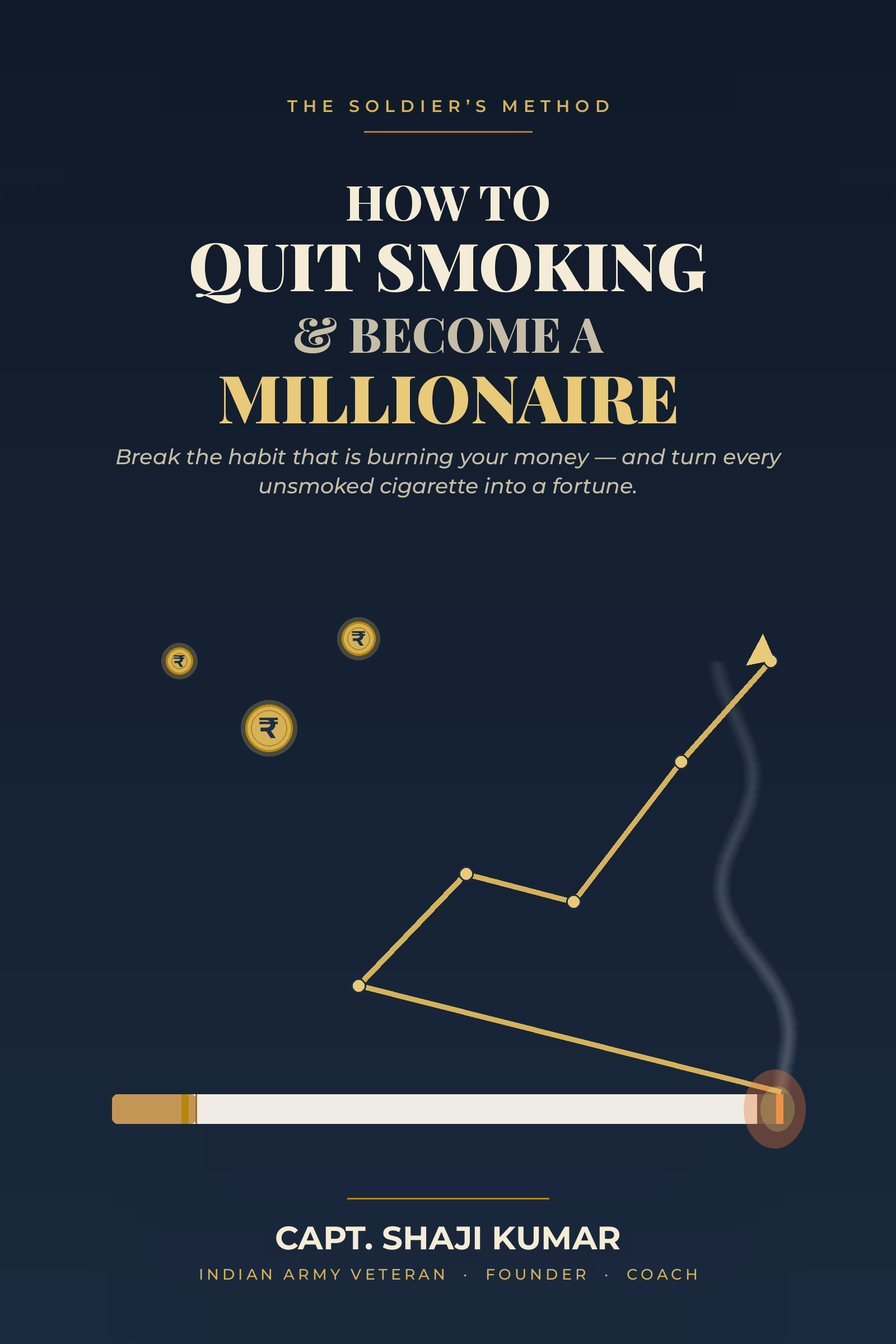
You can get your copy on Amazon here or read for Free:
📘 How to Quit Smoking and Become a Millionaire
If this article made you pause and think, please share it. Someone in your network may be waiting for the one message that finally helps them make the decision to quit.
Sometimes, changing one life begins with sharing one article.
We live in a world that has almost normalized stress.
Being busy is worn like a badge of honour. Sleepless nights are celebrated as dedication. Anxiety is dismissed as part of ambition. Burnout is called success.
But let me ask you one simple question.
If stress is the problem, why do so many people eliminate one source of stress only to find another waiting for them?
Someone changes jobs.
The work stress disappears.
Financial stress arrives.
They earn more.
Relationship stress begins.
They improve relationships.
Health anxiety takes over.
It is an endless cycle.
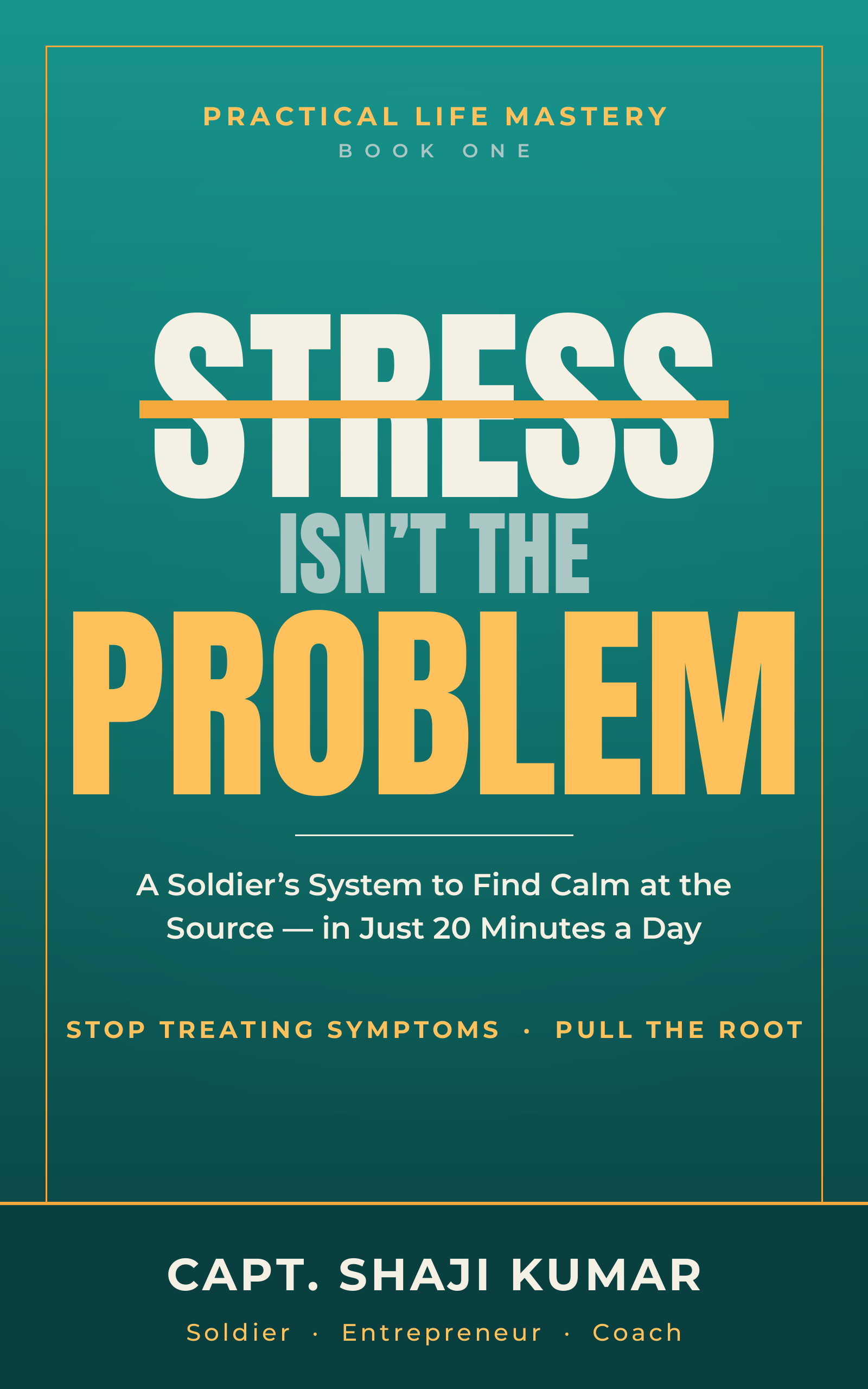
That is precisely why I wrote “Stress Isn’t The Problem.”
Because after spending decades in the Indian Army, building businesses, leading teams, facing personal setbacks and rebuilding life more than once, I realised something profound.
Stress is rarely the real problem.
It is only the symptom.
We Keep Treating Symptoms
Modern life offers countless solutions.
Meditation apps.
Music.
Vacations.
Weekend breaks.
Motivational videos.
Breathing exercises.
Most of them work.
For a while.
But then stress quietly returns wearing a different mask.
Why?
Because we keep removing leaves while the roots remain untouched.
Imagine a tree whose leaves keep turning yellow.
You can polish the leaves.
Trim them.
Spray them.
Replace them.
But unless you fix the roots, nothing changes.
Stress works exactly like that.
My Journey Changed the Way I Understood Stress
The lessons in this book did not come from a laboratory.
They came from life.
From military service.
From entrepreneurship.
From leadership.
From financial uncertainty.
From success.
From failure.
From rebuilding after losing almost everything.
There were moments when I realised something remarkable.
The people who stayed calm under immense pressure were not necessarily stronger.
They simply understood where stress was actually coming from.
That became the foundation of this book.
Stress Has Many Faces
Most people believe stress is just one thing.
It isn’t.
Stress appears in many forms.
Financial stress.
Career stress.
Family stress.
Health stress.
Relationship stress.
Identity stress.
Purpose stress.
Treating all of them with one generic solution is like prescribing the same medicine for every illness.
It simply doesn’t work.
One of the central ideas in my book is identifying the seven branches of stress so that you stop fighting the wrong battle.
Stop Asking, “How Do I Reduce Stress?”
Start asking,
“What is creating this stress?”
That single shift changes everything.
Instead of becoming reactive, you become aware.
Instead of suppressing emotions, you begin understanding them.
Instead of surviving every day, you begin designing a better life.
Clarity Is the Real Antidote
Throughout my coaching programmes under Clarity Under Pressure™, I have observed one common pattern.
People rarely lack intelligence.
They rarely lack capability.
They lack clarity.
Unclear priorities.
Unclear goals.
Unclear expectations.
Unclear boundaries.
And uncertainty is one of the greatest generators of stress.
When clarity increases, stress naturally begins to decrease.
That is why this book is not another motivational book.
It is a practical system.
A Soldier’s Framework
Military training teaches something invaluable.
When pressure increases, you don’t panic.
You return to your system.
That philosophy shaped this book.
Inside, you’ll discover:
Why chasing symptoms keeps you exhausted.
The seven branches of stress and how to identify which one is affecting you.
A practical 20-minute daily practice that helps reset your mind.
A simple seven-day reset.
A Pocket Protocol you can use whenever life feels overwhelming.
Nothing complicated.
Nothing theoretical.
Just practical methods that can be applied immediately.
Who Should Read This Book?
This book is for you if:
You constantly feel mentally exhausted.
Your mind refuses to switch off.
Work follows you home.
Small problems feel overwhelming.
You’re successful on the outside but restless within.
You want practical solutions instead of motivational speeches.
Whether you’re a professional, entrepreneur, student, leader, parent or someone simply trying to regain control of life, this book was written with you in mind.
Stress Doesn’t Need Another Escape Route
It needs understanding.
When you understand its source, you stop fearing it.
When you stop fearing it, you begin leading your life instead of reacting to it.
That is the transformation I hope every reader experiences.
A Personal Invitation
If this article resonated with you, I invite you to read my latest book:
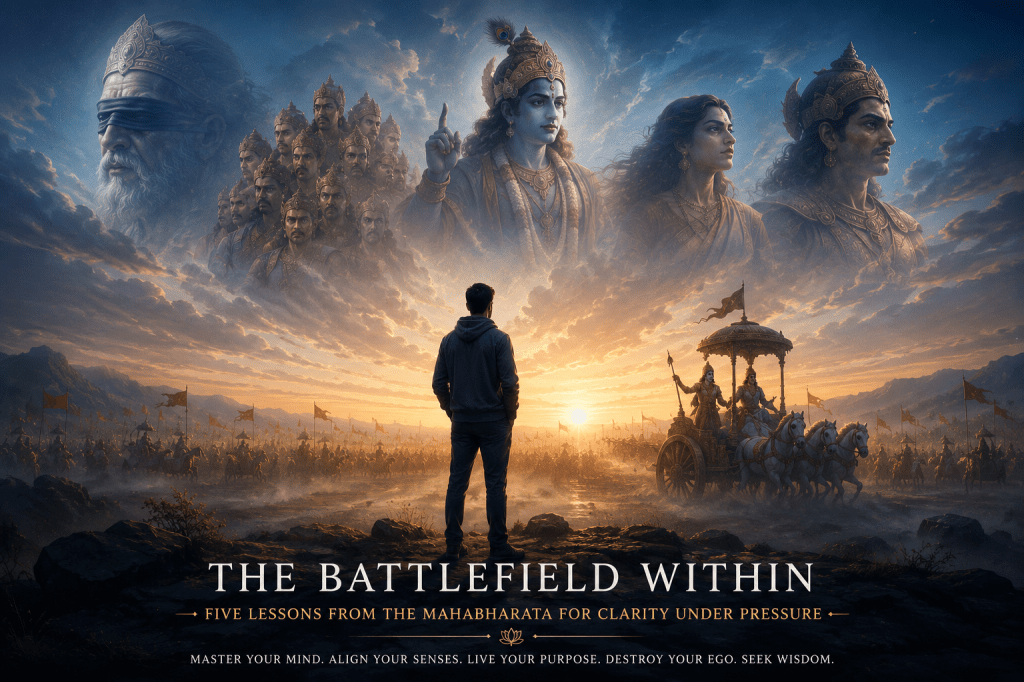
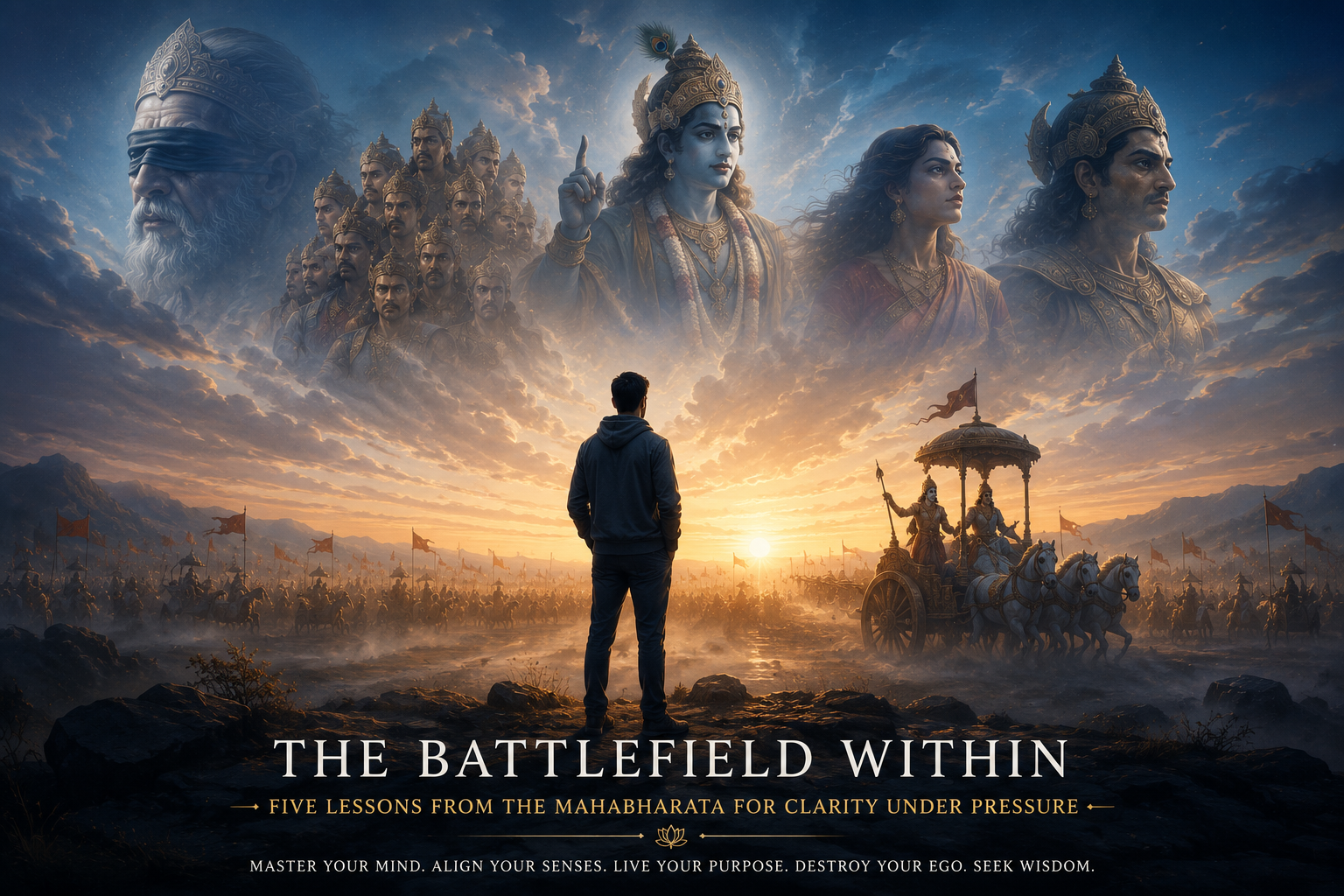
The Mahabharata is often described as the greatest epic ever written. Most people read it as a story of kingdoms, dynasties, politics, war, loyalty and betrayal. I see something more.
I see the Mahabharata as the story of every human mind.
Its greatest battlefield is not Kurukshetra. It is the battlefield within us.
Every single day, we fight invisible wars. Between discipline and temptation. Courage and fear. Ego and humility. Purpose and distraction. Clarity and confusion.
The Mahabharata is not merely ancient history. It is an operating manual for human behaviour.
When viewed through this lens, the characters become symbols of the forces that influence our decisions under pressure.
Here are five lessons that continue to shape my understanding of leadership and life.
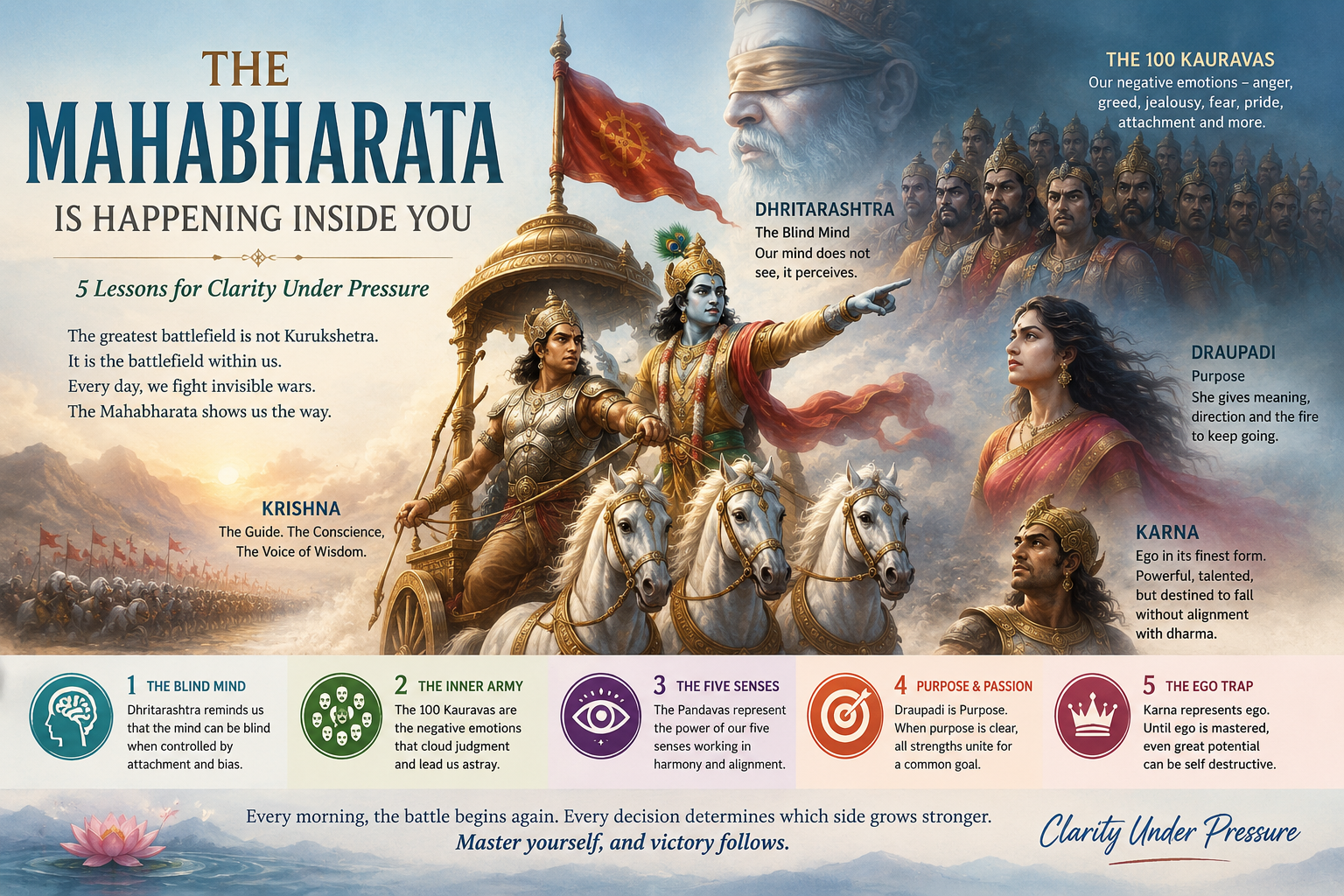
1. Dhritarashtra: The Blind Mind.
King Dhritarashtra was born blind.
Symbolically, I see him representing the human mind.
Our mind does not directly experience reality. It depends entirely on information supplied through the senses. Every sight, sound, smell, taste and touch is interpreted before it becomes our understanding of the world.
The problem is not blindness.
The problem is allowing emotion to distort perception.
Dhritarashtra repeatedly chose attachment over justice. His inability to rise above personal bias led to disastrous decisions.
The same thing happens to us.
When fear clouds judgment…When greed overrides ethics…When attachment becomes stronger than truth…
our decisions begin to resemble those of the blind king.
Clarity Under Pressure begins by recognising that perception is not always reality.
Before making important decisions, ask yourself:
“Am I seeing the situation as it is, or as my emotions want me to see it?”
That single question can prevent countless mistakes.
2. The Hundred Kauravas: Your Inner Army of Negative Emotions.
Why one hundred brothers?
Perhaps because negative emotions never arrive alone.
Anger invites revenge.
Fear creates hesitation.
Jealousy breeds resentment.
Greed demands more.
Arrogance rejects advice.
One negative thought rarely remains isolated. It recruits many others.
Whether or not one accepts this symbolic reading, it offers a useful reflection on human behaviour: destructive emotions often reinforce one another.
Every leader experiences this.
Every entrepreneur experiences this.
Every family experiences this.
When pressure increases, the army inside us grows louder.
The challenge is not eliminating emotion.
The challenge is refusing to let emotion command the mind.
The battle is never outside first.
It always begins within.
3. The Five Pandavas: Aligning Your Five Senses
Every human being is gifted with five senses.
Seeing.
Hearing.
Touch.
Taste.
Smell.
These senses constantly collect information about the world around us.
But information alone never creates success.
Alignment does.
Imagine a leader who sees opportunities but refuses to listen.
Or someone who hears advice but ignores evidence.
Or a professional who observes everything but acts without conviction.
Success demands that all our faculties work together.
The Pandavas remind us that strength does not come from individual excellence.
It comes from unity.
Clarity Under Pressure is achieved when what you see, hear, believe and act upon all point in the same direction.
4. Draupadi: Purpose Gives Direction.
One of the most profound symbolic interpretations I have encountered is seeing Draupadi as purpose.
Purpose gives direction to strength.
Without purpose, ability is scattered.
With purpose, ordinary people become extraordinary.
After her humiliation, Draupadi took a solemn vow. That moment transformed personal pain into collective resolve. Every Pandava found renewed determination through a shared cause.
That is exactly what purpose does.
Purpose aligns effort.
Purpose sustains resilience.
Purpose helps people endure hardships that talent alone cannot overcome.
Many organisations have intelligent people.
Many families have capable individuals.
Many professionals possess exceptional skills.
Yet they struggle because everyone is pulling in different directions.
Purpose creates alignment.
When purpose is clear, difficult decisions become easier.
Distractions lose their power.
Momentum replaces confusion.
5. Karna: The Silent Cost of Ego.
Among all the characters in the Mahabharata, Karna remains one of the most fascinating.
Brilliant.
Generous.
Fearless.
Loyal.
Yet tragically conflicted.
Many symbolic interpretations see Karna as representing the human ego. While this is not a traditional reading of the epic, it captures an important truth about life.
Ego rarely announces itself.
It disguises itself as self-respect.
As pride.
As the need to prove a point.
As the refusal to apologise.
As the inability to change.
As the belief that being right matters more than doing what is right.
Think about how many businesses have failed because leaders refused to listen.
How many partnerships collapsed because neither side would compromise.
How many families remain divided because someone chose pride over reconciliation.
Success rarely disappears because of a lack of intelligence.
It disappears because ego quietly takes control.
The greatest victories in life are often achieved not by defeating others, but by mastering ourselves.
And Then There Is Krishna.
Every battlefield needs guidance.
Krishna does not fight the war.
He becomes the charioteer.
The guide.
The voice of wisdom.
The conscience that helps Arjuna see clearly when emotions threaten to overwhelm him.
Every one of us needs a Krishna.
Sometimes it is a mentor.
Sometimes it is a coach.
Sometimes it is a trusted friend.
Sometimes it is our own inner conscience.
Clarity is rarely achieved in isolation.
Wise guidance helps us see what emotion often hides.
The Real Kurukshetra
The Mahabharata is not only about an ancient war.
It is about the war each of us fights every day.
The blind mind.
The army of negative emotions.
The disciplined senses.
A purpose worth living for.
The constant battle against ego.
And the quiet voice of wisdom that helps us choose the right path.
Every morning, the battle begins again.
Every decision determines which side grows stronger.
The question is not whether the Mahabharata still exists.
The question is this:
Who is winning the battle within you?
Because long before we lead organisations, build businesses or transform societies, we must first learn to master ourselves.
That, perhaps, is the timeless lesson of the Mahabharata.
And that is the essence of Clarity Under Pressure.
There comes a point in every person’s life when excuses begin to lose their meaning.
You can continue blaming the economy, your employer, your background, your age, your qualifications, or your circumstances. Many of those reasons may even be valid. Life has never promised a level playing field.
But at some point, one question refuses to go away.
What are you going to do about it?
That single question separates people who remain spectators from those who become creators of their own future. For decades we have conditioned ourselves to believe that success follows a predictable path. Study hard. Get a good job. Work for someone else. Wait for promotions. Retire comfortably.
The world has changed.
Jobs are changing. Industries are changing. Technology is changing. The skills that made people successful yesterday may not guarantee relevance tomorrow.
If there was ever a time to take charge of your own future, it is now.
Many people think entrepreneurship is only for a privileged few. They imagine billion dollar startups, venture capital funding, sophisticated offices, and teams of hundreds. Nothing could be farther from the truth.
Entrepreneurship begins with a problem. A problem you understand. A problem that frustrates you. A problem you genuinely want to solve.
It may be teaching children in your neighbourhood.
Helping senior citizens use technology.
Preparing students for interviews.
Creating healthy food for working professionals.
Repairing appliances.
Building websites.
Writing content.
Growing organic vegetables.
Offering bookkeeping services.
Designing homes.
Training people in communication.
Helping small businesses market themselves.
Every successful enterprise that exists today started because someone decided that a problem deserved a solution. Not every enterprise has to become a unicorn. Some simply have to become meaningful. That is enough.
I have spent decades working with people from different walks of life. I have seen extraordinary talent hidden behind ordinary appearances. The biggest obstacle has rarely been capability. It has almost always been belief. People underestimate themselves.
They wait until they feel ready.
They wait for the perfect opportunity.
They wait for more money.
They wait for someone to discover them.
They wait for confidence.
Sometimes they spend years waiting.
Confidence rarely arrives before action.
It usually arrives because of action.
You begin.
You stumble.
You learn.
You improve.
You grow.
Every entrepreneur has experienced uncertainty.
Every successful professional has made mistakes.
Every meaningful journey begins before certainty arrives.
Do not confuse small beginnings with small futures.
The size of your first step has nothing to do with the distance you can eventually travel.
What matters is whether you are moving.
Building your own enterprise is not merely about earning an income.
It changes something much deeper.
It changes the way you think.
Instead of asking, “Who will give me an opportunity?”
You begin asking, “How can I create one?”
Instead of asking, “Who will solve this problem?”
You begin asking, “Can I solve it?”
That shift changes everything.
The future belongs to people who create value.
It does not matter whether you are twenty-five or sixty-five.
It does not matter whether you begin from a garage, a spare bedroom, your dining table, or a mobile phone.
Every meaningful enterprise begins with one person deciding to act.
Not tomorrow. Today.
At the Global Learning Centre, this is the mindset we want to nurture. We are not trying to produce people who simply look for jobs. We want to develop people who can create opportunities for themselves and for others.
People who think independently.
People who solve problems.
People who build with integrity.
People who contribute to society while creating livelihoods.
The world does not need more people waiting for permission.
It needs more people willing to take responsibility.
Your future is not hidden somewhere waiting to be discovered.
Field notes for first-generation founders — building calm, judgment, and momentum when everything’s on the line.
Pressure Was Never the Problem
Picture the founder at 11 p.m. Payroll runs in nine hours. The number in the account doesn’t cover it. He opens the same spreadsheet for the fourth time, as if the figures might have changed since the third.
They haven’t.
Here’s what’s actually happening in that room — and it has nothing to do with the money. Under that kind of pressure, his thinking has narrowed to a tunnel. He isn’t weighing options anymore. He’s bracing. And a man who is bracing makes bad calls, because bracing is not the same as deciding.
That’s the whole game. Pressure doesn’t break you by making you afraid — fear is manageable. It breaks you by quietly removing your judgment at the exact moment you need it most. The first casualty isn’t your nerve. It’s your ability to think clearly.
I learned this young, in uniform. Commissioned in March 1988. The Army never trains you to feel no pressure — that’s a fantasy, and a dangerous one. It trains you so that when the pressure arrives, your judgment is still standing. The drill, the repetition, the checklist run a hundred times — none of it exists to make the moment calm. It exists so you can still make a sound decision inside a moment that isn’t.
Then I spent 28 years building a staffing & Facility Management business from nothing. Bootstrapped. No safety net. No family money behind me, no investor to call at midnight. Just payroll that had to clear, clients who had to be served, and a team that had to be paid whether or not the receivables came in on time. Pan-India, sixteen cities, one decision at a time.
And I found the same law operating that I’d first met in uniform: the people who survive pressure aren’t the ones who feel less of it. They’re the ones who keep their judgment intact while everyone around them loses theirs.
That’s the difference between built and given. Nobody handed me a calm nervous system. I built one — under load, on the job, the hard way. And the good news, the reason this newsletter exists, is that it’s *buildable*. It’s a system, not a personality trait. You don’t have to be born unshakeable. You can train it.
**That’s what this is for.**
Clarity Under Pressure™ is a fortnightly field manual for first-generation founders and professionals making hard transitions — the ones doing it without a template, without a network that already believes in them, without the luxury of a soft landing if it goes wrong. Every edition gives you one usable tool for keeping your head when the stakes spike: in the business, in the boardroom, in the room where the decision actually gets made.
No theory you can’t use by Friday. No motivational noise. Field notes from someone who’s been bracing at 11 p.m. and learned how to stop.
This edition’s tool: the 90-second triage
Next time pressure spikes and you feel the tunnel closing, don’t decide anything yet. First, run three questions out loud — on paper, not in your head, because the head is where the spiral lives:
1. **What’s actually true right now?** Facts only. Not the fear, not the worst case — the verifiable situation in front of you.
2. **What’s the single next action?** Not the whole solution. The *next step*. One.
3. **What can wait until morning?** Most of it can. Pressure lies about what’s urgent.
Ninety seconds. That’s a triage drill, and triage is what soldiers do when everything is on fire and the worst response is to freeze. It won’t make the problem smaller. It will keep your judgment standing while you solve it — which is the only thing that ever actually mattered.
Are we outsourcing the very faculty that built AI in the first place?
There was a time, not so very long ago, when intelligence was not artificial. It was simply a human being, thinking.
We solved problems by watching, reasoning, remembering, and imagining our way toward an answer. We argued and debated. We questioned, experimented, failed, and went back to try again. The process was slow and often maddening, but it produced something a machine still cannot hand us: judgment earned the hard way. Whether we turned out right or wrong almost didn’t matter. The understanding was ours, because the effort had been ours.
Today we stand on a somewhat unfamiliar surrounding.
For the first time in our history, we have built machines that can write an essay, draft a contract, compose music, generate a photograph, debug code, and hold a conversation convincing enough to forget there is no one on the other side. I belong to the cusp generation — old enough to remember the other way of doing things, young enough to use the new one every day. I can still picture myself at the office late in the evening, drafting by hand a felicitation note for the company’s anniversary, hunting for a slightly different line for each person so that no two people received the same congratulation. A single festival greeting could take the better part of a night. It seems almost quaint now. A few keystrokes and the machine offers me fifty versions before I’ve finished my tea.
Artificial intelligence is, without exaggeration, among the finest things our species has ever made.
And yet a question keeps returning, and I cannot quite talk myself out of it.
What happens when we lean on artificial intelligence so completely that we stop exercising the real thing?
In small ways, it has already begun. There was a time most of us could run a column of figures in our heads. Then the calculator arrived, and within a generation the skill quietly left us. You can still find it here and there — the older shopkeeper who glances at your basket, pauses for a beat, and tells you the exact total before you’ve reached for your phone. But he is the exception now. Take away most people’s calculator and watch them stall over a sum a schoolboy once managed standing up.
The irony at the heart of it
The irony is too large to step around.
Artificial intelligence did not descend from some machine. It came out of us. Every algorithm, every neural network, every stubborn line of code began in a human mind — people who spent decades thinking hard, asking awkward questions, and sitting with problems that refused to yield. Human intelligence is the parent of artificial intelligence.
What unsettles me is how quickly the child is being asked to replace the parent.
The student hands the assignment to it. The professional lets it write the report. The manager asks it to summarise the meeting he didn’t fully attend. The writer asks it for the idea he used to chase down himself. And in courtrooms in more than one country, judges have begun consulting it on the very questions they were appointed to weigh. A tool meant to extend human capacity is, by degrees, becoming a substitute for human effort.
Every convenience sends a bill
Each leap forward arrives wrapped in convenience. The calculator spared us the arithmetic. GPS spared us the map. The search engine spared us the trouble of remembering. We made those trades and, on balance, were richer for them.
This one is different in kind.
The earlier tools took over tasks. This one offers to take over the thinking itself — and that is a wholly different bargain.
A muscle left unused does not stay strong; it softens and forgets its own strength. The mind is no different. The real risk was never that the machine would out-think us. The risk is duller and closer to home: that we will simply lose the appetite to think for ourselves.
The lost art of the struggle
Almost everything I have learned that was worth keeping, I learned the slow way.
A child learns by falling over. A founder learns by getting it wrong with his own money on the line — I spent the better part of three decades building a company up from almost nothing, and not one useful lesson in all that time arrived gift-wrapped. A leader learns in the cold minutes when a hard decision has only him to make it. The struggle was never the obstacle standing between us and the lesson. The struggle *was* the lesson.
When every answer appears the instant we want it, we quietly give up the journey that turns information into understanding. Being handed an answer and arriving at one are not the same act. One leaves you with a fact. The other leaves you changed.
What we are handing the young
My real worry sits with the generation coming up behind us.
Many of them are growing up in a world where the answer arrives before the question has properly formed. It began innocently enough with Google and has become Gemini, ChatGPT, and whatever you happen to subscribe to next — and the design is the same each time. The first taste is free and frictionless, generous to a fault, right up until the dependence is complete. We have a word for that pattern, and it isn’t *convenience*.
Why spend an afternoon in the research when a summary lands in seconds? Why build an argument when one can be conjured whole? Why labour over a paragraph when the machine writes faster than you can think?
The technology is not the villain here. The danger is the moment convenience quietly replaces curiosity. Every real advance in human history came from someone who refused the accepted answer, distrusted the obvious, and went looking for what did not yet exist. If the next generation grows up consuming intelligence rather than producing it, I wonder what becomes of invention itself.
A bicycle, not a chauffeur
Good tools leave you stronger for having used them.
Someone once called the computer a bicycle for the mind, and it remains the right picture. A bicycle carries you further and faster than your legs alone ever could — but it still asks you to pedal, and you arrive fitter than you left. The danger today is that we are quietly trading the bicycle for a chauffeured car: it gets us there in comfort, asks nothing of us, and teaches us nothing about the road.
In the Army they taught us, in a hundred uncomfortable ways, that an outfit which stops training does not stay sharp for long. Capability is not a possession you bank. It is a discipline you keep — or slowly lose.
Where the real future lies
None of this is an argument for switching the machine off. That would be both foolish and impossible, and I have no interest in it.
The future will belong to people who can hold human judgment and artificial capability in the same hand. Let the machine do what it is extraordinary at — sift oceans of information, throw up a hundred possibilities in a minute, draft the rough first version. Then do what it cannot. Supply the context. Decide what any of it means. Choose, out of all those possibilities, which question was even worth asking.
The most valuable skill of the next twenty years may not be knowing how to use artificial intelligence at all. Almost everyone will manage that. The rarer thing will be the ability to keep thinking for yourself while you use it.
One question, before we get too comfortable
So perhaps, in the rush to embrace something genuinely remarkable, it is worth stopping long enough to ask ourselves a single plain question.
Are we using artificial intelligence to enlarge our intelligence — or to retire it?
The answer will shape more than the future of work. It will shape what we remain capable of.
Because long before intelligence was ever artificial, it was deeply, stubbornly human. And it was that intelligence — ours — that built the world we are now so tempted to hand over.
Stop Managing Your Time. Start Managing the Pressure.
A soldier-founder’s take on why your calendar isn’t the problem — and what actually is.
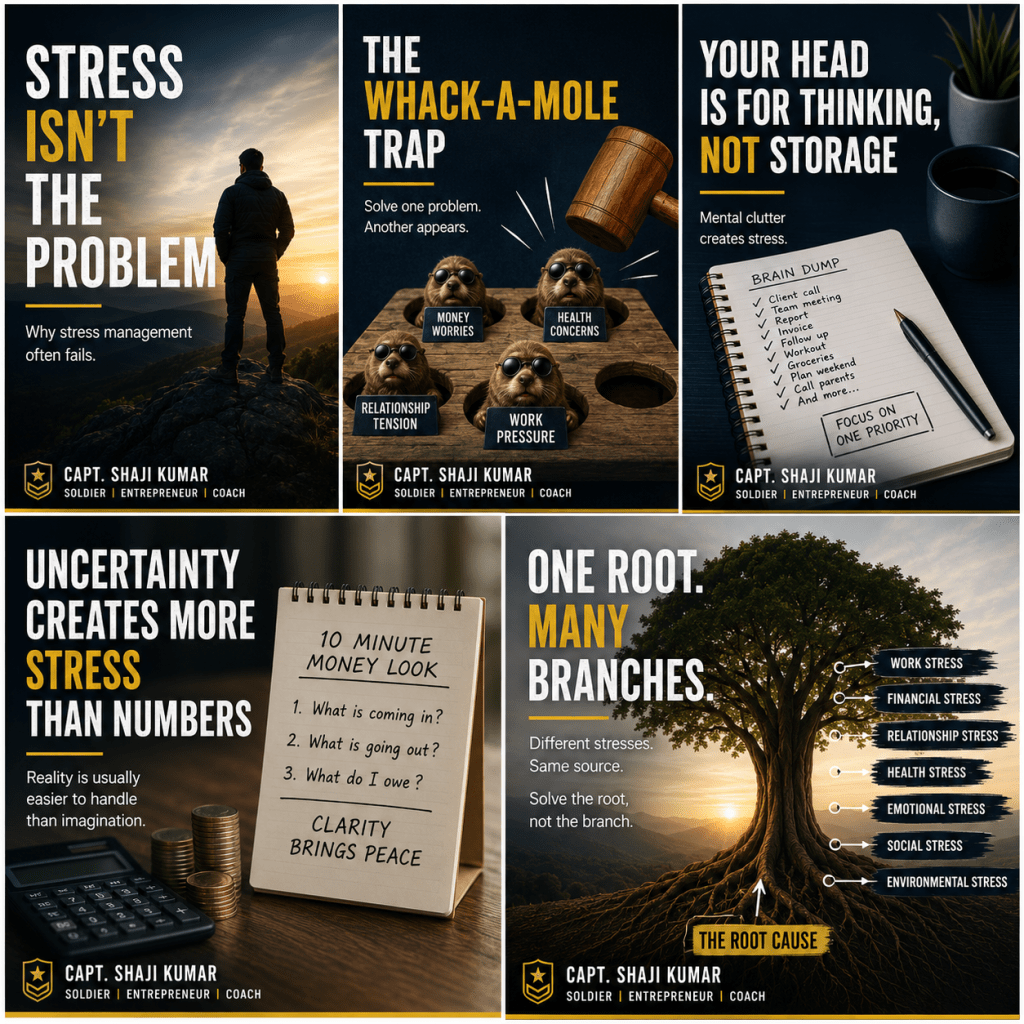
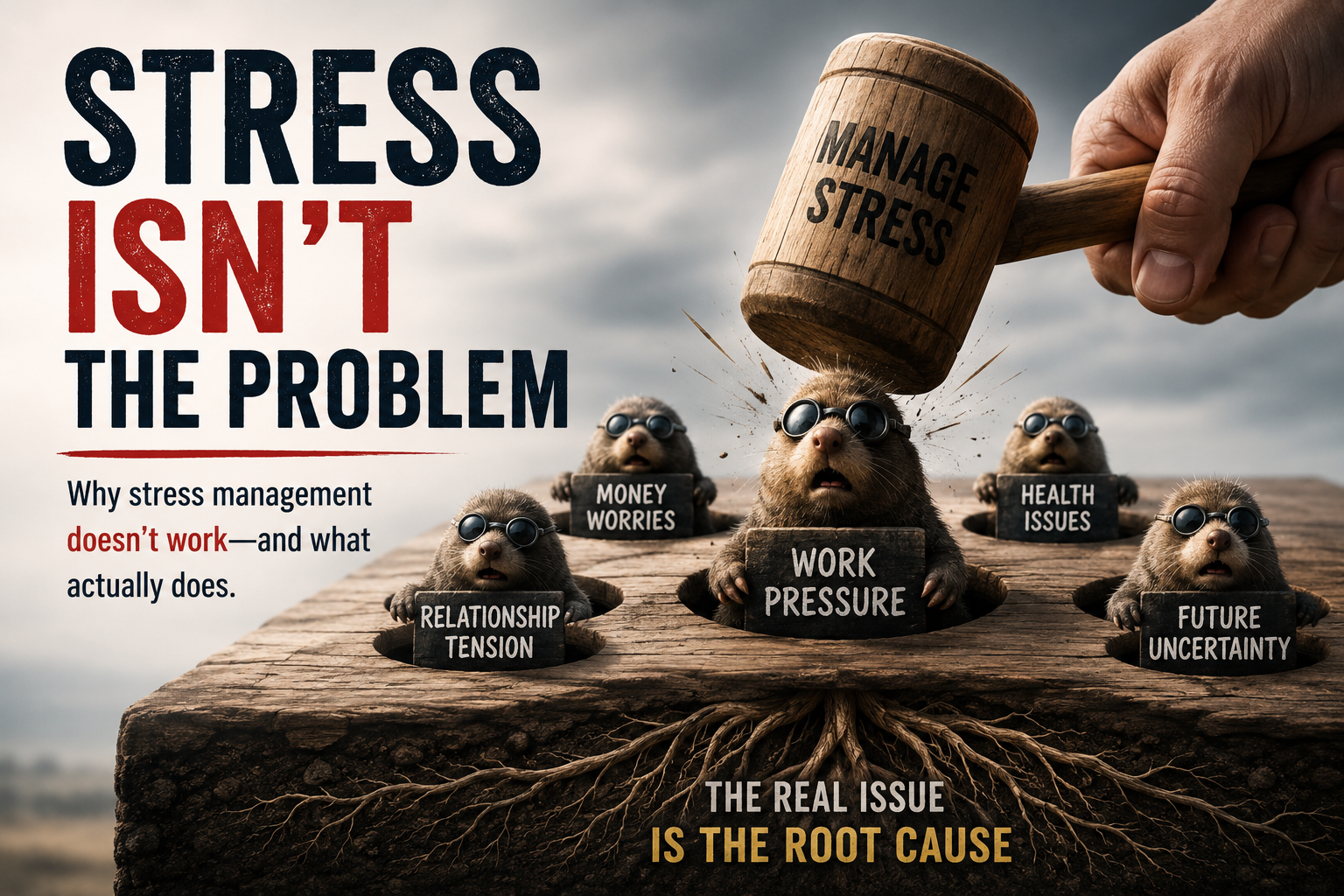
There is a game at every fair. A row of holes, a soft mallet, and a plastic mole that pops its head up. You hit it. It drops. Another appears somewhere else. You hit that one. A third pops up. The faster you swing, the faster they come. You never win. You only get tired.
That game is the most honest picture I know of how most of us manage our time.
We feel stressed, so we go looking for a better system. A new planner. A new app. Time-blocking. The two-minute rule. Eat the frog. Inbox zero. Each one works — for about a week. The relief drains away, the pressure resurfaces somewhere else, and off we go to buy the next mallet.
I played that game for the better part of twenty years. I want to tell you what I finally understood, because it changed how I work — and, more importantly, how I feel while I work.
I had it backwards
I am a former soldier and a first-generation businessman. I built a services business across India from almost nothing — no outside investor, close to four decades around people and pressure. Solving problems by force of will is, frankly, what I am good at. Give me an objective and I will take it head-on, with discipline, one task at a time.
That approach worked on everything except one thing: the constant, low-grade hum of feeling stressed and behind.
I treated it the way I treated every other problem — as a time problem. If I felt stressed, I must be disorganised. So I organised harder. Better lists. Tighter schedules. Earlier mornings. And every system handed me the same result: a short burst of control, then the pressure quietly seeping back in.
It took me an embarrassingly long time to see the obvious. I was hitting moles. I was never touching whatever sent them up.
Your to-do list is a symptom, not a cause
Here is the distinction that finally set me free.
Your overflowing to-do list is not the cause of your stress. It is a symptom of it.
Sit with that for a moment, because everything turns on it.
When you are calm, a long list is just a long list. You pick up the item on top and you start. When you are already stressed, that same list becomes a threat. Every item shouts at once. You freeze, you scatter, you refresh your inbox for the ninth time, and three hours vanish with nothing real to show for them.
Same list. Same hours. Completely different experience.
The difference was never the schedule. It was the state of the person reading it.
This is why the productivity hack always disappoints in the end. It is excellent at trimming the branches — and the branches do need trimming. But it never goes near the root. So the tree keeps producing. You stay busy, you stay behind, and you stay tired.
The hidden tax of a hot nervous system
We talk about stress as if it were only a feeling. It is also a thief of time, and a quiet, expensive one.
A stressed mind makes worse decisions, so you redo work. It cannot hold attention, so simple tasks take twice as long. It catastrophises, so you spend energy on problems that never arrive. It reaches for distraction, so an hour leaks away in scrolling you barely remember. None of this shows up on your calendar, but all of it is billed to your day.
So when you feel you have no time, look closer. Often you have plenty of time — you are simply paying a heavy tax on every hour because the operator is running hot. Lower the temperature, and hours you thought were lost quietly come back.
I have watched this in my own week, plainly. On the days I am calm, I do a full day’s work by mid-afternoon and wonder where the pressure went. On the days I am wound tight, I am at my desk from dawn to dark and finish convinced I never caught up. The workload on both days is roughly the same. The only variable that moved was me.
Which means the real work happens on two levels at once. The branch and the root. Let me give you one practical thing for each. Today. No app required.
The trap of the perfect system
There is a particular cruelty in the productivity industry, and it took me years to name it. The search for the perfect system becomes a stressor of its own.
Think about what actually happens when you adopt a new method. There is the reading. The setting up. The migrating of old lists into the new format. The learning curve. The quiet guilt the first time you fall off it. And then, when it inevitably fails to deliver the calm it promised, there is the disappointment — followed by the search for the next one. The tool that was meant to reduce your load has become another item on it.
I am not telling you to throw your systems away. A sensible list and a clear calendar are good servants. I am telling you to stop expecting them to do a job they were never built for. A calendar can order your hours. It cannot calm your mind. Asking it to is like asking a sharper axe to make the tree stop growing. The axe is fine. You are aiming it at the wrong place.
Once you stop demanding peace from your planner, something relaxes. The planner goes back to being a simple, useful thing. And your attention is freed for the two moves that genuinely change how a day feels.
The branch: do one thing at a time
We have been sold a lie about multitasking. We were told it makes us efficient. It does the opposite.
Your attention is not a floodlight that fills the whole room. It is a torch. It points at one thing. When you “multitask,” you are not doing two things at once — you are whipping the torch back and forth, and every swing leaves a smear of the last task on the next. Researchers call it attention residue. You know it as that foggy, frazzled feeling of being busy all day and accomplishing nothing.
Here is the fix, and it is almost insultingly simple.
One thing. Phone in another room.
Not on silent. Not face-down. In another room. The mere sight of it on your desk taxes you, because some part of your mind is standing guard over it. Move it, and that guard goes off duty.
Then take the single most important task on your list and give it one clean, undivided hour. When your mind reaches for something else — and it will, within ninety seconds — notice the pull and gently bring the torch back. Drift, notice, return. That is the whole discipline.
You will get more done in that one clean hour than in a whole frantic morning of switching. And — this is the part that matters for stress — you will finish it calmer than you started. Focus is not only productive. It is settling. A mind doing one thing is a mind at rest.
That is branch work. It is real and it works. But it is first-aid, not the cure.
The root: the most productive thing you will do all day is nothing
Now the part almost nobody wants to hear.
If your nervous system is running hot, no system on earth will hold. You will time-block a flawless day and then spend it anxious. You will clear your inbox and feel no lighter. Because the pressure was never in the inbox. It was in you — a stored backlog of stress that colours everything you look at.
You cannot out-organise that backlog. You can only drain it. And it drains through rest — a specific, deliberate kind of rest, not collapsing in front of a screen.
For me, that rest is meditation. Twenty minutes, twice a day. Sit comfortably, eyes closed, let your attention rest lightly on the breath or on a soft repeated word. When you drift, return. Drift, notice, return. That is all of it. No incense, no perfect posture, no belief required.
“But I don’t have forty minutes”
I know exactly how that sounds to a results-driven person. Forty minutes a day doing nothing, while the list is screaming? It feels like the least productive thing imaginable.
It is the most productive thing I do, and I do not say that loosely.
Those forty minutes change the quality of the other fifteen hours. The same workload stops feeling like a threat. I make sharper decisions. I stop reacting and start choosing. I waste far less of the day on the scattered, frantic busywork that stress manufactures. The reservoir lowers, and the moles stop popping up so fast.
You will not feel any of this from reading about it. That is the honest truth of the thing. The reservoir does not drain because you understood the idea. It drains because you sit.
A day rebuilt around the root
Let me show you the shape of it. Not theory — something you could copy tomorrow.
Begin with the rest, before the noise. Twenty minutes before the inbox owns you. You are not stealing time from your work; you are setting the temperature of everything that follows.
Then, one clean hour on the thing that matters most. Phone in another room. Torch on one task.
Do the small, sane things that keep the branches in check. When the work feels like too much, stop and empty your head onto a single page — every loose task, every worry, out of the mind and onto paper. Then pick the one item that, once done, makes the rest lighter. Do that one. The list shrinks faster than you expect, and the panic shrinks with it.
In the late afternoon — when most people hit the slump and reach for caffeine and another round of frantic switching — sit again. The second rest. It carries you into the evening as a person rather than a wrung-out version of one.
I watched a young founder I mentor try exactly this. He came to me convinced he needed a better app. His real problem was that he started every morning by opening his phone in bed, and by the time his feet hit the floor he was already behind, already reacting, already at a sprint. We changed nothing about his tools. We changed the first and the last forty minutes of his day. Within a fortnight he told me the work hadn’t got any smaller — but it had stopped feeling like it was chasing him.
Notice what that is. It is not a tighter schedule. It is a calmer operator running an ordinary one.
The belief to carry
I will leave you with the line I now keep close, because it reframes the whole business.
Stress is not happening to you. It is happening in you — and what happens in you, you can learn to tend.
Your calendar is not your enemy. Your task list is not your enemy. The frantic swinging is. The belief that if you could just find the perfect system the pressure would finally lift — that is the mole you have to stop chasing.
So trim the branches: one thing at a time, phone in another room. But do the quieter, harder, more valuable work as well. Tend the root. Sit. Drain the reservoir.
Manage the pressure, and you will find the time was never really the problem.
— Capt. Shaji Kumar
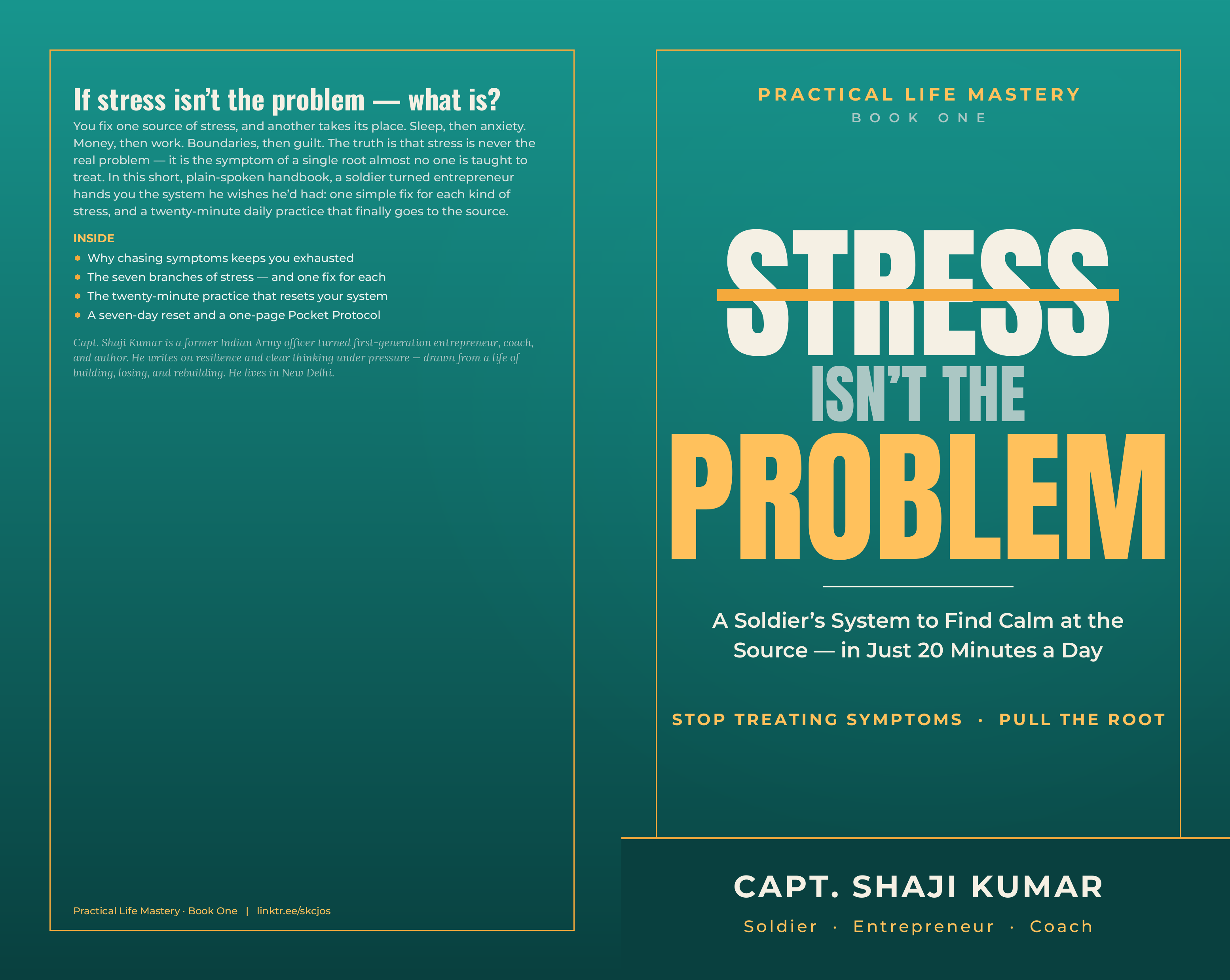
If this landed, it’s the spine of a handbook I’ve been working on — Stress Isn’t the Problem: A Do-It-Yourself Handbook to Stop Chasing Stress and Solve It at the Source. It’s the full method: the seven branches and the one root. Out on Amazon, first week of July. I’ll share the link here the day it’s live. 🌱
And the day I realised I had been fighting the wrong enemy.
For nearly twenty-eight years, I believed stress was the problem. So I did what most of us are taught to do. I managed it.
I slept more. I exercised every day. I rebuilt my diet from a hundred YouTube videos. I worked fewer hours — which, for a man building a business, was no small thing. I took breaks. I tried every sensible solution I could find.
And every one of them worked. For a while.
Then the stress came back. If it wasn’t work, it was money. If it wasn’t money, it was a relationship. If it wasn’t a relationship, it was my health. It felt like a game I was never meant to win.
Then one day a simple thought stopped me cold.
Stress wasn’t the problem. Whatever was feeding it was.
The Whack-a-Mole Game We All Play
Most of us treat stress the way we would treat a leaking roof. Find the problem. Patch it. Move on. But stress almost never behaves like a roof.
You finally fix your sleep, and anxiety shows up. You settle the anxiety, and work pressure climbs. You handle the work, and money worries arrive. You sort out the money, and a relationship begins to strain. Stress simply changes its disguise.
Picture that carnival game where little moles pop up from a grid of holes. You hammer one down, another springs up. You hammer that one, and a third appears. You can become very, very good at hitting moles and still never win the game.
Most of us are playing exactly that game with our lives.
Why Stress Keeps Coming Back
Every hard experience leaves a mark. And most of the time, we never finish feeling it. We suppress it. We ignore it. We distract ourselves. We promise to deal with it later.
Later rarely arrives.
So those unfinished experiences do not disappear. They go quiet. They wait, just beneath the surface. Then one ordinary day, something small happens. A comment. An email. A deadline. A memory.
And the reaction that comes out of us is far bigger than the moment deserves. Why? Because we are not only reacting to what is in front of us. We are reacting to years of backlog.
The event is small. The reservoir behind it is not.
The Mistake Modern Life Encourages
Modern life has one piece of advice about stress: get better at managing it. More apps. More planners. More productivity systems. More hacks.
Almost no one talks about emptying the reservoir itself.
So we become experts at coping, and never actually become calmer. We survive. We function. We perform. And underneath it all, we stay tired.
What Changed Everything for Me
The turn came when I stopped asking one question and started asking another. I stopped asking, “How do I get rid of this stress?” I started asking, “Why does it keep coming back?”
That second question changed everything. It showed me that stress was not my enemy. It was my messenger. It was simply telling me that something deeper was asking for attention.
When I began tending the root instead of swatting the branches, things changed. Not overnight. Not by magic. But steadily. The reactions grew smaller. The mind grew quieter. The body let go of a tension it had been holding for years.
Life did not get easier. I got calmer. That is a different thing entirely.
A Seven-Day Experiment
You do not have to take my word for any of this. Test it.
For the next seven days, whenever you feel stress rising, pause and ask yourself one question:
“Is my reaction bigger than the event in front of me?”
If the honest answer is yes, then what you are feeling is probably older than today. That single piece of awareness changes your relationship with stress. You stop fighting it. You start understanding it. And understanding is almost always the first step toward freedom.
The Real Goal
For years I was certain that stress was ruining my life. I see it differently now.
Stress was not ruining my life. Whatever I refused to face was.
The moment we stop chasing symptoms and start looking for the source, stress becomes easier to understand, easier to carry, and — in time — easier to overcome.
Maybe the goal was never to get better at handling stress. Maybe the goal is to stop feeding the thing that creates it.
Capt. Shaji Kumar is a former soldier, entrepreneur, and coach. He writes on discipline, stress, personal growth, and practical life mastery. His latest book, Stress Isn’t the Problem, explores the real roots of stress — and a simple, soldier’s system for finding calm at the source.
You are — and a liar too, every time you say “I just don’t have the time.”.
You have a full 24 hours. That’s 1,440 minutes. Every single day — the same 1,440 handed to every CEO, every monk, every living being on this Planet.
You’re not short of time. You’re just not managing it the way you could and SHOULD.
Want to solve the riddle of where your hours actually disappear?
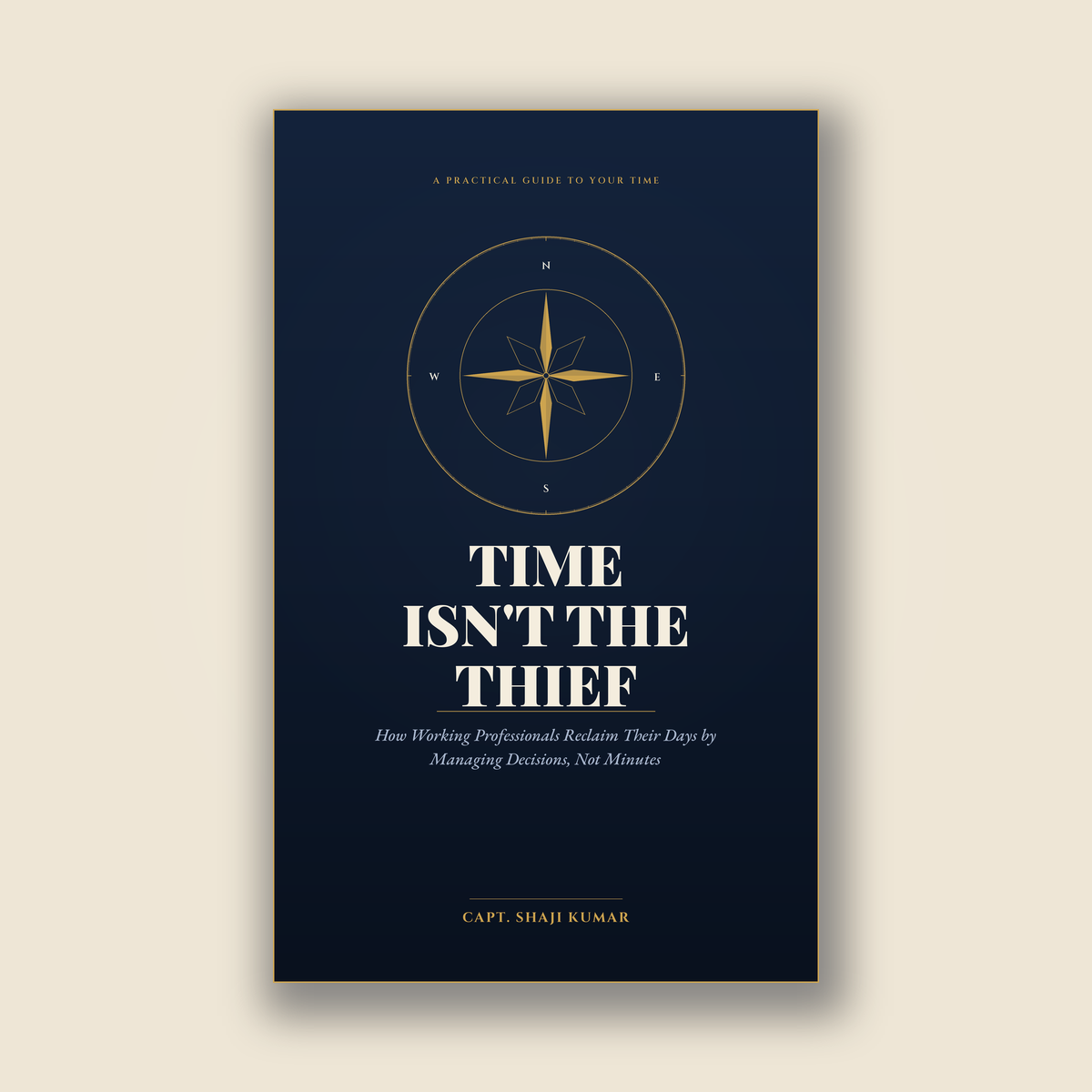
The answers are in my new book, “Time Isn’t the Thief”, available now on Amazon — and FREE to read on Kindle Unlimited.
⏰ Want the one-page Compass to keep beside your desk? — pop your details into this quick form and it’ll land in your inbox within seconds: https://forms.gle/iFitSARbCVs84dEU9
Not sure about tapping links? No need — just open Amazon and search “Time Isn’t the Thief.” It’s free to read on Kindle Unlimited.
And if you only want the one-page Compass from the post above, — pop your details into this quick form and it’ll land in your inbox within seconds: https://forms.gle/iFitSARbCVs84dEU9