
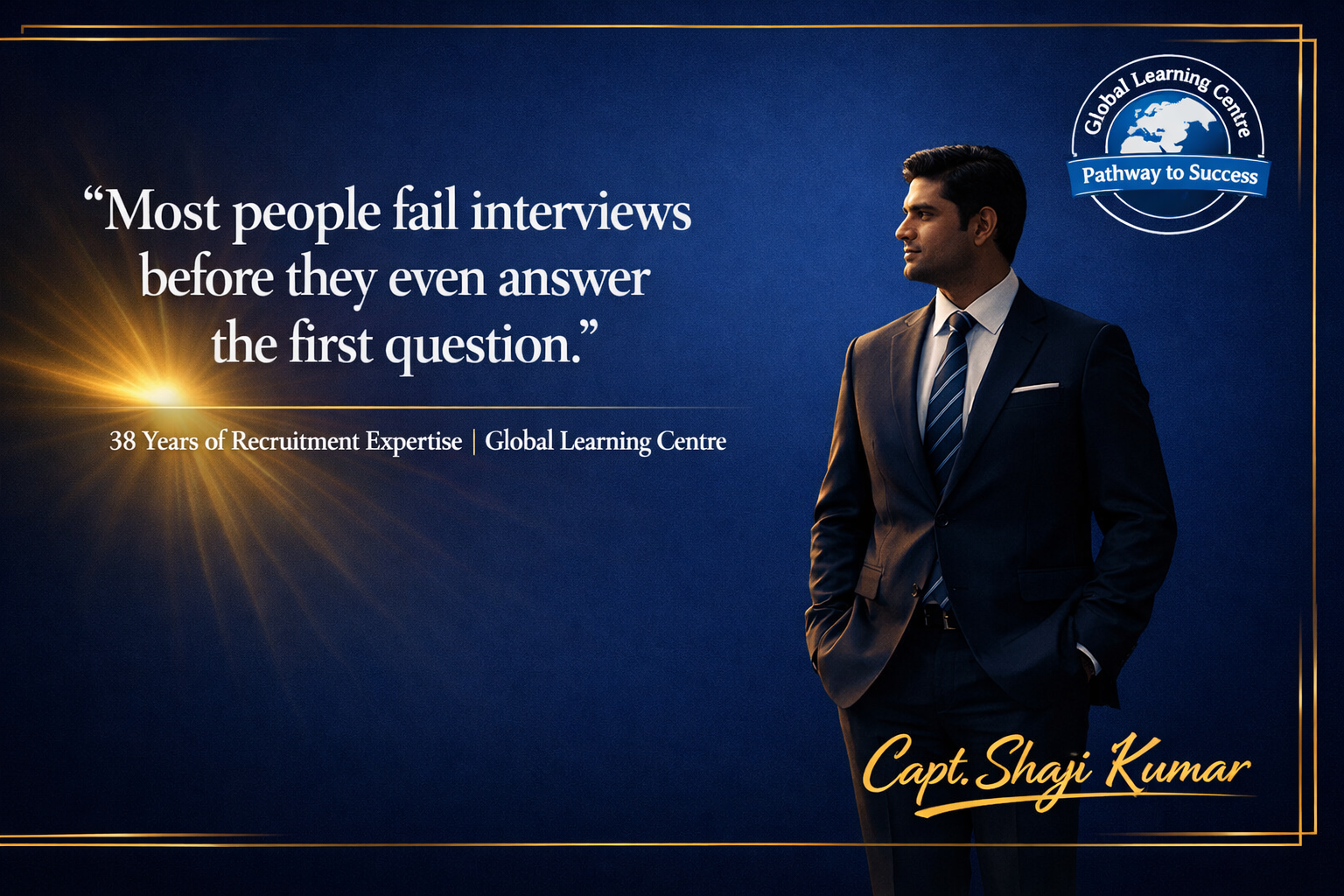
What Recruiters Silently Judge in Every Interview — And Why Smart Candidates Still Fail
By Capt. Shaji Kumar | Global Learning Centre
Most people walk into an interview believing the conversation begins when the first question is asked.
It does not.
In 38 years spent inside the world of recruitment — evaluating candidates, leading hiring teams, and running Chaque Jour for 28 years — I have observed one truth that cuts across every industry, every level, and every type of role:
The interview is decided long before you think it is.
And the candidates who understand this are the ones who consistently win offers.
What Recruiters Are Silently Judging — From the Moment You Walk In
Experienced interviewers are not simply listening to your answers. They are running a continuous, largely unconscious assessment that begins the moment you arrive and does not stop until you leave.
They are observing how you carry yourself before you sit down. They are noting whether you arrived prepared or scrambling. They are watching how you treat the receptionist, the assistant, the person who offers you water. They are registering whether your LinkedIn profile told the same story your CV did.
By the time the first question is posed, a preliminary impression has already formed. Your answers either confirm it, challenge it, or reinforce it. That is the game. Most candidates do not know they are already playing it.
What specifically are they evaluating? Four things, in every interview, without exception:
Clarity of thought. Can you organise your thinking and communicate it without rambling? Interviewers are not looking for perfection — they are looking for structure. A concise, well-ordered answer signals intelligence far more powerfully than an exhaustive one.
Knowledge of self. Do you know your own story? Can you articulate why you made the career decisions you made, what you learned, and where you are going? A candidate who cannot narrate their own professional journey confidently raises immediate doubts about self-awareness and direction.
Fit and intent. Have you done the work to understand this organisation, this role, and this team? Or did you apply broadly and hope for the best? Interviewers can feel the difference within the first three minutes.
Composure under pressure. When a difficult question arrives — and it will — do you think before you speak? Do you maintain your presence? Or do you visibly unravel? Composure is not the absence of nerves. It is the management of them.
Why Smart Candidates Still Fail
This is the part that surprises most people.
In my experience, the candidates who struggle most in interviews are not the under-qualified ones. They are often the most capable people in the process.
Intelligent professionals fail interviews for a specific set of reasons that have nothing to do with their competence:
They over-explain and under-structure. High-performing professionals are used to environments where thoroughness is valued. In an interview, thoroughness without brevity reads as inability to prioritise. A three-minute answer where two sentences would have sufficed does not demonstrate depth — it demonstrates poor communication.
They confuse experience with evidence. Saying “I have managed large teams” is not the same as saying “I led a team of 22 through a critical restructure and reduced attrition by 34% over 18 months.” The first is a claim. The second is evidence. Interviewers remember evidence.
They prepare for the wrong things. Most candidates rehearse answers. The best candidates prepare for the conversation. There is a significant difference. Rehearsed answers break down the moment an unexpected question arrives. A prepared mindset adapts.
They do not ask the right questions. Many candidates treat the “Do you have any questions for us?” moment as a formality. It is not. It is your opportunity to demonstrate strategic thinking, genuine curiosity, and the kind of engagement that signals you are already thinking like someone who works there.
The 5 Questions Every Interviewer Is Really Asking
Beneath every question an interviewer poses — regardless of how it is framed — there are five core assessments being made. Understanding these transforms how you approach every answer.
1. Can you actually do this job? This is the baseline. Your skills, qualifications, and relevant experience are being verified. But note: this is rarely the deciding factor. Most shortlisted candidates can do the job. The differentiators lie in the questions that follow.
2. Will you actually do this job? Motivation, commitment, and alignment with the role’s demands are being assessed. Are you genuinely interested in this opportunity, or is it simply available? Interviewers are skilled at detecting the difference.
3. Will you fit this team and culture? Values, working style, and interpersonal intelligence are all being evaluated here. A technically exceptional candidate who will fracture team dynamics is rarely hired. Culture fit is not a soft metric — for most organisations, it is a hard filter.
4. Will you create problems? This is the risk assessment. Every hiring decision carries a degree of risk. Interviewers are asking themselves: Will this person be difficult to manage? Will they cause friction? Will I regret this in six months? Your composure, self-awareness, and the way you discuss past challenges all feed this assessment.
5. Are you worth the investment? Hiring is expensive. Onboarding takes time. The question being asked — often unconsciously — is whether the return on this investment justifies the commitment. Your ability to articulate your value, your impact, and your trajectory directly determines the answer.
Answer these five questions across your interview — regardless of how they are worded — and you will stand apart from every other candidate in the room.
How to Make an Interviewer Remember You
The candidate who receives the offer is rarely the most qualified person who interviewed.
They are the person the panel could not stop thinking about after the room emptied.
Here is what creates that impression:
They opened with a clear, compelling narrative — not a summary of their CV, but a story of their professional journey that made the interviewer understand immediately why they were sitting in that chair.
They answered every question with the structure of a clear point, a specific example, and a demonstrated outcome. No rambling. No qualifications on every sentence. No excessive hedging.
They showed genuine intellectual engagement with the organisation — referencing something specific about the company’s direction, a challenge the industry faces, or a strategic question they had been thinking about since reading the job description.
They asked questions that revealed they had already been thinking about the role as if they were in it — not questions about benefits or holidays, but questions about priorities, team dynamics, and what success looks like in the first 90 days.
They followed up within 24 hours with a brief, personalised note that referenced something specific from the conversation and reaffirmed their interest with clarity and confidence.
None of these are extraordinary acts. All of them are rare.
A Final Word
Your qualifications got you the interview.
Your preparation — your structure, your self-awareness, your ability to communicate your value with precision and composure — will win you the offer.
One is in your past. The other is entirely in your hands.
If you have an important interview approaching and you want to walk in as the candidate they cannot afford to overlook, I would like to help.
In 38 years, I have seen what separates the candidates who get the call from the ones who wonder what went wrong. The gap is almost never talent. It is almost always preparation.
Let us close that gap — together.
Book a Free 15-Minute Clarity Call
About the Author
Capt. Shaji Kumar is an Executive Coach, Army Veteran, entrepreneur, and author focused on helping professionals navigate stress, overthinking, uncertainty, and high-pressure environments with clarity and precision.
Through his Clarity Under Pressure™ framework, he combines lessons from the Armed Forces, business leadership, entrepreneurship, and human behaviour to help individuals think clearly, act decisively, and build resilience in both life and career.
Explore the Books
Stress — The Silent Killer Within A practical 21-day guide designed to help young professionals manage workplace stress, emotional exhaustion, anxiety, and overthinking. Available on Amazon: https://www.amazon.in/dp/B0GX379YWG
Health in Your Hands Series Simple, practical, and awareness-driven books focused on health, stress management, emotional balance, and holistic well-being. Available on Amazon: https://www.amazon.in/gp/product/B0FV4BCC7K
Connect With Capt. Shaji Kumar
#InterviewTips #CareerAdvice #JobSearch #InterviewPreparation #CareerGrowth #RecruitmentInsights #JobSeeker #ProfessionalDevelopment #GlobalLearningCentre #GetHired #CareerCoaching #PathwayToSuccess #CaptShajiKumar #ClarityUnderPressure #InterviewSuccess #HiringTips #JobInterviewTips #CareerMentor #WorkplaceSuccess #RecruitmentExpert #ExecutiveCoach #ArmyVeteran


Leave a comment