Most people fail an interview before they ever answer a question.
For 38 years, I was the person on the other side of the interview table.
I’ve watched deserving people lose roles they should have won — not for lack of ability, but because no one ever told them how the decision is really made.
So I wrote it down.
Seven things that quietly decide senior-level hires, from someone who used to make those calls.
If you’re a professional in transition — or an officer making the leap to corporate — this is the unfair advantage I wish I could hand everyone.
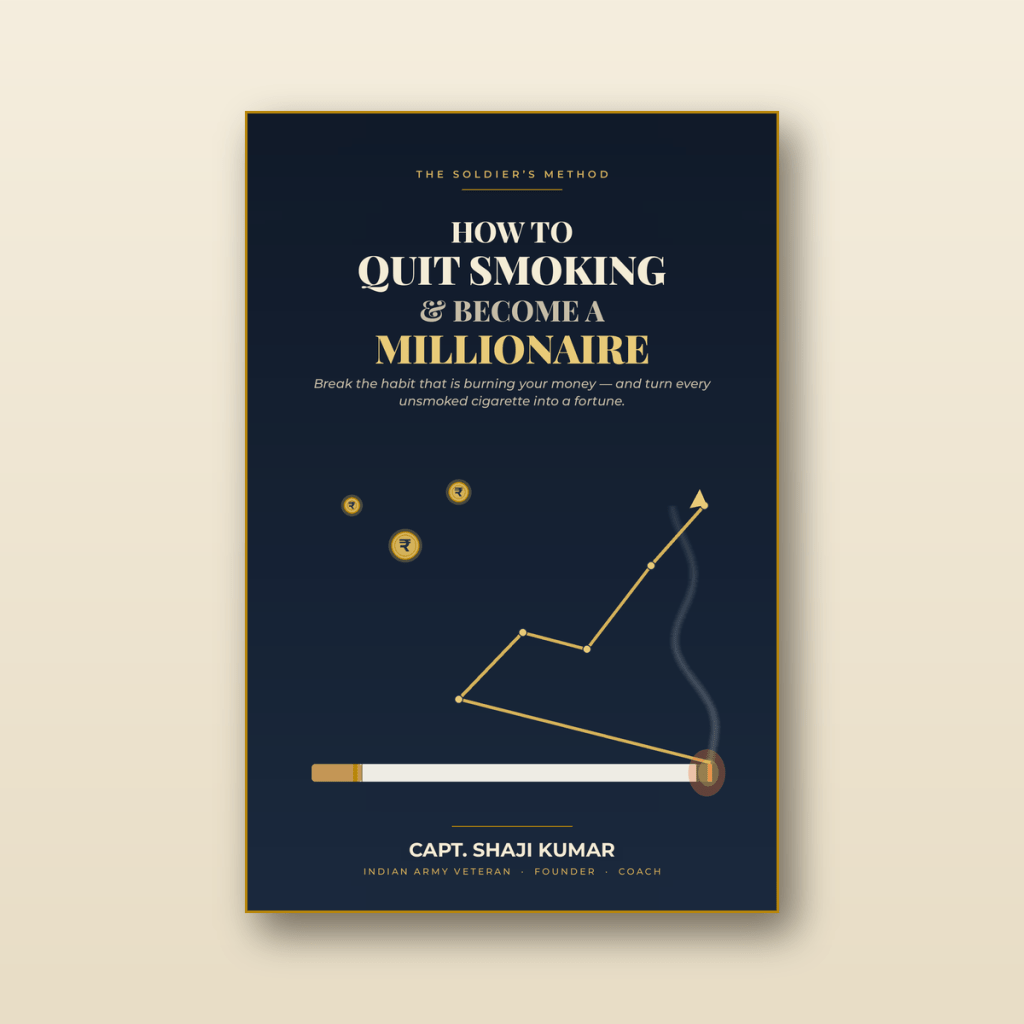
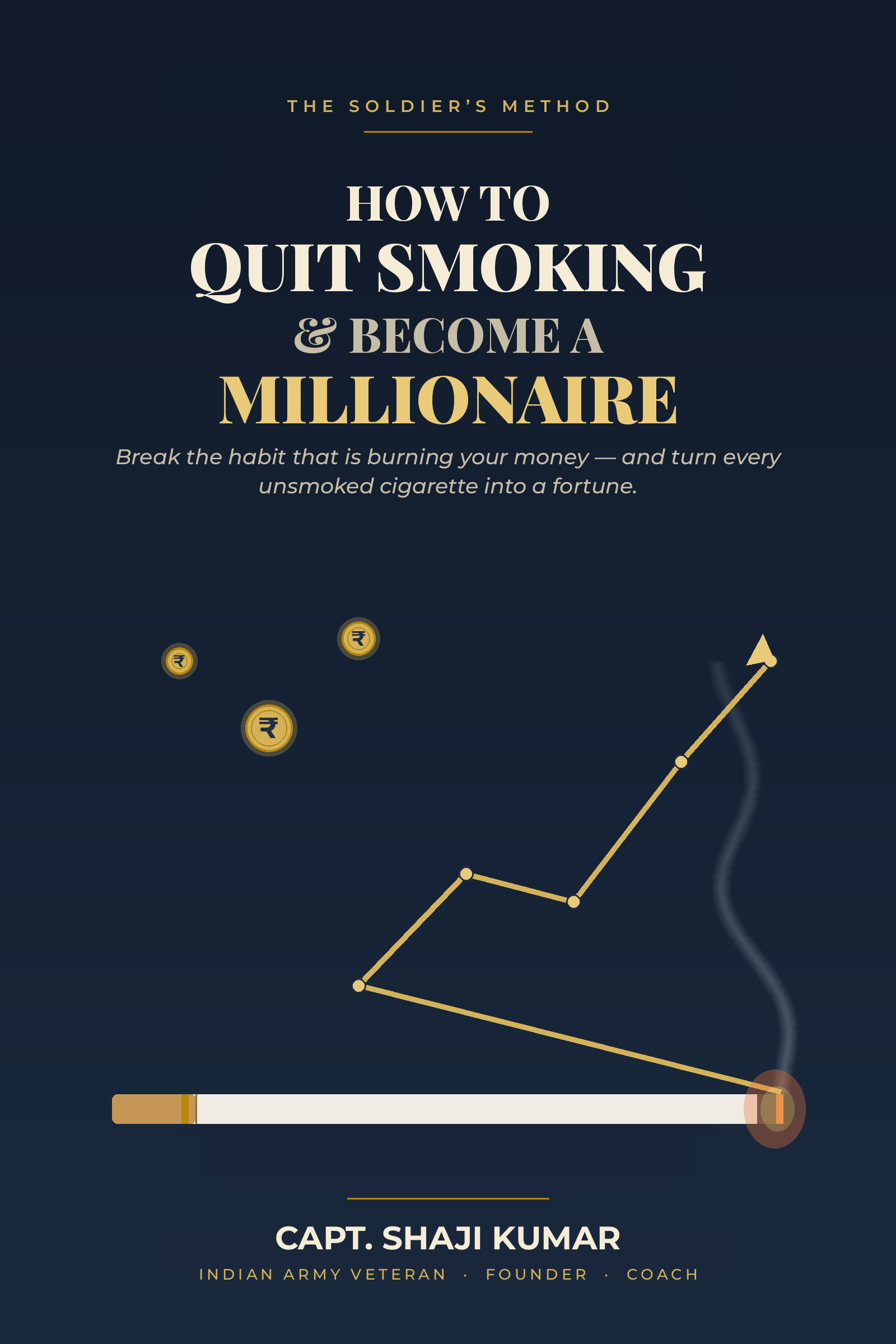
I told myself it steadied me — kept me sharp under pressure. What it actually did was quietly burn money, for decades.
It took me three attempts to finally quit. And when I sat down and did the honest arithmetic of what those cigarettes had cost me, the number stopped me cold. Had I simply redirected that daily spend into a steady investment, it would have grown past a Crore.
That one idea — the “Cigarette Fund” — became the heart of a small book I’ve just published. It isn’t a lecture. It’s the method that actually worked for me: how to break the craving, rebuild the willpower, and turn the money you were burning into the wealth you were owed.
If you’ve tried to quit and it hasn’t held — this is the approach I wish someone had handed me in 1984.
What would all those years of that daily spend have built for you?
Grab a Copy and see if you can kill Two birds with one stone. I did.
Available for Sale on Gumroad : How to Quit Smoking and Become a Millionaire https://lnkd.in/gMVT4qDw
On the weight that only one person in the room can never put down — and why that weight, carried rightly, is the highest privilege of leadership.
By Capt. Shaji Kumar · The Reflection Series
There is a phrase that has echoed through every corridor of power, every boardroom, every command post, and every founder’s office since Harry Truman first placed a small wooden sign on his desk in the Oval Office.
The buck stops here.
Five words. No ambiguity. No footnotes. No asterisk leading to a clause that redistributes the weight.
Most people who quote it have never truly felt its meaning. Because understanding those five words intellectually is entirely different from waking up at 3am with them sitting on your chest.
The leader is the only person in the organisation who does not have the luxury of pointing anywhere but inward.
The Architecture of Accountability
Here is the truth that no leadership manual fully prepares you for: every person in your organisation has an exit from accountability that you do not.
The team member who made the error can apologise. They can resign. They can move to another company, update their LinkedIn profile, and begin again with a largely clean slate. Their mistake follows them — but at a manageable distance. Time erodes it. A new role reframes it.
The middle manager who missed the target can point upward. They were working within a framework they did not design, executing a strategy they did not author, with resources that were not sufficient. There is always something above them to gesture toward.
Even the senior executive, one step below the top, carries the comfort of collective decision-making. The board approved it. The committee endorsed it. The consensus was clear.
But the leader — the one at the top, the founder, the CEO, the head of the organisation — has none of these exits. The apology is not enough. The resignation is not a resolution. The pointing upward finds only open sky. Every decision, every failure, every consequence of every call ever made under their watch circles back — inevitably, reliably, without exception — to their table.
The Word Everyone Else Gets to Use
Let us talk honestly about the word “sorry.”
It is a powerful word. In the right hands, offered with genuine remorse and a commitment to repair, it can rebuild trust, restore relationships, and close wounds that seemed permanent.
For most people in an organisation, sorry is also sufficient. It is the price of the mistake. Pay it, absorb the consequences — which may include losing the job — and move forward. The maximum cost is bounded. A job lost is a job that can be found again. A career disrupted is a career that can be rebuilt.
The leader does not have this arithmetic.
For everyone else, sorry is a settlement. For the leader, sorry is only the beginning of a much longer reckoning.
When a leader says sorry — genuinely, publicly, with weight — they are not closing the file. They are opening it. Because what follows sorry, for the person at the top, is a cascade of consequences that cannot be contained by a single word or a single act of contrition.
Investors who trusted the vision reassess.
Teams who believed in the direction begin to question their own loyalty to it.
Clients who built their own plans around yours recalibrate.
Competitors who were watching take note — and move.
Boards who extended confidence begin to sharpen their pencils.
And the market — indifferent, unsentimental, and without mercy — simply adjusts its valuation.
Sorry does not stop any of that. For the leader, accountability is not an event. It is a condition. Permanent, unrelenting, and non-negotiable.
The Catch-22 That No One Warned You About
Here is where leadership becomes genuinely, structurally unfair — and the sooner a leader accepts this, the more effective they become.
The leader must take the risk. That is the job. Without risk, there is no vision, no growth, no transformation, no reason for the organisation to exist beyond the maintenance of the status quo. Risk is not a feature of leadership — it is the definition of it.
And yet every risk the leader takes is a risk that, if it fails, lands entirely and exclusively on them.
They did not design the economic conditions that shifted. They did not engineer the competitor’s move that changed the landscape. They did not anticipate the geopolitical event, the regulatory change, the technology disruption. And yet — when the outcome falls short — the risk was theirs. The judgment was theirs. The decision to proceed was theirs.
This is the Catch-22: You must take the risk to lead. But there is no one to share it with when it does not work. You step forward alone. You carry it alone. And you answer for it alone.
The Leader’s Catch-22 — No Exit, Only Ownership
EVERYONE ELSE • Can say sorry and move on • Can lose the job — and start again • Risk is bounded and recoverable • Reputation is personal, containable • Can point upward — “I was told to” • Tomorrow is still relatively clean
THE LEADER • Sorry is not a strategy • Losing the role is the beginning, not the end • Risk is total — financial, reputational, human • Reputation carries the weight of every decision • There is no upward to point to • Tomorrow carries everything that happened today
The columns above are not a complaint. They are a contract. A contract that every genuine leader signs — usually without reading the fine print — the moment they accept the responsibility of the top seat.
The Loneliness That Comes With the Title
Leadership at the top is lonely. Not in the way that word is sometimes used casually — as a synonym for solitude or introversion. Lonely in a structural, existential sense.
Everyone around the leader has someone above them to consult, to defer to, to share the weight with. The leader has no one above. The board is not above — they are alongside, with their own interests and mandates. The mentor is not above — they advise, but they do not carry.
And this loneliness is not something to be fixed. It is something to be inhabited. The leader who spends their time searching for someone to share the ultimate accountability with is a leader who has not yet truly accepted the role.
The loneliness of the top is not a problem to be solved. It is a condition to be led from.
The most effective leaders I have worked with have made a quiet peace with this. They build strong teams — not to distribute the accountability, but to increase the quality of the decisions that accountability demands. They seek counsel — not to avoid the weight, but to carry it more wisely. They stay close to people who tell them the truth — not because truth makes the burden lighter, but because it makes the decisions cleaner.
The Reframe That Changes Everything
Here is where I want to shift the arc of this reflection. Because everything I have written above is true — and it is only half the story.
The buck stops here is not only a burden. It is a distinction.
In an entire organisation — sometimes hundreds, sometimes thousands of people — there is exactly one person for whom the full weight of every outcome, every decision, every risk, and every result is non-negotiable. One person whose name is on the line in a way that no one else’s is.
That is not a curse. It is the mark of genuine leadership. And it is extraordinarily rare.
Most people will live their entire professional lives never truly knowing what it means to be the final answer. Never experiencing the particular clarity — and the particular terror — of a decision that is entirely, irreversibly, consequentially yours. They will always have someone above them. Always have a committee to hide in. Always have the word sorry available as a genuine resolution.
You do not. And that is not a misfortune. It is an identity.
The leader who understands this — who stops grieving the exits they do not have and starts inhabiting the seat they do — becomes something qualitatively different from the people around them. Not better. Not superior. But different in a way that matters. Tested in a way that cannot be faked. Forged in a way that cannot be replicated by anyone who has not stood where they stand.
The buck does not stop at your table because life is unfair. It stops there because you are the only one equipped to answer it.
What the Leader Who Carries It Well Looks Like
In my years of coaching leaders across industries, the ones who carry this weight with genuine effectiveness share a handful of traits that are worth naming.
They never pretend the weight isn’t there. They do not perform invulnerability. They acknowledge — to themselves, and often to their teams — that the accountability is real, the stakes are high, and the decisions are hard. This honesty does not weaken them. It earns the trust of everyone watching.
They decide anyway. The weight does not become paralysis. They take the council, absorb the analysis, listen to the room — and then they decide. Clearly. On time. Without the endless deferral that masquerades as due diligence.
They own the outcomes — all of them. Not only the ones that worked. They stand in front of the team, the board, the client, the market — when things fall short — and they say: this was mine. Not the team’s. Not the conditions. Mine. And then they say what comes next.
They do not confuse accountability with self-destruction. Owning the outcome does not mean flagellating yourself indefinitely. The leader who makes peace with a bad decision, extracts the lesson, and moves forward is infinitely more effective than one who carries every past failure as a permanent indictment.
They remember why they accepted the seat. The vision. The mission. The people they are building something for. On the days when the weight is heaviest, it is the reason for carrying it that makes it possible to keep going.
The Privilege in the Burden
I want to close this reflection with something that may seem counterintuitive — but which I believe with complete conviction, having seen it in the lives of the leaders who do this well.
The buck stopping at your table is a privilege.
Not a comfortable one. Not an easy one. Not one that comes without cost, without sleepless nights, without the particular exhaustion of being the person who cannot pass it on.
But a privilege nonetheless.
Because the alternative — a life in which nothing of ultimate consequence is ever yours, in which every decision can be softened with a committee and every failure can be redirected with an apology — is a life lived at a remove from the thing that makes leadership meaningful.
You were not put at the top of the table to be comfortable. You were put there to answer. And the fact that you are the only one who can — in your organisation, in your context, in your moment — is not a sentence.
It is a calling.
The weight of the buck is the price of the vision. Pay it. Carry it. And lead from it. Because no one else in the room can.
✦ FROM THE AUTHORWords that go deeper than the blog.If this reflection stirred something in you, these books were written for exactly that moment.
📖 Health in Your Hands Your body is your first boardroom. The leader who cannot manage their own health cannot sustain the weight of accountability. Read on Amazon →
🧠 Stress — The Silent Killer Within A 21-Day Acupressure system to reset your nervous system, reduce anxiety and reclaim your health naturally. Read on Amazon →
COMING SOONBuilt, Not GivenA new book for young entrepreneurs in Tier 2 and Tier 3 cities who were never handed a headstart — but refuse to let that be their story.Be the first to know when it drops → skcjos@gmail.com
ABOUT THE AUTHORCapt. Shaji Kumar Capt. Shaji Kumar is a Leadership Coach, Author, and Speaker working with professionals and entrepreneurs who are ready to lead with clarity and courage. He is the author of Health in Your Hands and Stress — The Silent Killer Within, and his upcoming book Built, Not Given is written for entrepreneurs who were never handed a headstart. Connect with him, access his books, and join his inner circle at: linktr.ee/skcjos
LET’S STAY CONNECTEDJoin the inner circle. Leadership insights. Early access to Built, Not Given. Coaching opportunities. No noise — just substance, when it matters. ✉️ Sign up here: linktr.ee/skcjos📅 Book a coaching appointment: LinkedIn →✉️ Write directly: skcjos@gmail.com
Why fear — not ignorance — is the silent executioner of leadership decisions, and what happens when the ghosts of the past and the shadows of the future converge at exactly the wrong moment.
By Capt. Shaji Kumar · The Reflection Series
There is a moment every leader knows.
It does not announce itself. It arrives quietly — usually in the middle of the night, or in the silence just before a meeting begins. It is the moment when you know exactly what decision needs to be made. You can see it clearly. You understand what it requires.
And you do not move.
Not because you lack information. Not because the timing is wrong. But because somewhere between your mind and your action, fear has built a wall. And on either side of that wall lies a ditch — one filled with the wreckage of the past, and one filled with the shadows of a future you cannot yet see.
This is the double ditch. And it has swallowed more leadership potential than failure ever has.
The Architecture of Leadership Fear
Fear in leadership is rarely the dramatic kind. It does not announce itself as cowardice. It wears more sophisticated disguises — prudence, patience, further due diligence, waiting for the right moment. It borrows the language of wisdom to justify inaction.
But underneath every delayed decision, every hedged commitment, every conversation that never quite happens — fear is the architect.
And it draws its blueprints from two very specific sources:
The first source is the past. The leader who once trusted the wrong person and paid dearly for it. Who launched with conviction and landed badly. Who spoke up in a room and was humiliated for it. That leader does not forget. And when a similar moment arrives — when the terrain looks familiar, when the stakes feel comparable — the past rises up like a witness for the prosecution.
The second source is the future. The formless, unwritten territory of what has not yet happened. The catastrophe that exists only as possibility. The judgment that has not yet been passed. The failure that is still entirely theoretical. And yet — the mind treats it as real. Vivid. Inevitable. The future, imagined in fear, is more paralyzing than any past defeat.
The Double Ditch — Where Leaders Fall
I call it the double ditch because it traps from both sides simultaneously. The leader stands at the point of decision — and finds themselves unable to move forward or backward. The past pulls one way. The future frightens from the other. And in between, the decision waits.
The Double Ditch — Where Leaders Get Trapped
DITCH 1 — The Past • Fear of repeating old mistakes • Replaying past failures in HD • Letting yesterday veto today • Over-analysis paralysis • “Last time I tried this…”
DITCH 2 — The Future • Fear of an unknown outcome • Dread of peer judgment • Catastrophising what hasn’t happened • Waiting for perfect conditions • “What if it all goes wrong?”
What makes the double ditch so lethal is its invisibility. From the outside, a leader trapped in it looks composed. Measured. Even considered. The paralysis is internal. The organisation moves on. Opportunities close. And the leader remains exactly where fear left them — frozen at the edge.
What the Regressed Past Actually Costs
When we explored “What If?” in our last reflection, we discussed how the past can be either a professor or a prison. Fear tips the balance decisively toward the prison.
A leader governed by the regressed past does not just make slower decisions. They make fundamentally different ones — ones shaped by the emotional residue of old wounds rather than the actual demands of the present moment.
They under-invest in people because they once trusted the wrong one.
They avoid bold market moves because one launch failed publicly.
They soften feedback until it loses all meaning, because directness once cost them a relationship.
They defer strategy decisions until the window closes, because they are still refighting an old battle.
Every one of these is not caution. It is fear wearing caution’s clothing. And the organisation pays the price — in missed opportunity, in eroded trust, in a culture that learns to read the leader’s hesitation as permission to hesitate themselves.
Fear is contagious in a leadership culture. When the leader flinches, the team learns to flinch.
The Shadow of the Uncertain Future
The second ditch is subtler — and in some ways, more powerful. Because the future has not yet happened, the mind fills it with whatever it fears most.
I have coached leaders who were extraordinarily capable by any measure — experience, track record, emotional intelligence — and yet were unable to commit to decisions because of what might happen. Not what would happen. Not even what was likely to happen. What might.
This is not strategic risk assessment. That is a cognitive process that weighs probability and prepares contingencies. What I am describing is something different — a paralysis born of imagined catastrophe. A ditch dug not by reality, but by the fearful imagination of a mind that has been burned before and is determined, above all else, never to be burned again.
The cruel irony: The determination never to fail again is precisely what guarantees a different kind of failure — the failure of the unlived decision. The strategy never executed. The team never mobilised. The moment never seized. Fear of failure produces its own, quieter variety of failure. And this one leaves no dramatic story to tell. Only absence.
The Falter at the Edge — Why Good Leaders Freeze
Let us be specific about what the double ditch looks like in practice. Because it is not limited to weak leaders. Some of the most accomplished people I have worked with have found themselves standing at the edge, unable to step forward.
It typically happens in three distinct moments:
The promotion or transition decision. The leader who has earned the next level but cannot claim it. Who second-guesses their readiness not because the evidence is ambiguous, but because a past failure — a role they stumbled in, a project that came apart — has convinced them the floor might give way again.
The people decision. The leader who knows a team member needs to be moved on, but cannot bring themselves to act. Previous guilt over a similar decision, or fear of conflict, or dread of being seen as ruthless — any one of these is enough to delay action that the team desperately needs.
The strategic bet. The leader who can see the opportunity. Who understands the window. Who has done the analysis. But who stands at the edge of commitment and retreats — because what if this is the time it all unravels? What if the past was not an anomaly but a pattern?
In each case, the decision is not difficult because it is unclear. It is difficult because fear has made it feel dangerous.
Crossing the Double Ditch — The Leader’s Path Forward
I want to be clear: the answer is not fearlessness. Fearlessness in a leader is not courage — it is recklessness with other people’s futures. The goal is not to eliminate the ditch. It is to build a bridge across it.
That bridge is built from three materials:
Honest reckoning with the past. Not replaying it. Not exorcising it. But sitting with it long enough to separate the lesson from the scar. The lesson is yours to keep. The scar does not have to drive.
Calibrated courage about the future. Not blind optimism. Not catastrophising. But a clear-eyed assessment of what is actually probable versus what fear has convinced you is inevitable. Fear is a terrible statistician. Challenge its numbers.
A committed first step. Not the entire journey — just the next step. The double ditch is crossed not in a single leap but in a series of deliberate moves. The first commitment breaks the paralysis. Everything after becomes possible.
“Courage is not the absence of fear. It is the decision that something else matters more.” — Ambrose Redmoon
A Word for the Young Leader in the Smaller City
I want to speak directly to a particular kind of leader right now — one who perhaps did not grow up with every advantage. Who built what they have from ground that was not always even. Who carries the weight of having come from somewhere that the world did not immediately take seriously.
You know the double ditch better than most. Because your past contains not just personal failures but systemic ones — moments when the doors were not opened, when the room did not make space, when the credibility had to be earned twice over just to be believed once.
And your future contains not just uncertainty but the particular anxiety of the first generation — the one who cannot afford to fall back on what was handed to them, because nothing was.
I am writing a book for you. It is called Built, Not Given. And its entire premise is this: the fact that you were not given it is not your disadvantage. It is your foundation. Because what is built is sturdier than what is handed. What is earned cannot be taken. And the leader who has wrestled their way to where they are carries a depth of conviction that no inheritance can replicate.
The double ditch is real. But so is the bridge. And you already know how to build things.
Built, Not Given — Coming Soon. A book for the entrepreneur who started with hunger instead of headstarts. To be among the first to hear when it drops, write to skcjos@gmail.com with the subject: “Built, Not Given — Notify Me”
The Decision That Changes Everything
Fear will always be present in leadership. The question is never whether it shows up. It always does. The question is whether you let it make the decision — or whether you make it anyway.
The leader who crosses the double ditch does not do so without fear. They do so in spite of it. They acknowledge the past, they respect the future, and they step forward anyway — because they understand that the cost of inaction is a bill that comes due slowly, quietly, and with compound interest.
Your next decision is already forming. Fear is already weighing in. Acknowledge it. Name it. Extract the lesson it carries.
Then step.
Because the leader your team needs is not the one who never fears. It is the one who moves despite it.
“The most courageous act a leader will ever perform is the one they were most afraid to make.” — Capt. Shaji Kumar
✦ FROM THE AUTHORWords that go deeper than the blog.If this reflection stirred something in you, these books were written for exactly that moment.
📖 Health in Your Hands Your body is your first boardroom. Take command of it. Read on Amazon →
🧠 Stress — The Silent Killer Within Understand the cortisol loop that hijacks every fearful decision. Read now →
COMING SOONBuilt, Not GivenA new book for young entrepreneurs in Tier 2 and Tier 3 cities who were never handed a headstart — but refuse to let that be their story. You were not given the connections, the capital, or the classroom. But you were given hunger. And hunger, channelled right, builds empires. Be the first to know when it drops → skcjos@gmail.com
LET’S WORK TOGETHERIs fear holding your leadership back? Capt. Shaji Kumar works with professionals and entrepreneurs who are ready to move from hesitation to decision — and from decision to momentum. If this blog spoke to something you are navigating right now, let us have that conversation. Two ways to connect: 📅 Book an Appointment: LinkedIn → ✉️ Send a DM: skcjos@gmail.comWant exclusive insights, early access to Built, Not Given, and leadership tools delivered to your inbox? Drop your email at skcjos@gmail.com with the subject line: “Add me to the list”
ABOUT THE AUTHORCapt. Shaji Kumar Capt. Shaji Kumar is a Leadership Coach, Author, and Speaker working with professionals and entrepreneurs who are ready to lead with clarity and courage. He is the author of Health in Your Hands and Stress — The Silent Killer Within, and his upcoming book Built, Not Given is written for entrepreneurs who were never handed a headstart. Connect with him, access his books, and join his inner circle at: linktr.ee/captshajikumar
LET’S STAY CONNECTEDJoin the inner circle. Leadership insights. Early access to Built, Not Given. Coaching opportunities. No noise — just substance, when it matters. ✉️ Sign up here: linktr.ee/captshajikumar📅 Book a coaching appointment: LinkedIn →✉️ Write directly: skcjos@gmail.com
The two most powerful words in a leader’s vocabulary — and the thin line between using them to grow or using them to grieve.
By Capt. Shaji Kumar · The Reflection Series
Every leader carries a private museum.
It is not displayed on a wall or featured in a year-end review. It lives quietly in the back of the mind — a gallery of decisions made, paths not taken, words spoken too soon or too late. And standing at the entrance of that museum, etched above every doorway, are two words that never quite leave you alone:
“What if I had done it differently?”
What if I had trusted my instinct? What if I had listened more? What if I had held my ground — or let it go? What if I had taken that risk, or walked away from that one?
If you have led people, you know exactly what I mean. And if you claim you don’t — look closer.
The Question That Cuts Both Ways
Here is what makes “What if?” so fascinating — and so dangerous. It is not inherently a question of regret. It is a question of imagination. And imagination, in the hands of a leader, is either a torch or a trap.
Used wrongly, “What if?” becomes a regression machine. It pulls you backward into decisions already made, contexts already passed, and people who have long since moved on. It replays the film of your leadership failures on a loop — not to teach you anything new, but simply because the mind has not yet found peace with what happened.
This is relegation. A demotion of your present self to referee over a match that is already over.
The trap of retrospective “What if?” is that it feels productive. It masquerades as self-reflection. But there is a critical difference between a leader who examines the past to extract wisdom — and one who revisits it to punish themselves. One builds forward. The other builds a cage.
What Great Leaders Do Differently
The most effective leaders I have observed — and coached — share one subtle but defining trait. They do not avoid “What if?” They transform it.
They ask it prospectively, not retrospectively. Instead of “What if I had done that differently?” they ask, “What if I approach this differently — now?” They face the same human instinct to second-guess, but they redirect its energy forward, not backward.
They treat every “What if?” from the past as a mentor, not a magistrate. The decision was made. The outcome unfolded. The lesson is now the only thing with any real value left in it. They extract that lesson ruthlessly — and they let the rest go.
“A good leader is not one who never makes the wrong call. A great leader is one who never makes the same wrong call twice.”
There is a profound difference between the two. One is about perfection. The other is about wisdom.
The Three Faces of “What If?” in Leadership
In my years of coaching leaders across industries, I have seen “What if?” show up in three distinct forms. Each demands a different response:
The What If? Leadership Matrix
① The Wound Regret-driven. Replays past pain. Offers no new information. Must be acknowledged — then released.
② The Lesson Reflection-driven. Extracts insight from past decisions. The only form of “What if?” worth your time.
③ The Vision Future-driven. Asks what could be possible. The most powerful use of the question — and the rarest.
The Test Ask yourself: “Does this question give me energy or drain it?” Energy = lesson or vision. Drain = the wound.
The Decisions Leaders Wish They’d Made Differently
Let us be honest about what this looks like in practice. The decisions most leaders carry are rarely dramatic. They are quiet ones.
The team member they didn’t fight for — who left, taking irreplaceable knowledge with them.
The difficult conversation postponed for months, until a small problem became a structural one.
The strategy they knew in their gut was flawed, but endorsed anyway — because the room wanted to hear yes.
The moment they let fear disguise itself as caution, and called inaction “wisdom.”
The person they judged too quickly — and the relationship they never recovered.
Every one of these is a “What if?” waiting to happen. And every one of them contains a lesson worth more than the regret it generates — if you are willing to look at it clearly.
Is “What If?” Regression or Wisdom?
My answer is: it is entirely determined by your posture.
If you approach the past with your arms crossed — defensive, wounded, still trying to be right — “What if?” will keep you there. It becomes a holding room for unresolved pain, dressed up as leadership reflection.
But if you approach the past with open hands — genuinely curious, willing to be uncomfortable, committed to growth over pride — “What if?” becomes one of the most powerful development tools available to any leader.
The ancient wisdom traditions knew this well. The Stoics practiced memento mori — not as a counsel of despair, but as a prompt to live more deliberately. Buddhist teachers speak of impermanence as a liberating truth. The military conducts after-action reviews — structured, ego-free examinations of what happened and what it means going forward.
In every tradition, every culture, every field of high performance — the lesson is the same: the past is not your prison. It is your professor. But only if you are willing to sit in the classroom.
Five Questions to Transform Your “What If?”
The next time a “What if?” surfaces — and it will — try asking these in sequence:
What was I trying to achieve in that moment — and was that intention sound, even if the outcome wasn’t?
What did I know then that I acted on — and what do I know now that I didn’t have access to?
What pattern does this reveal about how I lead under pressure, uncertainty, or conflict?
What would I do differently — not to undo the past, but to equip myself for the next similar moment?
Can I forgive myself for the decision I made with the person I was then — and commit to being someone different now?
That fifth question is the one most leaders skip. And it is the most important of all. Because leadership growth that is not accompanied by self-compassion eventually produces brittle leaders — people so afraid of being wrong that they stop being bold.
The Gift Hidden Inside the Question
Here is what I want to leave you with.
“What if?” is not a sign of weakness. It is a sign of conscience. Leaders who never ask it are not confident — they are insulated. They have built walls around their decision-making that no feedback can penetrate. And that is far more dangerous than a leader who wrestles honestly with their choices.
The wrestle is the work. The discomfort is the growth. The question, asked rightly, is the gift.
So the next time “What if?” arrives uninvited and sits down across the table from you — do not send it away. Pour it a cup of tea. Ask it what it came to teach you. Extract every drop of wisdom it carries.
Then — and only then — let it go.
Because your next decision is already forming. And it deserves a leader who has done the work.
✦ FROM THE AUTHORThe conversation doesn’t stop here.Leadership is inseparable from wellbeing. If this reflection resonated with you, these two books were written to go deeper — into the body, the mind, and the silent forces that shape every decision you make.
📖 Health in Your Hands Take ownership of your physical wellbeing — the foundation every leader builds on. Read on Amazon →
🧠 Stress — The Silent Killer Within Understand the cortisol story behind every high-pressure decision you’ve ever made. Read now →
“What if?” is not a question about the past.
It is a question about who you are willing to become.
The harder you push against a bad habit, the stronger it pushes back. There is a Japanese approach that flips this completely — and it actually works.
By Capt. Shaji Kumar · 8 min read · Habits & High Performance
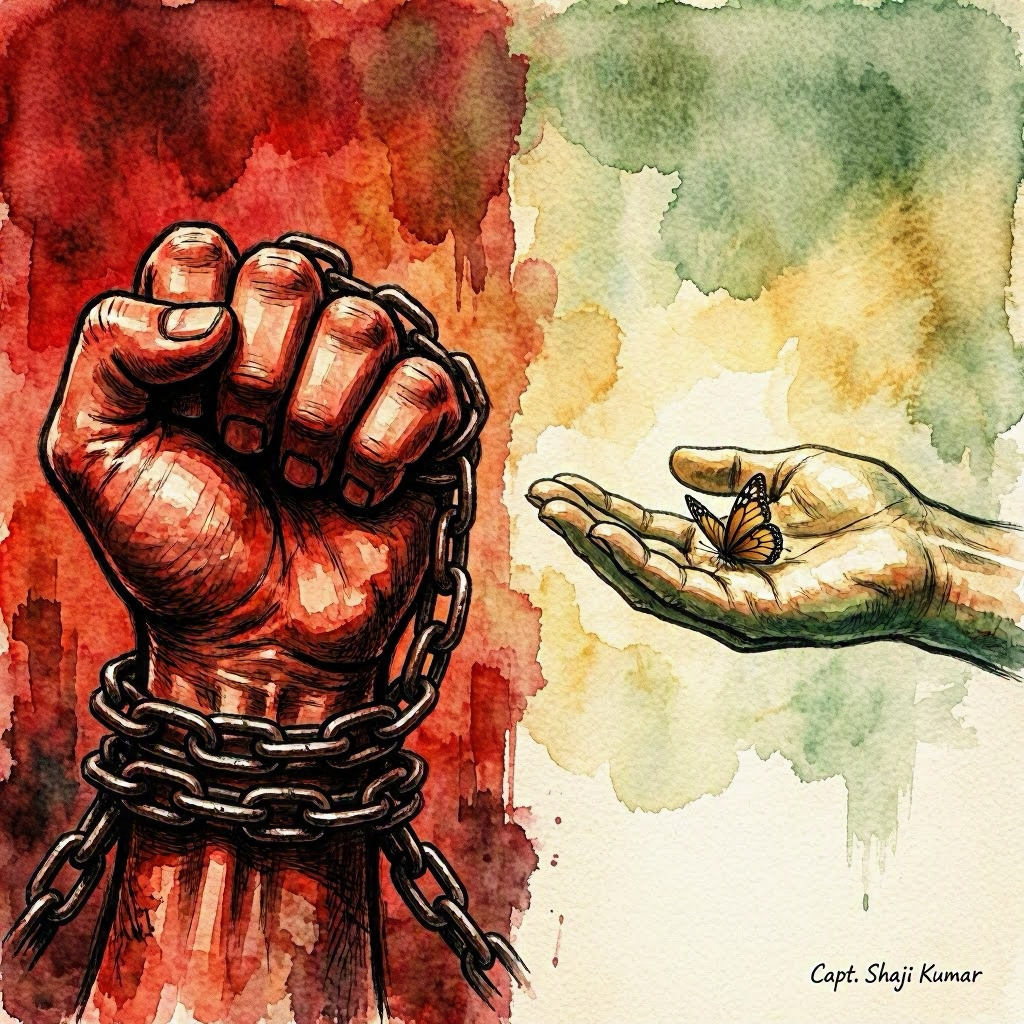
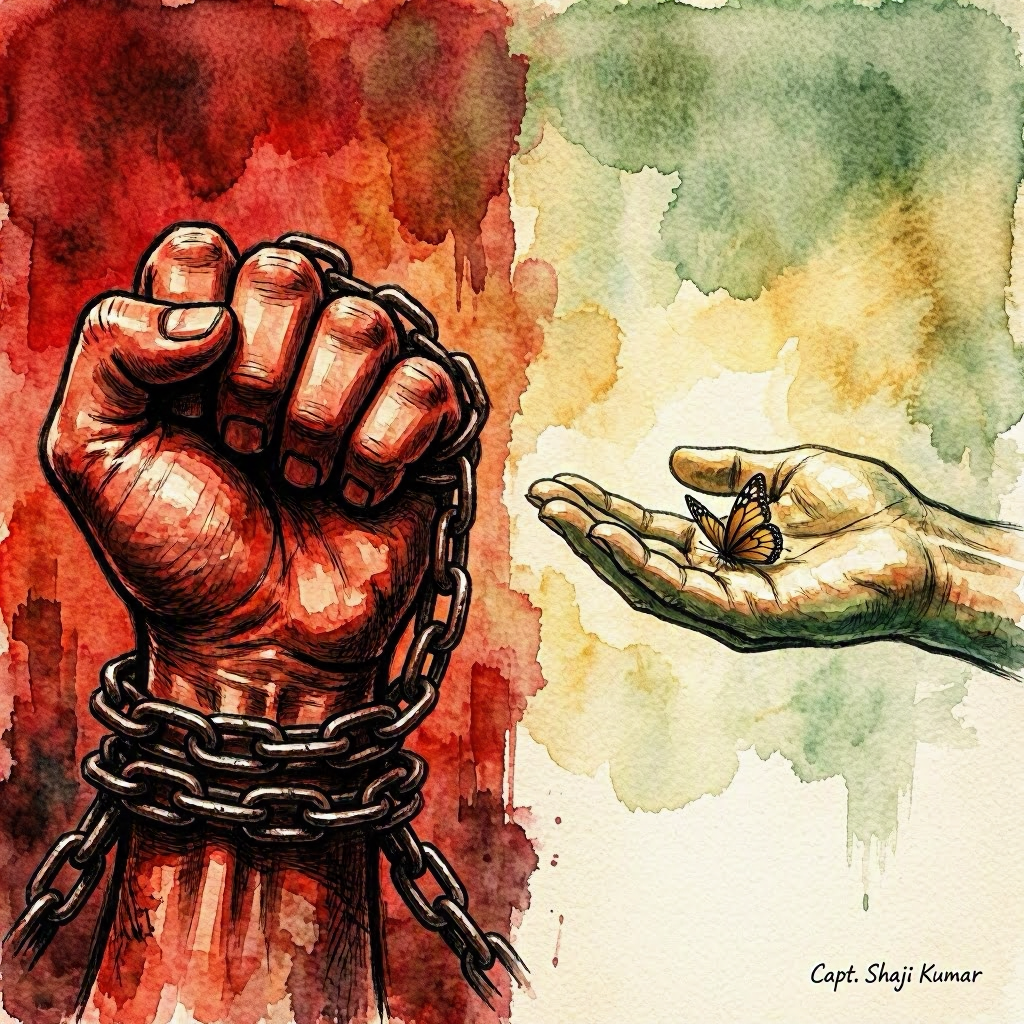
You have been here before. You decide — really decide — that this time you are quitting. No more mindlessly checking your phone before bed. No more skipping the gym. No more that third cup of coffee at 4 PM. You white-knuckle it for a few days, maybe a week. Then, like a compressed spring, the habit snaps back harder than before.
This is not weakness. This is not lack of discipline. This is what happens when you bring a sword to a philosophy fight.
Most high-performers are wired to tackle problems head-on — push harder, want it more, build stronger systems. But when it comes to habits, brute-force willpower is the wrong tool. And the Japanese have known this for centuries.
“You cannot fight your way out of a pattern you have unconsciously chosen to live in.”
Why Willpower Fails — Every Single Time
Here is the science behind the frustration. Every habit lives in a loop: cue → craving → routine → reward. When you try to suppress a habit by sheer force, you are attacking the routine while leaving the craving completely intact. You have not solved the loop. You have just added tension to it.
Neuroscience backs this up. The habit pathways in your brain are carved deep — through the basal ganglia, not the prefrontal cortex where rational decision-making lives. When you fight a craving, you are using your newest, most exhaustible neural resource (willpower) against one of the oldest, most efficient systems your brain has. You will lose. Not because you are weak — but because it was never a fair fight.
The relapse is not a failure. It is physics.
THE WESTERN APPROACH Resist the craving Suppress the urge Force the behavior Punish the relapse Define yourself by failures
THE JAPANESE APPROACH Observe the craving Acknowledge the urge Understand the reward Redirect with curiosity Detach identity from behavior
The Japanese Frameworks You Have Never Applied to Habits
CONCEPT 01
Mushin — “No Mind”
In Zen martial arts, mushin (無心) refers to a state of mental clarity where the practitioner does not react — they simply move. Applied to habits, mushin means creating a gap between the cue and your response. You notice the urge to reach for your phone. You do not fight it. You do not obey it. You simply observe it — like watching a cloud pass. That gap is where your power lives.
CONCEPT 02
Kaizen — Small, Relentless Improvement
Everyone knows kaizen as “continuous improvement.” But its real power in habit change is the idea that smallness is not weakness — it is strategy. Do not try to overhaul the habit. Shrink it. If you scroll social media for 90 minutes a night, do not quit cold turkey. Observe when you reach for the phone. Notice the emotion. Then reduce by five minutes. The goal is not dramatic transformation — it is quiet, undeniable momentum.
CONCEPT 03
Wabi-Sabi — Embracing Imperfection
Wabi-sabi (侘寂) is the Japanese aesthetic of finding beauty in imperfection and impermanence. For professionals trying to break habits, this is liberating: you do not need a perfect streak. The relapse is not the enemy — treating it as catastrophic is what drives people back into the habit loop in shame. Wabi-sabi says: the crack in the bowl is part of the bowl. Begin again without drama.
CONCEPT 04
Ikigai — The Deeper “Why”
Ikigai (生き甲斐) is often translated as “reason for being.” When applied to habit change, it asks a sharper question: what deeper need is this habit actually serving? The late-night doom-scrolling might be avoidance of an unresolved decision. The excess caffeine might be masking low-grade anxiety. Until you meet that underlying need, no surface-level habit fix will hold.
The 5-Step Practice: Observe, Do Not Fight
Here is how you actually apply this — not as a system, but as a daily practice.
1
Name it before you do it The moment you feel the pull of the habit, say it out loud or in your head: “I want to check my phone.” This small act of labeling activates the prefrontal cortex and creates the mushin gap. You are no longer inside the urge — you are watching it.
2
Get curious about the cue Ask: what triggered this? Was it boredom, stress, a specific time of day, a person, a location? Habits are far more situational than we think. Curiosity — not judgment — is the detective tool here.
3
Identify what reward you are actually seeking Dig one layer deeper. The reward is never the surface thing — it is connection, relief, stimulation, validation, or escape. Name the actual reward. Now you have something to redirect toward, not just something to suppress.
4
Take the smallest possible different action Kaizen in action. Do not replace the habit with a heroic new behavior. Replace it with something fractionally better. Reaching for your phone? Put it face-down for two minutes first. The two minutes becomes five. Five becomes the new norm.
5
Review without self-punishment At the end of each day, spend 90 seconds noting: when did the habit appear, what cue preceded it, did I observe or obey? No grades. No streaks. Just data. Wabi-sabi in practice.
Why This Works for High-Performers Specifically
Most productivity literature targets the average person trying to build basic routines. You are not that person. You have already built systems. You have read the books. You are still here because the habits you are fighting are not about lack of knowledge — they are about unmanaged cognitive load, performance pressure, and identity.
High-performers often develop habits as coping mechanisms for high-stakes environments. The scrolling is decompression. The late nights are control. The avoidance is protection. These are not weaknesses to be crushed — they are signals to be decoded.
“The executive who cannot stop checking email at midnight is not undisciplined. They are anxious about losing control. Fix the anxiety — the email habit dissolves.”
The Japanese observational approach respects your intelligence. It does not ask you to follow a 30-day plan or reward yourself with stickers. It asks you to think more clearly about what is actually happening — and to trust that clarity, not force, is what changes behavior at the root.
The Uncomfortable Truth About Habit Change
Here it is: the habits you most want to break are usually serving you in some way you have not fully acknowledged yet. They are efficient solutions your brain found to real problems. Fighting them without understanding them is like ripping out a load-bearing wall because you do not like where it is.
The Japanese approach does not ask you to be more disciplined. It asks you to be more honest. To sit with discomfort long enough to understand it. To be, for a few minutes each day, less warrior and more witness.
That shift — from combatant to curious observer — is where lasting change begins. Not with a dramatic declaration. Not with a new app. With the quiet, repeated act of watching yourself clearly, and choosing, one small moment at a time, something different.
The habit is not the enemy. The unawareness is. Start there.
TAKE THIS FURTHER
Go Deeper With These Books by Capt. Shaji Kumar
If this article resonated with you, these two books take the conversation much further — with practical, body-based tools for lasting transformation.
Book 1Health in Your Hands Discover how your body holds the power to heal. This book puts practical health tools directly in your hands — literally. Available on Amazon → https://www.amazon.in/gp/product/B0FV4BCC7K
Book 2Stress: The Silent Killer WithinA 21-Day Acupressure system to reset your Nervous System, Reduce Anxiety and Reclaim your health naturally. The science of stress has never been more accessible — or more urgent. This 21-day system uses ancient acupressure techniques to rewire your nervous system response from the ground up. Get it now → https://books2read.com/u/bMLojv
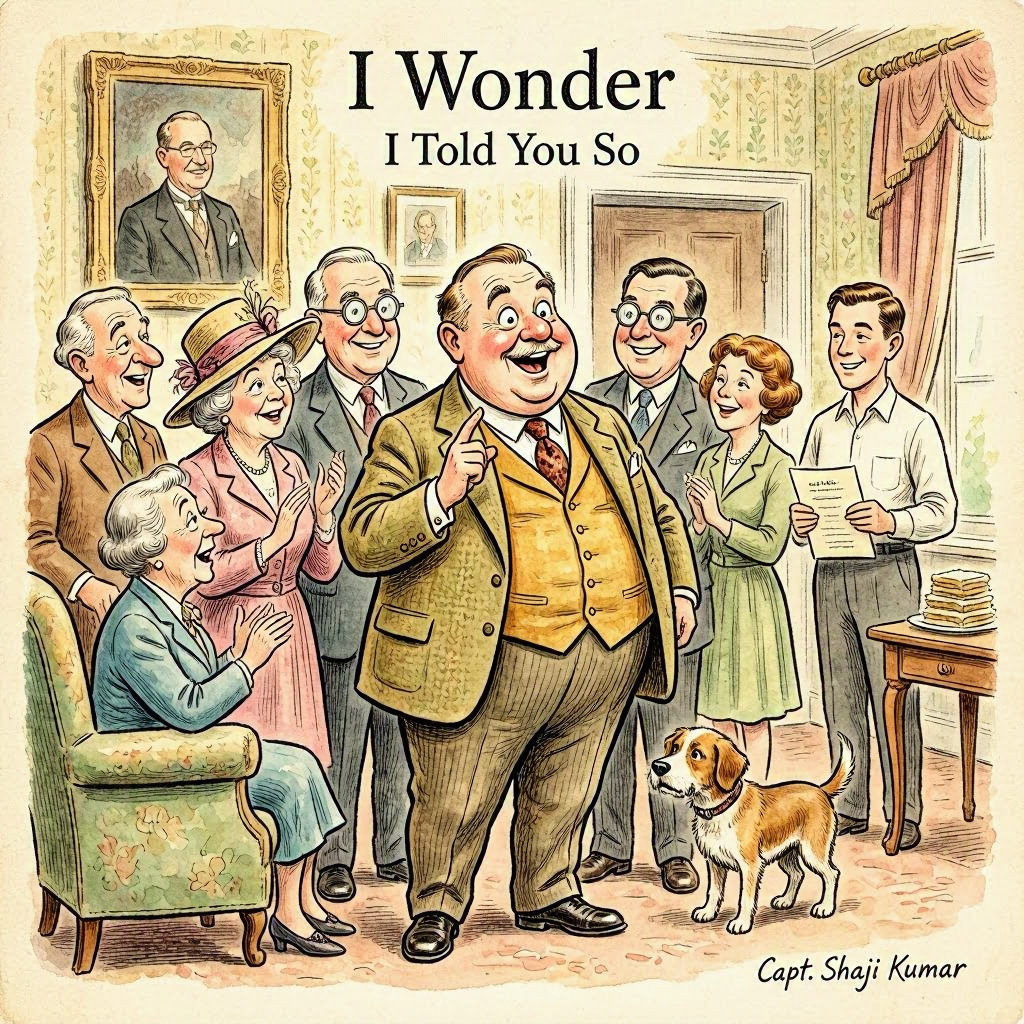
“I Told You So.” — The Three Most Dangerous Words in Human History.
Somewhere, right now, a person is achieving something. And somewhere very close by, another person is clearing their throat, straightening their collar, and preparing to deliver the four syllables that will completely steal the show. “I told You So”.
There is a moment, in every success story, that nobody talks about. Not the sleepless nights. Not the rejection letters thick enough to wallpaper a room. Not the phase where the person in question seriously considered abandoning everything and opening a small tea stall by the highway.
No. The moment nobody talks about is the one that comes immediately after success. The two-second window between the good news breaking and the arrival of The Prophets.
You will recognise them. They travel in groups. They have been waiting. Oh, how they have been waiting.
“I told you so.”
Three words. Delivered with the quiet satisfaction of a man who has just won a bet he placed fifteen years ago and never told anyone about.
Let us trace the life cycle of an achiever, shall we? For science.
Phase One: The Struggle. Our hero is trying. Really trying. Applying for jobs, facing rejections, doubting themselves at 2 AM, eating instant noodles with the quiet dignity of someone who has chosen ambition over a balanced diet. During this entire phase — and this is crucial — The Prophets are largely absent. They are busy. They have opinions to form. Predictions to quietly log in the filing cabinet of their memory, to be retrieved later, at the perfect dramatic moment.
Phase Two: The Breakthrough. It happens. The job offer arrives. The business takes off. The exam is cracked. Our hero, bleary-eyed and slightly disbelieving, picks up the phone to share the news.
Phase Three: The Prophecy Reclamation. Within forty-eight hours — sometimes forty-eight minutes — The Prophets assemble. And the sentence begins.
“You know, I always said this one had it in them.”
“I told your father, years ago — mark my words, I said.”
“I never doubted for even one second. Not one.”
Now here is the truly magnificent part. The prophecy, as delivered, bears absolutely no relationship to what was actually said during Phase One.
During Phase One, the same Prophet may have said, with considerable authority: “This field has no future. Why not try something stable? Have you considered government service?”
But memory, as it turns out, is a remarkably flexible instrument. By Phase Three, that conversation has been quietly edited, rearranged, and rereleased — much like a director’s cut of a film, except the director is rewriting history in real time and no one is allowed to check the original footage.
The achiever, meanwhile, stands there. Holding their hard-won success. Wondering if they imagined the last three years. Wondering if perhaps the Prophet was, in some metaphysical sense, correct all along. Wondering if they should say something. Deciding, wisely, not to.
And then — oh, then — comes the extended remix.
Because “I told you so” is never just four syllables. It is a gateway. A portal to an extended monologue in which the Prophet traces, in extraordinary detail, every single moment they supposedly believed in you — including moments you have no memory of and strong reason to doubt ever occurred.
“Remember that Sunday lunch in 2019? I looked across the table and I thought — that one. That one is going places.”
You were eating rice. You had just spilled dal on your shirt. You were not, by any observable measure, going places.
But here you are, nodding. Because what else do you do?
The supporting cast, of course, is equally spectacular.
There is The Competitive Prophet — who told you so, yes, but also told seventeen other people so, and is now doing complex mental arithmetic to figure out which prediction to lead with.
There is The Reluctant Prophet — who definitely had doubts, enormous doubts, but has decided that publicly owning a prophecy is better than admitting they once suggested you take up accounting.
And then there is The Retroactive Prophet — the purest form — who, if pressed, cannot actually recall saying anything at all, but has by now told the story of their belief in you so many times that they have genuinely begun to remember it. The brain is a wonderful thing.
Meanwhile, the actual achiever. The person who set the alarm at 5 AM. Who rewrote the application seventeen times. Who cried once in a parking lot and told nobody. Who kept going on the days when keeping going felt frankly unreasonable.
That person is standing quietly in the corner, eating cake, occasionally nodding, and thinking: I wonder. I really do wonder.
But they smile. Because they know. And that, in the end, is entirely enough.
The next time someone tells you “I told you so” — smile warmly, nod graciously, and know, deep in your bones, that the only person who truly told you so was the one who stared back at you in the mirror every morning and said: keep going.
That person deserves all the credit. And the cake.
Capt. Shaji Kumar | I Wonder, Issue 02
To every achiever who did it quietly, stubbornly, and entirely on their own — this one’s for you.
We know her name. We know her age. We know which street she lived on, which school she attended, what she was wearing. We have dissected her life, her family’s grief, her trauma — frame by frame — across every television channel and every social media feed.
We do not know his face.
That is where I want you to pause. Right there. In that gap — that enormous, telling, deeply shameful gap — lives everything that is wrong with how we as a society respond to rape.
The victim becomes the story. The perpetrator becomes a footnote. A case number. An “accused” hidden behind the thick procedural curtain of a legal system that was designed, we are told, to protect the innocent — but which, in practice, has become a sanctuary for the guilty.
Let us talk about what the numbers actually say. Not because numbers capture the truth of this crime — they cannot — but because they reveal the scale of our collective failure with a clarity that no amount of editorial outrage has managed to produce.
The Data — because the numbers demand to be heard:
India, NCRB 2024: 29,536 cases of rape reported. That is 80 reported cases every single day. And the word “reported” is doing enormous heavy lifting in that sentence — independent research suggests that over 99% of rapes in India go unreported, buried under the twin weight of social stigma and fear of retaliation.
Of children: In 2024, 784 registered rape victims were under 18 years of age. Under the POCSO Act in 2021 alone, 52,836 cases of sexual offenses against minor girls were filed. Children. In their own homes, their own schools, their own neighborhoods.
Conviction rate: India’s conviction rate in rape cases hovers between 27% and 32%. In Delhi — the city that shook the nation with the Nirbhaya case in 2012 — the acquittal rate in rape cases stands at a staggering 83%. In Karnataka, in 2023, of cases disposed of by courts, 92% ended in acquittals.
Court pendency: As of recent data, 95% of all crimes against women cases are pending trial. Justice delayed is not merely justice denied — in rape cases, it is a second assault on the survivor, drawn out across years.
The accused meanwhile? He returns home. He continues his life. In many cases, he is known to the victim — a neighbour, a relative, a person in a position of trust. He is not paraded. He is not named in most media coverage. He is protected, procedurally and socially, in ways the victim never was and never will be.
This is not an accident of the system. It is a feature of it.
Turn on any news channel after a high-profile rape case. Watch carefully. The camera will linger on the family of the victim — their devastation weaponized for viewership. The reporter will stand outside the hospital, outside the home, outside the court — and every question, every frame, every graphic will orbit the survivor. Her identity. Her background. Her movements on the night in question.
The rapist’s family will not be followed. His neighborhood will not be mapped. His history of behaviour will not be investigated and broadcast in prime time. He will not have to live the rest of his life as a figure of public shame — because the media has decided, consciously or not, that the victim is the more compelling story. Sensation sells. Suffering sells. A family broken sells. A predator exposed and humiliated? That is apparently less interesting.
This must change. And the change must be structural, not sentimental.
What the world has done — and what we refuse to consider:
Several countries have decided, through law and through will, that a rapist forfeits his standing as a protected citizen.
Bangladesh passed the Women and Children Repression Prevention (Amendment) Bill in 2020, introducing the death penalty for rape following mass public outrage over high-profile cases.
Pakistan introduced the death penalty for gang rape and child sexual abuse in 2020. Chemical castration is an additional sentencing option.
Saudi Arabia mandates death by public beheading for convicted rapists under Sharia law. Egypt, Iran, the UAE and China have similar provisions for aggravated rape, particularly involving minors.
North Korea sentences rapists to death by firing squad.
One does not have to admire the legal systems of these countries in their entirety to acknowledge the singular clarity of their message: this act places you outside the protection of civil society.
India, meanwhile, has the Nirbhaya Fund — announced in 2013, still largely unspent a decade later. It has fast-track courts — chronically understaffed and overwhelmed. It has the POCSO Act — routinely delayed in its application. It has laws. It has frameworks. It has committees. What it does not have is the will to make the punishment so swift, so certain, and so visible that it functions as a genuine deterrent rather than a bureaucratic inconvenience.
The argument against capital punishment is not without intellectual weight. There are serious, principled objections — the risk of wrongful conviction, the question of whether the state should hold the power of death, the evidence on deterrence. These arguments deserve a hearing in Parliament and in academic institutions. They are not arguments that should be used to endlessly delay action while children are being assaulted and survivors are being re-traumatized in courtrooms for years on end.
There is a middle ground that India has not seriously explored: mandatory, time-bound trials — completed within ninety days for rape cases. Automatic public identification of convicted rapists — their names, their photographs, their backgrounds published as a matter of public record. Constitutional amendment to classify rape, particularly of minors, as a crime against the state — not merely against the individual — triggering a fundamentally different order of response from the justice system.
The rapist should be the story. His face should be known. His family should have to reckon with what he has done. The community that sheltered him, that looked away, that whispered about the girl rather than condemning the man, should be made uncomfortable in the full light of public scrutiny.
Because here is the truth that our system refuses to confront: the victim did not choose this. He did. Every protection, every procedural courtesy, every anonymous news report that shields his identity is a choice — a choice we make, again and again, to protect the wrong person.
A child who was violated does not get to remain anonymous in her own memory. The very least a just society can do is ensure that the man who violated her cannot remain anonymous in ours.
We pour our outrage into candlelight vigils and hashtags that trend for forty-eight hours, then we move on — so I ask you plainly: how many more names do we need to remember before we decide that the one name we should never be allowed to forget is his?
Somewhere in India, as you read this sentence, a woman is being reminded that she did not come with enough.
Let that sit for a moment. Not as a statistic. Not as a headline you scroll past. As a fact about a living, breathing human being — perhaps a daughter, a sister, a friend — whose worth is being measured in rupees, in gold, in the square footage of a refrigerator her parents could or could not afford to send along with her to her new home.
We are, by every measure, a civilisation that has put men on the moon, mapped the human genome and built artificial intelligence that can write poetry. And yet, in the same civilisation, in the year 2024, sixteen women died every single day in India alone because the cheque their families wrote was not large enough for the family they married into.
The Data — because numbers have faces:
India, NCRB 2024: 5,737 dowry deaths recorded — over 15 women every single day. Uttar Pradesh alone accounted for 2,038 deaths, over one third of the national total. Bihar followed with 1,078.
Dowry-related suicides rose 6.7% between 2023 and 2024 — from 1,587 to 1,693 cases.
Cruelty by husband or relatives: over 1.2 lakh cases filed in 2024 alone. These are only the ones reported.
Pakistan: approximately 2,000 dowry deaths per year — the highest rate per 100,000 women in South Asia, and widely believed to be severely underreported.
The Dowry Prohibition Act has been on India’s statute books since 1961. Sixty-four years. The law exists. The dying continues.
These numbers are not abstract. Each one was a wedding. Each one was a woman who dressed in finery, touched the feet of elders, took the vows according to customs of the religion/faith pertaining thereof, or signed a register, and believed — as every young person has the right to believe on that day — that she was entering a life, not an invoice.
What is most chilling is not the violence itself, terrible as it is. It is the architecture around it. The neighbors who heard something and said nothing. The in-laws who watched it build and looked away. The police who filed it as a kitchen accident. The extended family that whispered about the girl’s shortcomings rather than the husband’s cruelty. The society that mourned briefly, then moved on to the next wedding season.
Dowry death is not a crime committed by monsters in dark alleys. It is a crime committed in decorated drawing rooms, in kitchens smelling of turmeric, in the presence of family photographs and gods on the wall. That is precisely what makes it so insidious — and so difficult to confront. Because confronting it means looking at people we know. People we love, perhaps. People we have eaten with.
Across the border in Pakistan, in the alleys of Dhaka, in the hills of Nepal — the geography changes, the language shifts, the religion differs — but the transaction remains the same. A young woman’s life, quietly balanced against the contents of a trunk she was expected to bring with her.
The laws are written. The penalties are clear. What is missing is something no legislature can mandate — the collective moral outrage of ordinary people who refuse, finally, to treat this as someone else’s problem.
We light candles for disasters we cannot control and fall silent about the ones we can — so tell me honestly, the next time you sit at a wedding and hear someone whisper about what the bride’s family did or did not bring, will you smile politely and reach for your glass, or will you finally say something?
We talk about time as though it is slipping away from us. As though it is the thief. But here is the uncomfortable truth — time is not the problem. The real question is what we are doing with it while it stands patiently at our door.
There is a practice, ancient in its wisdom yet devastatingly underused, that the most purposeful people on this earth quietly share. They think. Deliberately. Every single day, they sit with their goals — not just glance at them, but truly inhabit them. They turn them over in their minds the way you’d turn a compass in your hand until the needle finds north.
The human mind is an instrument of staggering, almost frightening power. Left idle, it wanders into worry. But directed — truly directed toward a worthy purpose — it becomes something closer to a force of nature. No goal that is genuinely pursued with daily intention remains impossible forever. None. The mind, once locked onto something it believes in, begins to work on it even in sleep.
This is not mysticism. This is simply how we are built.
So here is what I ask of you — not much, just this: write your goals down. Not on a screen you will swipe away. On paper, with your own hand. Then keep that list somewhere you cannot avoid it. On your desk. Beside your morning cup. Tucked into the book you read at night. Read it once, every day. Let it become as familiar as your own face in the mirror.
A goal that lives only in your head is a wish. A goal written down and revisited daily becomes something else entirely — it becomes a quiet, relentless, inevitable force.
You have the mind for it. You have always had the mind for it. The only question that remains is whether you will give it even five minutes of your day.
After all — if not now, when exactly were you planning to begin?