
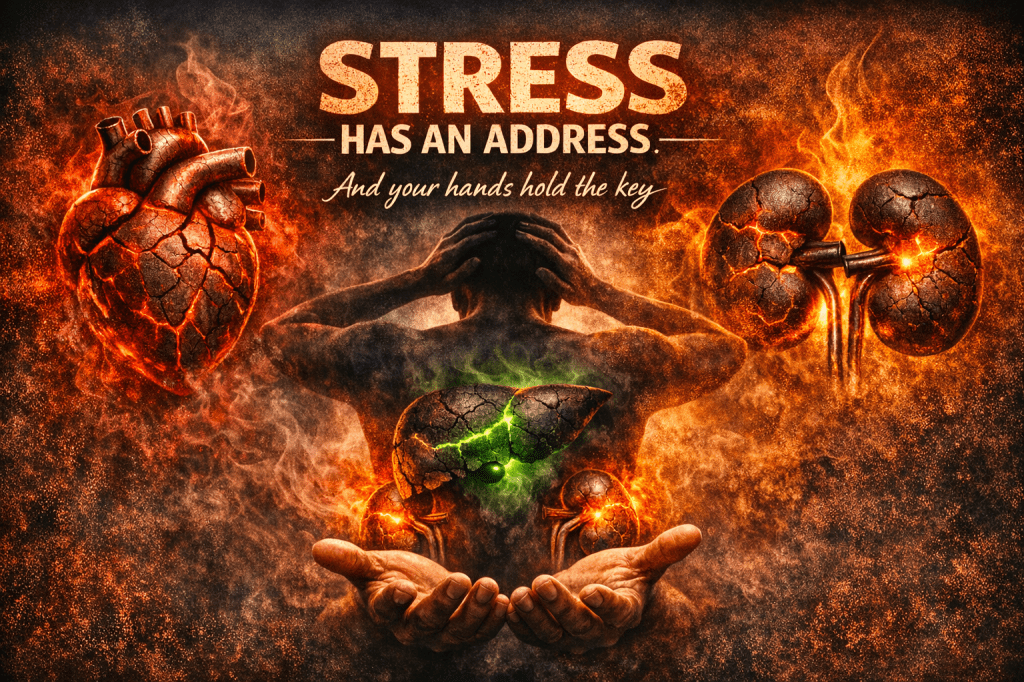
The Body Keeps the Score — Organ by Organ.
Your body has been keeping a very detailed record of everything you have been through. It is written in your organs. Time to read it — and respond.
There is a reason this phrase has become famous in the world of trauma and stress research. The body does not experience stress as an abstract event that happens to the mind. It experiences it as a physical event that happens to tissue, glands, organs, and cells. And over time, the tissue remembers.
In traditional Chinese Medicine, this understanding is thousands of years old — and expressed with elegant precision. Each major organ is associated not just with a physiological function but with an emotional domain. The heart with joy and its absence. The liver with smooth flow and, when disrupted, with anger and frustration. The kidneys with the capacity to face life without fear. The lungs with the ability to take in and let go — breath by breath. When stress persists, these emotional-organ relationships become sites of accumulation. The organ that carries the load eventually shows it.
Today’s post maps exactly where your specific stress pattern might be living — and gives you a targeted acupressure protocol for each organ system. You will likely recognise your own pattern before you finish reading.
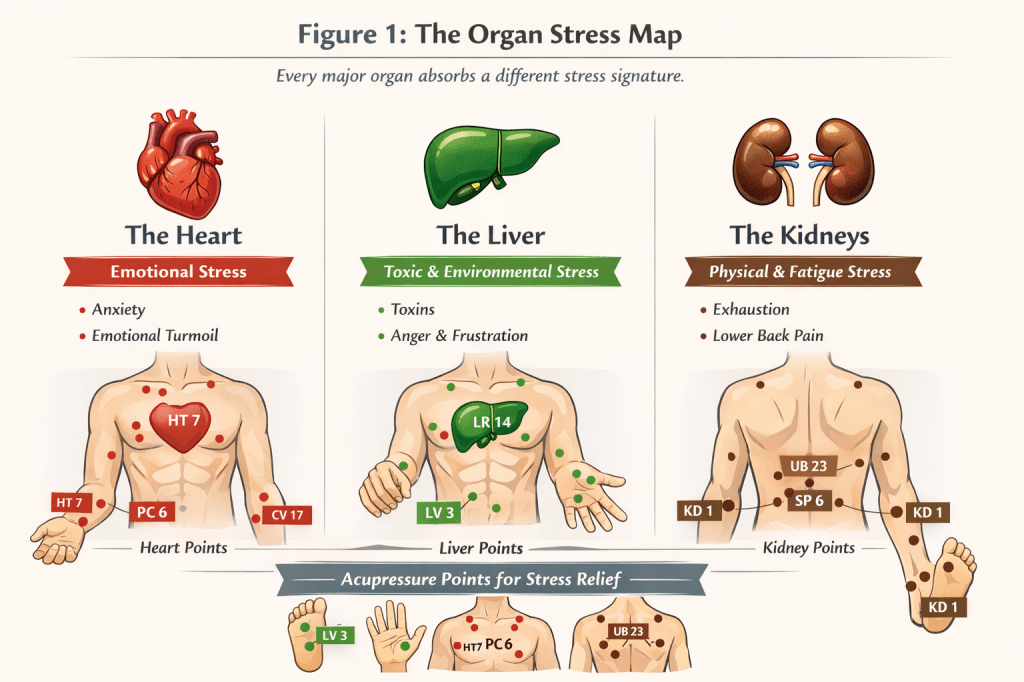
The Heart — When Stress Becomes a Feeling You Cannot Name
The Chinese medical classics describe the Heart as the emperor of all organs — the one that must remain calm and clear for all the others to function. When stress is relentless and the Heart is disturbed, the first sign is rarely physical. It is the inability to feel settled. The sense that something is wrong even when nothing specific is wrong. The racing thoughts at night. The disproportionate emotional response to small things. These are signs that the Heart’s Shen — its governing spirit and consciousness — is disturbed.
Physically, the heart under stress shows up as palpitations, elevated resting heart rate, blood pressure that is persistently high even when you are trying to rest, and a strange kind of chest tightness that comes and goes without a clear cause. Long-term, the cardiovascular consequences of unresolved stress are among the most serious and well-documented in medicine.
Heart Protocol
CV 17 (sternum centre): 2 minutes, sustained and gentle, with slow breath
BL 15 (back, level with heart): Tennis ball or partner press, 90 seconds, eyes closed
HT 7 (wrist crease, Spirit Gate): 2 minutes, press steadily while breathing out slowly
PC 6 (inner wrist, 2.5 fingers up): 90 seconds each wrist — the Heart’s protector point
Lifestyle addition: One tablespoon of raw honey in warm water each morning has been used across traditional medicine systems to support the heart and calm the spirit. Add a small pinch of cardamom — a heart-supportive spice with documented vasodilatory properties.
The Liver — Where Frustration Goes to Live
Of all the organ-stress relationships in Chinese medicine, the Liver-stress connection is perhaps the most immediately recognisable to a modern audience. When the Liver qi is constrained — when the smooth flow of energy through the body is blocked — the emotional signature is unmistakable: irritability that arrives before you have even had time to think, a short fuse that surprises even you, the feeling of things being stuck or obstructed, tension in the sides of the body and the ribcage.
Sound familiar? For most people living with chronic stress, the liver meridian is involved. And the physical consequences of long-term liver qi stagnation are not trivial: disrupted hormone metabolism, impaired detoxification, elevated inflammatory markers, digestive disturbance (the liver and the digestive system are intimately linked), and increasingly, research connecting liver health to mood disorders in ways that blur the traditional line between ‘physical’ and ‘mental’ health.
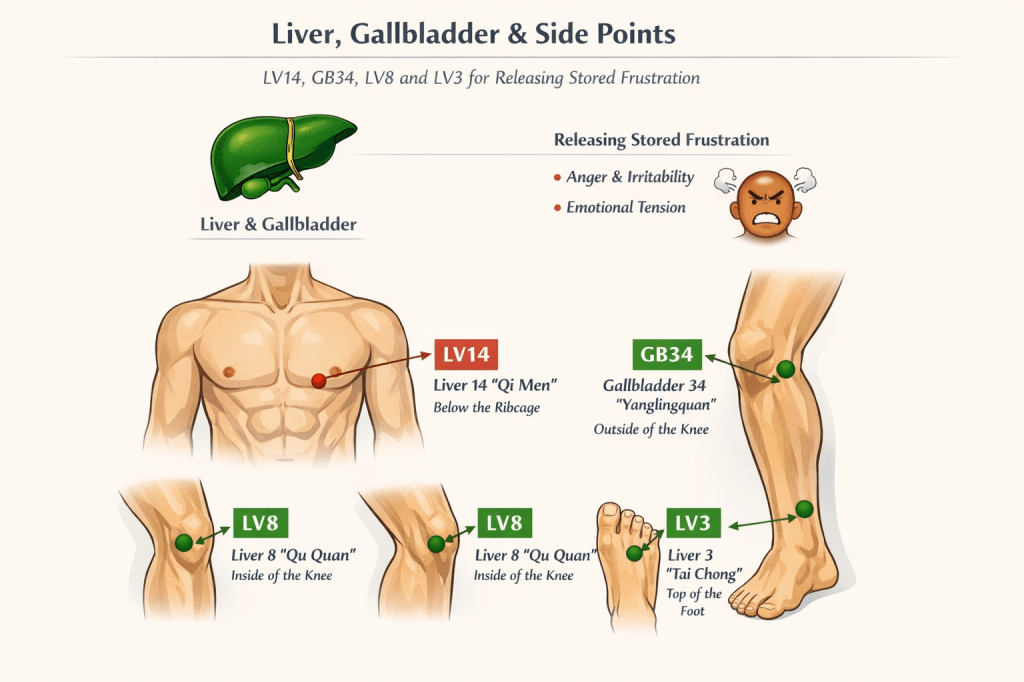
Liver Protocol
LV 3 (between first and second toes): The liver’s primary release valve — 90 seconds each foot, firm press, breathe through the tenderness
LV 14 (below breast, 6th intercostal): 90 seconds each side — the liver’s alarm point on the chest, often exquisitely tender
GB 34 (below outer knee): Influential point of the sinews — releases muscle tension from stress and frustration
LV 8 (inner knee crease): Nourishes liver blood — important for those with fatigue and emotional volatility from long-term stress
Lifestyle addition: The liver performs most of its detoxification work between 1am and 3am — which is exactly when stressed individuals with liver qi stagnation tend to wake. Going to bed by 11pm, drinking warm lemon water on waking, and avoiding alcohol entirely during stressful periods are the three most impactful liver lifestyle choices.
The Kidneys — When Fear Has Been the Background Note for Too Long
In Chinese medicine, the Kidney is the organ of fear and of fundamental vitality. When fear — not acute fright, but the low-grade existential anxiety of modern life, the worry about the future that never fully resolves — becomes chronic, it depletes the Kidney system. What this looks like physiologically is adrenal exhaustion: the state of being tired but unable to rest, depleted but unable to switch off, anxious without a specific cause.
The kidneys govern the bones, the lower back, the knees, the ears, and the hair. Chronic stress-induced kidney depletion shows up as persistent lower back ache, knee weakness, tinnitus, premature greying, and the specific kind of exhaustion that sleep does not fully resolve. If this description feels accurate to you, the kidney protocol below is where to begin.
Kidney Protocol
BL 23 (lower back, L2 level): The Kidney’s back-shu point — tennis ball method, 2 minutes, daily
KD 1 (sole of foot, centre): The grounding point — 2 minutes each foot, morning barefoot is ideal
KD 3 (inner ankle, behind bone): The Kidney’s source point— just behind and below the inner ankle bone; press firmly for 90 seconds each side
GV 4 (Ming Men, between L2-L3): Warm palm or heating pad, 2 minutes — rebuilds the Yang fire the kidneys need
Lifestyle addition: Black sesame seeds, kidney beans, walnuts, and bone broth are the four most kidney-nourishing foods in both Chinese dietary therapy and modern nutritional science. A tablespoon of black sesame daily — ground and added to porridge or smoothies — is one of the simplest kidney-supportive habits there is. Reduce salt intake: chronically high sodium places direct strain on the kidney’s filtration function.
The Lungs — Carrying Grief and the Inability to Let Go
The lungs govern not just breathing but, in Chinese medicine, the rhythm of taking in and letting go that applies as much to experiences, relationships, and emotions as it does to air. Grief — unprocessed loss of any kind, including the smaller but cumulative losses of a stressful life: opportunities, time, health, ease — is the emotion that damages the lung system most acutely.
People with lung-dominant stress often present with persistent respiratory symptoms (frequent colds, recurrent chest infections, chronic cough, asthma that worsens under emotional stress), a shallow, high breathing pattern that never quite settles, and a tendency to sigh frequently — which is the lung’s attempt to self-correct the breathing rhythm. They may also experience skin problems, because in Chinese medicine the lungs govern the skin and the body’s exterior.
Lung Protocol
LU 1 (upper chest, below clavicle): Lung’s alarm point — press firmly for 90 seconds, expect tenderness if grief is present
LU 7 (inner wrist, above thumb side): 1.5 finger-widths above the wrist crease on the thumb side — Lung’s command point; 90 seconds each
CV 17 (sternum centre): Opens the chest, deepens breath — 2 minutes with conscious expansion breathing.
Breathing practice: Grief-dominant stress responds particularly well to extended exhale breathing. Breathe in for 4 counts. Breathe out for 8. The longer exhale directly stimulates the vagus nerve and physiologically represents ‘letting go.’ Five minutes of this breathing daily, specifically paired with LU 1 pressure, is a practice of profound emotional as well as physical effect.
The Thyroid — Where Stress Disrupts the Hormonal Axis
The thyroid gland sits at the front of the throat, and its relationship with stress is direct and increasingly well-documented. Chronic cortisol elevation suppresses thyroid hormone conversion — specifically the conversion of the inactive form (T4) to the active form (T3). This is why many people with chronic stress develop subclinical hypothyroid symptoms: persistent fatigue, weight gain that does not respond to diet, hair thinning, cold intolerance, cognitive slowing, and depression — even when a standard TSH blood test returns as ‘normal.’
The throat is also — in both the physiological and energetic sense — the site of self-expression. The stress of suppressing what you need to say, of swallowing words and feelings, of living in environments where authentic expression feels unsafe, concentrates here. The sensation of a lump in the throat during emotional stress is not metaphor. It is the physical manifestation of unexpressed content held at the throat level.
Figure 3: Throat, Neck & Thyroid Points — CV22, ST9, TW17 for hormonal balance and jaw tension
Thyroid & Throat Protocol
- CV 22 (hollow at base of throat): One finger, very gentle pressure — never hard on the throat. Circular motion, 60 seconds. Releases the thyroid zone and the throat’s holding pattern.ST 9 (side of neck, beside Adam’s apple): CAUTION: Apply one side at a time only. Light touch — this point is near the carotid artery. 30 seconds each side, alternating. Regulates blood pressure and supports thyroid circulation.
- TW 17 (behind earlobe): In the bony depression behind each ear — press firmly but gently for 60 seconds each side. Releases jaw clenching, TMJ tension, and the neck tightening that stress produces.
Lifestyle addition: Iodine-rich foods support thyroid function directly: seaweed (nori, kelp), eggs, and iodised salt in moderation. Selenium, found in Brazil nuts (two daily is sufficient), is essential for thyroid hormone conversion. Avoid raw cruciferous vegetables in large quantities if thyroid function is already compromised — lightly cook them instead.
The Anti-Stress Diet — Feeding Your Nervous System
Food is information. Every meal you eat sends a signal to the nervous system, the immune system, and the hormonal axis either in the direction of resilience or in the direction of greater vulnerability to stress. The diagram below maps the most important food categories for stress recovery — not a complicated diet, but a daily orientation toward the foods that actively support the systems stress most damages.
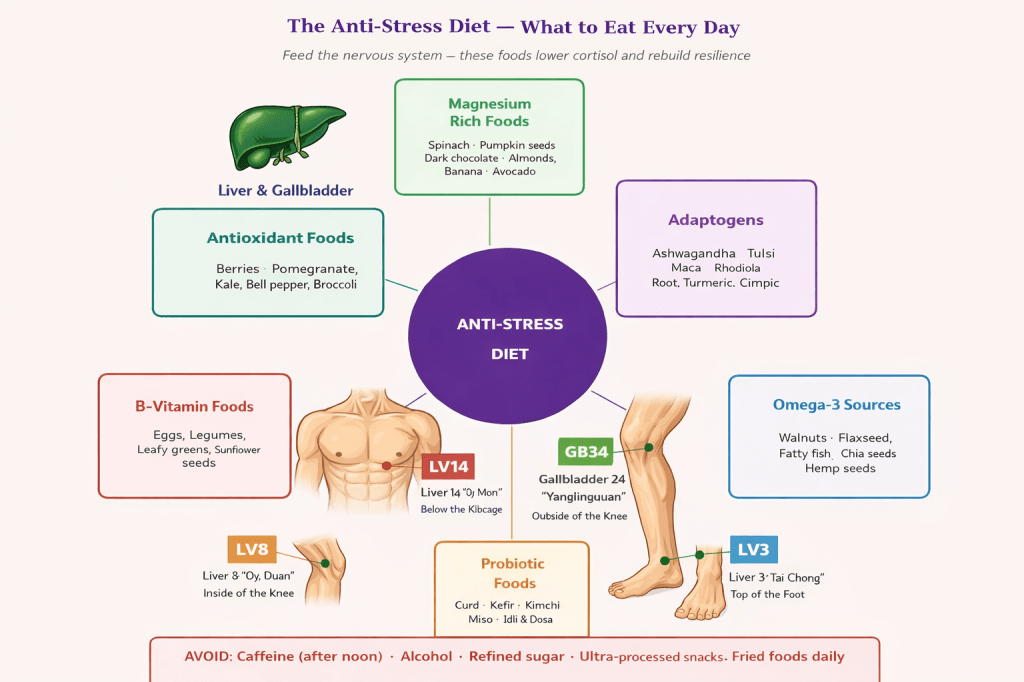
The 5 Daily Non-Negotiables for a Stressed Body
1. MAGNESIUM — Most stressed people are magnesium-deficient. Stress depletes it; deficiency worsens stress. A handful of pumpkin seeds or a tablespoon of ground flaxseed daily covers a significant portion of requirements.
2. PROBIOTICS — The gut-brain axis is a two-way street. Stressed guts produce stressed minds, and vice versa. One serving of fermented food daily (curd, kefir, kanji, kimchi) maintains the microbiome that produces 90% of your serotonin.
3. OMEGA-3 — Directly reduces neuroinflammation, which chronic stress generates. Walnuts, flaxseed, and fatty fish are the most accessible sources. These fats literally lubricate the nervous system.
4. B VITAMINS — The entire B-complex is stress-depleted and stress-essential simultaneously. Eggs, legumes, and leafy greens cover the full spectrum. Avoid single-B supplements — they work as a team.
5. ASHWAGANDHA — An adaptogenic herb with the most robust clinical evidence base for cortisol reduction. 300-600mg of root extract daily. Not a cure — an adaptation tool. Pair with the acupressure practice for compounded effect.
The Sleep-Cortisol Loop — Breaking the Cycle
Here is the vicious cycle that most stressed people are caught in: poor sleep raises cortisol; elevated cortisol disrupts the next night’s sleep; the resulting exhaustion lowers stress tolerance; everything feels more stressful; cortisol stays high. Around and around.
Breaking this cycle requires targeting both ends simultaneously. The acupressure practices in this series address the cortisol side. The sleep hygiene practices below address the sleep side. Together, they give the loop somewhere to break.
Consistent sleep and wake times — even on weekends. The circadian rhythm is the single most powerful regulator of cortisol, and it requires consistency to function.
No caffeine after 1pm. Caffeine has a half-life of five to seven hours. A 3pm coffee is still partly in your system at midnight.
The evening acupressure sequence (SP 6, KD 1, Yintang, HT 7) done lying in bed — this is detailed in full in Post 4 [To be published soon.
Magnesium glycinate 200-400mg before sleep: the most evidence-supported supplement for sleep quality and cortisol reduction, with an excellent safety profile.
No alcohol within three hours of sleep. Alcohol initially sedates but severely fragments sleep architecture in the second half of the night — producing the early-morning waking that stressed people so commonly report.
Your organs do not hold stress against you. They are simply waiting for the signal that it is safe to let go. These practices are that signal.
Work With Me
Understanding which organ system is carrying the primary load of your stress — and tailoring the acupressure practice accordingly — makes the practice significantly more efficient. The same hour invested, but directed precisely.
In a consultation, we identify your specific stress-organ pattern through a combination of symptom mapping, lifestyle history, and the classical diagnostic approaches that Chinese medicine uses to locate where in the body the stress has taken deepest root.
Then we build your protocol — points, sequence, timing, dietary adjustments, and lifestyle shifts calibrated to your specific picture.
Reach out: skcjos@gmail.com
Coming in Post 4: ‘The 21-Day Stress Reset — A Daily Practice That Actually Holds’
In Association with World Health Journey | Oman
Chronic stress does not just strain your body — it leaves lasting psychological patterns that shape every decision, relationship, and response you have. These patterns are measurable.
The Cognitive Health Check-Up from World Health Journey maps your psychological stress architecture — identifying the emotional patterns, cognitive distortions, and resilience gaps that chronic stress has created, before they become something harder to address.
Begin your assessment: www.whjonline.com/mmpi-2/
Know the pattern. Then you can change it.


 Capt. Shaji Kumar