Every aspiring author eventually confronts this question.
Should I self-publish my book or wait for a traditional publisher to pick it up?
For decades, only one answer seemed respectable.
You wrote.
You waited.
You submitted.
You collected rejection letters.
You waited some more.
And somewhere at the end of that long tunnel, hopefully, a publisher decided that your manuscript was worthy of becoming a book.
The publisher was the gatekeeper.
And the gatekeeper decided who entered.
Today that gate is still there.
But something remarkable has happened.
There is now another entrance.
And more and more authors are walking through it.
On their own.
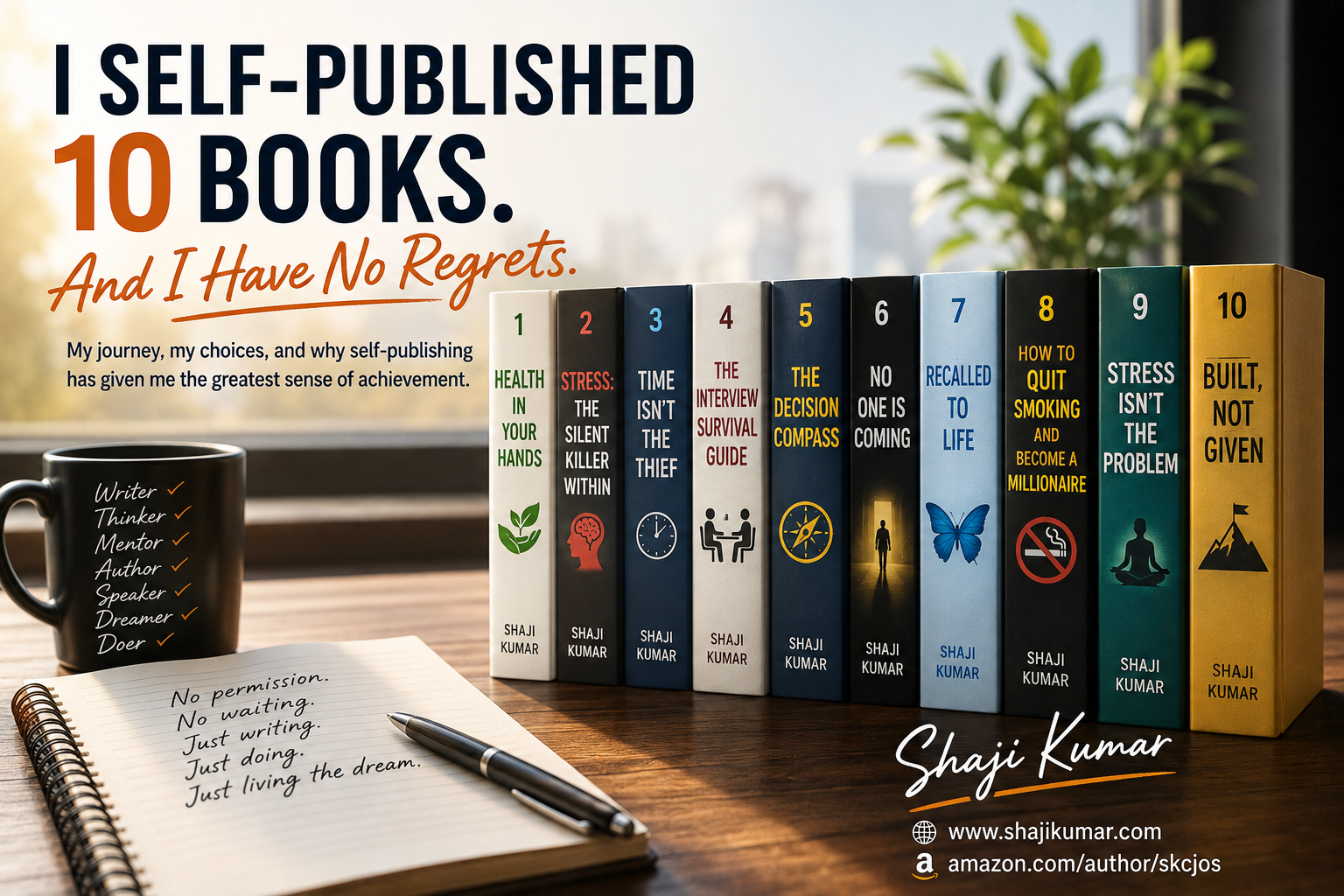
I have Self-Published Ten Books.
Let me make this personal.
I have published 10 Books!
Ten.
When I look at them today, I don’t first think about sales numbers, rankings, royalties or reviews.
I think about something much more personal.
I feel a sense of achievement.
Ten times, I had an idea.
Ten times, I sat down and converted that idea into thousands of words.
Ten times, I fought procrastination, self-doubts, rewrites, corrections and that nagging voice every writer knows:
Is this really worth publishing?
And ten times, I saw something that existed only in my mind become something I could actually hold in my hands.
A book.
With my name on it.
Am I satisfied with my decision to self-publish?
Absolutely.
Would I have felt differently if a large traditional publishing house had published all ten books?
Perhaps.
There is undoubtedly a certain prestige associated with being “published by” a recognised publishing house.
But here is the question I have increasingly begun asking myself:
Prestige for whom?
The Publisher?
The author?
Or the reader?
The Day We Stopped Needing Permission
Traditional publishing was built around scarcity.
Printing a book was expensive.
Distribution was complicated.
Bookstores had limited shelf space.
Marketing required money.
Publishing houses performed an essential role.
They selected manuscripts.
Invested in authors.
Printed books.
Distributed them.
Marketed them.
In other words, they made it possible for an author to reach a reader.
But technology changed that equation.
Today, an author sitting in Delhi, Mumbai, Kochi or a small town in India can write a manuscript, have it professionally edited, design a cover, format and make it available to readers around the World.
Without ever walking into the office of a traditional publisher.
That is revolutionary.
And like every revolution, it has upset the people who benefited from the old system.
The Numbers Are Telling Us Something.
The global publishing world has already begun changing.
In the United States, self-publishing has overtaken traditional publishing in the sheer number of titles produced.
Bowker data reported by Publishers Weekly showed more than 2.6 million self-published titles in 2023 compared with approximately 563,000 traditionally published titles.
But look at what is happening here.
India issued more than half a million ISBN’s in 2024, according to recent ISBN metadata research.
And the self-publishing ecosystem is growing rapidly.
Notion Press alone has claimed to publish between 30,000 to 35,000 books a year.
That is about 100 books a day.
Think about that for a moment.
Every Day.
One hundred new authors somewhere are turning their ideas into books through a single self-publishing platform.
That does not include Amazon KDP.
It does not include Bluerose.
It does not include Pothi.
It does not include the hundreds of hybrid and assisted publishing companies.
And it certainly does not include authors [myself included] who independently manage the entire process themselves.
The genie is out of the bottle.
And it is not going back in.
Traditional publishing is beginning to look like the Morning Newspaper.
I may be controversial when I say this.
But I believe the traditional publishing model is facing the same existential challenge newspapers did.
I belong to a generation that remembers waiting for the morning newspaper.
It was part of life’s ritual.
The newspaper arrived.
You picked it up.
You read the headlines over your morning tea.
You turned the pages.
You discussed the news.
Something almost sacred about that daily ritual.
And then came the Internet.
News became immediate.
Continous.
Personalised.
Accessible.
The newspaper did not disappear overnight.
It is still around.
But its position in our lives changed forever. It went from being the primary source of news to being one of the many sources.
I believe something similar is happening to traditional publishing.
Let me be clear.
Books are not dying.
Publishing is not dying.
Reading is not dying.
But the traditional gatekeeper model is losing its monopoly.
And that is a very different thing.
The Publisher Was Once the Only Route to the Reader.
For centuries, if you wanted to reach readers, you needed a publisher.
Today, you don’t.
That single fact changes everything.
The publisher is no longer the only bridge between the writer and the reader.
Amazon is a bridge.
Social Media is a bridge.
LinkedIn is a bridge.
Substack is a bridge.
Your website is a bridge.
Your professional network is a bridge.
Your readers themselves are a bridge.
Today, an author can build an audience before the book is even published.
In fact, I would argue that this is increasingly the smarter way to do it.
Write.
Share.
Engage.
Build credibility.
Build a community.
Understand your readers.
And when your book arrives, it does not arrive in an empty marketplace.
It arrives among people who already know you.
Let Me Say Something Important About Self-Publishing.
Self-publishing should not mean poorly publishing.
This is where I believe many aspiring authors get it wrong.
Publishing has become easier.
That does not mean writing a good book has become easier.
Nor has creating a professional book.
If anything, the standards should be higher.
When you self-publish, you cannot blame the publisher for a poor cover.
You cannot blame an editor for grammatical errors.
You cannot blame a marketing department for poor sales.
You own the process.
Completely.
And that is precisely what I like about it.
Freedom is wonderful.
But freedom comes with responsibility.
When I self-publish, I am not simply an author.
I am also the publisher.
I have to think about the manuscript.
The editing.
The cover.
The layout.
The title.
The description.
The pricing.
The launch.
The marketing.
The reviews.
The distribution.
Everything.
It is exhausting.
But strangely, it is also deeply satisfying.
Because when the finished book finally arrives, I know exactly how it got there.
If you are an aspiring author and would like some advice completely free of charge, drop me an email at skcjos@gmail.com, and I would be happy to share what I know. Not much, but still a ten-book experience.
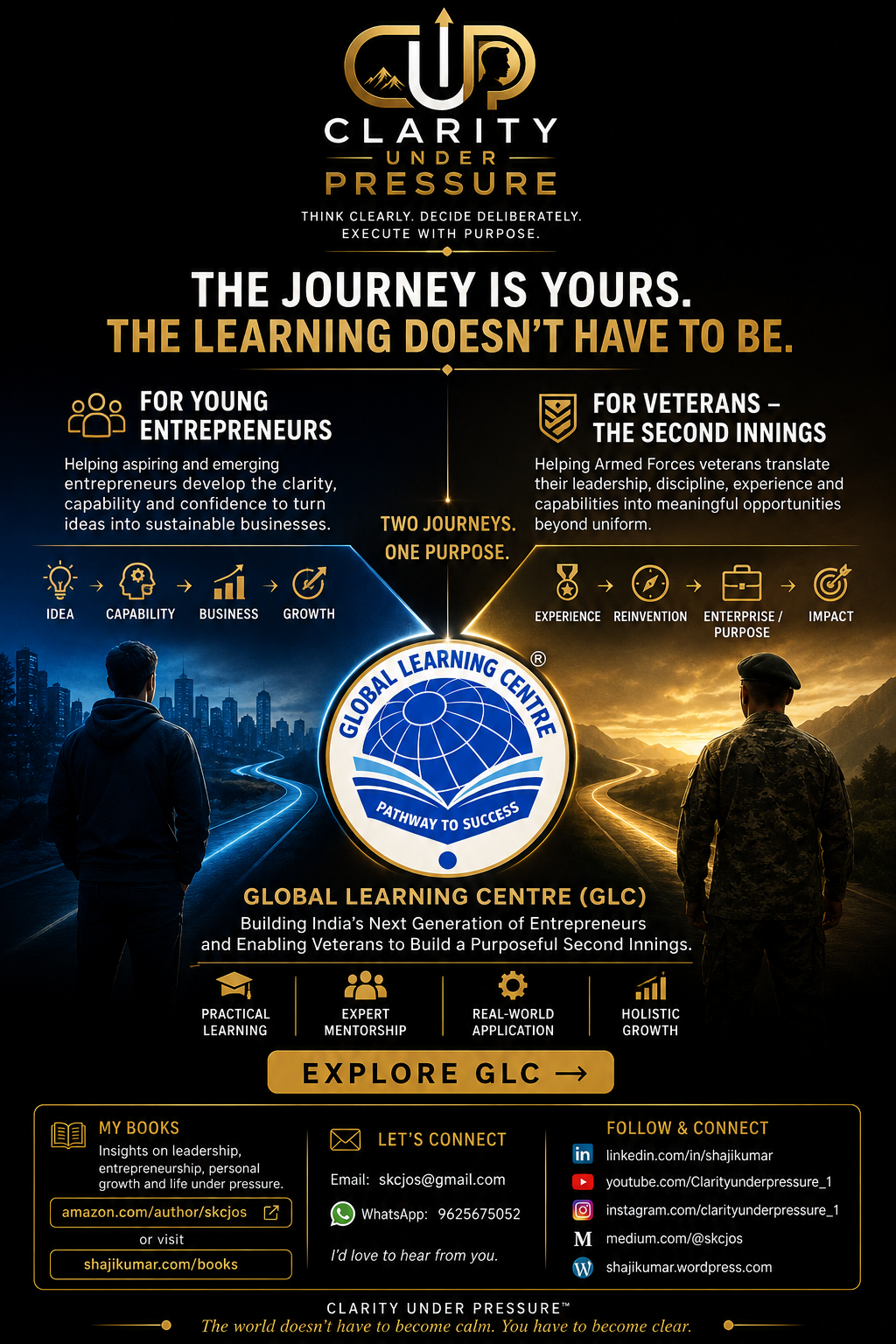
The Journey is yours. The Learning doesn’t have to be.
Global Learning Centre (GLC) is being built around two journeys:
FOR YOUNG ENTREPRENEURS
Helping aspiring and emerging entrepreneurs develop the clarity, capability and confidence to turn ideas into sustainable businesses.
FOR VETERANS — THE SECOND INNINGS
Helping Armed Forces veterans translate their leadership, discipline, experience and capabilities into meaningful opportunities beyond uniform.
The journey doesn’t end here. Let’s stay connected.
My Books | LinkedIn | YouTube | Instagram | Medium | Website


Leave a Reply