Tag: books

  • To Self-Publish or Get Published.

    Every aspiring author eventually confronts this question.

    Should I self-publish my book or wait for a traditional publisher to pick it up?

    For decades, only one answer seemed respectable.

    You wrote.

    You waited.

    You submitted.

    You collected rejection letters.

    You waited some more.

    And somewhere at the end of that long tunnel, hopefully, a publisher decided that your manuscript was worthy of becoming a book.

    The publisher was the gatekeeper.

    And the gatekeeper decided who entered.

    Today that gate is still there.

    But something remarkable has happened.

    There is now another entrance.

    And more and more authors are walking through it.

    On their own.

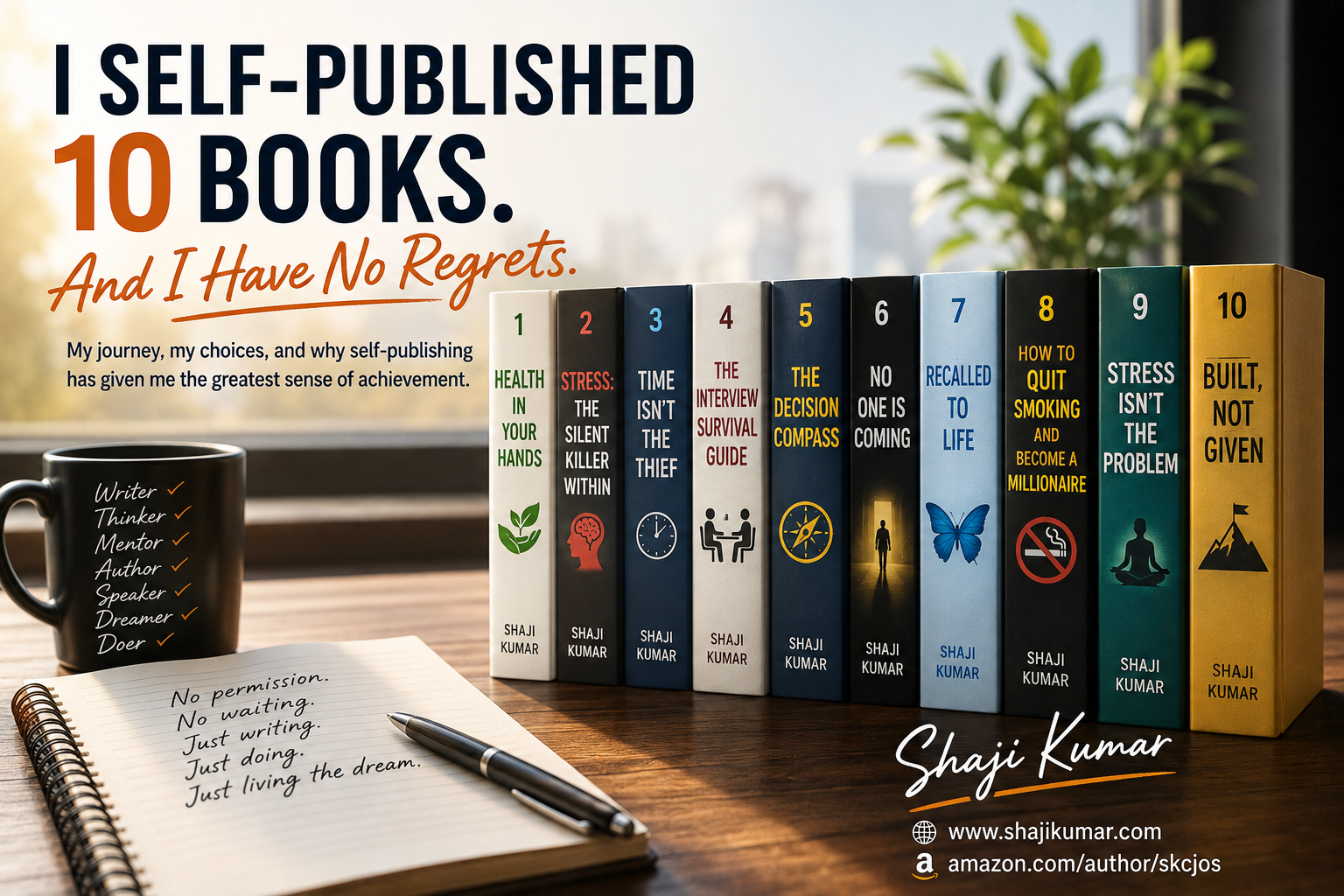
    I have Self-Published Ten Books.

    Let me make this personal.

    I have published 10 Books!

    Ten.

    When I look at them today, I don’t first think about sales numbers, rankings, royalties or reviews.

    I think about something much more personal.

    I feel a sense of achievement.

    Ten times, I had an idea.

    Ten times, I sat down and converted that idea into thousands of words.

    Ten times, I fought procrastination, self-doubts, rewrites, corrections and that nagging voice every writer knows:

    Is this really worth publishing?

    And ten times, I saw something that existed only in my mind become something I could actually hold in my hands.

    A book.

    With my name on it.

    Am I satisfied with my decision to self-publish?

    Absolutely.

    Would I have felt differently if a large traditional publishing house had published all ten books?

    Perhaps.

    There is undoubtedly a certain prestige associated with being “published by” a recognised publishing house.

    But here is the question I have increasingly begun asking myself:

    Prestige for whom?

    The Publisher?

    The author?

    Or the reader?

    The Day We Stopped Needing Permission

    Traditional publishing was built around scarcity.

    Printing a book was expensive.

    Distribution was complicated.

    Bookstores had limited shelf space.

    Marketing required money.

    Publishing houses performed an essential role.

    They selected manuscripts.

    Invested in authors.

    Printed books.

    Distributed them.

    Marketed them.

    In other words, they made it possible for an author to reach a reader.

    But technology changed that equation.

    Today, an author sitting in Delhi, Mumbai, Kochi or a small town in India can write a manuscript, have it professionally edited, design a cover, format and make it available to readers around the World.

    Without ever walking into the office of a traditional publisher.

    That is revolutionary.

    And like every revolution, it has upset the people who benefited from the old system.

    The Numbers Are Telling Us Something.

    The global publishing world has already begun changing.

    In the United States, self-publishing has overtaken traditional publishing in the sheer number of titles produced.

    Bowker data reported by Publishers Weekly showed more than 2.6 million self-published titles in 2023 compared with approximately 563,000 traditionally published titles.

    But look at what is happening here.

    India issued more than half a million ISBN’s in 2024, according to recent ISBN metadata research.

    And the self-publishing ecosystem is growing rapidly.

    Notion Press alone has claimed to publish between 30,000 to 35,000 books a year.

    That is about 100 books a day.

    Think about that for a moment.

    Every Day.

    One hundred new authors somewhere are turning their ideas into books through a single self-publishing platform.

    That does not include Amazon KDP.

    It does not include Bluerose.

    It does not include Pothi.

    It does not include the hundreds of hybrid and assisted publishing companies.

    And it certainly does not include authors [myself included] who independently manage the entire process themselves.

    The genie is out of the bottle.

    And it is not going back in.

    Traditional publishing is beginning to look like the Morning Newspaper.

    I may be controversial when I say this.

    But I believe the traditional publishing model is facing the same existential challenge newspapers did.

    I belong to a generation that remembers waiting for the morning newspaper.

    It was part of life’s ritual.

    The newspaper arrived.

    You picked it up.

    You read the headlines over your morning tea.

    You turned the pages.

    You discussed the news.

    Something almost sacred about that daily ritual.

    And then came the Internet.

    News became immediate.

    Continous.

    Personalised.

    Accessible.

    The newspaper did not disappear overnight.

    It is still around.

    But its position in our lives changed forever. It went from being the primary source of news to being one of the many sources.

    I believe something similar is happening to traditional publishing.

    Let me be clear.

    Books are not dying.

    Publishing is not dying.

    Reading is not dying.

    But the traditional gatekeeper model is losing its monopoly.

    And that is a very different thing.

    The Publisher Was Once the Only Route to the Reader.

    For centuries, if you wanted to reach readers, you needed a publisher.

    Today, you don’t.

    That single fact changes everything.

    The publisher is no longer the only bridge between the writer and the reader.

    Amazon is a bridge.

    Social Media is a bridge.

    LinkedIn is a bridge.

    Substack is a bridge.

    Your website is a bridge.

    Your professional network is a bridge.

    Your readers themselves are a bridge.

    Today, an author can build an audience before the book is even published.

    In fact, I would argue that this is increasingly the smarter way to do it.

    Write.

    Share.

    Engage.

    Build credibility.

    Build a community.

    Understand your readers.

    And when your book arrives, it does not arrive in an empty marketplace.

    It arrives among people who already know you.

    Let Me Say Something Important About Self-Publishing.

    Self-publishing should not mean poorly publishing.

    This is where I believe many aspiring authors get it wrong.

    Publishing has become easier.

    That does not mean writing a good book has become easier.

    Nor has creating a professional book.

    If anything, the standards should be higher.

    When you self-publish, you cannot blame the publisher for a poor cover.

    You cannot blame an editor for grammatical errors.

    You cannot blame a marketing department for poor sales.

    You own the process.

    Completely.

    And that is precisely what I like about it.

    Freedom is wonderful.

    But freedom comes with responsibility.

    When I self-publish, I am not simply an author.

    I am also the publisher.

    I have to think about the manuscript.

    The editing.

    The cover.

    The layout.

    The title.

    The description.

    The pricing.

    The launch.

    The marketing.

    The reviews.

    The distribution.

    Everything.

    It is exhausting.

    But strangely, it is also deeply satisfying.

    Because when the finished book finally arrives, I know exactly how it got there.

    If you are an aspiring author and would like some advice completely free of charge, drop me an email at skcjos@gmail.com, and I would be happy to share what I know. Not much, but still a ten-book experience.

    The Journey is yours. The Learning doesn’t have to be.

    Global Learning Centre (GLC) is being built around two journeys:

    FOR YOUNG ENTREPRENEURS

    Helping aspiring and emerging entrepreneurs develop the clarity, capability and confidence to turn ideas into sustainable businesses.

    FOR VETERANS — THE SECOND INNINGS

    Helping Armed Forces veterans translate their leadership, discipline, experience and capabilities into meaningful opportunities beyond uniform.

    The journey doesn’t end here. Let’s stay connected.

    My Books | LinkedIn | YouTube | Instagram | Medium | Website
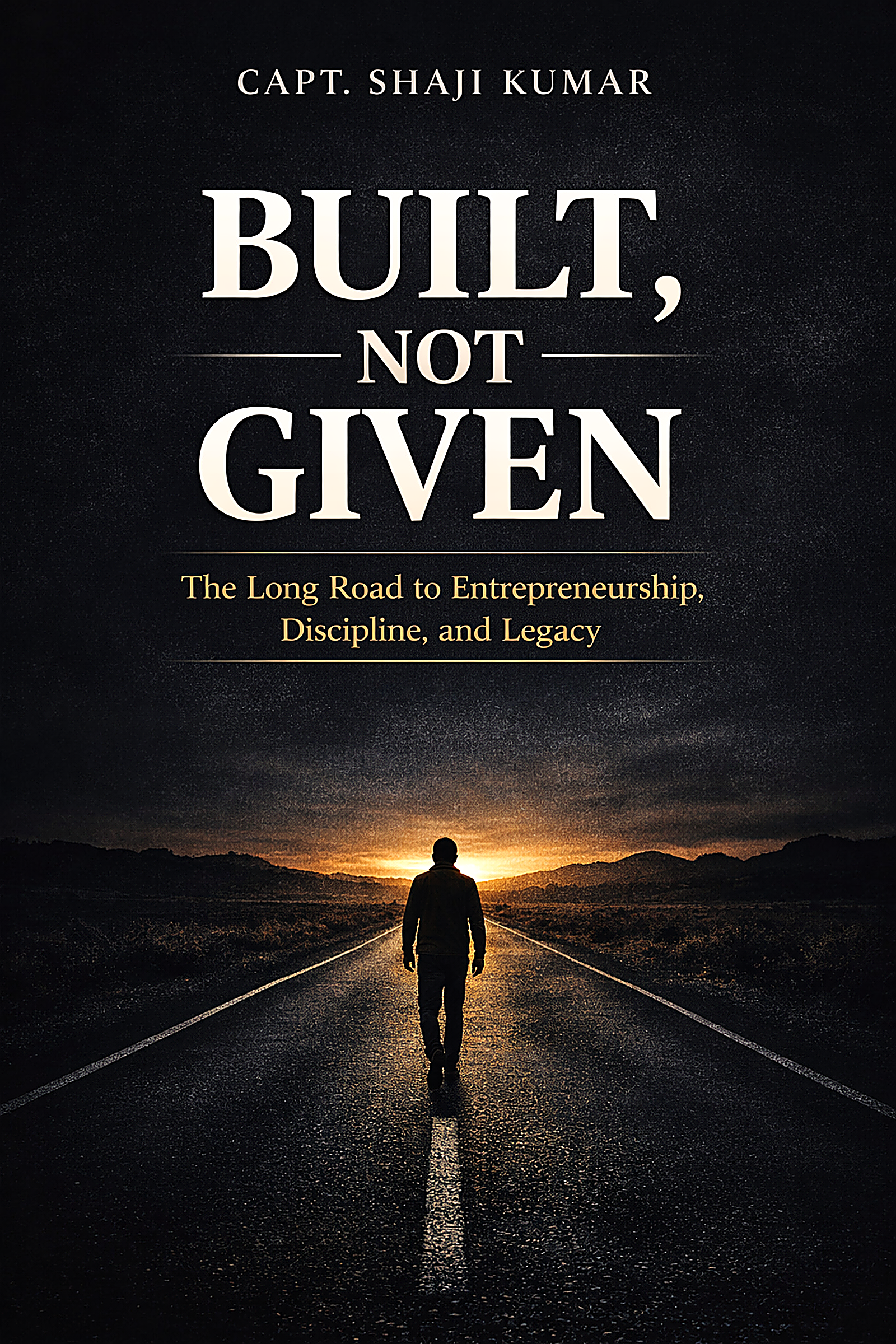
  • For the founder who was told to wait their turn.

    Most business books are written from the summit. This one is written from the climb.

    In 2008, Capt. Shaji Kumar didn’t know how he’d pay his team’s salaries the next morning. No investor to call. No partner to lean on. Just him, and the consequences of every decision he’d already made — a pattern set years earlier, the day he left the Army’s structure for the total uncertainty of building something of his own.

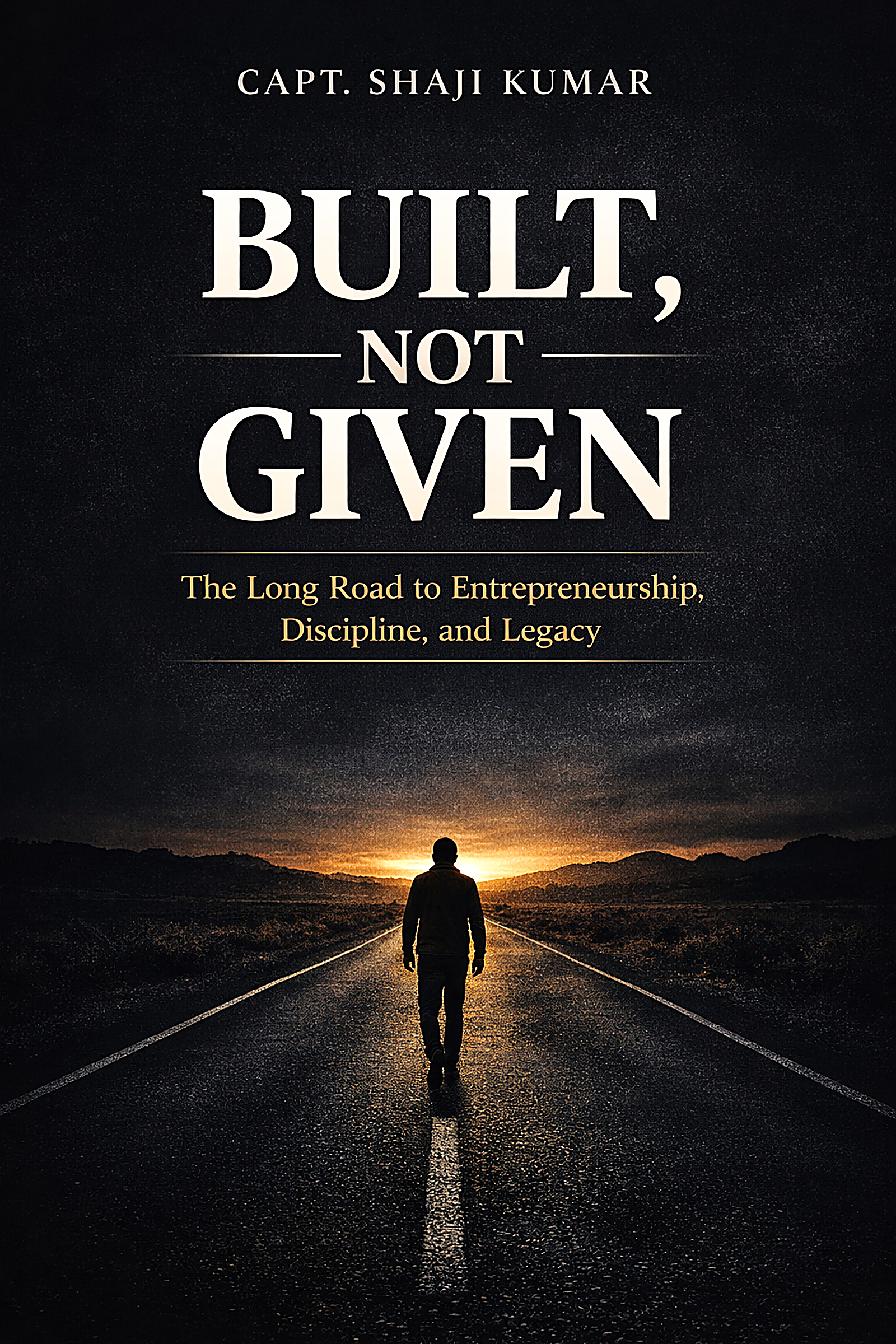
    Built, Not Given is that story: nearly three decades of building service enterprises from scratch, told with the same discipline that carried him through it. Not the highlight reel— the actual middle, where ventures are won by persistence, not brilliance, and by belief, not opportunity.

    Who this is for:

    First-generation founders in the grind, not the highlight reel

    Veterans weighing the leap into business

    MSME owners somewhere between “started” and “made it”

    What’s included: The full ebook (EPUB + Kindle-compatible file)

    Bonus: a short field-notes chapter not in the print edition

    Bottom-of-page line: Success is not given. It is built. Get your copy today.

    Where to get it

    Built, Not Given is published wide — deliberately, so you can read it however suits you best, on whatever platform you already trust:

    Pick whichever is easiest for you. They all lead to the same book.

    Beyond the book

    Built, Not Given sits alongside my other books and the work I do now coaching founders through their own version of this middle, under the Clarity Under Pressure™ banner. If you want to see the rest — other titles, writing, or how to work with me directly — everything’s at www.shajikumar.com.

  • The Price Nobody Puts in the Business Plan

    Every book about entrepreneurship talks about sacrifice in the abstract. Few are willing to describe it in the specific, quiet, domestic detail that Capt. Shaji Kumar does in Built Not Given. Chapter 3 opens not with a strategy lesson but with a Diwali week in October 2003 — the one week all of India empties out — when he found himself alone in his office on a Saturday evening, his entire recruitment team gone home for the holiday, with client requirements due Monday morning that couldn’t wait.

    That kind of moment, repeated in a hundred variations over decades, is what this chapter is actually about.

    "Your business slowly stops being merely a source of income. It becomes your mission, your burden, your hope, your identity. It becomes the first thing you think about in the morning and the last thing that keeps you awake at night. It becomes your baby."

    The most affecting part of the chapter isn’t about the business at all — it’s about what building it cost at home.

    "There was a phase in my life when I was so consumed by work that by the time I returned home most nights, my children who were quite young, would either be getting ready for bed or already asleep. That became normal."

    And then, the moments he says he’ll never forget:

    "On those nights, my children would stay awake a little longer so they could sit with me while I had dinner with them... They would sit close to me, sleepy but content simply to be there, and sometimes they would ask me to feed them with my own hands. Even now, that memory stays with me."

    He doesn’t dress this up as a win. He’s honest about the trade he was making in real time:

    The truth is, I was trying to build a future for my family, but in the process, I was sometimes absent from the very present I was trying to protect. That is a difficult truth to admit. But it is the truth.

    This is a book willing to sit in that discomfort rather than resolve it too quickly — which is part of why the chapter feels earned rather than performative.

    There’s also a sharper, more practical thread running through it: what actually holds a business together when things get hard. Not brilliance. Not marketing.

    If there is one thing that has carried my business through both good times and bad, it is not brilliance. It is not marketing. It is not strategy alone. It is integrity... Your customers should never stop believing in your venture. The day that belief weakens, your business begins to lose its backbone.

    He traces that integrity through a genuinely frightening stretch in 2008, when the global recession froze hiring almost overnight and he was left staring down a question every business owner eventually faces:

    How am I going to pay salaries and manage expenses next month? There is a particular kind of fear that comes with being responsible not just for your own survival, but for the livelihoods of others.

    And on the particular loneliness of the role — the fact that the person everyone leans on doesn’t get to lean on anyone:

    Your employees look to you for stability. Your clients look to you for confidence. Your family looks to you for reassurance... But who carries the entrepreneur? That is a question not enough people ask.

    The chapter doesn’t end on regret. It ends on something closer to hard-won clarity:

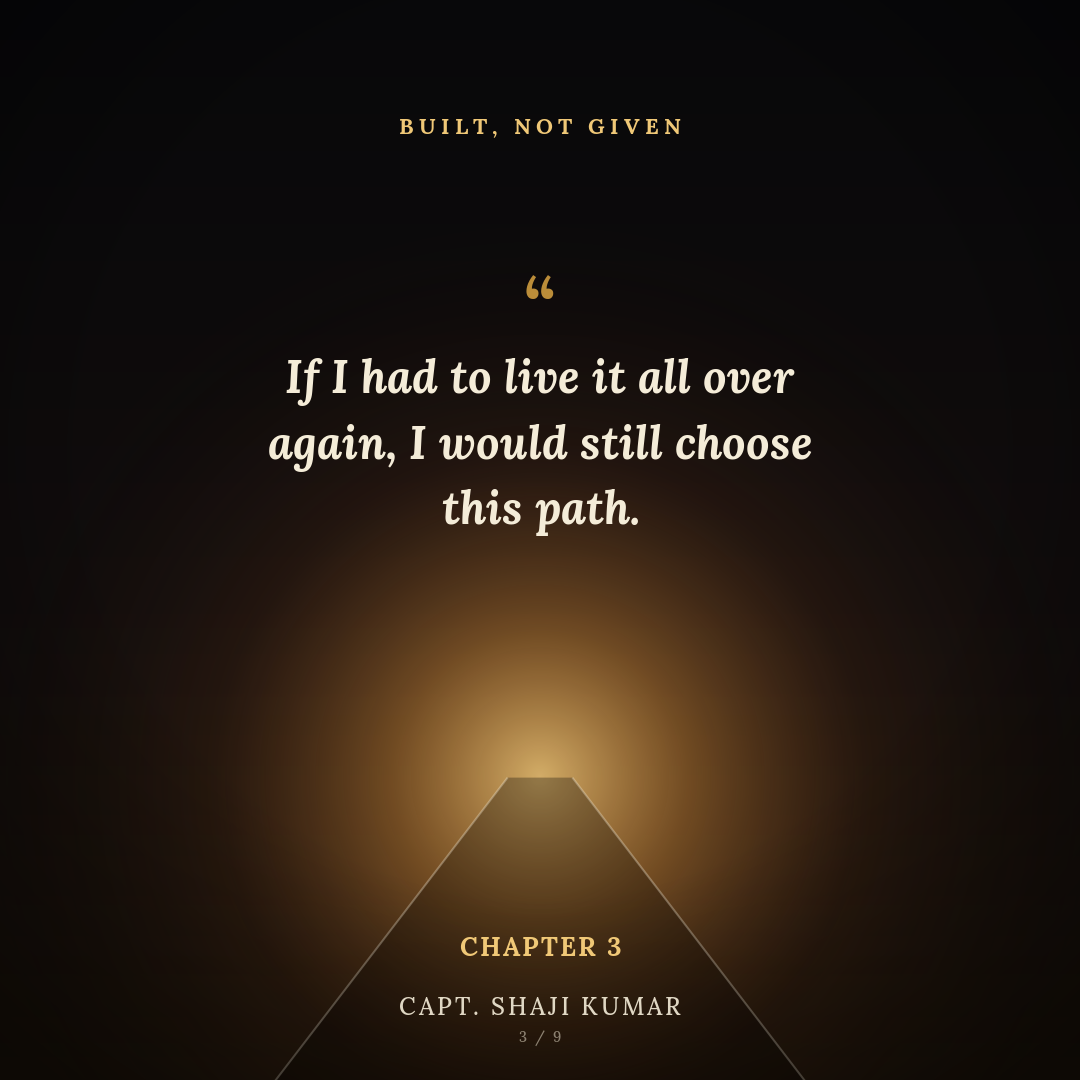
    If I had to live it all over again—the missed dinners, the sleepless nights, the humiliations, the setbacks, the fear, the uncertainty—I would still choose this path. Not because it was easy. But because it made me earn every inch of who I became.

    This is the third in a series of posts drawing from Built Not Given by Capt. Shaji Kumar. The full chapter also covers why he says “never be ashamed of what you built with your own hands” — worth reading if you’ve ever felt embarrassed by how modest your beginning looks.

    Where to get it

    Built, Not Given is published wide — deliberately, so you can read it however suits you best, on whatever platform you already trust:

    Pick whichever is easiest for you. They all lead to the same book.

    Beyond the book

    Built, Not Given sits alongside my other books and the work I do now coaching founders through their own version of this middle, under the Clarity Under Pressure™ banner. If you want to see the rest — other titles, writing, or how to work with me directly — everything’s at www.shajikumar.com.

    If you read it, I’d genuinely like to know what landed. Reply, comment, or leave a review wherever you bought it — for a book this new, that’s the thing that helps it find the next reader who needs it.

  • The Birbal Strategy: Why Your Dream Doesn’t Need to Warm You Yet

    There’s an old story about Birbal, the wisest man in Emperor Akbar’s court, that Capt. Shaji Kumar returns to in Built Not Given — and it’s become one of the most useful ideas in the whole book for anyone stuck in the “long middle” of building something.

    A man is challenged to stand all night in freezing water. He survives by fixing his eyes on a candle burning far in the distance. When he claims his reward, he’s told he cheated — he “drew warmth” from the flame, so the challenge doesn’t count. Birbal, hearing the absurdity of this, makes his point by trying to cook dinner over a candle held far away. Obviously, it doesn’t cook anything.

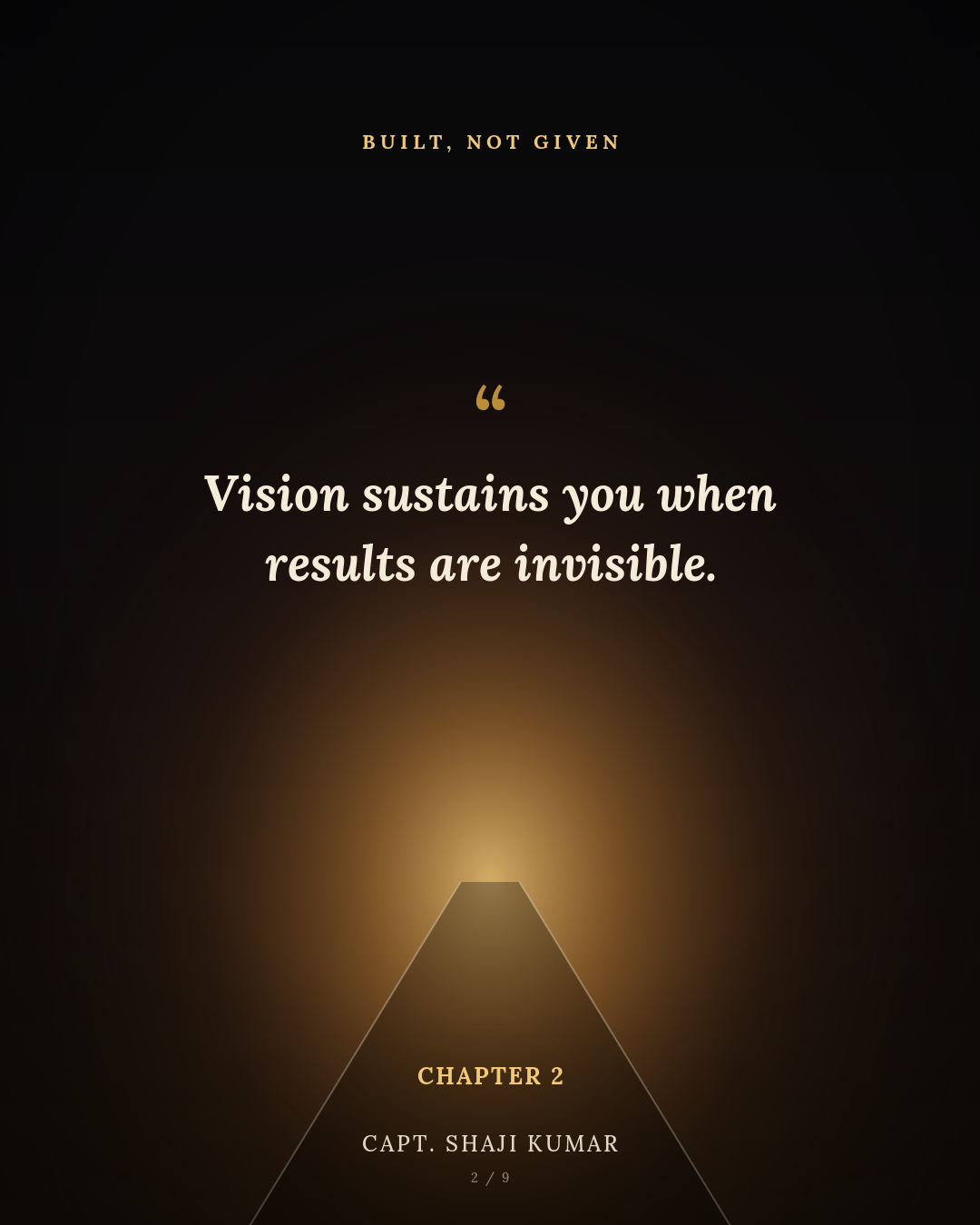
    "What mattered in that story was not the physical warmth of the candle. It was the psychological warmth of hope. The candle had not heated the man's body. It had sustained his mind. And that is what distant goals often do in life. They do not immediately change your circumstances. But they help you endure them."

    Kumar started his business in 1998 — before India had a “startup ecosystem,” before accelerators or angel networks or the reassuring TED-talk narrative that failure is just a step toward success. There was no community of founders telling him the hard years were normal.

    "There was only the work, the market, and the long, largely silent middle — the years between the beginning and any visible result."

    This is the part of entrepreneurship (or any long, worthwhile undertaking) that doesn’t get talked about enough: the stretch where the goal is real to you but invisible to everyone else, including your bank balance. Kumar’s point is that this isn’t a design flaw — it’s the actual shape of the thing.

    "For years, your dream may appear too far away to be useful in any practical sense. It may not pay your bills immediately. It may not impress people. It may not even reassure your own family. But if it remains alive in your mind—steady, visible, and meaningful—it can do something even more important: it can keep you going."

    He’s especially sharp on the modern trap of expecting speed:

    "We live in an age that celebrates speed, fast growth, fast funding, fast fame, faster exits and fast money which in many cases does disappear just as fast. And because of that, many people now enter entrepreneurship carrying a dangerously distorted expectation: that business is merely a shortcut to wealth. That illusion has ruined more dreams than failure itself."

    His answer isn’t grit-as-a-slogan — it’s something more specific: start small, but start with a why strong enough to survive contact with difficulty.

    "If your 'why' is weak, your perseverance will collapse the moment life becomes difficult. And life will become difficult. That is not pessimism. That is simply the reality of enterprise."

    And on the inevitability of mistakes along the way:

    "The only real danger is not in making mistakes. It is in allowing mistakes to weaken your resolve. Because if approached correctly, every mistake can become fuel."

    The chapter closes on what might be the book’s clearest thesis statement:

    "Do not allow the distance of the light to discourage you... Hope with direction. And that is far more powerful than optimism without substance. Because entrepreneurship is not won in one brilliant moment. It is won: in the long middle. In the waiting. In the uncertainty. In the years when nothing looks spectacular but everything important is quietly being built."

    If you’re in your own long middle right now — whatever you’re building — this is worth returning to. The candle doesn’t have to warm you today. It just has to still be burning.

    This is the second in a series of posts drawing from Built Not Given by Capt. Shaji Kumar. Grab a copy to read the rest of the chapter — including how to handle the crisis that inevitably arrives once the light finally gets closer.

    Where to get it

    Built, Not Given is published wide — deliberately, so you can read it however suits you best, on whatever platform you already trust:

    Pick whichever is easiest for you. They all lead to the same book.

    Beyond the book

    Built, Not Given sits alongside my other books and the work I do now coaching founders through their own version of this middle, under the Clarity Under Pressure™ banner. If you want to see the rest — other titles, writing, or how to work with me directly — everything’s at www.shajikumar.com.

    If you read it, I’d genuinely like to know what landed. Reply, comment, or leave a review wherever you bought it — for a book this new, that’s the thing that helps it find the next reader who needs it.

  • Built, Not Given: The Story Behind the Book.

    For the founder who was told to wait their turn.


    There’s a version of the founder story everyone tells: the idea, the risk, the breakthrough, the exit. It’s a good story. It’s also not the one that matters most.

    The one that matters most is the middle — the long stretch with no name, where you’re too far in to quit and too far out to see the end. I spent years there. Multiple times. There were mornings with no investor to call, no partner to lean on, and no certainty that things would hold. They held. I don’t always fully remember how.

    Those mornings weren’t unique to me. They’re not unique to founders, either — it’s what happens whenever someone chooses to build something with no guarantee it holds. Leaving the structure of the Army for the total uncertainty of business taught me a specific kind of discipline for exactly that stretch — not motivation, which runs out, but discipline, which doesn’t ask to feel like anything.

    I’ve spent nearly three decades building service enterprises from nothing — Chaque Jour Group now operates across 16 cities, bootstrapped from the start. Somewhere in those years, I kept meeting the same person over and over in different bodies: the first-generation founder with no safety net, the veteran wondering if the discipline that got them through service could get them through business, the MSME owner somewhere between “we started” and “we made it.” They kept asking me some version of the same question — how did you actually get through the years when nothing was working?

    I finally wrote the honest answer down. It’s called Built, Not Given.

    What the book actually is

    This isn’t a framework book, and it isn’t a highlight reel. It’s an honest, lived-in account of building something from scratch — the long middle where ventures are won by persistence, not brilliance, and by belief, not opportunity. If you’ve ever made a decision alone at an hour when no one else was awake to make it with you, this book was written for you.

    It’s for:

    • First-generation founders still in the grind, not the highlight reel
    • Veterans weighing whether the discipline of service translates to the uncertainty of business
    • MSME owners somewhere between “started” and “made it”

    Where to get it

    Built, Not Given is published wide — deliberately, so you can read it however suits you best, on whatever platform you already trust:

    Pick whichever is easiest for you. They all lead to the same book.

    Beyond the book

    Built, Not Given sits alongside my other books and the work I do now coaching founders through their own version of this middle, under the Clarity Under Pressure™ banner. If you want to see the rest — other titles, writing, or how to work with me directly — everything’s at www.shajikumar.com.

    If you read it, I’d genuinely like to know what landed. Reply, comment, or leave a review wherever you bought it — for a book this new, that’s the thing that helps it find the next reader who needs it.


    Success is not given. It is built.

    #BuiltNotGiven #FirstGenerationFounder #VeteranEntrepreneur #MSME #StartupJourney #Leadership #Entrepreneurship #IndianStartups #ClarityUnderPressure