

The popular notion that habits form in twenty-one days is, strictly speaking, an oversimplification. Research on habit formation suggests that the timeline varies widely — anywhere from eighteen to sixty-six days depending on the complexity of the behaviour and the individual. But twenty-one days is not arbitrary. It represents three complete biological cycles of several key systems: the gut lining renews itself every three to five days (so twenty-one days is four to seven full cycles), and many hormonal rhythms operate on seven-day patterns.
More practically: twenty-one days is long enough to produce measurable change and short enough to feel achievable. It is a commitment you can make without it feeling like forever. And the changes you will notice by Day 21 — if the practice is consistent — are real enough that continuing becomes its own motivation.
This post is your complete map. Morning routine, evening routine, crisis protocol for acute stress moments, the dietary framework, and the sleep hygiene protocol. Everything from Posts 1, 2, and 3 comes together here into a single, coherent daily practice. You do not need all of it at once. Start with what feels most accessible, and build.
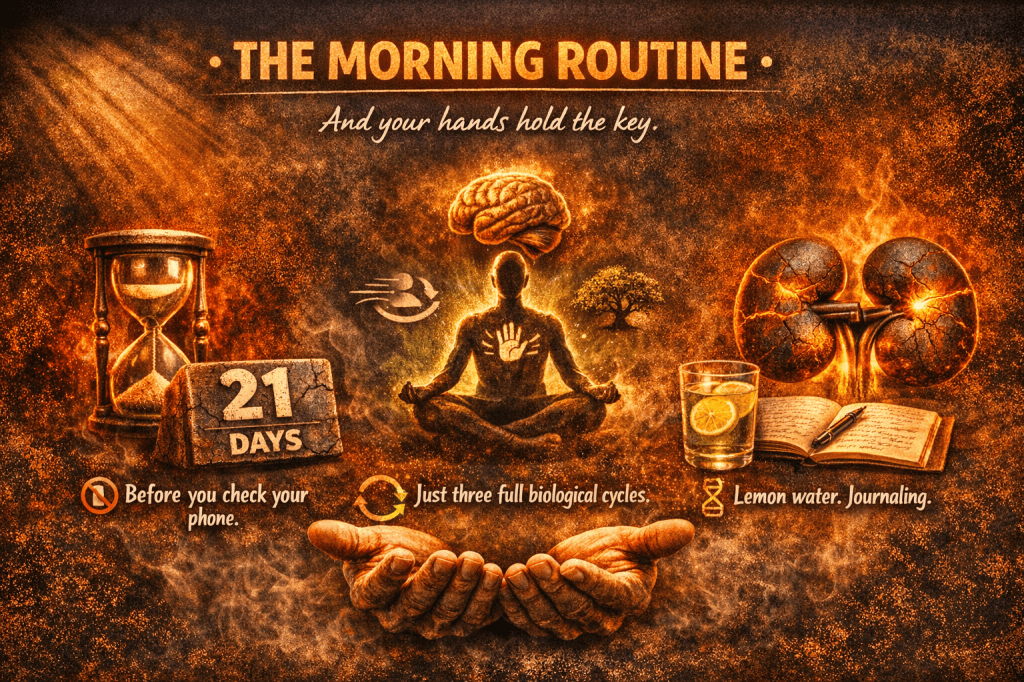
This is the most important instruction in the entire series: do the morning practice before you look at your phone. The moment you check your phone, your nervous system receives input — news, messages, social media, notifications — that begins the sympathetic activation cycle. Once that cycle starts, you are already managing its consequences rather than preventing them. Give your nervous system twenty-one minutes of its own signal before you give it the world’s.
The Full Morning Sequence — 21 Minutes
1. Wake without reaching for your phone. Lie still for one minute. Notice your body.
2. Three rounds of 4-7-8 breathing: In 4, hold 7, out 8. Vagus nerve activated.
3. GV 20 (crown) + Yintang (third eye): 90 seconds each, gentle sustained pressure.
4. HT 7 + PC 6 on both wrists: 2 minutes simultaneously. The emotional anchors.
5. KD 1 (soles, both feet): 2 minutes. Grounding before you stand up.
6. LV 3 (between toes 1 and 2): 90 seconds each foot. Releasing the night’s holding.
7. Warm water with lemon: before any food, before any caffeine. Sit while drinking it.
8. Three minutes of journalling: one question only — ‘What is within my control today?’
Total: 21 minutes. This is not self-indulgence. It is the most productive thing you will do all day.
Everything that follows in the next sixteen waking hours will be qualitatively different.
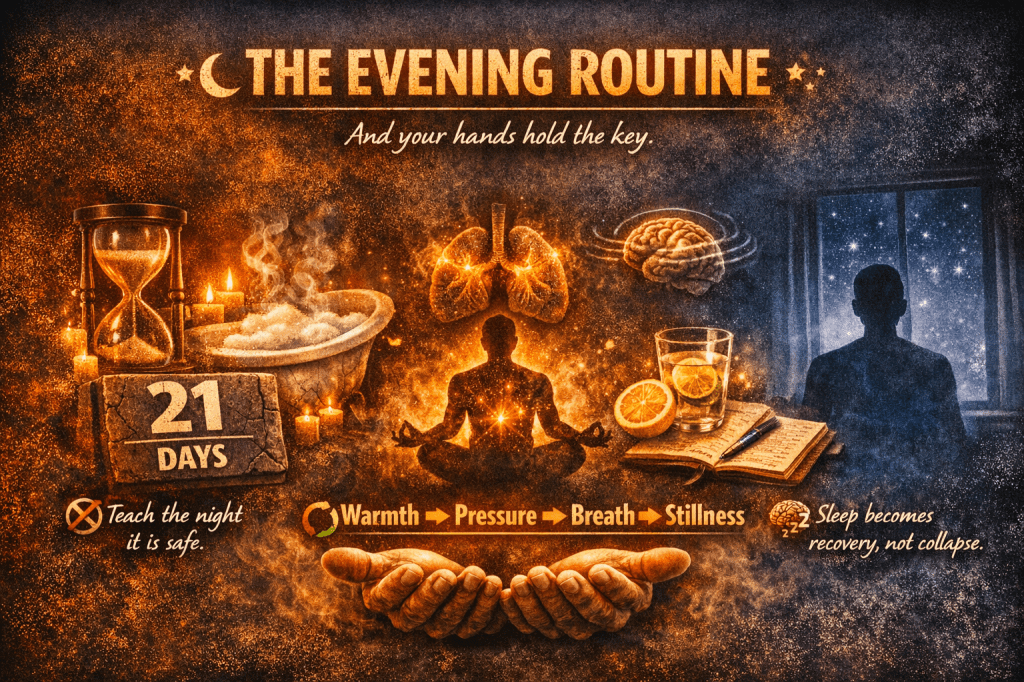
The Evening Routine — Teaching the Night It Is Safe
The evening practice has one job: to send the nervous system a clear, consistent signal that the day is over and safety has arrived. This signal is not just psychological — it is physiological, and it requires physical inputs to be received. The sequence below provides those inputs in the correct order: sensory input reduction first, then warming, then acupressure, then breath, then stillness.
The Full Evening Sequence — Last 25 Minutes Before Sleep
1. Screens off or night mode: hard stop on news, social media, anything requiring decisions.
2. Warm shower or hot foot soak: temperature drop after warmth triggers sleep hormones.
3. GB 21 + BL 10: shoulder summit and skull base release — where the day’s stress is stored.
4. SP 6 + KD 1: inner ankle and soles — the deepest calming points in the lower body.
5. Yintang + CV 17: third eye and heart centre — quieting the mind and the emotional body.
6. 4-7-8 breath, five rounds: lying down, eyes closed. This is the final physiological signal.
7. Three things you are grateful for: not performance — genuine noticing. The brain records safety.
8. Sleep — the nervous system in genuine rest mode, not collapsed exhaustion.
This sequence, practiced for seven consecutive nights, will change the quality of your sleep.
After twenty-one nights, it will have changed your relationship with the night entirely.
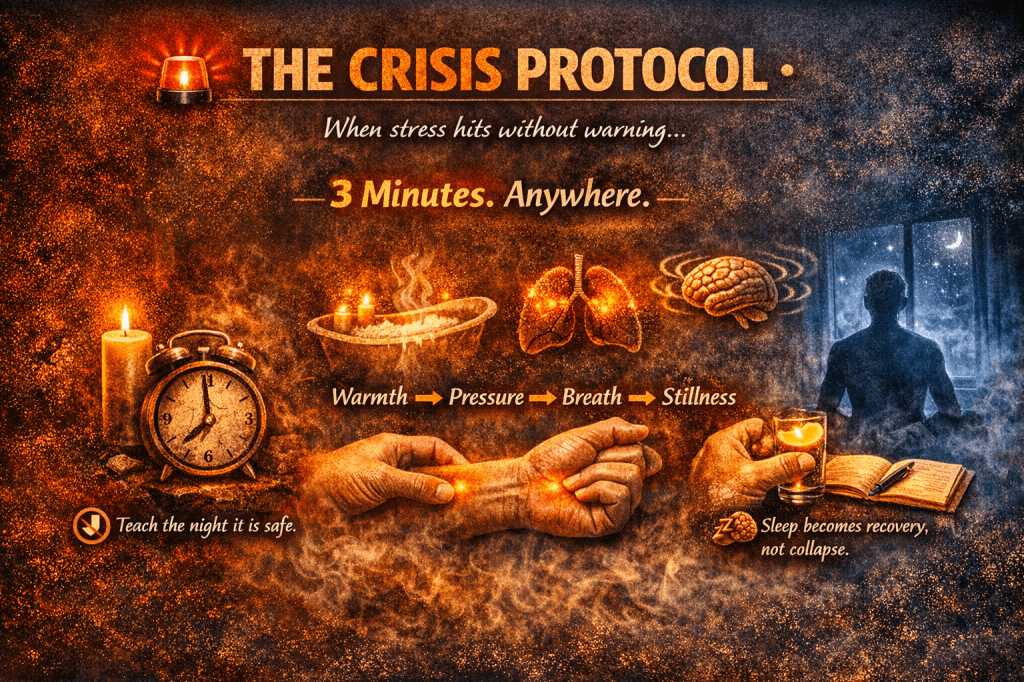
The Crisis Protocol — For When Stress Hits Without Warning
The daily practice addresses chronic stress. But acute stress — the sudden confrontation, the unexpected bad news, the panic that arrives without warning — needs its own protocol. The three-minute sequence below is designed to be used anywhere, invisibly, at the moment stress arrives rather than hours later.
The 3-Minute Crisis Protocol
STEP 1 — 30 seconds: Two rounds of 4-7-8 breath. Eyes can stay open. Nobody needs to know.
STEP 2 — 45 seconds: One finger pressed firmly on Yintang (between eyebrows). Eyes closed if possible.
STEP 3 — 45 seconds: HT 7 + PC 6 on both wrists simultaneously. Breathe into the pressure.
STEP 4 — 30 seconds: LI 4 (web of thumb): firm pinch, both hands. Exhale with the pressure.
STEP 5 — 30 seconds: Return to breath. 4 counts in, 6 counts out. Return to presence.
Use this in the car, in a meeting break, in a bathroom, before a difficult conversation.
Cortisol measurably drops within three minutes of vagal activation. This protocol delivers it.

Daily Foundations (Non-Negotiable)
Warm water with lemon: First thing, before anything else. Every single morning.
One serving fermented food: Curd, kefir, kanji, kimchi, or buttermilk. Non-negotiable for the gut-brain axis.
Handful of walnuts or pumpkin seeds: Omega-3 and magnesium in one small handful. Morning snack.
Two Brazil nuts: Daily selenium for thyroid hormone conversion. Two only — more is unnecessary and counterproductive.
One tablespoon ground flaxseed: In porridge, smoothie, or curd. Omega-3, lignans, and prebiotic fibre.
This Week, Eliminate These (One at a Time):
Week 1: No caffeine after 1pm. This single change will shift sleep quality faster than almost anything else.
Week 2: No alcohol on weekdays. Alcohol is a cortisol trigger and a sleep architecture disruptor — two things you cannot afford during a stress reset.
Week 3: Replace one ultra-processed meal per day with something whole. Not perfection — one meal. The compounded effect of three weeks of this is measurable in inflammatory markers.
What to Add (One at a Time):
Week 1: Ashwagandha root extract (300mg) with dinner. The most evidence-supported adaptogen for cortisol reduction.
Week 2: Magnesium glycinate (200-400mg) before sleep. Research consistently shows improvement in both sleep quality and stress response.
Week 3: One meal eaten in complete silence, without a screen. The nervous system needs to experience food as safe, not as background to stimulation.
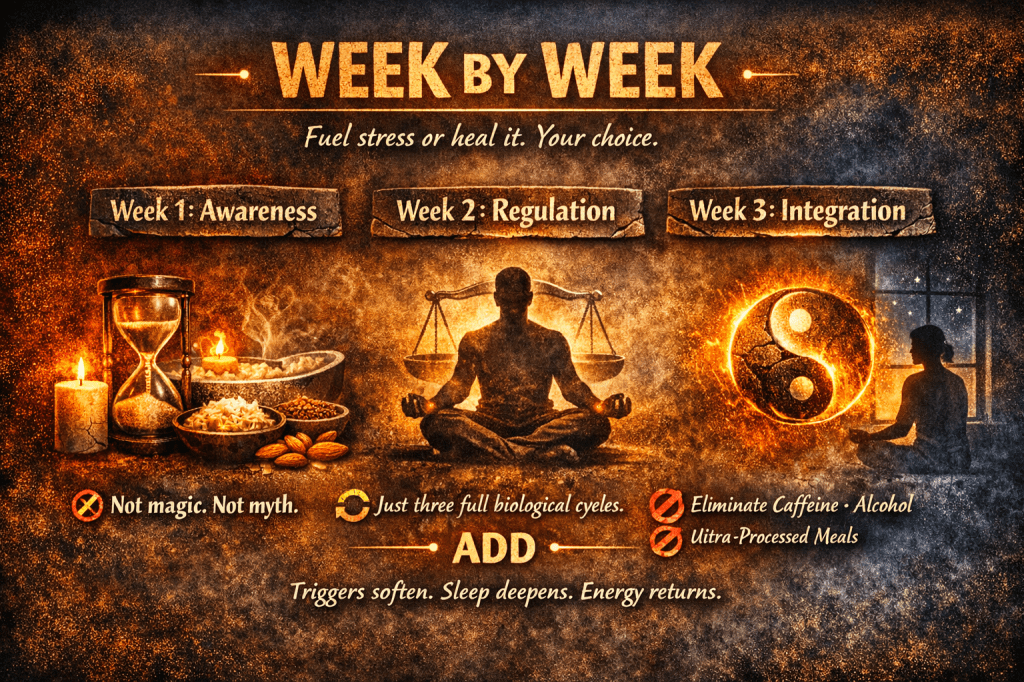
Change with stress does not arrive in a straight line. There are days in Week 1 when you will feel more tired than before — that is the parasympathetic system finally getting enough space to process what has accumulated. This is not failure. It is the beginning of genuine recovery. Here is a more detailed map of what each week brings:
Days 1 to 7 — The Awareness Week
The most important thing that happens in Week 1 is not physical improvement — it is the beginning of awareness. You start to notice when your shoulders tighten.
You catch yourself holding your breath. You feel the difference between the morning of Day 7 and the morning of Day 1 — and the difference, while not dramatic, is real. The points will be tender, particularly KD 1, HT 7, and GB 21. Tender means engaged. Stay with it.
Sleep will likely show the first changes: not necessarily that you sleep more, but that the quality of the sleep you do get deepens. The 4-7-8 breath paired with the evening points is usually responsible for this. Some people notice it from Night 3 onward.
Days 8 to 14 — The Regulation Week
By Day 8, the practice is beginning to feel less like a task and more like a ritual. The nervous system has now received fourteen days of consistent parasympathetic input — enough to begin establishing a new pattern. Cortisol output starts to regulate more predictably. The morning spike that launches many stressed people into reactivity before they have even had breakfast begins to soften.
Point tenderness decreases measurably. HT 7 in particular — which is often exquisitely tender in the first week — becomes more comfortable under pressure.
This is a direct indicator of reduced cardiac stress load. BL 23 (lower back kidney point) tenderness also reduces, reflecting adrenal recovery. Track these changes — they are your body’s own progress report.
Days 15 to 21 — The Integration Week
This is where the shift becomes qualitative, not just quantitative. People in Week 3 of this practice consistently report the same cluster of observations: things that would have triggered a stress response two weeks ago now feel manageable.
The internal distance between stimulus and response has grown. This is not detachment — it is regulation. The nervous system, given consistent signalling, has recalibrated its threat threshold.
Physically: resting heart rate has typically dropped several beats per minute. Blood pressure, if it was elevated, shows improvement. Digestion has normalised — the gut responds rapidly to nervous system regulation. Skin, if stress was affecting it, begins to clear. Energy — not the jittery energy of cortisol, but the sustained, even energy of a body that is genuinely resting and genuinely working in turn — returns.
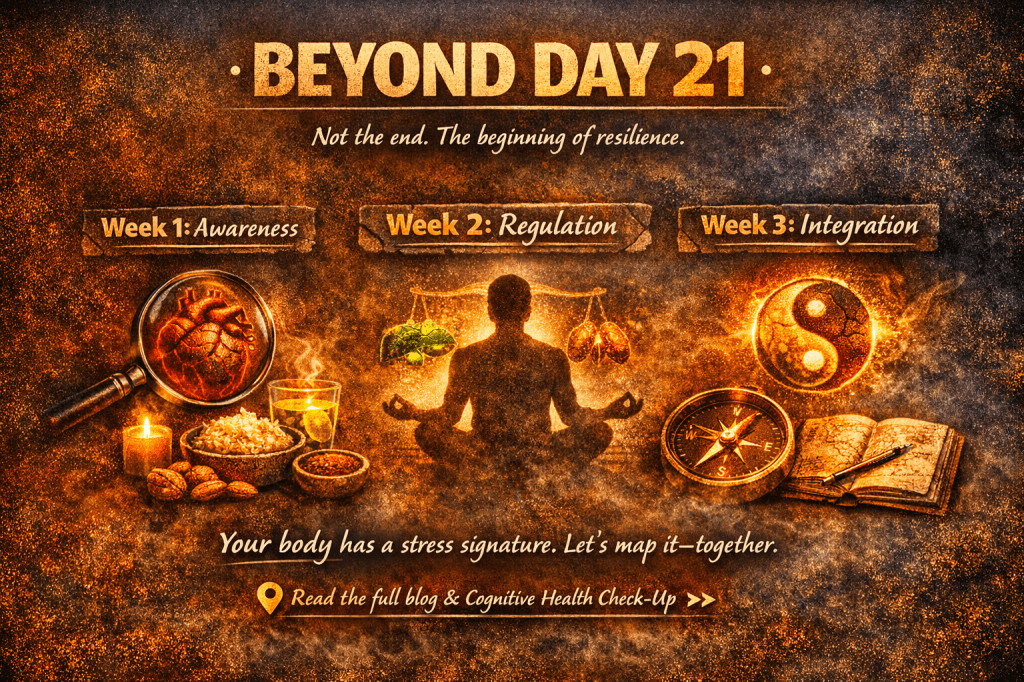
Beyond Day 21 — Making It Yours
Twenty-one days is the beginning, not the destination. Once the practice is established — once it has become as automatic as brushing your teeth — the question becomes: how do you deepen it? How do you move from stress management to genuine stress resilience?
The answer, in my experience, is personalisation. The sequences in this series are designed to be broadly effective for most people. But your body has a specific stress signature — particular points that are more relevant to you than others, particular times of day when you are most vulnerable, particular organ systems that carry the heaviest load. A personalised protocol, built around your specific pattern, is significantly more efficient than a general one.
That is what I offer in a consultation — not a replacement for this series, but a deepening of it. If you have done the twenty-one days and want to go further, I can help you read what your body is showing us and design the next stage of your practice with precision.
Ready to Go Deeper?
Book a personalized consultation to map your stress-organ pattern and build your protocol.
In Association with World Health Journey Take your Cognitive Health Check-Up: www.whjonline.com/mmpi-2
Series Complete – The Heal Yourself First series continues daily.


 Capt. Shaji Kumar