Your Nervous System is Struck on Alarm.
How to Switch it Off without a Single Pill.
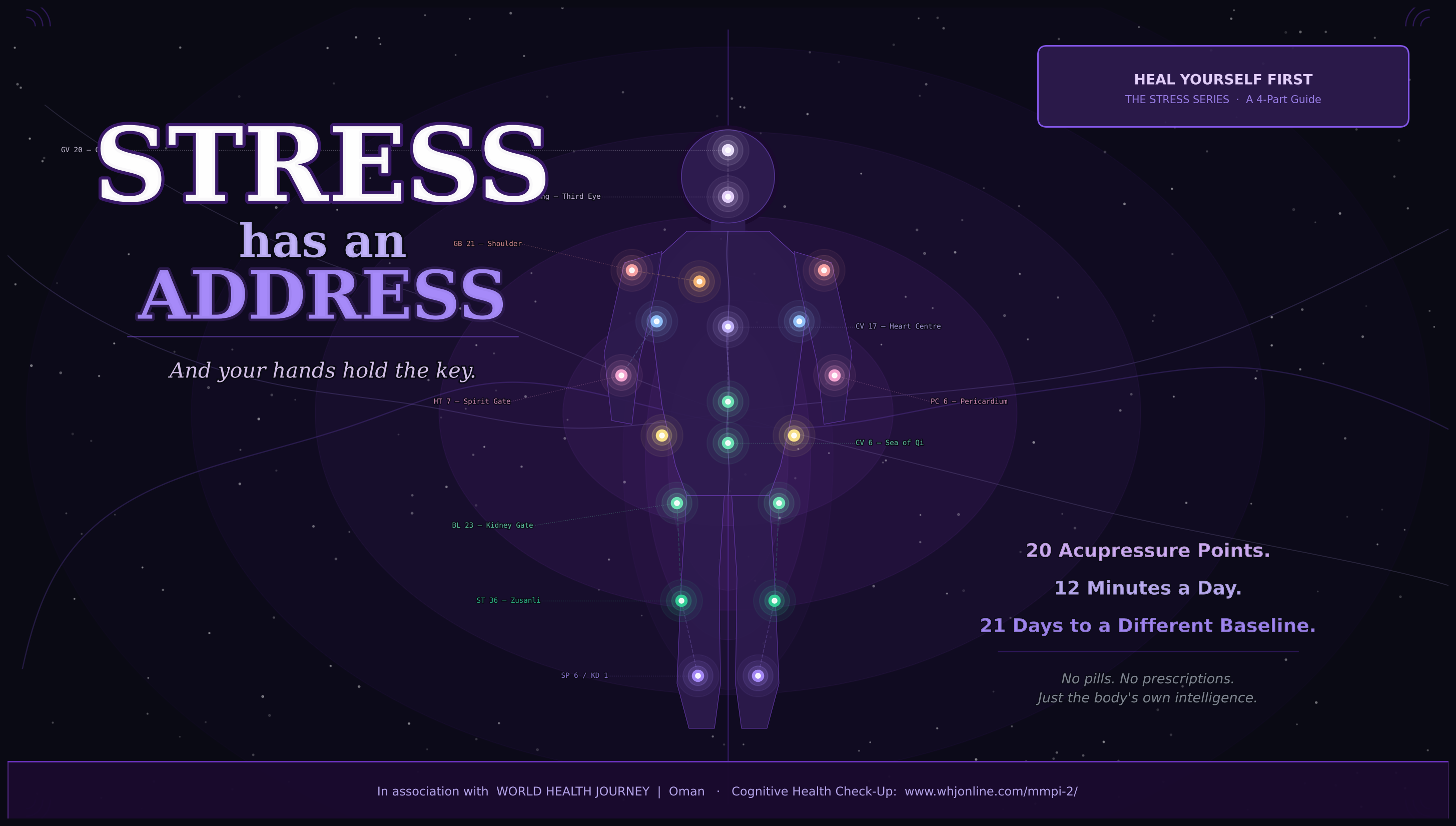
The problem is not that you cannot relax. The problem is that your nervous system has forgotten how. Let’s teach it again.
Why You Cannot Just ‘Calm Down‘
If than one person has told you to simply relax, breathe, or think positive thoughts when you are in stress, the advice is not wrong — it is just incomplete. The reason it fails is that stress does not live in your thoughts. It lives in your body. In your nervous system. In the precise calibration between two biological modes that govern every function you have: the sympathetic and the parasympathetic.
When you are stuck on alarm — where the sympathetic nervous system is chronically dominant — telling yourself to calm down is like asking a fire alarm to stop ringing by itself. The alarm does not respond to thoughts. It responds to signals. Specific, physiological signals. And acupressure is one of the most precise ways to send those signals.
In Post 1, [https://shajikumar.com/2026/03/16/heal-yourself-first-stress-series-1-of-4/] we looked at what stress does to your body and introduced the first tier of points. Today we go deeper: into the nervous system itself, into why some people seem permanently wired and cannot switch off even on holiday, and into the second layer of points — the ones that specifically target the adrenals, the heart, the lungs, and the spinal nervous system.
Two Modes — One Nervous System
Your autonomic nervous system runs everything that keeps you alive without you having to think about it: your heart rate, your breathing rhythm, your digestion, your immune response, your hormonal output. It has two branches, and they are meant to alternate — like breathing in and breathing out.
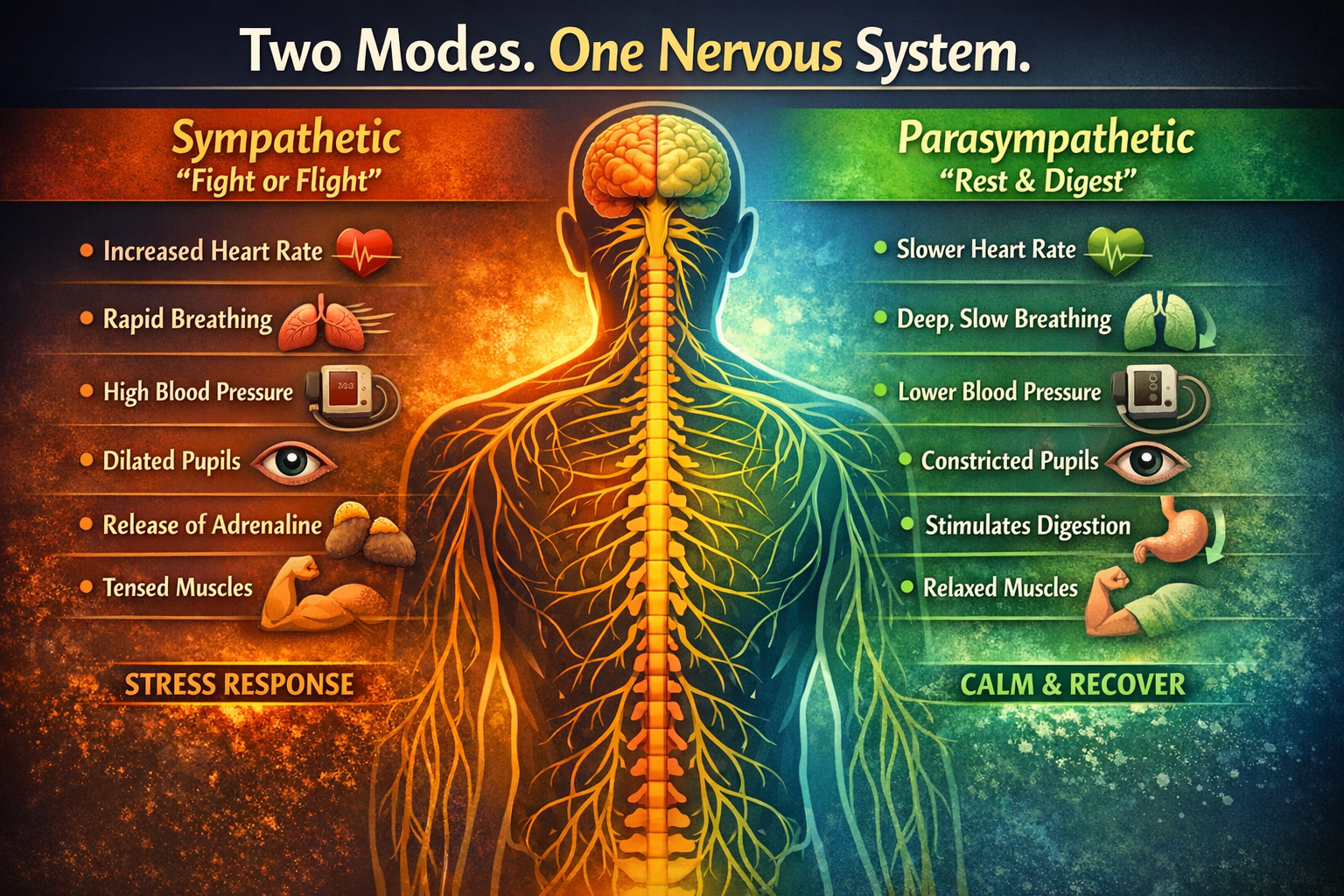
The diagram above shows what each mode actually does at the organ level. What it cannot show is how profoundly unbalanced most modern lives are: for millions of people, the sympathetic system has been the default for so long that the parasympathetic feels foreign. Rest feels unearned. Stillness feels dangerous. Relaxing makes them more anxious, not less — because their nervous system does not trust it.
This condition has a name in polyvagal* theory: chronic sympathetic activation, or more colloquial, a nervous system stuck in a low-grade fight-or-flight that never fully resolves. And the way out is not willpower. It is repetition of the parasympathetic signal, delivered consistently, until the nervous system learns a new default. That is exactly what a daily acupressure practice does.
| *The Polyvagal Theory — In Plain Language Dr. Stephen Porges’ polyvagal theory explains why simply telling yourself to calm down does not work. The nervous system has a hierarchy of safety responses: Level 1 — Social engagement (safe): You feel connected, calm, curious. Vagal tone is high. Level 2 — Fight or flight (threatened): Sympathetic system mobilises. You are vigilant, reactive. Level 3 — Freeze (overwhelmed): The system shuts down. Dissociation, numbness, collapse. Most chronically stressed people oscillate between Levels 1 and 2, never quite fully accessing Level 1. The acupressure points in this series work by directly stimulating the vagal pathways that pull the nervous system back to genuine safety — not performed calm, but physiological calm. |
The Back Points — Where Your Nervous System’s Engine Room Sits
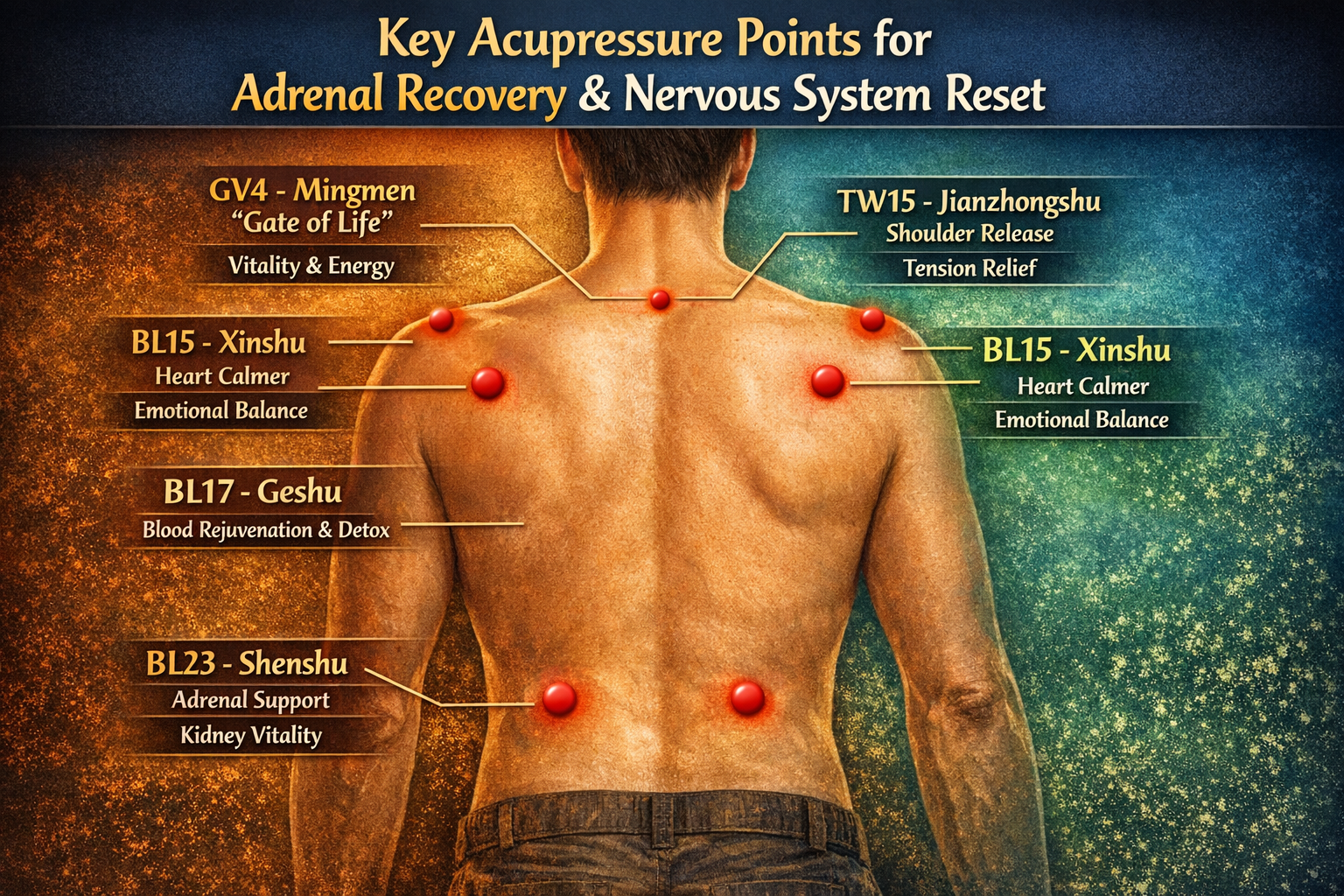
The back of the body is, in many ways, the most important region in acupressure for stress — and the most neglected in self-care. The bladder meridian runs the full length of the spine on both sides, and along it sit the ‘back-shu’ points: direct access points to every major organ in the body. The adrenal glands, which produce cortisol, sit just above the kidneys at the L2 level of the lower back. The heart sits at the T5 level of the mid-back. Stimulating these points sends a direct signal to the corresponding organ to regulate.
BL 23 — Shenshu: The Adrenal Recovery Point
One and a half finger-widths either side of the spine, at the level of the second lumbar vertebra — roughly at the waist level, in line with the navel. BL 23 is the back-shu (association) point of the Kidney organ system — which in Chinese medicine governs the adrenals and the fundamental energy of the body. Chronic stress depletes what Chinese medicine calls Kidney Jing (essence): the reserve energy that keeps you functioning when the surface reserves are gone.
When BL 23 is chronically tight and tender, it is a clinical indicator of adrenal burden. When it is regularly stimulated, research has demonstrated improvements in adrenal hormone regulation, reduction in lower back pain caused by tension, and enhanced recovery from fatigue. This is the point for people who are tired but cannot sleep — the paradox of adrenal exhaustion.
How to apply: Place two tennis balls in a sock. Lie on your back on a firm surface. Position the tennis balls either side of your spine at the waist. Breathe deeply and let the weight of your body apply pressure. Two minutes. This is the single most effective self-help method for BL 23. Alternatively, coax someone to apply firm thumb pressure directly into the point.
GV 4 — Mingmen: The Gate of Life
On the spine itself, between the second and third lumbar vertebrae. Mingmen — the Gate of Life — is considered one of the most important points in classical Chinese medicine for rebuilding constitutional vitality. It governs what the tradition calls Yang energy: the warming, activating force that stress chronically depletes. People with adrenal exhaustion and chronic stress often feel cold in the lower back — and Mingmen is cold when the energy here is deficient.
How to apply: Warm your palm by rubbing both hands together vigorously for thirty seconds. Then place the warmpalm directly over GV 4 (between the lower vertebrae at waist level). Hold for two minutes, breathing into the lower back. The warmth is part of the therapy. A warm wheat bag or heating pad placed here for ten minutes daily is a simple but powerful supplementary practice.
BL 15 — Jueyinshu: The Heart’s Back Door.
One and a half finger-widths either side of the fifth thoracic vertebra — between the shoulder blades, roughly level with the heart itself. BL 15 is the back-shu point of the Heart, and it is used clinically for the stress patterns that manifest in the chest: palpitations, racing heartbeat, the tightness that arrives with anxiety. In Chinese medicine, the Heart is not just a pump — it houses the Shen, the spirit or consciousness. When the heart is disturbed by chronic stress, the spirit becomes restless. BL 15 calms both.
How to apply: A partner pressing both points simultaneously is ideal. For solo application: two tennis balls in a sock at mid-back level, same as BL 23. Or lean back into a chair with a firm back and let the chair edge press into the points. Hold ninety seconds. You may feel your heart rate noticeably settle.
The Chest Points — Opening What Stress Has Closed
Stress contracts the chest. This is not metaphor — it is a measurable postural and physiological change. The pectorals tighten, the shoulders round forward, the sternum drops, and the breathing becomes shallow and high. All of this reduces lung capacity, increases sympathetic tone, and perpetuates the cycle. The chest points below reverse this process directly.
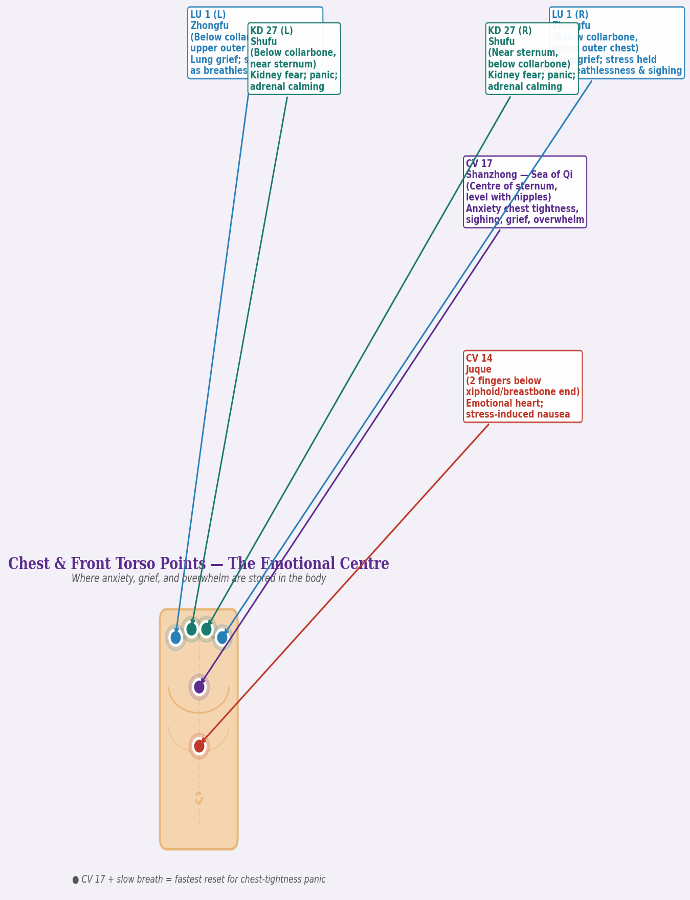
CV 17 — Shanzhong: The Sea of Qi and the Seat of Emotional Pain
At the centre of the sternum, level with the fourth intercostal space (roughly level with the nipples in men). CV 17 is the Influential Point of Qi — meaning it governs the movement of vital energy through the chest and throughout the body. It is also the point most associated with the kind of pain that stress produces in the emotional body: grief that sits in the chest, the tightness of anxiety that will not let you take a full breath, the ache of prolonged worry.
There is a reason we press our hand to our chest when we are moved, frightened, or heartbroken. The body knows this point intuitively. Regular stimulation of CV 17 opens the chest, deepens breathing, reduces the physical sensation of anxiety, and over time, processes the emotional weight that chronic stress accumulates here.
How to apply: Three fingers flat at the centre of the sternum [exact centre of the chest]. Gentle sustained downward pressure — not painful, but with presence. Eyes closed. Breathe into the chest and feel it expand against your fingers. Hold ninety seconds. Then make slow upward strokes along the sternum from CV 17 toward the throat — this opens the channel. Do this morning and evening.
LU 1 — Zhongfu: Where the Lungs Hold Grief
On the upper outer chest, just below the clavicle, approximately one hand-width down from the shoulder. In Chinese medicine, the Lung is the organ of grief — and every practitioner knows that LU 1 is tender in clients who have been carrying unprocessed sadness, loss, or the kind of exhaustion that comes from trying to hold everything together for too long. Stimulating this point releases both physical chest tightness and the emotional holding pattern beneath it.
How to apply: Use two fingers to press firmly into the hollow just below the collarbone on each side. Hold six seconds. The sensation is often intensely tender in stressed individuals — particularly those who have experienced loss or prolonged anxiety. Release slowly. Repeat five times per side. Then make small circles for thirty seconds.
KD 27 — Shufu: The Kidney’s Calming Point on the Chest
In the depression below the clavicle [Commonly known as the collarbone, is a long, S-shaped bone situated horizontally at the top of the chest], just lateral to the sternum. These two points are the highest points on the Kidney meridian — they are where the kidney’s calming, fear-resolving energy surfaces at the top of the body. Pressing KD 27 on both sides simultaneously is one of the fastest self-help techniques for acute panic, because it simultaneously addresses the adrenal component (fear, cortisol) and the chest component (tightness, breathlessness).
How to apply: Index and middle fingers of both hands pressed simultaneously into KD 27 on each side. Hold firmly for sixty seconds while breathing slowly through the nose. This is your first-response protocol for panic attacks when they arrive — not a replacement for medical care in severe panic disorder, but a powerful immediate intervention.
The 5-5-5 Regulation Technique.
This is a simple tool that pairs with the acupressure points and can be used anywhere, at any moment of acute stress. It takes ninety seconds and works by engaging three different regulatory pathways simultaneously.
| The 5-5-5 Technique — 90 Seconds to Regulation SENSE: Name 5 things you can see right now. Look at each one for a full second. Then name 4 things you can physically feel (your feet on the floor, the chair against your back). Then name 3 things you can hear. BREATHE: 5 counts in through the nose. 5 counts hold. 5 counts out through the mouth. Repeat 5 times. PRESS: With eyes closed, press KD 27 (below collarbones) with both hands simultaneously. Hold for 30 seconds while continuing to breathe slowly. Why it works: The sensory naming engages the prefrontal cortex, overriding the amygdala’s alarm.The extended exhale activates the vagus nerve. The KD 27 press closes the adrenal loop. Together, these three steps move the nervous system from alarm to regulation in under two minutes. |
Today’s Lifestyle Shift: The Two-Hour Wind-Down Protocol
The most common sleep complaint in stressed individuals is not the inability to fall asleep — it is the inability to stop thinking once the body is finally still. This is a nervous system problem, not a sleep problem. The sympathetic system does not switch off at bedtime because it has been on all day and has not received a clear ‘safe now’ signal.
The two-hour wind-down is the protocol that sends that signal. It works by gradually reducing sympathetic input and building parasympathetic momentum, so that by the time you lie down, the transition to sleep is physiological rather than a battle of willpower.
- Two hours before sleep: screens on night mode or off entirely. Not because screens are evil — because blue light is a cortisol trigger.
- Ninety minutes before sleep: warm shower or hot foot soak. Temperature drop after warmth triggers sleep hormone release.
- One hour before sleep: the evening acupressure circuit [I will discuss this in Detail in the next Post Part 4. Ten to twelve minutes.
- Thirty minutes before sleep: reading on paper, light conversation, or silence. No input that requires decision-making.
- At the bedside: the 4-7-8 breath, three rounds. Then sleep.
This sequence, practiced for seven consecutive days, produces measurable improvements in sleep onset time and subjective sleep quality for the vast majority of people who try it. The nervous system learns the pattern quickly — it is extraordinarily responsive to consistent signals.
The Post 2 Circuit — Your Nervous System Reset Sequence
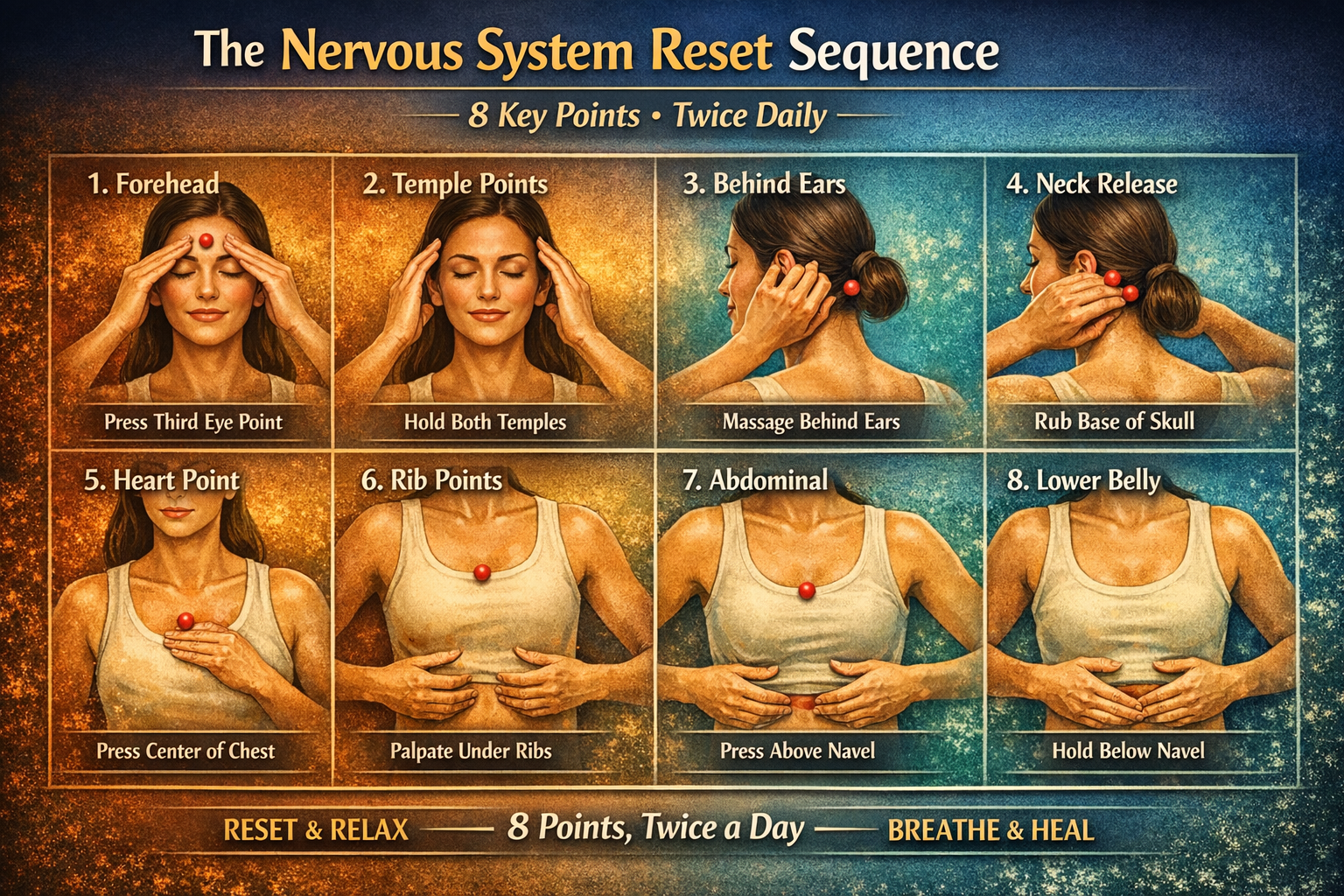
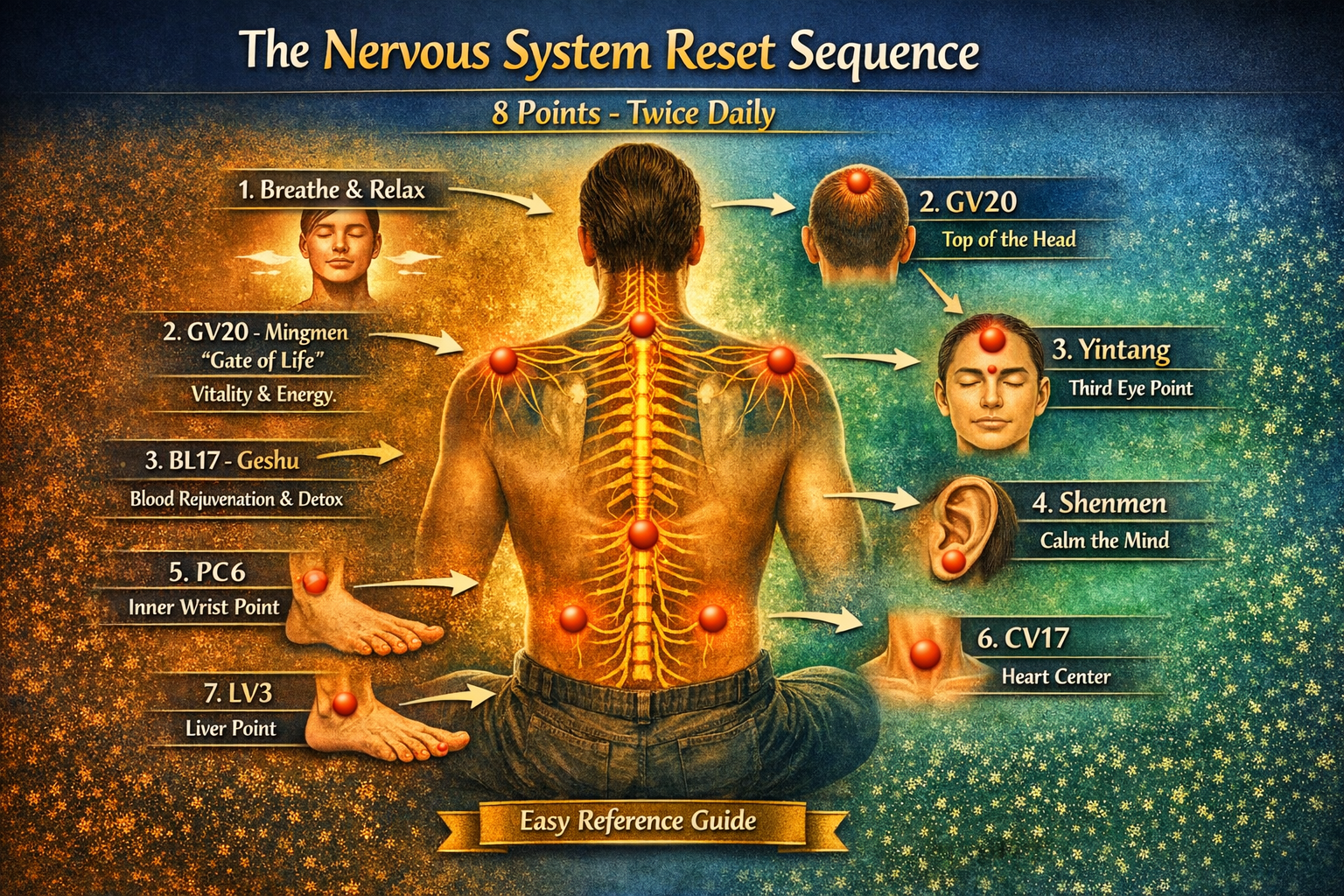
| Post 2 Daily Practice — Add These to Your Post 1 Foundation ① CV 17 — Chest centre (2 minutes, 4-7-8 breath throughout) ② KD 27 — Below collarbones (90 seconds each side, simultaneously) ③ LU 1 — Upper outer chest (90 seconds each side, gentle but sustained) ④ BL 23 — Lower back (2 minutes, tennis ball or partner press) ⑤ GV 4 — Ming Men / Gate of Life (90 seconds, warm palm pressure) ⑥ BL 15 — Mid-back heart point (90 seconds each side) ⑦ TW 15 — Shoulder summit (90 seconds each side, firm grip and release) ⑧ ST 36 — Below knee (2 minutes each leg, rebuilds depleted energy) Combined with the Post 1 sequence across morning and evening: a complete nervous system re-calibration. |
What to Expect After Two Weeks
By the end of two weeks of consistent practice — both the Post 1 and Post 2 sequences — you should notice several specific changes. Sleep onset becomes easier. The period between lying down and falling asleep shortens. Morning awakening is less abrupt — the cortisol spike that jolts many stressed people awake begins to soften into something more gradual and manageable.
The shoulder points GB 21 and TW 15 will feel measurably less tender. This is not because you have become desensitised — it is because the tissue is genuinely releasing stored tension. The difference between a point that is simply not being pressed and a point whose underlying tension has resolved is something you will feel clearly.
And you may notice something more subtle: moments of stillness that are comfortable rather than anxious. Brief windows where the background hum of stress is simply not there. Hold those moments. Notice them. They are not accidents — they are the nervous system remembering what it was built to feel.
The nervous system does not need to be broken to be reset. It just needs to be heard.
Coming in Post 3: ‘Stress Has an Address — It Lives in Your Organs (And Here Is How to Evict It)’
Work With Me
| For a Personalised Nervous System & Stress Profile The points in this series address the most common stress patterns — but the nervous system is individual. The sequence that most benefits someone with anxiety-dominant stress is different from the one that serves someone with shutdown and exhaustion. Someone carrying grief needs a different emphasis than someone driven by frustration and anger.A one-on-one consultation lets me understand your specific stress architecture: where it lives in your body, how long it has been there, and what the most direct pathway to your particular form of resolution looks like.Reach out: skcjos@gmail.com | www.linkedin.com/in/shajikumar |
In Association with World Health Journey | Oman | http://www.whjonline.com
Is stress affecting your mental health in ways you haven’t fully recognised yet?
Consider taking a Cognitive Health Check-Up — a clinically validated assessment that maps your stress profile, emotional health, and psychological resilience with precision.
Take the assessment here: www.whjonline.com/mmpi-2/
or Drop a Mail to shaji@whjonline.com
Because knowing where you stand is always the first step to getting better.


 Capt. Shaji Kumar