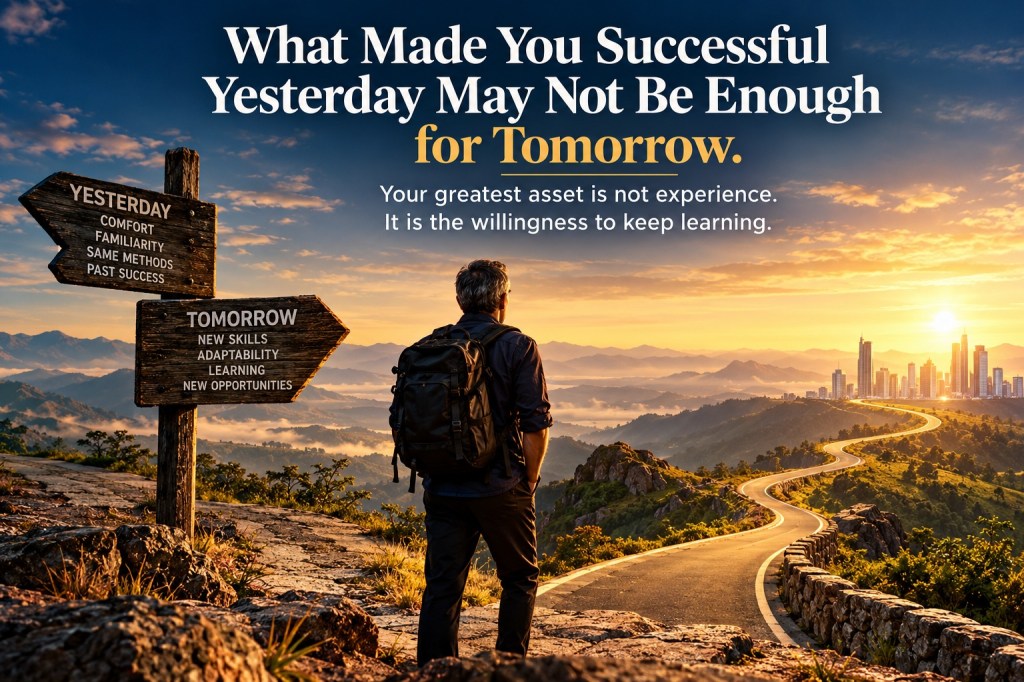
The entrepreneur’s greatest asset is not experience. It is the willingness to keep learning.
There is a lesson in professional life that most of us understand intellectually but struggle to accept emotionally.
What made you successful yesterday may not be enough to prepare you for tomorrow.
Success has a peculiar way of making us comfortable. The methods that worked, the decisions that paid off, the relationships that opened doors, and the instincts that helped us navigate difficult situations gradually become part of our identity.
We begin to believe that because we have succeeded before, we know how to succeed again.
That is where the danger begins.
The world does not stand still to accommodate our experience. Markets change. Technology evolves. Customers become more demanding. Employees think differently. Business models that once generated extraordinary returns can become obsolete almost overnight.
Yet, many of us continue to operate using the same assumptions that brought us success in the first place.
We mistake familiarity for competence and experience for immunity against change.
And when reality finally catches up, we wonder what went wrong.
The Law of Inertia Applies to Business Too
Newton’s first law of motion tells us that an object at rest remains at rest, and an object in motion continues in motion unless acted upon by an external force.
There is a powerful lesson here for founders and entrepreneurs.
In business, inertia is not always about standing still. Sometimes, it is about continuing to move in the same direction simply because that direction has served us well for years.
You continue doing what you have always done. You continue trusting the same processes. You continue making decisions based on yesterday’s realities.
Meanwhile, the world around you has moved on.
And if you fail to recognise that movement, you may discover that the very strengths that once propelled you forward have become limitations.
The entrepreneur who refuses to learn becomes a prisoner of past achievements.
The leader who stops questioning his assumptions eventually loses touch with the realities of the marketplace.
And the professional who believes that experience alone is sufficient risks becoming irrelevant in a world that rewards adaptability.
The greatest threat to future success is often the belief that past success guarantees it.
My Own Journey Taught Me This Lesson
My professional journey has taken me through the Indian Army, entrepreneurship, corporate leadership, recruitment, business advisory, and now the world of writing and coaching.
Each chapter demanded a different version of me.
The Army taught me discipline, preparedness, responsibility, and the importance of making decisions under pressure. It taught me that leadership is not merely about giving orders. It is about accepting responsibility when circumstances are difficult and the consequences of a decision are significant.
But I also learned something else.
The environment in which you operate determines how you must apply your strengths. Discipline remains valuable, but its application changes. Leadership remains essential, but the people you lead, the challenges you face, and the tools available to you evolve.
When I moved into the corporate world and eventually built my own business, I had to translate those lessons into a different environment.
Building a business from the ground up required more than determination. It demanded commercial judgement, an understanding of people, the ability to build relationships, and the willingness to make decisions without having all the answers.
Over the years, I built and managed a recruitment business that grew to approximately ₹150 crore in scale, without the benefit of external equity funding.
That journey was not built on one brilliant idea or a single moment of inspiration. It was the outcome of years of effort, learning, decisions, mistakes, relationships, and adjustments.
What worked at one stage of the business did not automatically work at the next.
As the organisation grew, the challenges changed. What could once be managed through personal involvement had to be supported by systems, people, and processes. What could be decided through instinct alone needed better information and more structured thinking.
Growth demanded that I grow with it.
And that is an important lesson for every founder.
You cannot build a bigger business by remaining the same person who built the smaller one.
The skills that help you start a business are not necessarily the skills that will help you scale it. The mindset that helps you survive the first few years may not be sufficient to navigate the complexities of expansion.
Every new stage of growth requires a new level of understanding.
The willingness to recognise that, and to learn accordingly, can make the difference between sustainable growth and stagnation.
When Life Forces You to Become a Beginner Again
There is another dimension to this lesson that I have come to understand through personal experience.
Sometimes, life does not give you the luxury of gradual change.
Sometimes, circumstances change so dramatically that the professional identity you spent decades building no longer provides the security you once took for granted.
You find yourself confronting realities you never expected to face. Familiar systems no longer offer the same support. The experience that once made you confident cannot, by itself, provide all the answers you need.
And suddenly, you are required to learn again.
Not because you have forgotten everything you knew, but because the circumstances demand a different application of what you know.
My own difficult experiences in recent years have brought me face to face with this reality. After decades of building a business and working across different professional environments, I found myself having to reconsider what came next.
It is not easy to confront uncertainty after having spent much of your life creating certainty for yourself and others.
It is even harder when you must separate your professional identity from the circumstances you are currently experiencing.
But I have come to appreciate a distinction that I believe every entrepreneur must understand.
Your circumstances may change your position, but they do not have to define your potential.
A setback can take away opportunities. A failed venture can disrupt financial security. An unexpected turn can force you to abandon a carefully constructed plan.
These are real consequences, and there is no value in pretending otherwise.
But the knowledge you have acquired, the judgement you have developed, the relationships you have built, and the lessons you have learned do not automatically disappear when circumstances change.
They may need to be applied differently. They may need to be supplemented with new skills. They may need to be re-examined in the light of a different reality.
That is precisely where learning becomes an instrument of renewal.
I have spent years in recruitment and business leadership. Today, I am exploring how that experience can be translated into writing, coaching, business advisory, and building learning platforms for others.
These are different arenas. They require different approaches, different tools, and different ways of reaching people.
I cannot assume that what worked in one business will automatically work in another.
I must learn the new environment, understand the audience, develop the necessary capabilities, and be willing to start with what I have rather than wait until I possess everything I might need.
That is not a rejection of experience.
It is an acknowledgement that experience becomes valuable when we are willing to keep building upon it.
Believe You Can, Then Build the Capacity to Do It
There is a second lesson I want to share with every founder, entrepreneur, and professional who feels that the next stage of life or business demands more than they currently possess.
It is this:
You do not always need to possess the capacity before you begin. Sometimes, you develop the capacity because you begin.
Think about it.
When you first start a business, you may not know how to build a large organisation. You may not understand every aspect of finance, marketing, technology, or people management.
When you begin writing, you may not know how to reach readers.
When you start coaching, you may not have mastered every framework or discovered the most effective way to communicate your ideas.
When you enter a new industry, you may lack the experience that others have accumulated over many years.
If you insist on acquiring complete competence before taking the first step, you may never begin.
The alternative is not reckless confidence or blind optimism.
It is a willingness to believe that you can learn what you do not yet know, acquire the skills you do not yet possess, and build the competence required to move forward.
Belief gives you the courage to begin. Learning helps you improve. Practice develops your ability. Feedback corrects your mistakes. Consistency turns small improvements into meaningful progress.
This is how capacity is built.
I would never suggest that belief alone can overcome every obstacle. Circumstances matter. Resources matter. Timing matters. Access to opportunities matters.
But without the belief that improvement is possible, we often disqualify ourselves before we have even tried.
The question is not whether you can do everything today.
The question is whether you are prepared to become capable of doing what tomorrow demands.
That is a far more empowering question.
The Founder Who Keeps Learning Has an Advantage
For entrepreneurs, continuous learning is not an academic exercise. It is a business survival strategy.
Consider five areas where it matters.
1. Learn to question your own assumptions.
The assumptions that helped you establish your business may no longer hold true. Revisit your pricing, customer expectations, delivery model, and competitive position. Ask yourself what has changed and what you may be failing to see.
2. Learn to recognise when your strengths have become limitations.
Being hands-on may have helped you build your business. But if every decision still depends on you, your involvement may be preventing the organisation from growing. Learn when to delegate, when to build systems, and when to let others do things differently.
3. Learn to embrace unfamiliar tools and technologies.
You do not need to become an expert in every new technology. But you must understand enough to determine whether it can improve productivity, reduce costs, strengthen customer relationships, or open new markets.
Curiosity is often more valuable than pretending to know everything.
4. Learn from failure without making failure your identity.
A failed decision deserves examination. A failed business deserves an honest assessment. But neither should automatically become a permanent verdict on your ability to succeed again.
Study what happened. Accept responsibility where it is yours. Understand what was beyond your control. Correct what can be corrected.
Then decide what you will do differently.
5. Learn to reinvent without abandoning your core values.
Adaptability does not mean changing everything about yourself. Integrity, discipline, accountability, and respect for people can remain constant even when your business model, professional role, or market changes.
Your values provide continuity. Your methods must remain open to evolution.
The most resilient entrepreneurs understand the difference.
Do Not Confuse Starting Again with Starting from Zero
One of the most damaging beliefs a person can carry after a setback is that everything they have built has been lost.
It is understandable to feel that way when a business closes, a career takes an unexpected turn, or years of effort appear to have yielded little in the present.
But there is a difference between losing an asset and losing the ability to create value.
Your previous business may no longer operate. Your former position may no longer exist. Your accumulated experience, however, can still help you recognise opportunities, assess risks, understand people, and make better decisions.
You may need to learn new skills. You may need to rebuild your network. You may need to approach markets in ways that would have seemed unfamiliar a decade ago.
You may even need to accept that your next beginning will look very different from your last success.
That is all right.
You are not required to recreate the past. You are required to use what the past has taught you to build a future that makes sense in the present.
This is particularly important for experienced professionals and older entrepreneurs.
There is a tendency to believe that reinvention belongs to the young, that new technologies are best left to younger generations, or that professional identity becomes fixed after a certain age.
I disagree.
Experience can provide perspective that cannot be acquired overnight. The challenge is to combine that perspective with the curiosity, humility, and willingness to experiment that allow new capabilities to develop.
Age may influence the time, resources, and energy available to you. It does not automatically eliminate your ability to learn, contribute, or create something meaningful.
You may not have the same starting point as someone twenty years younger.
But you do not have to compete on identical terms.
You can combine your experience with new skills and solve problems that others may not yet understand.
That is not a consolation prize. It can be a genuine competitive advantage.
A Simple Practice: Make Learning Part of Your Daily Work
You do not need a dramatic life change to begin.
Start with a simple discipline.
At the end of each working day, ask yourself three questions:
- What did I learn today that I did not know yesterday?
- Which assumption of mine was challenged by reality?
- What will I do differently tomorrow because of what I learned?
The answers need not be profound.
You may discover a better way to communicate with a customer, a more effective method of using a digital tool, a weakness in your sales process, or a mistake in the way you approached a decision.
What matters is that you do not allow experience to pass through your life without extracting a lesson from it.
Over time, this practice changes the way you work.
You become less defensive when challenged. You become more willing to ask questions. You begin to recognise patterns without assuming that every new situation is identical to an old one.
Most importantly, you stop treating learning as something you do before you begin your real work.
Learning is the work.
It is part of building the business, leading the team, serving the customer, and preparing for whatever comes next.
The Real Measure of Success
I have come to believe that professional success cannot be measured solely by the size of a business, the designation on a visiting card, the income earned, or the recognition received.
Those things matter. They can create security, open doors, and provide opportunities to contribute.
But they do not tell the whole story.
Another measure of success is your ability to respond when life changes the rules.
Can you question what you once believed to be certain?
Can you acknowledge that you do not know something without feeling diminished?
Can you acquire a new skill even when you are accustomed to being the experienced person in the room?
Can you accept that a method that once worked may no longer be effective?
Can you begin again without allowing your ego to dictate the terms?
These are not easy questions.
But they are worth asking, because the future rarely arrives in precisely the form we expect.
For a founder, the next phase of growth may demand a different leadership style.
For an entrepreneur, the next opportunity may require an unfamiliar business model.
For a professional, the next career chapter may require skills that were not part of the original job description.
And for someone rebuilding after a difficult period, the next beginning may require the courage to learn in public, experiment without guarantees, and accept that progress will not always be immediate.
In each case, the willingness to learn creates possibilities that the refusal to change closes off.
My Message to Every Founder and Entrepreneur
If you have built something meaningful, respect the experience that brought you here.
But do not allow that experience to become a wall between you and the future.
Remain curious. Question your assumptions. Learn from people who know things you do not. Develop capabilities that your next chapter may demand. Be prepared to discard methods that have stopped working, even when they were once responsible for your success.
And if circumstances have forced you to reconsider your direction, do not automatically assume that you have lost the ability to create value.
You may need a new approach. You may need to learn new skills. You may need to redefine success itself.
But you can begin with what you know, remain open to what you do not know, and build the capacity to do what you cannot yet do.
That is the real power of continuous learning.
Not that it guarantees success.
But that it keeps you capable of responding to change, finding opportunities, and moving forward when the old answers no longer work.
I have learned that life does not always reward us according to the plans we make. Sometimes, it tests our assumptions, strips away our certainties, and asks us to discover what remains when the familiar is no longer available.
In those moments, our willingness to learn may become one of our most valuable assets.
Because the goal is not to remain the person who succeeded yesterday.
The goal is to become the person who is ready for tomorrow.
And that journey begins with a simple decision:
I may not know how to do it today. But if it is worth doing, I am willing to learn.
A question for founders and entrepreneurs:
What is one skill, belief, or business practice that made you successful in the past but that you have had to rethink to remain relevant today?
Share your experience. Someone else may be standing at the same crossroads you once faced.
#ClarityUnderPressure #Entrepreneurship #Leadership #ContinuousLearning #BusinessGrowth


Leave a Reply