Tag: #Mindset

  • The Cautionary Vision of Aldous Huxley’s Brave New World.

    The Cautionary Vision of Aldous Huxley’s Brave New World.

    “But I don’t want comfort. I want God, I want poetry, I want real danger, I want freedom, I want goodness. I want sin.” — John the Savage.

    Aldous Huxley’s Brave New World (1932) stands as one of literature’s most prescient warnings about the perils of technological control and manufactured happiness. Written during the rise of mass production and behaviorist psychology, Huxley’s dystopian masterpiece explores a fundamental question that remains urgently relevant today: Can a society built on pleasure, efficiency, and stability ever truly fulfil human nature?

    The novel’s answer is a resounding no — and its exploration of why reveals profound truths about freedom, suffering, and what it means to be authentically human.

    The World State: Perfection Without Soul.

    Huxley’s World State represents the ultimate technocratic society, where every aspect of human existence has been optimised for stability and happiness. The citizens of AF 632 (After Ford, referencing Henry Ford’s assembly line revolution) live in a world that has seemingly solved humanity’s greatest problems:

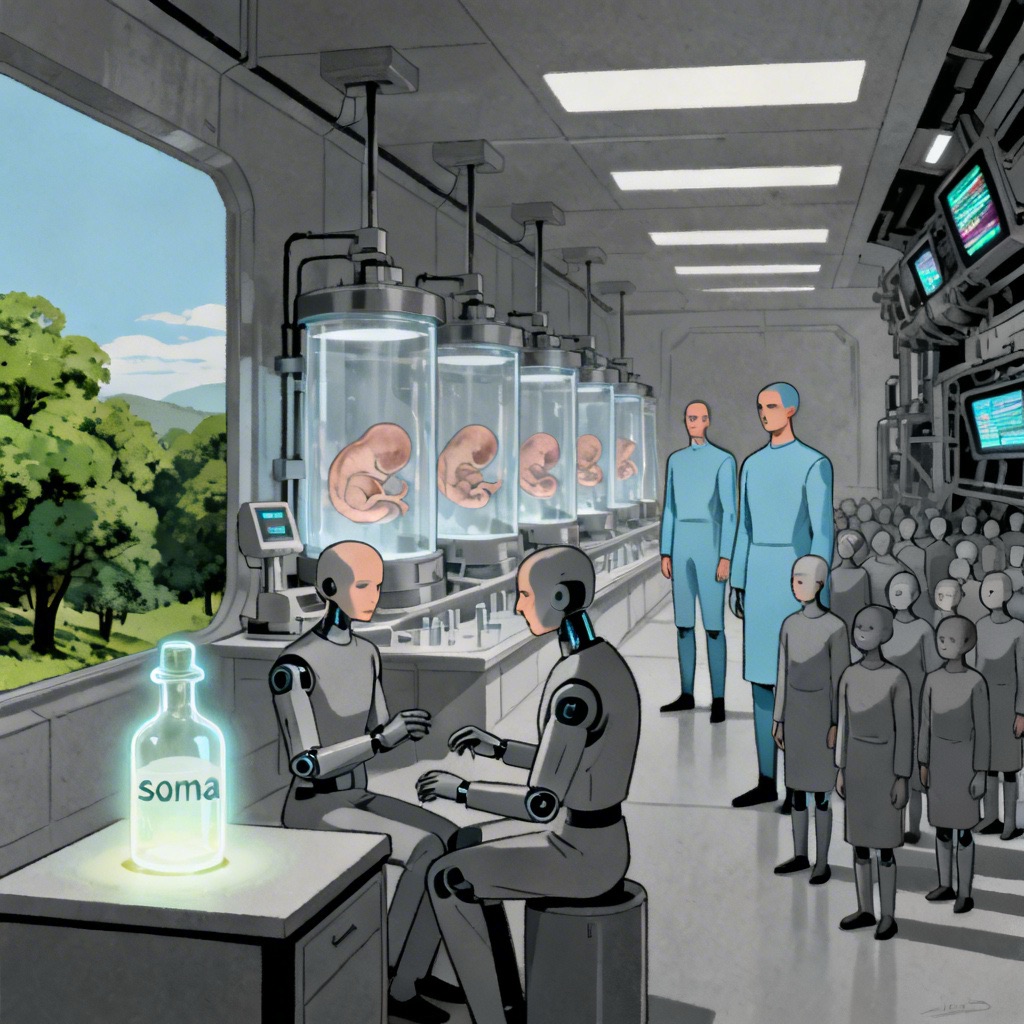
    Biological Engineering eliminates genetic inequality through controlled reproduction in “Hatcheries and Conditioning Centres.” Children are no longer born but manufactured, with their intelligence and physical capabilities predetermined by their assigned caste.

    Pavlovian Conditioning shapes behavior from infancy, ensuring each person finds satisfaction in their predetermined role. Delta and Epsilon children are conditioned to hate books and nature, while Alphas are trained for leadership — creating a society where oppression feels natural.

    Soma Distribution provides chemical happiness on demand. This miracle drug offers all the benefits of alcohol, narcotics, and antidepressants without hangovers, addiction, or side effects. Why suffer when relief is just a pill away?

    Sexual Liberation replaces love and family bonds with casual encounters, preventing the deep emotional attachments that might challenge state authority. The mantra “everyone belongs to everyone else” ensures no citizen develops loyalty to anyone but the state.On the surface, this world has achieved what every society claims to want: no war, no poverty, no suffering, no unfulfilled desires. Yet Huxley reveals this paradise as profoundly hollow.

    The Savage’s Mirror: What We Lose in Paradise.

    John the Savage serves as the novel’s moral center and our window into what the World State has sacrificed for its stability. Raised on Shakespeare and traditional human values on the Reservation, John embodies everything the World State has eliminated: passion, moral struggle, spiritual yearning, and the capacity for both profound joy and devastating sorrow.

    The Conflict Between Comfort and Truth.

    When John encounters World State civilisation, his horror isn’t directed at obvious evils but at the absence of meaning itself. He’s repulsed not by cruelty but by the casual indifference to beauty, truth, and human dignity. In his famous exchange with World Controller Mustapha Mond, John articulates the novel’s central theme:

    – John demands the right to be unhappy, to struggle, to face real danger.

    – Mond responds that such desires are antisocial and unnecessary in a world that can provide easy satisfaction.

    This conversation reveals Huxley’s crucial insight: a society that eliminates suffering also eliminates the conditions necessary for human growth, creativity, and genuine fulfillment.**

    Love vs. Conditioning.

    John’s relationship with Lenina crystallizes this conflict. His passionate, romantic love — shaped by Shakespeare’s sonnets — collides with her conditioned casual sexuality. Neither can understand the other:

    – John seeks transcendent connection, viewing sexuality as sacred when combined with love.

    – Lenina finds his intensity confusing and unnecessary, having been conditioned to view emotional attachment as unhealthy.

    Their tragic inability to connect represents the broader gulf between authentic human nature and engineered satisfaction.

    Huxley’s Prophetic Warnings.

    Writing in 1932, Huxley anticipated developments that wouldn’t fully emerge for decades. His warnings prove remarkably prescient:### The Tyranny of Pleasure Unlike Orwell’s 1984, where citizens are controlled through fear and pain, Brave New World presents a more seductive form of control. The World State doesn’t need to threaten its citizens — it simply makes them too comfortable to rebel.

    Modern parallels include:

    – Social media platforms designed to provide endless, easy gratification.

    – Consumer culture that promises happiness through material acquisition.

    – Pharmaceutical solutions for emotional and spiritual problems.

    – Entertainment that distracts from deeper questions about meaning and purpose.

    The Standardisation of Humanity.

    The World State’s caste system represents an extreme version of social engineering, but Huxley’s real concern is the broader tendency to treat humans as interchangeable units rather than unique individuals.

    Contemporary echoes appear in:

    – Educational systems focused on standardised testing rather than individual growth.

    – Economic policies that prioritize efficiency over human flourishing.

    – Technology that reduces complex human needs to data points and algorithms.

    The Elimination of Difficult Beauty.

    Perhaps most tragically, the World State has eliminated art, religion, and philosophy — anything that might disturb its citizens’ contentment. Beauty exists only in sanitised, consumable forms.

    Today’s version might include:

    – Art reduced to viral content optimised for engagement.

    – Spiritual practices repackaged as wellness trends.

    – Literature and philosophy marginalized in favor of immediately practical information.

    The Price of Paradise.

    John’s suicide represents the novel’s darkest conclusion: that authentic humanity cannot survive in a world designed to eliminate suffering. His death poses uncomfortable questions:

    Is struggle necessary for human fulfillment? The World State’s citizens appear happy, but their satisfaction seems shallow compared to John’s capacity for both ecstasy and agony.

    Can technology solve human problems without destroying human nature?

    Every technological solution in the World State comes with the hidden cost of diminishing some essential aspect of humanity.What happens when comfort becomes more important than truth? The citizens live in a carefully constructed illusion, protected from reality’s sharp edges but also cut off from its genuine beauty.

    Lessons for Our Time.

    Huxley’s vision feels increasingly relevant as we grapple with similar questions about technology, pleasure, and control. His novel suggests several crucial principles:

    Preserve Space for Difficulty.

    A truly human society must allow room for struggle, failure, and growth. Easy solutions to complex problems often eliminate opportunities for character development and genuine achievement.

    Value Individual Uniqueness.

    Efficiency and equality are worthy goals, but not at the cost of individual personality, creativity, and moral agency. Systems that treat people as interchangeable units ultimately dehumanise everyone.

    Choose Meaningful Over Comfortable.

    The novel argues that meaning matters more than happiness — that a difficult life pursuing truth and beauty surpasses an easy life of shallow pleasure.

    Question Technological Solutions.

    Every technological advance should be evaluated not just for its benefits but for its hidden costs to human flourishing. What aspects of humanity might we lose in exchange for convenience or comfort?

    Conclusion: The Enduring Challenge.

    Brave New World doesn’t offer easy answers, but it poses essential questions that each generation must answer anew. In our age of social media, artificial intelligence, and biotechnology, Huxley’s warnings feel prophetic rather than fantastical.

    The novel’s lasting power lies not in its specific predictions but in its fundamental insight: the greatest threats to human dignity often come disguised as benefits. A society that promises to solve all problems, eliminate all suffering, and provide all pleasures may inadvertently eliminate the struggles that make us most human.

    John the Savage’s tragic fate reminds us that the choice between comfort and authenticity, between easy happiness and meaningful existence, remains as relevant today as it was in 1932. The question isn’t whether we’ll face this choice — it’s whether we’ll have the courage to choose wisely when we do.

    As Huxley himself might say, the price of true humanity may be the willingness to embrace both the beauty and the terror of being genuinely alive.

    When we introspect, it is quite evident that all these magnificent and exemplary authors had such prophetic vision and extraordinary power of imagination.

  • Breaking Free: How to Reclaim Your Life from Social Media and Smartphone Addiction.

    Breaking Free: How to Reclaim Your Life from Social Media and Smartphone Addiction.

    In an era where the average person checks their phone 96 times per day, we’ve crossed a threshold from digital convenience to digital dependency. What started as tools to enhance our lives has become invisible chains that bind our attention, fragment our focus, and quietly erode our mental well-being.

    The Hidden Epidemic: Understanding Digital Addiction.

    What Social Media and Smartphone Addiction Really Looks Like Digital addiction isn’t just about spending “too much time” on your phone. It’s a complex behavioural pattern characterised by:

    Compulsive checking even when you know there won’t be new notifications.

    Phantom vibration syndrome – feeling your phone buzz when it hasn’t.

    FOMO (Fear of Missing Out) driving constant social media scrolling.

    Withdrawal anxiety when separated from your device.

    Sleep disruption from late-night scrolling or blue light exposure.

    Decreased face-to-face social skills and preference for digital interaction.

    How many of the above points resonates with you?

    This addiction operates on the same dopamine reward pathways as gambling, creating a cycle where each notification, like, or comment triggers a small hit of pleasure that keeps us coming back for more. We post something and then keep coming back to check the status. We even have the notifications on and every ping distracts us to divert our attention.

    I grew up in an era when there were no Mobile Phones. Yet we survived and had better more meaningful relations with our friends & family. If we had to meet someone a physical visit was the only means or a voice call via telephone. All that has changed. Now all we do is use the “convenience” of the Smart Phone. Every Birthday wish, every anniversary greetings and any other activity was a meet and greet affair.

    How Digital Addiction Is Rewiring Our Brains.

    The Neuroscience Behind the Compulsion.

    Social media platforms and smartphones are engineered using principles from behavioral psychology to maximize engagement – a euphemism for addiction. Here’s what happens in your brain:

    1. Dopamine hijacking: Each notification triggers dopamine release, the same neurotransmitter involved in substance addiction.

    2. Attention residue: Task-switching between phone and real life leaves cognitive “residue” that impairs focus.

    3. Shortened attention spans: Constant stimulation rewires neural pathways, making sustained concentration increasingly difficult.

    4. Social comparison overdrive: Endless exposure to curated content triggers unhealthy social comparison and inadequacy feelings.

    The Immediate Impact on Daily Life.

    Productivity Destruction:

    – Average knowledge worker checks email every 6 minutes.

    – It takes 23 minutes to fully refocus after a digital interruption.

    – Multitasking with devices reduces work quality by up to 40%.

    Relationship Erosion:

    – “Phubbing” (phone snubbing) damages intimate relationships.

    – Decreased empathy from reduced face-to-face interaction.

    – Family dinners interrupted by devices become disconnected experiences.

    Mental Health Deterioration:

    – Increased anxiety, depression, and loneliness despite being more “connected”.

    – Sleep disorders from blue light and late-night scrolling.

    – Decision fatigue from information overload.

    The Long-Term Consequences: What We’re Really Risking.

    Cognitive and Neurological Effects.

    Attention Deficit Normalisation:

    Years of rapid context-switching train your brain to crave constant stimulation. This leads to:

    – Difficulty with deep reading and complex thinking.

    – Increased distractibility that persists even when devices are absent.

    – Reduced capacity for boredom – a crucial state for creativity and reflection.

    Memory Formation Disruption:

    – External digital memory reduces internal memory consolidation.

    – “Google effect” where we remember where to find information rather than the information itself.

    – Decreased autobiographical memory formation due to constant documentation vs. experiencing.

    Social and Emotional Development.

    Empathy Erosion:

    – Reduced face-to-face interaction impairs emotional intelligence development.

    – Decreased ability to read non-verbal cues and emotional nuance.

    – Increased tolerance for online cruelty and decreased real-world social skills.

    Identity Fragmentation:

    – Constant curation of online personas disconnects us from authentic self.

    – Validation-seeking becomes external rather than internal.

    – Comparison culture breeds chronic dissatisfaction.

    Physical Health Impacts.

    Postural and Motor Issues:

    – “Text neck” leading to chronic cervical spine problems.

    – Repetitive strain injuries from excessive typing and swiping.

    – Reduced fine motor skills in children who primarily interact through touchscreens.

    Sleep and Circadian Disruption:

    – Blue light exposure disrupts melatonin production.

    – Hyper-vigilance from constant connectivity disrupts parasympathetic nervous system.

    – Chronic sleep deprivation leading to immune system compromise.

    The Path Back to Sanity: A Comprehensive Recovery Plan

    Phase 1: Digital Detox and Awareness Building (Weeks 1-2)

    Immediate Actions:

    1. Conduct a digital audit.

    – Use screen time tracking apps to establish baseline usage.

    – Log emotional states before and after phone use for one week.

    – Identify your most problematic apps and times of day.

    2. Create physical barriers.

    – Remove phones from bedrooms – use analog alarm clocks.

    – Establish “phone parking” areas in your home.

    – Use app timers and website blockers during focused work.

    3. Replace digital habits with analog alternatives.

    – Physical books instead of e-readers.

    – Paper notebooks for thinking and planning.

    – Analog watches to reduce phone checking for time.

    Phase 2: Mindful Reintegration (Weeks 3-6)

    Structured Digital Diet:

    1. Implement the “Phone Fast” schedule-No phones for first 60 minutes after waking.

    – 2-hour digital sunset before bedtime.

    – One full day per week completely offline.

    2. Curate your digital environment.

    – Unfollow accounts that trigger comparison or negativity.

    – Use “dumb” versions of necessary apps (web versions vs. native apps).

    – Remove all apps that don’t serve a specific, intentional purpose.

    3. Practice “Mono-tasking

    – One screen at a time maximum.

    – Complete focus on single activities for 25-minute intervals (Pomodoro Technique).

    – No background audio/video while working or eating.

    Phase 3: Building Analog Resilience (Weeks 7-12).

    Developing Non-Digital Coping Mechanisms:

    1. Cultivation practices.

    – Daily meditation or mindfulness practice (start with 5 minutes).

    – Regular exercise without music/podcasts – embrace movement meditation.

    – Engage in creative hobbies that require sustained attention (drawing, musical instruments, crafting).

    2. Social re-engagement

    – Schedule regular phone calls instead of texting.

    – Organize device-free social activities.

    – Join clubs or classes that require in-person participation.

    3. Intellectual restoration.

    – Read physical books for 30+ minutes daily.

    – Engage with long-form content (documentaries, academic papers, literature).

    – Practice writing by hand to slow thinking and improve retention.

    Advanced Strategies for Long-Term Success.

    Environmental Design.

    Create friction for digital consumption:

    – Keep phones in other rooms during work and meals.

    – Log out of social media accounts after each use.

    – Use grayscale phone settings to reduce visual appeal.

    Design ease for analog activities:

    – Keep books visible and accessible.

    – Have musical instruments or art supplies readily available.

    – Create comfortable spaces for conversation and reflection.

    Social Support Systems.

    Community accountability:

    – Join digital wellness groups or create accountability partnerships.

    – Communicate your goals with family and friends.

    – Reduced compulsive checking behaviors

    – Model healthy behavior for children and peers.

    Professional support when needed:

    – Consider therapy for severe addiction or underlying mental health issues.

    – Explore digital wellness coaching.

    – Participate in group therapy or support groups for technology addiction.

    Technology as Tool, Not Master.

    Intentional technology use:

    – Define specific purposes before picking up devices.

    – Set daily intention for technology use.

    – Regular “digital decluttering” sessions to remove unnecessary apps and accounts.

    What to Expect: The Recovery Timeline.

    Week 1-2: The Withdrawal Phase.

    – Increased anxiety and restlessness.

    – Boredom and feeling “disconnected”.

    – Phantom vibration syndrome.

    – This is normal and temporary.

    Week 3-6: Adaptation Period.

    – Improved sleep quality.

    – Increased attention span during reading.

    – Better presence during conversations.

    Month 2-3: Neuroplasticity Recovery.

    – Significantly improved focus and concentration.

    – Increased creativity and problem-solving ability.

    – Better emotional regulation.

    – Enhanced real-world social connections.

    Month 3+: The New Normal.

    – Technology becomes a tool rather than a compulsion

    – Increased life satisfaction and presence

    – Improved mental health metrics

    – Better physical health and posture

    The Future: Building a Healthier Digital Society.

    Individual Responsibility.

    Your personal journey toward digital wellness isn’t just about your own well-being – it’s about modeling healthy behavior for family, friends, and colleagues. Every person who chooses intentional technology use creates ripple effects in their community.

    Collective Action

    We need broader societal shifts:

    – Education about digital wellness in schools.

    – Workplace policies that respect attention and presence.

    – Technology design that prioritizes user well-being over engagement.

    – Cultural norms that value deep work and present-moment awareness.

    Remember: You Have More Power Than You Think.

    The technology companies have spent billions of dollars and employed teams of neuroscientists and behavioural psychologists to capture your attention. But you have something they don’t: conscious choice and the ability to change.

    Every moment you choose presence over distraction, deep work over shallow browsing, or real connection over digital validation, you’re rewiring your brain toward greater well-being and authentic living.

    The goal isn’t to become a digital hermit – it’s to use technology intentionally, as a tool that serves your highest purposes rather than a master that controls your attention and time.

    Start small. Be patient with yourself. And remember that reclaiming your attention is perhaps the most important act of self-care you can perform in the 21st century.

    Your authentic life is waiting on the other side of that screen. The question isn’t whether you can break free from digital addiction – it’s whether you’re ready to choose presence, depth, and real connection over the illusion of digital fulfilment. It is difficult, but not impossible.
  • The Mind’s Loop: How Overthinking Transforms Challenges into Monsters.

    The Mind’s Loop: How Overthinking Transforms Challenges into Monsters.

    Have you ever noticed how a small worry can snowball into an avalanche of anxiety in your mind? One moment you’re facing a manageable challenge, and the next, you’re trapped in a mental cinema playing every possible disaster scenario on repeat. This phenomenon—letting our minds wander into negative territories—is more common than we’d like to admit, and it’s time we understood why it happens and how to break free from its grip.

    The Anatomy of Mental Spirals.

    When we encounter a problem or uncertainty, our brains naturally try to solve it. This evolutionary trait once helped our ancestors survive by anticipating threats. However, in our modern world, this same mechanism can work against us. Instead of productive problem-solving, we often find ourselves caught in what psychologists call “rumination”—repetitive, negative thinking that amplifies rather than resolves our concerns.

    How Overthinking Distorts Reality.

    Consider this: you have a presentation next week. A healthy amount of preparation is beneficial, but overthinking transforms this simple task into a catastrophe. Your mind begins scripting scenarios:

    – “What if I forget my lines?”

    – “What if they ask questions I can’t answer?”

    – “What if my technology fails?”

    – “What if everyone thinks I’m incompetent?”

    Each “what if” feeds the next, creating an elaborate narrative of failure that exists nowhere but in your imagination. The presentation hasn’t happened yet, but you’re already experiencing the stress, anxiety, and defeat as if it were real.

    The Hidden Cost of Negative Mental Loops.

    When we allow these thought patterns to persist, we pay a price that extends far beyond the original concern:

    • Emotional Exhaustion: Constantly running worst-case scenarios drains our mental and emotional resources, leaving us feeling depleted before we even face the actual challenge.
    • Paralysis by Analysis: Overthinking often leads to inaction. We become so focused on everything that could go wrong that we fail to take the steps necessary to ensure things go right.
    • Present-Moment Blindness: While our minds are busy painting dark futures, we miss the beauty, opportunities, and joy available in our current reality.
    • Self-Fulfilling Prophecies: When we’re convinced of failure, we unconsciously behave in ways that increase its likelihood—a phenomenon that reinforces our negative beliefs.

    The Probability Paradox.

    Here’s the remarkable truth: most of what we worry about never actually happens. Research suggests that approximately 85% of what we worry about has positive or neutral outcomes. Even when challenges do arise, we typically handle them better than we anticipated.

    Yet our brains persist in this pattern because anxiety feels productive. It tricks us into believing that by worrying, we’re somehow preparing for or preventing negative outcomes. In reality, we’re simply rehearsing stress.

    Breaking the Loop: A Different Approach.

    The solution isn’t to stop thinking altogether—that’s neither possible nor desirable. Instead, we need to develop awareness of when our minds are wandering into unproductive territory and gently redirect them.

    1. Recognize the Pattern.

    The first step is awareness. Notice when you’re spiraling into negative scenarios. Ask yourself:

    – Is this thinking helping me solve the problem?

    – Am I focusing on what could go wrong rather than what could go right?

    – Am I treating imaginary scenarios as if they were facts?

    2. Challenge the Narrative.

    When you catch yourself catastrophizing, pause and question the story your mind is telling:

    – What evidence do I have that this worst-case scenario will happen?

    – Have I faced similar situations before? How did they actually turn out?

    – What’s the most likely outcome, not the most feared one?

    3. Redirect Your Mental Energy.

    Instead of feeding the negative loop, consciously shift your focus:

    – What can I do today to prepare for this situation?

    – What resources and strengths do I have available?- What positive outcomes are possible?

    Giving Your Mind Permission to Rest.

    Sometimes the most productive thing you can do is nothing at all. Our culture often celebrates constant mental activity, but periods of mental rest are crucial for clarity and creativity. When you feel stuck in overthinking:

    • Practice Mindful Breaks: Step away from the problem entirely. Take a walk, listen to music, or engage in an activity that brings you joy.
    • Trust the Process: Often, when we stop forcing solutions, they appear naturally. Your subconscious continues working on problems even when your conscious mind is at rest.
    • Set Thinking Boundaries: Designate specific times for problem-solving and stick to them. Outside these windows, gently redirect your attention to the present moment.

    The Promise of Tomorrow.

    Here’s a beautiful truth worth remembering: the future holds experiences of joy, growth, and success that you haven’t even imagined yet. When you paint your present with the dark colors of imaginary failures, you rob yourself of the anticipation and hope that make life vibrant.

    Your challenges are real, but they’re also temporary and solvable. The scenarios playing in your mind are fictional, but the anxiety they create is robbing you of peace in the here and now.

    Moving Forward with Intention.

    As you navigate the days ahead, remember that your mind is a powerful tool—but like any tool, it works best when directed with intention rather than allowed to run wild. When doubts arise, acknowledge them without judgment, then choose to focus on what you can control and influence.

    The ideas, solutions, and inspiration you need will come. They always do. But they’re more likely to arrive when your mind is calm, open, and focused on possibility rather than catastrophe.

    Your present moment is happening now, unrepeatable and full of potential. Don’t let imaginary tomorrows steal the gift of today.

    Remember: You are more resilient than you think, more capable than you fear, and more deserving of peace than your worried mind would have you believe.

    #PersonalDevelopment #Leadership #Mindset #Success #Mindfulness

  • The Chicken, The Egg, and The Art of Moving Forward.

    We’ve all heard the age-old riddle: “Which came first, the chicken or the egg?” Science tells us the egg wins this debate, but here’s the real question—does it actually matter?

    Some arguments are simply un-winnable. No amount of logic will ever settle certain debates, and that’s perfectly okay. The secret isn’t trying to force your way through these impossible puzzles—it’s learning to work around them.

    The Trap of Overthinking.

    How do you know if your past choices were right or wrong? Here’s the uncomfortable truth: you don’t.

    And constantly questioning every decision will only lead to paralysis. Sometimes, trusting what seems obvious saves us from the endless spiral of “what if.”

    Action Over Analysis.

    Want something to happen? Stop debating and start doing. Real progress comes from steady, disciplined effort—not perfect understanding. Show kindness to others (yes, even the difficult ones), focus on the present moment, and remember: every action looks different in hindsight.

    The Power of “What If”

    That little word “if” can destroy our peace of mind. We’ll always wonder about alternate paths once moments pass. Instead of lamenting, accept this as part of being human and keep moving forward.

    The bottom line? Some questions don’t need answers—they need acceptance. Focus your energy on what you can control today, not on solving yesterday’s riddles.

    #PersonalDevelopment #Leadership #Mindset #Success #Accountability

  • You Are the Author of Your Destiny: Why Everything Happens for a Reason—And That Reason Is Your Choices.

    “EVERYTHING HAPPENS FOR A REASON.”

    How many times have you heard this phrase whispered as comfort during difficult moments? How often have you seen it shared on social media as a blanket explanation for life’s unexpected turns? But what if this popular platitude, as commonly understood, is not just wrong—but dangerously disempowering?

    Today, we’re going to challenge everything you think you know about fate, destiny, and personal responsibility. We’re going to explore a radical reinterpretation that places you—not the universe, not God, not cosmic forces—at the center of your life’s narrative.

    The Dangerous Comfort of Cosmic Fatalism.

    Think about the traditional interpretation for a moment. “Everything happens for a reason” typically suggests that all your efforts—personal, professional, emotional—are mere footnotes to some cosmically predetermined set of outcomes. This worldview positions us as passengers on a journey we didn’t choose, heading toward destinations we cannot control.

    Under this framework, we become:

    • Slaves to fate rather than masters of our choices Absolved of responsibility for our failures Robbed of credit for our achievements
    • Victims of circumstances beyond our influence

    This interpretation strips us of agency. It suggests we have no real say in—let alone culpability for—the defining moments of our lives. It’s a philosophy of surrender disguised as wisdom.

    The Revolutionary Inversion: You Are the Reason

    But what if we completely invert this notion? What if we redefine “everything happens for a reason” not as some future cosmic explanation for tragedy or triumph, but as validation of the deliberate choices that led us to these critical junctures in the first place?

    This inversion is revolutionary because it:

    • Places you at the center of your narrative Transforms you from victim to architect Makes every outcome a reflection of your decisions
    • Empowers you to assert authority over chance, fate, and destiny

    Under this framework, everything does happen for a reason. And that reason is you—your choices, your actions, your willingness to take responsibility for the trajectory of your life.

    The Hard Truths About Extraordinary Achievement

    To reach the pinnacle of success, you must be willing to:

    1. Make hard choices when others choose comfort Do unpleasant but necessary things when others avoid discomfort Risk your most valuable assets when others play it safe Question societal expectations that may limit your potential
    2. Resist the uninvited imposition of others’ moral agendas on your goals

    This isn’t about becoming callous or abandoning all human connections. It’s about recognising that extraordinary results require extraordinary commitment—and that such commitment often conflicts with conventional expectations.

    The Sacrifice Principle: Nothing Worthwhile Comes Easy

    Here’s an uncomfortable truth: nothing worthwhile is ever achieved without sacrifice. This isn’t pessimism—it’s reality. Every great achievement in history has required someone to give up something else.

    The question isn’t whether you’ll make sacrifices. The question is whether you’ll make them consciously and strategically, or whether you’ll let life make them for you.

    This doesn’t mean abandoning everything that makes life meaningful. Rather, it means being intentional about what you’re willing to sacrifice and what you consider non-negotiable.

    The Controversy: Challenging Social Expectations

    Perhaps the most controversial aspect of this philosophy is its challenge to traditional social structures and expectations. Society often promotes a one-size-fits-all approach to life: education, career, marriage, children, retirement. But elite achievement often requires questioning these predetermined paths.

    This doesn’t mean these life choices are inherently wrong or that everyone should abandon them. Rather, it means: Questioning whether societal expectations align with your personal mission.

    A Balanced Perspective

    It’s important to note that this philosophy doesn’t advocate for a life devoid of human connection or moral consideration. Instead, it argues for conscious choice-making rather than unconscious conformity.

    Many successful individuals have found ways to achieve excellence while maintaining meaningful relationships and contributing positively to society. The key is being intentional about your choices rather than simply following a prescribed path.

    The question you must ask yourself is: What am I willing to sacrifice for greatness? And more importantly: What am I not willing to sacrifice?

    Your Choice, Your Reason, Your Destiny

    We return to where we began:

    “Everything happens for a reason.”

    But now you understand that the reason isn’t some mysterious cosmic force or predetermined destiny. The reason is you—your choices, your commitments, your willingness to take full responsibility for the direction of your life.

    This perspective is simultaneously liberating and terrifying. It places the full weight of your life’s outcomes squarely on your shoulders. No more blaming circumstances, bad luck, or unfair advantages. No more waiting for the universe to align in your favor.

    Instead, you become the author of your own story. Every chapter, every plot twist, every climactic moment becomes a reflection of your choices and your commitment to your chosen path.

    The Call to Action

    So here’s your choice: You can continue to view yourself as a passenger on life’s journey, hoping that everything will work out for mysterious cosmic reasons. Or you can embrace the radical responsibility of being the architect of your destiny.

    Remember: You are not at the mercy of fate. You are not a victim of circumstances. You are not waiting for permission from the universe to create the life you want.

    You are the reason everything happens in your life. Make sure it’s a reason you can be proud of.

    “The price of greatness is responsibility over every area of your life.”

  • The Universe’s Preparation Plan: How Your Past Is Secretly Training You for Future Success.

    Have you ever looked back and realized that something you did years ago—maybe on a whim or out of curiosity—suddenly became the exact skill, insight, or connection you needed today? This isn’t just coincidence. It’s evidence of a powerful truth: the universe has been preparing you all along.

    Think about your life as a training program designed specifically for you. Every experience, every choice, every “random” encounter has been part of your personal development curriculum. That job you hated taught you resilience. That hobby you pursued for fun gave you a marketable skill. That person you met by chance became your mentor.

    The pattern is clear: What feels like random events in the moment often reveals itself as perfect preparation when you look back.

    Every challenge you’ve faced has deposited resilience into your emotional bank account. That difficult client, that failed project, that personal setback—they weren’t just obstacles. They were training sessions for the bigger challenges ahead. When you face something difficult now, you’re not starting from zero; you’re drawing on interest earned from past struggles.

    Every meaningful relationship you’ve built has expanded your network in ways you can’t see. The colleague you helped five years ago might recommend you for your dream job tomorrow. The friend you supported through a tough time might introduce you to your future business partner. Good relationships compound over time, creating opportunities you couldn’t have planned.

    Start noticing how your past experiences serve you today. When you solve a problem using knowledge from an unexpected source, acknowledge it. When a past connection helps you in the present, recognize the pattern. This awareness builds confidence that you’re always being prepared for what’s next. If the universe prepares you through your past actions, then your present actions are preparing your future. Be intentional about what you’re planting:

    – Learn skills that interest you, even if they seem unrelated to your goals.

    – Build genuine relationships without expecting immediate returns.

    – Take calculated risks—they’re rehearsal for bigger opportunities

    The universe doesn’t make mistakes in your training program. Every experience—the easy and the difficult, the planned and the unexpected—has been part of your preparation. Your job isn’t to control the curriculum, but to show up for class, learn the lessons, and trust that you’re being prepared for something wonderful.

    Ready to transform your approach to life? Follow me for more insights on building resilience, embracing change, and finding meaning in the present moment.

    #ClearThinking #PersonalDevelopment #Success #Mindset #Leadership

  • The Weight We Carry: How Hidden Resentments Shape our Lives – And How to let them Go.

    The Hidden Burden: We all carry invisible weights—those hardened chunks of anger and hurt that accumulate over months, years, sometimes decades. Resentments aren’t just fleeting emotions; they’re psychological anchors that keep us tethered to painful moments long after they’ve passed.

    What Resentments Really Do to Us!

    1. They steal our present moments.
    2. They build invisible barriers.
    3. They distort our reality.

    The Misunderstood Path: What Letting Go Really Means.

    • Letting go is not weakness—it’s liberation.
    • We can release resentment AND maintain boundaries.
    • We can forgive someone AND never trust them again.
    • We can let go of the past AND protect our future.

    Without self-blame, honestly assess: What was your part? What patterns might you want to change going forward? This isn’t about justifying others’ harmful behavior—it’s about reclaiming your power to make different choices.

    The Choice Is Always Yours.

    Every morning, you wake up with a choice: Will you carry yesterday’s hurts into today’s possibilities? Or will you set down that burden and walk forward with open hands, ready to receive whatever good this day might bring?

    The heaviest thing you carry may not be in your backpack—it may be in your heart. But unlike physical weight, this burden disappears the moment you decide you’re tired of carrying it.

    Your peace is too precious to sacrifice to people who may have already forgotten they ever hurt you.

    Choose yourself. Choose freedom. Choose to finally let go.

    Ready to transform your approach to life? Follow me for more insights on building resilience, embracing change, and finding meaning in the present moment.

    #PersonalDevelopment

  • The Internal Compass-Navigating Life Through Mindset.

    Ability teaches us how we do, motivation determines why we do, and attitude decides how well we do.

    The greatest discovery of my generation is that human beings can alter their lives by altering their attitudes of mind.

    An opportunity only knocks once. The next one may be better or worse, but never the same one. That is why it is so crucial to make the right decision at the right time. A right decision at the wrong time becomes a wrong decision.

    Our attitude determines how we look at a setback. To a positive thinker, a setback can be a stepping-stone to success. To a negative thinker, it can be a stumbling block. Great thinkers and philosophers feel and believe that every problem comes with an equal or greater opportunity for success.

    Experience has shown that human resources are the most valuable asset. People are more valuable than capital or equipment. Unfortunately, human resources are also the most wasted of resources. People can be your biggest asset or your biggest liability.

    Having attended a number of training programs such as customer service, selling skills, strategic planning etc., I have come to the conclusion that most of these are great programs with one major challenge: none of them will work unless they have the right foundation and the right foundation is Quality People. Who are quality people?. They are people with character, integrity, good values and positive attitude.

    People with positive attitude have certain personality traits that are easy to recognise. They are caring, confident, patient and humble. They have high expectations of themselves and others. They expect positive outcomes. A person with a positive attitude is like a fruit of all seasons, are always welcome.

    “Dreams are a dime a dozen… it’s their execution that counts.” —Theodore Roosevelt.

    The winner has a solution for every problem; the loser has a problem for every solution.

    “Any fact facing us is not as important as our attitude toward it, for that determines our success or failure”. – Norman Vincent Peale

  • Attitude.

    Whenever you are in conflict with someone, there in one factor that can make the difference between damaging your relationship and deepening it. That factor is Attitude. Attitudes are fascinating psychological constructs that shape how we perceive, feel about, and respond to everything around us.

    There’s got to be more to life than this … there’s got to be more than this misery and unhappiness.

    You are not what you think you are. But what you think — YOU ARE! — Dr. Norman Vincent Peale.

    Think of attitude as the mental filter through which you experience the world. Some people see the world through the filter of optimism (the glass being half full) while others see life through a filter of pessimism (the glass being half empty). For instance, A person with a negative attitude thinks “I can’t”. A person with a positive attitude thinks “I can”. Attitude determines on dealing with problems and solutions. Rather than dwelling on problems, a positively inclined person would concentrate on solutions. Do not see limitations, look at possibilities. Understand this, your attitude is your window to the world.

    Our job is to keep the window clean. The dirt on the window is formed by criticism, rejection, disappointments, and also doubts. The problem is, that the dirt keeps building up, and all too many people do nothing about it. When we continue to go through life with a filthy window, we tend to lose our enthusiasm, we get frustrated and depressed, and most tragically, we give up on your dreams — all because we failed to clean our attitude window. But what we need to understand is that no one else will clean that window. We always have the choice – either to leave the window dirty, or to clean it and see everything clearly.

    What happens when we have our windshield all swamped in dirt and grime. However, the moment we use the window washer everything clears up. We will suddenly see the outside world through our windshield brighter and sunnier, and we will be happier.

    Granted, some really devastating things may have happened to you. You may have endured much suffering. Perhaps you’re going through some tough times right now, but even under the worst circumstances, I still contend that you have the power to choose your attitude. I’m not saying it’s easy, but the fact remains, the choice is yours.

    Everything can be taken from a man but one thing: the last of human freedom— to choose one’s attitude in any given set of circumstances. To end with the famous Charlie Chaplain Quote, “Nothing is permanent in our lives, not even our problems”.