Tag: technology

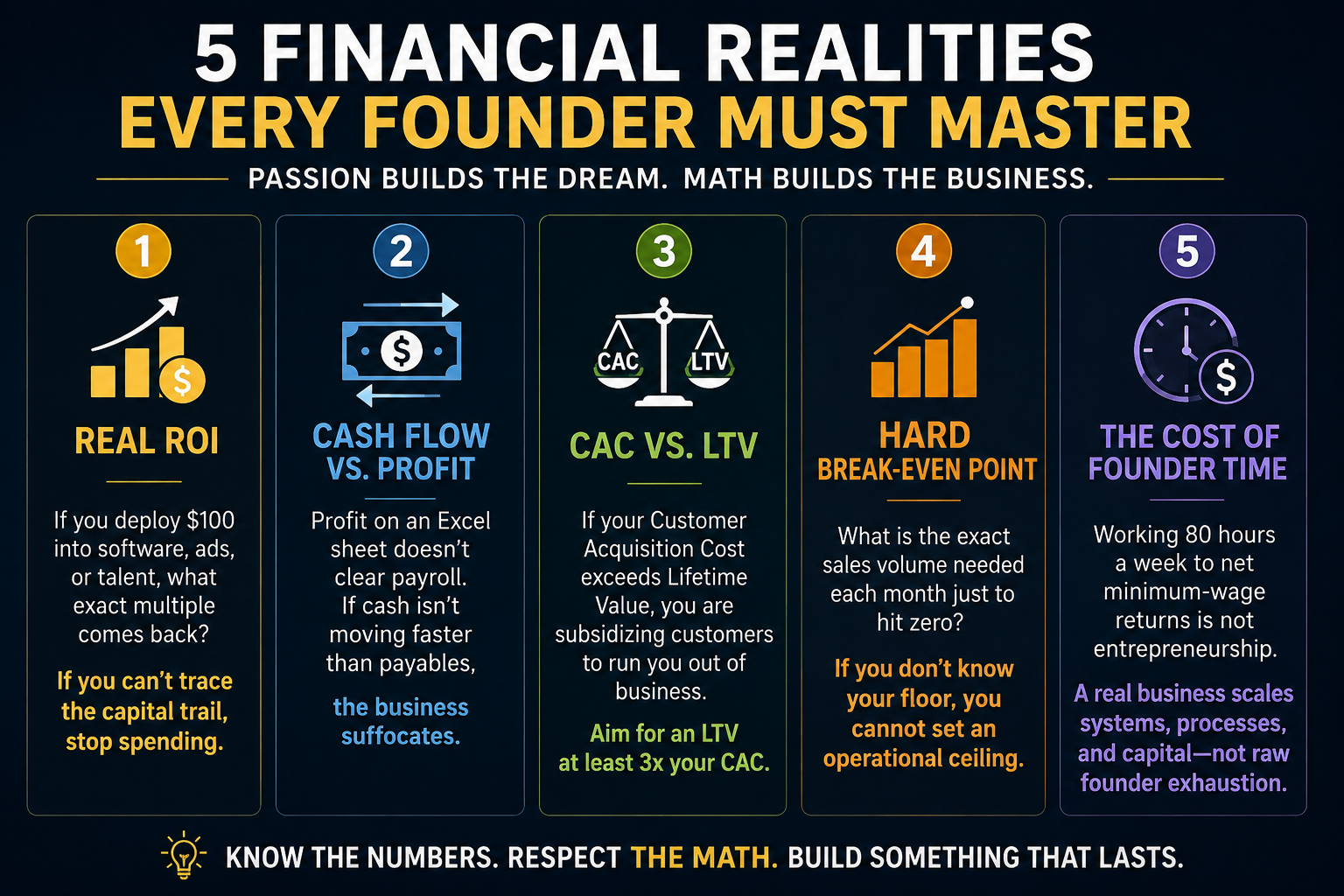
  • Passion Doesn’t Save Businesses. Math Does.

    Why founders build their own prisons, and the 5 metrics that set you free.

    A romantic myth in modern entrepreneurship is that sheer willpower can conquer any market friction. We celebrate pitch decks, launch parties, and overnight success stories.

    What nobody photographs is the quiet, exhausting middle: the founder staring at a spreadsheet at midnight, trying to understand why a company with surging sales has an empty bank account.

    Most businesses do not fail from a lack of passion. They bleed out because the founder refused to respect the arithmetic.

    In high-stakes environments—whether in field operations or executive commerce—enthusiasm is merely a prerequisite for entry. What determines survival under pressure is systemised discipline. If you cannot answer these five questions with total clarity, you are not operating a business. You are running a gamble.

    I. The Illusion of Effort vs. Return on Capital (ROI)

    Early in my career, I saw businesses deploy hard-earned capital into “brand visibility” initiatives that couldn’t be tracked, quantified, or tied back to revenue. They treated capital deployment like planting seeds in the dark, hoping something might sprout.

    When you spend capital—whether on a CRM system, an ad campaign, or a new hire—you must demand an answer: What is the exact multiple coming back through the door?

    If you invest $10,000 in a new initiative, you need to know whether it generates $30,000 in enterprise value or simply burns cash to keep people busy. If you cannot map the pipeline from expense to cash inflow, stop spending.

    II. The Difference Between Profit and Oxygen (Cash Flow)

    One of the most dangerous traps for early-stage founders is the accrual trap. You send out an invoice for $50,000, celebrate a profitable month on your dashboard, and move forward.

    Then payroll comes due on the 1st, and the client hasn’t paid.

    Profit is an accounting opinion; cash in hand is reality. If money isn’t cycling through your accounts faster than your liabilities come due, your business will suffocate. Working capital discipline means negotiating payment terms ruthlessly, collecting receivables aggressively, and ensuring your operational runway is never tied up in someone else’s bureaucracy.

    III. The Unit Economic Reality Check (CAC vs. LTV)

    A business model is fundamentally simple: buy customers for less than they are worth to you over time.

    Yet, countless startups burn through seed capital acquiring users at $100 per head, only to realise those users will only ever spend $40. They convince themselves that “scale” will miraculously fix the discrepancy. Scale doesn’t fix broken unit economics; it only accelerates the burn rate.

    If your Customer Acquisition Cost (CAC) is higher than your Lifetime Value (LTV), you are paying your customers to put you out of business. If your LTV comfortably outweighs your CAC, you have a predictable engine that can absorb market downturns.

    IV. Knowing Your Baseline Floor (Break-Even)

    Before you plan for record growth, you must know your survival floor.

    How many billable retainers, finished units, or service contracts must you clear every single month just to keep the lights on and the team paid? If you cannot calculate your hard break-even number off the top of your head, you don’t have command of your enterprise.

    Knowing your baseline removes operational panic. It tells you exactly where safety ends, and profit begins.

    V. The Founder’s Prison (The Cost of Time)

    Perhaps the most common trap is the founder who replaces a 40-hour corporate job with an 80-hour business that pays half as much.

    They take pride in the grind, handling every administrative task, client email, and operational fire drill. But trading 70 hours a week for marginal profits is not business building—it is self-inflicted servitude.

    A viable enterprise must scale systems, processes, and capital. If the entire operation halts the moment you step away for 48 hours, you have not built an asset. You have built a demanding job that you cannot quit.

    The Bottom Line

    Passion provides the spark, but numbers provide the armour.

    Before you sign the next lease, launch the next marketing blitz, or hire your next specialist, pull up your balance sheet. Look at the unit economics with complete honesty. When you respect the math, the business takes care of itself.

  • No One Is Coming — And That’s the Best News You’ll Get This Year

    No One Is Coming — And That’s the Best News You’ll Get This Year

    “Stop scanning the horizon for rescue. The cavalry is not coming.”

    I left the Indian Army with no capital, no mentor, no business plan, and no roadmap. I built a company across sixteen cities over nearly three decades. I have stood at the top with a clear view, certain I had figured it all out. And I have woken in a cold sweat, not knowing how I would pay salaries the next morning, with no investor to call and no partner to share the weight.

    Across all of it, one truth kept surfacing: no one is coming. No one is coming to rescue the business, to make the hard call, to take responsibility off your hands. The day you understand that fully is the day you actually become a founder. It sounds like a sentence. It is the opposite. It means everything that gets built from here has your signature on it.

    Here’s what I mean, in practice. Right now, you’re probably waiting — for a partner, an investor, a sign, the right moment, someone to tell you it’s safe to move. Entrepreneurship does not begin with an idea. It begins the moment there is no one left to take responsibility but you. That moment feels like abandonment. It is actually arrival.

    The investor will not save a business you haven’t proven. The mentor will not make your decision. The market does not care that you feel unready. The sooner you accept full ownership, the sooner you stop bleeding energy on hope and start spending it on work.

    Four things I’d ask you to do this week — the same four I ask every founder I coach:

    • Write down the one decision you’ve been outsourcing to “when things are clearer.” Make it this week.
    • List who you are waiting on. Beside each name, write what you would do if they never showed up — then do that.
    • Replace “What if it goes wrong?” with “If it goes wrong, what is my next move?” Plan the move, not the fear.
    • Accept the signature. Every outcome from here, good or bad, is yours. Act like an owner before you feel like one.

    Rescue is a fantasy. Ownership is the job.

    #Entrepreneurship #Leadership #SelfReliance #SmallBusiness

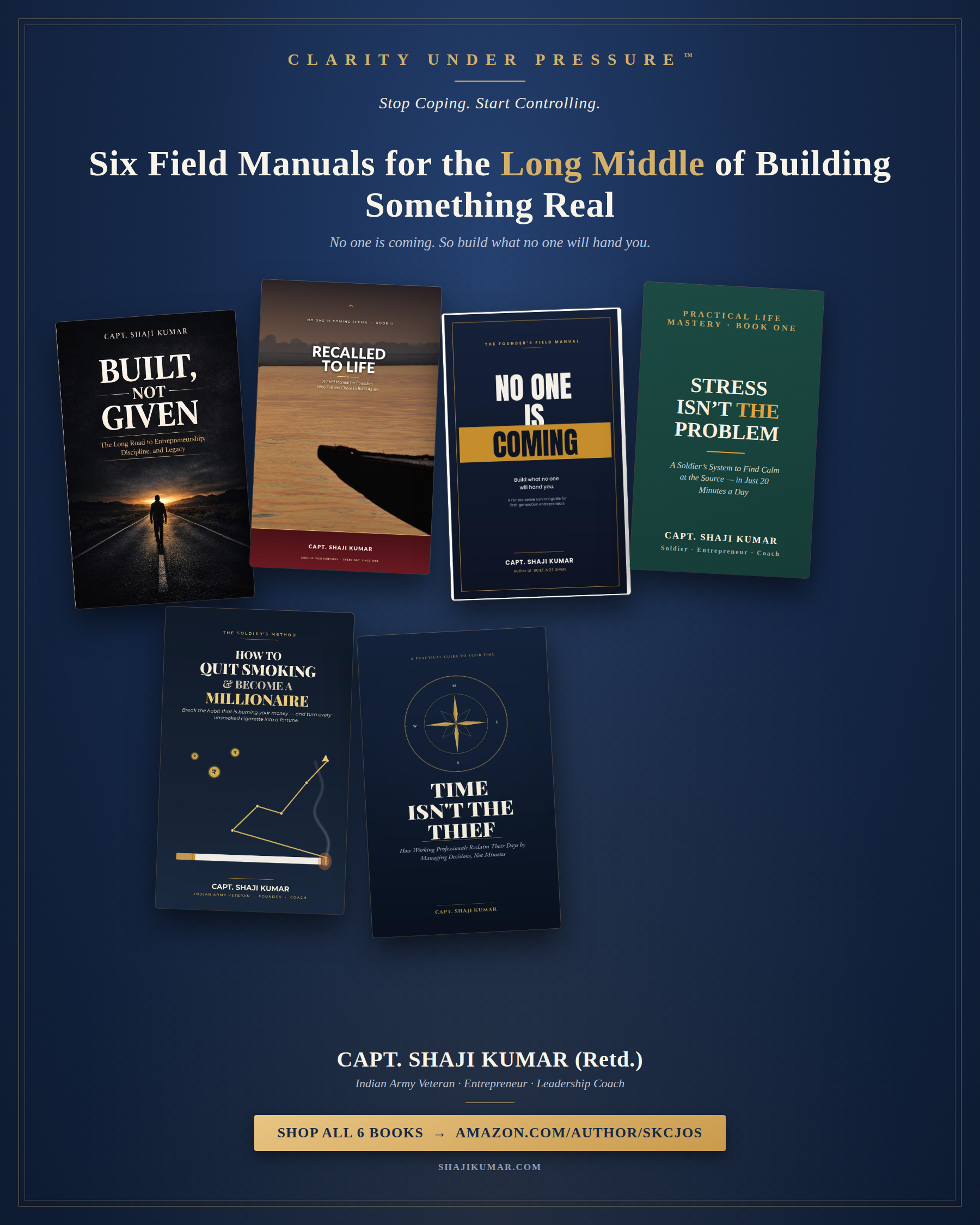
    Capt. Shaji Kumar (Retd.) is an Indian Army veteran turned entrepreneur and leadership coach. Get No One Is Coming: amazon.com/dp/B0H24F7GX7 (free on Kindle Unlimited) All books: amazon.com/author/skcjos  ·  Newsletter — Clarity Under Pressure: shajikumar.substack.com
  • When Intelligence Was Not Artificial

    When Intelligence Was Not Artificial

    Are we outsourcing the very faculty that built AI in the first place?

    There was a time, not so very long ago, when intelligence was not artificial. It was simply a human being, thinking.

    We solved problems by watching, reasoning, remembering, and imagining our way toward an answer. We argued and debated. We questioned, experimented, failed, and went back to try again. The process was slow and often maddening, but it produced something a machine still cannot hand us: judgment earned the hard way. Whether we turned out right or wrong almost didn’t matter. The understanding was ours, because the effort had been ours.

    Today we stand on a somewhat unfamiliar surrounding.

    For the first time in our history, we have built machines that can write an essay, draft a contract, compose music, generate a photograph, debug code, and hold a conversation convincing enough to forget there is no one on the other side. I belong to the cusp generation — old enough to remember the other way of doing things, young enough to use the new one every day. I can still picture myself at the office late in the evening, drafting by hand a felicitation note for the company’s anniversary, hunting for a slightly different line for each person so that no two people received the same congratulation. A single festival greeting could take the better part of a night. It seems almost quaint now. A few keystrokes and the machine offers me fifty versions before I’ve finished my tea.

    Artificial intelligence is, without exaggeration, among the finest things our species has ever made.

    And yet a question keeps returning, and I cannot quite talk myself out of it.

    What happens when we lean on artificial intelligence so completely that we stop exercising the real thing?

    In small ways, it has already begun. There was a time most of us could run a column of figures in our heads. Then the calculator arrived, and within a generation the skill quietly left us. You can still find it here and there — the older shopkeeper who glances at your basket, pauses for a beat, and tells you the exact total before you’ve reached for your phone. But he is the exception now. Take away most people’s calculator and watch them stall over a sum a schoolboy once managed standing up.

    The irony at the heart of it

    The irony is too large to step around.

    Artificial intelligence did not descend from some machine. It came out of us. Every algorithm, every neural network, every stubborn line of code began in a human mind — people who spent decades thinking hard, asking awkward questions, and sitting with problems that refused to yield. Human intelligence is the parent of artificial intelligence.

    What unsettles me is how quickly the child is being asked to replace the parent.

    The student hands the assignment to it. The professional lets it write the report. The manager asks it to summarise the meeting he didn’t fully attend. The writer asks it for the idea he used to chase down himself. And in courtrooms in more than one country, judges have begun consulting it on the very questions they were appointed to weigh. A tool meant to extend human capacity is, by degrees, becoming a substitute for human effort.

    Every convenience sends a bill

    Each leap forward arrives wrapped in convenience. The calculator spared us the arithmetic. GPS spared us the map. The search engine spared us the trouble of remembering. We made those trades and, on balance, were richer for them.

    This one is different in kind.

    The earlier tools took over tasks. This one offers to take over the thinking itself — and that is a wholly different bargain.

    A muscle left unused does not stay strong; it softens and forgets its own strength. The mind is no different. The real risk was never that the machine would out-think us. The risk is duller and closer to home: that we will simply lose the appetite to think for ourselves.

    The lost art of the struggle

    Almost everything I have learned that was worth keeping, I learned the slow way.

    A child learns by falling over. A founder learns by getting it wrong with his own money on the line — I spent the better part of three decades building a company up from almost nothing, and not one useful lesson in all that time arrived gift-wrapped. A leader learns in the cold minutes when a hard decision has only him to make it. The struggle was never the obstacle standing between us and the lesson. The struggle *was* the lesson.

    When every answer appears the instant we want it, we quietly give up the journey that turns information into understanding. Being handed an answer and arriving at one are not the same act. One leaves you with a fact. The other leaves you changed.

    What we are handing the young

    My real worry sits with the generation coming up behind us.

    Many of them are growing up in a world where the answer arrives before the question has properly formed. It began innocently enough with Google and has become Gemini, ChatGPT, and whatever you happen to subscribe to next — and the design is the same each time. The first taste is free and frictionless, generous to a fault, right up until the dependence is complete. We have a word for that pattern, and it isn’t *convenience*.

    Why spend an afternoon in the research when a summary lands in seconds? Why build an argument when one can be conjured whole? Why labour over a paragraph when the machine writes faster than you can think?

    The technology is not the villain here. The danger is the moment convenience quietly replaces curiosity. Every real advance in human history came from someone who refused the accepted answer, distrusted the obvious, and went looking for what did not yet exist. If the next generation grows up consuming intelligence rather than producing it, I wonder what becomes of invention itself.

    A bicycle, not a chauffeur

    Good tools leave you stronger for having used them.

    Someone once called the computer a bicycle for the mind, and it remains the right picture. A bicycle carries you further and faster than your legs alone ever could — but it still asks you to pedal, and you arrive fitter than you left. The danger today is that we are quietly trading the bicycle for a chauffeured car: it gets us there in comfort, asks nothing of us, and teaches us nothing about the road.

    In the Army they taught us, in a hundred uncomfortable ways, that an outfit which stops training does not stay sharp for long. Capability is not a possession you bank. It is a discipline you keep — or slowly lose.

    Where the real future lies

    None of this is an argument for switching the machine off. That would be both foolish and impossible, and I have no interest in it.

    The future will belong to people who can hold human judgment and artificial capability in the same hand. Let the machine do what it is extraordinary at — sift oceans of information, throw up a hundred possibilities in a minute, draft the rough first version. Then do what it cannot. Supply the context. Decide what any of it means. Choose, out of all those possibilities, which question was even worth asking.

    The most valuable skill of the next twenty years may not be knowing how to use artificial intelligence at all. Almost everyone will manage that. The rarer thing will be the ability to keep thinking for yourself while you use it.

    One question, before we get too comfortable

    So perhaps, in the rush to embrace something genuinely remarkable, it is worth stopping long enough to ask ourselves a single plain question.

    Are we using artificial intelligence to enlarge our intelligence — or to retire it?

    The answer will shape more than the future of work. It will shape what we remain capable of.

    Because long before intelligence was ever artificial, it was deeply, stubbornly human. And it was that intelligence — ours — that built the world we are now so tempted to hand over.