
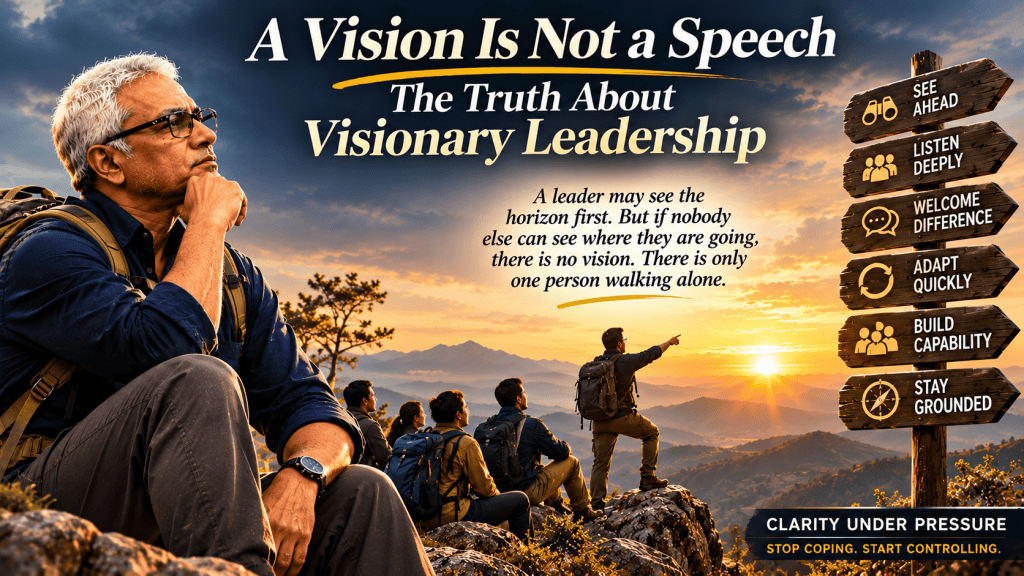
A leader may see the horizon first. But if nobody else can see where they are going, there is no vision. There is only one person walking alone.
Visionary leadership is one of the most admired ideas in business.
We celebrate leaders who see opportunities before others do. We admire founders who imagine possibilities that the market has not yet recognised. We associate vision with the ability to look beyond today’s problems and create a picture of tomorrow.
All of that matters.
But over the years, I have become uncomfortable with one aspect of how visionary leadership is often portrayed.
We have created a mythology around the individual at the top.
The leader sees.
The leader decides.
The leader announces.
Everyone else aligns.
And that, apparently, is vision.
I do not believe it is.
A vision may begin in the mind of one person. But it becomes reality through the intelligence, experience and commitment of many others.
The moment a leader believes that the vision belongs exclusively to him or her, leadership begins to turn into isolation.
Command taught me the importance of people
My earliest lessons in leadership came during my years as a commissioned officer in the Indian Army.
The military teaches structure, discipline, responsibility and command. But it also teaches a lesson that has remained with me throughout my life.
You may have the authority to make the final decision. You do not necessarily have all the information required to make the best one.
A leader may issue an order, but its successful execution depends on people.
Those people bring professional knowledge, experience and observations that may not always be visible from the top.
That distinction followed me into business.
A vision needs commitment before it needs followers
When I left the Army after five years, I walked away from a secure and respected professional path.
I entered civilian employment, but I was never completely satisfied.
Eventually, that dissatisfaction pushed me towards entrepreneurship.
In 1998, I incorporated my company.
But incorporating a company and committing to it are two very different things.
For nearly eighteen months, I continued working while trying to build the business on the side. I wanted the future, but I was reluctant to completely let go of the security of the present.
Eventually, I realised something that has stayed with me ever since.
A vision without commitment remains an idea.
In late 1999, moving into early 2000, I finally left my job and committed myself fully to the business.
That was when the real journey began.
But I was not some solitary visionary with a perfect blueprint for the future.
Far from it.
No leader builds anything significant alone
Over the years, the organisation grew across 16 cities and eventually reached a turnover of more than ₹130 crore.
From the outside, it might appear to be a story of entrepreneurial vision.
I know the reality.
No one person builds an organisation of that scale alone.
Employees brought commitment. Colleagues brought ideas. People closer to customers and operations often saw things that leadership could not.
There were mistakes.
There were unexpected opportunities.
There were decisions that worked.
And there were circumstances that forced us to change.
That experience taught me something important.
The person at the top may see the horizon. But the people closest to the ground often see the obstacles first.
A leader who ignores either perspective is leading with incomplete information.
The danger of confusing agreement with alignment
One of the most overused words in leadership is alignment.
But alignment around what, and decided by whom?
A leadership team can develop a strategy and present it to employees as a “shared vision.” But if the people responsible for implementing it have had no opportunity to question it, improve it or contribute to it, it is not truly shared.
It has simply been communicated.
That does not mean every decision should be democratic. Leadership requires decisions, and someone must ultimately accept responsibility for making them.
But wise leaders make room for disagreement.
They ask questions.
They listen to inconvenient observations.
They understand that criticism is not always resistance.
Sometimes the person challenging your vision is trying to show you something you have missed.
The danger begins when disagreement is treated as disloyalty.
Eventually, intelligent people stop telling leaders what they really think. They start telling them what they believe the leader wants to hear.
That is when a leader becomes most vulnerable.
Not when people disagree.
When nobody does.
Vision without humility becomes ego
Success can create a dangerous illusion.
When your decisions repeatedly produce good results, it becomes easy to believe that your judgement is consistently superior.
You begin trusting your instincts more than the collective intelligence around you.
That is when vision becomes ego.
Over the years, I have learnt to ask myself a few uncomfortable questions:
What am I not seeing?
Who knows more about this than I do?
What are people reluctant to tell me?
Have I become so attached to my original idea that I can no longer recognise a better one?
A leader’s responsibility is not to prove that the original vision was right.
The responsibility is to move the organisation towards the best possible future.
Sometimes that requires changing your mind.
Vision gives direction. It cannot predict everything.
Nobody can predict the future with certainty.
Leaders can study trends, recognise patterns and make informed decisions. But markets change, technology disrupts, customer behaviour shifts and unexpected events can transform the environment overnight.
I have experienced enough of business and life to know that even well-considered plans can be overtaken by circumstances.
That does not make vision less important.
It makes adaptability essential.
The strongest leaders are not those who insist on following the original map. They are those who recognise when the terrain has changed.
A vision should provide direction.
It should never become a prison.
Vision has a human cost
There is another aspect of visionary leadership that deserves greater attention.
Every vision has consequences.
Growth creates pressure.
Transformation creates uncertainty.
Expansion demands more from people.
Change can disrupt established roles and routines.
It is easy for leaders to stand on a stage and describe a glorious future.
The more difficult question is:
Who is carrying the burden of getting us there?
A leader must never treat people as instruments for achieving a vision.
If people are expected to build the future with you, they deserve honesty, respect and a meaningful role in the journey.
A leader does not simply ask people to follow a destination.
A leader accepts responsibility for how they travel towards it.
Vision must eventually become clarity
I have seen organisations with impressive vision statements that nobody can remember.
I have attended presentations filled with powerful language that left people wondering what they were supposed to do the following morning.
That is not vision.
Vision must become clarity.
Where are we going?
Why does it matter?
What are we trying to change?
What must we stop doing?
What will success look like?
And what role does each person play?
If people cannot translate a vision into meaningful action, it remains an aspiration.
The real objective is not followers. It is capability.
This, to me, is the real test of visionary leadership.
Followers wait to be told what to do.
People who believe in the purpose understand why it matters.
A leader who creates only followers must remain at the centre of everything.
A leader who develops capability creates an organisation that can think, respond and move forward even when the leader is not present.
The more important question is not:
“How many people follow me?”
It is:
“How many people can carry this forward without me?”
That is a far more meaningful measure of leadership.
My own vision has changed with every chapter
When I look back at my own professional journey, I see several distinct chapters.
The Army.
Civilian employment.
Entrepreneurship.
Building a company.
Success.
Setbacks.
Writing.
Coaching.
And now, Clarity Under Pressure and the work I am building around it.
I did not see the entire journey when I began.
When I left the Army, I did not know where every road would lead.
When I incorporated my company, I did not know how large it would eventually become.
And today, I still do not pretend to have a perfect picture of the future.
But I know the direction in which I want to travel.
I know the problems I want to help solve.
And I know that I must remain willing to learn and adapt.
That, perhaps, is what visionary leadership really means.
It is not the ability to predict the future. It is the courage to move towards a better one while remaining intelligent enough to change when reality teaches you something new.
The final test of visionary leadership
The world does not need more leaders who claim to have all the answers.
It needs leaders who can see possibilities while remaining open to perspectives they may have missed.
Leaders who provide direction without demanding blind obedience.
Leaders who welcome disagreement without losing decisiveness.
Leaders who create ambition without forgetting the people carrying it forward.
A vision may begin with one person’s imagination.
But its strength lies in the people who help make it real.
So perhaps the most important question a visionary leader can ask is not:
“Can you see what I see?”
But:
“What can you see that I cannot?”
That one question can change the quality of leadership.
Because the future is too important to be imagined by one person alone.
Acknowledgement
This article was inspired by a blog written by Raffaello Palandri, whose thoughts on visionary leadership provided the original spark for this reflection.
The perspectives and experiences shared in this article have been developed and interpreted through my own journey as an Army officer, entrepreneur, business leader and someone who has experienced both success and adversity.
I am grateful to Raffaello for the idea that prompted me to reflect on what authenticity truly means in leadership.
The Clarity Under Pressure Perspective
A leader’s vision should provide direction, not demand blind obedience.
See ahead.
Listen deeply.
Question your assumptions.
Develop people who can think independently.
And never become so attached to your vision that you stop seeing reality.

