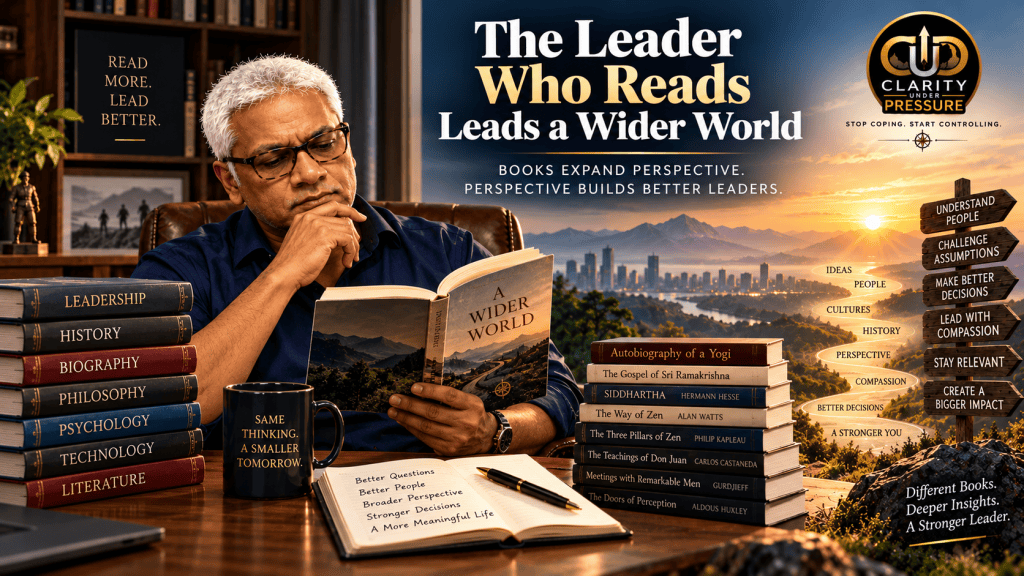
Books do more than transfer knowledge. They expand our imagination, challenge our assumptions, deepen our understanding of people and help us see the world through perspectives we may never encounter in our own lives. For a leader, reading is not a hobby. It is a professional responsibility.
There is a question I often ask myself: How can we expect to lead people if we are unwilling to understand the world they live in?
Leadership is fundamentally about people. It is about understanding motivations, managing differences, making decisions, recognising potential and navigating uncertainty. Yet many professionals spend years acquiring technical qualifications, attending management programmes and pursuing career advancement without making time for one of the most powerful instruments of personal development: reading.
I find that rather unfortunate.
A book is a remarkable thing. It allows us to travel without moving, experience lives we have never lived, visit periods of history long before we were born and understand emotions that may be completely unfamiliar to us.
For a few hundred pages, we can step outside our own identity and enter someone else’s world.
We can experience courage through the eyes of a soldier, injustice through the life of someone denied opportunity, ambition through the struggles of an entrepreneur, or loss through the reflections of someone who has endured unimaginable hardship.
We may never meet these people. We may never visit the places they describe. Yet their experiences can change the way we think, judge and respond to others.
That is the magic of reading.
And that is precisely why every leader should read.
Reading teaches us to see beyond ourselves
One of the greatest dangers in leadership is the belief that our own experience is sufficient to understand everyone else’s.
It is not.
We tend to interpret the world through the circumstances in which we were raised, the education we received, the people we encountered and the experiences that shaped our thinking.
These experiences are valuable, but they also create boundaries.
Reading helps us cross those boundaries.
A novel can take us into the life of someone from a different culture. A biography can reveal the decisions and sacrifices behind an extraordinary achievement. A work of history can explain why societies behave the way they do. A philosophical text can challenge beliefs we have accepted without ever examining them.
The more we read, the more we realise that there are many ways of looking at the same situation.
This matters enormously in leadership.
A manager dealing with an employee’s poor performance may see a lack of commitment. But what if there are circumstances the manager does not understand?
A business leader may interpret resistance to change as unwillingness. But what if the resistance comes from a legitimate concern about how the change will affect people?
An entrepreneur may judge a competitor’s decision as irrational without understanding the pressures under which that decision was made.
Reading does not automatically make us compassionate or wise. But it gives us the opportunity to develop the imagination and understanding that compassion requires.
A leader who reads learns to look beyond the immediate behaviour and consider the human story behind it.
Reading develops the most underrated leadership skill: empathy
We often discuss leadership in terms of strategy, execution, communication, decision-making and performance.
All of these matter.
But there is another quality that determines how effectively we bring people together: empathy.
Empathy is not about agreeing with everyone. Nor does it mean avoiding difficult decisions or lowering standards.
It is the ability to recognise that another person’s experience may be very different from our own.
Books provide an extraordinary opportunity to develop this ability.
When we read about people who have lived through war, poverty, discrimination, displacement, failure or personal loss, we begin to understand circumstances beyond our immediate experience.
We may not share their background, beliefs or choices. But we can begin to understand their fears, hopes, disappointments and aspirations.
For a leader, this is invaluable.
You cannot build a strong organisation by understanding only the people who think like you. You cannot inspire a team if you are unable to appreciate what matters to its members. And you cannot make responsible decisions if you see every situation exclusively from the management’s point of view.
Reading broadens the emotional vocabulary of a leader.
It reminds us that people are not merely designations, salaries, performance ratings or numbers on an organisational chart.
They are individuals with histories, responsibilities, ambitions and struggles of their own.
Books are mentors who never ask for an appointment
Throughout my professional life, I have learnt from people who have influenced the way I think and act.
Some were superiors in the Army. Some were colleagues and business associates. Others were entrepreneurs, professionals and individuals whose paths crossed mine at different stages.
But there is another category of mentors that is always available.
Books.
A good book can place decades of someone’s experience within your reach. You can learn from the successes of a business leader without working in that organisation. You can examine the failures of an entrepreneur without making the same mistakes. You can understand the thinking of a philosopher who lived centuries ago.
You can return to a book after ten years and discover something entirely different because you have changed in the meantime.
That is what makes reading so powerful.
The book remains the same, but the reader brings a different set of experiences, questions and perspectives to it.
A passage that seemed ordinary at twenty may become deeply meaningful at fifty. A lesson that appeared theoretical during one’s early career may become painfully practical after years of managing people and making difficult decisions.
Reading is therefore not simply the accumulation of information. It is a continuing conversation between the author’s experience and our own.
My journey from reading to writing
I have always believed that words have the power to influence how we think.
My academic grounding in English Literature gave me an early appreciation of language, ideas and storytelling. My years in the Indian Army taught me discipline, responsibility and the importance of understanding people under pressure. My subsequent journey in entrepreneurship exposed me to the practical realities of building organisations, managing teams and making decisions where the consequences were real.
Each chapter gave me a different lens through which to understand the world.
Over time, reading and reflection became closely connected with writing.
I have now written ten books, each allowing me to explore ideas, examine experiences and communicate lessons that I believe may be useful to others.
Writing has reinforced something I have come to value deeply: the more we read, the more carefully we think; and the more carefully we think, the better questions we begin to ask.
Reading gives us material to reflect upon. Reflection helps us develop our own understanding. Writing forces us to organise that understanding and examine whether we can communicate it clearly.
The three together create a powerful cycle of learning.
I would encourage every leader to experience this cycle, even if writing a book is not an ambition.
Maintain a journal. Record your observations. Write down lessons from difficult decisions. Reflect on conversations that changed your thinking.
Do not allow valuable experiences to disappear into the routine of everyday work.
Reading protects leaders from intellectual arrogance
There is a particular danger that comes with seniority.
The longer we occupy positions of authority, the easier it becomes to assume that we know enough.
We have managed teams. We have handled difficult situations. We have built businesses. We have attended conferences, completed programmes and accumulated qualifications.
Gradually, we may begin to believe that our experience gives us the answers to most questions.
That is when intellectual arrogance can quietly take over.
A leader who does not read risks becoming dependent on yesterday’s knowledge. The world changes, industries evolve, technology advances and human expectations shift. Yet the leader continues to interpret new situations through old assumptions.
Reading challenges this comfort.
It exposes us to arguments we may disagree with, ideas we may initially find uncomfortable and perspectives that question our established beliefs.
It teaches us that knowledge is not a destination.
The most valuable readers are not necessarily those who agree with everything they read. They are those who are prepared to examine an argument, question its assumptions, retain what is useful and reject what does not stand up to scrutiny.
A leader should not read merely to confirm existing beliefs.
A leader should read to discover what might be missing from them.
Reading is essential in an age of artificial intelligence
We are entering a period in which information is becoming increasingly accessible.
Artificial intelligence can summarise books, answer questions, analyse documents and produce material within seconds. The amount of information available to us is growing at an extraordinary pace.
But access to information and the development of understanding are not the same thing.
A summary can tell you what an author wrote. It cannot always reproduce the experience of engaging with the argument, following its development, questioning its assumptions and allowing an idea to influence your thinking.
Reading requires attention. It asks us to slow down, follow a line of thought and remain with an idea long enough to understand its implications.
In a world that increasingly rewards speed, this ability to concentrate may become one of the most valuable assets a leader possesses.
AI can help us retrieve information. But leaders must still develop the judgement to decide what matters, what is credible, what is ethical and what action should follow.
That judgement needs intellectual nourishment.
Reading provides much of it.
What should a leader read?
I am often asked whether leaders should restrict themselves to management books, business biographies and professional literature.
My answer is an emphatic no.
A leader should read widely.
Read history to understand how societies, institutions and nations evolve.
Read biographies to understand the decisions, failures and sacrifices behind individual achievements.
Read philosophy to question assumptions and examine the meaning of responsibility, justice and purpose.
Read fiction to understand human behaviour, relationships and the complexity of emotions.
Read science and technology to remain aware of the forces shaping the future.
Read economics to understand how decisions affect businesses, communities and livelihoods.
Read literature that challenges your beliefs and takes you into worlds unfamiliar to you.
And occasionally, read something that has absolutely no connection with your profession.
Some of the most valuable ideas come from unexpected places.
A leader who reads only about leadership may become very good at repeating leadership vocabulary. A leader who reads about humanity, history, science, society and the human condition has a greater opportunity to develop perspective.
The objective is not to read everything.
It is to remain intellectually curious.
Make reading a leadership discipline
Reading should not be something we do only when we have spare time.
If we wait for a free hour in an already crowded schedule, we may never find one.
Treat reading as an investment in your ability to think.
Here is a simple approach I would recommend:
1. Give reading a fixed place in your day.
Even twenty minutes of uninterrupted reading every day can build a meaningful habit over time.
2. Read beyond your professional comfort zone.
If you work in finance, read literature. If you are an entrepreneur, read history and philosophy. If you are a military professional, explore psychology, economics and technology.
3. Keep a record of important ideas.
Write down passages, questions and observations that make you stop and think. Do not collect quotations merely to share them. Reflect on what they mean.
4. Discuss what you read.
Conversations about books can reveal interpretations you may not have considered. Encourage your colleagues and team members to exchange ideas.
5. Apply what you learn.
The value of reading is not measured by the number of books on your shelf. It is measured by whether reading changes the quality of your thinking, decisions and behaviour.
And perhaps most importantly, do not turn reading into another competition. There is no prize for finishing fifty books in a year if none of them changes the way you see the world.
One book read thoughtfully can be more valuable than ten books read mechanically.
A leader’s library is a reflection of a leader’s curiosity
I have always felt that the books we keep close to us say something about the questions we are trying to answer.
Some books help us understand the world. Others help us understand ourselves. Some provide knowledge, while others provide perspective. A few may even change the direction of our lives.
We should never underestimate the influence of a book encountered at the right moment.
A young professional may discover a new direction through a biography. An entrepreneur may find the courage to persist after reading about someone else’s failure. A senior executive may reconsider an established belief after encountering a different philosophy. A person going through a difficult period may find comfort in the words of someone who has faced similar circumstances.
Books do not make decisions for us. They do something more valuable.
They expand the range of possibilities we can see before making those decisions.
For a leader, that is a tremendous advantage.
The final word: Never outgrow the habit of reading
Looking back at my own journey, I realise that every chapter has demanded a willingness to learn.
The Army gave me one foundation. Entrepreneurship required another set of capabilities. Writing and coaching have opened further avenues for learning and contribution.
And the process continues.
I do not believe that a leader should ever reach a stage where learning becomes optional. The world is too complex, people are too diverse and the consequences of leadership decisions are too significant for us to become complacent.
Reading keeps us curious. It makes us question. It introduces us to lives beyond our own. It reminds us that there is always another perspective to consider and another lesson to discover.
A leader who reads is not necessarily a better leader by default. But a leader who refuses to read, question and learn is gradually limiting the very qualities that leadership demands.
So, the next time you find yourself saying that you do not have time to read, ask yourself whether you can afford not to.
Your designation may give you authority. Your experience may give you confidence. But it is your continuing willingness to learn that will help you remain relevant.
Open a book. You may discover a new idea, a different perspective, or perhaps a part of yourself that you had not yet encountered.
And you never know. The next book you read may change the way you lead.