
Why we keep trading freedom for comfort, and what one chapter of a 145-year-old novel says about it.
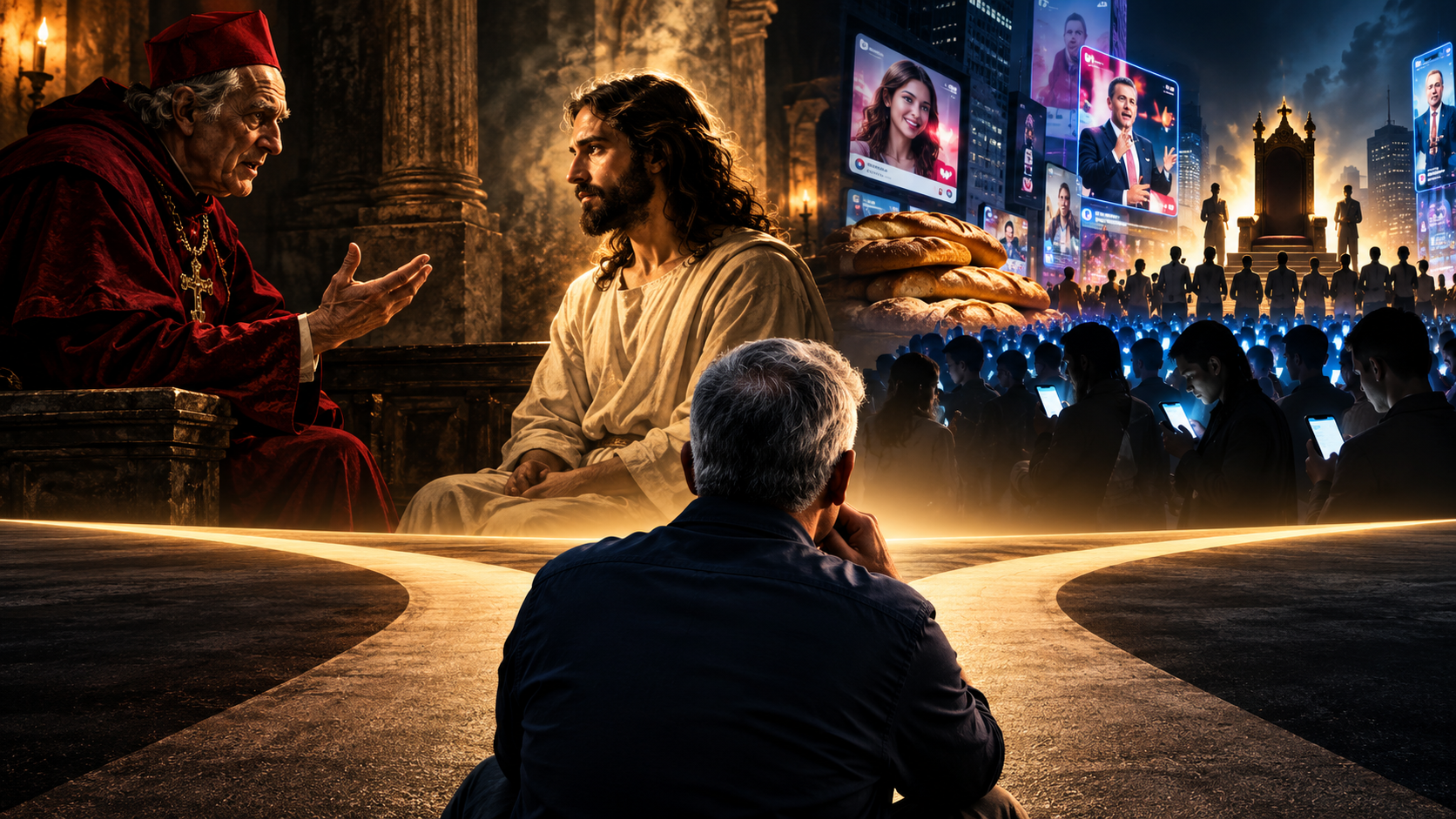
I first read The Brothers Karamazov long after I had left the Army and long after I had started building a company from nothing. I expected a great Russian novel. What I got was a mirror.
Dostoevsky finished the book in 1880. He died a few months later. He could not have known about smartphones, recommendation engines, gig platforms or the feeds we scroll before breakfast. Yet a single chapter inside it, “The Grand Inquisitor,” describes our present moment with unsettling accuracy. It is a chapter about freedom, and about how eagerly human beings hand it over.
The story in brief
The novel is a murder mystery on the surface. Fyodor Pavlovich Karamazov, a greedy, shameless father, is killed. Three legitimate sons, and one illegitimate one, are each tangled in the aftermath. Dmitri is passionate and reckless. Ivan is the intellectual, cold and tormented. Alyosha is the gentle novice who tries to love everyone. Smerdyakov, the illegitimate son and family cook, quietly carries the darkest resentment.
But the murder is only the frame. Beneath it, Dostoevsky asks questions that have not aged a day. Can a person be good without something larger than themselves to answer to? Who bears responsibility when a wrong is committed: the one who does it, the one who wished it, or the one who could have stopped it? And what do human beings really want: freedom, or relief from the burden of it?
Ivan’s poem, and the Inquisitor’s bargain
In the middle of the book, Ivan tells Alyosha a story he has composed. In sixteenth-century Seville, at the height of the Inquisition, Christ quietly returns. He is recognised at once, heals a child, and the aged Grand Inquisitor arrests him, visiting him in his cell that night.
The Inquisitor does not deny who his prisoner is. He accuses him. His charge is that Christ made a terrible mistake by refusing the three temptations in the wilderness: to turn stones into bread, to perform a spectacular miracle, and to accept power over the kingdoms of the world. Christ, he says, overestimated humanity. He offered people freedom, and freedom is unbearable. Most people, the Inquisitor argues, do not want the agony of choosing for themselves. They want bread, certainty and someone to obey. So the Church has corrected the error. It has taken the burden of conscience from people’s shoulders, and they are grateful. In return for being fed and told what to believe, they surrender their liberty willingly.
Read that again with today’s world in mind. Because I see the three temptations everywhere.
Bread: comfort in exchange for choice
The first temptation is bread. In the novel, the Inquisitor says people will lay their freedom at the feet of whoever feeds them and, in effect, ask to be made servants.
We now live in a world engineered to feed us. Free services, next-day delivery, frictionless everything. I do not say this with contempt; I have run staffing and facility management operations across sixteen cities and I know that people need security first. Nobody lectures a hungry person about liberty. But look at what we quietly accept in exchange for convenience: our attention, our data, our habits, and increasingly our judgement. When an app decides what we watch, whom we meet, what we buy and what we read, we are still fed. We are simply not choosing anymore.
The Inquisitor’s insight is that the trade rarely feels like a loss. It feels like relief.
Miracle: the attraction of spectacle
The second temptation is the miracle: astonish the crowd and they will follow without question. Our era runs on spectacle. Outrage, viral clips, confident voices promising one weird trick, one leader, one product that will fix everything. We reward the loudest and most certain, because certainty is comforting and doubt is tiring.
Dostoevsky understood that people crave mystery and authority precisely because they cannot bear uncertainty. Whoever offers a clean, confident answer, whether a demagogue, an influencer or an algorithm, will always find followers. The person who says “this is complicated, and you must think for yourself” will not trend.
Authority: the desire for one banner to gather under
The third temptation is power: unite humanity under a single authority and end the chaos. The Inquisitor argues that people restlessly search for something to worship together, and that they will fight and kill over whose object of worship is right unless someone takes charge.
We see the modern version in tribal politics, ideological echo chambers and the pressure to pick a side on every issue before we have understood it. Belonging is a real human need. But when the price of belonging is surrendering one’s own thinking, the Inquisitor has already won, and no one had to force anyone.
The other Karamazov question: “everything is permitted”
Ivan is also credited with the famous idea that if there is no God, everything is permitted. That is more of a nerve than a thesis in the book, and Dostoevsky handles it carefully. He does not simply say “believe or become a monster.” He shows Ivan wrestling, unable to accept a world in which innocent children suffer, and unable to escape the moral vertigo of what follows.
The consequence unfolds in the story with cruelty. Smerdyakov takes Ivan’s cold philosophy literally and acts on it. Ivan, who never touched a weapon, is destroyed by the realisation that ideas have owners and consequences. That is a lesson for anyone who thinks that thought is free of responsibility, including every commentator, executive and content creator today. What we argue and normalise matters. Someone, somewhere, will take us at our word.
Alyosha and the alternative to the Inquisitor
If the book ended with Ivan, it would be a work of despair. It does not. Alyosha’s answer is not an argument. It is a way of being. When Ivan finishes his poem, Alyosha does not rebut it. He walks over and kisses his brother. The gesture says more than a treatise could: love, offered freely and without conditions, is the one thing the Inquisitor’s system cannot manufacture or control.
Alyosha’s teacher, the elder Zosima, gives the novel’s moral centre. Every person, he says, is responsible for everyone and everything. It is a demanding idea. We tend to draw a tidy line around our own actions and call the rest someone else’s problem. Zosima erases the line. In a time when we are quick to blame institutions, platforms and strangers, active responsibility for the world immediately around us is a radical and useful stance.
What this means for how we lead and live
I spent five years in uniform and have spent over two decades in business. Both taught me the same thing about pressure. Under stress, the mind reaches for someone to decide for it. It is why crises produce strong-man leaders, and why exhausted teams cling to rigid rules. The Inquisitor’s offer is most seductive when we are tired, afraid and overloaded.
So here is what Dostoevsky leaves me with, as a founder, a mentor and a citizen:
- Notice what you are trading. Every convenience has a price. Ask what you are handing over, and whether you would choose to hand it over if it were asked openly.
- Protect the discomfort of choosing. Decision-making is a muscle. If we outsource all of it, whether to tools, platforms or a charismatic leader, it wastes.
- Be suspicious of total certainty. Whoever offers to remove all your doubt is usually selling something. Real clarity survives questions; false clarity forbids them.
- Own more than your share. Zosima’s radical responsibility is not guilt for its own sake. It is the recognition that culture, community and business are all built by people who decided the problem was theirs to fix.
- Choose love over argument when it counts. Not every disagreement needs winning. Sometimes the Alyosha response, presence and kindness, does what logic cannot.
The book’s uncomfortable gift
The reason The Brothers Karamazov endures is not that it gives answers. It refuses to let us hide from the questions. Dostoevsky pits the strongest possible case against faith, freedom and human goodness, then lets it stand without cheating. The reader has to do the work.
That, in the end, is the point. A society that stops doing that work, that hands its conscience to whoever feeds it best, has already accepted the Inquisitor’s bargain, and it will not feel like defeat. It will feel like comfort.
Freedom is heavy. Dostoevsky knew that. He also knew that the weight is what makes us human.
If you have read the novel, I would like to know which brother you find yourself closest to, and whether you think the Inquisitor was right. And if you have not, this is a good year to start.
Capt. Shaji Kumar is an Indian Army veteran, entrepreneur, executive coach and author of the Practical Life Mastery Series, writing on leadership, decision-making and building a life “Built, Not Given.”
If this made you think, subscribe to Clarity Under Pressure for weekly reflections on leadership, decisions and staying steady when it matters.
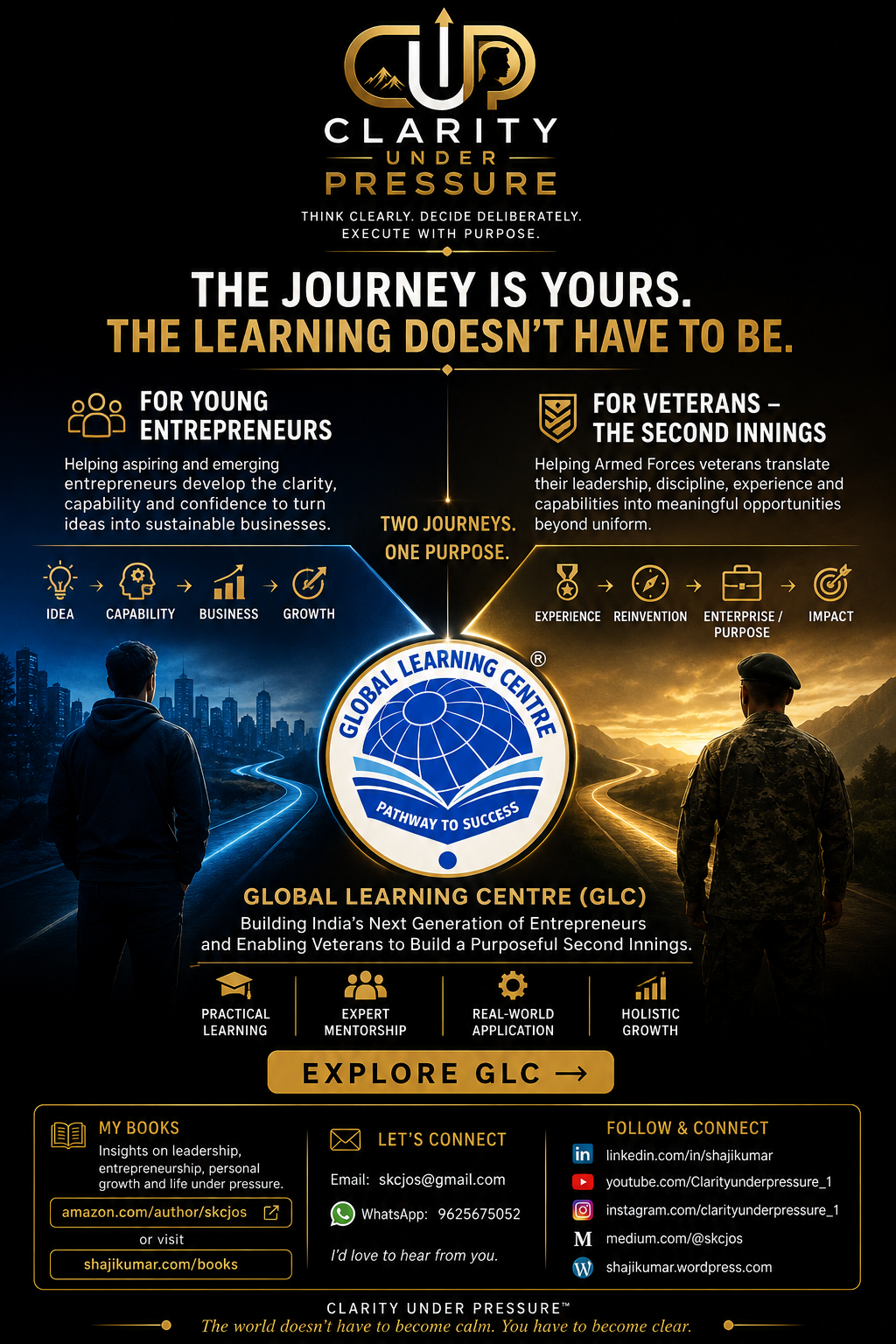
The Journey is yours. The Learning doesn’t have to be.
Global Learning Centre (GLC) is being built around two journeys:
FOR YOUNG ENTREPRENEURS
Helping aspiring and emerging entrepreneurs develop the clarity, capability and confidence to turn ideas into sustainable businesses.
FOR VETERANS — THE SECOND INNINGS
Helping Armed Forces veterans translate their leadership, discipline, experience and capabilities into meaningful opportunities beyond uniform.
The journey doesn’t end here. Let’s stay connected.
My Books | LinkedIn | YouTube | Instagram | Medium | Website

