
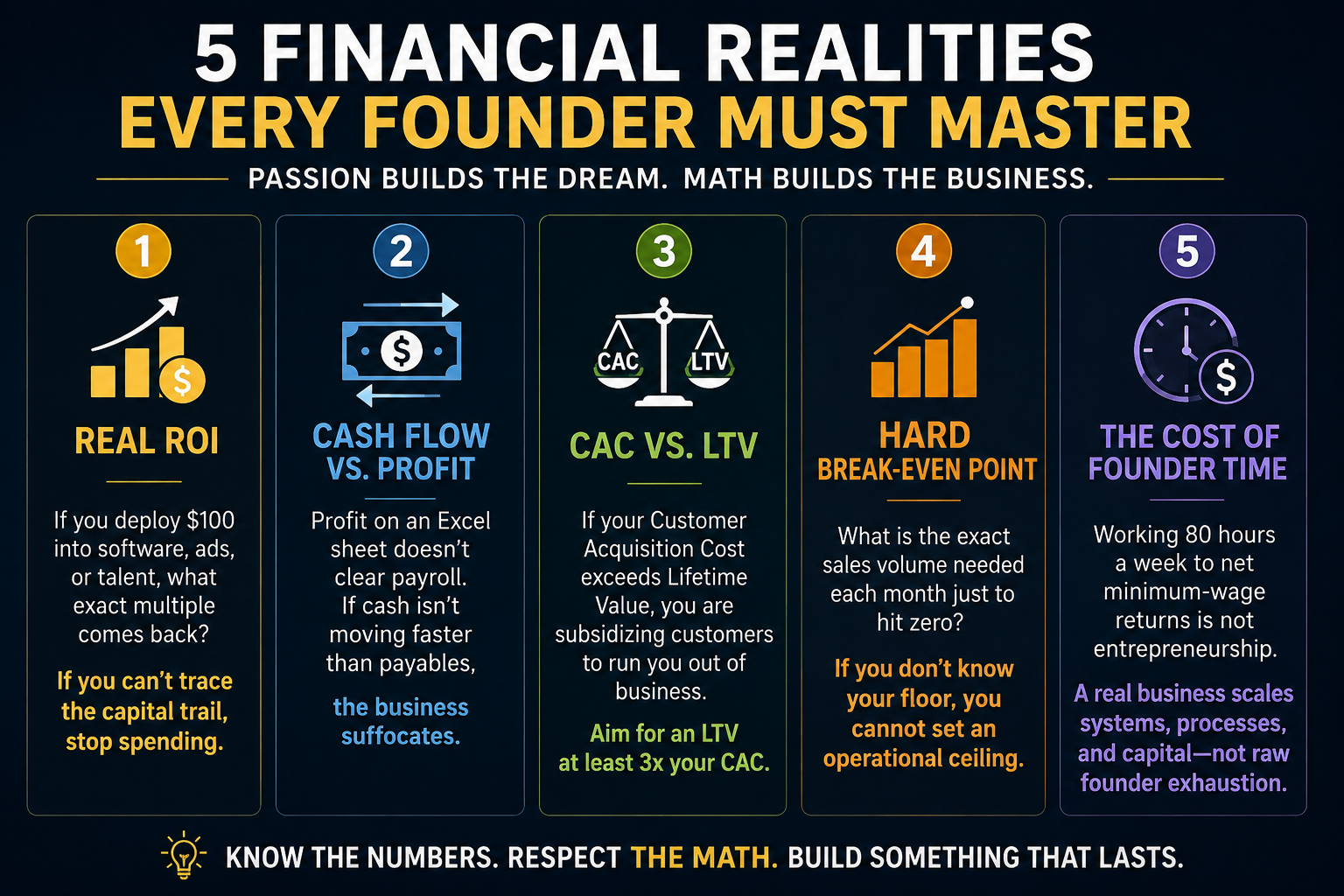
Why founders build their own prisons, and the 5 metrics that set you free.
A romantic myth in modern entrepreneurship is that sheer willpower can conquer any market friction. We celebrate pitch decks, launch parties, and overnight success stories.
What nobody photographs is the quiet, exhausting middle: the founder staring at a spreadsheet at midnight, trying to understand why a company with surging sales has an empty bank account.
Most businesses do not fail from a lack of passion. They bleed out because the founder refused to respect the arithmetic.
In high-stakes environments—whether in field operations or executive commerce—enthusiasm is merely a prerequisite for entry. What determines survival under pressure is systemised discipline. If you cannot answer these five questions with total clarity, you are not operating a business. You are running a gamble.
I. The Illusion of Effort vs. Return on Capital (ROI)
Early in my career, I saw businesses deploy hard-earned capital into “brand visibility” initiatives that couldn’t be tracked, quantified, or tied back to revenue. They treated capital deployment like planting seeds in the dark, hoping something might sprout.
When you spend capital—whether on a CRM system, an ad campaign, or a new hire—you must demand an answer: What is the exact multiple coming back through the door?
If you invest $10,000 in a new initiative, you need to know whether it generates $30,000 in enterprise value or simply burns cash to keep people busy. If you cannot map the pipeline from expense to cash inflow, stop spending.
II. The Difference Between Profit and Oxygen (Cash Flow)
One of the most dangerous traps for early-stage founders is the accrual trap. You send out an invoice for $50,000, celebrate a profitable month on your dashboard, and move forward.
Then payroll comes due on the 1st, and the client hasn’t paid.
Profit is an accounting opinion; cash in hand is reality. If money isn’t cycling through your accounts faster than your liabilities come due, your business will suffocate. Working capital discipline means negotiating payment terms ruthlessly, collecting receivables aggressively, and ensuring your operational runway is never tied up in someone else’s bureaucracy.
III. The Unit Economic Reality Check (CAC vs. LTV)
A business model is fundamentally simple: buy customers for less than they are worth to you over time.
Yet, countless startups burn through seed capital acquiring users at $100 per head, only to realise those users will only ever spend $40. They convince themselves that “scale” will miraculously fix the discrepancy. Scale doesn’t fix broken unit economics; it only accelerates the burn rate.
If your Customer Acquisition Cost (CAC) is higher than your Lifetime Value (LTV), you are paying your customers to put you out of business. If your LTV comfortably outweighs your CAC, you have a predictable engine that can absorb market downturns.
IV. Knowing Your Baseline Floor (Break-Even)
Before you plan for record growth, you must know your survival floor.
How many billable retainers, finished units, or service contracts must you clear every single month just to keep the lights on and the team paid? If you cannot calculate your hard break-even number off the top of your head, you don’t have command of your enterprise.
Knowing your baseline removes operational panic. It tells you exactly where safety ends, and profit begins.
V. The Founder’s Prison (The Cost of Time)
Perhaps the most common trap is the founder who replaces a 40-hour corporate job with an 80-hour business that pays half as much.
They take pride in the grind, handling every administrative task, client email, and operational fire drill. But trading 70 hours a week for marginal profits is not business building—it is self-inflicted servitude.
A viable enterprise must scale systems, processes, and capital. If the entire operation halts the moment you step away for 48 hours, you have not built an asset. You have built a demanding job that you cannot quit.
The Bottom Line
Passion provides the spark, but numbers provide the armour.
Before you sign the next lease, launch the next marketing blitz, or hire your next specialist, pull up your balance sheet. Look at the unit economics with complete honesty. When you respect the math, the business takes care of itself.

