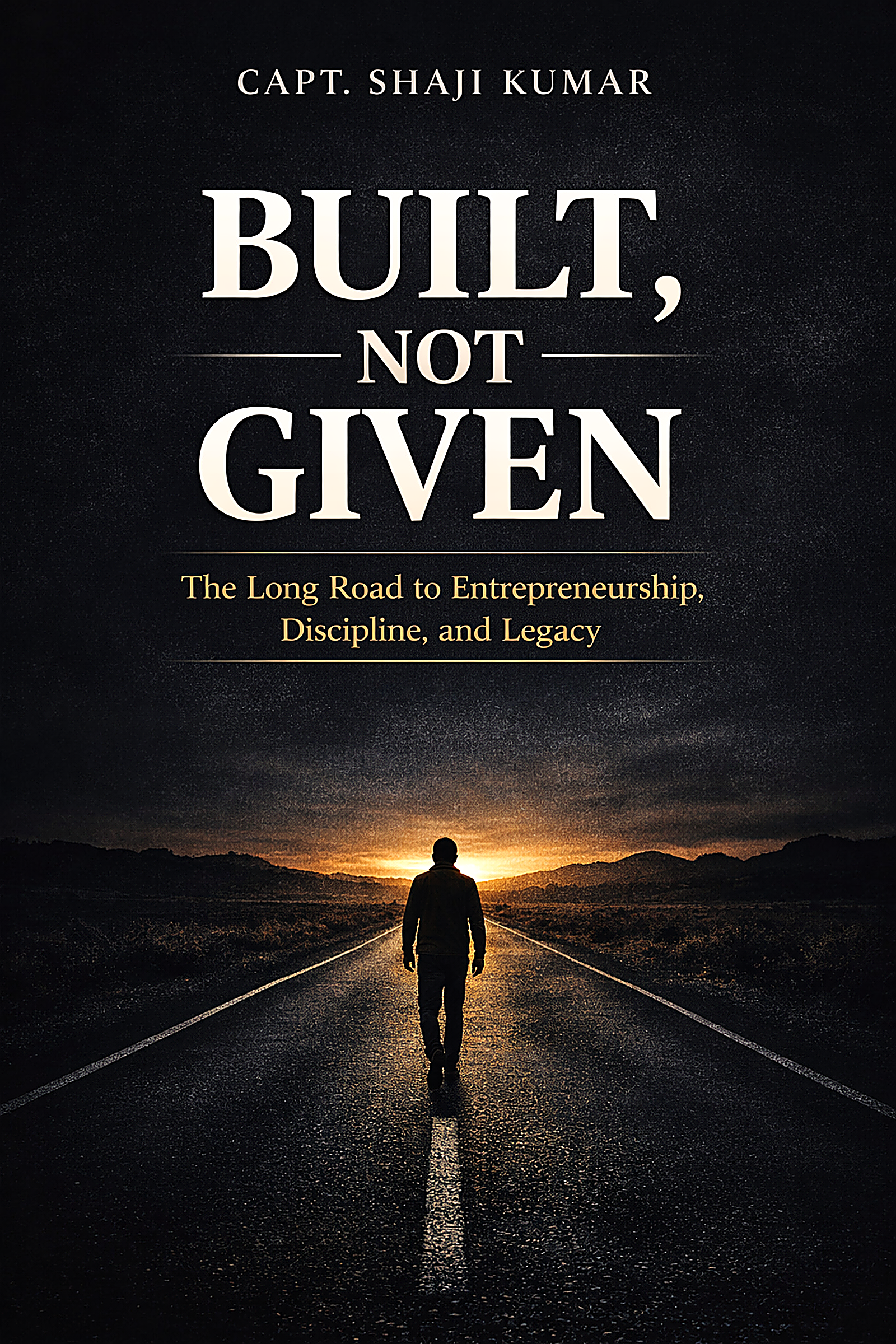
Most business books are written from the summit. This one is written from the climb.
In 2008, Capt. Shaji Kumar didn’t know how he’d pay his team’s salaries the next morning. No investor to call. No partner to lean on. Just him, and the consequences of every decision he’d already made — a pattern set years earlier, the day he left the Army’s structure for the total uncertainty of building something of his own.
Built, Not Given is that story: nearly three decades of building service enterprises from scratch, told with the same discipline that carried him through it. Not the highlight reel— the actual middle, where ventures are won by persistence, not brilliance, and by belief, not opportunity.
Who this is for:
First-generation founders in the grind, not the highlight reel
Veterans weighing the leap into business
MSME owners somewhere between “started” and “made it”
What’s included: The full ebook (EPUB + Kindle-compatible file)
Bonus: a short field-notes chapter not in the print edition
Bottom-of-page line: Success is not given. It is built. Get your copy today.
Where to get it
Built, Not Given is published wide — deliberately, so you can read it however suits you best, on whatever platform you already trust:
IngramSpark: distributed to bookstores and libraries worldwide — ask your local bookstore or library to order it in if you’d rather hold a copy from your own shelf network
Pick whichever is easiest for you. They all lead to the same book.
Beyond the book
Built, Not Given sits alongside my other books and the work I do now coaching founders through their own version of this middle, under the Clarity Under Pressure™ banner. If you want to see the rest — other titles, writing, or how to work with me directly — everything’s at www.shajikumar.com.
Every book about entrepreneurship talks about sacrifice in the abstract. Few are willing to describe it in the specific, quiet, domestic detail that Capt. Shaji Kumar does in Built Not Given. Chapter 3 opens not with a strategy lesson but with a Diwali week in October 2003 — the one week all of India empties out — when he found himself alone in his office on a Saturday evening, his entire recruitment team gone home for the holiday, with client requirements due Monday morning that couldn’t wait.
That kind of moment, repeated in a hundred variations over decades, is what this chapter is actually about.
"Your business slowly stops being merely a source of income. It becomes your mission, your burden, your hope, your identity. It becomes the first thing you think about in the morning and the last thing that keeps you awake at night. It becomes your baby."
The most affecting part of the chapter isn’t about the business at all — it’s about what building it cost at home.
"There was a phase in my life when I was so consumed by work that by the time I returned home most nights, my children who were quite young, would either be getting ready for bed or already asleep. That became normal."
And then, the moments he says he’ll never forget:
"On those nights, my children would stay awake a little longer so they could sit with me while I had dinner with them... They would sit close to me, sleepy but content simply to be there, and sometimes they would ask me to feed them with my own hands. Even now, that memory stays with me."
He doesn’t dress this up as a win. He’s honest about the trade he was making in real time:
“The truth is, I was trying to build a future for my family, but in the process, I was sometimes absent from the very present I was trying to protect. That is a difficult truth to admit. But it is the truth.“
This is a book willing to sit in that discomfort rather than resolve it too quickly — which is part of why the chapter feels earned rather than performative.
There’s also a sharper, more practical thread running through it: what actually holds a business together when things get hard. Not brilliance. Not marketing.
“If there is one thing that has carried my business through both good times and bad, it is not brilliance. It is not marketing. It is not strategy alone. It is integrity... Your customers should never stop believing in your venture. The day that belief weakens, your business begins to lose its backbone.“
He traces that integrity through a genuinely frightening stretch in 2008, when the global recession froze hiring almost overnight and he was left staring down a question every business owner eventually faces:
“How am I going to pay salaries and manage expenses next month? There is a particular kind of fear that comes with being responsible not just for your own survival, but for the livelihoods of others.“
And on the particular loneliness of the role — the fact that the person everyone leans on doesn’t get to lean on anyone:
“Your employees look to you for stability. Your clients look to you for confidence. Your family looks to you for reassurance... But who carries the entrepreneur? That is a question not enough people ask.“
The chapter doesn’t end on regret. It ends on something closer to hard-won clarity:
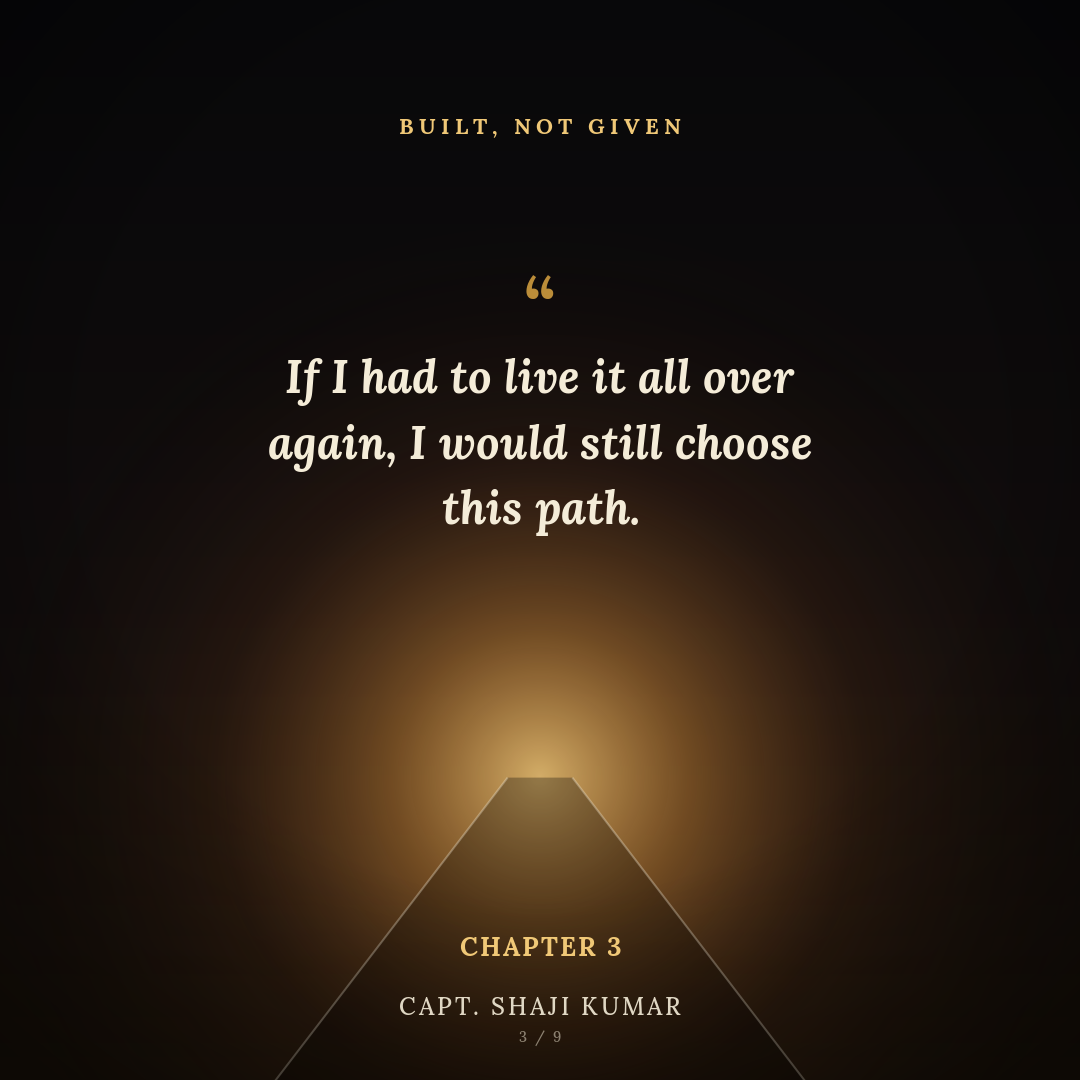
“If I had to live it all over again—the missed dinners, the sleepless nights, the humiliations, the setbacks, the fear, the uncertainty—I would still choose this path. Not because it was easy. But because it made me earn every inch of who I became.“
This is the third in a series of posts drawing from Built Not Given by Capt. Shaji Kumar. The full chapter also covers why he says “never be ashamed of what you built with your own hands” — worth reading if you’ve ever felt embarrassed by how modest your beginning looks.
Where to get it
Built, Not Given is published wide — deliberately, so you can read it however suits you best, on whatever platform you already trust:
IngramSpark: distributed to bookstores and libraries worldwide — ask your local bookstore or library to order it in if you’d rather hold a copy from your own shelf network
Pick whichever is easiest for you. They all lead to the same book.
Beyond the book
Built, Not Given sits alongside my other books and the work I do now coaching founders through their own version of this middle, under the Clarity Under Pressure™ banner. If you want to see the rest — other titles, writing, or how to work with me directly — everything’s at www.shajikumar.com.
If you read it, I’d genuinely like to know what landed. Reply, comment, or leave a review wherever you bought it — for a book this new, that’s the thing that helps it find the next reader who needs it.
There’s an old story about Birbal, the wisest man in Emperor Akbar’s court, that Capt. Shaji Kumar returns to in Built Not Given — and it’s become one of the most useful ideas in the whole book for anyone stuck in the “long middle” of building something.
A man is challenged to stand all night in freezing water. He survives by fixing his eyes on a candle burning far in the distance. When he claims his reward, he’s told he cheated — he “drew warmth” from the flame, so the challenge doesn’t count. Birbal, hearing the absurdity of this, makes his point by trying to cook dinner over a candle held far away. Obviously, it doesn’t cook anything.
"What mattered in that story was not the physical warmth of the candle. It was the psychological warmth of hope. The candle had not heated the man's body. It had sustained his mind. And that is what distant goals often do in life. They do not immediately change your circumstances. But they help you endure them."
Kumar started his business in 1998 — before India had a “startup ecosystem,” before accelerators or angel networks or the reassuring TED-talk narrative that failure is just a step toward success. There was no community of founders telling him the hard years were normal.
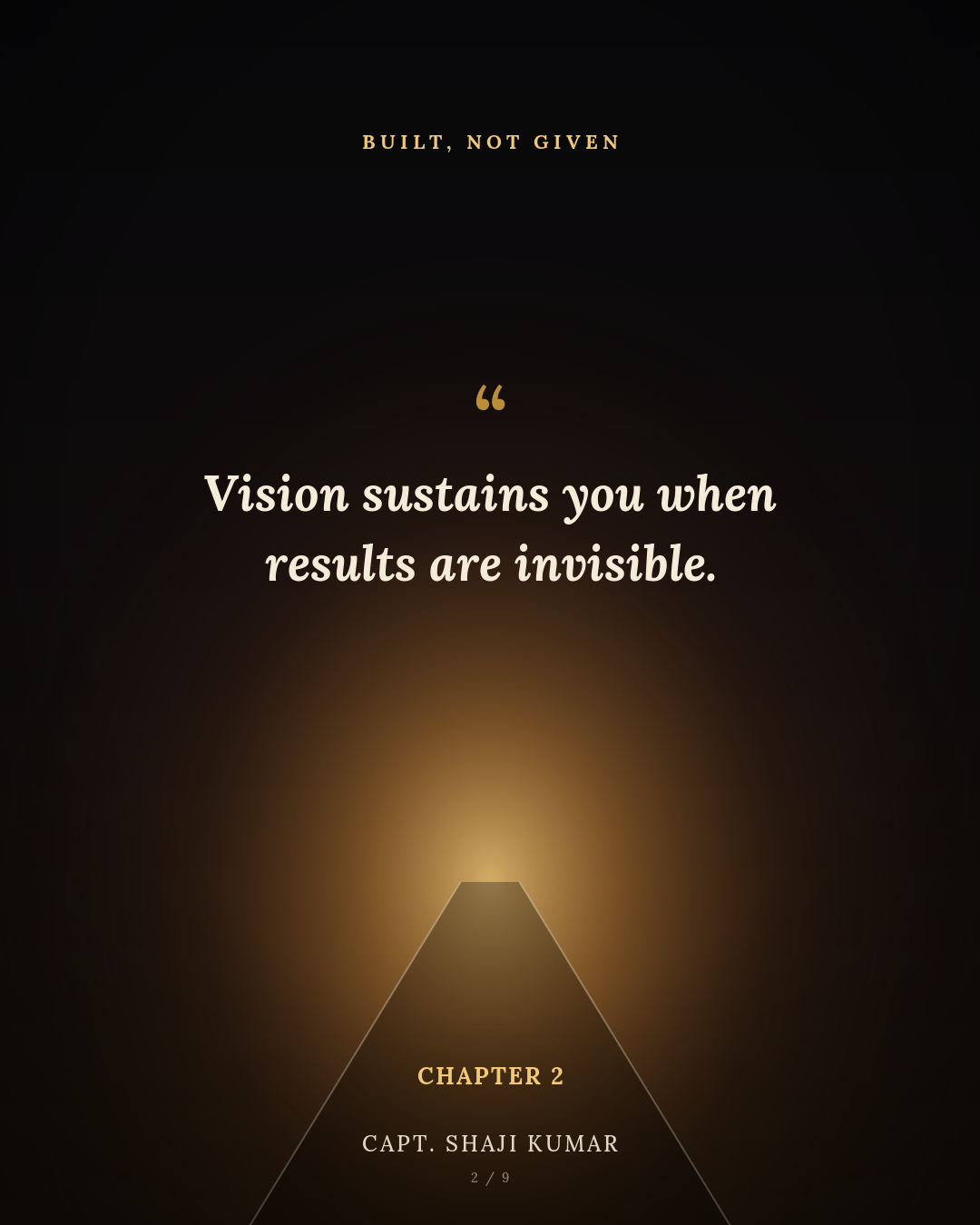
"There was only the work, the market, and the long, largely silent middle — the years between the beginning and any visible result."
This is the part of entrepreneurship (or any long, worthwhile undertaking) that doesn’t get talked about enough: the stretch where the goal is real to you but invisible to everyone else, including your bank balance. Kumar’s point is that this isn’t a design flaw — it’s the actual shape of the thing.
"For years, your dream may appear too far away to be useful in any practical sense. It may not pay your bills immediately. It may not impress people. It may not even reassure your own family. But if it remains alive in your mind—steady, visible, and meaningful—it can do something even more important: it can keep you going."
He’s especially sharp on the modern trap of expecting speed:
"We live in an age that celebrates speed, fast growth, fast funding, fast fame, faster exits and fast money which in many cases does disappear just as fast. And because of that, many people now enter entrepreneurship carrying a dangerously distorted expectation: that business is merely a shortcut to wealth. That illusion has ruined more dreams than failure itself."
His answer isn’t grit-as-a-slogan — it’s something more specific: start small, but start with a why strong enough to survive contact with difficulty.
"If your 'why' is weak, your perseverance will collapse the moment life becomes difficult. And life will become difficult. That is not pessimism. That is simply the reality of enterprise."
And on the inevitability of mistakes along the way:
"The only real danger is not in making mistakes. It is in allowing mistakes to weaken your resolve. Because if approached correctly, every mistake can become fuel."
The chapter closes on what might be the book’s clearest thesis statement:
"Do not allow the distance of the light to discourage you... Hope with direction. And that is far more powerful than optimism without substance. Because entrepreneurship is not won in one brilliant moment. It is won: in the long middle. In the waiting. In the uncertainty. In the years when nothing looks spectacular but everything important is quietly being built."
If you’re in your own long middle right now — whatever you’re building — this is worth returning to. The candle doesn’t have to warm you today. It just has to still be burning.
This is the second in a series of posts drawing from Built Not Given by Capt. Shaji Kumar. Grab a copy to read the rest of the chapter — including how to handle the crisis that inevitably arrives once the light finally gets closer.
Where to get it
Built, Not Given is published wide — deliberately, so you can read it however suits you best, on whatever platform you already trust:
IngramSpark: distributed to bookstores and libraries worldwide — ask your local bookstore or library to order it in if you’d rather hold a copy from your own shelf network
Pick whichever is easiest for you. They all lead to the same book.
Beyond the book
Built, Not Given sits alongside my other books and the work I do now coaching founders through their own version of this middle, under the Clarity Under Pressure™ banner. If you want to see the rest — other titles, writing, or how to work with me directly — everything’s at www.shajikumar.com.
If you read it, I’d genuinely like to know what landed. Reply, comment, or leave a review wherever you bought it — for a book this new, that’s the thing that helps it find the next reader who needs it.