
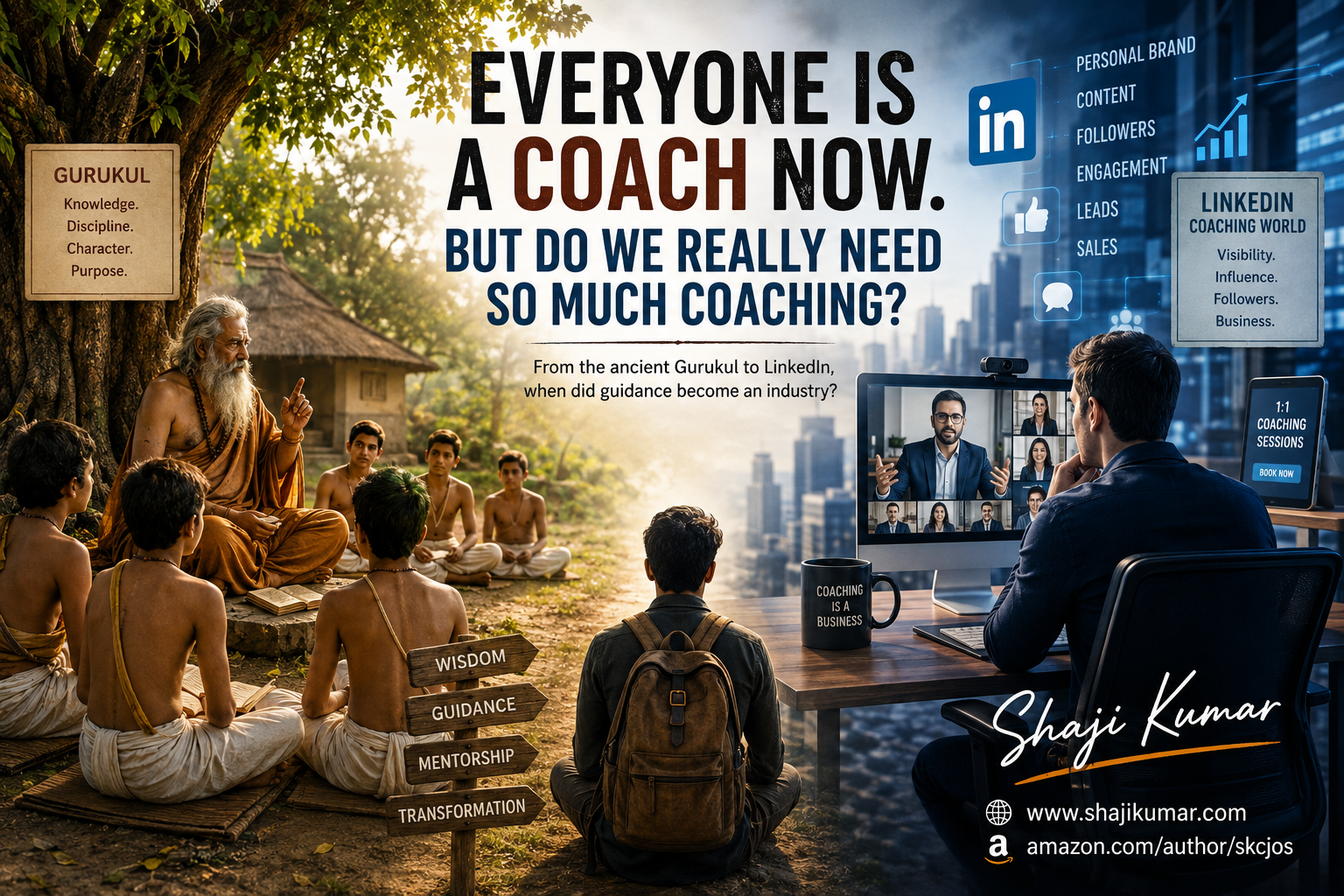
Open LinkedIn on any given morning and you will quickly notice something interesting.
Someone wants to coach you to become a better leader.
Someone else wants to help you discover your purpose.
Another promises to unlock your hidden potential.
There are career coaches, executive coaches, life coaches, leadership coaches, mindset coaches, business coaches, wellness coaches, relationship coaches and performance coaches.
Sometimes I wonder whether we will soon need a coach to help us choose the right coach.
Before anyone misunderstands me, let me make one thing clear.
I am not against coaching.
In fact, having spent over three decades in Human Resources and leadership roles, I have seen first-hand how good coaching can transform people. I have watched capable leaders become more self-aware. I have seen individuals discover strengths they had underestimated. I have seen people change the way they lead because someone asked them the right questions at the right time.
Good coaching can be enormously valuable.
But the extraordinary growth of coaching has made me think.
When did we begin to need so many coaches?
And more importantly, what does our growing dependence on coaching say about the world we live in?
To find an answer, I found myself looking backwards rather than forwards.
Back to an idea that has been part of Indian civilisation for centuries.
The Gurukul.
When Learning Was About More Than Education
The Gurukul system was built around a relationship that went far beyond formal education.
Children and young people would live and learn under the guidance of a Guru. But the Guru was not merely a teacher standing in front of a classroom delivering information.
The relationship was more immersive.
The Guru observed the student.
He understood the student’s strengths and weaknesses.
He corrected behaviour.
He encouraged discipline.
He imparted knowledge.
He questioned thinking.
He developed character.
And, perhaps most importantly, he prepared the individual for life.
Learning was not confined to a timetable.
Life itself was part of the curriculum.
Students learned through observation, participation, responsibility and experience.
The relationship between the Guru and the Shishya was deeply personal. A good Guru did not necessarily treat every student in exactly the same way. Guidance was often shaped by the needs and capabilities of the individual.
When I look at this through a modern lens, I cannot help asking an interesting question.
Was this not, in many ways, coaching?
Perhaps mentoring too.
Perhaps teaching.
Perhaps parenting.
Perhaps something that combined all of these.
The difference was that it was not packaged as a professional service.
Nobody needed a website.
Nobody displayed testimonials.
Nobody built a personal brand around the number of lives they had transformed.
Guidance was simply an accepted and natural part of human development.
Somewhere along the way, we began separating all of these roles.
Teachers teach.
Mentors mentor.
Consultants advise.
Therapists provide psychological support.
Coaches coach.
Influencers inspire.
And increasingly, social media tells us who is qualified to do each of these things.
There is nothing inherently wrong with professionalising expertise. In many cases, professional standards are necessary and valuable.
But I sometimes wonder whether we have fragmented something that was once naturally embedded in human relationships.
Looking Back at My Own Career
When I look back over my own professional journey, I can identify several people who had a profound influence on me.
Some were bosses.
Some were senior leaders.
Some were colleagues.
Some were friends.
A few may have been mentors without either of us ever formally using that word.
They did not necessarily sit across from me and announce that the next sixty minutes would be a coaching session.
There was no structured contract.
No coaching objective written down.
No formal feedback report at the end of the conversation.
But they influenced me.
Some challenged me when I was wrong.
Some trusted me before I had fully earned that trust.
Some gave me opportunities that stretched me.
Some told me things I did not particularly want to hear.
And some simply listened when I needed perspective.
Looking back, I realise that many of the most important lessons of my career came through conversations.
Not training programmes.
Not presentations.
Not competency frameworks.
Conversations.
A senior leader who takes the time to explain why something matters can influence a young professional for years.
A manager who believes in an employee at the right moment can change the direction of a career.
A colleague who tells you an uncomfortable truth can sometimes do more for your development than an expensive course.
None of these people called themselves coaches.
But they were, in their own way, guides.
And that made me wonder whether the growth of the coaching industry is really only about coaching.
Perhaps it is about something deeper.
Perhaps it reflects what we are missing.
The Modern World Has Created a Vacuum
Why are so many people seeking coaches today?
The easy answer is that modern life has become more complicated.
Careers are no longer linear.
Jobs disappear.
Industries change.
Technology evolves faster than many of us can adapt.
The definition of success has become increasingly personal and confusing.
People are constantly told to find their purpose, build their personal brand, discover their passion, achieve financial independence and become the best version of themselves.
That is a lot of pressure.
At the same time, many of the traditional sources of guidance have weakened.
Families are often geographically dispersed.
Communities are less connected.
Workplaces have become increasingly transactional.
Managers are under pressure to deliver targets and manage teams with fewer resources.
Senior leaders often have little time for meaningful developmental conversations.
People may be surrounded by hundreds of digital connections and yet have very few people with whom they can have an honest conversation.
Perhaps this explains part of the coaching boom.
Maybe people are not simply buying coaching.
Maybe they are buying something much more basic.
Attention.
Time.
Listening.
Perspective.
Encouragement.
Accountability.
A safe space to think aloud.
If you look at it that way, the growth of coaching begins to make more sense.
The question then changes.
Instead of asking why there are so many coaches, perhaps we should ask why so many people feel they need one.
The Difference Between Guidance and Dependency
This is where I believe an important distinction needs to be made.
There is a significant difference between helping someone grow and making them dependent on your guidance.
The best teachers eventually want their students to think for themselves.
The best parents want their children to become independent.
The best leaders want their teams to become capable of making decisions without constantly seeking approval.
And I believe the same should be true of coaching.
A good coach should help you see more clearly.
Not see for you.
A good coach should ask better questions.
Not provide every answer.
A good coach should challenge your assumptions.
Not replace your judgement with theirs.
A good coach should build your confidence.
Not make you believe that you cannot progress without another session.
To me, the ultimate measure of successful coaching is not how long a client remains dependent on a coach.
It is how confidently that person eventually walks without one.
This is where the ancient relationship between Guru and Shishya becomes particularly interesting.
The purpose of education was not to create a lifelong follower incapable of independent thought.
The purpose was to prepare the individual for life.
To develop capability.
Character.
Judgement.
And independence.
The student eventually left.
That, in many ways, was the success of the relationship.
Perhaps modern coaching should remember that principle.
Have We Commercialised Human Guidance?
This question may make some people uncomfortable.
Have we turned something fundamentally human into an industry?
There is nothing wrong with professionals being paid for their expertise. Doctors, lawyers, teachers, consultants and coaches invest time in developing knowledge and skills.
Professional coaching, when practised ethically and competently, requires considerable expertise.
But the rapid growth of the industry has also created a crowded marketplace.
Anyone who spends time on social media will have noticed the increasing number of people presenting themselves as coaches.
The barriers to entering the profession can sometimes appear unclear to an outsider.
Credentials vary.
Experience varies.
Methodologies vary.
And the promises can occasionally be extraordinary.
“Transform your life.”
“Unlock your potential.”
“Find your purpose.”
“Become unstoppable.”
“Achieve the life you deserve.”
These are powerful promises.
Perhaps too powerful.
Because real human development is rarely that simple.
People are complicated.
Careers are complicated.
Relationships are complicated.
Life is complicated.
No coach, mentor, leader or guru has all the answers.
And perhaps that is something both coaches and clients need to remember.
Guidance should create greater clarity.
It should not sell certainty where certainty does not exist.
What Organisations Need to Learn
Having spent much of my career in HR, I also believe organisations need to examine their own role in the growing demand for coaching.
Over the years, organisations have invested heavily in leadership development.
They have introduced competency frameworks, assessment centres, executive education programmes and coaching interventions.
Many of these initiatives are valuable.
But I sometimes wonder whether organisations have forgotten one of the most important development tools available to them.
The manager.
A good manager can be one of the most influential people in an employee’s professional life.
A manager sees the individual in action.
They understand the context.
They witness strengths and weaknesses.
They have opportunities to provide feedback in real time.
They can stretch people.
Trust them.
Correct them.
Challenge them.
And help them grow.
Yet many managers are never properly trained to develop people.
They are trained to manage performance.
Meet targets.
Control costs.
Complete appraisals.
Deliver results.
Development becomes an HR initiative rather than a leadership responsibility.
Then, when people need guidance, organisations hire external coaches.
Again, there is nothing wrong with that.
External coaches can bring objectivity and expertise that internal managers cannot.
But perhaps organisations need to ask themselves a difficult question.
Are we investing in coaching because our managers have become too busy to guide their own people?
Could some of the demand for coaching be reduced if organisations created cultures where managers genuinely took responsibility for developing those who worked with them?
Perhaps we need fewer inspirational leadership slogans and more meaningful conversations.
Fewer development frameworks and more managers who actually care about the development of their people.
Fewer formal mentoring programmes and more senior leaders willing to make time for younger professionals.
The answer is not to eliminate coaching.
The answer is to recognise that development cannot be outsourced entirely.
We Have Always Needed Guides
Despite all these questions, I remain convinced of one thing.
Human beings have always needed guides.
We learn from other people.
We observe.
We imitate.
We question.
We receive feedback.
We make mistakes.
And occasionally, someone wiser or more experienced helps us see something we could not see ourselves.
That person may be a Guru.
A teacher.
A parent.
A manager.
A mentor.
A friend.
Or a professional coach.
The labels may have changed.
The fundamental human need has not.
Perhaps that is why coaching has become so important in modern life.
We live in an age overflowing with information but often lacking wisdom.
We have unlimited access to advice but limited access to genuine guidance.
We can follow thousands of experts online while still feeling unsure about our own decisions.
In such a world, a good coach can provide something technology cannot easily replace.
Human attention.
Thoughtful questions.
Perspective.
And the space to think.
That is valuable.
Very valuable.
But there is a line we should be careful not to cross.
Guidance should empower.
Not control.
Coaching should encourage independent thinking.
Not dependency.
A mentor should help you find your path.
Not insist that you follow theirs.
And perhaps the greatest guide is not the person who gives you the most answers.
It is the person who eventually teaches you how to find your own.
So, Have We Turned Guidance Into an Industry?
Perhaps we have.
But I am not sure that is necessarily the problem.
The more interesting question may be why the industry has grown so rapidly.
Maybe modern life has created a shortage of the things human beings have always needed.
Someone to listen.
Someone to challenge.
Someone to encourage.
Someone to tell us the truth.
Someone to help us make sense of our experiences.
In the Gurukul, guidance was embedded in the relationship between the Guru and the student.
In our professional lives, it may come from a manager, mentor or coach.
The format has changed.
The need remains.
My concern is not that coaching exists.
My concern is what happens if we begin believing that every important decision requires external validation.
At some point, the purpose of guidance must be to help us trust ourselves.
The Guru eventually lets the student leave.
The teacher hopes the student will think independently.
The parent hopes the child will stand on their own feet.
The leader hopes the team will eventually perform without constant supervision.
And perhaps the best coach should hope for exactly the same thing.
To become less necessary.
Not more.
That, to me, is the real test of guidance.
It should not create followers.
It should create people capable of walking their own path.
And perhaps that is the lesson we can still learn from an ancient idea like the Gurukul.
What do you think?
Has coaching become an essential part of modern life?
Or have we created an industry around something that was once a natural responsibility of teachers, parents, leaders and communities?
I would genuinely like to hear from coaches, leaders, HR professionals and anyone whose life has been changed by a mentor or coach.
HAPPY TEACHERS DAY

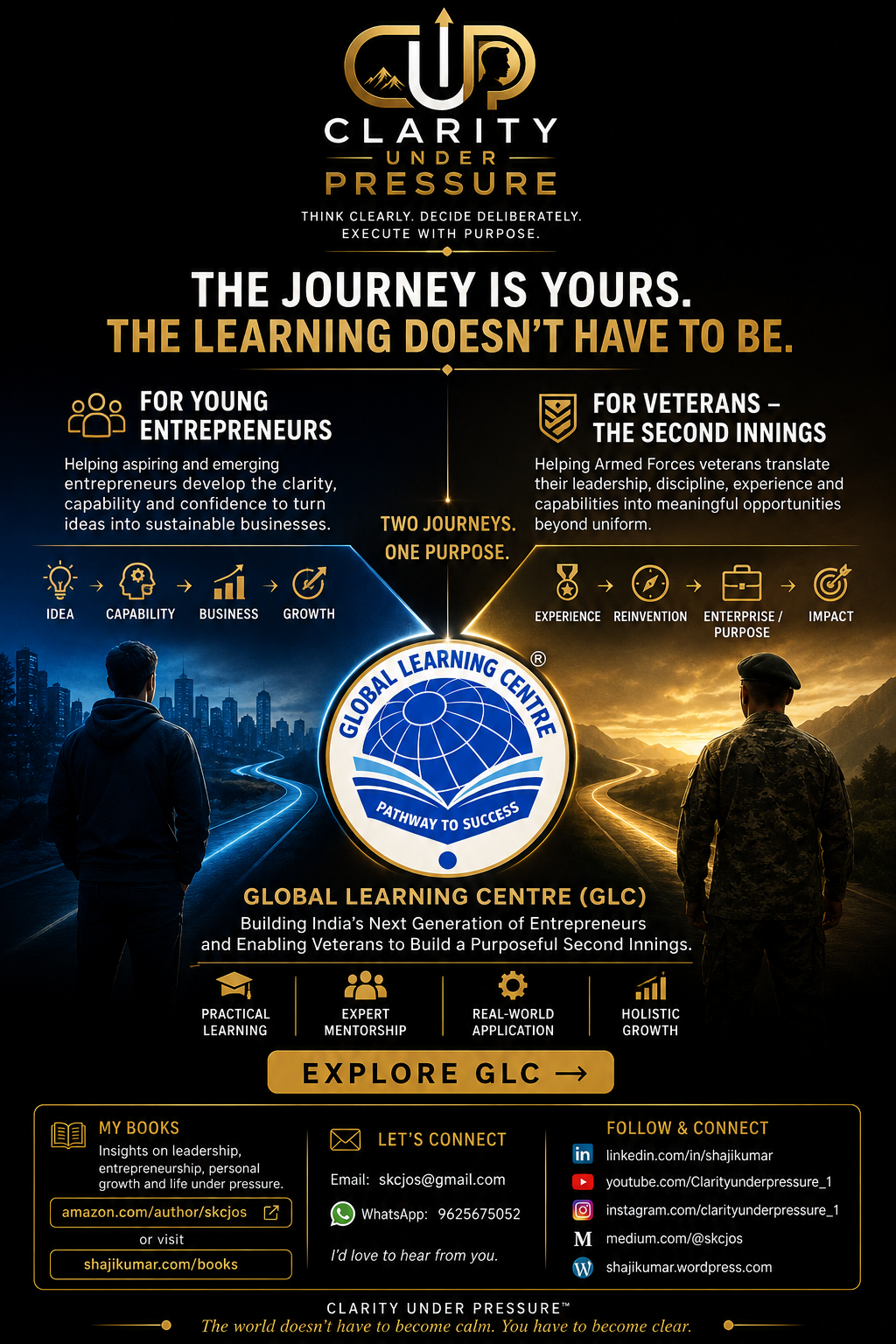
The Journey is yours. The Learning doesn’t have to be.
Global Learning Centre (GLC) is being built around two journeys:
FOR YOUNG ENTREPRENEURS
Helping aspiring and emerging entrepreneurs develop the clarity, capability and confidence to turn ideas into sustainable businesses.
FOR VETERANS — THE SECOND INNINGS
Helping Armed Forces veterans translate their leadership, discipline, experience and capabilities into meaningful opportunities beyond uniform.
The journey doesn’t end here. Let’s stay connected.
My Books | LinkedIn | YouTube | Instagram | Medium | Website
 Capt. Shaji Kumar