Tag: clarityunderpressure

  • When Life asks, “Why Me?” – Ask a Better Question.

    Clarity Under Pressure™ | A Lesson Every Young Person Should Learn Before Life Teaches It the Hard Way.
    A Lesson in Clarity Under Pressure™

    There is one question that most of us ask at some point in our lives.

    Why me?

    Why did this happen to me?

    Why did I fail?

    Why did I lose?

    Why did that opportunity disappear?

    Why did someone I trusted walk away?

    Why did life become difficult just when I thought things were finally falling into place?

    And when the situation becomes particularly painful, we sometimes take the question a little further.

    “God, why me?”

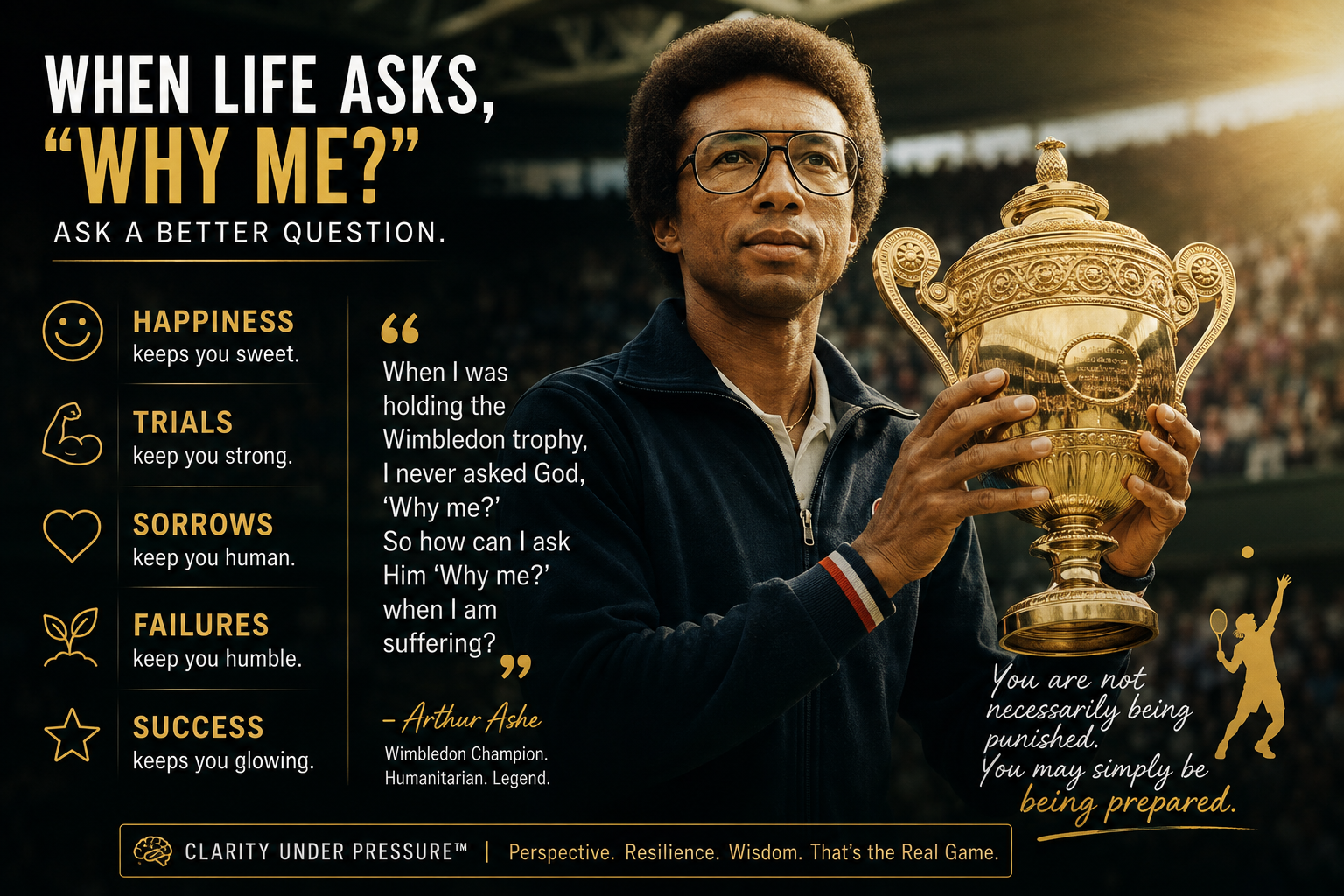
    There is a beautiful story associated with the legendary American tennis player Arthur Ashe that has stayed with me for a long time.

    Arthur Ashe was a Wimbledon champion, a remarkable sportsman and a deeply dignified human being. Later in life, he contracted HIV, reportedly as a result of a blood transfusion during medical treatment.

    People who knew about his faith reportedly asked him a difficult question.

    “Arthur, you have always been such a God-fearing and devout man. Why would God allow this to happen to you? Did you ever ask Him, ‘Why me?’”

    Arthur’s answer, as the story is commonly told, was remarkably simple.

    He reminded them of what it takes to become a Wimbledon champion.

    Millions may dream of becoming professional tennis players.

    Thousands may eventually play professionally.

    A much smaller number reach the Grand Slam tournaments.

    Only a handful get to Wimbledon.

    Four reach the semifinals.

    Two reach the final.

    And ultimately, only one person lifts the trophy.

    Then came the question that makes this story so powerful.

    When he was standing there holding the Wimbledon trophy, did he ever ask God, “Why me?”

    No.

    So, when life turned painful, how could he now ask, “Why me?”

    Whether every detail of the story is historically precise is not really the point.

    The lesson is.

    We are remarkably comfortable accepting the good things that happen to us.

    We rarely question them.

    When we receive a promotion, we do not usually look upwards and ask, “Why me?”

    When the business succeeds, we do not wonder why we were chosen.

    When money comes, when people praise us, when an opportunity opens at exactly the right moment, we simply accept it.

    But when things go wrong, the question appears almost immediately.

    Why me?

    Perhaps we need to look at life differently.

    Life does not come to us in separate compartments called happiness, success, failure and sorrow. They are all part of the same journey.

    Happiness keeps us sweet.

    Trials make us stronger.

    Sorrows remind us that we are human.

    Failures keep us humble.

    Success gives us confidence and makes us glow.

    The mistake is to think that only the pleasant parts belong in our lives.

    They don’t.

    The difficult parts belong there too.

    And this is something I believe young people need to understand very early in life.

    Do not compare your life with somebody else’s life.

    We live in an age where comparison has become almost unavoidable.

    You look at someone’s LinkedIn profile and wonder why you are not doing as well.

    You look at Instagram and wonder why your life does not look as exciting.

    You see someone’s car, house, business, designation, relationship or achievements and quietly ask yourself, “What am I doing wrong?”

    But there is a problem with comparison.

    You are looking at your entire life and comparing it with a carefully selected portion of someone else’s.

    You don’t know their struggles.

    You don’t know their disappointments.

    You don’t know what they sacrificed to get where they are.

    And you certainly don’t know whether the life they are displaying is actually making them happy.

    There is an old analogy that captures this beautifully.

    A child standing on a farm sees an aeroplane flying overhead and dreams of one day being able to fly.

    At the same time, the pilot flying that aeroplane looks down and sees a farmhouse below.

    He may be thinking about getting home.

    Both are looking at something the other person has.

    Both may be unaware of the longing on the other side.

    That is life.

    We spend so much time wanting what somebody else has that we sometimes fail to appreciate what we already possess.

    If wealth alone guaranteed happiness, the richest people would be the happiest people on earth.

    If power guaranteed security, powerful people would never need protection.

    If fame guaranteed love, celebrities would have perfect marriages.

    If possessions guaranteed peace, the biggest houses would have the soundest sleep.

    But life does not work that way.

    Sometimes the person with very little sleeps peacefully.

    Sometimes a child with the simplest toy laughs the loudest.

    Sometimes a person living a very ordinary life enjoys a depth of contentment that money cannot purchase.

    This is not an argument against ambition.

    Far from it.

    Dream big.

    Work hard.

    Build something meaningful.

    Become financially independent.

    Compete with yourself.

    Try to become better every day.

    But do not make the mistake of believing that achievement alone will complete you.

    There will always be someone richer.

    Someone more successful.

    Someone younger.

    Someone more famous.

    Someone who appears to have reached the destination before you.

    That is why perspective matters.

    And that is where Clarity Under Pressure™ begins.

    Clarity under pressure does not mean that you stop feeling pain.

    It does not mean pretending that failure does not hurt.

    It does not mean becoming indifferent to disappointment.

    It means learning to pause when circumstances become difficult.

    It means refusing to allow one bad chapter to convince you that the entire book is bad.

    It means asking better questions.

    Instead of asking:

    “Why me?”

    Ask:

    “What can I learn from this?”

    Ask:

    “What is within my control?”

    Ask:

    “What do I need to change?”

    Ask:

    “What kind of person will I become because of this experience?”

    Those are very different questions.

    And they put you back in the driver’s seat.

    Some failures will teach you more than success ever could.

    Some disappointments will take you in a direction you would never have chosen yourself.

    Some closed doors may eventually turn out to have protected you from something you could not see at the time.

    And some difficult periods may simply be preparing you for responsibilities you are not yet ready to carry.

    That is why I believe young people should not be afraid of difficult times.

    Respect them.

    Learn from them.

    Go through them.

    But do not allow them to define you.

    Your circumstances are not your identity.

    Your failure is not your identity.

    Your bank balance is not your identity.

    Your designation is not your identity.

    Your past is not your identity.

    What ultimately matters is the person you choose to become.

    So, when life is kind to you, be grateful.

    When you succeed, remain humble.

    When you fail, learn.

    When you suffer, remain human.

    When you have more than you need, share.

    When you have less than you want, remain hopeful.

    And when life becomes unbearably difficult, perhaps pause before asking:

    “Why me?”

    There may be a better question.

    “What am I going to do with this?”

    That question changes everything.

    Because perhaps life is not always punishing you.

    Perhaps it is sometimes preparing you.

    Live simply.

    Be grateful.

    Walk humbly.

    Love genuinely.

    Work honestly.

    And when the pressure comes, keep your clarity.

    That is the real game.

    Clarity Under Pressure™

    The Arthur Ashe story is widely circulated in various versions. The precise statistics and wording vary across retellings; the enduring lesson, rather than the numerical accuracy of the anecdote, is what matters here.

    Explore my Books on https://www.shajikumar.com
  • 5 Lessons for Clarity Under Pressure : The Mahabharata Is Happening Inside You

    5 Lessons for Clarity Under Pressure : The Mahabharata Is Happening Inside You

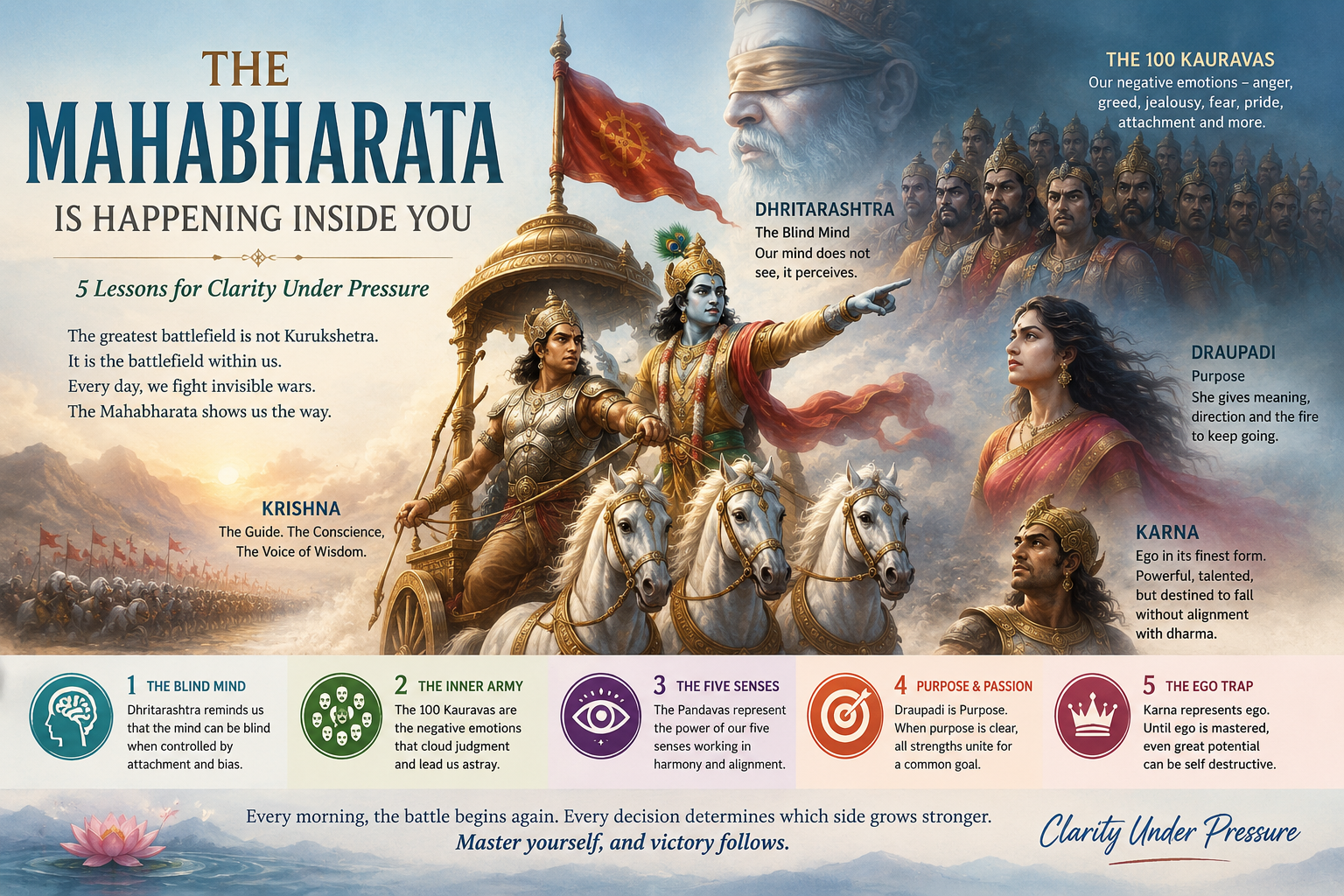
    The Mahabharata is often described as the greatest epic ever written. Most people read it as a story of kingdoms, dynasties, politics, war, loyalty and betrayal. I see something more.

    I see the Mahabharata as the story of every human mind.

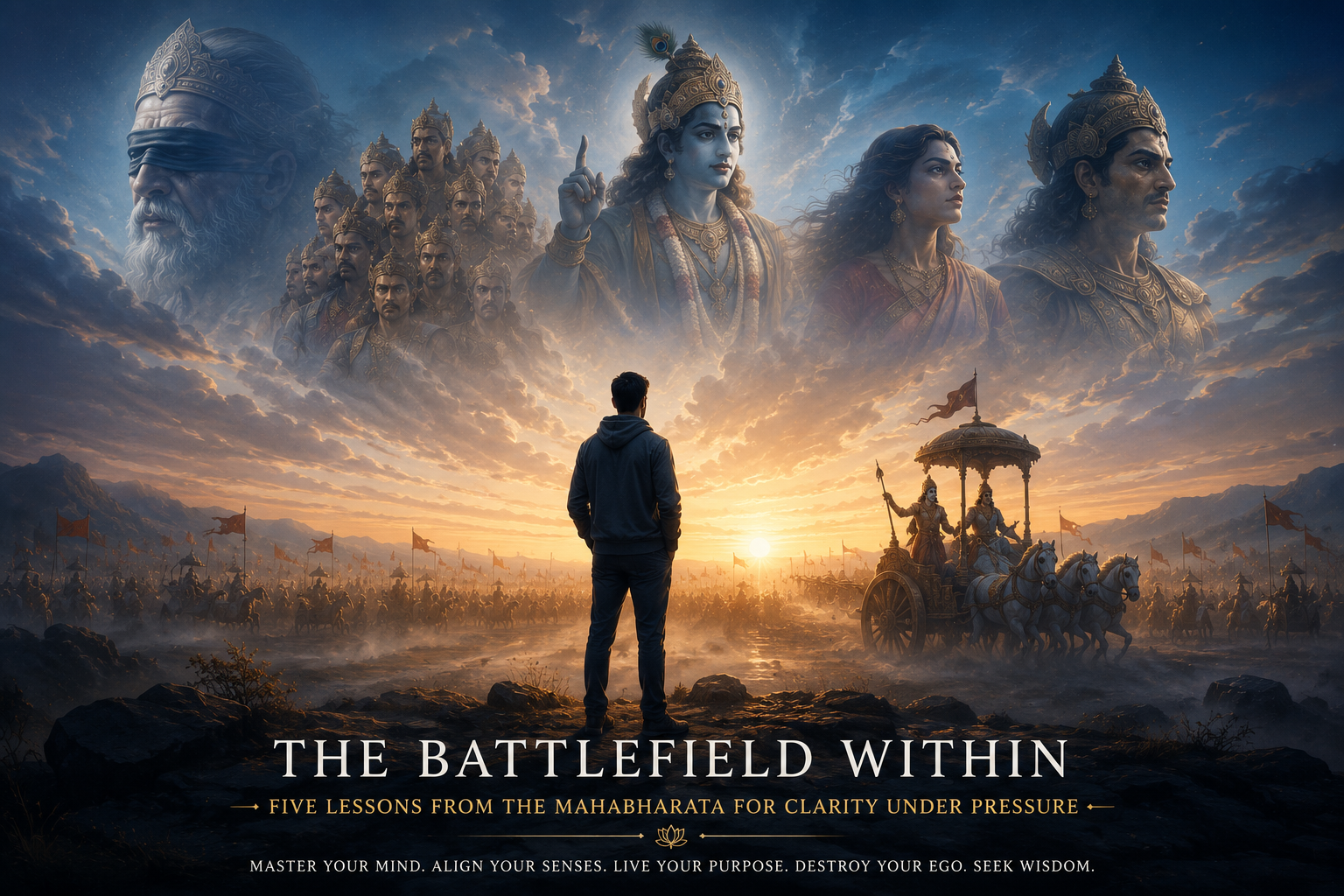
    Its greatest battlefield is not Kurukshetra. It is the battlefield within us.

    Every single day, we fight invisible wars. Between discipline and temptation. Courage and fear. Ego and humility. Purpose and distraction. Clarity and confusion.

    The Mahabharata is not merely ancient history. It is an operating manual for human behaviour.

    When viewed through this lens, the characters become symbols of the forces that influence our decisions under pressure.

    Here are five lessons that continue to shape my understanding of leadership and life.

    1. Dhritarashtra: The Blind Mind.

    King Dhritarashtra was born blind.

    Symbolically, I see him representing the human mind.

    Our mind does not directly experience reality. It depends entirely on information supplied through the senses. Every sight, sound, smell, taste and touch is interpreted before it becomes our understanding of the world.

    The problem is not blindness.

    The problem is allowing emotion to distort perception.

    Dhritarashtra repeatedly chose attachment over justice. His inability to rise above personal bias led to disastrous decisions.

    The same thing happens to us.

    When fear clouds judgment…When greed overrides ethics…When attachment becomes stronger than truth…

    our decisions begin to resemble those of the blind king.

    Clarity Under Pressure begins by recognising that perception is not always reality.

    Before making important decisions, ask yourself:

    “Am I seeing the situation as it is, or as my emotions want me to see it?”

    That single question can prevent countless mistakes.

    2. The Hundred Kauravas: Your Inner Army of Negative Emotions.

    Why one hundred brothers?

    Perhaps because negative emotions never arrive alone.

    Anger invites revenge.

    Fear creates hesitation.

    Jealousy breeds resentment.

    Greed demands more.

    Arrogance rejects advice.

    One negative thought rarely remains isolated. It recruits many others.

    Whether or not one accepts this symbolic reading, it offers a useful reflection on human behaviour: destructive emotions often reinforce one another.

    Every leader experiences this.

    Every entrepreneur experiences this.

    Every family experiences this.

    When pressure increases, the army inside us grows louder.

    The challenge is not eliminating emotion.

    The challenge is refusing to let emotion command the mind.

    The battle is never outside first.

    It always begins within.

    3. The Five Pandavas: Aligning Your Five Senses

    Every human being is gifted with five senses.

    Seeing.

    Hearing.

    Touch.

    Taste.

    Smell.

    These senses constantly collect information about the world around us.

    But information alone never creates success.

    Alignment does.

    Imagine a leader who sees opportunities but refuses to listen.

    Or someone who hears advice but ignores evidence.

    Or a professional who observes everything but acts without conviction.

    Success demands that all our faculties work together.

    The Pandavas remind us that strength does not come from individual excellence.

    It comes from unity.

    Clarity Under Pressure is achieved when what you see, hear, believe and act upon all point in the same direction.

    4. Draupadi: Purpose Gives Direction.

    One of the most profound symbolic interpretations I have encountered is seeing Draupadi as purpose.

    Purpose gives direction to strength.

    Without purpose, ability is scattered.

    With purpose, ordinary people become extraordinary.

    After her humiliation, Draupadi took a solemn vow. That moment transformed personal pain into collective resolve. Every Pandava found renewed determination through a shared cause.

    That is exactly what purpose does.

    Purpose aligns effort.

    Purpose sustains resilience.

    Purpose helps people endure hardships that talent alone cannot overcome.

    Many organisations have intelligent people.

    Many families have capable individuals.

    Many professionals possess exceptional skills.

    Yet they struggle because everyone is pulling in different directions.

    Purpose creates alignment.

    When purpose is clear, difficult decisions become easier.

    Distractions lose their power.

    Momentum replaces confusion.

    5. Karna: The Silent Cost of Ego.

    Among all the characters in the Mahabharata, Karna remains one of the most fascinating.

    Brilliant.

    Generous.

    Fearless.

    Loyal.

    Yet tragically conflicted.

    Many symbolic interpretations see Karna as representing the human ego. While this is not a traditional reading of the epic, it captures an important truth about life.

    Ego rarely announces itself.

    It disguises itself as self-respect.

    As pride.

    As the need to prove a point.

    As the refusal to apologise.

    As the inability to change.

    As the belief that being right matters more than doing what is right.

    Think about how many businesses have failed because leaders refused to listen.

    How many partnerships collapsed because neither side would compromise.

    How many families remain divided because someone chose pride over reconciliation.

    Success rarely disappears because of a lack of intelligence.

    It disappears because ego quietly takes control.

    The greatest victories in life are often achieved not by defeating others, but by mastering ourselves.

    The greatest battle in the Mahabharata was never fought at Kurukshetra. It is fought every morning inside your own mind. Once you understand that, this ancient epic becomes one of the most practical guides to leadership, resilience and decision-making ever written.

    And Then There Is Krishna.

    Every battlefield needs guidance.

    Krishna does not fight the war.

    He becomes the charioteer.

    The guide.

    The voice of wisdom.

    The conscience that helps Arjuna see clearly when emotions threaten to overwhelm him.

    Every one of us needs a Krishna.

    Sometimes it is a mentor.

    Sometimes it is a coach.

    Sometimes it is a trusted friend.

    Sometimes it is our own inner conscience.

    Clarity is rarely achieved in isolation.

    Wise guidance helps us see what emotion often hides.

    The Real Kurukshetra

    The Mahabharata is not only about an ancient war.

    It is about the war each of us fights every day.

    The blind mind.

    The army of negative emotions.

    The disciplined senses.

    A purpose worth living for.

    The constant battle against ego.

    And the quiet voice of wisdom that helps us choose the right path.

    Every morning, the battle begins again.

    Every decision determines which side grows stronger.

    The question is not whether the Mahabharata still exists.

    The question is this:

    Who is winning the battle within you?

    Because long before we lead organisations, build businesses or transform societies, we must first learn to master ourselves.

    That, perhaps, is the timeless lesson of the Mahabharata.

    And that is the essence of Clarity Under Pressure.


    Follow me on http://www.shajikumar.com