Leadership is not about becoming a different person every few years. It is about having the courage to question what once made you successful, recognise when the world has changed, and find the strength to begin again.
There is a dangerous moment in every leader’s life.
It does not necessarily arrive when a business fails, when a career stalls, or when an important decision goes wrong. Sometimes, it arrives when everything that once worked continues to feel comfortable.
The leader knows the answers. The methods are familiar. The experience is considerable. The reputation has been earned. People still turn to that person for guidance.
And somewhere beneath this apparent stability, the world has begun to move on.
The market has changed. Customers have different expectations. Technology has altered the rules. Younger professionals think differently. The very qualities that once created an advantage may no longer be enough.
This is where leadership faces its real test.
Can you question the person you have become without denying the person you have been?
I have learnt that question through experience, not theory.
My first reinvention began when I was 29
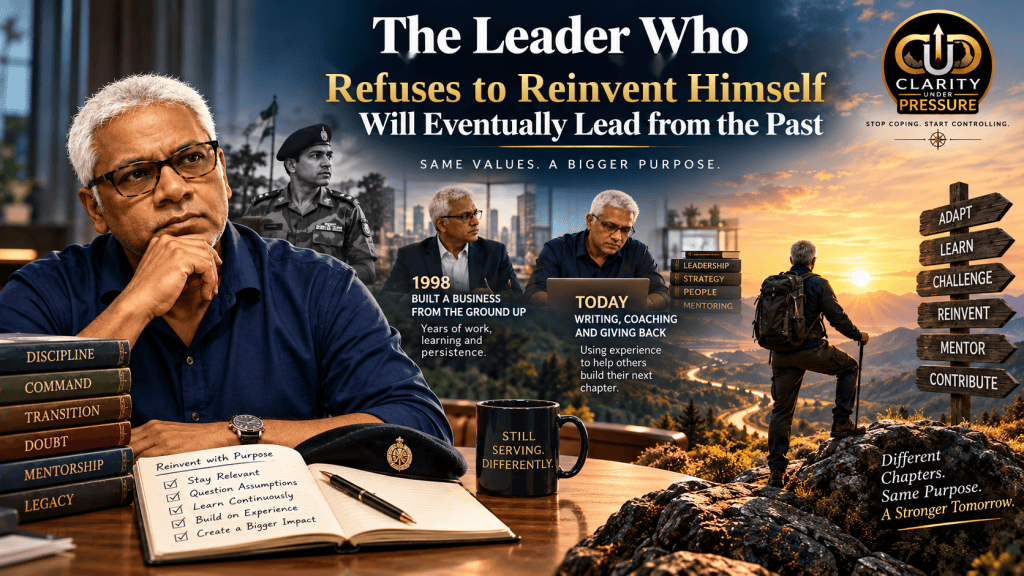
In September 1993, I left the Indian Army.
I had served for five years as a Captain in the Indian Army, taking on responsibilities that included Battery Second-in-Command, Adjutant, Regiment Quartermaster and Battery Commander.
The Army gave me discipline, responsibility, an understanding of systems, and the ability to function under pressure. It taught me that leadership is not a title on a visiting card. It is the responsibility to make decisions, take ownership and move people towards a common objective.
But leaving the Army brought a different challenge.
The structure I had known was gone. The chain of command no longer existed around me. The experience that had been meaningful and valuable within a military environment did not automatically translate into a civilian career.
I had the ability. I had the discipline. What I lacked was a map.
That distinction matters.
Sometimes, people do not struggle because they lack talent. They struggle because the environment in which their talent was developed has changed, and they have not yet learnt how to apply it in the new environment.
I could have spent years defining myself by what I had been. Instead, I had to learn how to build on it.
The task was not to discard my Army experience. It was to discover how that experience could serve a different purpose.
That was my first important lesson in reinvention: your past should be your foundation, not your prison.
The next chapter required a different kind of leadership
In 1998, I established my own business.
Building a company from the ground up required more than transferring military discipline into the corporate world. I had to understand customers, commercial realities, recruitment, relationships, people management and the economics of running an enterprise.
Over the years, the business expanded across 16 cities and grew into an organisation with a turnover of more than ₹130 crore.
That journey took time. It demanded decisions, persistence, learning and the willingness to take responsibility for outcomes.
But here is something leaders often overlook.
The qualities that help you establish an organisation are not always the same qualities required to lead it at the next stage.
In the beginning, a founder may need to be involved in almost everything. Every customer matters. Every rupee counts. Every problem finds its way to the founder’s desk.
As the organisation grows, the leader must learn to delegate, develop other leaders, create systems and resist the temptation to remain the centre of every decision.
The founder who cannot make that transition becomes the organisation’s biggest bottleneck.
The same principle applies to executives, military officers, entrepreneurs and professionals.
A leadership style that works for a team of five may not work for a team of five hundred. A strategy that succeeds in one market may fail in another. A reputation built over twenty years cannot guarantee relevance for the next twenty.
Experience is valuable, but experience without reflection can become a collection of outdated assumptions.
The question is not whether your old methods once worked. The question is whether they are still serving the purpose you now have to fulfil.
Reinvention is not the same as abandoning yourself
I want to make an important distinction here.
Reinvention has become a popular word. It is often presented as the need to keep changing one’s identity, acquiring new skills, developing a fresh personal brand and constantly proving one’s relevance.
That can easily become exhausting.
If every change in the market forces you to question your worth, you will spend your life chasing the next definition of success. If every setback makes you believe that your entire identity is obsolete, you will repeatedly start from zero.
Neither is necessary.
Effective reinvention begins with discernment.
You must know what to preserve and what to change.
Preserve your principles. Reconsider your methods.
Preserve your integrity. Reassess your strategy.
Preserve the wisdom gained from experience. Remain willing to question the conclusions you drew from it.
Preserve your sense of purpose. Be flexible about the route you take to fulfil it.
A leader does not need to become a new person every time circumstances change. A leader needs to understand which parts of the old approach remain useful and which parts are no longer adequate.
This is especially important in times of uncertainty. Under pressure, we instinctively reach for familiar responses. But familiarity and effectiveness are not the same thing.
At Clarity Under Pressure, this is one of the principles I return to repeatedly: the ability to pause, examine the situation honestly, distinguish facts from assumptions and choose a response rather than simply repeat a reaction.
Sometimes the most courageous leadership decision is not to do more of what made you successful.
It is to acknowledge that the next stage requires something different.
When circumstances change, leaders have two responsibilities
There is a question that deserves serious attention: why is the burden of change so often placed entirely on the individual?
Organisations frequently ask their people to become more adaptable. Employees must learn new technologies, acquire new capabilities and prepare for changing roles. Entrepreneurs must respond to changing customer behaviour. Leaders must keep pace with artificial intelligence and evolving markets.
Much of this adaptation is necessary.
But there is a difference between helping people develop and expecting them to absorb every consequence of decisions made elsewhere.
A responsible leader does not merely ask, “How can my people adapt?”
The leader also asks, “What must I change about the way we work?”
If a team is repeatedly exhausted, is the problem a lack of resilience, or are the priorities unrealistic?
If employees cannot perform effectively, do they need more training, or are the systems preventing them from doing their jobs?
If a business is losing customers, should the sales team simply work harder, or must the organisation reconsider its product, service or value proposition?
If technology is changing an industry, is the answer to demand that everyone learn new tools, or must the leadership also rethink roles, processes, training and the distribution of the benefits?
These questions separate genuine leadership from the convenient practice of transferring responsibility downwards.
Reinvention must not become an excuse for leaders to avoid examining the systems they control.
The best leaders reinvent themselves, but they also have the courage to reinvent the conditions in which others work.
The most dangerous sentence in leadership
There is one sentence that should make every experienced leader pause:
“This is how we have always done it.”
It sounds harmless. Sometimes, it reflects a process that has stood the test of time. But often, it is a defence against the discomfort of learning something new.
I have seen how experience can become a source of confidence. That is one of its great advantages. An experienced leader has seen enough to recognise patterns, anticipate consequences and avoid unnecessary mistakes.
Yet experience can also make us selective about the evidence we accept.
We remember the decisions that worked. We develop explanations for the ones that did not. Gradually, our past successes become the basis for assumptions that we stop examining.
The world does not owe us continued success simply because we were successful before.
A leader must therefore cultivate the discipline of asking uncomfortable questions:
- What has changed that I may not have recognised?
- Which of my strengths could become limitations if I overuse them?
- What am I defending simply because I invested years in building it?
- Which voices have I stopped listening to?
- If I were starting today, knowing what I know now, what would I do differently?
These are not questions of weakness. They are instruments of professional maturity.
The leader who asks them early can often change course before circumstances force the decision.
Reinvention after sixty is not a contradiction
There is another dimension to this subject that matters deeply to me.
We tend to divide life into stages. We study in our youth, establish ourselves in adulthood, build a career, accumulate experience and eventually begin to think about slowing down.
But why should the acquisition of wisdom signal the end of contribution?
A person who has spent decades leading teams, building businesses, managing people or navigating difficult decisions possesses something that cannot be acquired through a short course: lived experience.
That experience does not automatically make someone relevant. It must still be examined, updated and translated into a form that others can use.
But it is an extraordinary resource when combined with humility and a willingness to learn.
My own journey continues to evolve. The Army chapter taught me discipline. Entrepreneurship taught me commercial realities and the demands of building something from nothing. Writing has given me a way to examine experience and communicate ideas. Coaching offers an opportunity to help others think through their decisions. Through Clarity Under Pressure and the Global Learning Centre, I am working to turn accumulated experience into something useful for professionals, entrepreneurs and people preparing for their next chapter.
These are not unrelated identities. They are different expressions of a continuing purpose.
I do not have to erase the Army officer to become an entrepreneur. I do not have to abandon the entrepreneur to become a coach or author.
I can carry forward what each chapter taught me while recognising that the next chapter requires new ways of thinking and working.
That is the distinction between reinventing yourself and losing yourself.
One builds on experience. The other runs away from it.
And there is no reason to assume that the capacity to contribute expires on a particular birthday.
What leaders must learn in the age of AI
The need for reinvention is becoming more visible as artificial intelligence and automation reshape work.
New tools are emerging. Established roles are changing. Skills that were valuable yesterday may need to be supplemented by new capabilities tomorrow.
Leaders cannot afford to ignore these developments.
But neither should they confuse the acquisition of every new tool with meaningful transformation.
A leader who adopts AI without reconsidering the underlying business problem may simply automate an inefficient process. An organisation that trains employees in new software without giving them clarity about their responsibilities may create activity without improving outcomes.
Technology is an instrument. Leadership determines the purpose for which it is used.
The real task is to remain curious, understand what is changing, identify what matters and make deliberate choices about how to respond.
You do not need to become an expert in everything. You need to recognise what you must understand, where you need specialist help and which assumptions require revision.
The same applies to every major transition, whether technological, economic or personal.
Reinvention is not an endless race to acquire more.
It is the ability to identify what the next stage demands and prepare intelligently for it.
A practical discipline for leaders who want to remain relevant
Reinvention becomes useful when it moves beyond a motivational slogan and becomes a leadership practice.
I would begin with five disciplines.
1. Conduct an honest review.
Examine your current role, business or professional direction. Identify what is working, what is deteriorating and what you may be refusing to acknowledge.
2. Separate your identity from your position.
Your designation, company, professional reputation and current source of income are parts of your life. They are not the complete measure of your ability or worth. Knowing this gives you the freedom to explore alternatives without treating every change as a personal defeat.
3. Build on what you already know.
Do not discard decades of experience in the pursuit of something fashionable. Identify the underlying capabilities you can transfer into a new role, market or purpose. Then identify the gaps you must close.
4. Run small experiments before making large commitments.
Test an idea. Speak to people who understand the field. Undertake a pilot project. Learn a new skill in a practical setting. Smaller experiments can help you discover whether a new direction deserves greater investment.
5. Review the environment, not just yourself.
If you lead an organisation, examine its systems, incentives, decision-making processes and culture. If you are navigating a career transition, assess the real opportunities and constraints around you. Do not assume that every difficulty can be solved by working harder on yourself.
These disciplines make reinvention a considered response to reality rather than a reaction to fear.
The leader’s final responsibility
Leadership is ultimately about preparing for a future that cannot be managed entirely through yesterday’s experience.
The irony is that the longer we have been successful, the more difficult it can become to question our methods. We have invested time, reputation and emotion in building what we have. Changing direction can feel like an admission that the past was wrong.
It need not be.
A decision can have been right for its time and still be inadequate for the present. A skill can have served you brilliantly and still require updating. A professional identity can have given your life meaning without needing to define every chapter that follows.
The objective is not perpetual change. It is purposeful evolution.
My transition from military service to entrepreneurship taught me that capability must sometimes find a new expression. Building a business taught me that growth requires different forms of leadership at different stages. My continuing work in writing, coaching and learning reinforces the belief that experience becomes more valuable when we remain willing to examine it and share what it has taught us.
If there is one lesson I would offer another leader, it is this:
Do not wait for a crisis to discover that your old methods are no longer sufficient. Do not confuse loyalty to your past with an obligation to repeat it. And do not demand that your people change while exempting yourself from the same responsibility.
The leader who continues learning retains the ability to choose.
The leader who stops learning eventually allows circumstances to choose on their behalf.
Your next chapter does not require you to deny everything you have achieved. It requires you to decide what those achievements have prepared you to do next.
That is the real work of reinvention.
And it begins with one question:
What must I be willing to change so that I can continue to lead with purpose?
Capt. Shaji Kumar (Retd)
Army Veteran | Entrepreneur | Author | Executive Coach
Clarity Under Pressure. Stop Coping. Start Controlling.
If this resonated, subscribe to Clarity Under Pressure for the next weekly edition.

