Why founders build their own prisons, and the 5 metrics that set you free.
A romantic myth in modern entrepreneurship is that sheer willpower can conquer any market friction. We celebrate pitch decks, launch parties, and overnight success stories.
What nobody photographs is the quiet, exhausting middle: the founder staring at a spreadsheet at midnight, trying to understand why a company with surging sales has an empty bank account.
Most businesses do not fail from a lack of passion. They bleed out because the founder refused to respect the arithmetic.
In high-stakes environments—whether in field operations or executive commerce—enthusiasm is merely a prerequisite for entry. What determines survival under pressure is systemised discipline. If you cannot answer these five questions with total clarity, you are not operating a business. You are running a gamble.
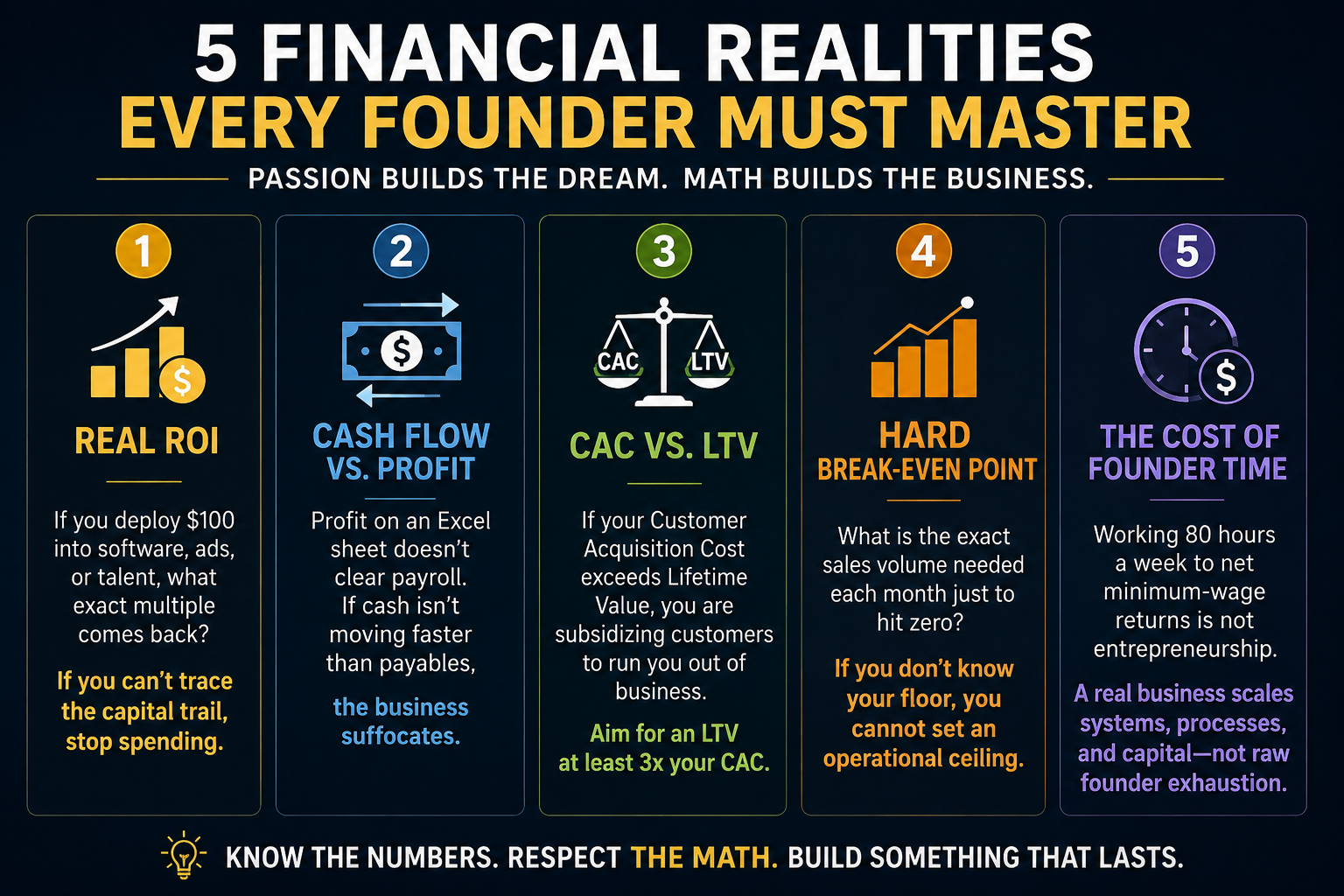
I. The Illusion of Effort vs. Return on Capital (ROI)
Early in my career, I saw businesses deploy hard-earned capital into “brand visibility” initiatives that couldn’t be tracked, quantified, or tied back to revenue. They treated capital deployment like planting seeds in the dark, hoping something might sprout.
When you spend capital—whether on a CRM system, an ad campaign, or a new hire—you must demand an answer: What is the exact multiple coming back through the door?
If you invest $10,000 in a new initiative, you need to know whether it generates $30,000 in enterprise value or simply burns cash to keep people busy. If you cannot map the pipeline from expense to cash inflow, stop spending.
II. The Difference Between Profit and Oxygen (Cash Flow)
One of the most dangerous traps for early-stage founders is the accrual trap. You send out an invoice for $50,000, celebrate a profitable month on your dashboard, and move forward.
Then payroll comes due on the 1st, and the client hasn’t paid.
Profit is an accounting opinion; cash in hand is reality. If money isn’t cycling through your accounts faster than your liabilities come due, your business will suffocate. Working capital discipline means negotiating payment terms ruthlessly, collecting receivables aggressively, and ensuring your operational runway is never tied up in someone else’s bureaucracy.
III. The Unit Economic Reality Check (CAC vs. LTV)
A business model is fundamentally simple: buy customers for less than they are worth to you over time.
Yet, countless startups burn through seed capital acquiring users at $100 per head, only to realise those users will only ever spend $40. They convince themselves that “scale” will miraculously fix the discrepancy. Scale doesn’t fix broken unit economics; it only accelerates the burn rate.
If your Customer Acquisition Cost (CAC) is higher than your Lifetime Value (LTV), you are paying your customers to put you out of business. If your LTV comfortably outweighs your CAC, you have a predictable engine that can absorb market downturns.
IV. Knowing Your Baseline Floor (Break-Even)
Before you plan for record growth, you must know your survival floor.
How many billable retainers, finished units, or service contracts must you clear every single month just to keep the lights on and the team paid? If you cannot calculate your hard break-even number off the top of your head, you don’t have command of your enterprise.
Knowing your baseline removes operational panic. It tells you exactly where safety ends, and profit begins.
V. The Founder’s Prison (The Cost of Time)
Perhaps the most common trap is the founder who replaces a 40-hour corporate job with an 80-hour business that pays half as much.
They take pride in the grind, handling every administrative task, client email, and operational fire drill. But trading 70 hours a week for marginal profits is not business building—it is self-inflicted servitude.
A viable enterprise must scale systems, processes, and capital. If the entire operation halts the moment you step away for 48 hours, you have not built an asset. You have built a demanding job that you cannot quit.
The Bottom Line
Passion provides the spark, but numbers provide the armour.
Before you sign the next lease, launch the next marketing blitz, or hire your next specialist, pull up your balance sheet. Look at the unit economics with complete honesty. When you respect the math, the business takes care of itself.
Starting a business will be one of the best and worst decisions you ever make — sometimes on the same Tuesday.
This is for anyone who has already taken the leap, is seriously considering it, or is knee-deep in the chaos, wondering if it was all a terrible mistake. Spoiler: you’re not alone, and you’re probably not doing it wrong.
In this post, we’ll get honest about the emotional rollercoaster of entrepreneurship — the sleepless nights, the self-doubt, and the moments when quitting feels like the smart move. We’ll also dig into the mindset shifts that separate entrepreneurs who push through from those who fold. And yes, we’ll talk about the rewards too — the kind that remind you exactly why you started.
No fluff. No toxic positivity. Just the real, messy, exhilarating truth about what it actually takes to build something from nothing.
The Emotional Rollercoaster of Starting a Business
Recognising the Passion That Drives You Forward
Every entrepreneur starts with a spark — that restless feeling that something needs to exist in the world, and you’re the one to build it. This passion isn’t just motivation; it’s your fuel during the hard days when logic tells you to quit.
Passion keeps you problem-solving when others would walk away
It attracts co-founders, early customers, and investors who believe in your vision
It gives your work meaning beyond the paycheck
Confronting the Fear of Failure Head-On
Fear is unavoidable in entrepreneurship. The difference between founders who survive and those who fold is how they respond to it.
Fear Response
Outcome
Avoiding the fear
Paralysis, missed opportunities
Facing the fear
Faster decisions, real growth
Most fears are just worst-case scenarios your brain invented. Name them, examine them, and move through them.
Finding Strength in Moments of Doubt
Doubt will show up — usually at 2 AM when a deal falls through or a key team member resigns. During these moments:
Revisit your “why” — reconnect with what started this
Talk to other founders — they’ve been exactly where you are
Track small wins — progress is often invisible until you look back
The Harsh Realities Every Entrepreneur Must Face
Navigating Financial Uncertainty Without Losing Hope
Cash flow problems don’t announce themselves politely. One month you’re celebrating a big contract; the next, you’re calculating whether payroll clears. Smart entrepreneurs build a 6-month emergency runway, diversify revenue streams early, and get comfortable having uncomfortable money conversations with investors and clients.
Managing the Physical and Mental Toll of Long Hours
Burnout isn’t a badge of honour — it’s a warning light. Chronic sleep deprivation kills decision-making faster than any competitor. Protect your energy like a business asset:
Block non-negotiable recovery time
Move your body daily, even if it’s a 20-minute walk
Know your personal depletion signals before they become crises
Overcoming Isolation and the Loneliness of Leadership
The higher you climb, the fewer people truly understand your pressure. Many founders carry decisions alone that would crush most people. The fix isn’t suffering silently — it’s building a peer network of fellow entrepreneurs who speak your language without judgment.
Dealing With Failure and Turning Setbacks Into Lessons
Failure Response
Outcome
Blame external factors
Repeated mistakes
Analyze honestly
Extracted lessons
Adjust and re-execute
Compounding growth
Every failed product, lost client, or collapsed partnership carries a precise lesson. The entrepreneurs who last are the ones who debrief ruthlessly and rebuild deliberately.
The Thrilling Rewards That Make It All Worthwhile
Experiencing the Rush of Landing Your First Big Client
Nothing quite compares to that moment when a major client says “yes.” Your phone buzzes, you read the email twice, and suddenly every sleepless night feels justified. That rush is real — it’s proof that your idea has genuine value in the marketplace, and nobody can take that feeling away from you.
Building Something Meaningful From Nothing
Starting with a blank page and watching it grow into something real is deeply satisfying in a way a regular paycheck never touches. You’re creating jobs, solving problems, and leaving a mark. That sense of authorship — knowing you built this — becomes part of your identity in the best possible way.
Gaining the Freedom to Live Life on Your Own Terms
Traditional Job
Entrepreneurship
Fixed schedule
You set the hours
Capped salary
Unlimited earning potential
Someone else’s vision
Your own mission
Limited flexibility
Freedom to pivot
Yes, early-stage entrepreneurship demands brutal hours. But the trade-off is ownership — over your time, your decisions, and your future. When the business matures, that freedom becomes very real. You stop living by someone else’s calendar and start designing your own life.
Key Mindset Shifts That Separate Survivors From Quitters
Embracing Uncertainty as a Catalyst for Growth
Uncertainty isn’t your enemy — it’s the environment where real growth happens. Entrepreneurs who thrive get comfortable not knowing every answer. They treat ambiguity like a training ground rather than a threat.
Developing Resilience Through Consistent Daily Habits
Resilience isn’t built during crises — it’s built at 6 AM when nobody’s watching. Small, repeatable habits create the mental toughness you’ll need when things get hard:
Morning journaling to process stress
Exercise to regulate cortisol and boost decision-making
Weekly reviews to track progress and recalibrate
Reframing Failure as a Stepping Stone to Success
Old Mindset
Survivor Mindset
Failure = proof I’m not enough
Failure = data I can work with
Mistakes = embarrassment
Mistakes = tuition fees
Setbacks = stop signs
Setbacks = detours
Every failed product, lost client, or missed target carries a lesson. Entrepreneurs who quit take failure personally. The ones who survive look at it practically.
Cultivating a Long-Term Vision Over Short-Term Comfort
Short-term thinking kills more businesses than bad markets ever will. Keeping a clear picture of your five-year goal makes today’s discomfort feel purposeful, not pointless. Your vision anchors you when emotions pull you off course.
Practical Strategies to Balance the Agony and the Ecstasy
Building a Strong Support Network of Mentors and Peers
No entrepreneur survives the journey alone. Surrounding yourself with people who’ve been in the trenches — and made it out — changes everything.
Find mentors who’ll give you honest feedback, not just encouragement
Join founder communities (local or online) where vulnerability is welcomed
Schedule regular check-ins with peers who understand the unique pressures you face
A good mentor saves you from mistakes they’ve already paid for. That’s priceless.
Setting Boundaries to Protect Your Mental Health
Your business needs you functional, not burned out. Without deliberate boundaries, the work will consume everything.
Designate clear “off” hours and actually stick to them
Separate your identity from your company’s performance — a bad month doesn’t make you a bad founder
Build non-negotiable recovery rituals: sleep, exercise, or even just a daily walk
Celebrating Small Wins to Sustain Motivation
The gap between starting and succeeding is long. If you only celebrate the big moments, you’ll run out of fuel halfway there.
Keep a visible “wins list” — even tiny ones count
Share milestones with your team or support circle
Treat progress as proof that your efforts are working
Small wins compound — emotionally and practically.
Real Stories of Entrepreneurs Who Embraced Both Extremes
How Rock Bottom Moments Led to Breakthrough Success
Howard Schultz was rejected by 217 investors before Starbucks became a global brand. Each “no” sharpened his pitch.
Sara Blakely maxed out her savings selling fax machines door-to-door before Spanx made her a billionaire.
Walt Disney went bankrupt and lost his first studio before building the empire we know today.
Rock bottom rarely signals the end — it usually signals a pivot.
Lessons From Entrepreneurs Who Rebuilt After Total Loss
Entrepreneur
Loss
Comeback
Steve Jobs
Fired from Apple
Founded NeXT, returned to transform Apple
Elon Musk
Nearly bankrupt in 2008
Tesla and SpaceX both survived and thrived
Henry Ford
Two failed companies
Built the most dominant auto brand of his era
Inspiring Examples of Vision Triumphing Over Adversity
Oprah Winfrey was fired from her first TV job for being “too emotional.” That same quality built a media empire worth billions.
What Long-Term Survivors Say About the Journey
Survivors consistently share three truths:
Pain taught them more than success ever did
Resilience is built through repetition, not inspiration
The journey itself becomes the reward
Starting a business is never a straight line — it’s messy, unpredictable, and deeply personal. There will be days when everything feels impossible and days when you can’t believe you actually pulled it off. The highs are real, the lows are real, and so is every emotion in between. The entrepreneurs who make it aren’t the ones who never struggle — they’re the ones who keep going anyway, armed with the right mindset, solid strategies, and the wisdom to learn from those who’ve walked the path before them.
If you’re in the thick of it right now, feeling the weight of the hard parts, just know that the struggle is part of the story — not a sign that you’re doing it wrong. Take the lessons, lean on the right people, and hold onto why you started. The agony and the ecstasy come as a package deal, and for those who stick with it, the ride is absolutely worth it.
The Journey is yours. The Learning doesn’t have to be.
Global Learning Centre (GLC) is being built around two journeys:
FOR YOUNG ENTREPRENEURS
Helping aspiring and emerging entrepreneurs develop the clarity, capability and confidence to turn ideas into sustainable businesses.
FOR VETERANS — THE SECOND INNINGS
Helping Armed Forces veterans translate their leadership, discipline, experience and capabilities into meaningful opportunities beyond uniform.
No One Is Coming — And That’s the Best News You’ll Get This Year
“Stop scanning the horizon for rescue. The cavalry is not coming.”
I left the Indian Army with no capital, no mentor, no business plan, and no roadmap. I built a company across sixteen cities over nearly three decades. I have stood at the top with a clear view, certain I had figured it all out. And I have woken in a cold sweat, not knowing how I would pay salaries the next morning, with no investor to call and no partner to share the weight.
Across all of it, one truth kept surfacing: no one is coming. No one is coming to rescue the business, to make the hard call, to take responsibility off your hands. The day you understand that fully is the day you actually become a founder. It sounds like a sentence. It is the opposite. It means everything that gets built from here has your signature on it.
Here’s what I mean, in practice. Right now, you’re probably waiting — for a partner, an investor, a sign, the right moment, someone to tell you it’s safe to move. Entrepreneurship does not begin with an idea. It begins the moment there is no one left to take responsibility but you. That moment feels like abandonment. It is actually arrival.
The investor will not save a business you haven’t proven. The mentor will not make your decision. The market does not care that you feel unready. The sooner you accept full ownership, the sooner you stop bleeding energy on hope and start spending it on work.
Four things I’d ask you to do this week — the same four I ask every founder I coach:
Write down the one decision you’ve been outsourcing to “when things are clearer.” Make it this week.
List who you are waiting on. Beside each name, write what you would do if they never showed up — then do that.
Replace “What if it goes wrong?” with “If it goes wrong, what is my next move?” Plan the move, not the fear.
Accept the signature. Every outcome from here, good or bad, is yours. Act like an owner before you feel like one.
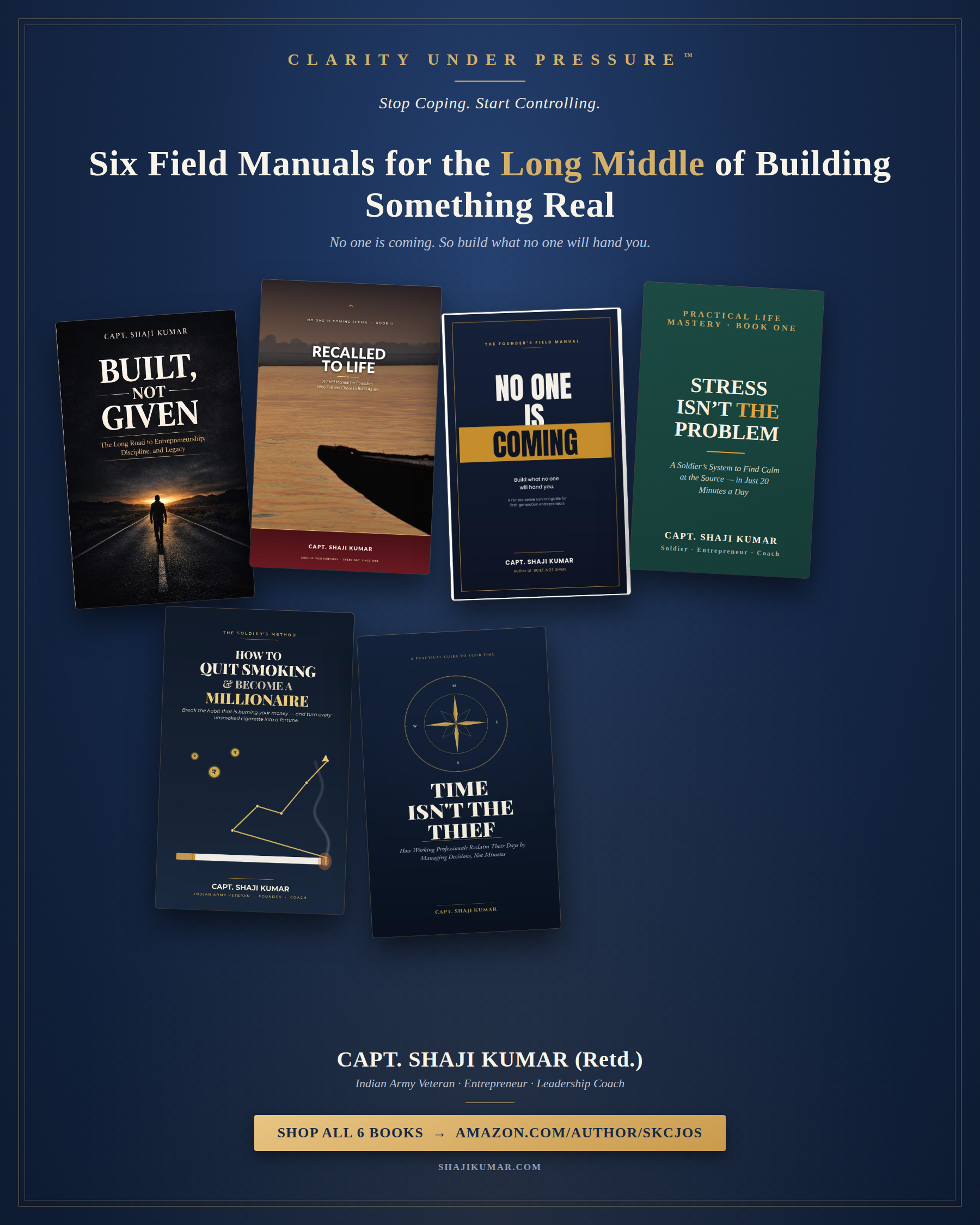
Capt. Shaji Kumar (Retd.) is an Indian Army veteran turned entrepreneur and leadership coach. Get No One Is Coming: amazon.com/dp/B0H24F7GX7 (free on Kindle Unlimited)All books: amazon.com/author/skcjos · Newsletter — Clarity Under Pressure: shajikumar.substack.com
On the weight that only one person in the room can never put down — and why that weight, carried rightly, is the highest privilege of leadership.
By Capt. Shaji Kumar · The Reflection Series
There is a phrase that has echoed through every corridor of power, every boardroom, every command post, and every founder’s office since Harry Truman first placed a small wooden sign on his desk in the Oval Office.
The buck stops here.
Five words. No ambiguity. No footnotes. No asterisk leading to a clause that redistributes the weight.
Most people who quote it have never truly felt its meaning. Because understanding those five words intellectually is entirely different from waking up at 3am with them sitting on your chest.
The leader is the only person in the organisation who does not have the luxury of pointing anywhere but inward.
The Architecture of Accountability
Here is the truth that no leadership manual fully prepares you for: every person in your organisation has an exit from accountability that you do not.
The team member who made the error can apologise. They can resign. They can move to another company, update their LinkedIn profile, and begin again with a largely clean slate. Their mistake follows them — but at a manageable distance. Time erodes it. A new role reframes it.
The middle manager who missed the target can point upward. They were working within a framework they did not design, executing a strategy they did not author, with resources that were not sufficient. There is always something above them to gesture toward.
Even the senior executive, one step below the top, carries the comfort of collective decision-making. The board approved it. The committee endorsed it. The consensus was clear.
But the leader — the one at the top, the founder, the CEO, the head of the organisation — has none of these exits. The apology is not enough. The resignation is not a resolution. The pointing upward finds only open sky. Every decision, every failure, every consequence of every call ever made under their watch circles back — inevitably, reliably, without exception — to their table.
The Word Everyone Else Gets to Use
Let us talk honestly about the word “sorry.”
It is a powerful word. In the right hands, offered with genuine remorse and a commitment to repair, it can rebuild trust, restore relationships, and close wounds that seemed permanent.
For most people in an organisation, sorry is also sufficient. It is the price of the mistake. Pay it, absorb the consequences — which may include losing the job — and move forward. The maximum cost is bounded. A job lost is a job that can be found again. A career disrupted is a career that can be rebuilt.
The leader does not have this arithmetic.
For everyone else, sorry is a settlement. For the leader, sorry is only the beginning of a much longer reckoning.
When a leader says sorry — genuinely, publicly, with weight — they are not closing the file. They are opening it. Because what follows sorry, for the person at the top, is a cascade of consequences that cannot be contained by a single word or a single act of contrition.
Investors who trusted the vision reassess.
Teams who believed in the direction begin to question their own loyalty to it.
Clients who built their own plans around yours recalibrate.
Competitors who were watching take note — and move.
Boards who extended confidence begin to sharpen their pencils.
And the market — indifferent, unsentimental, and without mercy — simply adjusts its valuation.
Sorry does not stop any of that. For the leader, accountability is not an event. It is a condition. Permanent, unrelenting, and non-negotiable.
The Catch-22 That No One Warned You About
Here is where leadership becomes genuinely, structurally unfair — and the sooner a leader accepts this, the more effective they become.
The leader must take the risk. That is the job. Without risk, there is no vision, no growth, no transformation, no reason for the organisation to exist beyond the maintenance of the status quo. Risk is not a feature of leadership — it is the definition of it.
And yet every risk the leader takes is a risk that, if it fails, lands entirely and exclusively on them.
They did not design the economic conditions that shifted. They did not engineer the competitor’s move that changed the landscape. They did not anticipate the geopolitical event, the regulatory change, the technology disruption. And yet — when the outcome falls short — the risk was theirs. The judgment was theirs. The decision to proceed was theirs.
This is the Catch-22: You must take the risk to lead. But there is no one to share it with when it does not work. You step forward alone. You carry it alone. And you answer for it alone.
The Leader’s Catch-22 — No Exit, Only Ownership
EVERYONE ELSE • Can say sorry and move on • Can lose the job — and start again • Risk is bounded and recoverable • Reputation is personal, containable • Can point upward — “I was told to” • Tomorrow is still relatively clean
THE LEADER • Sorry is not a strategy • Losing the role is the beginning, not the end • Risk is total — financial, reputational, human • Reputation carries the weight of every decision • There is no upward to point to • Tomorrow carries everything that happened today
The columns above are not a complaint. They are a contract. A contract that every genuine leader signs — usually without reading the fine print — the moment they accept the responsibility of the top seat.
The Loneliness That Comes With the Title
Leadership at the top is lonely. Not in the way that word is sometimes used casually — as a synonym for solitude or introversion. Lonely in a structural, existential sense.
Everyone around the leader has someone above them to consult, to defer to, to share the weight with. The leader has no one above. The board is not above — they are alongside, with their own interests and mandates. The mentor is not above — they advise, but they do not carry.
And this loneliness is not something to be fixed. It is something to be inhabited. The leader who spends their time searching for someone to share the ultimate accountability with is a leader who has not yet truly accepted the role.
The loneliness of the top is not a problem to be solved. It is a condition to be led from.
The most effective leaders I have worked with have made a quiet peace with this. They build strong teams — not to distribute the accountability, but to increase the quality of the decisions that accountability demands. They seek counsel — not to avoid the weight, but to carry it more wisely. They stay close to people who tell them the truth — not because truth makes the burden lighter, but because it makes the decisions cleaner.
The Reframe That Changes Everything
Here is where I want to shift the arc of this reflection. Because everything I have written above is true — and it is only half the story.
The buck stops here is not only a burden. It is a distinction.
In an entire organisation — sometimes hundreds, sometimes thousands of people — there is exactly one person for whom the full weight of every outcome, every decision, every risk, and every result is non-negotiable. One person whose name is on the line in a way that no one else’s is.
That is not a curse. It is the mark of genuine leadership. And it is extraordinarily rare.
Most people will live their entire professional lives never truly knowing what it means to be the final answer. Never experiencing the particular clarity — and the particular terror — of a decision that is entirely, irreversibly, consequentially yours. They will always have someone above them. Always have a committee to hide in. Always have the word sorry available as a genuine resolution.
You do not. And that is not a misfortune. It is an identity.
The leader who understands this — who stops grieving the exits they do not have and starts inhabiting the seat they do — becomes something qualitatively different from the people around them. Not better. Not superior. But different in a way that matters. Tested in a way that cannot be faked. Forged in a way that cannot be replicated by anyone who has not stood where they stand.
The buck does not stop at your table because life is unfair. It stops there because you are the only one equipped to answer it.
What the Leader Who Carries It Well Looks Like
In my years of coaching leaders across industries, the ones who carry this weight with genuine effectiveness share a handful of traits that are worth naming.
They never pretend the weight isn’t there. They do not perform invulnerability. They acknowledge — to themselves, and often to their teams — that the accountability is real, the stakes are high, and the decisions are hard. This honesty does not weaken them. It earns the trust of everyone watching.
They decide anyway. The weight does not become paralysis. They take the council, absorb the analysis, listen to the room — and then they decide. Clearly. On time. Without the endless deferral that masquerades as due diligence.
They own the outcomes — all of them. Not only the ones that worked. They stand in front of the team, the board, the client, the market — when things fall short — and they say: this was mine. Not the team’s. Not the conditions. Mine. And then they say what comes next.
They do not confuse accountability with self-destruction. Owning the outcome does not mean flagellating yourself indefinitely. The leader who makes peace with a bad decision, extracts the lesson, and moves forward is infinitely more effective than one who carries every past failure as a permanent indictment.
They remember why they accepted the seat. The vision. The mission. The people they are building something for. On the days when the weight is heaviest, it is the reason for carrying it that makes it possible to keep going.
The Privilege in the Burden
I want to close this reflection with something that may seem counterintuitive — but which I believe with complete conviction, having seen it in the lives of the leaders who do this well.
The buck stopping at your table is a privilege.
Not a comfortable one. Not an easy one. Not one that comes without cost, without sleepless nights, without the particular exhaustion of being the person who cannot pass it on.
But a privilege nonetheless.
Because the alternative — a life in which nothing of ultimate consequence is ever yours, in which every decision can be softened with a committee and every failure can be redirected with an apology — is a life lived at a remove from the thing that makes leadership meaningful.
You were not put at the top of the table to be comfortable. You were put there to answer. And the fact that you are the only one who can — in your organisation, in your context, in your moment — is not a sentence.
It is a calling.
The weight of the buck is the price of the vision. Pay it. Carry it. And lead from it. Because no one else in the room can.
✦ FROM THE AUTHORWords that go deeper than the blog.If this reflection stirred something in you, these books were written for exactly that moment.
📖 Health in Your Hands Your body is your first boardroom. The leader who cannot manage their own health cannot sustain the weight of accountability. Read on Amazon →
🧠 Stress — The Silent Killer Within A 21-Day Acupressure system to reset your nervous system, reduce anxiety and reclaim your health naturally. Read on Amazon →
COMING SOONBuilt, Not GivenA new book for young entrepreneurs in Tier 2 and Tier 3 cities who were never handed a headstart — but refuse to let that be their story.Be the first to know when it drops → skcjos@gmail.com
ABOUT THE AUTHORCapt. Shaji Kumar Capt. Shaji Kumar is a Leadership Coach, Author, and Speaker working with professionals and entrepreneurs who are ready to lead with clarity and courage. He is the author of Health in Your Hands and Stress — The Silent Killer Within, and his upcoming book Built, Not Given is written for entrepreneurs who were never handed a headstart. Connect with him, access his books, and join his inner circle at: linktr.ee/skcjos
LET’S STAY CONNECTEDJoin the inner circle. Leadership insights. Early access to Built, Not Given. Coaching opportunities. No noise — just substance, when it matters. ✉️ Sign up here: linktr.ee/skcjos📅 Book a coaching appointment: LinkedIn →✉️ Write directly: skcjos@gmail.com