Author: Capt. Shaji Kumar

  • Still Deciding? That Is the Pressure Talking.

    Last day to register: free live webinar, Saturday 21 November 2026, 11:00 AM IST

    Think of the last decision you postponed. Not a small one. The hard conversation with a partner. The hire you keep “thinking about”. The price rise you know is overdue. The contract you should have ended months ago.

    Here is the uncomfortable part. You probably know what you should do. You have known for weeks.

    So why haven’t you done it?

    You did not lose your intelligence. You lost access to it.

    Remember an exam where you studied everything, and in the hall your mind went blank? You walked out of the gate and the answer came straight back.

    The knowledge never left. What you lost was access to it.

    That is what pressure does to capable people. Your thinking narrows. Your attention locks onto whatever confirms the fear. Emotions get louder than reasoning. And your guesses begin to feel like facts.

    Some of the worst decisions in business are made by highly intelligent, highly experienced people. Intelligence does not protect you. Clarity does.

    The fact, and the story your mind adds

    Your boss sends a WhatsApp: “Call me when free.” Four words.

    By the time you reach for the phone, you have been fired, found a new job and told your family. The fact: he wants a call. Everything else is a story.

    You lose a client. The fact: we lost a client. The story: the business is failing, I made a terrible mistake, nobody trusts me anymore.

    Under pressure, we react to the story as if it were the fact. And then we make decisions from inside it.

    The real problem is rarely what happened. It is what takes control of you after it happens.

    “Still deciding” is a reflex, not a plan

    In the Clarity Under Pressure work, I describe eight automatic reflexes people fall into when the stakes rise: Seize, Dodge, Appease, Polish, Brace, Spin, Sprint and Verdict.

    If you have been “still deciding” for days, two of them are probably running the show.

    Dodge says, “Let us wait until next quarter.” Problems grow and trust quietly erodes.

    Spin says, “Let me look at the data once more.” You end up with fourteen browser tabs and no decision.

    Neither one feels like fear. Both feel like being careful. That is exactly why they work so well.

    Here is the question that cuts through it: what are the consequences of doing nothing? Waiting for certainty is itself a decision. It is usually a poor one, because certainty rarely arrives before the deadline does.

    What a calm decision-maker does differently

    In January 2009, a passenger jet lost both engines after a bird strike over a crowded city. The captain had only a few minutes. He did not panic and he did not improvise wildly. He worked through his training in order, and the aircraft landed on the Hudson River with everyone on board alive.

    Pilots do not trust their feelings in an emergency. They trust a pause and a sequence.

    You can learn the same thing for a Tuesday-morning crisis. Five steps, one memory line:

    1. Recognise. What is happening inside me?
    2. Pause. Can I create ten seconds of space?
    3. Reframe. What is actually true?
    4. Choose. What matters most now?
    5. Execute. What is my next clear action?

    The shortcut is three words: react last.

    What happens tomorrow at 11:00 AM IST

    In one free hour, “Why Smart People Make Poor Decisions Under Pressure”, you will:

    • Understand why capable people decide badly when it matters most
    • Spot your own default pressure reflex
    • Interrupt it in ten seconds, live, with me
    • Use a five-step method to get your clarity back
    • Walk out with a real next action for a real situation of your own, and a free Decision Toolkit to use at work on Monday

    There will be two short live exercises, so bring one real decision with you. Not a case study. Yours.

    This is for founders, entrepreneurs, business leaders, senior professionals and anyone who has to decide when the information is incomplete and people depend on the answer.

    Run the Decision Filter on this one

    You do not need to take my word for it. Run one of the questions from the session right now.

    • What is the worst realistic outcome of giving this an hour? You attend, and it turns out to be less useful than you hoped.
    • Can you live with that? Almost certainly.
    • What is the cost of doing nothing? Another week of the same decision, sitting where it was.

    That is a responsible decision, not a perfect one. It is also the whole method in miniature.

    Today is the last day to register. The Zoom link goes to registered participants.

    Register free: shajikumar.com/webinar

    So, what is the decision you have been postponing, and what is the smallest next step you could take on it today?

    Clarity Under Pressure. Stop Coping. Start Controlling.

    Capt. Shaji Kumar (Retd)

  • The Leader Who Stops Reading Eventually Stops Growing

    The Leader Who Stops Reading Eventually Stops Growing

    Books do more than transfer knowledge. They expand our imagination, challenge our assumptions, deepen our understanding of people and help us see the world through perspectives we may never encounter in our own lives. For a leader, reading is not a hobby. It is a professional responsibility.

    There is a question I often ask myself: How can we expect to lead people if we are unwilling to understand the world they live in?

    Leadership is fundamentally about people. It is about understanding motivations, managing differences, making decisions, recognising potential and navigating uncertainty. Yet many professionals spend years acquiring technical qualifications, attending management programmes and pursuing career advancement without making time for one of the most powerful instruments of personal development: reading.

    I find that rather unfortunate.

    A book is a remarkable thing. It allows us to travel without moving, experience lives we have never lived, visit periods of history long before we were born and understand emotions that may be completely unfamiliar to us.

    For a few hundred pages, we can step outside our own identity and enter someone else’s world.

    We can experience courage through the eyes of a soldier, injustice through the life of someone denied opportunity, ambition through the struggles of an entrepreneur, or loss through the reflections of someone who has endured unimaginable hardship.

    We may never meet these people. We may never visit the places they describe. Yet their experiences can change the way we think, judge and respond to others.

    That is the magic of reading.

    And that is precisely why every leader should read.

    Reading teaches us to see beyond ourselves

    One of the greatest dangers in leadership is the belief that our own experience is sufficient to understand everyone else’s.

    It is not.

    We tend to interpret the world through the circumstances in which we were raised, the education we received, the people we encountered and the experiences that shaped our thinking.

    These experiences are valuable, but they also create boundaries.

    Reading helps us cross those boundaries.

    A novel can take us into the life of someone from a different culture. A biography can reveal the decisions and sacrifices behind an extraordinary achievement. A work of history can explain why societies behave the way they do. A philosophical text can challenge beliefs we have accepted without ever examining them.

    The more we read, the more we realise that there are many ways of looking at the same situation.

    This matters enormously in leadership.

    A manager dealing with an employee’s poor performance may see a lack of commitment. But what if there are circumstances the manager does not understand?

    A business leader may interpret resistance to change as unwillingness. But what if the resistance comes from a legitimate concern about how the change will affect people?

    An entrepreneur may judge a competitor’s decision as irrational without understanding the pressures under which that decision was made.

    Reading does not automatically make us compassionate or wise. But it gives us the opportunity to develop the imagination and understanding that compassion requires.

    A leader who reads learns to look beyond the immediate behaviour and consider the human story behind it.

    Reading develops the most underrated leadership skill: empathy

    We often discuss leadership in terms of strategy, execution, communication, decision-making and performance.

    All of these matter.

    But there is another quality that determines how effectively we bring people together: empathy.

    Empathy is not about agreeing with everyone. Nor does it mean avoiding difficult decisions or lowering standards.

    It is the ability to recognise that another person’s experience may be very different from our own.

    Books provide an extraordinary opportunity to develop this ability.

    When we read about people who have lived through war, poverty, discrimination, displacement, failure or personal loss, we begin to understand circumstances beyond our immediate experience.

    We may not share their background, beliefs or choices. But we can begin to understand their fears, hopes, disappointments and aspirations.

    For a leader, this is invaluable.

    You cannot build a strong organisation by understanding only the people who think like you. You cannot inspire a team if you are unable to appreciate what matters to its members. And you cannot make responsible decisions if you see every situation exclusively from the management’s point of view.

    Reading broadens the emotional vocabulary of a leader.

    It reminds us that people are not merely designations, salaries, performance ratings or numbers on an organisational chart.

    They are individuals with histories, responsibilities, ambitions and struggles of their own.

    Books are mentors who never ask for an appointment

    Throughout my professional life, I have learnt from people who have influenced the way I think and act.

    Some were superiors in the Army. Some were colleagues and business associates. Others were entrepreneurs, professionals and individuals whose paths crossed mine at different stages.

    But there is another category of mentors that is always available.

    Books.

    A good book can place decades of someone’s experience within your reach. You can learn from the successes of a business leader without working in that organisation. You can examine the failures of an entrepreneur without making the same mistakes. You can understand the thinking of a philosopher who lived centuries ago.

    You can return to a book after ten years and discover something entirely different because you have changed in the meantime.

    That is what makes reading so powerful.

    The book remains the same, but the reader brings a different set of experiences, questions and perspectives to it.

    A passage that seemed ordinary at twenty may become deeply meaningful at fifty. A lesson that appeared theoretical during one’s early career may become painfully practical after years of managing people and making difficult decisions.

    Reading is therefore not simply the accumulation of information. It is a continuing conversation between the author’s experience and our own.

    My journey from reading to writing

    I have always believed that words have the power to influence how we think.

    My academic grounding in English Literature gave me an early appreciation of language, ideas and storytelling. My years in the Indian Army taught me discipline, responsibility and the importance of understanding people under pressure. My subsequent journey in entrepreneurship exposed me to the practical realities of building organisations, managing teams and making decisions where the consequences were real.

    Each chapter gave me a different lens through which to understand the world.

    Over time, reading and reflection became closely connected with writing.

    I have now written ten books, each allowing me to explore ideas, examine experiences and communicate lessons that I believe may be useful to others.

    Writing has reinforced something I have come to value deeply: the more we read, the more carefully we think; and the more carefully we think, the better questions we begin to ask.

    Reading gives us material to reflect upon. Reflection helps us develop our own understanding. Writing forces us to organise that understanding and examine whether we can communicate it clearly.

    The three together create a powerful cycle of learning.

    I would encourage every leader to experience this cycle, even if writing a book is not an ambition.

    Maintain a journal. Record your observations. Write down lessons from difficult decisions. Reflect on conversations that changed your thinking.

    Do not allow valuable experiences to disappear into the routine of everyday work.

    Reading protects leaders from intellectual arrogance

    There is a particular danger that comes with seniority.

    The longer we occupy positions of authority, the easier it becomes to assume that we know enough.

    We have managed teams. We have handled difficult situations. We have built businesses. We have attended conferences, completed programmes and accumulated qualifications.

    Gradually, we may begin to believe that our experience gives us the answers to most questions.

    That is when intellectual arrogance can quietly take over.

    A leader who does not read risks becoming dependent on yesterday’s knowledge. The world changes, industries evolve, technology advances and human expectations shift. Yet the leader continues to interpret new situations through old assumptions.

    Reading challenges this comfort.

    It exposes us to arguments we may disagree with, ideas we may initially find uncomfortable and perspectives that question our established beliefs.

    It teaches us that knowledge is not a destination.

    The most valuable readers are not necessarily those who agree with everything they read. They are those who are prepared to examine an argument, question its assumptions, retain what is useful and reject what does not stand up to scrutiny.

    A leader should not read merely to confirm existing beliefs.

    A leader should read to discover what might be missing from them.

    Reading is essential in an age of artificial intelligence

    We are entering a period in which information is becoming increasingly accessible.

    Artificial intelligence can summarise books, answer questions, analyse documents and produce material within seconds. The amount of information available to us is growing at an extraordinary pace.

    But access to information and the development of understanding are not the same thing.

    A summary can tell you what an author wrote. It cannot always reproduce the experience of engaging with the argument, following its development, questioning its assumptions and allowing an idea to influence your thinking.

    Reading requires attention. It asks us to slow down, follow a line of thought and remain with an idea long enough to understand its implications.

    In a world that increasingly rewards speed, this ability to concentrate may become one of the most valuable assets a leader possesses.

    AI can help us retrieve information. But leaders must still develop the judgement to decide what matters, what is credible, what is ethical and what action should follow.

    That judgement needs intellectual nourishment.

    Reading provides much of it.

    What should a leader read?

    I am often asked whether leaders should restrict themselves to management books, business biographies and professional literature.

    My answer is an emphatic no.

    A leader should read widely.

    Read history to understand how societies, institutions and nations evolve.

    Read biographies to understand the decisions, failures and sacrifices behind individual achievements.

    Read philosophy to question assumptions and examine the meaning of responsibility, justice and purpose.

    Read fiction to understand human behaviour, relationships and the complexity of emotions.

    Read science and technology to remain aware of the forces shaping the future.

    Read economics to understand how decisions affect businesses, communities and livelihoods.

    Read literature that challenges your beliefs and takes you into worlds unfamiliar to you.

    And occasionally, read something that has absolutely no connection with your profession.

    Some of the most valuable ideas come from unexpected places.

    A leader who reads only about leadership may become very good at repeating leadership vocabulary. A leader who reads about humanity, history, science, society and the human condition has a greater opportunity to develop perspective.

    The objective is not to read everything.

    It is to remain intellectually curious.

    Make reading a leadership discipline

    Reading should not be something we do only when we have spare time.

    If we wait for a free hour in an already crowded schedule, we may never find one.

    Treat reading as an investment in your ability to think.

    Here is a simple approach I would recommend:

    1. Give reading a fixed place in your day.

    Even twenty minutes of uninterrupted reading every day can build a meaningful habit over time.

    2. Read beyond your professional comfort zone.

    If you work in finance, read literature. If you are an entrepreneur, read history and philosophy. If you are a military professional, explore psychology, economics and technology.

    3. Keep a record of important ideas.

    Write down passages, questions and observations that make you stop and think. Do not collect quotations merely to share them. Reflect on what they mean.

    4. Discuss what you read.

    Conversations about books can reveal interpretations you may not have considered. Encourage your colleagues and team members to exchange ideas.

    5. Apply what you learn.

    The value of reading is not measured by the number of books on your shelf. It is measured by whether reading changes the quality of your thinking, decisions and behaviour.

    And perhaps most importantly, do not turn reading into another competition. There is no prize for finishing fifty books in a year if none of them changes the way you see the world.

    One book read thoughtfully can be more valuable than ten books read mechanically.

    A leader’s library is a reflection of a leader’s curiosity

    I have always felt that the books we keep close to us say something about the questions we are trying to answer.

    Some books help us understand the world. Others help us understand ourselves. Some provide knowledge, while others provide perspective. A few may even change the direction of our lives.

    We should never underestimate the influence of a book encountered at the right moment.

    A young professional may discover a new direction through a biography. An entrepreneur may find the courage to persist after reading about someone else’s failure. A senior executive may reconsider an established belief after encountering a different philosophy. A person going through a difficult period may find comfort in the words of someone who has faced similar circumstances.

    Books do not make decisions for us. They do something more valuable.

    They expand the range of possibilities we can see before making those decisions.

    For a leader, that is a tremendous advantage.

    The final word: Never outgrow the habit of reading

    Looking back at my own journey, I realise that every chapter has demanded a willingness to learn.

    The Army gave me one foundation. Entrepreneurship required another set of capabilities. Writing and coaching have opened further avenues for learning and contribution.

    And the process continues.

    I do not believe that a leader should ever reach a stage where learning becomes optional. The world is too complex, people are too diverse and the consequences of leadership decisions are too significant for us to become complacent.

    Reading keeps us curious. It makes us question. It introduces us to lives beyond our own. It reminds us that there is always another perspective to consider and another lesson to discover.

    A leader who reads is not necessarily a better leader by default. But a leader who refuses to read, question and learn is gradually limiting the very qualities that leadership demands.

    So, the next time you find yourself saying that you do not have time to read, ask yourself whether you can afford not to.

    Your designation may give you authority. Your experience may give you confidence. But it is your continuing willingness to learn that will help you remain relevant.

    Open a book. You may discover a new idea, a different perspective, or perhaps a part of yourself that you had not yet encountered.

    And you never know. The next book you read may change the way you lead.

  • Free Live Session: Why Smart People Make Poor Decisions Under Pressure

    Most bad decisions are not made by people who lack intelligence. They are made by capable people, at the worst possible moment, when the first reflex takes over before judgement arrives.

    On Saturday, 21 November 2026 at 11:00 AM IST I am running a free 60-minute live session on Zoom: Why Smart People Make Poor Decisions Under Pressure.

    • The eight pressure reflexes, and how to spot yours in the moment
    • The 10-Second Reset™, practised live
    • The Four Clarity Questions™ to separate facts from assumptions
    • The Decision Filter™ to choose what matters
    • A free Decision Toolkit for everyone who registers

    Reserve your free seat here.

    Which reflex catches you out most under pressure: rushing, freezing, over-analysing or avoiding?

    Clarity Under Pressure. Stop Coping. Start Controlling.

  • Beginnings Are Not Meant to Impress. They Are Meant to Build.

    Beginnings Are Not Meant to Impress. They Are Meant to Build.

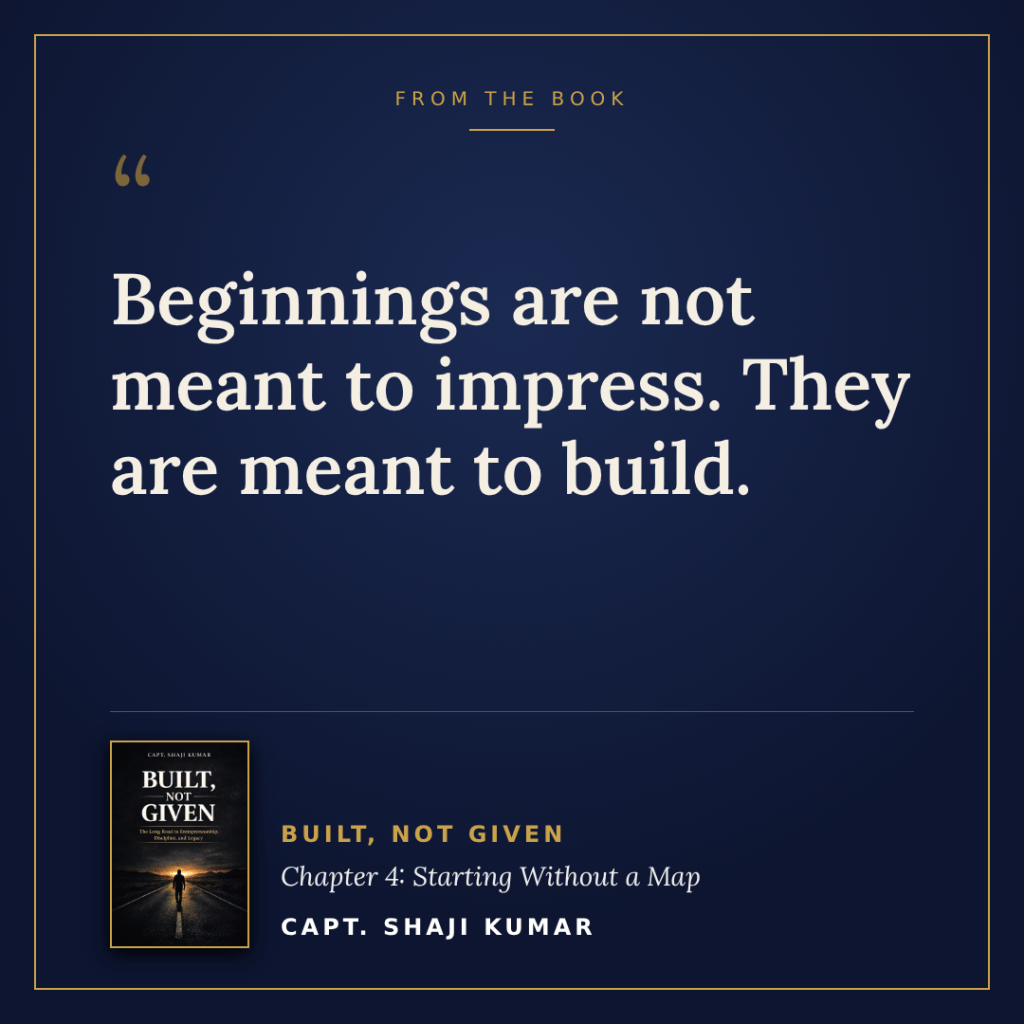
    Quote card from Built, Not Given by Capt. Shaji Kumar: Beginnings are not meant to impress. They are meant to build.

    Comparing your first chapter to someone else’s highlight reel?

    “Beginnings are not meant to impress. They are meant to build.”

    From Chapter 4 of Built, Not Given, “Starting Without a Map.”

    The chapter is honest about the early stage: an office that is small or does not exist yet, a tight budget, and the temptation to hide where you are starting. Its answer is not to hurry past that stage. It is to build through it.

    That is only one thread. Inside Built, Not Given: why the first battle is always internal, the Birbal strategy for keeping a distant light burning, the real price of building something of your own, and the loneliness nobody warns you about.

    If you are a young founder, or still deciding whether to start, this book is written for you.

    What are you building that does not look impressive yet?

    Capt. Shaji Kumar
    Clarity Under Pressure™. Stop Coping. Start Controlling.

    Get the book: Built, Not Given

  • The Human Side of Leadership: Why Emotional Intelligence Matters More Than Authority

    The Human Side of Leadership: Why Emotional Intelligence Matters More Than Authority

    You can command attention through your designation. You can demand performance through authority. But earning the trust of people requires something far more important: the ability to understand them.

    I have spent a considerable part of my professional life working with people.

    As a commissioned officer in the Indian Army, I learnt that leadership is not simply about giving instructions and expecting them to be followed. It is about understanding the people entrusted to your care, recognising their strengths, knowing their limitations and accepting responsibility for the decisions that affect them.

    Later, as an entrepreneur, I discovered that the same principle applied in an entirely different environment.

    Building a business, managing teams across multiple cities, dealing with customers, negotiating difficult situations and taking decisions that affected people’s livelihoods taught me something that no management textbook could fully explain.

    People may work for your organisation, but they do not leave their humanity at the office door.

    Every individual brings personal circumstances, ambitions, insecurities, expectations and emotions into the workplace. A leader who ignores this reality may be able to manage processes, but will struggle to lead people.

    This is where Emotional Intelligence becomes indispensable.

    Authority can make people follow. Emotional intelligence helps them believe.

    There is a fundamental difference between managing people and leading them.

    A manager can allocate responsibilities, establish targets, monitor performance and demand accountability. These are important parts of organisational management.

    But leadership goes further.

    It requires the ability to understand what motivates people, recognise what concerns them, appreciate how they respond to pressure and understand why two individuals may react very differently to the same situation.

    I have seen how easily leaders confuse silence with agreement, compliance with commitment and a lack of confrontation with satisfaction.

    An employee may agree with a decision in a meeting and still have serious reservations. A team member may appear disengaged because of a personal difficulty rather than a lack of professional interest. A disagreement may not be an act of defiance. It may be an attempt to point out something that others have overlooked.

    A leader who does not understand these distinctions is likely to misread situations and make poor decisions.

    Emotional intelligence allows us to pause before judging, listen before responding and understand before deciding.

    It does not make leadership softer. It makes leadership more informed.

    The Army taught me that people are not interchangeable

    My years in the Indian Army gave me an early understanding of responsibility and leadership under pressure.

    Military organisations operate within a defined structure. Roles are clearly established, responsibilities are assigned and decisions often have to be made within tight timelines.

    But no matter how well-defined the chain of command may be, leadership ultimately depends on people.

    A unit is not made effective merely by its equipment, procedures or organisational chart. It is the collective capability, discipline, morale and commitment of the people that determine its effectiveness.

    A leader must understand that individuals respond differently to pressure. Some need direction. Some need encouragement. Some need the opportunity to demonstrate what they can do. Others may need a difficult conversation.

    The responsibility of a leader is to recognise these differences without compromising the standards expected of the team.

    That distinction has stayed with me throughout my professional journey.

    The environment may change. The uniform may be replaced by business attire. The chain of command may give way to an organisational hierarchy. But the human element remains constant.

    You cannot lead effectively if you do not understand the people you are leading.

    Emotional intelligence is not about keeping everyone happy

    There is a misconception that an emotionally intelligent leader must always be agreeable, accommodating and diplomatic.

    I disagree.

    Leadership sometimes requires decisions that people will not welcome. There are situations where performance must be addressed, difficult feedback must be given, resources must be reallocated and changes must be implemented.

    Avoiding these conversations in the name of empathy is not emotional intelligence. It is an abdication of responsibility.

    Equally, emotional intelligence does not mean asking employees to suppress legitimate concerns, remain cheerful in difficult circumstances or accept every management decision without question.

    A leader must be capable of recognising when dissatisfaction is a consequence of poor communication and when it is a legitimate response to an unfair decision or an avoidable organisational problem.

    There is a significant difference.

    If a team is exhausted because of unrealistic workloads, a motivational speech about resilience is not the answer.

    If employees have lost confidence because management repeatedly fails to honour its commitments, a communication workshop will not repair the damage.

    If people are afraid to speak because disagreement is treated as disloyalty, telling them to be more open will achieve very little.

    Emotional intelligence must begin with an honest examination of the circumstances in which people are working.

    It cannot become a convenient way of asking employees to manage the emotional consequences of decisions they had no role in making.

    Empathy without accountability is incomplete leadership.

    The real test is how you behave when you are under pressure

    It is relatively easy to demonstrate patience when everything is going according to plan.

    The real test comes when targets are missed, customers are dissatisfied, financial pressures mount, deadlines are threatened or people make mistakes.

    This is when a leader’s emotional intelligence becomes visible.

    Does the leader react immediately or take time to understand what happened?

    Does the leader publicly embarrass someone or address the issue constructively?

    Does the leader listen to an explanation or assume that the first account is the complete truth?

    Does the leader acknowledge personal responsibility when a decision goes wrong, or immediately search for someone to blame?

    I have come to believe that a leader’s response during difficult moments often leaves a deeper impression than a hundred speeches about organisational values.

    People remember how they were treated when things went wrong.

    They remember whether they were heard, whether they were treated fairly and whether the person leading them accepted responsibility.

    You may forget a conversation after a few days. The person on the receiving end may remember it for years.

    That is the responsibility that comes with leadership.

    Building a business taught me the value of understanding people

    When I established my company in 1998, I was entering a new chapter of my professional life.

    Over the years, the business expanded across 16 cities and grew into an organisation with a turnover exceeding ₹130 crore.

    Building and managing an organisation at that scale involves much more than commercial decisions.

    It involves understanding customers, employees, colleagues, business partners and the different expectations they bring to the table.

    It also involves recognising that the same decision may be interpreted differently by different people.

    A decision that appears commercially necessary to the management may create uncertainty among employees. A change that seems operationally efficient may place additional pressure on a team. A performance-related conversation that management considers routine may have a significant effect on an individual’s confidence.

    This does not mean that every decision must be altered to accommodate every reaction.

    It means that a leader must understand the human consequences before deciding how to proceed.

    The ability to communicate a difficult decision honestly, listen to concerns and explain the reasoning behind it is an important part of leadership.

    People may not always agree with the decision. But they should not have to struggle to understand whether they have been treated with fairness and respect.

    Emotional intelligence begins with self-awareness

    We often concentrate on understanding other people. But the first person a leader must learn to understand is himself or herself.

    What happens when someone challenges your judgement?

    How do you react when a subordinate disagrees with you?

    Do you become defensive when your decisions are questioned?

    Can you recognise when frustration is influencing your judgement?

    Are you able to separate a person’s disagreement with your decision from their respect for you as a leader?

    These are important questions.

    A leader who cannot recognise personal emotional triggers may unintentionally allow them to influence decisions.

    Anger can become an excuse for harshness. Insecurity can become micromanagement. Ego can prevent someone from acknowledging a mistake. Anxiety can lead to excessive control.

    The problem is that the leader may not even recognise what is happening.

    Self-awareness creates the opportunity to interrupt these patterns.

    It allows us to distinguish between what a situation demands and what our emotions are pushing us to do.

    That is particularly important when decisions have consequences for other people.

    The five dimensions I consider essential

    I would encourage every leader to examine emotional intelligence through five practical dimensions.

    1. Self-awareness

    Understand your own emotional responses. Recognise your strengths, limitations, triggers and biases. You cannot manage what you refuse to acknowledge.

    2. Self-regulation

    Do not allow a momentary emotion to determine a decision with long-term consequences. Composure does not mean the absence of emotion. It means retaining control over your response.

    3. Empathy

    Make a genuine effort to understand another person’s perspective. Do not assume that everyone sees a situation through the same lens as you.

    4. Relationship management

    Learn to handle disagreements, build trust, communicate clearly and resolve conflict without turning every difference of opinion into a personal contest.

    5. Accountability

    This dimension deserves particular attention. Understanding people’s emotions is not enough. A leader must also examine the consequences of decisions, accept responsibility for mistakes and be willing to address the conditions that create unnecessary pressure.

    These dimensions are interconnected. None should be treated as a substitute for the others.

    Emotional intelligence in the age of change

    Today’s leaders are dealing with an environment that is changing at an extraordinary pace.

    Technology, artificial intelligence, new business models, changing workforce expectations and economic uncertainty are challenging established ways of working.

    But one thing has not changed.

    People still want to be treated with dignity. They want to know that their contribution matters. They want clarity about expectations and fairness in the way decisions are made.

    As organisations become more technology-driven, the human qualities of leadership will become even more important.

    Artificial intelligence may improve the speed of analysis and automate many routine activities. It may help leaders access information and make better-informed decisions.

    But it cannot relieve a leader of the responsibility to exercise judgement, understand human consequences and take accountability.

    Technology can support leadership. It cannot replace the responsibility of leading people.

    A lesson I continue to learn

    Today, through my work as an author, executive coach and through Clarity Under Pressure, I spend considerable time thinking about how people respond to pressure, uncertainty and change.

    I have learnt that people do not always need a leader who has an immediate answer to every problem.

    Sometimes they need someone who will listen without passing judgement.

    Sometimes they need clarity rather than reassurance.

    Sometimes they need a difficult truth delivered with respect.

    And sometimes they simply need a leader who is prepared to acknowledge that the situation is difficult rather than pretending that everything is under control.

    That, to me, is emotional intelligence in practice.

    It is not about becoming popular. It is not about avoiding confrontation. It is certainly not about manipulating people’s emotions to secure compliance.

    It is about understanding the human beings behind the roles they perform and recognising the responsibility that comes with having authority over their work.

    The final word

    Leadership is often measured through results, growth, profitability, targets and organisational performance.

    These measures matter. But they do not tell the entire story.

    We must also ask what kind of organisation we are building, what kind of relationships we are creating and what people experience while working under our leadership.

    A leader who consistently delivers results but leaves behind a trail of damaged relationships, diminished confidence and disengaged people should examine what success really means.

    Emotional intelligence is not an optional leadership accessory. It is central to the ability to lead responsibly.

    You may have the experience, the qualifications, the designation and the authority.

    But if you cannot understand people, manage your own reactions, listen to difficult feedback and accept the human consequences of your decisions, your leadership will always remain incomplete.

    People may follow your instructions because they have to. They will give you their trust only when they believe you understand and respect them.

    And trust, once earned, is one of the most valuable assets a leader can build.

  • The Leader Who Refuses to Reinvent Himself Will Eventually Lead from the Past

    The Leader Who Refuses to Reinvent Himself Will Eventually Lead from the Past

    Leadership is not about becoming a different person every few years. It is about having the courage to question what once made you successful, recognise when the world has changed, and find the strength to begin again.

    There is a dangerous moment in every leader’s life.

    It does not necessarily arrive when a business fails, when a career stalls, or when an important decision goes wrong. Sometimes, it arrives when everything that once worked continues to feel comfortable.

    The leader knows the answers. The methods are familiar. The experience is considerable. The reputation has been earned. People still turn to that person for guidance.

    And somewhere beneath this apparent stability, the world has begun to move on.

    The market has changed. Customers have different expectations. Technology has altered the rules. Younger professionals think differently. The very qualities that once created an advantage may no longer be enough.

    This is where leadership faces its real test.

    Can you question the person you have become without denying the person you have been?

    I have learnt that question through experience, not theory.

    My first reinvention began when I was 29

    In September 1993, I left the Indian Army.

    I had served for five years as a Captain in the Indian Army, taking on responsibilities that included Battery Second-in-Command, Adjutant, Regiment Quartermaster and Battery Commander.

    The Army gave me discipline, responsibility, an understanding of systems, and the ability to function under pressure. It taught me that leadership is not a title on a visiting card. It is the responsibility to make decisions, take ownership and move people towards a common objective.

    But leaving the Army brought a different challenge.

    The structure I had known was gone. The chain of command no longer existed around me. The experience that had been meaningful and valuable within a military environment did not automatically translate into a civilian career.

    I had the ability. I had the discipline. What I lacked was a map.

    That distinction matters.

    Sometimes, people do not struggle because they lack talent. They struggle because the environment in which their talent was developed has changed, and they have not yet learnt how to apply it in the new environment.

    I could have spent years defining myself by what I had been. Instead, I had to learn how to build on it.

    The task was not to discard my Army experience. It was to discover how that experience could serve a different purpose.

    That was my first important lesson in reinvention: your past should be your foundation, not your prison.

    The next chapter required a different kind of leadership

    In 1998, I established my own business.

    Building a company from the ground up required more than transferring military discipline into the corporate world. I had to understand customers, commercial realities, recruitment, relationships, people management and the economics of running an enterprise.

    Over the years, the business expanded across 16 cities and grew into an organisation with a turnover of more than ₹130 crore.

    That journey took time. It demanded decisions, persistence, learning and the willingness to take responsibility for outcomes.

    But here is something leaders often overlook.

    The qualities that help you establish an organisation are not always the same qualities required to lead it at the next stage.

    In the beginning, a founder may need to be involved in almost everything. Every customer matters. Every rupee counts. Every problem finds its way to the founder’s desk.

    As the organisation grows, the leader must learn to delegate, develop other leaders, create systems and resist the temptation to remain the centre of every decision.

    The founder who cannot make that transition becomes the organisation’s biggest bottleneck.

    The same principle applies to executives, military officers, entrepreneurs and professionals.

    A leadership style that works for a team of five may not work for a team of five hundred. A strategy that succeeds in one market may fail in another. A reputation built over twenty years cannot guarantee relevance for the next twenty.

    Experience is valuable, but experience without reflection can become a collection of outdated assumptions.

    The question is not whether your old methods once worked. The question is whether they are still serving the purpose you now have to fulfil.

    Reinvention is not the same as abandoning yourself

    I want to make an important distinction here.

    Reinvention has become a popular word. It is often presented as the need to keep changing one’s identity, acquiring new skills, developing a fresh personal brand and constantly proving one’s relevance.

    That can easily become exhausting.

    If every change in the market forces you to question your worth, you will spend your life chasing the next definition of success. If every setback makes you believe that your entire identity is obsolete, you will repeatedly start from zero.

    Neither is necessary.

    Effective reinvention begins with discernment.

    You must know what to preserve and what to change.

    Preserve your principles. Reconsider your methods.

    Preserve your integrity. Reassess your strategy.

    Preserve the wisdom gained from experience. Remain willing to question the conclusions you drew from it.

    Preserve your sense of purpose. Be flexible about the route you take to fulfil it.

    A leader does not need to become a new person every time circumstances change. A leader needs to understand which parts of the old approach remain useful and which parts are no longer adequate.

    This is especially important in times of uncertainty. Under pressure, we instinctively reach for familiar responses. But familiarity and effectiveness are not the same thing.

    At Clarity Under Pressure, this is one of the principles I return to repeatedly: the ability to pause, examine the situation honestly, distinguish facts from assumptions and choose a response rather than simply repeat a reaction.

    Sometimes the most courageous leadership decision is not to do more of what made you successful.

    It is to acknowledge that the next stage requires something different.

    When circumstances change, leaders have two responsibilities

    There is a question that deserves serious attention: why is the burden of change so often placed entirely on the individual?

    Organisations frequently ask their people to become more adaptable. Employees must learn new technologies, acquire new capabilities and prepare for changing roles. Entrepreneurs must respond to changing customer behaviour. Leaders must keep pace with artificial intelligence and evolving markets.

    Much of this adaptation is necessary.

    But there is a difference between helping people develop and expecting them to absorb every consequence of decisions made elsewhere.

    A responsible leader does not merely ask, “How can my people adapt?”

    The leader also asks, “What must I change about the way we work?”

    If a team is repeatedly exhausted, is the problem a lack of resilience, or are the priorities unrealistic?

    If employees cannot perform effectively, do they need more training, or are the systems preventing them from doing their jobs?

    If a business is losing customers, should the sales team simply work harder, or must the organisation reconsider its product, service or value proposition?

    If technology is changing an industry, is the answer to demand that everyone learn new tools, or must the leadership also rethink roles, processes, training and the distribution of the benefits?

    These questions separate genuine leadership from the convenient practice of transferring responsibility downwards.

    Reinvention must not become an excuse for leaders to avoid examining the systems they control.

    The best leaders reinvent themselves, but they also have the courage to reinvent the conditions in which others work.

    The most dangerous sentence in leadership

    There is one sentence that should make every experienced leader pause:

    “This is how we have always done it.”

    It sounds harmless. Sometimes, it reflects a process that has stood the test of time. But often, it is a defence against the discomfort of learning something new.

    I have seen how experience can become a source of confidence. That is one of its great advantages. An experienced leader has seen enough to recognise patterns, anticipate consequences and avoid unnecessary mistakes.

    Yet experience can also make us selective about the evidence we accept.

    We remember the decisions that worked. We develop explanations for the ones that did not. Gradually, our past successes become the basis for assumptions that we stop examining.

    The world does not owe us continued success simply because we were successful before.

    A leader must therefore cultivate the discipline of asking uncomfortable questions:

    • What has changed that I may not have recognised?
    • Which of my strengths could become limitations if I overuse them?
    • What am I defending simply because I invested years in building it?
    • Which voices have I stopped listening to?
    • If I were starting today, knowing what I know now, what would I do differently?

    These are not questions of weakness. They are instruments of professional maturity.

    The leader who asks them early can often change course before circumstances force the decision.

    Reinvention after sixty is not a contradiction

    There is another dimension to this subject that matters deeply to me.

    We tend to divide life into stages. We study in our youth, establish ourselves in adulthood, build a career, accumulate experience and eventually begin to think about slowing down.

    But why should the acquisition of wisdom signal the end of contribution?

    A person who has spent decades leading teams, building businesses, managing people or navigating difficult decisions possesses something that cannot be acquired through a short course: lived experience.

    That experience does not automatically make someone relevant. It must still be examined, updated and translated into a form that others can use.

    But it is an extraordinary resource when combined with humility and a willingness to learn.

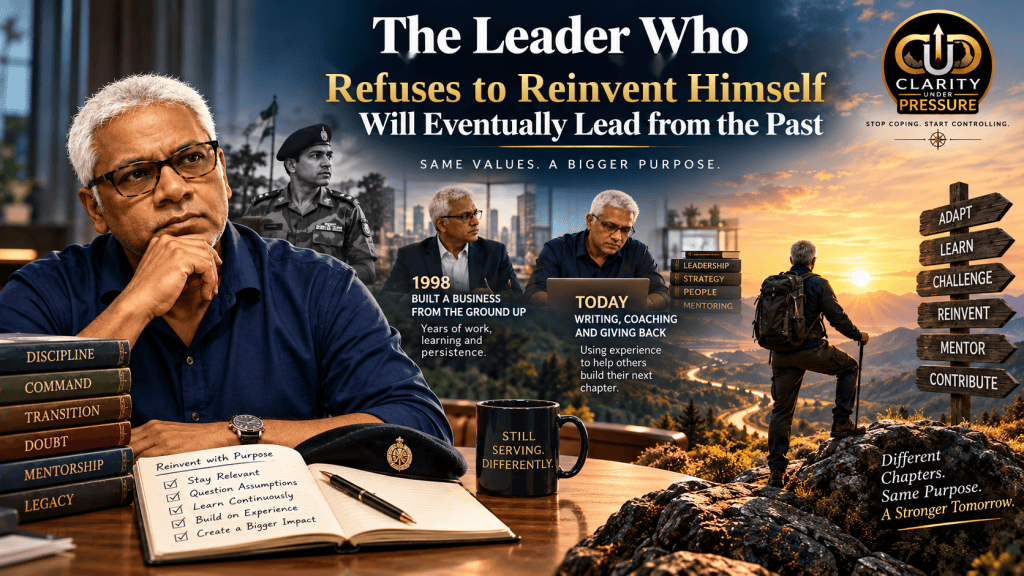
    My own journey continues to evolve. The Army chapter taught me discipline. Entrepreneurship taught me commercial realities and the demands of building something from nothing. Writing has given me a way to examine experience and communicate ideas. Coaching offers an opportunity to help others think through their decisions. Through Clarity Under Pressure and the Global Learning Centre, I am working to turn accumulated experience into something useful for professionals, entrepreneurs and people preparing for their next chapter.

    These are not unrelated identities. They are different expressions of a continuing purpose.

    I do not have to erase the Army officer to become an entrepreneur. I do not have to abandon the entrepreneur to become a coach or author.

    I can carry forward what each chapter taught me while recognising that the next chapter requires new ways of thinking and working.

    That is the distinction between reinventing yourself and losing yourself.

    One builds on experience. The other runs away from it.

    And there is no reason to assume that the capacity to contribute expires on a particular birthday.

    What leaders must learn in the age of AI

    The need for reinvention is becoming more visible as artificial intelligence and automation reshape work.

    New tools are emerging. Established roles are changing. Skills that were valuable yesterday may need to be supplemented by new capabilities tomorrow.

    Leaders cannot afford to ignore these developments.

    But neither should they confuse the acquisition of every new tool with meaningful transformation.

    A leader who adopts AI without reconsidering the underlying business problem may simply automate an inefficient process. An organisation that trains employees in new software without giving them clarity about their responsibilities may create activity without improving outcomes.

    Technology is an instrument. Leadership determines the purpose for which it is used.

    The real task is to remain curious, understand what is changing, identify what matters and make deliberate choices about how to respond.

    You do not need to become an expert in everything. You need to recognise what you must understand, where you need specialist help and which assumptions require revision.

    The same applies to every major transition, whether technological, economic or personal.

    Reinvention is not an endless race to acquire more.

    It is the ability to identify what the next stage demands and prepare intelligently for it.

    A practical discipline for leaders who want to remain relevant

    Reinvention becomes useful when it moves beyond a motivational slogan and becomes a leadership practice.

    I would begin with five disciplines.

    1. Conduct an honest review.

    Examine your current role, business or professional direction. Identify what is working, what is deteriorating and what you may be refusing to acknowledge.

    2. Separate your identity from your position.

    Your designation, company, professional reputation and current source of income are parts of your life. They are not the complete measure of your ability or worth. Knowing this gives you the freedom to explore alternatives without treating every change as a personal defeat.

    3. Build on what you already know.

    Do not discard decades of experience in the pursuit of something fashionable. Identify the underlying capabilities you can transfer into a new role, market or purpose. Then identify the gaps you must close.

    4. Run small experiments before making large commitments.

    Test an idea. Speak to people who understand the field. Undertake a pilot project. Learn a new skill in a practical setting. Smaller experiments can help you discover whether a new direction deserves greater investment.

    5. Review the environment, not just yourself.

    If you lead an organisation, examine its systems, incentives, decision-making processes and culture. If you are navigating a career transition, assess the real opportunities and constraints around you. Do not assume that every difficulty can be solved by working harder on yourself.

    These disciplines make reinvention a considered response to reality rather than a reaction to fear.

    The leader’s final responsibility

    Leadership is ultimately about preparing for a future that cannot be managed entirely through yesterday’s experience.

    The irony is that the longer we have been successful, the more difficult it can become to question our methods. We have invested time, reputation and emotion in building what we have. Changing direction can feel like an admission that the past was wrong.

    It need not be.

    A decision can have been right for its time and still be inadequate for the present. A skill can have served you brilliantly and still require updating. A professional identity can have given your life meaning without needing to define every chapter that follows.

    The objective is not perpetual change. It is purposeful evolution.

    My transition from military service to entrepreneurship taught me that capability must sometimes find a new expression. Building a business taught me that growth requires different forms of leadership at different stages. My continuing work in writing, coaching and learning reinforces the belief that experience becomes more valuable when we remain willing to examine it and share what it has taught us.

    If there is one lesson I would offer another leader, it is this:

    Do not wait for a crisis to discover that your old methods are no longer sufficient. Do not confuse loyalty to your past with an obligation to repeat it. And do not demand that your people change while exempting yourself from the same responsibility.

    The leader who continues learning retains the ability to choose.

    The leader who stops learning eventually allows circumstances to choose on their behalf.

    Your next chapter does not require you to deny everything you have achieved. It requires you to decide what those achievements have prepared you to do next.

    That is the real work of reinvention.

    And it begins with one question:

    What must I be willing to change so that I can continue to lead with purpose?

    Capt. Shaji Kumar (Retd)

    Army Veteran | Entrepreneur | Author | Executive Coach

    Clarity Under Pressure. Stop Coping. Start Controlling.

    If this resonated, subscribe to Clarity Under Pressure for the next weekly edition.

  • The Five Minutes That Could Change Your Next Decision

    There was a service line I had invested in. Time. Effort. People. We had built the capability. We had put in the work. But the results were not coming. Not consistently.

    I held on. Because I had invested. Because I believed it would turn. Because letting go felt like failure.

    Months passed. Then more. And slowly, I realised something uncomfortable. I was no longer holding the business. The business was holding me.

    That is a dangerous place to be. It took attention from the areas that were working. It drained energy that could have gone elsewhere. It was a quiet drag, constant without ever being dramatic.

    The decision to let go came late. But when it came, it was clear. We shut it down. We reallocated resources. We focused on what was already working. The impact was immediate. Clarity returned. Execution improved. Energy shifted.

    Nothing new had been added. Something misaligned had simply been removed.

    I have thought about that period many times. What stayed with me was not the shutdown. It was how long I took to see what was already in front of me. I was not short of intelligence. I was short of clarity. And I was under pressure, which is when thinking becomes noisy. We rush. We assume. We confuse urgency with importance. We protect what we have already spent instead of asking what is true today.

    Most bad decisions are not made because people lack intelligence. They are made because people are under pressure.

    If I had stopped for five quiet minutes and answered a few honest questions, I believe I would have decided months earlier. So I put those questions on one page.

    The 5-Minute Clarity Check has seven questions.

    1. What is actually happening?
    2. What am I assuming?
    3. What is within my control?
    4. What decision needs to be made?
    5. What happens if I do nothing?
    6. What is the worst realistic outcome?
    7. What is my next intelligent move?

    Write short, honest answers. Do not try to be perfect. Finish with one next action, not a grand plan.

    Question two is the one that would have helped me most. I was assuming that the service line would turn. I was treating a hope as a fact. Question five would have helped too. Doing nothing was a decision, and it was costing me every single month.

    Five minutes is a starting reset, not a deadline. Give yourself more time when the decision is big. And this worksheet does not replace qualified legal, medical, financial or other professional advice. But before your next important decision, pause. Separate what you know from what you fear. Then decide.

    It is free. Download your copy here: https://shajikumar.com/clarity-check/

    If you use it, I would genuinely like to know what you found. Reply to this post and tell me.

    Clarity Under Pressure™. Stop Coping. Start Controlling.

    Capt. Shaji Kumar

  • Success Can Make a Leader Arrogant. Failure Can Make One Fearful.

    Success Can Make a Leader Arrogant. Failure Can Make One Fearful.

    The real test of leadership is not how you behave when everything goes right or when everything falls apart. It is whether you retain your judgement, humility and perspective when circumstances are beyond your control.

    There is a dangerous assumption in leadership.

    When things go well, we tend to believe that our decisions, intelligence, hard work and strategic thinking were entirely responsible for the outcome.

    When things go wrong, we search for the mistake. We question our judgement, blame our decisions and sometimes conclude that we were never good enough.

    Both conclusions can be misleading.

    The truth is that success and failure are rarely the exclusive products of individual effort. They are shaped by decisions, preparation, timing, circumstances, people, opportunities and events that may be completely outside our control.

    I believe this is one of the most important lessons a leader must understand.

    You must take responsibility for your decisions without becoming arrogant about your successes or allowing your failures to destroy your confidence.

    The part of success we rarely acknowledge

    In my professional journey, I have occupied different positions and experienced very different environments.

    I served as a commissioned officer in the Indian Army. I subsequently moved into civilian employment and eventually established my own company in 1998.

    The business grew over the years, expanded across 16 cities and reached a turnover of more than ₹130 crore.

    There was considerable effort behind that journey. There were decisions to be made, relationships to build, people to manage, risks to take and problems to solve. None of it happened automatically.

    But would it be accurate to say that every successful outcome was entirely the result of my individual ability?

    I do not think so.

    There were people who believed in the business. There were customers who gave us opportunities. There were employees whose commitment helped build the organisation. There were market conditions, timing and circumstances that influenced our progress.

    Some decisions worked because we had thought them through carefully. Others benefited from circumstances falling into place.

    That distinction matters.

    A leader who attributes every success to personal brilliance eventually develops an exaggerated opinion of his or her own judgement.

    And that is when success becomes dangerous.

    It creates the illusion that because you have succeeded before, you will continue to succeed.

    But the world does not operate according to our expectations.

    Markets change. Customers change. Competitors emerge. Technology disrupts established models. People make decisions that affect our plans. Circumstances shift without seeking our permission.

    What worked yesterday may not work tomorrow.

    The ability to recognise this is not pessimism. It is maturity.

    Luck and risk are two sides of the same reality

    We often talk about luck as though it is something that belongs only to other people.

    When someone else succeeds, we may attribute it to the right connections, favourable circumstances or being in the right place at the right time.

    When we succeed, we prefer to talk about our hard work, determination and strategic brilliance.

    This is a convenient way of looking at the world, but it is not an honest one.

    If we acknowledge that circumstances beyond our control can contribute to success, we must also accept that circumstances beyond our control can contribute to failure.

    The same uncertainty that creates an opportunity can also create a setback.

    A business may benefit from a sudden change in market demand. Another may suffer because of an unexpected disruption.

    A leader may make a sound decision, but an external event may render the outcome unfavourable.

    A competitor may make an apparently brilliant move, only for a completely unrelated development to change the market.

    This does not mean that effort and judgement are unimportant. Quite the opposite.

    It means that leaders must distinguish between what they can control, what they can influence and what they must simply prepare to face.

    I would argue that this distinction should be at the heart of every leadership decision.

    Take responsibility for your actions. Respect the forces you cannot control. Never confuse the two.

    Success is a particularly dangerous teacher

    One of the most common mistakes I have observed in leadership is the tendency to become overconfident after a period of success.

    A business performs well for several years. The founder begins to believe that the business model is virtually invincible.

    A senior executive delivers a series of successful projects. Gradually, the executive starts believing that personal judgement is always superior to the judgement of others.

    A manager achieves exceptional results and begins to assume that the same methods will work in every situation.

    The danger is not success itself.

    The danger is what success can make us believe about ourselves.

    When things are going well, we may stop asking difficult questions. We may become less attentive to warning signs. We may take larger risks because previous risks worked out. We may begin to confuse a favourable outcome with proof that every decision was correct.

    That is how confidence turns into complacency.

    A leader must remember that a successful outcome does not necessarily validate every decision that preceded it.

    Sometimes a good decision produces a disappointing result because circumstances intervene.

    Sometimes a poor decision produces a favourable result because circumstances happen to cooperate.

    The outcome is important, but it is not the only measure of the quality of the decision.

    This is particularly relevant when reviewing business performance.

    Did we succeed because our strategy was sound, or did the market simply move in our favour?

    Did we make a good investment, or did we benefit from favourable timing?

    Did our leadership approach create sustainable performance, or did the team compensate for weaknesses in the system?

    These are questions that successful leaders must be willing to ask.

    Failure can be an equally misleading teacher

    There is another side to this.

    Failure can be just as damaging to a leader’s judgement as success.

    When something goes wrong, we tend to revisit every decision and question everything we did.

    We may conclude that we lacked the necessary ability, that our strategy was fundamentally flawed or that we should never have taken the risk in the first place.

    But not every failure is proof of poor judgement.

    Sometimes the decision was reasonable, the preparation was adequate and the risks were understood. The outcome was still unfavourable because uncertainty is part of every meaningful undertaking.

    Of course, this must never become an excuse for avoiding accountability.

    If we made a poor decision, ignored evidence, failed to prepare or refused to listen to people who raised legitimate concerns, we must acknowledge it.

    But we must also avoid the opposite mistake of treating every unfavourable outcome as a personal failure.

    There is a difference between learning from a mistake and losing confidence in your ability to make decisions.

    A leader who cannot distinguish between the two may become excessively cautious.

    Every new opportunity begins to look like a potential disaster. Every decision is postponed.

    Every risk is magnified.

    Eventually, the fear of making another mistake becomes more damaging than the original failure.

    Leadership requires the ability to recover, reflect and make the next decision with better judgement.

    Not every setback should make you abandon the journey.

    Sometimes it should simply make you examine the route.

    The leader’s responsibility is to prepare for uncertainty

    If we accept that outcomes are influenced by factors beyond our control, how should we lead?

    I believe the answer lies in preparation, perspective and the ability to adapt.

    We cannot eliminate uncertainty, but we can improve our ability to respond to it.

    During my years in business, I learnt that growth should never be confused with invulnerability.

    An organisation may be performing well, but that is precisely when its leadership should be examining vulnerabilities.

    Are we overly dependent on one customer?

    Are we relying on one source of revenue?

    Have we built systems that can function without the founder being involved in every decision?

    Are we listening to changes in customer behaviour?

    Do we have sufficient financial resilience to withstand an unexpected disruption?

    Are we developing people who can lead when circumstances change?

    These questions may not appear urgent when business is booming. But that is exactly when they should be asked.

    It is relatively easy to talk about risk management when a crisis has already arrived.

    The real leadership test is whether you prepare for the possibility of disruption while everything appears to be working.

    I have come to believe that a leader’s job is not to predict every eventuality. It is to build an organisation that does not collapse simply because something unexpected happens.

    Never allow success to make you forget the people who helped create it

    There is another dimension to this subject that deserves attention.

    When an organisation succeeds, the person at the top often receives much of the recognition.

    The founder becomes the face of the business. The CEO is credited with the turnaround. The senior leader is praised for the team’s performance.

    But no significant organisation is built by one person alone.

    Behind every successful leader are people who contributed in ways that may never be fully acknowledged.

    Employees who stayed committed during difficult periods. Colleagues who challenged decisions. Customers who trusted the organisation. Partners who supported its growth.

    Families who accepted the sacrifices that came with the journey.

    A leader who recognises the role of others remains grounded.

    A leader who takes all the credit eventually creates an environment in which people feel invisible.

    And when people stop feeling valued, the organisation begins to lose something far more important than a performance metric.

    It begins to lose trust.

    Humility is therefore not simply a personal virtue. It is an organisational responsibility.

    Five leadership lessons from luck and risk

    I would like to leave fellow leaders with five principles that I consider particularly important.

    1. Do not become intoxicated by success.

    Celebrate achievements, but continue questioning your assumptions. Success should strengthen your confidence, not weaken your curiosity.

    2. Do not allow failure to define your ability.

    Examine what went wrong. Separate avoidable mistakes from circumstances beyond your control. Learn without destroying your confidence.

    3. Build resilience into your decisions.

    Do not create a business or a career that depends entirely on everything going according to plan. Prepare for disruption.

    4. Share credit and accept responsibility.

    When things go well, acknowledge the contribution of others. When things go wrong, do not rush to transfer blame.

    5. Remain adaptable.

    The circumstances that created your success may not remain the circumstances that sustain it. Keep learning, questioning and adjusting.

    These principles apply whether you are leading a small team, managing a large organisation, building a business or navigating a professional transition.

    Clarity Under Pressure: Perspective is a leadership advantage

    Today, through my work in writing, executive coaching and Clarity Under Pressure, I often return to the importance of perspective.

    Pressure has a way of distorting our judgement.

    Success can make us believe that we are in complete control. Failure can make us believe that we have lost all control.

    Neither perception is necessarily accurate.

    The ability to step back, examine the facts, recognise the role of circumstances and decide what to do next is an essential leadership capability.

    It is also one of the most difficult capabilities to develop.

    We must learn to celebrate without becoming complacent, accept responsibility without carrying unnecessary guilt, take risks without becoming reckless and remain confident without assuming that we are invincible.

    That balance is what separates mature leadership from the temporary excitement of success.

    The final word

    I have seen enough of professional life to understand that the road to success is rarely as straightforward as it appears when viewed in retrospect.

    We often construct a neat story around our achievements. We identify the decisions that worked, the risks we took and the qualities that helped us succeed.

    But the complete story is usually more complicated.

    There were opportunities we did not create. There were circumstances we could not control.

    There were people who made a difference. There were risks that could have produced a very different outcome.

    And there were decisions that taught us lessons we would not have learnt otherwise.

    This is why I believe leaders must develop a healthy respect for uncertainty.

    Do not assume that success makes you invincible.

    Do not assume that failure makes you incapable.

    Do not judge another person’s journey merely by its visible outcome. You rarely know the full story behind someone else’s success or setback.

    And never become so attached to your past achievements that you stop preparing for what comes next.

    The mark of a mature leader is not the ability to control every outcome. It is the wisdom to make the best decisions possible, the humility to recognise what lies beyond personal control and the resilience to respond when circumstances change.

    Nothing is entirely as good or as bad as it may appear at first.

    Leadership begins when we learn to see beyond the immediate outcome.

    Capt. Shaji Kumar (Retd)

    Army Veteran | Entrepreneur | Author | Executive Coach

    Clarity Under Pressure. Stop Coping. Start Controlling.

    If this resonated, subscribe to Clarity Under Pressure for the next weekly edition.

    Inspired by themes explored in Morgan Housel’s The Psychology of Money, particularly the relationship between luck, risk, success and failure.

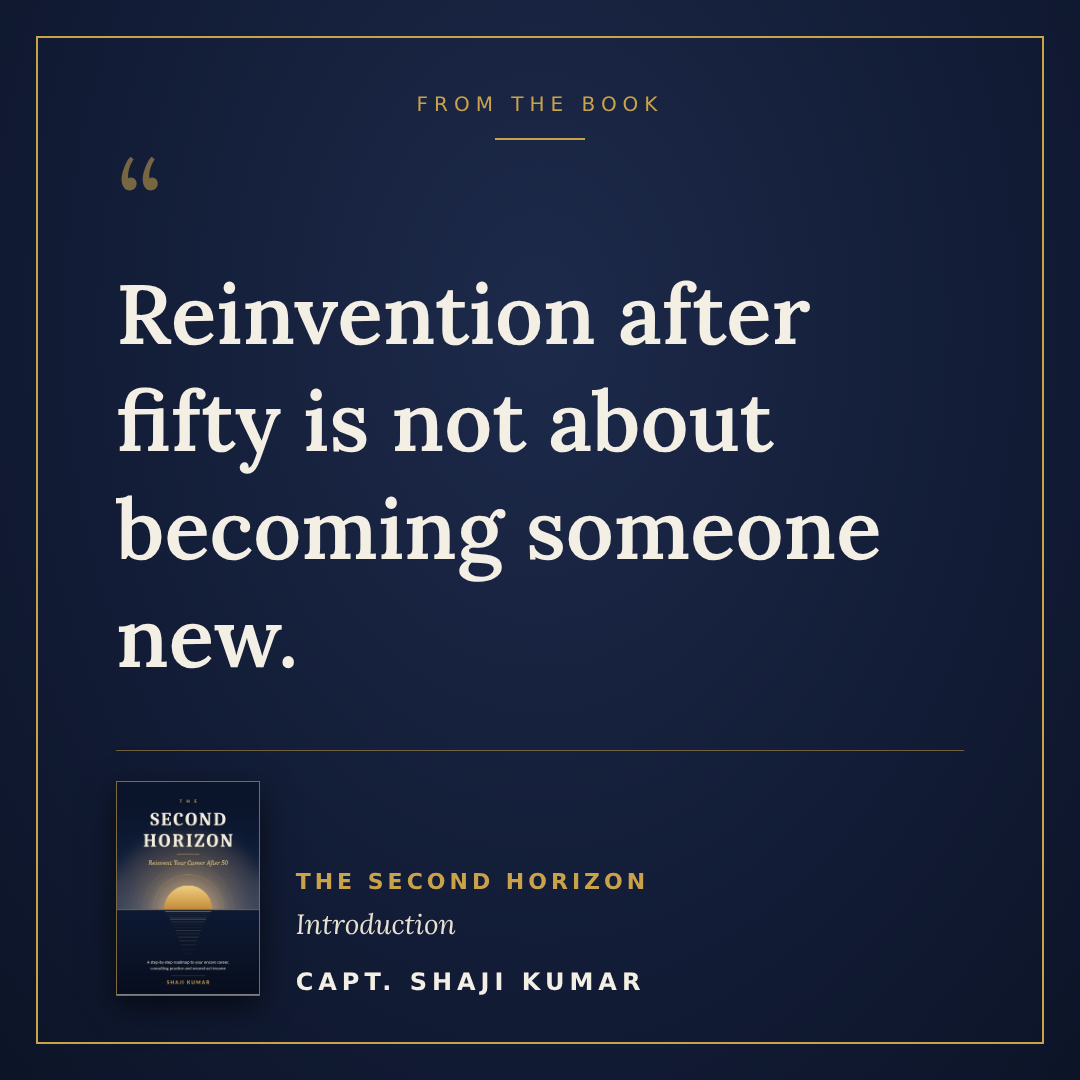
  • Reinvention After Fifty Is Not About Becoming Someone New.

    Reinvention After Fifty Is Not About Becoming Someone New.

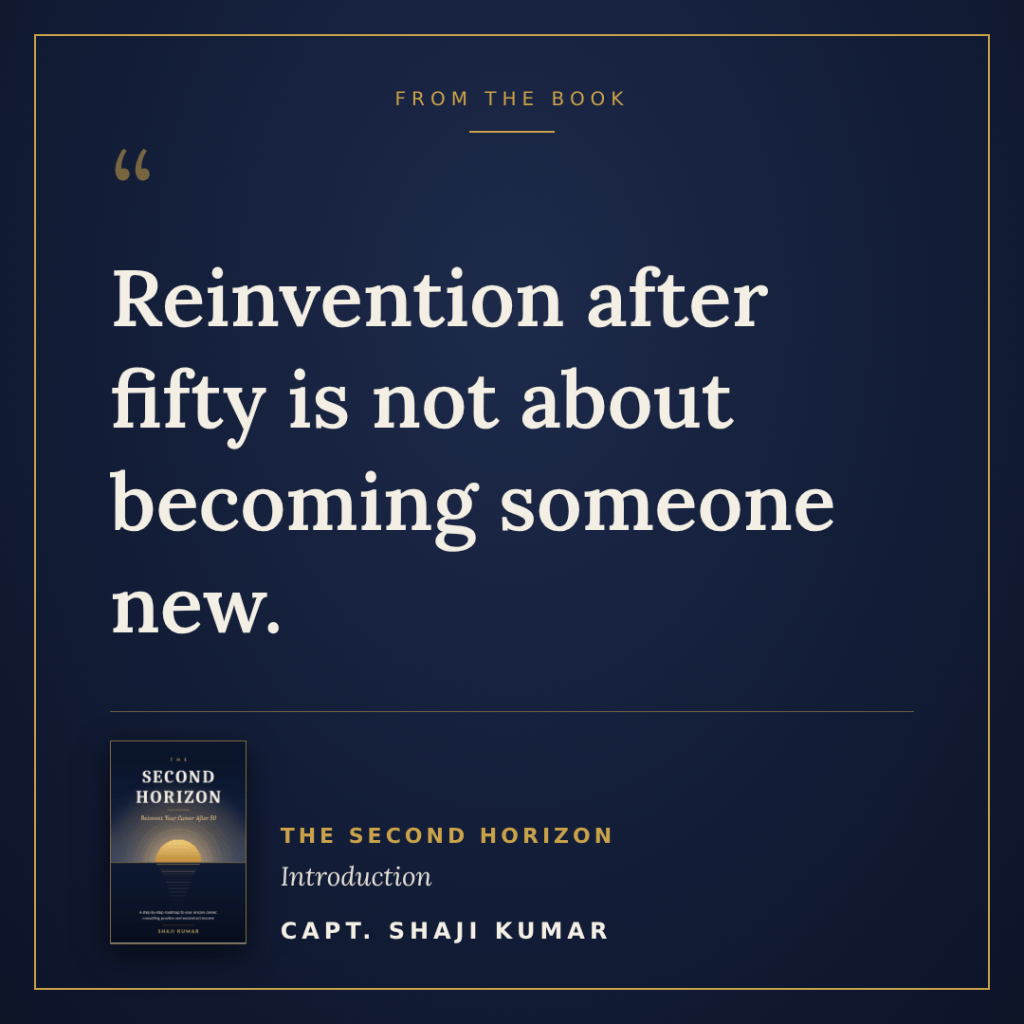
    Quote card from The Second Horizon by Capt. Shaji Kumar: Reinvention after fifty is not about becoming someone new.

    Retirement is not the finish line. It is a fork in the road.

    “Reinvention after fifty is not about becoming someone new. It is about becoming more fully the person your experience has already made you, and then putting a name, a price and a place on it.”

    From the Introduction of The Second Horizon, “Reinvent Your Career After 50.”

    For most of the twentieth century, life came in three boxes: learn, work, rest. People now live into their eighties and nineties, which leaves twenty-five or thirty years that the old model never planned for. The real gap is not only money. It is purpose, structure and identity.

    The Second Horizon is a working manual for that stretch. It gives you ten steps, from auditing your lifetime skill stack to designing a signature advisory offer, pricing your advice and winning your first five clients. Every chapter ends with an action you can finish in an afternoon. It is a roadmap, not a guarantee of income.

    What is the first thing you would put a name and a price on?

    Capt. Shaji Kumar
    Clarity Under Pressure™. Stop Coping. Start Controlling.

    Get the book: The Second Horizon

  • Leadership Begins When You Stop Trying to Be the Hero

    Leadership Begins When You Stop Trying to Be the Hero

    On self-mastery, difficult decisions, and the quiet courage to lead when circumstances refuse to cooperate.

    I have spent a considerable part of my life observing leadership from two very different worlds. The Indian Army taught me the importance of discipline, responsibility and functioning under pressure. The corporate world taught me that even the best plans can be undone by people, markets and circumstances that refuse to follow the script.

    Over the years, I have come to believe that we often misunderstand leadership.

    We celebrate the appointment, the promotion, the new office, the successful venture and the moment when a person finally gets the authority he has worked so hard to acquire. We admire the leader who takes charge, makes a bold announcement and appears to have all the answers.

    But these are not necessarily the moments that define a leader.

    The real test begins when something goes wrong.

    When a decision produces an unexpected consequence. When a trusted colleague disappoints you. When a business faces a challenge you did not anticipate. When the people who once looked to you for answers begin to question whether you have any.

    There is no applause in these moments. There is no carefully prepared speech. There is only a difficult situation, a set of imperfect choices and the knowledge that your response will affect more people than yourself.

    That is where leadership begins to reveal its true character.

    The first person you must learn to lead is yourself

    One of the most important lessons I have learnt is that professional competence and emotional maturity are not the same thing.

    A person may possess exceptional knowledge, considerable experience and an impressive record of achievement, yet struggle when circumstances challenge his sense of control.

    We have all seen capable people make poor decisions because they were angry, frightened, embarrassed or too invested in proving themselves right.

    The problem is rarely a lack of intelligence. More often, it is the inability to create a small but essential distance between what happens to us and how we choose to respond.

    In the Army, discipline is not meant to be a uniform you wear in public. It must become part of how you conduct yourself when nobody is watching.

    The same principle applies in business.

    When a customer walks away, when a deal falls through, when cash flow tightens or when an employee makes an expensive mistake, the immediate temptation is to react. We want to assign blame, defend our decisions or demonstrate that we are still in control.

    But reaction is not leadership.

    Leadership requires us to pause long enough to distinguish between what we feel, what we know and what we need to do.

    Anger may be justified, but it does not automatically make our judgement reliable. Fear may be understandable, but it should not become the architect of our decisions. Pride may be natural, but it must never become more important than the truth.

    The first responsibility of a leader is not to control the people around him. It is to ensure that his own emotions do not take control of the situation.

    This is easier to write about than to practise. I know that. Years of experience do not make us immune to human weaknesses. They merely give us more opportunities to recognise them and, hopefully, respond better the next time.

    When the room looks to you for stability

    There is a particular kind of silence that descends on a room when something serious has gone wrong.

    People stop speaking casually. Conversations become shorter. Someone looks at the clock. Someone else looks at you.

    They may not say it aloud, but the question is unmistakable.

    What happens now?

    In such moments, people are not necessarily expecting you to produce an instant solution. Often, they are looking for reassurance that the situation can still be understood, that the facts will be examined and that the next decision will not be made out of panic.

    A leader’s behaviour has consequences beyond his immediate actions. It influences how others interpret a crisis and how effectively they respond to it.

    If you become volatile, the room becomes more volatile. If you begin blaming people before understanding what happened, others start protecting themselves instead of solving the problem. If you pretend that nothing is wrong, you destroy the opportunity to confront reality while there is still time to act.

    Composure, therefore, is not about appearing fearless.

    It is about being able to acknowledge the seriousness of a situation without allowing its seriousness to overwhelm your judgement.

    There is a difference between being calm and being indifferent. There is also a difference between being decisive and being impulsive.

    A calm leader does not ignore the danger. He studies it.

    A decisive leader does not rush simply to appear strong. He understands when action is necessary, what information is available and what consequences must be considered.

    And a mature leader knows that sometimes the most useful thing he can say is, “I do not have the complete answer yet. Let us establish the facts before we decide.”

    That statement does not diminish authority. Used honestly, it strengthens credibility.

    The danger of making yourself the centre of everything

    Building a business teaches you some difficult lessons about ownership, responsibility and the limits of personal control.

    When you start something of your own, it is natural to become emotionally attached to it. The business begins to represent more than revenue or market share. It becomes an extension of your identity, your ambition and your belief in what you are capable of creating.

    That attachment can be a source of extraordinary energy.

    It can also become a blind spot.

    You begin to confuse criticism of the business with criticism of yourself. You find it difficult to abandon an approach that is no longer working because you have invested too much in it. You hold on to decisions longer than necessary because changing your mind feels like admitting defeat.

    At some point, the question changes from “What is best for the enterprise?” to “How do I protect my position?”

    That is a dangerous moment for any leader.

    A business, institution or team cannot become healthier than the quality of decisions made on its behalf. And decisions become distorted when the leader’s ego occupies more space than the problem itself.

    I have come to value a simple distinction: responsibility is not the same as personal attachment.

    Responsibility requires you to care deeply about the outcome. Personal attachment can make you believe that the outcome must validate you.

    The first encourages ownership. The second can cloud judgement.

    Sometimes leadership means changing direction. Sometimes it means admitting that a trusted approach has failed. Sometimes it means allowing another person to take the lead because they are better equipped to solve the problem.

    And sometimes it means accepting that, despite your best efforts, the outcome will not be what you wanted.

    The leader who must always be the hero eventually becomes an obstacle to the work.

    The real measure of leadership is not how indispensable you make yourself. It is whether the people, systems and institutions you build become stronger because of your contribution.

    The Bhagavad Gita and the discipline of doing your work

    I have always found the situation in which Arjuna finds himself on the battlefield of Kurukshetra deeply relevant to the challenges of leadership.

    Here is a warrior who possesses the training, experience and capability to perform his duty. Yet when he confronts the human consequences of the battle before him, his certainty breaks down.

    He hesitates. He questions himself. He is overwhelmed by competing emotions and moral considerations.

    What makes this moment significant is that Arjuna’s difficulty is not simply a lack of courage. He is confronting a conflict between what he feels, what he believes and what he understands his responsibility to be.

    How often does a leader face a similar conflict?

    A business decision may be commercially necessary but personally painful. A restructuring may protect the organisation while affecting the livelihoods of employees. A difficult conversation may damage a relationship in the short term but prevent a larger problem later.

    Leadership rarely offers the comfort of perfect choices.

    The Bhagavad Gita does not ask us to become emotionless. Its teaching on disciplined action invites us to examine the relationship between duty, judgement, desire and attachment to outcomes.

    For me, one of its most practical lessons is this: do the work that is yours to do, but do not allow your need for a particular result to consume your judgement.

    This is not an argument for passivity. Nor does it suggest that consequences do not matter.

    Quite the opposite.

    We must think carefully, prepare thoroughly, act responsibly and accept accountability for our decisions. But we must also recognise the limits of our control.

    We can influence a decision. We cannot guarantee every consequence.

    We can act with integrity. We cannot compel everyone to recognise it.

    We can work towards success. We cannot demand that circumstances cooperate simply because we have worked hard.

    The distinction matters because leaders who become desperate to control every outcome often lose the very clarity they need to make good decisions.

    When the need to win becomes greater than the responsibility to act rightly, leadership begins to lose its moral centre.

    Strength does not require you to pretend that you have no doubts

    For far too long, we have associated leadership with invulnerability.

    The leader is expected to know. The founder is expected to have a plan. The senior executive is expected to remain confident. The person in authority is expected to project certainty, even when the situation itself is uncertain.

    This expectation can become a trap.

    When leaders are afraid to acknowledge doubt, they stop asking questions. When they cannot admit mistakes, they begin defending them. When they believe that seeking advice will diminish their authority, they isolate themselves precisely when they need other perspectives the most.

    There is nothing weak about recognising the limits of your knowledge.

    The weakness lies in refusing to acknowledge those limits and allowing others to suffer the consequences.

    A leader can say, “I may be missing something. What do you see that I do not?”

    A founder can admit that the original strategy needs to change.

    A senior professional can seek the counsel of someone with greater expertise.

    These are not admissions of incompetence. They are expressions of intellectual honesty.

    My experience has taught me that leadership is not a solo performance. It is a responsibility exercised through people, relationships, conversations and decisions.

    You cannot build a sustainable organisation by insisting that every answer must originate with you.

    You build it by creating an environment where people can disagree without fear, bring uncomfortable facts to the table and challenge an assumption before it becomes an expensive mistake.

    Authority gives a leader the power to speak.

    Maturity gives him the willingness to listen.

    Difficult decisions require conversation, not just command

    There are moments when a leader must make a decision and accept responsibility for it. Consultation cannot become an excuse for endless delay.

    But there is an equally serious mistake in assuming that because you possess authority, you automatically possess the best understanding of the problem.

    People closest to an issue often see details that those at the top miss. A junior employee may recognise a process failure. A team member may understand why a strategy is not working on the ground. A colleague may identify a risk that everyone else has overlooked.

    If these voices are discouraged, the organisation loses access to valuable information.

    The example of Krishna and Arjuna is instructive here. Krishna does not merely dismiss Arjuna’s distress. He engages with his questions and challenges his understanding, guiding him through a deeper examination of duty and action.

    The lesson for a modern leader is not that every situation requires a philosophical discussion. It is that people are more likely to develop clarity when they are helped to understand the problem, rather than merely instructed to obey.

    Good leadership creates space for honest dialogue.

    It does not fear dissent. It distinguishes disagreement from disloyalty. It understands that the objective is not to win every argument but to arrive at a sound decision.

    And once the decision is made, it ensures that responsibility is clear and execution follows.

    Listening and decisiveness are not opposites. They are complementary disciplines.

    Sometimes the most important leadership decision is to let go

    We speak frequently about ambition, persistence and resilience. These qualities matter, but they are incomplete without discernment.

    Persistence is valuable when the objective remains worthwhile and the approach has a reasonable prospect of success.

    Persistence becomes stubbornness when evidence repeatedly tells us that something is not working and we refuse to reconsider.

    There are times when a leader must continue despite adversity. There are other times when the wiser choice is to change course, reduce exposure, relinquish control or walk away.

    The difficulty is that we do not make these decisions in a vacuum. We bring our history, our investments, our pride and our fears into the room.

    We remember how much we have sacrificed to reach this point. We worry about what people will say if we change direction. We convince ourselves that one more attempt will make everything right.

    Sometimes it does.

    Sometimes it only makes the eventual cost greater.

    Mature leadership requires the courage to separate the value of the original objective from our attachment to the path we chose to reach it.

    A setback is an event. It need not become an identity.

    A failed strategy is information. It need not become a permanent verdict on our ability.

    A difficult season can demand a change in direction without requiring us to abandon our principles.

    The leader’s task is to protect what genuinely matters, not to defend every decision made along the way.

    What remains when the position disappears?

    Perhaps the most revealing question about leadership is not what happens when you acquire authority, but what remains when you no longer possess it.

    Titles change. Organisations restructure. Businesses rise and fall. Circumstances that once seemed permanent can change with astonishing speed.

    When these changes occur, a person who has built his entire identity around a position may find it difficult to understand who he is without it.

    But leadership, at its deepest level, cannot depend entirely on a designation.

    It is reflected in how you treat people when you have nothing to gain from them. It is reflected in whether you accept responsibility when shifting the blame would be easier. It is reflected in how honestly you assess your own mistakes and how generously you acknowledge the contribution of others.

    It is also reflected in what you leave behind.

    Did people become more capable because they worked with you? Did you create systems that could function without your constant intervention? Did you help others develop the confidence to make decisions? Did you leave an organisation, a team or a relationship in better condition than you found it?

    These questions matter more to me today than the outward symbols of success.

    The longer I observe professional life, the more convinced I become that leadership is less about occupying the centre of attention and more about creating the conditions in which meaningful work can continue.

    The leader who needs to be remembered in every room has not yet understood the full value of building something that can stand without him.

    The work that remains

    I do not believe that leadership is a destination we reach after accumulating enough experience.

    It is a discipline we keep returning to.

    Every difficult decision tests our judgement. Every conflict tests our restraint. Every setback tests our relationship with our own identity. Every position of authority presents another opportunity to confuse power with wisdom.

    We will not get everything right.

    There will be moments when we react too quickly, hold on too long or fail to listen carefully enough. The question is whether we are willing to examine those moments honestly and learn from them.

    For me, the most enduring lesson is that leadership begins with clarity about the self.

    Know what drives you. Recognise what unsettles you. Understand where your judgement becomes vulnerable to fear, pride or the desire for approval.

    Then develop the discipline to act according to your values, especially when circumstances make that difficult.

    You do not need to be the loudest person in the room. You do not need to possess every answer. You do not need to turn every setback into a heroic story.

    You need the judgement to see the situation clearly, the courage to make difficult choices and the humility to recognise that you are not the only person capable of finding a solution.

    The world does not need more leaders who merely appear invincible.

    It needs leaders who can face uncertainty without surrendering their judgement, exercise authority without losing their humanity and accept responsibility without making themselves the centre of every story.

    That is the kind of leadership worth practising.

    Not leadership that announces itself with fanfare, but leadership that gives others the confidence to move forward when the way ahead is unclear.

    Perhaps the real measure of a leader is not how the world responds when he arrives, but how well the work continues when he is no longer there.

    That is a lesson I continue to learn.

    And it is a lesson I believe every leader, whether in uniform, in business or in the quiet responsibilities of everyday life, must eventually confront.

    Clarity Under Pressure is not about controlling every circumstance. It is about mastering your response to the circumstances you cannot control.


    A question for reflection

    When circumstances begin to work against you, do you become more determined to prove yourself right, or more willing to discover what the situation is trying to teach you?

    I would be interested in hearing your perspective.

    Capt. Shaji Kumar (Retd)

    Clarity Under Pressure. Stop Coping. Start Controlling.

    If this resonated, subscribe to Clarity Under Pressure for the next weekly edition.